Antinucleon spectra in the Dirac equation with
scalar and vector Wood-Saxon potentials
R. Lisboa and M. Malheiro*, P. Alberto† and A. S. de Castro**
* Institute Tecnológico de Aeronáutica, CTA, São José dos Campos, São Paulo 12-228-900, Brazil.
†Departamento de Física e Centro de Física Computacional, Universidade de Coimbra, P-3004-516 Coimbra, Portugal
** Departamento de Física e Química, Universidade Estadual Paulista, 12516-410 Guaratinguetd,
São Paulo, Brazil
Abstract. We analyze here the spin and pseudospin symmetry for the antinucleon spectra solving the Dirac equation with scalar and vector Wood-Saxon potentials. In relativistic nuclear mean field theories where these potentials have large magnitudes and opposite signs we show that contrary to the nucleon case where pseudospin interaction is never very small and cannot be treated perturba-tively, for antinucleon systems this interaction is perturbative and an exact pseudospin symmetry is possible. This result manifests the relativistic nature of the nuclear pseudospin symmetry.
Keywords: pseudospin symmetry, wood-saxon potentials, antinucleon PACS: 21.10.Hw,21.10.Pc,25.43.+t,21.60.Cs
INTRODUCTION
The pseudospin symmetry is exact when the nucleon doublets (n,l,j = I + 1/2) and
(n - 1,1 + 2, j = 1 + 3/2) are degenerate and can therefore be relabeled as pseudospin
doublets (n = n - 1,1 = l+1,j = ˜ ± 1/2). The number 1 = 1 + 1 is the pseudo orbital angular momentum of the lower component of the Dirac spinor [1]. These partners are degenerate when the strong attractive scalar S and repulsive vector V potentials have the same magnitude but opposite signs, E = F + iS'=0orat least when E' = 0 [2, 3]. The E potential is responsible for the pseudospin interaction in the second-order differential equation of the lower Dirac spinor. This potential also acts as the binding potential, and cannot be set to zero in nuclei, since in that case there would not be any fermion bound states. By the charge conjugation operation, the sign of vector potential V and energy E are changed while the sign of scalar potential S remains the same [4]. This means that E = V + S turn into - A and A = V - S into - E . Thus in the case of antinucleons the spin and pseudospin symmetries are realized on the lower and upper Dirac components, respectively. For antifermions the binding potential - A cannot vanish in order to have bound states. Thus, the exact spin symmetry for antinucleons is never possible.
The coupled first-order radial Dirac equations for fermions (left) and antifermions
(right) are
G'K+ ^GK = (s + 2m -A)FK ¯'¯ + ^ G k = (ec + 2m + l)Fk
(1) FK+1-^FK = - ( e - I ) GK ¯ +
1- ¯
¯ = -(ec + A)GR .
These two sets of equations are very similar to one another if one takes into account the change of the role of A and E potentials with respect to the upper and lower radial equations. Another important difference comes from the binding energy which is
e = E - m for fermions while for antifermions it is ec = -E - m. We solved the Eqs.(1)
with Wood-Saxon potentials, where the parameters used are obtained from the best fit of Pb208 experimental neutron spectrum [5, 6]. In Fig.1 the strength of scalar potential
CPU 39, Nuclear Physics 2008, XXXI Workshop on Nuclear Physics in Brazil, edited by V. Guimaraes, J. R. B. Oliveira, K. C. D. Macario, and F. A. Genezini
© 2009 American Institute of Physics 978-0-7354-0676-6/09/$25.00
D [ MeV ] 200 400 600
D [ MeV ] 200 400 600
0.00 -0.75 -1.00 If 1
1
• — • 2 p 1/2 - 2 p 3/2• — • 2 f 5/2 - 2 f 7/2 »—* 2 P9/2 - 2 h . . .
Antinucleons spin-doublets /
A—a 2g 9/ - 1i • — • 2d 5/2 - 1g 7/2
• — • 2s 1/2 - 1d 3/2 / Nucleons C^ \\
'}
0.00 -0.50 -0.75(a) S [ MeV ] -400
-200 -1.00
0.75
(b) -600 -400 -200 S [ MeV ]
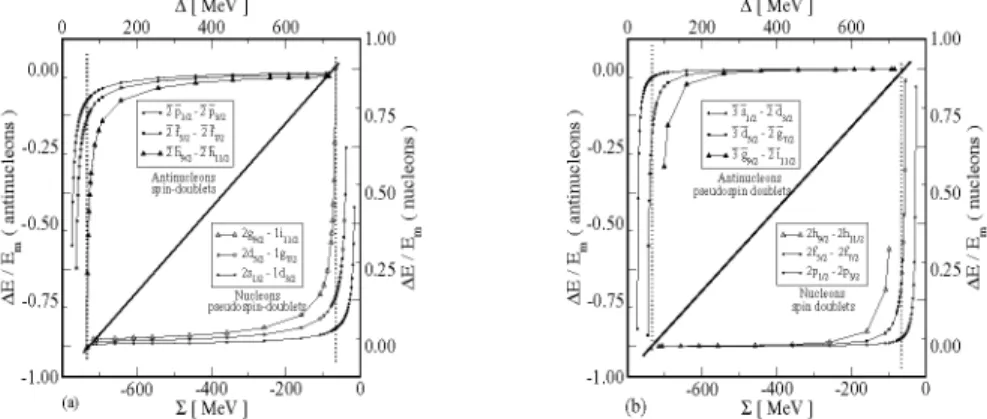
FIGURE 1. The DE/Em versus S potential for nucleons in bottom side of the diagonal for different (a) pseudospin and (b) spin doublets. The DE/Em versus D potential for antinucleons in upper side of the diagonal for different (a) spin and (b) pseudospin doublets. In Fig.1 the dotted vertical line stands for the S 0 and D 0 values used in 208Pb calculation.
is iS0 = —358 MeV while the vector potential changes in the range 0 < |V0| < 292 MeV.
For nucleons, as S is the binding potential, the exact pseudospin symmetry cannot be achieved since S = 0 would mean that no bound states would exist. In the lower side of
the diagonal in the Fig. 1(a) the pseudospin interaction is small when S —> 0 but cannot
be treated perturbatively because DE/Em is large. When |S| is large the fermions are
more bounded (Em large) and relativistic so that DE/Em is small. In the lower side
of the diagonal in the Fig. 1 (b) the spin symmetry is not good near the dotted vertical line (nuclear physics values) because D is big. When D —> 0 spin symmetry is exact
for fermions. Because of the inversion of the role played by S and D potentials for antifermions (D is the now the binding potential) exact spin symmetry cannot be reached because one cannot set D = 0. Actually, in the upper side of the diagonal in the Fig. 1(a)
we see that DE/Em is large when D —> 0. Furthermore, we see from the upper side of the
diagonal in the Fig. 1 (b) that the case S = 0 is possible and we have an exact pseudospin
symmetry with degenerate antinucleon pseudospin partners (DE = 0).
Summarizing, in the nucleus the charge conjugation transformation relates the spin symmetry of the negative energy bound state solutions (antinucleons) to the pseudospin symmetry of the positive energy bound state solutions (nucleons). We show that for antinucleon systems the exact pseudospin can be realized (S = 0) while still having bound states, since D is the binding potential. This fact manifests the relativistic nature of the nuclear pseudospin symmetry.
A C K N O W L E D G M E N T S
This work was supported by FAPESP, CAPES-GRICES/183/07, CNPq, and POCI/FP/81923/2007
scien-tific programs. REFERENCES
1. J. N. Ginocchio, Phys. Rev. Lett 78, 436 (1997); Phys. Rep. 414, 165 (2005).
2. J. Meng, K. Sugawara-Tanabe, S. Yamaji, P. Ring, and A. Arima, Phys. Rev. C 58, R628 (1998). 3. J. Meng, K. Sugawara-Tanabe, S. Yamaji, and A. Arima, Phys. Rev. C 59, 154 (1999).
4. A. S. de Castro, P. Alberto, R. Lisboa and M. Malheiro, Phys. Rev. C 73, 054309 (2006).
5. P. Alberto, M. Fiolhais, M. Malheiro, A. Delfino, andM. Chiapparini, Phys. Rev. C 65,034307 (2002). 6. P. Alberto, M. Fiolhais, M. Malheiro, A. Delfino andM. Chiapparini, Phys. Rev. Lett. 86, 5015 (2001).
0 0
1.00 1.00
-0.25
0.50 -0.50
0.25 0.25
0.00 0.00
0 0
-600