S
ho
rt
R
e
p
o
rt
0103 - 5053 $6.00+0.00
*e-mail: [email protected]
Hydrolysis of Methyl Benzoate from
Piper arboreum
by
Naupactus bipes
Beetle
Clécio S. Ramos and Massuo J. Kato*
Instituto de Química, Universidade de São Paulo, CP 26077, 05513-970 São Paulo-SP, Brazil
O 3-geranil-4-hidroxibenzoato de metila (1), um novo produto natural, foi isolado das folhas de
Piper arboreum (Piperaceae). O metabolismo das folhas de P. arboreum pelo besouro Naupactus bipes (Germar, 1824 - Coleoptera: Curculionidae) resultou na biotransformação de 1 para o ácido 3-geranil-4-hidroxibenzoico (2). As estruturas dos metabólitos 1 e 2 foram determinadas com base na interpretação dos dados espectroscópicos de EM, IR, RMN de 1H e de 13C.
A new natural product was isolated from Piper arboreum (Piperaceae) leaves, the methyl 3-geranyl-4-hydroxybenzoate (1). The metabolism of P. arboreum leaves by Naupactus bipes
beetle (Germar, 1824 - Coleoptera: Curculionidae) led to the hydrolysis of 1 to 3-geranyl-4-hydroxybenzoic acid (2). The structures of both compounds were determined based on spectroscopic analysis (1H and 13C NMR, MS, and IR).
Keywords:Piper arboreum, prenylated benzoic acid, piperaceae, biotransformation, Naupactus bipes
Introduction
Piper arboreum is a shrub with approximately 3 m height and it is popularly known as long pepper, rosemary-of-Angola or wood-rosemary-of-Angola.1P. arboreum has been used
in Brazil as tea and for treatment of rheumatisms, bronchitis, colds and flu.2 A previous chemical investigation carried
out on leaves of P. arboreum led to the identification of the amides N-[10-(13,14-methylenedioxyphenyl)-7(E),9(Z )-pentadienoyl]-pyrrolidine, arboreumine, N- [10-(13,14-methylenedioxyphenyl)-7(E)-pentaenoyl]-pyrrolidine and N-[10-(13,14-methylenedioxyphenyl)-7(E),9(E )-pentadienoyl]-pyrrolidine).3 Additional investigation on
leaves from allopatric species of P. arboreum revealed now the occurrence of a new natural product methyl 3-geranyl-4-hydroxybenzoate (1) previously described as synthetic product.4,5 The function of plant secondary metabolites
in mediating insect-plant interactions has been addressed in several studies6,7 and more recently, the specificity of
Piper-insects relationship and the metabolism of secondary compounds by herbivorous insects has been investigated.8,9
Herein, we describe the hydrolysis of methyl benzoic acid derivative 1 to 3-geranyl-4-hydroxybenzoic acid (2) during the digestive process of P. arboreum leavesby N. bipes beetles.
Experimental
Instrumentation and chromatography materials
IR spectra were measured in KBr pellets on a Perkin-Elmer infrared spectrometer model 1750. UV spectra were recorded on a HP 8452 A spectrophotometer using MeOH as solvent. LREIMS spectra were measured at 70 eV and recorded on a VG Platform II spectrometer. 1H and 13C NMR spectra were
recorded at 300 and 75 MHz, respectively, on Bruker DPX-300 spectrometer. CDCl3 (Aldrich) was used as solvent and TMS as internal standard. Chemical shifts were reported in
dunits (ppm) and coupling constants (J) in Hz. Elemental analyses was obtained on a Perkin-Elmer elemental analyzer model 2400 CHN. Silica gel (Merck, 230-400 mesh) was used for column chromatographic separations, while silica gel 60 PF254 (Merck) was used for analytical (0.25 mm) or preparative (1.0 mm) TLC chromatography. HPLC analysis of extracts and pure compounds were performed on a HP-1050 instrument using a reversed phase column Supelco C18 eluted in a gradient mode starting with MeOH:H2O (1:1) raising to 100% MeOH in 30 min, with a flow rate of 1 mL min-1 and
detection set at 254 nm.
Plant material
Ramos and Kato 561 Vol. 20, No. 3, 2009
W 46°43’671”), and identified by Dr. Elsie F. Guimarães (Instituto de Pesquisas Jardim Botânico do Rio de Janeiro, Brazil). The voucher specimen (Kato-0697) was deposited in the Herbarium of Instituto de Botânica, São Paulo, Brazil.
Insect material
Specimens of N. bipes that had been feeding on Piper
species were collected at the Campus of the Universidade de São Paulo in December 2000 and identified by Dr. Sérgio Antônio Vanin (Departamento de Zoologia, Instituto Biociências da Universidade de São Paulo, São Paulo, Brazil). Voucher specimen (CSR 001) has been deposited at Museu de Zoologia da Universidade de São Paulo. Adult beetles were reared in cages in the laboratory and maintained on a diet constituted of P. arboreum leaves under artificial light (17 h light-7 h dark) at ambient temperature (24-27 ºC).
Extraction and isolation of constituents
Dried ground leaves (40 g) from P. arboreum
were extracted three times with CH2Cl2-MeOH (2:1) (2 × 500 mL), which after concentrated in vacuum yielded 12 g of crude extracts. Part of the extract from leaves (5 g) was suspended in MeOH-H2O (1:4), filtered in a bed of celite (2/3, v/v), then 5 mL of 1 mol L-1 NaCl solution was
added to the filtrate and the solution was extracted three times with CH2Cl2 (150 mL each). The organic fraction was dried over anhydrous Na2SO4 and concentrated in vacuum yielding 1 g of a chlorophyll free leaves extract. This extract was subjected to fractionation over silica gel column using hexane with increasing amounts of EtOAc as eluent yielding 30 fractions (1-30). Fraction 5 (50 mg) was subjected to prepare TLC hexane:EtOAc:AcOH (4:1:0.5), three elutions, to yield 1 (16 mg).
The dried feces (400 mg) of N. bipes feeding on P. arboreum leaves were extracted three times with CH2Cl2 -MeOH (2:1) (60 mL each). The residue was concentrated in vacuum yielding 65 mg of crude extract. The extract was subjected to prepare TLC using hexane:EtOAc:AcOH (3:6.7:0.3), three elutions, to yield 2 (1.3 mg).
Methyl 3-geranyl-4-hydroxybenzoate (1)
White amorphous solid; IR (KBr) νmax/cm-1: 3368,
2957, 2920, 1713, 1603, 1507, 1434, 1202, 1198 and 772; LREIMS m/z (rel. int.) 288 [M] (2), 175 (48), 123 (67), 69 (78) and 41 (100). Elemental analysis:C 74.59%, H 8.45%, O 16.96%; calculated for C18H24O3: C 74.97%, H 8.39%, O 16.64%; 1H and 13C NMR, see Table 1.
3-Geranyl-4-hydroxybenzoic acid (2)
White amorphous solid; LREIMS m/z (rel. int.) 274 [M] (1), 175 (16), 123 (48), 69 (85) and 41 (100). 1H and 13C
NMR, IR in agreement with literature data.10,11
Results and Discussion
Compound 1 was isolated from extract (CH2Cl2-MeOH, 2:1) of P. arboreum leavesas a white amorphous solid. Its molecular formula was established as C18H24O3 by elemental analysis and LREIMS data. The IR spectrum indicated the presence of hydroxyl group (3368 cm-1), a carbonyl
group (1713 cm-1), an aromatic ring (1507, 1434 cm-1),
and C-O stretching band (1202 cm-1). The 1H NMR
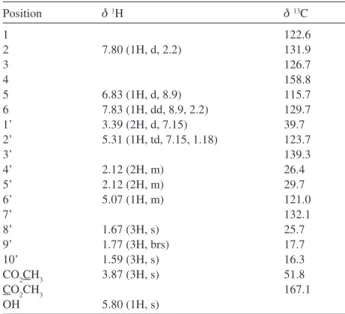
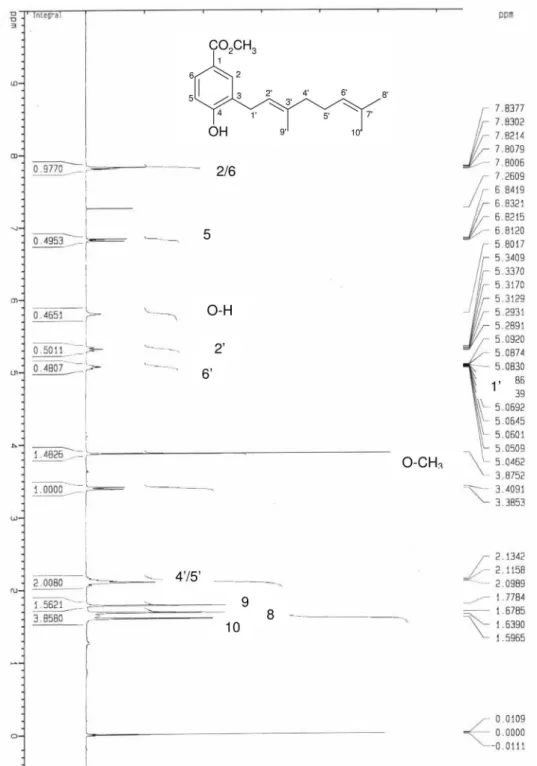
spectrum (Table 1) of 1 showed signals corresponding to three-coupled aromatic resonance at d 7.80 (1H, d, J
2.2 Hz), 6.83 (1H, d, J 8.9 Hz) and 7.90 (1H, dd, J 8.9 and 2.2 Hz) assignable for a 1,4,5-trisubstituted aromatic ring and a signal at d 5.80 (1H, s) characteristic of a phenolic hydrogen; it also displayed a singlet at d 3.87 (3H, s) of a methyl ester group, which was confirmed by signal at dC
51.8. The assignments of 1H and 13C NMR data signals for
aromatic moiety were further confirmed by comparison to those reported for known benzoic acids analogues. The isoprenyl side chain signals were determined from COSY and HETCOR spectra. Thus, the methylene protons H-1´at
d3.39 (2H, d, J 7.2 Hz) were coupled to the olefinic proton H-2´ at d 5.31 (1H, td, J 7.2 and 1.8 Hz), which in turn showed an allylic coupling to methyl group H-9´ at d 1.77 (3H, s). The methine proton H-6´at d 5.07 (1H, m) was further coupled to the methylene proton H-5´at d 2.12
Table 1.1H and 13C NMR (300 and 75 MHz, respectively, CDCl
3, J in
Hz) data for compound 1
Position d1H d13C
1 2 3 4 5 6 1’ 2’ 3’ 4’ 5’ 6’ 7’ 8’ 9’ 10’ CO2CH3 CO2CH3 OH
7.80 (1H, d, 2.2)
6.83 (1H, d, 8.9) 7.83 (1H, dd, 8.9, 2.2) 3.39 (2H, d, 7.15) 5.31 (1H, td, 7.15, 1.18)
2.12 (2H, m) 2.12 (2H, m) 5.07 (1H, m)
1.67 (3H, s) 1.77 (3H, brs) 1.59 (3H, s) 3.87 (3H, s)
5.80 (1H, s)
(2H, m). The E geometry of the D2´,3´ double bond was
established based on 13C NMR data of the vinyl methyl
group C-9’ (d 17.7) when compared to the chemical shifts of geraniol (C-Me, d 17.1) and nerol (C-Me, d24.0), which have (E) and (Z) configurations, respectively.12 The
assignments of aromatic carbons signals were based on comparison of 1H and 13C NMR data to those reported
for known benzoic acid analogues.13 The linkage position
of monoterpene moiety was deduced from NOESY spectrum and also by comparison of 1H and 13C NMR
spectral data with those published for prenylated benzoic acids.14,15
N. bipes beetle was observed feeding on P. arboreum
leaves specimens growing in a cultivation area. Thus, ten individuals of beetle were collected and maintained during three weeks on a diet constituted of fresh leaves
of P. arboreum in order to obtain fecal material from
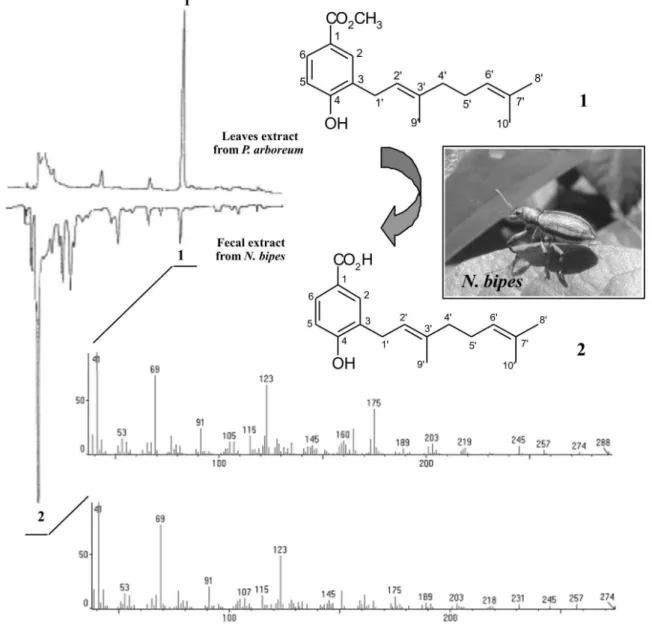
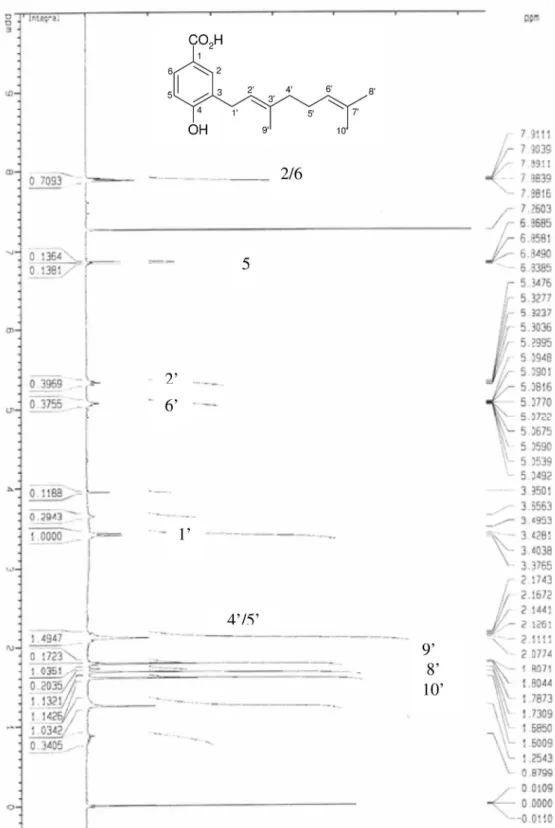
N. bipes. The collected feces were dried and extracted with CH2Cl2:MeOH and the same procedure was carried out with not predated leaves from host plants. The fecal and leaves extracts were analyzed by HPLC and the chromatographic profile of fecal extract showed an additional major compound as compared to the chromatogram of leaves extracts. Moreover, a decrease in the relative content of 1 in the fecal extract chromatogram as compared to leaves extract chromatogram was observed and a new compound 2 could be observed (Figure 1). The fecal extract was subjected to purification steps resulting in isolation of 2. Its structure was established based on spectroscopic data of LREIMS, 1H and 13C NMR as the
known 3-geranyl-4-hydroxybenzoic acid previously isolated from P. gaudichaudianum and P. elongatum.10,11
Figure 1. Chromatogram (HPLC) of extract from leaves of P. arboreum and fecal extract from N. bipes beetle. Mass spectra (LREIMS) of 1 and 2 (C18H24O3,
Ramos and Kato 563 Vol. 20, No. 3, 2009
This finding is compatible with the formation of benzoic acid 2 as hydrolysis product of 1 during digestive process of beetle N. bipes. A previous investigation carried out on N. Bipes feeding on Piper solmsianum leaves revealed the O-demethylation reaction at both para positions of 3,4,5-trimethoxyphenyl ring of tetrahydrofuran lignan (-)-grandisin and no trace of benzoic acid 2 could be detected in their feces.9
Acknowledgments
This work was funded by grants provided by FAPESP and CNPq. MJK is grateful to CNPq for research fellowship. CSR thanks FAPESP for providing a scholarship.
Supplementary Information
Supplementary data are available free of charge at http:// jbcs.sbq.org.br, as PDF file.
References
1. Guimarães, E. F.; Giordano, L. C. S.; Rodriguésia2004, 55, 21.
2. Duke, J. A.; Vasquez, R.; Amazonian Ethnobotanical Dictionary, CRC Press: Florida, 1994.
3. Silva, R. V.; Navickiene, H. M. D.; Kato, M. J.; Bolzani, V. da S.; Méda, C. I.; Young, M. C. M.; Furlan, M.; Phytochemistry
2002, 59, 521.
4. Blunt, S. B.; Chen, T-B.; Wiemer, D. F; J. Nat. Prod. 1998, 61,
1400.
5. Inouye, H.; Ueda, S.; Inoue, K.; Matsumura, H.; Phytochemistry
1979, 18, 1301.
6. Zarbin, P. H. G.; Villar, J. A. F. P.; Corrêa, A. G.; J. Braz. Chem. Soc.2007, 18, 1100.
7. Marques, F. A.; Wendler, E. P.; Maia, B. H. L. N. S.; Venturab, M. U.; Arruda-Gatti, I. C.; J. Braz. Chem. Soc. 2007, 18, 1242.
8. Vanin, A. S.; Ramos, C. S.; Guimarães, E. F.; Kato, M. J.; Rev.
Bras.Entomol.2008, 52, 72.
9. Ramos, C. S; Vanin S. A; Kato, M. J.; Phytochemistry2008,
69, 2157.
10. Lago, J. G. L.; Ramos, C. S.; Casanova, C. C. D.; Morandim, A. de A.; Bergamo, C. D.; Cavalheiro, A. J.; Bolzani, V. da S.; Furlan, M.; Guimarães, E. F.; Young, M. M. C.; Kato, M. J.;
J. Nat. Prod. 2004, 67, 1783.
11. Masuoka. C.; Ono, M.; Ito, Y.; Nohara, T.; Food Sci. Technol. Res. 2003, 9, 197.
12. De Haan, J. W.;Van de Ven, L. J. M.; Org. Magn. Reson.1973,
5, 147.
13. Moreira., D. de L.; Guimarães, E. F.; Kaplan, M. A. C.;
Phytochemistry 1998, 48, 1075.
14. Baldoqui, D. C.; Kato, M. J.; Cavalheiro, A. J.; Bolzani, V. da S.; Young, M. C. M.; Furlan, M.; Phytochemistry1999, 51, 899.
15. Orjala, J.; Erdelmeier, C. A. J.; Wright, A. D.; Rali, T.; Sticher, O.; Planta Med. 1993, 59, 546.
Received: March 17, 2008
Web Release Date: February 20, 2009
S
u
p
p
le
m
e
nta
ry
Inf
o
rm
a
ti
o
n
0103 - 5053 $6.00+0.00
*e-mail: [email protected]
Hydrolysis of Methyl Benzoate from
Piper arboreum
by
Naupactus bipes
Beetle
Clécio S. Ramos and Massuo J. Kato*
Instituto de Química, Universidade de São Paulo, CP 26077, 05513-970 São Paulo-SP, Brazil
Hydrolysis of Methyl Benzoate from Piper arboreum byNaupactus bipes Beetle J. Braz. Chem. Soc.
S2
Hydrolysis of Methyl Benzoate from Piper arboreum byNaupactus bipes Beetle J. Braz. Chem. Soc.
S4