A
r
ti
c
le
0103 - 5053 $6.00+0.00
*e-mail: [email protected]
Spectroscopic Investigations of Iron(II) and Iron(III) Oxalates
Maria C. D’Antonio,a,b Alejandra Wladimirsky,a Daniel Palacios,a Liliana Coggiola,a
Ana C. González-Baró,c Enrique J. Baran*,c and Roberto C. Mercaderd
aDepartamento de Ciencias Básicas, UTN-Unidad Académica Río Gallegos, 9400 Río Gallegos, Argentina
bDepartamento de Ciencias Exactas y Naturales, Universidad Nacional de la Patagonia Austral, 9400 Río Gallegos, Argentina
cCentro de Química Inorgánica and dDepartamento de Física and Instituto IFLP (CONICET), Facultad de Ciencias Exactas, Universidad Nacional de La Plata, 1900 La Plata, Argentina
Na tentativa de contribuir para uma melhor caracterização dos complexos de FeII e FeIII com
o ânion oxalato, uma investigação dos seus espectros vibracionais (infravermelho e Raman) e espectros Mössbauer de 57Fe foi realizada. Foi observado que os dois polimorfos de FeC
2O4.2H2O,
α and β, não podem ser diferenciados com exatidão por nenhum destes métodos espectroscópicos, demonstrando uma alta similaridade estrutural das duas formas cristalinas. Amostras parcialmente deuteradas de β-FeC2O4.2H
2O também foram investigadas para aprimorar a análise espectroscópica
vibracional. No caso do Fe2(C2O4)3.4H
2O, um modelo estrutural pôde ser proposto a partir dos
resultados dos dados vibracionais e de Mössbauer combinados. O espectro de Mössbauer registrado a 298 K para este complexo é discutido em detalhes pela primeira vez.
In an attempt to contribute to a better characterization of FeII and FeIII oxalate complexes, an
investigation of their vibrational (infrared and Raman) and 57Fe-Mössbauer spectra was performed.
It is shown that the two polymorphs, α and β, of FeC2O4.2H
2O cannot be accurately differentiated
with any of these spectroscopic methods, demonstrating the high structural similarity of these two crystalline forms. Partially deuterated samples of β-FeC2O4.2H
2O were also investigated to
improve the vibrational-spectroscopic analysis. In the case of Fe2(C2O4)3.4H
2O, a structural model,
derived from results of combined vibrational and Mössbauer data, could be proposed. The 298 K Mössbauer spectrum for this complex is discussed in detail for the first time.
Keywords: iron oxalates, IR spectroscopy, Raman spectroscopy, Mössbauer
Introduction
Metal cation oxalate deposits formed during biodeterioration processes of minerals by the action of lichens or fungi have been reported in the scientific literature.1-3 It is also well known that calcium oxalates are
frequently produced as normal or pathological biominerals by different forms of life,3-5 and their wide distribution in
the plant kingdom is well documented.3,4,6 On the other
hand, metal oxalates have been used as chemical precursors of synthetic nanomaterials, ceramic superconductors or catalysts.3,7
As part of our studies about oxalate biominerals3 and
biomineralization processes in plants,6,8,9 we have initiated
different studies to attain a wider insight into the general
physicochemical properties of metal oxalates.10 In this
paper we report results of an investigation based on the spectroscopic behavior of iron(II) and iron(III) oxalates.
The naturally formed dihydrated FeII oxalate,
FeC2O4•2H2O, is the mineral humboldtine.3,11 Interestingly,
evidences of this oxalate have so far never been found at mineral/lichen interfaces. One may speculate that possibly a microbial oxidation of FeII to FeIII occurs, followed
by hydrolysis and precipitation of different degrees of crystalline FeIII oxides.1,3 The occurrence of an iron(III)
oxalate has been reported for the lichen Calopia callopsima growing on an iron-rich dolomite,12 although the formation
of this oxalate has later been questioned.2
On the other hand, it is well established that dihydrated oxalates of different divalent transition metal cations, including iron, are dimorphic, adopting either the α-MIIC
for which the prototype is humboldtine, or its derived β-MIIC
2O4•2H2O form.3,13 Besides, the corresponding
FeIII compound is so far not so well characterized, and
information on its structural features is not available.
Experimental
Syntheses
The FeII oxalates were obtained by slow mixing
of diluted solutions of ferrous ammonium sulfate and oxalic acid. Working with a slight excess of the acid renders preferentially α-Fe(C2O4)•2H2O, whereas the β-Fe(C2O4)•2H2O is generated by limiting the acid
concentration.14 Both microcrystalline precipitates
were characterized by their typical X-ray powder diffractograms,14 using a Philips PW 1710 diffractometer
and Cu-Kα radiation (λ = 1.5425 Å).
For the synthesis of partially deuterated β-Fe(C2O4)•2H2O samples, the same procedure as above was employed, but working directly with 3 mL of D2O at a micro-scale level.
FeIII oxalate from Aldrich and used as supplied.
The chemical analysis for this product confirmed a Fe2(C2O4)3•4H2O stoichiometry (C = 16.15; H = 1.83; Fe =
24.68 mass%; calculated values for C6H8Fe2O16: C = 16.08; H = 1.79; Fe = 24.95 mass%).
Spectroscopic measurements
The infrared spectra in the range of 4000-400 cm-1 were
recorded with an FTIR Bruker EQUINOX-55 instrument, using the KBr pellet technique. Raman spectra, in the same spectral range, were measured on powdered samples using the FRA 106 Raman accessory of an IF66 Bruker spectrophotometer. Radiation from a Nd:YAG solid-state laser (1064 nm) was used for excitation.
Room temperature 57Fe Mössbauer spectra were taken
in transmission geometry using a conventional constant acceleration spectrometer of 512 channels with a 10 mCi nominal activity 57Co/Rh source. The hyperfine parameters
were obtained by fitting the data to Lorentzian shape lines using a least-squares computer code with constraints. Isomer shifts were calibrated against an α-Fe foil at room temperature.
Results and Discussion
FeII oxalates
Crystal structure of the complexes Oxalate complexes of MII(C
2O4)•2H2O stoichiometry,
with MII = Mg2+, Fe2+, Co2+, Ni2+ and Zn2+, display two
crystalline modifications.3,13 The prototype of the most
stable form, usually referred to as α-MII(C
2O4)•2H2O, is
the mineral humboldtine (α-Fe(C2O4)•2H2O). It belongs
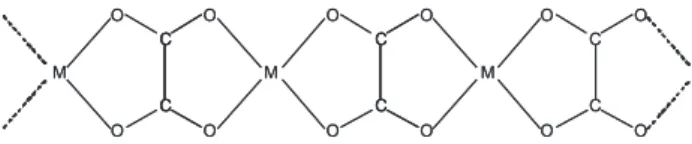
to the monoclinic space group C2/c with Z = 4. The metal cations and oxalate groups generate an infinite chain arrangement as depicted in Figure 1, where the oxalate acts as a tetradentate (bridging) ligand. Each MII cation is
additionally coordinated to two water molecules, generating a distorted octahedral MO6 environment. These chains generate ordered sheets lying perpendicularly to the c axis of the unit cell.13,14
The second crystal modification, β-MII(C
2O4)•2H2O, is
very similar, showing only a certain degree of disorder in the piling of successive sheets, which causes a reordering of the hydrogen bonds between sheets. This second form usually is irreversibly transformed to the most stable modification by heating, or by prolonged contact with the mother liquor during the synthesis, and crystallizes in the orthorhombic Cccm space group with Z = 8.14
As mentioned above, our X-ray powder diffractograms confirmed the monoclinic structure for α-Fe(C2O4)•2H2O and the orthorhombic one for β-Fe(C2O4)•2H2O.
Vibrational spectra
The IR and Raman spectra for both crystalline polymorphs of Fe(C2O4)•2H2O are practically identical,
confirming the strong molecular structure similarities between them. To illustrate the general spectral pattern for both samples, those of α-Fe(C2O4)•2H2O, in the spectral range between 2000 and 400 cm-1, are shown in Figure 2.
Spectral investigations of complexes in which oxalate acts as a tetradentate ligand showed that the corresponding patterns are relatively simple in the high frequency region,15
a situation which is confirmed in the present case. The now proposed assignments are based on the spectroscopic behavior of the “free” oxalate anion,16 in
comparisons with well-known data from spectroscopic studies of a great variety of metal oxalates resumed by Nakamoto,17 as well as on the results of our recent study of
syntheticmoolooite, Cu(C2O4)•0.2H2O,10 in which the metal
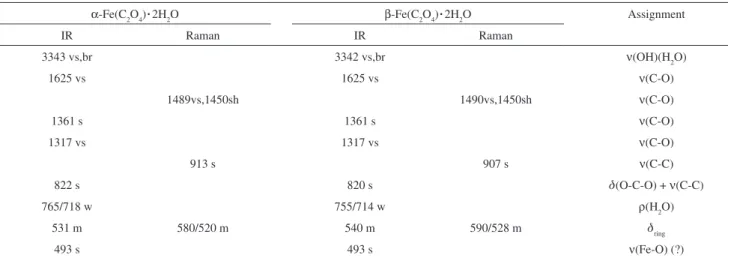
cation displays, in the plane, an identical chain structure as that depicted in Figure 1. The proposed assignments are shown in Table 1.
Figure 1. Schematic drawing of the infinite chain arrangement present in
MII oxalates of composition MII(C
d (H2O), certainly overlaps with the strong and broad IR band centered at 1625 cm-1. Only in the lower frequency
region small energy differences could be observed, although the form of the bands is identical.
In order to attain a better insight into the possible origin of these low energy bands we have performed deuteration experiments and measured the IR spectra of partially deuterated samples of β-Fe(C2O4)•2H2O, analyzing the observed band shifts using the Teller-Redlich product rule.18
This analysis is presented in Table 2 and briefly commented as follows: (i) According to the Teller-Redlich product rule, in deuteration experiments the expected νH/νD ratio must be
close to 1.41, although due to coupling and anharmonicity effects this ratio is usually found to lie between 1.2 and 1.4.18 (ii) After deuteration of a β-Fe(C
2O4)•2H2O sample,
the ν(O-H) stretching band of the water molecules generates a new, very strong band centered at 2512 cm-1 with a weak
shoulder at 2458 cm-1, both of which fulfill the above
requirement. (iii) The deformational mode of water appears as a medium intensity band at 1184 cm-1, confirming the
assumption that d (H2O) is overlapped by the intense
Figure 2. FT-Infrared (above) and Raman spectra (below) of
α-Fe(C2O4).2H2O in the spectral range between 2000 and 400 cm-1.
Table 1. Assignment of the vibrational spectra of the two modifications of Fe(C2O4).2H2O (band positions in cm-1)
α-Fe(C2O4).2H
2O β-Fe(C2O4).2H2O Assignment
IR Raman IR Raman
3343 vs,br 3342 vs,br ν(OH)(H2O)
1625 vs 1625 vs ν(C-O)
1489vs,1450sh 1490vs,1450sh ν(C-O)
1361 s 1361 s ν(C-O)
1317 vs 1317 vs ν(C-O)
913 s 907 s ν(C-C)
822 s 820 s d(O-C-O) + ν(C-C)
765/718 w 755/714 w ρ(H2O)
531 m 580/520 m 540 m 590/528 m dring
493 s 493 s ν(Fe-O) (?)
Band intensities: vs, very strong; s, strong; m, medium; w, weak; br, broad; sh, shoulder.
The comparison of the IR spectra in the highest frequency region, related to the water stretching motions, does not show significant differences between the two crystalline forms. Both complexes present a very strong and broad band centered at about 3340 cm-1, totally similar
in their general shape and structure. The bending mode,
Table 2. Analysis of the band shifts of β-Fe(C2O4).2H
2O after partial deuteration (band positions in cm-1)
Normal sample/Table 1 Part. deuterated sample νH/νD 3342 vs, br 2512 vs / 2458 sh 1.33 / 1.26
ca. 1620 (overlapped) 1184 m 1.37
820 s 809 s 1.01
755/714 w 450 m 1.58
540 m 545 m
493 s 495 s
1625 cm-1 oxalate band. (iv) The weak 755/714 cm-1 doublet
disappears after deuteration, indicating clearly that it must be related to the proposed vibrational modes of coordinated water. This assignment is reinforced by the fact that no bands in this region are found in the case of Cu(C2O4)•nH2O samples, in which water is not coordinated to copper(II), but is of “zeolitic” nature.10 Besides, the fact that the shift of this
doublet generates a new band at 450 cm-1, with a relatively
high νH/νD ratio, suggests that this last band probably involves
an additional vibrational mode. (v) The small shift of the 820 cm-1 band, which does not fulfill the Teller-Redlich rule,
suggests that its origin may be eventually more complex than suggested in Table 1. (vi) The constancy of the position of the last two bands after deuteration clearly shows that they are not involved in water motions. We have tentatively assigned them to a Fe-O stretching vibration.
Finally, it is interesting to mention that our IR and Raman spectra are similar to those previously reported by Edwards and Russell for a structurally uncharacterized Fe(C2O4)•2H2O sample. Their spectroscopic analysis was
performed without any structural consideration.19
Mössbauer spectra
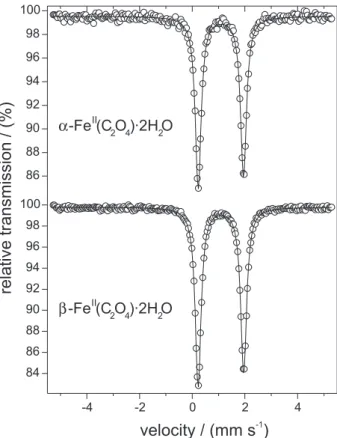
As it was not possible to differentiate the two forms of iron(II) oxalate by means of their IR and Raman spectra, we have tried to verify if this would be possible through their Mössbauer spectra. However, as indicated by the two spectra in Figure 3, and hyperfine parameter values in Table 3, the interactions at the FeII sites of the two forms
are identical within the experimental uncertainties, and hence make it also impossible to establish any difference by means of this technique. The small asymmetry observed in the L1/L2 ratio may be due to a slight texture or preferential orientation of the sample. The values of L1/L2 obtained after the fittings are 1.06 ± 0.01 for the α-polymorph and 1.07 ± 0.01 for the β-polymorph.
Isomer shifts, d, lie clearly in the range expected for FeII in octahedral or quasi-octahedral environments, usually
found between 1.06 and 1.29 mm s-1.20,21 On the other hand,
the quadrupole splitting (∆Q) values are consistent with the high spin electronic configuration for the FeII cation.22
These results compare very well with earlier measurements performed on α-Fe(C2O4)•2H2O.23
FeIII oxalate
Vibrational spectra
The structure of ferric oxalate has so far not been determined. Therefore, it is interesting to advance in its structural characterization using spectroscopic information. The FTIR spectrum of one of the investigated samples is shown in Figure 4. Unfortunately, no good quality Raman spectra could be obtained for this compound. The spectra have usually a very poor signal to noise ratio and only a very limited number of bands could be unambiguously identified. Both the IR and the Raman spectra show strong similarities with those previously reported for a hexahydrated ferric oxalate sample.19
A comparison of the IR spectrum of ferric oxalate with those of the previously commented ferrous complexes immediately indicates important differences, pointing to different structural arrangements. The presence of a high
Table 3. Hyperfine parameters derived from the Mössbauer spectra of the two polymorphic forms of Fe(C2O4).2H
2O and of Fe2(C2O4)3.4H2O at 298 K. The isomer shifts d are referred to α-Fe at 298 K
Complex d / (mm s-1) ∆Q / (mm s-1) Γ / (mm s-1) A / (%)
α-Fe(C2O4).2H2O 1.19 (1) 1.72 (1) 0.27 (1) 100 (2)
β-Fe(C2O4).2H
2O 1.20 (1) 1.73 (1) 0.27 (1) 100 (1)
Fe2(C2O4)3.4H
2O 0.38 (1) 0.39 (1) 0.28 (1) 100 (1)
Figure 3. 298 K 57Fe-Mössbauer spectra of the two modifications of
energy IR band (1736 cm-1), with no Raman counterpart,
immediately suggests the presence of terminal carbonyl groups. Besides, a comparison of the IR spectrum with those of ionic oxalates16 excludes the possibility of an ionic
structure and, on the other hand, for stoichiometric reasons the formation of a dimeric complex must be expected. As the corresponding Mössbauer spectrum (see next section) confirms the equivalence of these dimeric sites and the octahedral coordination, one plausible structural arrangement may be similar to that shown in Figure 1, but containing only one pair of metal centers, disrupting the polymeric structure. This implies the presence of a central oxalate group acting as a tetradentate ligand bridging the two FeIII cations, and
two terminal (bidentate) oxalate ligands, each interacting with only one of the metal centers. The coordination of the cations is completed by two water molecules, lying again perpendicularly to the iron/oxalate linkage.
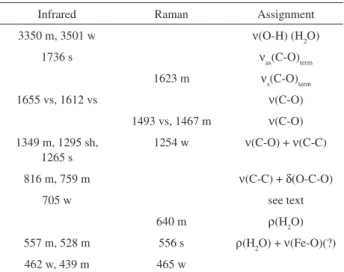
The proposed spectral assignment for this complex is shown in Table 4. Stretching vibrations of the water molecules are clearly identified in the IR spectrum, and lie somewhat higher than in the ferrous oxalates, whereas the corresponding bending mode, d(H2O), is surely overlapped by the strong 1655/1612 cm-1 IR doublet. A pair of IR
and Raman bands can unambiguously be assigned to the antisymmetric and symmetric stretchings of the terminal carboxylate groups, respectively. Two groups of ν(C-C)
motions have been assigned in agreement with the presence of two structurally different oxalate groups in the structure; one of them overlaps with the ν(C-O) stretchings and the other with an oxalate deformational mode. The weak 705 cm-1
IR band is probably of a similar complex nature as the 755/714 cm-1 doublet analyzed in the case of β-Fe(C
2O4)•2H2O.
In the lower frequency region, water librational modes have been tentatively assigned and also a reasonable value for one of the Fe-O stretching vibrations17 is proposed.
Mössbauer spectrum
There is no reported 57Fe Mössbauer data available for
ferric oxalate, except for brief mentions made in two papers, one investigating the thermal behavior of oxalatoferrate(III) complexes24 and other from a study of mixed ligand oxalate
complexes of FeIII.25
The spectrum of Fe2(C2O4)3•4H2O is shown in Figure 5 and the derived hyperfine parameters are included in Table 3. The presence of a unique quadrupole doublet of
Table 4. Assignment of the vibrational spectra of Fe2(C2O4)3.4H2O (band
positions in cm-1)
Infrared Raman Assignment
3350 m, 3501 w ν(O-H) (H2O)
1736 s νas(C-O)term
1623 m νs(C-O)term
1655 vs, 1612 vs ν(C-O)
1493 vs, 1467 m ν(C-O)
1349 m, 1295 sh, 1265 s
1254 w ν(C-O) + ν(C-C)
816 m, 759 m ν(C-C) + δ(O-C-O)
705 w see text
640 m ρ(H2O)
557 m, 528 m 556 s ρ(H2O) + ν(Fe-O)(?)
462 w, 439 m 465 w
Band intensities: vs, very strong; s, strong; m, medium; w, weak.
Figure 4. FT-Infrared spectrum of Fe2(C2O4)3.4H
2O in the spectral range between 2000 and 400 cm-1.
Figure 5. 298 K 57Fe-Mössbauer spectrum of Fe
narrow line width, Γ, clearly confirms that both FeIII cations
present the same environment. The observed isomer shift lies clearly in the range expected for an octahedral FeIIIO
6
environment.20,21 Besides, the relatively low quadrupole
splitting, which is appreciably lower than those found in mixed ligand FeIII oxalato complexes,25 indicates the
presence of a scarcely distorted octahedral environment and a high spin electronic configuration for FeIII.
Conclusions
It is demonstrated that the two polymorphic forms of Fe(C2O4)•2H2O cannot be differentiated by means of their vibrational (IR and Raman) and 57Fe Mössbauer spectra,
confirming the close structural relationship between these two forms. Some of the performed vibrational spectroscopic assignments could be supported by measurements with partially deuterated samples.
On the other hand, and also combining vibrational and Mössbauer data, it was possible to make, for the first time, a structural proposal for the corresponding FeIII
oxalate of composition Fe2(C2O4)3•4H2O. The structures
of the oxalates of both oxidation states of iron are closely related. In the ferrous complex, FeII and oxalate groups
generate an infinite chain arrangement, with the anion acting as a tetradentate ligand and each cation additionally coordinated to two water molecules, originating a distorted FeIIO
6 octahedral environment. In the case of the ferric
complex, the polymeric structure is disrupted, presenting only a central tetradentate oxalate group bridging the two FeIII cations and two terminal bidentate ligands, each
interacting with only one metal ion, which also in this case completes its coordination sphere with two water molecules, generating again a FeIIIO
6 environment.
Acknowledgments
This work has been supported by the Consejo Nacional de Investigaciones Científicas y Técnicas de la República Argentina-CONICET, the Universidad Tecnológica Nacional and the Universidad Nacional de La Plata. A.C.G-B., E.J.B. and R.C.M. are members of the Research Career from CONICET.
References
1. Adamo, P.; Violante, P.; Appl. Clay Sci.2000, 16, 229.
2. Chen, J.; Blume, H. P.; Beyer, L.; Catena2000, 39, 121. 3. Baran, E. J.; Monje, P.V. In Metal Ions in Life Sciences; Sigel,
A.; Sigel, H.; Sigel, R. K. O., eds.; J. Wiley: Chichester, 2008, vol. 4, ch. 7.
4. Khan, S. R., ed.; Calcium Oxalate in Biological Systems, CRC-Press: Boca Raton, 1995.
5. Baran, E. J.; Química Bioinorgánica, McGraw-Hill Interamericana de España: Madrid, 1995.
6. Monje, P. V.; Baran, E. J. In Advances in Plant Physiology; Hemantaranjan, A., ed.; Scientific Publishers: Jodhpur, 2004, vol. 7, ch. 15.
7. Donkova, B.; Mehandjev, D.; J. Mater. Sci.2005, 40, 3881.
8. Monje, P. V.; Baran, E. J.; Plant Physiol.2002, 128, 707. 9. Monje, P. V.; Baran, E. J.; Phytochemistry2005, 66, 611.
10. D’Antonio, M. C.; Palacios, D.; Coggiola, L.; Baran, E. J.;
Spectrochim. Acta 2007, 68A, 424.
11. Strunz, H.; Mineralogische Tabellen, 7th ed., Geest & Portig:
Leipzig, 1978.
12. Ascaso, C.; Galvan, J.; Rodríguez-Pascual, C.; Pedobiologia
1982, 24, 219.
13. Lagier, J. P.; Pezerat, H.; Dubernat, J.; Rev. Chim. Miner. 1969,
6, 1081.
14. Deyrieux, R.; Peneloux, A.; Bull. Soc. Chim. Fr.1969, 2675. 15. Scott, K. L.; Wieghardt, K.; Sykes, G.; Inorg. Chem.1973, 12,
655.
16. Begun, K. M.; Fletcher, W. H.; Spectrochim. Acta1963, 19,
1343.
17. Nakamoto, K.; Infrared and Raman Spectra of Inorganic and Coordination Compounds, 5th ed., J. Wiley: New York, 1997.
18. Siebert, H.; Anwendungen der Schwingungsspektroskopie in derAnorganischen Chemie, Springer: Berlin, 1966.
19. Edwards, H. G. M.; Russell, N. C.; J. Mol. Struct. 1998, 443,
223.
20. Menil, F.; J. Phys. Chem. Solids1985, 46, 763.
21. Mercader, R. C.; Baran, E. J.; Weil, M.; J. Phys. Chem. Solids
2006, 67, 1781.
22. Drago, R. S.; Physical Methods in Inorganic Chemistry, Reinhold Publ.: New York, 1965.
23. Wrobleski, J. T.; Brown, D. B.; Inorg. Chem.1979, 18, 2738, and references therein.
24. Gallagher, P. K.; Kurkjian, C. R.; Inorg. Chem.1966, 5, 214. 25. Abras, A.; Figueiredo de Oliveira, E.; Hyperfine Interact. 1991,
66, 271.
Received: March 27, 2008