135
JULY-AUGUST REV. HOSP. CLÍN. FAC. MED. S.PAULO 54 (4): 135 - 138, 1999
LOW BLOOD GLUCOSE LEVELS AND OTHER
COM-PLICATIONS DURING GROWTH HORMONE
SUPPLEMENTATION IN SEPSIS
Joel Faintuch, Renata B. A. Leme, Maria Emilia L. F. Cruz, Angela M. B. Lima, Daniel Giannella Neto and Joaquim J.Gama-Rodrigues
FAINTUCH, J. et al. - Low blood glucose levels and other complications during growth hormone supplementation in sepsis. Rev. Hosp. Clín. Fac. Med. S. Paulo 54 (4):135 - 138, 1999.
SUMMARY: Blood glucose levels in the high normal range or even moderate hyperglycemia is the expected profile in septic postoperative patients receiving high-calorie enteral alimentation. The addition of growth hormone as an anabolic agent should additionally reinforce this tendency. In a cancer patient undergoing partial gastrectomy with lymphadenectomy and suffering from postoperative subphrenic abscess and prolonged sepsis, tube feeding (38.3 kcal/kg/day) and growth hormone (0.17 IU/kg/day) were simultaneously administered for 25 days. Blood glucose levels were in the lower limits of the normal range before growth hormone introduction, and continued with a similar tendency during most of the therapeutic period. Two additional com-plications, namely heart arrest and peripheral edema, were documented during the same period. It is concluded that sepsis was the most likely mecha-nism for low glucose values, and that high-calorie enteral diet and growth hormone supplementation did not prevent that result. It is uncertain whether heart arrest was due to the drug, but its association with peripheral edema is well documented in clinical series.
DESCRIPTORS: Growth Hormone. Enteral Nutrition. Hypoglycemia. Sepsis. Peripheral Edema.
Malnourished cancer patients in the perioperative period are at high risk for septic complications3.Nutritional sup-port, preferably via the enteral route12, is an accepted modality for accelerat-ing recovery and inhibitaccelerat-ing infectious complications in this and other critical situations, and an enhanced result might be produced by supplementation with recombinant human growth hor-mone (GH)22. It is true that in cancer populations, some studies with GH failed to demonstrate appreciable ben-efits15. However, in our own experi-ence8, as well as in that of others19, encouraging responses without signifi-cant side effects have been observed even in these circumstances.
The present report deals with the unusual findings of blood glucose concentrations in an elderly, malnour-ished, surgical, and septic cancer patient managed with high-calorie enteral feeding and adjunctive GH administration.
CASE REPORT
A 67-year-old male was admitted with the diagnosis of gastric cancer of the antrum. Curative subtotal gastrec-tomy was performed, but a left sub-phrenic abscess that did not yield to conservative measures appeared in the late postoperative period. After 33 days, another laparotomy was indicat-ed, and the abscess was debrided and drained. The patient progressed with a septic course, malnutrition, dependent edema, pleural effusions, and respira-tory failure. Mechanical ventilation was required for a total of 39 days, and hemodynamic instability demanding vasoactive drugs occurred during seven days.
Throughout the second postopera-tive hospitalization, cultures from the
wound site and various drains and catheters revealed Escherichia coli, Pseudomonas aeruginosa, Entero-bacter cloacae, Enterococcus faecalis and Staphyloccocus aureus, which were treated according to antibiotic sensitivity tests. White blood cell counts were permanently elevated during the hospital stay at levels of 10,400 – 39,000 cells/mm3.
Nutritional findings at admission: Height 1.68 m, weight 47.0 kg, body mass index 16.7 kg/m2, serum albu-min 30 g/L, hemoglobin concentra-tion 12.3 g/100 mL.
Dietetic management: Immedia-tely after the reoperation, severe ileus contraindicated use of the gastroin-testinal tract. Parenteral alimentation was thus introduced, in the proportion of 1800 kcal/day (38.3 kcal/kg/day). By the ninth postoperative day, tube feeding was phased in, aiming at the same energy intake and employing a polymeric commercial diet.
RHCFAP/2978
Anthropometric and biochemical variables fluctuated during the hospi-talization period, but without a clear trend (Table 1). The only exception was during intermittent episodes of dependent edema, as well as pleural effusion, during which body weight increased and serum albumin dimin-ished to as little as 23 g/L, requiring the utilization of albumin replace-ment, diuretics, and pleural catheter drainage. Sepsis was a feature of the entire hospital stay, and so was per-sistent muscle weakness, preventing early discontinuation of artificial ven-tilation (Table 1).
Growth hormone program: On the 16th day after subphrenic abscess operation, GH therapy was introduced as an adjunct to the enteral diet, to stimulate protein anabolism22, increase muscle strength to enable the patient to recover vigorous thorax expansion6,and enhance the immune response11. The clinical status of the patient was not considered incompati-ble with such medication, since he didn’t suffer from systemic or intracranial hypertension, was not dia-betic, displayed no extrarespiratory organ failures, and had no clinical evi-dence of active cancer at that moment. Given the fact that in subjects undergoing long-term ventilatory sup-port, average duration of GH therapy is in the range of 5–6 weeks6, a pre-liminary plan of a 4-week supplemen-tation was defined at 8 IU/day (0.17 IU/kg/day). Actual duration of the program was 25 days. Nutritional findings remained stable during this period. Septic manifestations did not disappear. However, muscle strength increased, and the patient was suc-cessfully weaned from the ventilator by the end of this time.
Several unexpected episodes occurred simultaneously with GH use. The most serious was a heart arrest of undetermined cause, which occurred on the seventh day of prescription of the drug and which was successfully reversed. The patient developed super-ficial coma and muscle deficits in the
limbs, but fully recovered in the ensu-ing two weeks.
Peripheral edema of hands and feet was the second noteworthy event. Previously mentioned disturbances with dependent edema and pleural effusion did not recur during GH ther-apy, but by the third week of treatment, fluid accumulation in the distal part of the extremities was evident. Shortly thereafter, the hormone was discontin-ued, but the patient continued to dis-play the uncommon feature of large hands giving the impression of boxing gloves, as well as comparably swollen feet, which contrasted with the other-wise thin and malnourished limbs. The edema was soft, painless, and easily depressed, and it disappeared within approximately three weeks.
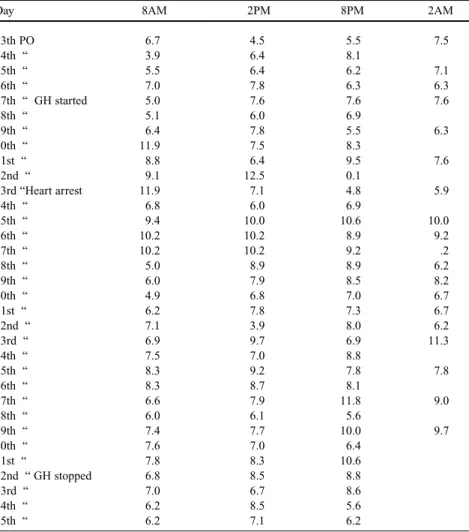
During the postoperative course of the patient, blood glucose levels main-tained a strange pattern that started before the introduction of GH and continued thereafter, requiring con-stant monitoring and occasional thera-peutic intervention. Despite the fact that there were two predisposing con-ditions for hyperglycemia, namely septic catabolism and hypercaloric diet, to which the introduction of GH further contributed, and despite the elderly condition of the patient, glycemic measurements close to the lowest limit of normal occurred on various occasions. True hypoglycemia (below 3.5 mmol/L) was clinically suspected but never confirmed, although the complication may have been masked by frequent administra-tions of intravenous hypertonic glu-cose, started prophylactically whenev-er glucose levels below 4.5 mmol/L were found.
As a matter of fact, modest hyper-glycemia did occur as well during a 3-day period shortly after the heart arrest, as well as on a few other occa-sions. Still, the majority of the labora-tory tests indicated normal or low-normal readings (Table 2).
DISCUSSION
Depressed blood glucose determi-nations should not be surprising
dur-ing advanced malnutrition, but sur-gery and sepsis classically modify this perspective, due to hormone and cytokine imbalance. The addition of GH-therapy is deemed nutritionally advantageous within this critical set-ting, but could further damage glu-cose regulation4,16,17.
Hyperglycemia is definitely con-sidered a potentially limiting factor for prescribing GH to elderly or dia-betic populations1.
Rare pulmonary, pancreatic, or neuroendocrine cancers manufacture hormones or peptides with glucose-lowering properties, but such a find-ing is extremely unusual for gastric adenocarcinoma5. Moreover, this patient maintained normal preopera-tive glucose concentrations, under-went radical extirpation of his disease, and had no evidence of tumor recur-rence by the time glucose fluctuations were recognized.
Extensive clinical experience with GH in adults has never revealed hypo-glycemia1-3,5,and even direct adminis-tration of human recombinant IGF-1 to critically ill patients failed to elicit such an abnormality20. It should be noted that glucose decreases were diagnosed before the introduction of the hormone in the present case.
It would seem a paradox to incrim-inate sepsis itself for the biochemical aberration, but severe hypoglycemia and even hypoglycemic seizures may on occasion be triggered by bacterial and parasitic processes7,10,18. Why a condition so intimately associated with glucose intolerance should be a possi-ble cause for the opposite effect is still incompletely understood. Impaired gluconeogenesis has been suspected in this context18, but interleukin-6 could also be involved with this phenome-non10. In rats, circulating endotoxin induces hypoglycemia, among other effects, and GH may enhance some of the metabolic responses16.
In the current study, cytokine or endotoxin measurements were not available, and gluconeogenesis studies were not performed. Nevertheless septic metabolic changes could be the
136
predominant explanation for the find-ings. Hypoglycemia was certainly demonstrated days ahead of GH use, in a phase of very severe disease. Nevertheless, it is interesting to notice that the anabolic agent did not prevent its continuation, and perhaps even contributed toward its maintenance for some time (Table 2).
As mentioned before, the eventful course of GH-supplementation in this
experience included two other surpris-es. Heart arrest is not currently accepted as a GH-dependent compli-cation1,2,5,22, and many other circum-stances could have been responsible for this accident. Severe electrolyte imbalance, hypoxia, or heart arrhyth-mia were ruled out in this mishap, but the subject was nevertheless a frail malnourished elderly man with septic complications and undergoing artifi-cial ventilation. In our preliminary
results with this agent, no cardiac abnormalities were detected8,and it is believed that GH may be beneficial to heart function in long-term pro-grams13. Therefore, it is not certain that GH played a role in this problem. As regards peripheral edema, it has been associated with GH adminis-tration for a long time1,2,but we were still surprised by its relatively rapid onset and anatomical severity. Yet this was a relatively benign complication with moderate functional impairment, which was mostly a cosmetic incon-venience and did not require any spe-cific treatment. As already indicated, it was essentially reabsorbed by the third week.
Perhaps the overarching question in the entire episode reported here is the indication and tolerance of GH pharmacotherapy during critical ill-ness. There is sufficient evidence in the literature that sepsis and organ failures do not preclude a positive result from such supplementa-tion4,6,11,16,17,22. In the current case, recovery of food ingestion and sponta-neous breathing clearly coincided with GH administration. At the same time, it is suspected that elevated mor-bidity and mortality may also be a consequence in critical patients, in some yet insufficiently defined set-tings21. Whether this depends on the ability of GH to potentiate the inflam-matory response to circulating endo-toxin9, or to interfere with other endogenous mediators, is presently unknown and clearly requires further investigation.
In conclusion, this was a case of growth hormone supplementation in a critically ill, septic postoperative patient that was followed by a depressed glycemic pattern, plus two additional complications, namely heart arrest, and peripheral edema. A strong association with the drug can only be made regarding peripheral edema, but it may be speculated that the context of high GH concentrations in a seriously ill subject could have had deleterious impact on the other reactions as well.
137
JULY-AUGUST REV. HOSP. CLÍN. FAC. MED. S.PAULO 54(4): 135 - 138, 1999
Variable / Date Pre- GH started Heart arrest GH discontinue
operative 17th P.O. 23rd P.O 42nd P.O.
Serum albumin (g/L) 30 28 27 34
Hemoglobin (g/dL) 12.3 1.0 10.9 13.0
White blood cells (/mm3 ) 7.9 10.4 39.0 18.4
Obs.: P.O.: Post-operative day
Table 1- General laboratory determinations
Day 8AM 2PM 8PM 2AM
13th PO 6.7 4.5 5.5 7.5
14th “ 3.9 6.4 8.1
15th “ 5.5 6.4 6.2 7.1
16th “ 7.0 7.8 6.3 6.3
17th “ GH started 5.0 7.6 7.6 7.6
18th “ 5.1 6.0 6.9
19th “ 6.4 7.8 5.5 6.3
20th “ 11.9 7.5 8.3
21st “ 8.8 6.4 9.5 7.6
22nd “ 9.1 12.5 0.1
23rd “Heart arrest 11.9 7.1 4.8 5.9
24th “ 6.8 6.0 6.9
25th “ 9.4 10.0 10.6 10.0
26th “ 10.2 10.2 8.9 9.2
27th “ 10.2 10.2 9.2 .2
28th “ 5.0 8.9 8.9 6.2
29th “ 6.0 7.9 8.5 8.2
30th “ 4.9 6.8 7.0 6.7
31st “ 6.2 7.8 7.3 6.7
32nd “ 7.1 3.9 8.0 6.2
33rd “ 6.9 9.7 6.9 11.3
34th “ 7.5 7.0 8.8
35th “ 8.3 9.2 7.8 7.8
36th “ 8.3 8.7 8.1
37th “ 6.6 7.9 11.8 9.0
38th “ 6.0 6.1 5.6
39th “ 7.4 7.7 10.0 9.7
40th “ 7.6 7.0 6.4
41st “ 7.8 8.3 10.6
42nd “ GH stopped 6.8 8.5 8.8
43rd “ 7.0 6.7 8.6
44th “ 6.2 8.5 5.6
45th “ 6.2 7.1 6.2
Obs.: Normal glucose range 3.5 - 9.0 mmol/L;
Hypertonic glucose administered IV whenever glycemia < 4.5 mmol/L; P.O. : Postoperative day;
138
REV. HOSP. CLÍN. FAC. MED. S.PAULO 54(4):135 - 138, 1999 JULY-AUGUST
RESUMO RHCFAP/2978
FAINTUCH, J. e col. - Baixos níveis de glicemia e outras complicações durante suplementação de hormô-nio do crescimento na sepse. Rev. Hosp. Clin. Fac. Med. S. Paulo 54 (4):135 - 138, 1999.
RESUMO: O perfil glicêmico esperado em pacientes pós-oper-atórios sépticos recebendo nutrição enteral de elevado teor calórico é de valores sanguíneos no limite superior do normal ou mesmo hiperglicemia moderada.A adição de hormônio do crescimento (GH) como agente
anabólico deveria reforçar ainda mais esta tendência.Num paciente com câncer submetido a gastrectomia par-cial e linfadenectomia, que se compli-cou no pós operatório com abscesso subfrênico e sepse prolongada, administrou-se conjuntamente dieta de sonda (38,3 kcal/kg/dia) e GH (0,17 UI/kg/dia).Antes da introdução de GH as taxas glicêmicas situavam-se nos limites inferiores do normal, e esta tendência persistiu durante a maior parte do período terapêutico.Duas complicações adicionais, nominal-mente parada cardíaca e edema peri-férico, foram documentadas nesta
mesma etapa.Conclui-se que a sepse é o mais provável mecanismo de redução da glicemia neste caso, e que o emprego de dieta enteral e de GH não conseguiu prevenir tal efeito.É questionável se a parada cardíaca foi devida ao suplemento hormonal, mas o edema periférico é um secundarismo bem conhecido deste agente em estu-dos clínicos.
DESCRITORES: Hormônio do crescimento. Nutrição enteral. Hi-poglicemia. Sepse. Edema peri-férico.
REFERENCES
1. BLETHEN S L, ALLEN D B & GRAVES D - Safety of recombinant deoxyribonucleic acid-derived growth hormone: The National Cooperative Growth Study Experience. J Clin Endocrinol Metab 1996; 81:1704-1710.
2. CUNEO R C, JUDD S & WALLACE J D - The Australian Multicenter Trial of growth hormone (GH) treatment in GH-defi-cient adults. J Clin Endocrinol Metab 1998; 83:107-116. 3. DALY J M, REDMOND H P & GALLAGHER H
-Perioperative nutrition in cancer patients. JPEN 1992 16(Suppl 6):100S-105S.
4. GATZEN C, SCHELTINGA M R & KIMBROUGH T D -Growth hormone attenuates the abnormal distribution of body water in critically ill surgical patients. Surgery1992; 112:181-187. 5. HOFF A O & VASSILOPOLOU S R - The role of glucagon administration in the diagnosis and treatment of patients with tumour hypoglycemia. Cancer1998, 82:1585-1592.
6. KNOX J B, WILMORE D W & DEMLING R H - Use of growth hormone for postoperative respiratory failure. Am J Surg
1996; 171:576-580.
7. KOCHAR D K & KUMAWAT B L - Cerebral malaria or Plasmodium falciparum malaria with hypoglycaemia. Lancet
1996; 347:1549-1550.
8. LEME R B A, FAINTUCH J, CRUZ M E L S et al. - Short-term growth hormone supplementation in high-risk surgical cancer patients. Intens Care Med1998; 24(Suppl 1):S52.
9. LIAO W, RUDLING M & ANGELIN B - Contrasting effects of growth hormone and insulin-like growth factor-I on the biological activities of endotoxin int he rat. Endocrinology1997; 138:289-295. 10. MILLER S I, WALLACE R J Jr & MUSHER D M -Hypoglycemia as a manifestation of sepsis. Am J Med 1980;
68:649- 654.
11. SAITO H, INOUE T & FUKATSU K - Growth hormone and the immune response to bacterial infection. Horm Res1996; 45:50-54.
12. SHIKORA S A & OGAWA A M - Enteral nutrition and the critically ill. Postgrad Med J 1996; 72:395-402.
13. SILVERMAN B L & FRIEDLANDER J R - Is growth hor-mone good for the heart ? J Pediatr 1997; 131(1 Pt 2):S70-S74. 14. STRASSMANN G, MASUI Y & CHIZZANTE R - The role of
interleukin-6 in lipopolysaccharide-induced weight loss, hypoglyce-mia, and fibrinogen production in vivo. Cytokine1993; 5:285-290. 15. TAYEK J A & BRASEL J A - Failure of anabolism in malnou-rished cancer patients receiving growth hormone: A clinical research center study. J Clin Endocrinol Metab1995; 80:2082-2087. 16. VAN DEN BERGHE G, ZEGHER F & LAUWERS P
-Growth hormone secretion in critical illness: effect of dopamine. J Clin Endocrinol Metab1994; 79:1141-1146.
17. VAN DEN BERGHE G, ZEGHER F & VELDHUIS J D -The somatotropic axis in critical illness: effect of continuous growth hormone (GH)-releasing hormone and GH-releasing pepti-de-2 infusion. J Clin Endocrinol Metab1997; 82:590-599. 18. WILMORE D W - Impaired gluconeogenesis in extensively
inju-red patients with Gram-negative bacteremia. Am J Clin Nutr
1977; 30:1355-1356.
19. WOLF R F, PEARLSTONE D B & NEWMAN E - Growth hormone and insulin reverse net whole body and skeletal muscle pro-tein catabolism in cancer patients. Ann Surg 1992; 216:280-288. 20. YARWOOD G D, ROSS R J & MEDBAK S - Administration
of human recombinant insulin-like growth factor-I in critically ill patients. Crit Care Med1997; 25:1352-1361.
21. ZIEGLER T R - Anabolic agents in nutritional support. In: Clinical Congress Program Book, 22nd, A.S.P.E.N. Lake Buena Vista, FL,
USA, 1998. p 117-124.
22. ZIEGLER T R, YOUNG L S & FERSARIBALIVIERA E -Use of human growth hormone combined with nutritional support in a critical care unit. JPEN1990; 14:574-581.