Hayling Test – adult version: applicability in the assessment
of executive functions in children
Larissa de Sousa Siqueira,
1Lilian Cristine Scherer,
1Caroline Tozzi Reppold
2and Rochele Paz Fonseca
1, 3 1- Pontifícia Universidade Católica do Rio Grande do Sul, Porto Alegre, RS, Brazil2-Universidade Federal de Ciências da Saúde de Porto Alegre, Porto Alegre, RS, Brazil
3- Université de Montréal, Montréal, QC, Canada
Abstract
Childhood neuropsychology is a growing scientiic area in Brazil. Regarding cognitive function in infancy, executive function (EF) has been the main focus of several studies because of its importance for and complexity in human cognition and behavior. Executive functions can be considered a set of cognitive processes related to control and integration devoted to the execution of goal-directed behaviors. Research has shown that these abilities begin in infancy and progressively develop until adulthood. Although some studies on EF development in children have already been conducted, our knowledge on this topic is still incipient. Because of the relevant role of age in cognition and EF development, the present study investigated whether differences exist between children aged 6 to 12 years concerning their performance on the Hayling test–adult version, an instrument that assesses the EF components of initiation and inhibition. Pilot data are presented that verify the applicability of this test to children. Signiicant differences were found between comparable age groups only in three of the seven main Hayling test scores, suggesting that the adult version may not be appropriate for children, and an adaptation of the test for child assessment is necessary. The study may lead to an initial relection on the development of these components and thus contribute to improvements in the ield of child neuropsychology. Keywords: executive function, child neuropsychological assessment, Hayling test, cognitive development.
Received 30 September 2010; received in revised form 16 November 2010; accepted 18 November 2010. Available on line 28 December 2010
Larissa de Sousa Siqueira, Neuropsychology, Ministério da Educação/Universidade Federal do Rio Grande do Sul; Clinical and Experimental Neuropsychology Laboratory, Pontifícia
Universidade Católica do Rio Grande do Sul. Lilian Cristine
Scherer, Linguistics Faculty, Post-Graduation Program in letras,
Pontifícia Universidade Católica do Rio Grande do Sul. Rochele
Paz Fonseca, Psychology Faculty, Post-Graduation Program in Psychology, Human Cognition Area, Clinical and Experimental Neuropsychology Laboratory, Pontifícia Universidade Católica
do Rio Grande do Sul; Faculté de Médecine, Université de
Montréal, Montréal, Québec, Canada. Caroline Tozzi Reppold,
Universidade Federal de Ciências da Saúde de Porto Alegre,
Department of Psychology. Correspondence regarding this
article should be directed to: Rochele Paz Fonseca, Pontifícia
Universidade Católica do Rio Grande do Sul, Av. Ipiranga,
6681, Prédio 11, 9º andar, Sala 932, Porto Alegre, RS, CEP
90619-900, Brazil. Phone/Fax: +55-51-3320-3500, ext. 7742. E-mail: [email protected]
Introduction
Despite the scientific and clinical advances
in neuropsychology in Brazil, the number of neuropsychological instruments developed to assess the
infant population is still low. To lessen this gap, one option
is the use and adaptation of tests widely administered to
the adult population, accompanied by standardization.
However, infancy presents peculiar features in terms of cognitive and emotional development, and neuropsychological tests for adults demand precaution
and the formulation of speciic criteria for interpreting the results in infants (Ardila, 1996; Rosselli & Ardila, 2003).
Executive functions (EF) have increasingly become the focus of many studies because of their importance for cognition, human behavior, and the complexity of their
interaction with other cognitive functions (Marcovitch &
Zelazo, 2009; Matute, Chamorro, Inozemtseva, Rosselli, & Ardila, 2008).
In addition, EF can be considered a set of
higher-order cognitive processes that organize and adjust
human behavior and cognition to it into a context
and the subject’s aims (Bielak, Mansueti, Strauss,
& Dixon, 2006). These executive components must
rely on the contribution of several components and subprocesses, such as attention, planning, initiation and inhibition of processes and information, cognitive
lexibility, multiple task monitoring, working memory, and verbal luency control. All of these processes are
targeted to solve problems and are directly related to thought and behavior management (Chan, Shum,
Studies have shown that EF emerge in infancy and continue to develop in adolescence (Sun, Mohay,
& O’Callaghan, 2009). The ages of 5-8 years and
11-12 years appear to be milestones in the development
of executive components. Moreover, age, schooling,
socioeconomic level, and other factors play important roles in the development of these cognitive functions
(Ardila, 1996; Rosselli & Ardila, 2003).
The literature refers to the relationship between EF and the frontal lobe, concluding that the assessment of cognitive components in infancy and adolescence
is related to the maturation of this cortical region. However, new indings have related EF to other brain regions, such as more posterior areas (Tamnes et al., 2010). Some authors suggest that EF reach maturity later compared with other cognitive functions. According to Romine and Reynolds (2005), for example, these
processes develop intensively between 6 and 8 years of age and continue to develop until the end of adolescence
and the beginning of adulthood.
Concerning EF component assessment in clinical practice, different standardized instruments have been used to complement clinical observations (for review,
see Chan et al., 2008; Lezak, Howieson, & Loring, 2004; Strauss, Sherman, & Spreen, 2006). Among the
most widely adopted are the Wisconsin Card Sorting Test, Stroop Test, Trail Making Test, and measures of
verbal luency. Several tests that evaluate EF should be seen as tools with which to assess speciic EF components and not the construct as a whole. Because
of the multidimensionality of EF, some instruments predominantly measure the planning component, such as the Tower of London Test, whereas another instrument may measure inhibition (Stroop Test) and so on (Andres
& Van der Linden, 2000).
The Hayling test (Burgess & Shallice, 1997) is an
instrument that asks the subject to complete sentences
by saying a inal word to complete the sentence. The
aim of Part A of the test is evaluate the preprogrammed organizing process because in this phase the constructs to be examined are concentrated attention, verbal initiation, processing speed, and the strategy of a well-succeeded search for automated words related to the preactivation
of semantic networks. Part B assesses more complex
EF components, such as verbal inhibition and planning, because the subject must inhibit the content of the sentence (semantics) and develop alternative strategies in his lexical search to complete the syntactic stimulus
(Chan et al., 2008).
While using the same structure to present the stimuli, the two test conditions (Parts A and B) allow the comparative evaluation of the functioning of two EF components (initiation and inhibition) related to a
single symbolic form (verbal). This speciicity generates a valuable clinical tool for the detection of modiications
that are potentially useful for the diagnosis and treatment
of patients with executive dysfunction. Supervisory
Attentional System theory, developed by Norman and Shallice (1986), is the most accepted theory for explaining the cognitive processes that underlie the solution of Parts
A and B of the Hayling test (Chan et al., 2008).
From an information processing perspective, Norman and Shallice (1986) made a distinction between the automatic and controlled processing required during daily cognitive processing and problem solving
situations. Supervisory Attentional System theory is
a theoretical model of the cognitive processes that underlie behavior presumably directed to the aims that
are necessary in non-ordinary situations. It represents a
set of cognitive processes that involve initiation, strategy generation toward a target, and performance evaluation required to execute complex cognitive, non-ordinary
and unlearned tasks. It is involved whenever action and
thinking schemas, which represent routines capable of effectively accomplishing an aim, cannot be selected by means of automatic triggering provided by learned
cues. This system plays a vital role in problem solving
situations in which well-learned behaviors or sequential
reasoning are insuficient or inadequate and when new
behaviors need to be planned and monitored to reach
satisfactory performance in the task.
Considering this cognitive neuropsychological relationship, the Hayling test generates a measure of an individual’s capacity to develop strategies targeted to
the fulillment of task demands. According to Burgess
and Shallice (1996), the inability to generate adequate strategies may lead to low performance in the test and
contribute to errors.
The Hayling test has been used internationally for several age groups but mainly with adults (Frias,
Dixon, & Strauss, 2009), both in the assessment of EF
inhibitory components in neurological syndromes, such
as traumatic brain injury (Draper & Ponsford, 2008), and
in psychiatric syndromes, such as the examination of EF
in schizophrenia (Chan et al., 2010). Because of the fact
of being theoretically and experimentally well grounded, this instrument has been used as a tool in neuroimaging studies that seek a deeper understanding of the neural
correlates of verbal inhibitory processes (Allen et al., 2008; Nathaniel-James, Fletcher, & Frith, 1997).
However, a review of the literature yields few studies on EF processing with a developmental neuropsychological perspective using this accurate instrument for measuring
verbal initiation and inhibition. Studies with children and
adolescents have been conducted (Herba, Tranah, Rubia,
& Yule, 2006; Robinson, Goddarb, Dritschel, Wisley, & Howlin, 2009; Shallice et al., 2002) but only with clinical populations. No studies have focused on healthy children
with the goal of delimiting a developmental performance
standard. In Brazil, the Hayling test was adapted for
has been used to assess EF components in adults with right cerebrovascular lesion (Gindri, Zibetti & Fonseca,
2008). However, it has not yet been used for infant neuropsychological assessment in Brazil. In this context,
the present article presents data on the performance of
school-aged children as a pilot study for the veriication
of the applicability of the adult version of the Hayling
test (Fonseca et al., 2010) in child neuropsychological
assessment to verify the presence or absence of differences
in performance between children aged 6 and 12 years.
Methods
Participants
Twenty-four children participated in this study (n
= 12, 6-year-olds, all in the irst year of Fundamental
Course; n = 12, 12-year-olds, three of whom were in the
ifth grade and nine of whom were in the sixth grade).
The subjects were regularly enrolled at public schools
in the city of Porto Alegre, RS, Brazil. The groups were
paired by gender, with four boys in the 6-year-old group
and three in the 12-year old group. No differences were found in this variable between groups (χ2[1] = 0.756,
p = .385). Regarding socioeconomic status according
to the 2008 Associação Brasileira de Empresas e
Pesquisa economic classiication criteria in Brazil, the
majority of the children’s families belonged to the B2
socioeconomic class.
The inclusion criteria were the following: (i) in the
irst year of school (for the 6-year-old children), (ii) the presence of self-report capacity, (iii) the absence of repetition of school years, (iv) the absence of reports
of generalized deicits in learning and oral language,
(v) the absence of non-corrected sensory dificulties
(visual or auditory), neurological impairments, and self-reported psychiatric syndromes, and (vi) Brazilian
Portuguese as the native language. To verify the
sample’s characterization and inclusion criteria, a questionnaire was administered to the children’s parents or guardians that included demographic, cultural, and health condition questions, with the latter considering aspects related to pregnancy, birth, and biopsychosocial
development. The Raven Progressive Matrices Test (Angelini, Alves, Custódio, Duarte, & Duarte, 1999)
was administered to exclude children with evidence of
intellectual dificulties, and the Conners Questionnaire
(Barbosa & Gouveia, 1993) was answered by the subjects’ teachers to exclude subjects with suggestive
signs of attention deicit and hyperactivity disorder.
Procedures and instruments
The study procedures were approved by the Ethics Committee in Research of Pontifícia Universidade
Católica do Rio Grande do Sul (protocol 09/04864). All
children were selected according to the inclusion criteria and evaluated using the adult version of the Hayling
test (Fonseca et al., 2010). The assessment occurred in
the school where the children were enrolled, in a quiet
place with no inluence of external factors. The test consists of two parts, with a mean duration of 15 min. In Part A, the subject must say a word that coherently completes a sentence read by the examiner. In Part B, the
subject must produce a word that does not present any
logical or meaningful relation with the sentence. In Part
A, the stimulus syntactic and semantic context (sentence) leads to the activation of a word that is coherent with the
semantic context of the clause. In Part B, the subject must
inhibit the dominant answer, one that would be logical and coherent, and search for a word that is not related to the
syntactic and semantic context required by the clause.
The assessment was audio-recorded, and the time measure was collected, following the instructions for
administration and registration of the test. The only
adaptation done for the administration of the Hayling test in children was in the examples so that they were
more accessible and more easily comprehended.
Regarding the scores, the Hayling test can generate scores concerning response time, correct answers, and
errors in both parts. The main scores that were the
most sensitive were the following: Part A (the addition of errors related to the number of sentences in which
the answers were not inhibited; maximum = 15), Part
B (the error score was calculated as a function of the
values referring to qualitative classiications according
to the answers given by the children, with the worst
error scored 3; maximum = 45). A more general error
score in Part B was also calculated, with a maximum
of 15 (i.e., the number of possible incorrect answers).
The total times were also scored from the addition of the time between the stimulus and the beginning of the
answer in each part. The total time of execution for
each part is used to compare the speed of processing
and performance inhibition between Parts A and B. Two
calculations were made: a subtraction (Time B - Time
A) and a quotient (Time B / Time A).
Data analysis
In addition to the descriptive analysis of the
quantitative scores of accuracy and time in Parts A and
B of the Hayling test, the Independent Samples t-test was used for the comparison of pilot data in 6- and
12-year-old children. The signiicance level was set to p
≤ .05. All data were parametric according to the one-sample Kolmogorov-Smirnov test. Data were analyzed using SPSS version 18.0 software.
Results
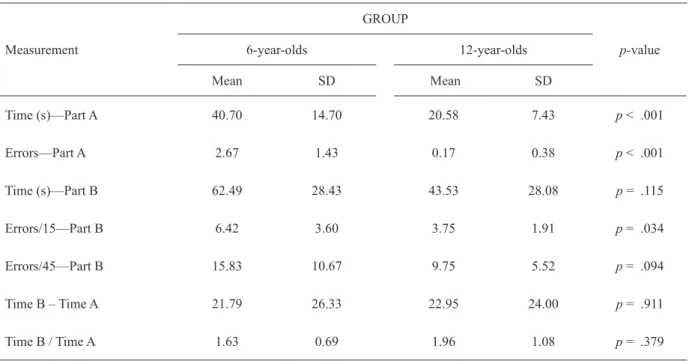
Table 1 shows the performance on the Hayling test
for the two age groups. Signiicant differences were
A of the instrument and in the number of sentences erroneously completed in Part B (p = .034; maximum
score = 15 points). A difference was found in the least
representative score in Part B, which was the number of incorrect sentences, but not in the score that considered
error severity (score of 45) or in the time score. The
12-year-old group appeared to have greater heterogeneity
in their results compared with the 6-year-old group.
Discussion
Despite the fact that the sample consisted of 24 participants, this pilot study found signiicant differences
between the two groups (6- and 12-year-old children) in the time and error scores in Part A, demonstrating
that age appears to inluence performance in the test, particularly in Part A. Although no signiicant age
difference was found in the execution time of Part
B, the results showed a signiicant difference in the
execution time of Part A, demonstrating that the 12-year-old children exhibited higher speed accompanied by higher accuracy in correctly completing the test
compared with the 6-year-old participants.
These results may relect characteristics of
immaturity in the development of EF in 6-year-old children, such as sustained attention, processing speed, and initiation, which are known to be predictors of
inhibition development (Reck & Hund, 2010). A possible
explanation for the difference between groups in Part A
of the test is that the dificulty in initiation in the
6-year-old children may be related to lexical and semantic development, causing them to make more mistakes and need more time in the search for a word to complete
the sentences. In Part B, the child does not necessarily
need to utilize semantic networks, and completing the sentences with words that do not require contextualized
lexical access is easier for the child.
Part B of the Hayling test-adult version may
not be an eficient instrument for evaluating EF in
children aged 6 and 12 years because the stimuli in
this part could have been dificult to solve by both
groups when considering the complex language
stimuli that must be inhibited, making their inal responses easier to achieve by chance. Despite the signiicant differences among groups in Part A of
the instrument, more prominent differences could be expected in Part B, which were not found in this
study. Thus, this inding appears to relect the need
to develop an adapted version of the tool for infants, with less complex sentences and within a semantic and syntactic format that should be more related to the vocabulary and syntactic structures to which
children are exposed and use in their daily life.
The use of strategies that favor retrieval of non-related
words (e.g., using as a response to a stimuli objects found
in the assessment environment) was not investigated in
this study. However, the clinical observation of these
occurrences may justify the results presented by the groups in
their performance in Part B of the Hayling test.
The younger children showed a tendency toward lower performance when the test required higher inhibitory demand, with an increase in the number of completely
wrong sentences. Thus, the lower performance in younger children in Part B may relect dificulties in inhibiting
automatic responses or a strategy to complete each sentence
according to the instructions given.
Measurement
GROUP
p-value
6-year-olds 12-year-olds
Mean SD Mean SD
Time (s)—Part A 40.70 14.70 20.58 7.43 p < .001
Errors—Part A 2.67 1.43 0.17 0.38 p < .001
Time (s)—Part B 62.49 28.43 43.53 28.08 p = .115
Errors/15—Part B 6.42 3.60 3.75 1.91 p = .034
Errors/45—Part B 15.83 10.67 9.75 5.52 p = .094
Time B – Time A 21.79 26.33 22.95 24.00 p = .911
Time B / Time A 1.63 0.69 1.96 1.08 p = .379
This comparative pilot study was based on a relatively reduced sample of participants and was an important phase in the pre-adaptation of the instrument
of EF examination for children aged 6 to 12 years. Additionally, some children demonstrated dificulties
comprehending some stimuli of the test, demonstrating that instruments designed for adults must be adapted
for children because of the complex stimuli. With the
Hayling test, some sentences may not have activated some semantic-syntactic networks in the children, which
may have aided accuracy and inhibitory speed.
The results of this study suggest a lack of success in
inding age-related differences in the groups’ performance
in a task that analyzes the executive component of inhibition, suggesting that the nature of EF development
remains stable during the second infancy period.
Moreover, the results suggest that the adult version of the Hayling test appears to not have discriminated the most
important clinical scores (i.e., deicits in the inhibitory
process), indicating the necessity to adapt the test to
children. Such a version will be developed based on the
results found in the present study and the existing child versions of other instruments, such as the Junior Hayling
test (Shallice et al., 2002).
Studies on autistic disorders already use a version of the Hayling test adapted to children for EF assessment
(Robinson et al, 2009). These studies report a signiicant
correlation between age and performance in Part A of the instrument in children with a diagnosis of Asperger
Syndrome or autism. As suggested by Anderson (1998),
developing valid and well-standardized assessment
measures speciically for children is important and
should be based on a deep comprehension of brain and
cognitive development in childhood. The need to adapt
tests for infant neuropsychological assessment, even in children younger than 6 years old, was suggested by
Argolo et al. (2009).
The Hayling test is an eficient instrument for
diagnosing executive dysfunction involving components
of initiation and inhibition of verbal content. However,
this instrument must be adapted to the infant population to verify performance with regard to age and years of schooling and increase our understanding of typical and
atypical EF development in childhood. The study of EF
in the second infancy period, in addition to contributing to our knowledge about the processes involved in these functions, will allow researchers and clinicians to attain a better comprehension of the correlations and development of these components, thus contributing to
advances in the ield of infant neuropsychology.
References
Allen, P., Mechelli, A., Stephan, K.E., Day, F., Dalton, J., Williams, S., & McGuire, P.K. (2009). Fronto-temporal interactions during overt verbal initiation and suppression. Journal of Cognitive Neuroscience, 20, 1656-1669.
Anderson, V. (1998). Assessing executive functions in children:
biological, psychological, and developmental considerations.
Neuropsychological Rehabilitation, 8, 319-349.
Andrés, P., & Van der Linden, M. (2000). Age-related differences in supervisory attentional system functions. Journal of Gerontology: Serie B. Psychological Sciences and Social Sciences, 55B, P373-P380.
Angelini, A.L., Alves, I.C.B., Custódio, E.M., Duarte, W.F., & Duarte, J.L.M. (1999). Matrizes progressivas coloridas de raven: escala especial. Manual. São Paulo: Centro Editor de Testes e Pesquisa
em Psicologia - CETEPP.
Ardila, A. (1996). Towards a cross-cultural neuropsychology. Journal of Social and Evolutionary Systems, 19, 237-248.
Argollo, N., Bueno, O.F.A, Shayer, B., Godinho, K., Abreu, K., Durán, P., ... Capovilla, A.G.S. (2009). Adaptação transcultural da Bateria
NEPSY: avaliação neuropsicológica do
desenvolvimento—estudo-piloto. Avaliação Psicológica, 8, 59-75.
Barbosa, G.A., & Gouveia, V.V. (1993). O fator hiperatividade do Questionário de Conners: validação conceptual e normas diagnósticas. Temas: Teoria e Prática do Psiquiatra, 23, 188-202.
Bielak, A.A.M., Mansueti, L., Strauss. E., & Dixon, R.A. (2006). Performance on the Hayling and Brixton tests in older adults. norms and correlates. Archives of Clinical Neurospychology, 21, 141-149.
Burgess, P.W., & Shallice, T. (1996). Response suppression, initiation and strategy use following frontal lobe lesions. Neuropsychologia,
34, 263-273.
Burgess, P.W., & Shallice, T. (1997). The Hayling and Brixton tests.
Bury St. Edmunds, UK: Thames Valley Test Company.
Chan, R.C.K., Huang, J., Guo, L., Cao, X., Hong, X., & Gao, Z. (2010). Executive control in schizophrenia in task involving semantic inhibition and working memory. Psychiatry Research,
179, 259-266.
Chan, R.C.K., Shum, D., Toulopoulou, T., & Chen, E.Y.H. (2008).
Assessment of executive functions: review of instruments
and identiication of critical issues. Archives of Clinical Neuropsychology, 23, 201-216.
Draper, K., & Posnford, J. (2008). Cognitive functioning ten years following traumatic brain injury and rehabilitation.
Neuropsychology, 22, 618-625.
Fonseca, R.P., Oliveira, C., Gindri, G., Zimmermann, N., & Reppold, C. (2010). Teste Hayling: um instrumento de avaliação de componentes das funções executivas. In C. Hutz (Ed.), Avaliação psicológica e neuropsicológica de crianças e adolescentes
(pp.337-364). São Paulo: Casa do Psicólogo.
Frias, C.M., Dixon, R.A., & Strauss, E. (2009). Characterizing
executive functioning in older special populations: from cognitively
elite to cognitively impaired. Neuropsychology, 23, 778-791.
Gindri, G., Zibetti, M.R., & Fonseca, R.P. (2008). Funções executivas
pós-lesão de hemisfério direito: estudo comparativo e frequencia
de déicits. Psico, 39, 181-190.
Herba, C.M., Tranah, T., Rubia, K., & Yule, W. (2006). Conduct
problems in adolescence: three domains of inhibition and effect of
gender. Developmental Neuropsychology, 30, 659-695.
Lezak, M.D., Howieson, D.B., & Loring, D.W. (2004).
Neuropsychological assessment. (4th edition). New York: Oxford
University Press.
Marcovitch, S., & Zelazo, P.D. (2009). A hierarchical competing
systems model of the emergence and early development of
executive function. Developmental Science, 12, 1-18.
Matute, E., Chamorro, Y., Inozemtseva, O., Rosselli, M., & Ardila, A. (2008). Efecto de la edad em una tarea de planiicación y organizacíon (“pirâmide de México”) en escolares. Revista de Neurologia, 47, 61-70.
Nathaniel-James, D.A., Fletcher, P., & Frith, C.D. (1997). The
functional anatomy of verbal initiation and suppression using the
Hayling Test. Neuropsychologia, 35, 559-566.
Norman, D.A., & Shallice, T. (1986). Attention to action: Willed and automatic control and bahavior. In R.J. Davidson, G.E. Schwartz & D. Shapiro (Eds.), Consciousness and self-regulation (series title: Advances in research and theory, vol. 4) (pp. 1-18). Plenum Press: New York.
Reck, S.G., & Hund, A.M. (2010). Sustained attention and age predict inhibitory control during early childhood. Journal of Experimental Child Psychology, in press.
Robinson, S., Goddarb, L., Dritschel, B., Wisley, M., & Howlin, P. (2009). Executive functions in children with Autism Spectrum Disorders. Brain and Cognition, 71, 362-368.
Brian and Cognition, 52, 326-333.
Romine, C.B., & Reynolds, C.R. (2005). A model of the development of frontal lobe functioning: indings from a meta-analysis. Applied Neuropsychology, 12, 190-201.
Shallice, T., Marzocchi, G.M., Coser, S., del Savio, M., Meuter, R.F., & Rumiati, R.I. (2002). Executive function proile of children with attentional deicit hyperactivity disroder. Developmental Neuropsychology, 21, 43-71.
Strauss, E., Sherman, E.M.S., & Spreen, O. (2006). A compendium of
neuropsychological tests: Administration, norms, and commentary,
3rd. edition. New York: Oxford University Press.
Sun, J., Mohay, H., & O’Callaghan, M. (2009). A comparison of
executive function in very preterm and term infants at 8 months
corrected age. Early Human Development, 85, 225-230.
Tamnes, C.K., Ostby, Y., Walhovd, K.B., Westlye, L.T., Due-Tonnessen, P., & Fjell, A.M. (2010). Neuroanatomical correlates of executive
functions in children and adolescents: a magnetic resonance imaging