O
RIGINALA
RTICLE Revista Brasileira de FisioterapiaNeural mobilization and static stretching in
an experimental sciatica model –
an experimental study
Mobilização neural e alongamento estático em um modelo experimental de
ciatalgia – estudo experimental
Gladson R. F. Bertolini1, Taciane S. Silva1, Danilo L. Trindade1, Adriano P. Ciena1, Alberito R. Carvalho1,2
Abstract
Objective: To verify the effectiveness of neural mobilization and static stretching in reducing pain in rats submitted to experimental sciatica. Methods: The rats (n=23) were divided into three groups: sham (SG/n=8), without intervention; stretching (STCG/n=8), treated with static stretching; and neural mobilization (NMG/n=7), treated with neural mobilization. The animals underwent an experimental model of sciatica by compression of the right ischiatic nerve with catgut suture thread. There were five consecutive sessions of treatment that began on the third day after lesion. The pain caused by the sciatica was evaluated by a functional incapacitation test that measured paw elevation time (PET), and values over 10s were indicative of pain. PET was measured at the following moments: before the lesion (M1), immediately before (M2) and after the first session (M3), immediately after the last session (M4) and 24h after the last session (M5). ANOVA was applied with repeated measures and unrepeated measures for intra- and inter-group comparison, respectively.
Results: In the SG, post-lesion PETs were greater than M1 (p<0.001), suggesting persistence of pain. In the STCG, post-lesion PETs were greater than M1 (p<0.001), but lower when comparing M3 vs. M4 (p<0.05) and M3 vs. M5 (p<0.01) suggesting the effectiveness of the treatment. In NMG, M2, M3 (p<0.001) and M4 (p<0.05) were greater in relation to M1, but not M5, showing that this treatment reestablished the normal PET values. Conclusion: Both forms of therapy were effective in reducing pain, with neural mobilization being the more effective of the two.
Key words: sciatica; physical therapy modalities; neuralgia.
Resumo
Objetivo: Verificar a eficácia da mobilização neural e do alongamento estático na redução da dor em ratos submetidos à ciática experimental. Métodos: Os ratos (n=23) foram divididos em três grupos: simulacro (GS/n=8), sem intervenção; alongamento (GAL/ n=8), tratados com alongamento estático; e mobilização neural (GMN/n=7), tratados com mobilização neural. Submeteram-se os animais a um modelo experimental de ciática, comprimindo o nervo isquiático direito com fio de catgut. Realizaram-se cinco sessões consecutivas de tratamento que se iniciaram no terceiro dia pós-lesão. Avaliou-se a dor, provocada pela ciática, pelo teste de incapacidade funcional que mensurava o tempo de elevação da pata (TEP) do animal, e valores maiores que 10 segundos eram indicativos de dor. O TEP foi mensurado nos momentos: antes da lesão (M1), imediatamente antes (M2), após a 1ª sessão (M3), imediatamente após a última sessão (M4) e 24 horas após a última sessão (M5). Aplicou-se ANOVA com medidas repetidas e não repetidas para análise intra e intergrupos, respectivamente. Resultados: No GS, os TEPs no pós-lesão foram maiores que M1(p<0,001), sugerindo persistência da dor. No GAL, os TEPs foram maiores no pós-lesão em relação a M1 (p<0,001), mas diminuiu nas comparações M3xM4 (p<0,05) e M3xM5 (p<0,01) sugerindo a eficácia do tratamento. No GMN, M2, M3 (p<0,001) e M4 (p<0,05) foram maiores em relação a M1, mas M5 não, mostrando que este tratamento restabeleceu os valores normais de TEP. Conclusão: As duas formas de terapia foram eficazes na redução da dor, sendo a mobilização neural mais efetiva.
Palavras-Chave: ciática; modalidades de fisioterapia; neuralgia.
Received: 03/09/2008 – Revised: 18/12/2008 – Accepted: 05/05/2009
1 Laboratory for the Study of Injuries and Physical Therapy Resource, Universidade Estadual do Oeste do Paraná (UNIOESTE), Cascavel (PR), Brazil 2 Physical Therapy Department, Universidade Paranaense (UNIPAR), Toledo (PR), Brazil
Introduction
Sciatica can be considered a referred pain syndrome in which the pain is reported in the lower limb in the absence
of any local disturbance1. This condition is due to ischiatic
nerve compression, the most common cause being herniated disk. Other causes that can be cited are degenerative spine disease, infections, traumatic posterior hip dislocation,
con-genital anomalies2, piriformis syndrome3 and lumbar spinal
canal stenosis. The symptoms include low back pain, pain along the nerve, sensorial disturbances and weakness of the
lower limb muscles innervated by the ischiatic nerve4.
The rehabilitation methods of conditions that cause back pain are quite controversial in the literature, and the studies that attempt to determine the best strategies for
intervention are still inconclusive5. Stretching exercises are
rarely described in detail in these studies, but it seems that
static stretching is the most commonly employed6. In
prac-tice, static stretching is widely used, and it is considered a safe method that aims to lengthen a muscle at a tension
level that can be tolerated for a given time7. Not only the
di-sagreements relevant to the treatment of lumbar disorders, stretching itself as a specific technique is reported in the
literature as a source of debate8, which justifies considering
stretching as a variable of study.
Sciatica due to nerve compression9, originating from
a neurapraxic-type injury, is characterized by a decrease in nerve conductivity and causes selective atrophy of the
muscle fibers innervated by compromised motor neurons10.
Neural provocation tests are conducted with the objective
of aiding in the diagnosis of nerve compression syndromes11,
and they are adapted for the treatment of these syndromes (neural mobilization), with varied results reported in the
literature12-15.
The principle of neural mobilization is that changes in the mechanics or the physiology of the nervous system can result in other system dysfunctions or dysfunctions of the musculoskeletal structures that receive its innervations. The neural mobilization technique is used to regain the movement and elasticity of the nervous system, with the objective of improving neurodynamics and reestablishing axoplasmic flow, thus restoring nerve tissue homeostasis, which promotes the return to its normal functions. The
te-chnique is also used to regain joint flexibility14. While both
neural mobilization and static stretching are therapeutic resources with questionable results presented in the litera-ture, the aim of this study was to verify the effectiveness of neural mobilization and static stretching in reducing pain in rats submitted to an experimental sciatica model.
Methods
Experimental groups
Twenty-three Wistar rats, weighing a mean 347.00±31.68 g,
were used for the experimental model. he animals were housed
(three to four per cage) at a controlled temperature of 25±1 oC and
on a 12 h light/dark cycle with free access to food and water. he animals were divided into three groups:
• Sham Group (SG, n=8) – submitted to sciatica in the right
limb and to sham treatment;
• Stretching Group (STCG, n=8) – submitted to sciatica and
treated with static stretching;
• Neural Mobilization (NMG, n=7) – submitted to sciatica
and treated with neural mobilization.
All of the experiments in the present study were conducted according to international ethics regulations for animal
expe-riments16. he study was approved by the Ethics Committee on
Animal Experimentation and Practical Classes of Universidade Estadual do Oeste do Paraná, process number 0109.
Experimental lesion protocol
Anesthesia was induced with ketamine (95 mg/kg) and xylazine (12 mg/kg) via the intraperitoneal route. Experimen-tal neuropathy in rats was produced by surgery, according to a
method previously described by Bennett and Xie17. Briely, the
right ischiatic nerve was exposed at the mid-thigh level and the nerve was then constricted with four loose ligatures using chromic catgut 4.0 spaced at about 1 mm, reproducing chronic pain. Soon after, suturing was performed using plane suture.
Functional incapacitation test
he functional incapacity test was accomplished using a rotating metal cylinder, and a computer program connected to a metallic boot adapted to the animal’s paw, as originally
described by Tonussi and Ferreira18.
he rats were placed in the cylinder for 1 minute. A compu-ter-assisted device measured the total time that the right hind paw was not in contact with the surface of the cylinder (paw elevation time; PET). he left hind paw was also connected by a
boot, but without information transfer to the computer18.
he experiment began with the rats training in the cylin-der. he following day, the time values of the normal gait were logged. PET was measured at the following moments:
compression; immediately after the last session (M4); and 24h after the last session (M5). here was a total of ive con -secutive sessions at the same time of day on subsequent days.
After the inal data collection, the animals were sacriiced by
means of decapitation in guillotine. Animals without chan-ges normally maintain paw elevation for approximately 10 seconds during gait, and animals with pain due to ischiatic
nerve compression present a higher PET19.
Treatment protocols
For the treatment protocols, the animals were sedated with ethyl ether, and the treatment was applied to the right hind
limb, in the three groups. In the STCG, the treatment protocol
was accomplished with the animal in dorsal decubitus, hip
le-xed at approximately 70o, maximum knee extension and ankle
dorsilexion until resistance to the motion was felt; the posi-tion was then maintained for one minute. In the protocol used
for the NMG, the animal was positioned in similar way to the STCG, however the ankle was moved passively in plantarlexion
and dorsilexion, with approximately 30 movements in one minute. his intervention was adapted from the intervention
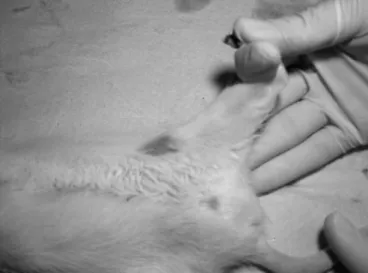
recommended for ischiatic nerve stretching in humans20. he
position used for both interventions can be seen in Figure 1. In
the SG, the animal was also sedated and positioned in dorsal
decubitus, but only the hip was maintained in lexion of about
70o, with free knee and ankle joints.
Statistical analysis
he results were expressed by means of descriptive statis-tics (mean and standard deviation) and analyzed by one-way ANOVA and repeated measures ANOVA, for inter- and intra-group comparison, respectively. Tukey post-hoc tests were also
used. Diferences were considered statistically signiicant at
the p<0.05 level.
Results
For the results related to PET, the SG showed a signiicant increase after the lesion (M2) compared to the moment before
the lesion(M1), and this increase continued at every appraised
moment. When comparing the post-lesion value (M2) to the subsequent moments (M3, M4 and M5), there was signiicant
PET decrease, suggesting the persistence of pain (Figure 2).
For the STCG, as in the SG, there was signiicant PET increase when comparing the moment before the lesion (M1) to the subsequent ones (M2, M3, M4 and M5). In contrast, when com
-paring the moment after lesion (M2) with the subsequent ones,
there was a signiicant decrease after the last treatment (M4) and after 24 hours of the last treatment (M5) suggesting that,
although the pain has persisted after the lesion, it diminished but did not disappear completely (Figure 2).
Finally, for the NMG, there was also signiicant diference when comparing the moment before lesion (M1) to the mo
-ments after lesion (M2), immediately after treatment and after the last treatment (M3 and M4, respectively), but not when
compared to the moment 24 hours after the last treatment
(M5). his shows that there was pain provocation after the
lesion, however due to the intervention, there was pain
remis-sion. As in the STCG, there was a signiicant decrease when comparing the moment after lesion (M3) to the moment after
Figure 1. Positioning the animal to receive treatment with hip inflexion,
knee extension and ankle dorsiflexion.
Figure 2. Variation in paw elevation times, in seconds, for: the sham
group (SG), stretching group (STCG) and neural mobilization group
(NMG); at the moments: before lesion (M1), on the 3rd day after the
lesion and before the initial treatment (M2), on the 3rd day after the
lesion and after the first treatment (M3), after the last day of therapy (M4), and 24 hours after the last day of therapy (M5).
0.00 5.00 10.00 15.00 20.00 25.00 30.00 35.00 40.00
M1
P
a
w ele
vation time (s)
SG STCG MNG * *
*
* *
* *
* * *
*
# ##
#
Ɣ
M5 M4
M3 M2
the last treatment (M4) and to the moment 24 hours after the last treatment (M5) (Figure 2).
Discussion
In the present study, the aim was to analyze and compare two techniques of kinesiotherapy for the pain associated with an experimental sciatica model. To achieve that, neural mobi-lization and static stretching were used because the literature indicates contrasting results for pain processes due to
periphe-ral nerve lesion12-15.
Hall and Elvey21 contraindicate stretching as therapy for
nerve lesions, and they indicate gentle oscillatory movements in the anatomical structures around the afected nerve tis-sue. hey mention that when the nerve fascicle is stretched, its cross-sectional area is reduced, intra-fascicular pressure
increases, nerve ibers are compressed and microcirculation
is compromised; and the pressure received by the nerve will
afect the edema and the demyelination. Given that neural
mobilization consists of short oscillatory movements and that in the present study this technique was more efective than static stretching, it is suggested that the tension
main-tained by static stretching may be less beneicial to nerve
integrity than short, repetitive stress. However, future studies that make a comparison between intra-fascicular pressure caused by static stretching and by neural mobilization are needed before this hypothesis can be accepted.
Kikukawa et al.22 investigated the acute changes in the
axonal cytoskeleton after one hour of moderate stretching (2 N) in the brachial plexus nerves of rats. hey reported that the microtubules were depolymerized by stretching, which
can afect axonal nerve transport. Kobayashi et al.23 evaluated
changes in blood low with the straight-leg-raising test in 12 patients before and after microdiscectomy and found that during the test there was low reduction. hey mention that the adhesions caused by inlammatory reactions between the lesion and the nerve root could reduce nerve mobility during limb movement, resulting in changes in low with subsequent hypoxia, edema and demyelinisation.
However, Cleland et al.12 investigated the use of passive
stre-tching, similar to the “slump test”, in patients with low back pain, and with a positive test result. hey used a visual analog scale (VAS), a pain diagram and the Oswestry Disability Index for evalu-ation; the patients were treated for three weeks, twice a week. At the end, the patients submitted to treatment with lumbar mobili-zation and exercises as well as the stretching slump had improve-ments in disability, pain and centralization of symptoms.
he present study also found that the group submitted to one minute of daily static stretching for one week had improvement
in pain because the PET values on the last day of treatment and 24 hours later were higher than the values after the lesion. hat was not the case for the sham group. In the sham group, there
was a signiicant PET increase in the post-lesion evaluations, and at every other moment there was a signiicant PET decrease,
indicating the presence of pain during gait.
Considering the evidence for and against the use of static stretching in peripheral nerve disorders and comparing it to the
positive indings of the present study, it seems that one of the sour -ces of bias in the studies is the tension imposed on the nerve, given that there is no standard for the amount of stress manually applied to the tissues. hus, future studies should objectively quantify the degree of tension imposed by stretching and correlate it with the
functional variables. According to Elvey15, any inlammatory
pro-cess afecting a nerve root can lead to the development of ibrous tissue, causing adhesions that result in dysfunction, mobility dei -cit, and generating pain during movement. herefore, this would be the reason for treating the nerve with passive movement; ho-wever, the therapeutic efect is only explained in general terms, such as preventing the formation of adhesions around the nerve,
reducing edema and inding a response of variations in beneicial
physiological pressure.
According to Cleland, Hunt and Palmer24, if the etiology
of symptoms originates from the intra-neural edema, the changes in intra-neural pressure that accompany the neu-ral mobilization may be sufficient to disperse the edema, thus alleviating the hypoxia and reducing the associated symptoms. It could also be directly associated with the immobilization reduction in the neurogenic inflammation. In addition, there is the hypothesis that nerve movement within pain-free variations can help to reduce nerve com-pression, friction and tension, therefore decreasing its mechanosensitivity. This decrease was seen in the group submitted to neural mobilization given that it regained the pre-lesion values 24 hours after the end of treatment in a similar way to the stretching group when PET at the end of treatment and after 24 hours was compared to the moment after lesion. There was also a significant difference compa-red to the sham group at the post-lesion moment. Therefore, neural mobilization seems to be a better form of treatment when compared to passive stretching alone. Still, the neural mobilization and the nerve stretching were not effective in decreasing pain immediately after the first treatment ses-sion, indicating that the combination of both techniques could produce the desired analgesic effects.
Analyzing the results for a diferent angle, it is known that one of the consequences of compromised lumbar structures, including sciatica and regardless of origin, is the temporary or permanent reduction in activity, which causes a certain degree
that the connective tissue around the soleus muscle of rats submitted to immobilization sufered disorganization of the
collagen ibers; and the reduction in the aggregation of state
of the collagen bundles caused a decrease in the crystalline characteristics and in the collagen orientation. However, daily stretching after four weeks of immobilization was capa-ble of improving the macromolecular reorganization. hus, it appears that the efect on the macromolecular organization
combined with the variation in intra-neural pressure24 may
justify the positive results of the neural mobilization compa-red to static stretching.
It is worth noting that the obtained results are limited by the absence of direct efects on the ischiatic nerve and for the model used in the study (rats). Nevertheless, because the lesion model reproduces the symptomatology found in humans with
sciatica17, the evaluation model is useful to predict changes in
the animals’ pain18,19, and the therapy adapted for the hind limb
of the animals is viable, we concluded that the two forms of therapy were efective in reducing pain and that neural mo-bilization was more efective. Other limitations of the present study are the need to compare the functional aspects evaluated here and possible histological changes. his approach in future studies may make the results more relevant.
Acknowledgements
To Universidade Estadual do Oeste do Paraná (UNIOESTE) and to Hospital Universitário do Oeste do Paraná (HUOP) for the partial funding of this study.
1. North RB, Kidd DH, Zahurak M, Piantadosi S. Specificity of diagnostic nerve blocks: a prospective, randomized study of sciatica due to lumbosacral spine disease. Pain. 1996;65(1):77-85.
2. Dosani A, Giannoudis PV, Waseem M, Hinsche A, Smith RM. Unusual presentation of sciatica in a 14-year-old girl. Injury. 2004;35(10):1071-2.
3. Rossi P, Cardinalli P, Serrao M, Parisi L, Bianco F, De Bac S. Magnetic resonance imaging findings in piriformis syndrome: a case report. Arch Phys Med Rehabil. 2001;82(4):519-21.
4. Kobayashi S, Yoshizawa H, Yamada S. Pathology of lumbar nerve root compression. Part 2: morphological and immunohistochemical changes of dorsal root ganglion. J Orthop Res. 2004;22(1):180-8.
5. Mannion AF, Denzler R, Dvorak J, Müntener M, Grob D. A randomised controlled trial of post-operative rehabilitation after surgical decompression of the lumbar spine. Eur Spine J. 2007;16(8):1101-17.
6. Henchoz Y, Kai-Lik So A. Exercise and nonspecific low back pain: a literature review. Joint Bone Spine. 2008;75(5):533-9.
7. Rosário JLP, Souza A, Cabral CMN, João SMA, Marques AP. Reeducação postural global e alongamento estático segmentar na melhora da flexibilidade, força muscular e amplitude de movimento: um estudo comparativo. Fisioter Pesq. 2008;15(1):12-8.
8. Rosário JLP, Marques AP, Maluf AS. Aspectos clínicos do alongamento: uma revisão de literatura. Rev Bras Fisioter. 2004;8(1):1-6.
9. Vogt MT, Rubin DA, Palermo L, Christianson L, Kang JD, Nevitt MC, et al. Lumbar spine listhesis in older African American women. Spine J. 2003;3(4):255-61.
10. Pitcher GM, Ritchie J, Henry JL. Nerve constriction in the rat: model of neuropathic, surgical and central pain. Pain. 1999;83(1):37-46.
11. Coppieters MW, Stappaerts KH, Wouters LL, Janssens K. Aberrant protective force generation during neural provocation testing and the effect of treatment in patients with neurogenic cervicobrachial pain. J Manipulative Physiol Ther. 2003;26(2):99-106.
12. Cleland JA, Childs JD, Palmer JA, Eberhart S. Slump stretching in the management of non-radicular low back pain: a pilot clinical trial. Man Ther. 2006;11(4):279-86.
13. Scrimshaw SV, Maher CG. Randomized controlled trial of neural mobilization after spinal surgery. Spine (Phila PA 1976). 2001;26(24):2647-52.
14. Oliveira Junior HF, Teixeira ÁH. Mobilização do sistema nervoso: avaliação e tratamento. Fisioter Mov. 2007;20(3):41-53.
15. Elvey RL. Treatment of arm pain associated with abnormal brachial plexus tension. Aust J Physiother. 1986;32(4):225-30.
16. Andersen ML, D’Almeida V, Ko GM, Kawakami R, Martins PJF, Magalhães LE, et al. Princípios éticos e práticos do uso de animais de experimentação. São Paulo: UNIFESP; 2004.
17. Bennett GJ, Xie YKA. A peripheral mononeuropathy in rat that produces disorders of pain sensation like those seen in man. Pain. 1988; 33:87-107.
18. Tonussi CR, Ferreira SH. Rat knee-joint carrageenin incapacitation test: an objective screen for central and peripheral analgesics. Pain. 1992;48(3):421-7.
19. Cunha NB, Moesch J, Mallmann JS, Ciena AP, Bertolini GRF. Uso do laser, 670 nm, no quadro álgico de ratos submetidos a modelo experimental de ciatalgia. Rev Bras Med Esporte. 2008;14(2):115-8.
20. Makofsky HW. Coluna vertebral: terapia manual. Rio de Janeiro: Guanabara Koogan; 2006.
21. Hall TM, Elvey RL. Nerve trunk pain: physical diagnosis and treatment. Man Ther. 1999;4(2):63-73.
22. Kikukawa K, Fukunaga K, Kato T, Yamaga M, Miyamoto E, Takagi K. Acute changes in the axonal cytoskeleton after mild stretching of the rat brachial plexus. J Orthop Res. 2003;21(2):359-64.
23. Kobayashi S, Shizu N, Suzuki Y, Asai T, Yoshizawa H. Changes in nerve root motion and intraradicular blood flow during an intraoperative
straight-leg-raising test. Spine (Phila Pa 1976). 2003;28(13): 1427-34.
24. Cleland J, Hunt GC, Palmer J. Effectiveness of neural mobilization in the treatment of a patient with lower extremity neurogenic pain: a single-case design. J Man Manip Ther. 2004;12(3):143-52.
25. American College of Sports Medicine. Pesquisas do ACSM para a fisiologia do exercício clínico: afecções musculoesqueléticas, neuromusculares, neoplásicas, imunológicas e hematológicas. Rio de Janeiro: Guanabara Koogan; 2004.