© Revista Brasileira de Fisioterapia
Effects of muscle stretching and physical
conditioning as physical therapy treatment for
patients with fi bromyalgia
Efeitos do alongamento muscular e condicionamento físico no tratamento
fi sioterápico de pacientes com fi bromialgia
Bressan LR1, Matsutani LA1, Assumpção A2, Marques AP2, Cabral CMN3
Abstract
Objective: To investigate the effects of muscle stretching exercises and physical conditioning as physical therapy treatment for
fi bromyalgia. Methods: Fifteen women with a diagnosis of fi bromyalgia in accordance with the criteria of the American College of
Rheumatology were evaluated and divided into two groups: Group 1 (G1, eight patients) underwent treatment consisting of muscle
stretching and Group 2 (G2, seven patients), participated in a physical conditioning program. Sleep quality, pain-modulating factors,
associated symptoms and medications used were evaluated. Furthermore, the Fibromyalgia Impact Questionnaire (FIQ) was applied
to evaluate the impact of fi bromyalgia. The treatment lasted for eight weeks, with one session per week of 40 to 45 minutes in duration.
The FIQ data obtained before and after treatment were analyzed by means of Student’s t test for dependent samples (α< 0.05) and other variables were analyzed descriptively. Results: Most of the patients presented poor quality of sleep (86.67%). Many presented
worsening of their pain when doing domestic tasks (40%) and there were no factors that relieved their pain (28.57%). All presented
sleep disorders with associated symptoms (100%) and most used antidepressives (69.23%). For the FIQ data, statistically signifi cant
differences were observed in morning tiredness (p= 0.0428) and stiffness (p= 0.0130) among the G1 patients. Conversely, no difference
was observed in G2 after the treatment. Conclusions: It is suggested that the muscle stretching may have had a positive impact on
fi bromyalgia, with reductions in morning tiredness and stiffness among the patients evaluated.
Key words: physical fi tness; muscle stretching exercises; fi bromyalgia; questionnaires; exercise therapy.
Resumo
Objetivo: Verifi car os efeitos de exercícios de alongamento muscular e condicionamento físico no tratamento fi sioterápico da fi bromialgia
(FM). Casuística e métodos: Foram avaliadas 15 mulheres com diagnóstico de FM, segundo os critérios do Colégio Americano de
Reumatologia, divididas em dois grupos: Grupo 1 (G1) com oito pacientes, realizou tratamento por meio de alongamentos musculares
e Grupo 2 (G2), sete pacientes, condicionamento físico. Foram avaliados qualidade do sono, fatores de piora e melhora da dor,
sintomas associados e medicamentos utilizados. Além disso, foi aplicado o Fibromyalgia Impact Questionnaire (FIQ), para avaliar o
impacto da FM. O tratamento durou oito semanas, sendo uma sessão semanal com duração de 40 a 45 minutos. As variáveis do FIQ
antes e depois dos tratamentos foram comparadas pelo teste t para amostras dependentes (α< 0,05) e as demais foram analisadas descritivamente. Resultados: A maioria das pacientes apresentava sono não reparador (86,67%), piora da dor com serviços domésticos
(40%), nenhum fator de melhora da dor (28,57%), distúrbios do sono como sintomas associados (100%) e utilizava antidepressivos
(69,23%). Em relação às variáveis do FIQ, observaram-se diferenças estatisticamente signifi cantes no sono (p= 0,0428) e rigidez
matinal (p= 0,0130) nas pacientes do G1. Já no G2, não foram observadas diferenças signifi cantes após o tratamento. Conclusões:
Sugere-se que os alongamentos musculares realizados podem gerar impacto positivo na FM, promovendo melhora do sono e rigidez
matinal das pacientes avaliadas.
Palavras-chave: aptidão física; exercícios de alongamento muscular; fi bromialgia; questionários; terapia por exercício.
Received: 02/10/2006 – Revised: 24/06/2007– Accepted: 28/11/2007
1 Department of Physical Therapy, Centro Universitário Fundação Instituto de Ensino para Osasco (Unifi eo) – Osasco (SP), Brasil 2 Department of Physical Therapy, Fonoaudiologia e Terapia Ocupacional, Universidade de São Paulo (USP) – São Paulo (SP), Brasil 3 Master’s Program in Physical Therapy, Universidade Cidade de São Paulo (Unicid) – São Paulo (SP), Brasil
Correspondence to: Cristina Maria Nunes Cabral, Departamento de Fisioterapia, Programa de Mestrado em Fisioterapia, Universidade Cidade de São Paulo, Rua Cezário Galeno, 475, Tatuapé, CEP 03071-000, São Paulo (SP), Brasil, e-mail: [email protected]
88
89
Introduction
Fibromyalgia (FM) is a rheumatic syndrome whose etiology is still unknown. It predominately occurs in women aged between 40 to 55. It is characterized by widespread chronic pain and ten-derness at specii c points (tender points) sensitive to touch in anatomically determined regions. Other symptoms are chronic fatigue, sleep disturbance, short periods of morning rigidity, panic syndrome and anxiety1-3. FM is predominant in women. It is found in 2% of the general population from which 3.4% are women and 0.5% are men4,5. It occurs mainly in white people, and 14% to 20% of these cases are detected by a rheumatologist6-8.
The exact causes of FM are still unknown, however, a genetic predisposition, neuroendocrine, psychosomatic and sleep disturbance could cause FM, including other external factors such as trauma, peripheral arthritis and muscular micro-trauma caused by de-conditioning. Besides that, cli-mate changes, physical conditioning and emotional stress are other variables which could have an impact on the symptoms6,9.
Physical therapy plays an important role in the treat-ment of FM when the program includes stretching, muscular strengthening, hydrotherapy and aerobic exercises, such as walking, biking and swimming. Generally, lower intensity ex-ercises are more ei cient in the treatment of FM and dimin-ish its impact in patients’ quality of life10.
Richards and Scott11 studied FM patients and aimed
to verify their level of well-being using a scale from level 1 (much worse) to level 7 (much better). One hundred and thirty two FM patients were divided into two groups. The participants in the first group received an individual aerobic exercise program in which the use of a motorized treadmill or bicycle ergometer was recommended along with pro-gressive increases in exercise time; at the end of 12 weeks, this group was doing two 25 minute sessions, twice a week. The participants of the second group were given one hour of stretching and relaxation classes twice a week. In three weeks, 35% of the patients in the first group felt better (6 or 7 on the scale) whereas only 18% of the participants in the second group felt better. No statistically significant dif-ferences were observed in the results obtained using the Fibromyalgia Impact Questionnaire (FIQ), Chalder’s fatigue scale, SF-36 questionnaire or McGill’s pain questionnaire (secondary objectives).
Studies show that aerobic exercise benefits people be-cause it relieves muscular tension, physical dysfunctions and pain. It also psychologically benefits individuals be-cause it improves self-esteem and diminishes the effects of depression and anxiety. Although it seems that aerobic exercise always helps FM patients, research indicates that it
increases the intensity of the symptoms at first and then it gradually improves health12-14. In the treatment of FM,
aero-bic exercise programs have been conducted in many dif-ferent ways and they normally include walking15-17, biking16
and group games14. Benefits are noted whichever modality
is performed.
Physical conditioning programs are also considered when examining evidence of the positive effects of super-vised aerobic exercise. They involve aerobic, stretching and strengthening exercises. However, it is difficult to identify which modality of exercise or which association between them have the best results when they are all performed together.
FM is a chronic syndrome and its occurrence is often related to a large number of side ef ects. For this reason, it is important to i nd an ef ective treatment of FM based on stretching or physical conditioning exercises, which minimize the impact of the syndrome in patients’ daily lives. Appropriately, this study aimed to verify the ef ects of physical therapeutic treatment of FM patients and consisted of muscular stretching and physical conditioning exercises.
Methods
Sample
Fifteen women diagnosed as Fibromyalgia patient, accord-ing to h e ACR Criteria (1990), were evaluated. h e women were recruited at the i bromyalgia clinic of the Hospital das Clínicas da Faculdade de Medicina da Universidade de São Paulo (HC-FMUSP). All participants signed an Informed Con-sent Form and the procedures of the study were approved by the HC-FMUSP Ethics Committee (protocol number 1030/03). h e patients were also required to show an adequate cogni-tive level so as to understand the orientations and procedures and were asked not to modify their level of physical activities while the study was carried out.
After the evaluation, the patients were randomly divided into two groups: eight participants were selected for group 1 (G1), they went under a treatment consisting of muscular stretching exercises; seven people were put in group 2 (G2), where they underwent a treatment consisting of physical con-ditioning exercises.
Materials
90
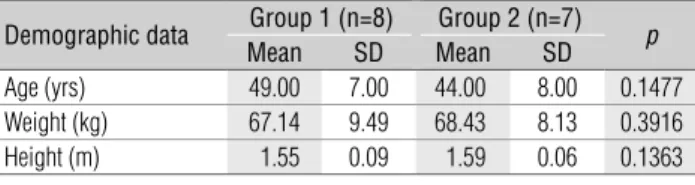
Table 1. Means and standard deviations (SD) for age, weight, height
and p-value.
Demographic data Group 1 (n=8) Group 2 (n=7) p
Mean SD Mean SD
Age (yrs) 49.00 7.00 44.00 8.00 0.1477
Weight (kg) 67.14 9.49 68.43 8.13 0.3916
Height (m) 1.55 0.09 1.59 0.06 0.1363
pain, sleeping patterns and side ef ects. h e FIQ, an instru-ment proposed by Burckhardt et al.20, recently translated into
Portuguese, was used to evaluate the impact of FM21.
Procedures
h e evaluation and treatment were performed at the
Rheumatology Clinic of HC-FMUSP. Initially, the patients were evaluated through an interview which was focused on the items of the evaluation form, and through the administra-tion of the FIQ quesadministra-tionnaire.
h e treatment was carried out for eight consecutive weeks and consisted of a 40-45 minute weekly session. h e participants of G1 underwent a treatment based on static muscular stretching of the triceps surae, isquiotibial, gluteal, paravertebral, latissimocondy-loideus, pectoral, trapezius and respiratory muscles. Stretching was performed in dorsal decubitus or sitting. h e exercises were performed in a series of i ve repetitions, remaining in the same position for 30 secs. h e practice of stretching at home was rec-ommended and some orientations were given in an instructive brochure which was previously used by Matsutani22.
h e participants of G2 underwent a physical conditioning treatment consisting of walking for a period of 30 minutes us-ing a motorized treadmills ( i ve minutes warm-up, 25 minutes walking, i ve minutes rest). h e walking speed was determined at 60-75% of the maximum heart rate, deducting patients’ age from 220 ( i xed value). During the series, maximum heart rate was measured by equipment connected to the treadmill. At the end of the eight weeks, all patients were re-evaluated following the previously described procedures.
Data analyses
h e variables sleeping patterns, factors in the improvement and worsening of pain, side ef ects and medicines in use were descriptively analysed. Statistical analyses were performed at a 5% level of signii cance. h e normality of the data was tested using the Anderson-Darling test. h e demographic data, as well as that obtained using the FIQ, before and after the treatment, were com-pared using t-tests for dependent variables, excluding fatigue and
sleeping patterns of G1. h e latter did not show normal distribu-tions and were compared using the Wilcoxon test.
Results
When age, weight and height were compared between the groups, no statistically signii cant dif erences were observed for any of these variables (Table 1). Furthermore, the majority of the patients were married (42.96%), white (71.43%) and had not i nished high school (46.67%).
In relation to their sleeping patterns, the majority of the patients (86.67%) showed non restorative sleep, 60% of them showed disturbed sleep, 40% woke up tired and 20% took a long time to sleep. Concerning those factors which caused worsening of pain, the majority of the pa-tients (40%) showed worsening of pain when they per-formed housework or any kind of physical effort (33.33%). Related to the factors that caused improvements of pain, the majority of the patients (28.57%) stated that nothing could improve their pain whereas 21.43% stated that the symptoms improved when they exercised. Regarding the side effects, 100% of the patients showed sleep disorders and 40% suffered from migraines.
h e most common medicines in use were antidepressants (69.23%) and muscular relaxants (30.77%). Analgesic Drugs and anti-infl amatories were used by 23.08% of the patients. Other medicines were used by 53.85% of the patients, and included gastritis, ulcer and antihypertensive drugs.
Table 2 shows the results for G1, obtained through the application of FIQ before and after the treatment. Statistical signii cant dif erences were found for the sleeping patterns (p=0.0428) and stif ness (p=0.0130) variables whereas the other variables did not change after the treatment.
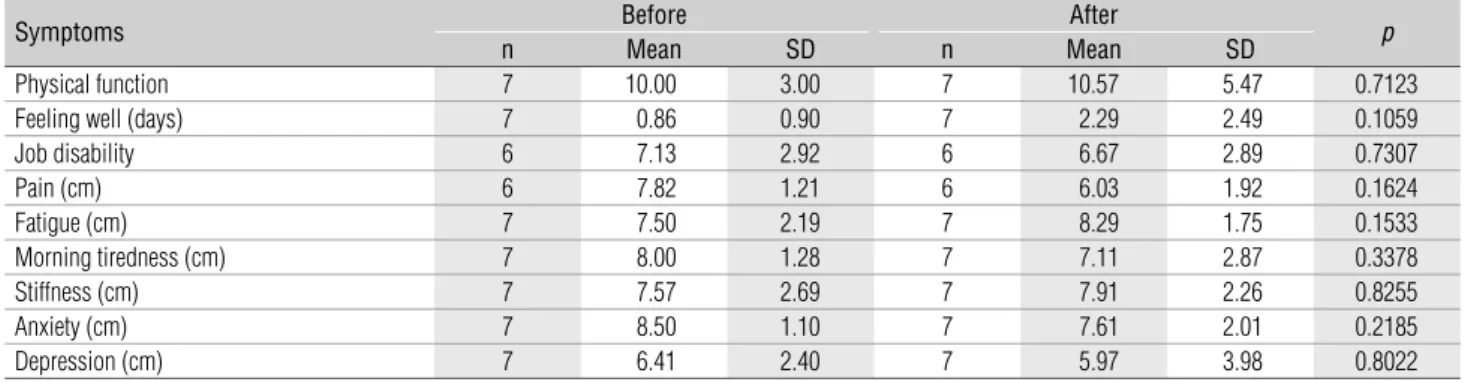
h e results for G2 are reported in Table 3. h ere were no sta-tistically signii cant dif erences for any of the variables in this group. It is important to note that the number of individuals in Table 2 and 3 varied because some data were not correctly i lled in and therefore were not considered.
Discussion
h is study aimed to evaluate the ef ects of muscular
stretching and physical conditioning exercises in the treat-ment of FM patients, verifying their impact on the disease. h e results allowed us to suggest that muscular stretching exercises generated a positive impact on the symptoms of FM. h ey improved sleeping patterns and they also decreased rigidity in FM patients. Although physical conditioning exer-cises improved some of the variables analysed using the FIQ, no signii cant dif erences were observed.
91
Table 2. Means and standard deviations (SD) of symptoms reported at FIQ before and after treatment for Group 1.
Symptoms Before After p
n Mean SD n Mean SD
Physical function 8 11.75 6.73 8 10.63 5.18 0.6830
Feeling well (days) 8 2.25 2.19 8 3.38 2.33 0.3964
Job disability 7 6.04 2.33 7 6.40 2.36 0.1677
Pain (cm) 8 7.14 2.05 8 5.56 2.26 0.1332
Fatigue (cm) 8 8.11 2.67 8 7.15 1.69 0.1730
Morning tiredness (cm) 8 8.43 1.95 8 5.41 3.19 0.0251*
Stiffness (cm) 8 7.76 1.60 8 4.95 2.03 0.0130*
Anxiety (cm) 8 8.59 1.04 8 6.76 2.23 0.0896
Depression (cm) 8 6.59 3.26 8 4.85 2.29 0.1138
* signifi cant difference after treatment (p <0.05)
Table 3. Means and standard deviations (SD) of symptoms reported in the FIQ before and after treatment for Group 2.
Symptoms Before After p
n Mean SD n Mean SD
Physical function 7 10.00 3.00 7 10.57 5.47 0.7123
Feeling well (days) 7 0.86 0.90 7 2.29 2.49 0.1059
Job disability 6 7.13 2.92 6 6.67 2.89 0.7307
Pain (cm) 6 7.82 1.21 6 6.03 1.92 0.1624
Fatigue (cm) 7 7.50 2.19 7 8.29 1.75 0.1533
Morning tiredness (cm) 7 8.00 1.28 7 7.11 2.87 0.3378
Stiffness (cm) 7 7.57 2.69 7 7.91 2.26 0.8255
Anxiety (cm) 7 8.50 1.10 7 7.61 2.01 0.2185
Depression (cm) 7 6.41 2.40 7 5.97 3.98 0.8022
relation to age, weight and height, the participants were homog-enous. h e most common side ef ect observed in our sample was sleep disturbance, which occurred in 100% of patients from which 8.67% showed non restorative sleep. According to Moreira and Carvalho23, some studies show that sleeping disorders occur
in 100% of FM patients. Migraine headaches, edema, formica-tion, morning stif ness, abdominal pain, dizziness, depression and occasional arthritis occur less frequently. Haun et al.24,
Ka-ziyama et al.25 e Ido et al.26 also observed the same symptoms,
however, in dif erent proportions.
Other literature on the subject shows that many factors worsen pain in patients, including climate changes, fatigue, bad sleeping patterns, physical inactivity, anxiety and stress8,24,26,27.
For the patients in this study, the factors that worsened their symptoms were housework, physical ef ort, nervousness, cli-mate changes, carrying excess weight and depression. Not all factors reported in the literature were observed in this study since the answers were given freely. However, some of these factors coincide with the ones related by other researchers in previous studies.
In relation to the factors which improved pain, 28.57% of the patients related that nothing could relieve their pain and 21.43% of them stated that it only improved when they exercised. Other factors, which were found to contribute to the relief of pain, were rest, medicine, walks and warm showers. Some of these factors
coincided with those found by Antônio27: warm showers or warm
compresses, physical activities, and strengthening exercises. h e fact that a large number of patients stated that nothing could relieve their pain demonstrated the dii culty specialists are faced with when they try to suggest treatments to relieve the symptoms in FM patients, especially pain.In this study, only two specii c modalities of exercises were used. As physical condition-ing programs involve dif erent types of exercises, it is dii cult to identify which exercises provide the best results18,19.
h e most often used medicines related in the literature for the treatment of FM are Analgesic Drugs, anti-infl ammatories, antidepressants and muscular relaxants8,25,27. In accordance
with the literature, the medicines which were most used by FM patients in this study were antidepressants and muscular re-laxants followed by Analgesic Drugs and anti-infl ammatories.
Nowadays, the treatment of FM only through the use of medicines is not sui cient to control symptoms and improve the quality of life at the same time. h e applications of other therapies such as cognitive-behavioural therapy, biofeedback, educational programs, acupuncture, as well as physical therapy are necessary. At present, many other resources are available such as electrotherapy, massotherapy, hydrotherapy, aerobic and muscular stretching exercises.
92
signii cant dif erences in the sleeping patterns and stif ness variables in the G1, after treatment. Although, in G2, some variables showed positive results, no statistically signii cant dif erences were observed. h at suggests that the treatments applied somehow improved, even though minimally, their impact on FM. Marques et al.10 ai rm that physical exercise
programs lower the ef ects of the FM symptoms in patients’ daily lives. Since the types, intensities and durations of these programs vary, it is dii cult to compare which exercises have the best results. Low-intensity, as well as those types of ex-ercises in which patients can identify their ef ort and pain limits, seem to be most ef ective. Besides that, engaging in exercise programs is the best way to extend therapeutic relief. h e exercises performed in this study were of low-intensity, since the speed of the walking performed in the physical conditioning program was between 60 and 75% of their maxi-mum heart rate and the stretching exercises were performed according to the limits of each patient.
Martin et al.18 observed a signii cant reduction in the
num-ber of tender points, in the myalgic scores, and an increase in aerobic capacity in the group of patients who performed the physical exercises, but did not observe the same for the group which performed stretching exercises. h e researcher observed no dif erences in the FIQ. However, the group that performed physical exercise showed some improvements when compared to the group who performed stretching exercises. h ese results are similar to those found for G2 in the present study, although higher mean values in the present case were found with the FIQ questionnaire after the treatment, no statistical signii cant dif erences were revealed.
Richards and Scott11 observed that 35% of the patients who
performed aerobic exercises showed improvements in well-being compared with 18% of the patients who performed only muscu-lar stretching and relaxing exercises. h e researchers observed no statistically signii cant dif erences in the FIQ, Chalder fatigue scale, SF-36 and McGill pain questionnaires. In the present study, no statistically signii cant dif erences were found in the FIQ scores of patients treated with physical conditioning program using treadmills. Nevertheless, in contrast to the above study, signii cant dif erences were found in the sleeping patterns and stif ness vari-ables for the patients treated with muscular stretching. h ese dif-ferences could be explained by the fact that the aerobic exercises proposed by those authors had a progressive increase in exercise
time and that could have improved the patients’ conditioning, which did not happen in the present study.
According to the results of this study and the related litera-ture, most research shows that physical conditioning and mus-cular stretching exercise programs improve physical capacity, well-being and muscular strength among other benei ts. How-ever, no great dif erences were observed when quality of life was evaluated using adequate questionnaires.
According to Valim28, evidence shows that physical
condition-ing as well as muscular stretchcondition-ing exercises benei t FM patients. h e present study only showed improvements in sleeping pat-terns and stif ness, when muscular stretching was performed and was evaluated using the FIQ. In this study, physical conditioning exercises were performed only once a week. h is short time pe-riod could perhaps have been responsible for the unsatisfactory improvements in conditioning. Additionally, the small sample of patients could maybe explain why some variables did not show signii cant dif erences.
As was pointed out beforehand, FM impacts negatively on patients’ quality of life. h e symptomatology of this syndrome is complex and involves physical as well as social and emo-tional aspects. h is kind of multidisciplinary approach was not found in the literature. h is could possibly have occurred because these aspects have been omitted or even because
they have not been considered in treatment. h e majority
of the articles only emphasised physical treatment using stretching, physical conditioning or other kinds of exercises. As a consequence, aspects of quality of life were not involved in the majority of studies related to FM when it could have been fundamental, since the main objective of this syndrome’s treatment is to improve patients’ quality of life.
93
References
1. Roizenblatt S, Hilário MOE, Goldenberg J, Tufi k S. Fibromialgia juvenil. Rev Bras Reumatol. 1997;37(5):271-3.
2. Weinstenin SL, Bulkwalter JA. Ortopedia de Turek. Princípios e suas aplicações. 5a ed. São Paulo: Manole; 2000.
3. Yoshinari NH, Bonfá ESDO. Reumatologia para o clínico. São Paulo: Roca; 2000.
4. Wolfe F, Ross K, Anderson J, Russell IJ, Herbert L. The prevalence and characteristics of fi bromyalgia in the general population. Arthritis Rheum. 1995;38:19-28.
5. White KP, Speenchley M, Harth M, Ostbye T. Comparing self-reported function and work disability in 100 community cases of fi bromyalgia syndrome versus controls in London, Ontario. Arthritis Rheum. 1999;42:76-83.
6. Kaziyama HHS. Fibromialgia x síndrome dolorosa e miofascial. Acta Ortop Bras. 1998;6(3):133-7.
7. Carvalho MAP, Rego RR. Fibromialgia. In: Moreira C, Carvalho MAP. Reumatologia: diagnóstico e tratamento. 2a ed. Rio de Janeiro: Medsi; 2001. p. 247-60.
8. Perea DCB. Fibromialgia: epidemiologia, diagnóstico, fi siopatologia e tratamento fi sioterápico. Fisioter Bras. 2003;4(4):282-8.
9. Martinez JE. Fibromialgia: o que é, como diagnosticar e como acompanhar. Acta Fisiátrica. 1997;4(2):99-102.
10. Marques AP, Matsutani LA, Ferreira EAG, Mendonça LLF. A fi sioterapia no tratamento de pacientes com fi bromialgia: uma revisão de literatura. Rev Bras Reumatol. 2002;42(1):42-8.
11. Richards SC, Scott DL. Prescribed exercise in people with fi bromyalgia; parallel group randomized controlled trial. BMJ. 2002;325:185-7.
12. Meyer BB, Lemley KJ. Utilizing exercise to affect the symptomatology of fi bromyalgia: a pilot study.Med Sci Sports Exerc. 2000;32(10):1691-7.
13. Offenbächer M, Stucki G. Physical therapy in the treatment of fi bromyalgia. Scand J Rheumatol. 2000;29(Suppl 113):78-95.
14. Ramsay C, Moreland J, Ho M, Joyce S, Walker S, Pullar T. An observer-blinded comparison of supervised and unsupervised aerobic exercise regimens in fi bromyalgia. Rheumatology. 2000;39:501-5.
15. Nichols DS, Glenn TM. Effects of aerobic exercise on pain perception, affect and level of disability in individuals with fi bromyalgia. Phys Ther. 1994;74:327-32.
16. Meiworm L, Jakob E, Walker UA, Peter HH, Keul J. Patients with fi bromyalgia benefi t from aerobic endurance exercise. Clin Rheumatol. 2000;19:253-7.
17. Meyer BB, Lemley KJ. Utilizing exercise to affect the symptomatology of fi bromyalgia: a pilot study. Med Sci Sports Exerc. 2000;32:1691-7.
18. Martin L, Nutting A, MacIntosh BR, Edworthy SM, Butterwick D, Cook J. An exercise program in the treatment of fi bromyalgia. J Rheumatol. 1996;23:1050-3.
19. Jentoft ES, Kvalvik AG, Mengshoel AM. Effects of pool-based and land-based aerobic exercise on women with fi bromyalgia/chronic widespread muscle pain. Arthritis Care Res. 2001;45:42-7.
20. Burckhardt CS, Clark SR, Bennett RM. The Fibromyalgia Impact Questionnaire: development and validation.J Rheumatol. 1991;18:728-33.
21. Marques AP, Snatos AMB, Assumpção A, Matsutani LA, Lage LV, Pereira CAB. Validação da versão brasileira do Fibromyalgia Impact Questionnaire. Rev Bras Reumatol. 2006;46:24-31.
22. Matsutani LA. Efi cácia de um programa de tratamento fi sioterapêutico sobre a qualidade de vida de pacientes com fi bromialgia [dissertação]. São Paulo (SP): FMUSP; 2003.
23. Moreira C, Carvalho MAP. Reumatologia: diagnóstico e tratamento.2a ed. Rio de Janeiro: Medsi; 2001.
24. Haun MVA, Ferraz MB, Pollak DF. Validação dos critérios do Colégio Americano de Reumatologia (1990) para classifi cação da fi bromialgia, em uma população brasileira. Rev Bras Reumatol. 1999;39(4):221-30.
25. Kaziyama HHS, Yeng LT, Teixeira MJ, Piagge FD. Síndrome fi bromiálgica. Rev Med Bras. 2001;80(Pt 1):111-27.
26. Ido CS, Rothenbuhler R, Janz Júnior LL. Eletroestimulação nervosa transcutânea de baixa freqüência nos “tender points” dos pacientes fi bromiálgicos juvenis. Rev Fisioter Univer São Paulo. 2003;10(1):1-6.
27. Antônio SF. Fibromialgia. Rev Bras Med. 2001;58:215-24.