A critical analysis of tinnitus
measuring methods
Summary
Andréia Aparecida de Azevedo 1, Patrícia Mello de
Oliveira 2, Adriana Gomes de Siqueira 3, Ricardo
Rodrigues Figueiredo 4
1 MD. Otorhinolaryngologist. Partner. 2 Speech and Hearing Therapist. 3 Speech and Hearing Therapist.
4 M.S. in ENT - Federal University of Rio de Janeiro, Assistant ENT Professor - Valença Medical School, RJ. OTOSUL, Otorrinolaringologia Sul-Fluminense.
Mailing Address: Rua 60, 1680 ap. 202 Bairro Sessenta Volta Redonda RJ 27261-130.
Paper submitted to the ABORL-CCF SGP (Management Publications System) on December 12th, 2005 and accepted for publication on June 16th, 2006. cod. 1644.
O
ne of the main factors that make tinnitus treatment so difficult is the subjectivity of measuring methods and therapeutic monitoring. Database: Our aim, in this study, is to make a critical analysis of tinnitus measuring methods. Conclusion: There is no consensus about tinnitus measuring methods, causing criticism in the methodology used in many papers. In Brazil, the simplest methods are the most used.Keywords: scales, measurement, tinnitus. REVIEW ARTICLE
INTRODUCTION
Tinnitus may be defined as a hearing sensation that does not come from outside, seeming to come from one or both ears, or even from the head, without a precise
source location1. It is, in fact, a symptom, and not a
dise-ase, and according to varied studies, it affects between 14 and 32% of the population, and it may be disabling in up to 5% of the cases2. It may even be a sequela of different
pathological processes which are no longer active2.
Among the many classifications proposed for tinnitus, the one most accepted today classifies tinnitus into Auditory (caused by alterations in the ear, auditory pathways and auditory cortex) and Para-auditory (caused by vascular and muscle structures near the ear and
audi-tory pathways) 2.
Tinnitus physiopathology has yet many gaps of kno-wledge to be filled, and it is believed that in many cases
it is multifactorial2. Among the major theories proposed,
we list excitotoxicity2-4, lesions in the efferent system2,5,
tectorial membrane collapse6, correlation with pain7 and
the activation of psychosomatic and autonomic loops8. It
is possible that, in the future, a theoretical model becomes part of these theories.
Besides the difficulties brought about by the lack of understanding in physiopathology, there is also some difficulty in measuring tinnitus and, consequently, in
assessing therapeutic results9. We still lack a consensus
on the ideal methodology to measure tinnitus. It may be extremely subjective and influenced by environmental and psychosomatic factors. Many treatment results with medication and other means of treatment are disputed by
the tinnitus measuring criteria employed10,11.
In the present paper we intend to carry out a criti-cal analysis of the main methods used today to measure tinnitus.
Acuphenometry
It means “ to measure acuphens” (tinnitus). This is one of the oldest methods and one of the least employed today. It encompasses a set of audiologic techniques used to try find in tonal audiometry a pure tone similar to the
patient’s tinnitus6.
According to some authors, it could also be useful in the topo-diagnosis of dysacousia, starting from the idea that conductive dysacousia would generate tinnitus of lower frequencies (“water fall”, “ocean waves”); and sensorineural dysacousia would generate higher frequency tinnitus (“cicada”, “whistle”, “cricket”). Mixed dysacousia would have a varied behavior, generating low or high tinnitus2,6.
Acuphenometry is highly dependent on the patient’s intellectual capacity and concentration, including certain skills to perceive sounds of different frequencies. It may
work exceptionally well with musicians. It is also greatly examiner-dependent. In cases of unilateral tinnitus, the test is easier, since it compares the tinnitus with the sounds made to the contralateral ear. In bilateral cases, the at-tempts are gradual and successive, giving the ear higher and lower tones until it comes to one sound that more closely resembles the patient’s tinnitus. Sound masking is necessary in most of the cases6. Most studies classify most of the tinnitus in the higher frequencies, notably between
6 and 8 kHz6.
Acuphenometry has the major advantage of allo-wing for tinnitus monitoring, thus, treatment monitoring; and it also aids in the topo-diagnosis of auditory lesions. However, there are some disadvantages. First, tonal audio-metry tries to correlate pure tones and tinnitus, which in many cases is multitonal. Moreover, few patients are able to provide an accurate correlation of their tinnitus with pure tones, even with experienced examiners. Acuphenometry is highly important in the treatment by masking, which is today increasingly less used. In our opinion, for acuphe-nometry, the cons outweigh the pros in this method.
Analogue and Visual Scale (AVS)
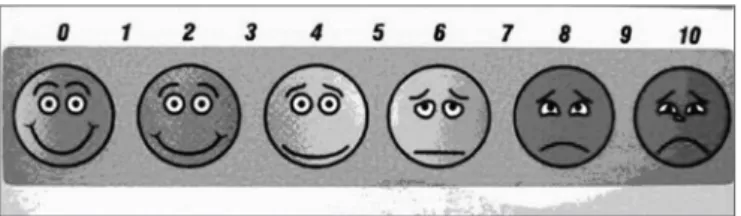
This is the scale that has been more frequently used
in Brazilian tinnitus studies10,12-14. Actually, it is a visual
gra-ph used to determine the level of disturbance or discomfort caused by tinnitus, in a scale from 1 to 10. Intensity and discomfort are the most valued items.
As the examiner asks the patient to determine in a 1 to 10 scale, how much the tinnitus bothers him/her, without a visual aid (as shown in figure 1), there may be score variations that the patient may attribute to different things, according to the variables related to psychosomatic and intellectual factors. The use of an image produces a visual reinforcement that may be remembered by the patient him/herself.
AVS’s main advantage, besides the visual reinforce-ment and response standardization, is its very simplicity; such factor may be decisive in intellectually challenged patients. Nonetheless, this same simplicity may be seen as a disadvantage of this method, since it may induce a superficial and variable problem in assessment, and so, ideally, it must be associated with other methods. We believe that for the Brazilian population, this is still the most applicable assessment method.
Tinnitus Handicap Inventory (THI)
Increasingly, methods that measure not only the direct effects of a disease, but also the effects such disease
has on the patients’ lives have been used15,16. In 1996,
New-man, Jacobson and Spitzer published an article about the development of the Tinnitus Handicap Inventory, through the observation and criticism of other methods such as the Tinnitus Handicap/Support Questionnaire, Tinnitus Effect Questionnaire, Tinnitus Severity Questionnaire
and Tinnitus Reaction Questionnaire15. According to the
authors, their main goal was to create a method with the following characteristics:
•Summarized, adequate to daily clinical practice; •easy deployment and interpretation;
•approaching different tinnitus impacts on the patient’s life quality;
•validity and reliability.
Clinical data from tinnitus patients and data from other scales were used in developing the THI. Three major
items are assessed by the THI, and they are15:
•tinnitus-related function reactions, such as diffi-culty to concentrate and anti-social behavior;
•tinnitus-related emotional reactions, such as anger, frustration, irritability and depression;
•tinnitus-related catastrophic reactions, such as despair, hopelessness, fear of “severe disease”, loss of control and incapacity to cooperate.
Below are the original THI questionnaire (Chart 1), and its interpretation (Chart 2):
In our view, in relation to the authors’ initial pro-posal, the THI is more complex than the AVS; however still usable in the daily clinical practice. For the Brazilian Population, it may not be of easy application in many situations. As to the tinnitus aspect items used, its validity and reliability leads us to believe it is a valid method is more complex than AVS; however still applicable in routine clinical practice. For the Brazilian population, it may be hard to apply in many situations. As to the items used to approach the numerous aspects related to tinnitus, validity and reliability, we believe it is the most valid method.
Hospital Anxiety and Depression Scale (HADS)
According to the authors, this scale can be summa-rized and is of easy use. Its main goal is to separate the psychological aspects from those purely somatic. HADS is made up of 14 items (each with scales from 0 to 3), each subdivided in 11 subscales of 11 items each, assessing
aspects related to anxiety and depression18.
In our opinion, this scale, besides being relatively complex, evaluates only the tinnitus psychosomatic as-pects, thus being incomplete.
Tinnitus Disturbance Simplified Scale Analysis (TDSSA) Seeking a simplified method to quantify tinnitus,
prioritizing aspects related to the patient’s daily life that is affected by the tinnitus, we developed this scale in 2004.
Our proposal considers individual characteristics and occasional psychological alterations found in patients
with tinnitus19. It stems from the clinical observation of
outpatient ward patients and those patients who partici-pated in the 1st PAZ (Tinnitus Self-Help Program), held
in Volta Redonda, in 20024. In this program, we held talks
by otorhinolaryngologists, hearing therapists and physical therapists, also patient integration with reports from their individual experiences regarding their tinnitus, based on other similar groups, including the GAPZ (Tinnitus Pa-tients’ Support Group), pioneer in Brazil, at the Federal
University of São Paulo2.
The scale classifies the degree of discomfort cau-sed by tinnitus from 0 to 10, according to the following
characteristics19:
(1) Tinnitus perceivable only in silent environments, not interfering with sleep patterns;
(2) Tinnitus perceivable only in silent environments, makes the patient, at least occasionally, to have trouble falling asleep, does not lead the patient to seek medical help in order to get prescriptions for sleeping pills;
(3) The same situation above mentioned, but here the patient seeks medical help to get prescriptions for sleep inducing medication;
(4) Tinnitus perceivable during the day, easily masked by environmental noise;
(5) Tinnitus perceivable during the day makes the patient avoid silent environments;
(6) Tinnitus perceivable during the day, causing emotional instability/irritability;
(7) Tinnitus interferes with professional, schooling and/or domestic activities, reducing performance in ge-neral;
(8) Tinnitus causing reclusion and anti-social beha-vior (isolation, aggressiveness, etc.);
(9) Tinnitus causing hospital admittance for psychia-tric reasons;
(10) Tinnitus makes the patient consider drastic actions, such as inflicting deafness, cutting the ear off and suicide.
In type 2 tinnitus, the symptom draws the patient’s attention, however, often times he/she does not seek me-dical help. Starting on type 3, patients usually seek meme-dical care. From type 5 on, associated psychological alterations become increasingly more important. In the extreme case of type 10, we may mention the cases of patients that would have committed suicide because of tinnitus (there are cases reported in both, the national and international literature), and patients who ask the physician to destroy
their auditory nerve19.
Chart 1. Tinnitus Handicap Inventory questionnaire, copied from Ferreira Pea et al.17
SCORE 4 0 2
1. Because of your tinnitus, do you have difficulties to concentrate? Yes No Sometimes 2. The volume (intensity) of your tinnitus makes it difficult for you to hear people? Yes No Sometimes 3. Does your tinnitus make you nervous? Yes No Sometimes 4. Does your tinnitus make you confuse? Yes No Sometimes 5. Because of your tinnitus, do you feel hopeless? Yes No Sometimes 6. Do you complain much of your tinnitus? Yes No Sometimes 7. Because of your tinnitus, do you have trouble to start sleeping at night? Yes No Sometimes 8. Do feel as if you could not get rid of your tinnitus? Yes No Sometimes
9. Does your tinnitus interfere in your capacity to enjoy social activities (such as dinners, going to the movies, etc.)? Yes No Sometimes 10. Because of your tinnitus, do you feel frustrated? Yes No Sometimes 11. Because of your tinnitus, do you think you may have some serious disease? Yes No Sometimes 12. Does your tinnitus make it difficult for you to enjoy life? Yes No Sometimes 13. Does your tinnitus interfere in your home or work activities? Yes No Sometimes 14. Because of your tinnitus, do you feel frequently irritated? Yes No Sometimes 15. Because of your tinnitus, do you have difficulties reading? Yes No Sometimes 16. Does your tinnitus make you upset? Yes No Sometimes 17. Do you feel your tinnitus impairs your relationship with family and friends? Yes No Sometimes 18. Do you find it hard to withdraw your attention from the tinnitus and concentrate in something else? Yes No Sometimes 19. Do you feel powerless to control you tinnitus? Yes No Sometimes 20. Because of your tinnitus, do you feel frequently tired? Yes No Sometimes 21. Because of your tinnitus, do you feel frequently depressed? Yes No Sometimes 22. Does your tinnitus make you feel anxious? Yes No Sometimes 23. Do you feel you can no longer withstand your tinnitus? Yes No Sometimes 24. Does your tinnitus get worse when you are stressed? Yes No Sometimes 25. Does your tinnitus make you feel insecure? Yes No Sometimes
Chart 2. Tinnitus Handicap Inventory scores and interpretation, from Newman et al.
0 - 16 Mild (Only perceived in silent environments) GRADE 1 18 - 36 Light (Easily masked out by environmental noise and easily forgotten with daily activities) GRADE 2 38 - 56 Moderate (Perceived even in the presence of background noise, although it does not prevent daily activities) GRADE 3 58 - 76 Severe (Perceived almost in any situation, impacts sleep patterns and may interfere with daily activities) GRADE 4 78 - 100 Catastrophic (Always present, impairs sleep, impairs the performance of any activity) GRADE 5
assess the tinnitus symptom in an objective way, since if we could objectively measure tinnitus we would have obtained different scores in this scale for patients with tinnitus of the same intensity, its major value lies in assessing symp-tom progression and the therapeutic effects in one given
patient, since it is based on a patient’s daily routine19.
We believe the main criticism to this scale lies in its very simplicity that may suggest a superficial tinnitus asses-sment. Moreover, by including items related to sleep and psychiatric disorder treatments must be analyzed carefully.
As positive factors, we mention the ease of application by the physician, who may quantify tinnitus through questions belonging to his own anamnesis (the patient does not have to answer a specific questionnaire, since this may inhibit some patients), and it also values the items that most dis-turb the patient in his/her daily activities.
Animal models for tinnitus
with tinnitus, and it would also allow the study of drugs in lab animals. The major problem was how to be sure
the animal had tinnitus9,20.
The first attempts to establish an animal model for tinnitus started in the late 70’s, through techniques that measured the 2-deoxiglucose (2-DG) amount in the animal’s brain. It is known that the only source of energy used by neurons is glucose. 2-DG is a glucose analogue, which is partially metabolized, and the rest is built up in the physiologically active tissue. It was then proposed that its building up was an indirect indication of an increase
in brain metabolism9,21.
Lab animals suffered unilateral destruction of the cochlea and auditory nerve and were analyzed as to the building up of 2-DG, at 2, 7 and 21 days after the proce-dure. It was then observed that the 2-DG concentration suffered a reduction early on, and later reached levels that were similar to those found in the intact side. It was then proposed that this supposed recovery of metabolic activity happened because of tinnitus development in these animals, since we know that in humans, about 50% of the patients submitted to unilateral cochlea and auditory nerve
destruction develop tinnitus9,21.
The problems that culminated with the little ac-ceptance of this model were the doubts related to the correlation between metabolic activity recovery and the presence of tinnitus, and the very fact that in humans only 50% of the patients who undergo cochlear destruction
develop tinnitus9.
Then, the conditioned behavioral models became
the goal to be reached9,20,22. The models developed during
the 80’s and 90’s by Jastreboff et al. are currently the most accepted by the international scientific community. We will try, in a simplified way, to expose the very basis of these models.
The basic idea is to create associations between silence and danger and, inversely, between noise and safety. Thus, correlating tinnitus with the perception of noise, we expect that the animal with tinnitus would not
have fear reactions in a silent environment9,20.
Initially, the animals (i.e. rats) underwent partial water deprivation, monitored by animal weight control. In a separate chamber, tubes supplied water to the animals and the water intake was measured. Later on, the animals were conditioned to fear silent environments, since they received electrical discharges whenever the environmental noise was suppressed. Consequently, in the silent water tube filled chamber there was a reduction in the number of times these animals sought water. Fear associated with silence may be later on abolished with repetitive suppres-sion of environmental noise no longer associated with
electrical discharges9,20.
Then they compared the necessary conditioning time for both, the fear and silence association and the
dissociation, in rats to which salicylates were given (whi-ch produce, depending on the dose and length of time using it, tinnitus in almost 100% of human beings), with control groups that received only saline solution. Statis-tically significant differences between these two groups allowed the conclusion that the salicylate exposed rats were effectively with tinnitus. The animals that receive salicylate took longer than those in the control group to make and to unmake the association between silence and fear using electrical discharges and later suppressing them. This happened because they had tinnitus20. In another experiment, the introduction of salicylate was compared to the introduction of sounds (that mimicked tinnitus),
with similar results in both groups9.
It was proven that salicylates have their action res-tricted to the auditory system of rats, and tests with other ototoxic drugs, such as quinine, presented similar results, strengthening the model. Moreover, these models allow for frequency (through the exposure to different sounds during fear suppression) and intensity (through the obser-vation, in humans, that the salicylate toxicity is proportio-nal to the dose used) evaluation. Later studies with these models have corroborated with the understanding of the association between tinnitus and the calcium homeostasis, with the anomalous activity of the auditory pathways and
with the Tinnitus Retraining Therapy (TRT)9 itself.
Other models were developed, based on the same conditioning principle. Animal models are useful in order to understand the tinnitus physiopathology and also its treatment, prior to tests with human beings. Notwithstan-ding, they require a complex and expensive laboratorial structure. Unfortunately, the animal models do not solve the problem of not having an objective model of tinnitus measurement in humans. Such model would represent a watershed in understanding and treating tinnitus. Me-anwhile, our only alternatives for clinical tests in humans are the scales and questionnaires.
CONCLUSION
REFERENCES
1. Meyer B et al. Définitions et Classifications. In: Meyer B, editor. Acou-phènes et Hyperacousie. Paris: Société Française dOto-rhino-laryn-gologie et de Chirurgie de la Face et du Cou; 2001. p. 3-8. 2. Azevedo AA, Figueiredo RR. Atualização em Zumbido. Rev Bras
Otor-rinolaringol, Caderno de Debates 2004;70(1):27-40.
3. Bonfils P, Puel JL. Synapses cóchleaires et acouphènes. In: Meyer B, editor. Acouphènes et hyperacousie. Paris: Société Française dOto-rhino-laryngologie et de Chirurgie de la Face et du Cou; 2001. p. 96-106.
4. Cunha N, Puel JL. Zumbidos, presente e futuro: da investigação à aplicação clínica. In: http://www.otoneuro.pt/fórum; 2000. 5. Fávero M. Estudo das vias auditivas eferentes em indivíduos com
zum-bido [Doutorado]. São Paulo: Universidade de São Paulo; 2003. 6. Menezes P, Santos Filha VAV. Acufenometria: o resgate de um
ins-trumento de avaliação do zumbido e sua correlação com perdas auditivas sensoriais. Revista Fonoaudiologia Brasil 2005;3(1):1-4. 7. Boureau F, Meyer B. Analogies avec la douleur. In: Meyer B, editor.
Acouphènes et hyperacusie. Paris: Société Française dOto-rhino-laryngologie et de Chirurgie de la Face et du Cou; 2001. p. 107-20. 8. Hazell JWP, Jastreboff PJ. Tinnitus Internal Auditory mechanisms: a
model for tinnitus and hearing impairment. J Otolaryngol 1990;19:1-5.
9. Jastreboff P, Sasaki CT. An animal model of tinnitus: a decade of de-velopment. Am J Otol 1994;15(1):19-27.
10. Azevedo A, Figueiredo RR. Uso do acamprosato no tratamento do zumbido: um estudo duplo-cego. Rev Bras Otorrinolaringol 2005;71(5):618-23.
11. Crítica ao estudo “Tinnitus treatment with acamprosate: a double-blind study”, http://www.newswise.com/articles/view/514635, Setembro de 2005.
12. Sanchez T, Kii MA, Lima AS, Bento RF, Lorenço KG, Miniti A. Ex-periência Clínica com EGb 761 no tratamento do zumbido. Arq Otorrinolaringol 2002;6(3):198-204.
13. Sanchez T, Balbani APS, Bittar RF, Bento RF. Teste da lidocaína em pacientes com zumbido: quando realizar e como interpretar. Arq Otorrinolaringol 1998;2(2):48-55.
14. Azevedo A, Figueiredo RR. Uso da trimetazidina no tratamento do zumbido. Revista da Sociedade de ORL do Rio de Janeiro 2005;5(1):12-15.
15. Newman C, Jacobson GP, Spitzer JB. Development of the Tin-nitus Handicap Inventory. Arch Otolaryngol- Head Neck Surg 1996;122(2):143-8.
16. Winfried R, Weise ND, Kley ND, Martin A. Psychophysiologic Treat-ment of Chronic Tinnitus: A Randomized Clinical Trial. Psychosomatic Medicine 2005;67(5):833-8.
17. Ferreira PEA, Cunha F, Onishi ET, Branco FCA, Ganança FF. Tinnitus Handicap Inventory: adaptação cultural para o português brasileiro. Pró-fono 2005;17(3):303-10
18. Andersson G, Kaldo-Sandström V, Ström L, Strömgren T. Internet administration of the Hospital Anxiety and Depression Scale in a sample of tinnitus patients. J Psychosomatic research 2003;55:259-62.
19. Figueiredo RR, Azevedo AA. Incômodo gerado pelo zumbido: uma proposta de classificação. Estoril, Portugal: Conventus ORL Latina; 2004.
20. Jastreboff P, Brennan JF, Coleman JK, Sasaki CT. Phantom Auditory Sensation in Rats: An Animal Model for Tinnitus. Behavioral Neuros-cience 1988;102(6):811-22.
21. Sasaki C, Kauer JS, Babitz L. Differential [14C]2-deoxyglucose uptake after deafferentation of the mammalian auditory pathway-a model for examining tinnitus. Brain Research 1980;194:511-16.