www.bjorl.org
Brazilian
Journal
of
OTORHINOLARYNGOLOGY
REVIEW
ARTICLE
Degree
of
tinnitus
improvement
with
stapes
surgery
---a
review
夽
Aliciane
Mota
G.
Cavalcante
a,
Isabella
Monteiro
de
Castro
Silva
a,
Bianca
Jessica
Neves
a,
Carlos
Augusto
Oliveira
b,
Fayez
Bahmad
Jr
a,c,d,∗aUniversidadedeBrasília(UnB),CiênciasMédicas,Brasília,DF,Brazil bUniversidadedeBrasília(UnB),EscoladePós-Graduac¸ão,Brasília,DF,Brazil cHarvardMedicalSchool,OtologyandNeurotology,Boston,UnitedStates
dUniversidadedeBrasília(UnB),FaculdadedeCiênciasdaSaúde,Brasília,DF,Brazil
Received17June2017;accepted6December2017 Availableonline5January2018
KEYWORDS
Otosclerosis; Tinnitus; Stapessurgery
Abstract
Introduction:Otospongiosisistemporalboneosteodystrophy,characterizedbydisorderedbone resorptionandneoformationingeneticallypredisposedindividuals.Clinically,otospongiosisis characterizedbyprogressiveconductiveand/ormixedhearinglossandbytinnitus.
Objective:Areviewofthelasttwodecadesofpublicationsthatreportthedegreeoftinnitus improvementwithstapessurgery.
Methods:125articlespublishedinthelast20yearsmentioningtherelationshipbetween oto-sclerosisandtinnitus.Literaturehasalwaysshownthatthehearingimprovementafterstapes surgerywasthemainresultsoughtandfound.However,recentarticleshasreinforcedtheneed forsurgeryfor thetinnitusimprovement.Theidealtimetoassesstinnitusthroughdifferent scalesisinthesixthmonthpost-operative.Theestimatedaveragehearingimprovementis93% andtinnitusis85.52%.
Results:Summaries of 12 articles were reviewed which fulfilled the search criteria ofthe survey,and8studieswereincludedinthestudyaccordingtheselectioncriteria.Thisstudies
夽 Pleasecitethisarticleas:CavalcanteAM,SilvaIM,NevesBJ,OliveiraCA,BahmadFJr.Degreeoftinnitusimprovementwithstapes
surgery---areview.BrazJOtorhinolaryngol.2018;84:514---8. ∗Correspondingauthor.
E-mail:[email protected](F.BahmadJr).
PeerReviewundertheresponsibilityofAssociac¸ãoBrasileiradeOtorrinolaringologiaeCirurgiaCérvico-Facial.
https://doi.org/10.1016/j.bjorl.2017.12.005
investigatingthedegreeoftinnitusimprovementwithstapessurgery,usingdifferentscalesas: tinnitusfunctionalindex,visualanalogscale,tinnitusfunctionalindexandvisualanalogscale, visualanalogscaleand‘‘questionnaireaskingabouttinnitus’’,Newman’smethodandTinnitus ScoreAdvocatedbytheJapanAudiologicalSociety.Thetotalofthesamplesoftheevaluated articleswasof254participants.
Conclusion: Weconcludethatstapessurgeryiseffectiveforthetreatmentoftinnitus(average improvementis85.52%),andhearingloss(averageimprovementis93%).Whendecidingabout thesurgicalindicationinpatientswithotosclerosis,thepresenceandleveltinnitusshouldbe consideredaswellasthelevelofhearing.
© 2017 Associac¸˜ao Brasileira de Otorrinolaringologia e Cirurgia C´ervico-Facial. Published by Elsevier Editora Ltda. This is an open access article under the CC BY license (http:// creativecommons.org/licenses/by/4.0/).
PALAVRAS-CHAVE
Otosclerose; Zumbido; Estapedectomia
Graudemelhoradozumbidocomestapedectomia---umarevisão
Resumo
Introduc¸ão: Aotoscleroseéumaosteodistrofiadoossotemporal,caracterizadapelareabsorc¸ão eneoformac¸ãoósseadesordenadasemindivíduosgeneticamentepredispostos.Clinicamente,a otoscleroseécaracterizadaporperdaauditivaprogressivacondutivae/oumistaeporzumbido. Objetivo: Umarevisãodasúltimasduasdécadasdepublicac¸õesquerelatamograudemelhora dozumbidocomaestapedectomia
Método: Foram analisados 125 artigos publicados nos últimos 20 anosque mencionavam a
relac¸ãoentreotoscleroseezumbido.Aliteraturasempremostrouamelhoriaauditivacomo principalobjetivoeresultadodaestapedectomia.Noentanto,artigosrecentesreforc¸arama necessidadedecirurgiaparaamelhoriadozumbido.Omomentoidealparaavaliarozumbido atravésdediferentesescalasénosextomêspós-operatório.Amelhoriaauditivamédiaestimada éde93%eadozumbido,de85,52%.
Resultados: Foramrevisadosresumosde12artigosquepreencheramoscritériosdepesquisa, sendoincluídosnoestudo8artigosdeacordocomoscritériosdeselec¸ão.Esteestudoinvestiga ograudemelhoradozumbidocomaestapedectomia,utilizandodiferentesescalas:tinnitus functionalindex,escalavisualanalógica,tinnitusfunctionalindexeescalavisualanalógica, escala visualanalógicae‘‘questionáriosobreozumbido’’,métododeNewmaneoTinnitus ScoreAdvocated,daSociedadeAudiológicadoJapão(JapanAudiologicalSociety).Ototaldas amostrasdosartigosavaliadosfoide254participantes.
Conclusão:Concluímos quea estapedectomiaé bastante eficaz notratamento dozumbido
(melhora média de 85,52%) e perda auditiva (melhora média de 93%). Ao decidir sobre a indicac¸ão cirúrgicaem pacientescomotosclerose, apresenc¸ae onível dezumbido devem serconsiderados,assimcomooníveldeaudic¸ão.
© 2017 Associac¸˜ao Brasileira de Otorrinolaringologia e Cirurgia C´ervico-Facial. Publicado por Elsevier Editora Ltda. Este ´e um artigo Open Access sob uma licenc¸a CC BY (http:// creativecommons.org/licenses/by/4.0/).
Introduction
Otospongiosisistemporalbone osteodystrophy, character-ized by disordered bone resorption and neoformation in geneticallypredisposedindividuals.Alltheoticcapsulemay beinvolved,althoughtheareaclosetothefissulaante fen-estram(anteriortotheovalwindow)isthemostcommonly affectedsite.
Clinically,otospongiosis is characterizedby progressive conductiveand/ormixedhearinglossandbytinnitus Sen-sorineural hearing loss, aural fullness and vertigo may eventuallyoccur.
Tinnitus is an abnormal sound sensation that some patientswithhearinglossexperience.Patientswith
otoscle-rosismayexperiencevariabledegreesoftinnitusassociated withtheirhearingloss.Gristwoodetal.1reportedthat65%
ofpatientswithhearinglossduetootosclerosishave tinni-tusbasedonareviewof1014consecutivecasesofclinical otosclerosis.
ThenDeuyeretal.reportedthat tinnitusprevalence is estimatedto be65---85%.2 Previous studies have indicated
that tinnitus does decrease when hearing improves after stapedectomy.2Severalstudieshavebeentalkingaboutthe
prospectivefashion.Theobjectiveofthissystematicreview is to evaluate the result of publications that report the degree of tinnitus improvementwith stapes surgery, with emphasison thetype of methodused andthe evaluation period.
Methods
Searcheswere conductedin the databasesPubMed, using the extracted descriptors of Medical Subject Headings (MeSH) that characterized the theme: otosclerosis AND stapessurgeryORstapedotomyANDtinnitus.
The inclusion criteria of the studies were: articles in English;publishedinthelast20years;prospectivestudyand clinicalstudiesinadultswithemphasisontheotosclerosis, stapessurgeryandscalestomeasurethedegreeoftinnitus improvement.Retrospectivestudieswereexcluded.
Results
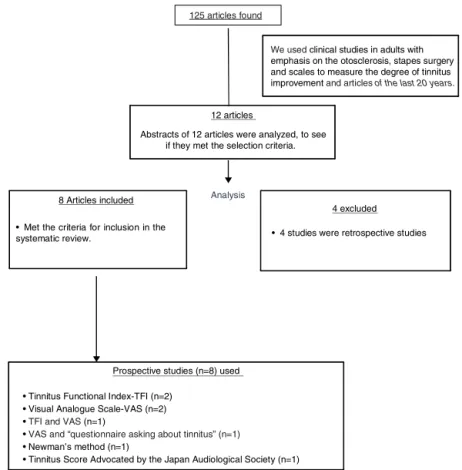
Summariesof12articleswerereviewedwhichfulfilledthe inclusioncriteriaofthesurvey,and8studieswereincluded inthe studyaccording the inclusioncriteria. Fig.1 shows theflowdiagramforinclusion.
Characteristicsofstudies
Thisreviewfoundeightstudiesinvestigatingthedegreeof tinnitusimprovement withstapes surgery, usingdifferent
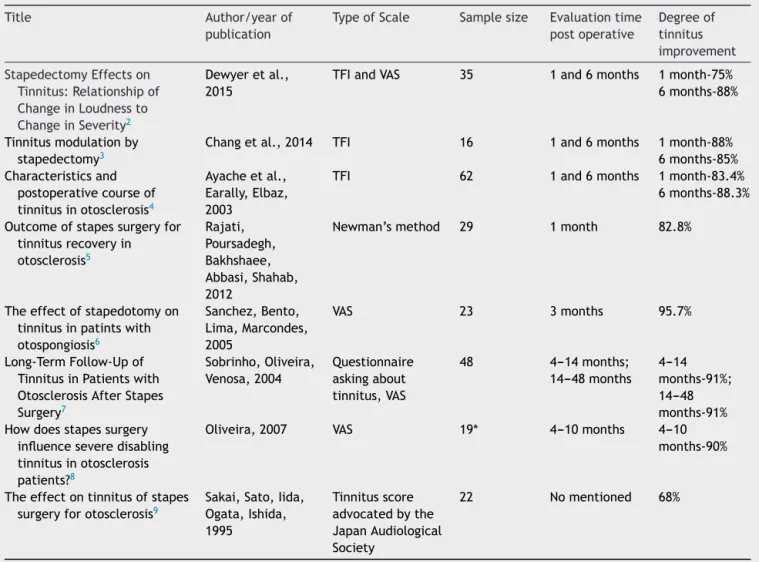
scales. The stapessurgery were stapedectomy and stape-dotomy. The articles used different scales as: Tinnitus Functional Index-TFI, Visual Analog Scale-VAS, TFI and VAS,VASand‘‘questionnaireaskingabouttinnitus’’, New-man’smethod andTinnitusScoreAdvocated bytheJapan AudiologicalSociety.
Inthe1stmonthofpostoperativeevaluation,theresults variedbetween75%and88%improvementintinnitus.Inthe 6thmonth,between85%and88.3%.
Sakaietal.didnotmentiontheevaluationperiod.Inthis article,thedegreeofimprovementwas68%.
Sanchezetal.reportedthattheimprovementaroundthe 3rdmonthwasof95.7%,beingtheperiodofgreatestdegree observedamongallthearticles.
Instudiesinwhich theevaluationwasdonebetween 4 and10months;4and14monthsand14and48months,the degreeoftinnitusimprovementvariedfrom90to91%.
Thetotalofthesamplesoftheevaluatedarticleswasof 254participants(Table1).
Discussion
Althoughtinnitusisoftenrelatedtootosclerosis,ithasbeen infrequentlydiscussedintheliterature.However,it repre-sentsamajorsourceofdiscomfortforafewpatients,who areofteninquisitiveaboutthecourseofthissymptom.2
Nopostoperativetinnituswasobservedinpatientswho werefreeoftinnituspreoperatively,butthisfactordidnot seemtobestatisticallysignificantasapredictiveindicator of the course of tinnitus. This finding was also noted by
125 articles found
We used clinical studies in adults with emphasis on the otosclerosis, stapes surgery and scales to measure the degree of tinnitus improvement and articles of the last 20 years.
12 articles
Abstracts of 12 articles were analyzed, to see if they met the selection criteria.
8 Articles included
• Met the criteria for inclusion in the systematic review.
4 excluded
• 4 studies were retrospective studies
Analysis
Prospective studies (n=8) used
• Tinnitus Functional Index-TFI (n=2) • Visual Analogue Scale-VAS (n=2) • TFI and VAS (n=1)
• VAS and “questionnaire asking about tinnitus” (n=1) • Newman’s method (n=1)
• Tinnitus Score Advocated by the Japan Audiological Society (n=1)
Table1 Articles,typeofScales,evaluationtimepost-operativeandresults.
Title Author/yearof
publication
TypeofScale Samplesize Evaluationtime postoperative
Degreeof tinnitus improvement
StapedectomyEffectson Tinnitus:Relationshipof ChangeinLoudnessto ChangeinSeverity2
Dewyeretal., 2015
TFIandVAS 35 1and6months 1month-75% 6months-88%
Tinnitusmodulationby stapedectomy3
Changetal.,2014 TFI 16 1and6months 1month-88% 6months-85% Characteristicsand
postoperativecourseof tinnitusinotosclerosis4
Ayacheetal., Earally,Elbaz, 2003
TFI 62 1and6months 1month-83.4%
6months-88.3%
Outcomeofstapessurgeryfor tinnitusrecoveryin otosclerosis5 Rajati, Poursadegh, Bakhshaee, Abbasi,Shahab, 2012
Newman’smethod 29 1month 82.8%
Theeffectofstapedotomyon tinnitusinpatintswith otospongiosis6
Sanchez,Bento, Lima,Marcondes, 2005
VAS 23 3months 95.7%
Long-TermFollow-Upof TinnitusinPatientswith OtosclerosisAfterStapes Surgery7 Sobrinho,Oliveira, Venosa,2004 Questionnaire askingabout tinnitus,VAS
48 4---14months; 14---48months
4---14 months-91%; 14---48 months-91% Howdoesstapessurgery
influenceseveredisabling tinnitusinotosclerosis patients?8
Oliveira,2007 VAS 19* 4---10months 4---10
months-90%
Theeffectontinnitusofstapes surgeryforotosclerosis9
Sakai,Sato,Iida, Ogata,Ishida, 1995
Tinnitusscore advocatedbythe JapanAudiological Society
22 Nomentioned 68%
KersleyandGray,10butDelBoetal.11mentionedthat
tinn-itusoccurredlateraftersurgeryin7%ofpatientswhowere freeoftinnitusintheimmediatepostoperativeperiod.
Shea12 and Causse and Vincent13 tried to correlate
pitchof preoperative tinnitus in otosclerosis patients and decreaseofthissymptomafterstapessurgery.Bothstated that only low-tone tinnitus is affected by stapes surgery. Causse and Vincent indicated that this kind of tinnitus is related to the elasticity of the oval-window mechanism, whichiscorrectedbystapessurgery.
In a temporal-bone study searching for a pathological correlate for tinnitus, Oliveira and Schuknecht14 found
endolymphatichydropsin18%ofthebonesstudied,normal histopathologyin11%,andotosclerosisin11%.Thesewere the major histopathological diagnoses found in tinnitus patients.Ifweconsiderthattinnitusstartswitha biochemi-calalterationintheinner-earfluids,whichinthebeginning will not be detectable by light miscroscopy but later is seen as endolymphatic hydrops, and that otosclerotic focusesin thecochleaprovokethesebiochemicalchanges inendolymphandperilymph,thesemajorhistopathological diagnosis found in temporal bones of tinnitus patients weretie together.Iftheforegoingexplanationistrue,the onlywayin which stapessurgerycan influencetinnitusin
otosclerosispatientsisbychangingtheconductivepartof theequation.
Again,OliveiraandSchuknecht14 foundbetter
preserva-tionofsensoryandneuralstructuresinpatientswithtinnitus thaninpatientswiththesamehistopathological diagnosis butwithouttinnitus.Possibly,tinnitusisaveryearlysignof cochlearlesionandtendstodecreaseasthelesionworsens. Ofcourse,theideasdiscussedintheprecedingparagraphs arefarfrombeingproved,butwebelievethattheycomprise aninterestinghypothesistobeinvestigated.
Conclusion
Thisreviewof254casesofotosclerosisshowedthrough dif-ferentscalesandindifferentmomentsthatstapessurgery was valuable in the improvement of tinnitus, which was observedin85.52%ofpatientswithpreoperativetinnitus.
Theprimaryindicationfor stapessurgeryis toimprove hearing.4
wehaveconcludedthatthestapessurgerycanalsoalleviate tinnitusinmostotoscleroticpatients.
Conflicts
of
interest
Theauthorsdeclarenoconflictsofinterest.
References
1.GristwoodRE,VenablesWN.Otosclerosisandchronictinnitus. AnnOtolRhinolLaryngol.2003;112:398---403.
2.DewyerNA,KiringodaR,KramYA,ChangJL,ChangCYJ,Cheung SW.Stapedectomyeffectsontinnitus:relationship ofchange inloudnesstochangeinseverity.OtolaryngolHeadNeckSurg. 2015;153:1019---23.
3.Chang CJ,CheungSW. Tinnitusmodulation bystapedectomy. OtolNeurotol.2014;35:1065---9.
4.Ayache D, EarallyF, ElbazP. Characteristics and postopera-tivecourseoftinnitusinotosclerosis.OtolNeurotol.2003;24: 48---51.
5.RajatiM,PoursadeghM,BakhshaeeM,AbbasiA,ShahabiA. Out-comeofstapessurgeryfortinnitusrecoveryinotosclerosis.Int TinnitusJ.2012;17:42---6.
6.LimaAdaS,Sanchez TG,Marcondes R,BentoRF. Theeffect ofstapedotomyontinnitusinpatientswithotospongiosis.Ear NoseThroatJ.2005;84:412---4.
7.SobrinhoPG,OliveiraCA,VenosaAR.Long-termfollow-upof tinnitusinpatientswithotosclerosisafterstapessurgery.Int TinnitusJ.2004;10:197---201.
8.Oliveira CA. How does stapes surgery influence severe dis-ablingtinnitusinotosclerosispatients?AdvOtorhinolaryngol. 2007;65:343---7.
9.SakaiM,SatoM,IidaM,OgataT,IshidaK.Theeffecton tinni-tusofstapessurgeryforotosclerosis.RevLaryngolOtolRhinol (Bord).1995;116:27---30.
10.Kersley JA, Gray AJ. Stapedectomy: a review with a pre-liminary report on the piston operation. J Laryngol Otol. 1964;78:374---83.
11.DelBoM,ZaghisA,AmbrosettiU.Someobservationsconcerning 200 stapedectomies: fifteen years postoperatively. Laryngo-scope.1987;97:1211.
12.SheaJJ.Otosclerosisandtinnitus.JLaryngol.1981;0101Suppl 4:149---50.
13.CausseIB,VincentR.Poorvibrationofinnerearfluidsasacause oflowtonetinnitus.AmJOtol.1995;16:701---2.