Introduction
Proposal of analytical records
for choreographic compositions in gymnastics for all
CDD. 20.ed. 796.41
http://dx.doi.org/10.1590/1807-55092016000100159
Maria Letícia Abud SCARABELIM
*Eliana de TOLEDO
**Faculdade de Ciên-cias Aplicadas, Uni-versidade Estadual de Campinas, Campinas, SP, Brasil.
Gymnastics for All (GfA), formerly called General
Gymnastics (GG), is a practice that belongs to the broad
universe of Gymnastics¹ and that has currently become
a unique practice, given some of its peculiarities.
GfA may be defi ned as “the foundation for all
gymnastic disciplines, physical movement and sporting
activities”². Th
erefore, it may involve all kinds of
gymnastics (Artistic, Rhythmic, Acrobatic, etc.), as well
as other expressions of body language and practices, as
pointed out by Perez-Gallardo and Souza³:
Abstract
Gymnastics for All (GfA) is a practice found in the wide world of gymnastics and its greatest form of
expression is through choreographic compositions (CC) due to historical and pedagogical reasons, among
other factors. In addition, in the international arena, gymnastics festivals have become a privileged forum
to perform CC as they take place in different contexts of social intervention, such as schools, clubs,
associations, NGOs, and universities. In this context, our objective is to provide a tool to register and
analyze GfA choreographic compositions by means of analytical record system. Based on bibliographical
and documentary research, we propose a set of eight aspects that address general and specifi c aspects
of CC in GfA. We conclude that the proposed tool displays a didactic and very detailed structure that is
based on the theoretical prerogatives of the area. Not only it is useful to professionals and practitioners
with different profi les, but it also holds the power of being of great value to all those involved in the
processes of CC in GfA as a tool for recording data (including historical data), which is a catalyst for
processes of refl ection and changes (whenever they are required).
K
EYW
ORDS: Gymnastics for all; Choreographic compositions; Science of sport; Routine.
An expression of body language that combines various interpretations of gymnastics (Natural, Standardized, Artistic, Rhythmic, Aerobics, etc) and blends them with other practices (Dance, Folklore, Games, Th eatre, Mimicry, etc.), in a free and creative way, according to the characteristics of the social group, promoting social interaction among participants (p.292).
Besides, GfA
off ers a variety of activities suitable for all genders, age groups, abilities, and cultural backgrounds.
Based on these references, we can see it as an
expression of the body language and the universe
of gymnastics that focuses on leisure, both inclusive
and participatory in nature, and that is typically
expressed through a presentation of a choreographic
composition (CC).
Choreographic compositions are part of a vast
universe of Arts, which encompasses Performing Arts,
Circus Arts and Dance. Some gymnastic practices
have artistic features
4, whether they are sports-based
(especially Rhythmic and Artistic Gymnastics)
or performance-focsed (such as GfA). In all these
practices, CCs can be conceived with various aspects,
including technical elements (formations, poses,
transitions, etc) and aesthetic elements. Dantas
5is one of the authors who advocate this premise by
point out that “movements and gestures [...] allow
impressions and conceptions to be made; experiences
Some authors in the area claim that CC is part
of GfA, while others attribute its importance to
its educational and motivational character for the
group
15.
Silva
16proposes that CC can also be regarded
as the “synthesis of the learning process of GfA”, and
in its development process, many foundations can
emerge and be encouraged: creativity, participation,
human development, relationship with elements of
the body expressions, etc
13.
In this regard, Ayoub
12stressed that:
Assuming that CCs are made of elements that have
in themselves diff erent forms of expression, meaning
and objectives, Criollo
8stresses out that they can be
interconnected, based on a thematic motif,
According to Gerlin
10, from her studies and
experiences in the European Gymnastics Union
(UEG), “choreography means for our group in General
Gymnastics the process and the products of creation”.
In her view, the following are the elements required to
create a choreography: space, time, music, movement,
objects, and actions; considering that movements are
interconnected with all the other elements at all times.
Such choreographic compositions may include, in
addition to the gymnastic elements, other practices
and body languages (dances, circus activities,
performing arts, games, sports, etc.), thus allowing
For these reasons, we consider that choreographic
compositions in GfA are of utmost importance, and
have been treated as such, not only by a considerable
number of researchers, but also by its practitioners
and managers. Th
is can be seen, for example, in the
relevance of the gymnastics festivals around the world,
from local events (in schools, clubs, associations,
universities etc.) to the most traditional and pompous
gatherings, such as Slet (Sokol)
17-18, Deutsch
Turnenfest
19, World Gymnaestrada
12, 20-21and others.
Patrício and Bortoleto
22point that
to be represented; values, sense and meaning to be
projected, and feelings, sensations and emotions
to be revealed [...]”. Therefore, while analyzing
choreographies, all these aspects should be taken
into account through the analysis of four operations:
description of events in its structure, assessment of
how it works, interpretation of its intentions and
contextualization of its message, whatever it is
6.
Rudolf Laban
7, the greatest theorist of Dance in
the 20th century, proposes that CCs should display a
combination of these elements, which he calls “outer
forms of movement” e “elements of emotional
content”, as addressed in his theory:
Choreology is the logic or science of Dance, which could be understood as a purely geometrical study, but in fact is much more than that. Choreology is a kind of grammar and syntax of the language of movement, dealing not only with the outer forms of movement, but also with its mental and emotional content. Th is is based on the belief that movement and emotion, form and content, body and mind are an inseparable unit (p.viiii).
[...] which is the idea related to the content of dance, the cornerstone on which an “ARMAZON” of movements is developed. It can be a narrative or an image, when the motif comes from a literary narrative or story, from the spirit of a musical piece, from a character, from an emotional state, etc.
Choreographic compositions in GfA can be
understood as
9,
compositions of a particular routine that mainly rely on body elements, predominantly associated with gymnastics, in a logical and harmonious interconnection that has a beginning, middle and end, with or without apparatus, be they large and/or small (p.43).
plays a very important role in physical education and dance activities because any complex athletic or artistic movement has its own duration and continuity, which must be perceived by the performer (p.98).
When we consider general gymnastics as something to be performed, we must ensure that it will not be seen only as a “product” disconnected from a process. On the contrary, this perspective of performance in general gymnastics (GG) needs to be treated as an integral part of the educational process of GG [...] in the process of creating a choreographic composition, the students’ experiences and interests as well as the tenets of team spirit must take precedence, by encouraging cooperation, the ability to take actions and the students’ autonomy as subjects of the educational process, where co-authoring with other subjects may take place while seeking new interpretations, new readings and new meanings that were previously unknown.
Method
Within the scope of GfA
athat was studied and
reviewed a, it was observed that researchers still fail
to delve into the topic of CC in GfA and, in this
The methods used in this research are
bibliographical and documentary.
Th
e bibliographical research aims to put the
researcher in direct contact with all material
that has been written, said or fi lmed on a given
subject
23. Th
is type of research includes sources
such as books, articles, theses, dissertations, and
monographs. For the purposes of this study we
searched all the books whose titles mentioned
the following terms: Gymnastics for All, General
Gymnastics, and Choreographic Composition
found in Brazilian book databases. Th
e articles
were obtained from scientifi c digital platforms as
SciElo and WebScience, as well as from journals in
the specifi c fi eld of Gymnastics, such as Science of
Gymnastics Journal, mentioning the same keywords
as those found in the books. It is worth mentioning
that abstracts and articles were also searched in the
is characterized by the information found in documents that did not receive any scientifi c treatment, such as reports, newspaper articles, magazines, letters, fi lms, recordings, photographs, and other communications materials.
Th
ese documents typically provide information
about the topic of the research and are available
on GfA-related Association sites such as the
International Gymnastics Federation
25, ISCA,
DGI, and also from youtube.com.
contribute to the maintenance of the gymnastics tradition, reaching a wide range of countries, with secular traditions in the realm of gymnastics or not, as is the case in Brazil. [...] In short, we understand that the opinion of the experts we consulted with corroborates the indicators found in the literature in that they show the “exceptional” contribution of the Gymnastics Festivals to personal and professional development of those involved.
context, this study aims to create/propose a procedure
to examine and record CC in GfA through analytical
records. Such records could be useful to teachers and
gymnasts in order to enhance their individual and/
or collective characteristics as an encouragement
for them to take part in domestic and international
events, in addition to keeping an accurate and
detailed record of their compositions (which could
also serve as a historical record of the group).
At the same time, we aim at contributing to
the professional training of those involved in GfA,
bridging a likely gap in vocational training.
annals of all editions of the International Forum
of General Gymnastics (2001, 2003, 2007, 2010,
2012, 2014), and those keywords were also searched
in the theses and dissertations available on CAPES
portal (a Brazilian national electronic library
consortium for science and technology). Th
is survey
was conducted from January 2014 to March 2015.
Th
e documentary research, on the other hand,
24:
Some possible ways
of analyzing choreographic compositions in gymnastics for all
Even though it is known that there are some
models of CC analytical records and guidelines
on this subject in the fi eld of GfA, these have not
been published in the academic arena. Examples
are both the model devised by the current GfA
Technical Committee of the Brazilian Gymnastics
Confederation (CBG) for the accreditation of
Brazilian GfA groups for the World Gymnaestrada,
and the guidelines posted on FIG’s website about
the event “Gym For Life Challenge”
26.
Undoubtedly, these tools are of great importance
for the area of Gymnastics since they bring relevant
information about CC that will also be addressed
in this new model proposed.
It is important to stress that, given the variety of
CC, some aspects may not be considered by these
tools. Th
ere is no need for the records to be thoroughly
completed and some additional aspects may even be
included. What we present below is merely a supporting
model, for we understand that every choreography is
unique in its varied elements and, ideally, each should
also have a unique analysis and record.
TABLE 1 - Analytical Record 1 : General characterization of the choreographic composition.
It could be used as a free-writing activity to generate ideas for writing. It could also be used to explore students’ knowledge, understandings, and perceptions of dance in relation to embodiment or materiality. Further, it could be modeled or used as an in-class lesson to demonstrate the performative and creative possibilities of writing.
Th
e fi rst part of this study has already been
published
28and proposed a system of analytical
records for the General Aspects of CC in GfA. We
will refer to this fi rst part of the study in this paper
and will also propose a recording system for its
Specifi c Aspects (the ultimate goal of this study).
Th
is paper will present the complete proposal of
analytical records for CC in GfA.
General aspects of choreographies
The proposal of keeping analytical records
starts with Analytical Record 1 - which is a general
characterization of the choreographic composition
containing basic information that is typically found
in registration forms or participant information forms
for groups participating in gymnastics festivals.
Source: Translated and adapted from SCARABELIM
and TOLEDO28 (p.191).
AR 1 - GENERAL CHARACTERIZATION 1 Title:
2 Duration:
3 Number of participants: 4 Music/ musical style: 5 Mise-en-scènes: Yes or No?
6 Apparatus? Yes or No? Traditional or non-traditional? How many? Name or type? Describe:
7 Practices beyond Gymnastics? Yes or No? What are they?
8 Which disciplines of Gymnastics were used?
In their structure, CC is essentially composed
of choreographic formations that may or may
not be geometric
15. All choreographic formations
determine the spatial positioning of the participants
at a given moment of the choreography
29, and
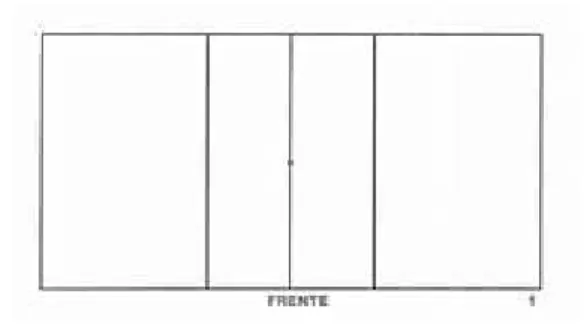
FIGURE 1 - Graphic cell.
Source: ROCHA30 (p.26).
Considering that each graphic cell represents a
choreographic moment, a CC should contain some
or many of such cells, all of which must be properly
identifi ed. In addition, an extra space should be
provided for descriptions and/or comments. Th
e
methodology developed by the author basically
consists of fi ve steps or processes:
1) Definition of the graphic cell and the
standardization of the stage front and the length
in meters;
2) Defi nition of the choreography and numbers
associated with it (number of participants, number
of formations, etc.);
3) Outline (sketch) of the formations, with their
identifi cation and the positioning of the elements;
4) Recording in the graphic cell by means of
documentation (photos, videos, etc.) and;
5) Subsequent checks for possible corrections.
Th
is model was used and improved by Bortoleto
and Pinto
31, who propose a model with a graphical
representation of the CC space, given the need to
record the activities of the Unicamp Gymnastics
Group (GGU).
Th
e symbols relating to the elements that make up
a particular choreographic moment may be diff erent.
a few of them: phenomenological, new materialist
and Deleuzian approaches. Th
ese forms escape
the academic writing conventions and each one of
them has its particular features; they are considered
important pedagogical tools and can take various
forms and justifi cations for their use:
Toledo
15also stresses that gymnasts need to
remain in the formation for a period of time, so
that it can be truly regarded as a choreographic
formation. Otherwise, it will be characterized as a
choreographic transition, which is a form of move in
which a choreographic formation shifts to another.
Thus, the next record will address which
formations are part of this particular CC, including
a description of what is performed in each one.
TABLE 2 - Symbols used for different activities in a graphic cell.
For this study, we adopted the symbols already defi ned
by Bortoleto and Pinto
31, as follows: fast moves,
slow moves, boys and girls; adding, simultaneously,
other three descriptions/details: low, middle and high
levels and their respective symbolism:
Source: Translated and adapted from SCARABELIM and TOLEDO28 (p.189).
Activity Symbol
Fast moves g
Slow moves
4
Boys l
Girls
○
Low level q
Middle level u
High level p
We believe that the identifi cation of the levels
that the gymnast uses during the choreographic
composition is important because it is based on such
identifi cation that one can get a better sense of the
fi gure formed by the gymnasts at that choreographic
It is important to stress that the possibilities of fi gures can also be executed with the use of materials, as well as with the group members, not only at the fl oor level, but also considering the possibility of executing “balances” such as human pyramids or by using aerial apparatus.
According to the authors Toledo and
Scarabelim
28Th e symbols relating to the levels must accompany the symbol of each member/gymnast because, during the choreography, gymnasts may occupy diff erent levels at the same time. Th ey can also be used for representing a choreographic formation as a whole. It is suggested that the symbols of the levels should be represented on a slightly smaller scale in order to avoid possible visual pollution and to achieve a faster identifi cation. If in a given choreographic formation the gymnast should use more than one level, both must be identifi ed.
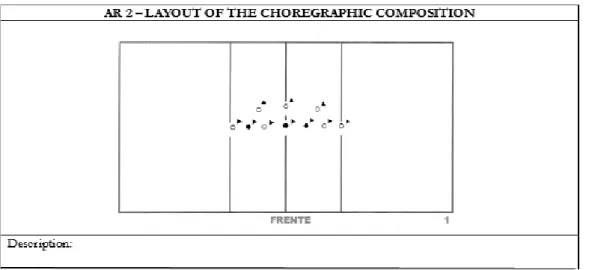
Therefore, Analytical Record 2 - Layout of
the choreographic composition, includes the CC
graphic cells, with their symbols and descriptions.
Here is an example of a graphical cell:
moment, or by the apparatus they use, as stated by
Santos and Santos
9:
Source: Translated a n d a d a p t e d f r o m : SCARABELIM and TOLEDO28
(p.190).
FIGURE 2 - Analytical Record 2: layout of the choreographic composition.
Analytical Record 3, which was created specifi cally for
the purposes of this paper, aims to conduct a typological
and quantitative analysis of the choreographic
TABLE 3
-TABLE 4 - Analytical Record 4: qualitative analysis of the general choreographic components. Analytical Record 3: quantitative and type analysis of choreographic formations.
AR 3 - QUANTITATIVE AND TYPE ANALYSIS OF CHOREOGRAPHIC FORMATIONS
Choreographic formations Amount
Circles
Semicircles
Straight lines (lines/columns) Squares
Triangles Spirals Diagonals X shapes Oval shapes Fish school shapes V shapes Others Total
Th
ere is no minimum or maximum number of
formations for each CC, because this amount is
associated with other factors such as the purpose of
the composition, its theme, its duration, the group
profi le, among others. However, it is interesting to
rely on such records to analyze which formations
have previously been used and which may be used
in the future. It is then possible to check if there
are repeated formations (whose variation is only in
their dimensions) or very similar set of formations
(as circles/semicircles, or diagonals/V-shaped or
X-shaped). In both cases, CC may become repetitive,
monotonous and demotivating to those who are
watching it and/or to those who are practicing it.
Th
e Scarabelim and Toledo
28also point out
that:
Th e said eight items are directly linked to a conception of GfA, where the choreographic composition is taken as a unit, that is, a
Source: Translated a n d a d a p t e d f r o m : SCARABELIM and TOLEDO28
(p.192).
* O p i n i o n : R e g u l a r, Satisfactory, Good, Very Good, Excellent.
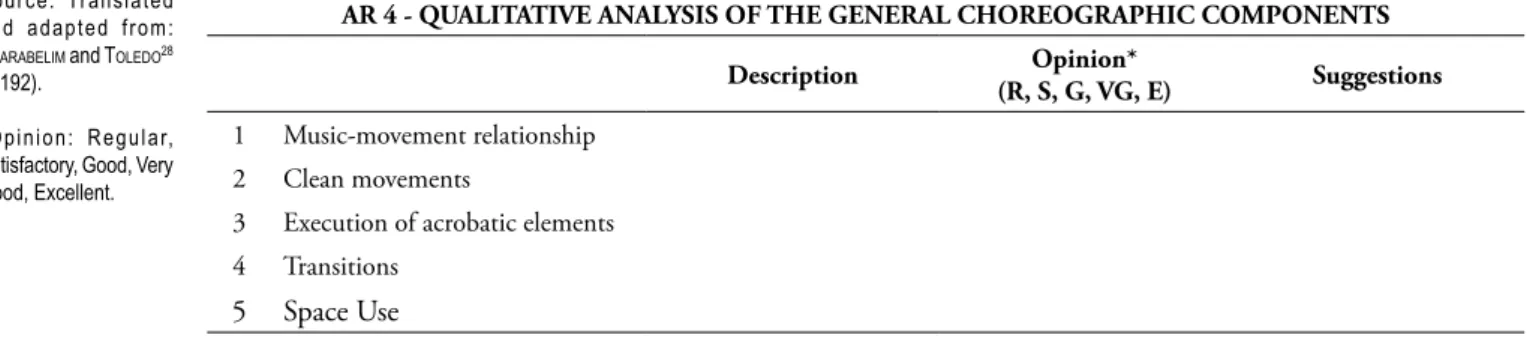
AR 4 - QUALITATIVE ANALYSIS OF THE GENERAL CHOREOGRAPHIC COMPONENTS
Description Opinion*
(R, S, G, VG, E) Suggestions
1 Music-movement relationship
2 Clean movements
3 Execution of acrobatic elements
4 Transitions
5 Space Use
Th
ere is also a third analytical record, which refers
to the qualitative analysis of the general choreographic
components that are common to all routines.
Th
e
Scarabelim and Toledo
28point out that
the reasons that guided the creation of this record
and the choice of each single item used are based
on diff erent studies, fundamentally conducted by
Santos and Santos
9. Th
ese items, in summary,
refers to:
1) Music-movement relationship: check whether or not the movements are performed in harmony with the music based on an analysis of tempo, melody, accents, pulse, beat, musical alternations, among others. The rhythm of the music should be aligned with the rhythm of the movements of the gymnasts in the choreography, where both should nearly make up a single choreographic element20. According
to the authors, in a GfA choreography, this rhythmic harmony is essential.
2) Clean movements: consider if the movements are carried out collectively (should that be the goal), if they are clear to the spectator (individually or collectively), if the movements do not pose risks to the gymnasts should failures occur in the execution (which might reveal gaps in the learning process), among other aspects. [...] 3) Execution of acrobatic elements: consider whether the acrobatic elements are being carried out satisfactorily or if there is the need for/possibility of improvement. Description of the acrobatic elements (number of people participating, where they occur, etc.). Acrobatic elements are very interesting to be used in a choreographic composition, as they bring a
challenge and risk profi le, creating positive feelings in the audience as well as in those who practice these elements.
4) Transitions: characterize how transitions are performed between one formation and another, identifying the quantity, whether they are carried out using gymnastic elements or dance moves, if they are executed as one single group or in small groups, etc. Th ere are other types of transitions in a GfA choreography, such as the transition from one movement to the other, from one song to the other, from one rhythm to the other20. However, for this
analytical record, we suggest that transitions between choreographic formations are described and analyzed. Priority should be given to the homogeneity and unity of the performance by means of transitions that fl ow harmoniously20.
5) Space Use: Description of how the space is used by gymnasts through formations and transitions and if they concentrate more in a particular place or if the entire space is used, etc.
Specifi c aspects
of the choreographic composition
Once the analytical records that refer to the
general aspects of the CC are completed, other
records on the specifi c aspects of CC can be started.
Th
us, Analytical Record 5 relates to the typological
and quantitative analysis of the basic elements of
gymnastics that are present in CC:
AR 5 - TYPOLOGICAL AND QUANTITATIVE ANALYSIS OF THE BASIC ELEMENTS OF GYMNASTICS
Elements/
Types or names Swing Circumduction Balances
Rotations/
Pivots “Waves”
Individual Acrobatic Elements
Small Jumps Jumps/ Leaps
Type Type
Type
Type
Total Number Suggestions/ or Analysis
Analytical Record 5: typological and quantitative analysis of the basic elements of gymnastics. TABLE 5
-Th
e proposal of Record 5 is based on Souza et
al.
32, and aims to determine what are the body or
gymnastics elements present in CC and its typologies.
As a result, one can clearly see the elements used in
Analytical Record 6: typological and quantitative analysis of the acrobatic group elements. TABLE 6
-AR 6 - TYPOLOGICAL AND QUANTITATIVE ANALYSIS OF THE ACROBATIC GROUP ELEMENTS
Acrobatic group elements Types/Names Total
Balance exercises Dynamic exercises Combined exercises
The determination of these three types of
acrobatic group elements was based on the studies
conducted by
Perez-Gallardo and Azevedo
33,
Merida
34-35and FIG
36. Th
erefore Perez-Gallardo
and Azevedo
33:
The balance exercises (or static positions) are exercises in which the partners form and maintain a pose for at least three seconds. Th is kind of movement is also characterized by transitions, which are movements performed by the base, by the top or both, in order to form a pose in which the partners do not shift their support during a transition.
In the dynamic exercises, the essential characteristic is the existence of a phase that includes the flight of the top. During this phase, the top performs movements such as somersaults or twists.
Since GfA is an essentially collective practice, there
are many relationships between the ways acrobatics
are performed and in Acrobatic Gymnastics (AcroG).
In both, CC is present and one can see moments when
acrobatics are performed in groups or individually, on
the fl oor or in the air. Acrobatic elements are typical
variations and/or absence of certain elements. It is
worth mentioning that the completion of this record
contributes to the technical training of teachers and
participants, since it requires the knowledge of a
language typically used in the fi eld of gymnastics. It
also demands a creative process when defi ning any new
nomenclature for elements created by those involved.
Another specific component of a GfA
choreography, which is directly related to gymnastic
elements, are the inverted positions (static or
dynamic), also referred to as acrobatic elements.
Thus, Analytical Record 6 aims to conduct a
typological and quantitative analysis of the acrobatic
elements:
AR 7 - COHERENCE THEME ANALYSIS
Components / Analysis Th eme of the CC Costumes Music Apparatus
Description
Analysis
Suggestion
TABLE 7 - Analytical Record 7: coherence theme analysis.
of gymnastics practices in general and are present in
several of them, both in competitive or demonstrative
modalities. Acrobatic elements are appealing to CC
because regardless of whether they are mandatory or
not, they give a sense of challenge and risk, both to
those who practice it, and to the audience. Some of
these elements have a higher level of diffi
culty and,
when well executed in CC (individually or in groups),
cause a very positive impact on the audience.
Both gymnastic and acrobatic elements are widely
used in CC of GfA, since these are also infl uenced
by other types of gymnastics, such as artistic (where
acrobatics prevail) or rhythmic (where gymnastic
elements prevail). It is suggested that these elements
should be both evenly and harmonically distributed, in
harmony with the proposed theme of the CC of GfA.
Th
e following information could be present in
each of these components:
-
Th
eme of the choreography
: what it is, how and
when it was chosen, what are its main characteristics
and the r
easons for selecting it;
-
Costumes
: how many outfi ts it uses, name (for
those which are folk-based or typical of a region),
description (design, colors), how and why they were
chosen (related to the theme);
-
Music
: how, when and why it was chosen; style
or musical rhythm; technical data (name, author,
group/band, album, length etc.), relationship with
the theme, and forms of music mixing (if any);
-
Apparatus
: how, when and why it was chosen,
name, color, size (small, medium or large), shape,
quantity, relation to the theme.
Th
e teacher/coach or even the gymnasts can fi ll
out this form and analyze whether there is coherence
between these four choreographic aspects, also
marking suggestions for future changes or minor
adjustments. It is not uncommon to see CC at
festivals that show a mismatch between those
aspects. Besides, as we understand it, this alignment
is precisely one of the principles that draws GfA
close to its artistic and performing roles.
For
Gallardo
29, there are subjective aspects in a
CC that are related to the human development of
its practitioners, such as cooperation, organization,
responsibility, honor, respect, solidarity, creativity,
among other. Given this subjectivity, CCs are diffi
cult to
be measured in a more objective analysis. Nevertheless,
the authors consider to be possible to narrate (or
describe) these subjective aspects of CCs using a system
of analytical records developed for this purpose.
As already mentioned by some authors
1,12,15, GfA
stands out as a unique practice in its choreography
development process, since it values inclusion,
socialization, and human development, among
other aspects. Taking all this into consideration,
we realized that one of the records should focus
exclusively on this aspect, and that perception gave
rise to ANALYTICAL RECORD 8.
AR 8 - THE CHOREGOGRAPHIC COMPOSITION PROCESS
Description:
TABLE 8 - Analytical Record 8: the choreographic composition process.
Th
is record can be used for a brief description of
the “step-by-step” development of the choreography,
with specifi cations as to the order and the way CC
gradually materializes. This description can be
provided by means of a script, as follows: What did
we do fi rst? How did we choose the theme, the music,
and the apparatus? Th
en, what did we do? Did we
defi ne the formations, divided the group into two
for an early creative process using the apparatus? And
so on. Alternatively, this analytical record could be
developed in a narrative format, as if we were telling
the story of the creative process of the composition.
In both cases, in order to compile a collection of
chronological records, the authors suggest that,
during this choreographic development process,
records should be made (by means of photos, videos,
and testimonials) so that they would become part
of this record at the end of the process.
Discussion
Th
e main objective of this study was to propose
a choreographic analytical tool to be used in GfA,
consisting of a set of eight analytical records (AR),
which address general and specifi c aspects of CC,
duly supported by the theoretical references in
the area. Th
is tool enables the assessment of the
following aspects:
- AR1 - General characterization of the
choreographic composition;
- AR2 - Layout of the choreographic composition;
- AR3 - Quantitative and type analysis of
choreographic formations;
- AR4 - Qualitative analysis of the general
choreographic components;
- AR5 - Typological and quantitative analysis of
the basic elements of gymnastics;
- AR6 - Typological and quantitative analysis of
the acrobatic group elements;
- AR7 - Coherence theme analysis;
Resumo
Proposta de fi chas analíticas de composições coreográfi cas na ginástica para todos
A Ginástica para Todos (GPT) é uma prática encontrada no amplo universo da ginástica, e a sua maior forma
de expressão se dá por meio de composições coreográfi cas (CC), por motivos históricos, pedagógicos, entre
outros. E os festivais de ginástica vêm se mostrando, em nível internacional, como um fórum privilegiado de
mostra das CC, ocorrendo em diferentes contextos de intervenção social, como escolas, clubes, associações,
ONGs e universidades. Nesse contexto, nosso objetivo é fornecer um instrumento para registrar e analisar
composições coreográfi cas de GPT, por meio de fi chas analíticas. A partir de uma pesquisa bibliográfi ca e
documental, propõe-se um conjunto de oito fi chas analíticas, que abordam aspectos gerais e específi cos
das CC na GPT. Conclui-se que o instrumento proposto possui uma estrutura didática e bem detalhada,
alicerçada nas prerrogativas teóricas da área, o que viabiliza seu uso por diferentes perfi s de profi ssionais
e praticantes, podendo ser de grande valia para todos os envolvidos nos processos de CC na GPT, como
uma ferramenta de registro (inclusive histórico), catalizadora de processos de refl exão e mudanças (caso
sejam necessárias).
P
ALAVRAS-
CHAVE: Ginástica para todos; Composição coreográfi ca; Ciências do esporte; Coreografi a.
Notes
a. Th ese references and choreographies of national and international festivals were discussed on the theme “Choreographic Compositions in GfA.” Th e reference used in the research is described in Method.
Th e author Maria Leticia Abud Scarabelim is a researcher at LAPEGI - Laboratory of Gymnastics Researches and Experiences, Faculty of Applied Sciences, University of Campinas.
Th e author Eliana de Toledo is coordinator of LAPEGI - Laboratory of Gymnastics Researches and Experiences, and professor of the Sports Science Course, Faculty of Applied Sciences, University of Campinas.
Th
erefore, this study contributes to the production
of
new scientifi c knowledge in the fi eld of GfA, as
well as to the activities of teachers and participants
of GfA, enabling them to:
- organize, in a single document, detailed
information about the choreographic composition
created;
- have a tool for the analysis of each composition;
- enhance or propose changes to the choreography,
from the identifi cation of items or components
that were not covered, but that could be included
(should the group be willing to), by assessing the
information available on the records;
- use these records for future objectives or challenges
to the group (replacement of members; implement
partial changes to meet the rules of a festival);
- become a historical choreographic collection
of the group;
- obtain organized and detailed information
about CC for future scientifi c work.
References
1. Souza EPM. Ginástica geral: uma área do conhecimento da educação física [tese]. Campinas (SP): Universidade Estadual de Campinas, Faculdade de Educação Física; 1997.
2. Fedération Internationale de Gymnastique. Gymnastics for all regulation manual, 2009. Lausanne: FIG; 2009. Available from: www.fi g-gymnastics.com.
3. Perez-Gallardo JS, Souza EPM. La experiência del grupo ginástico Unicamp en Dinamarca. III Congresso Latino Americano - ICHPER; 1995; Foz do Iguaçu, BR. Foz do Iguaçu: ICHPER; 1995. p.292-8.
4. Scarabelim MLA. Fichas analíticas de composições coreográfi cas na ginástica para todos: primeiros ensaios [monografi a]. Campinas (SP): Universidade Estadual de Campinas, Faculdade de Ciências Aplicadas; 2014.
5. Dantas M. O enigma do movimento. Porto Alegre: UFRGS; 1999.
6. Silva ER. O que essa obra de arte me diz? Salvador: Universidade Federal da Bahia; 2008. Disponível em: www.por-talabrace.org.
7. Laban R. Choreutics: annotated by Lisa Ullmann. London: MacDonald and Evans; 1963
8. Criollo YSN. Programa de entrenamiento para la escuela de gimnasia artística feminina de la Federación Deportiva del Azuay de 5 a 6 años [tesis]. Cuenca (Equador): Universidad Politecnica Salesiana; 2013.
9. Santos JCE, Santos NGM. Ginástica para todos: elaboração de coreografi as e organização de festivais. Jundiaí: Fontoura; 2009.
10. Gerlin I. Th e elements of choreography. Austin: Ballet Austin Academy. Available from: http://www.balletaustin.org/ education/documents/ElementsofChoregraphyHandout.pdf.
11. Paoliello E, Toledo E, Ayoub E, Bortoleto,MAC, Graner L. Grupo Ginástico Unicamp 25 anos. Campinas: UNICAMP; 2014. 12. Ayoub E. Ginástica geral e educação física escolar. 3rd ed. Campinas: UNICAMP; 2011.
13. Toledo E, Tsukamoto MHC, Gouveira CR. Fundamentos da ginástica geral. In: Nunomura M, Tsukamoto MHC, organizadoras. Fundamentos das ginásticas. Jundiaí: Fontoura; 2009. p.23-50.
14. Pollatou E, Hatzitaki V, Karadimou K. Rhythm or music? Contrasting two types of auditory stimuli in the performance of a dancing routine. Percept Mot Skills. 2003;97:99-106.
15. Toledo E. Nomination of the choreographic formations: feasibility and meanings. III Fórum Internacional de Ginástica Geral; 2005; Campinas, BR. Campinas: FEF/UNICAMP; 2005. p.99-102.
16. Silva Y. Ginástica geral: um processo de construção coreográfi ca com crianças. In: Toledo E, Silva PC, organizadores. Democratizando o ensino da ginástica: estudos e exemplos de sua implantação em diferentes contextos sociais. Várzea Paulista: Fontoura; 2013. p.97-120.
17. Banjak SJ. Sokol: gymnastic manual. East Orange: Th e Slovak Gymnastic Union Sokol; 1993. 18. Kubin Z. XIV Vsesokolský SLET. Praha: Plot; 2006.
19. Neumann H. Deutsche Turnfeste - Spiegelbild der deutschen turnbewegung. Wiesbaden: Limpert; 1987.
20. Wichmann A. Th e historical roots of the gymnaestrada: national gymnastics festivals in nineteenth-century Europe. In: Merkel U, organizer. Power, politics and internation events: socio-cultural analyses of festivals and spectacles. New York: Routledge; 2013.
21. Mechbach J, Waneberg PL. Th e world gymnaestrada: a non-competitive event. Th e concept “Gymnastics for All” from the perspective of ling gymnastics. Scand Sport Stud Forum. 2011;2:99-118.
22. Patrício TL, Bortoleto MAC. Festivais ginásticos: princípios formativos na visão de especialistas. Conexões. 2015;13:98-114. 23. Lakatos EM, Marconi MA. Fundamentos de metodologia científi ca. 5a ed. São Paulo: Atlas; 2003.
24. Oliveira MM. Como fazer pesquisa qualitativa. Petrópolis: Vozes; 2008.
25. Fedération Internationale de Gymnastique. About gymnastics for all. Lausanne: FIG; 2015. Available from: http:// www.fi g-gymnastics.com.
26. Fedération Internationale de Gymnastique. Gym for life challenge. Lausanne: FIG; 2015. Available from: http:// www.gymforlife2017.com/.
27. Ulmer JB. Embodied writing: choreographic composition as methodology. Res Dance Educ. 2015;16:33-50. 28. Scarabelim MLA,Toledo E. Proposta de criação de uma fi cha analítica de composições coreográfi cas na ginástica para
todos: primeiros ensaios. Conexões. 2015;13:181-96.
30. Rocha B. Diagramação e registro de coreografi as do Grupo Ginástico Unicamp. Rev Corpoconsciência. 2004;13:77-92. 31. Bortoleto MAC, Pinto L. Th e graphic representation of a general gymnastics choreography: the case of Urban Movi-ments of Gymnastics Group of Unicamp (GGU). IV Fórum Internacional de Ginástica Geral; 2007; Campinas, BR. Campinas: FEF/UNICAMP; 2007. p.253-8.
32. Souza EPM, Toledo E, Palermo CT. Manual e vídeo de elementos básicos da ginástica rítmica desportiva: com e sem aparelhos. Campinas: Centro de Comunicação da UNICAMP; 1997. Elementos corporais.
33. Perez-Gallardo JS, Azevedo LHR. Fundamentos básicos da ginástica acrobática competitiva. Campinas: Autores As-sociados; 2007. Os exercícios acrobáticos.
34. Merida FV. Fundamentos da ginástica acrobática. In: Nunomura M, Tsukamoto MH, organizadoras. Fundamentos das Ginásticas. Jundiaí: Fontoura; 2009. p.173-200.
35. Merida FV. Ensinando a ginástica acrobática. In: Nista-Piccolo VL, Toledo E, organizadoras. Abordagens pedagógicas do esporte. Campinas: Papirus; 2014. p.123-41.
36. Fedération Internationale de Gymnastique. Code of Points acrobatic gymnastics: 2013. Lausanne: FIG; 2013. Availabre from: www.fi g-gymnastics.com.
37. Russel K. Gymnastics challenges: a view form 50 years of coaching and teaching. In: Schiavon LM, Heinen T, Bortoleto MAC, Nunomura M, Toledo E. High performance gymnastics. Hildesheim: Arete-Verlag; 2014. p.1-17.
38. Toledo E, Schiavon LM. Ginástica geral: diversidade e identidade. In: Paoliello E, organizadora. Ginástica geral: ex-periências e refl exões. São Paulo: Phorte; 2008. p.216-39.
ENDEREÇO Maria Letícia Abud Scarabelim Faculdade de Ciências Aplicadas Universidade Estadual de Campinas R. Pedro Zaccaria, 1300 - Campus Limeira 13484-350 - Limeira - SP - BRASIL e-mail: [email protected]