Introduction
Men’s artistic gymnastics:
is the use of elastic surfaces systematic in the training process?
CDD. 20.ed. 796.41
http://dx.doi.org/10.1590/1807-55092016000100051
Marco Antonio Coelho BORTOLETO* Tiago Furtado COELHO*
*Faculdade de Edu-cação Física, Univer-sidade Estadual de Campinas, Campinas, SP, Brasil.
Artistic Gymnastics (AG) from a systemic point of view should be considered a dynamic/open system, and therefore receptive to outside interferences when searching for its equilibrium1. Th e systemic analysis of AG’s internal logic reveals an individual practice (psychomotor) developed in a standard space (“the apparatus”), manifesting encoded skills2-3. Th us, space becomes the main element of the praxeological system, deserving a detailed analysis4.
Considering that AG is a secular sport, present at the modern Olympic Games since the fi rst edition in 1896, its sociocultural context is considered traditional making the modernization of the sport slower3, 5. Nevertheless, it was in the practice space, meaning in the apparatus, that the most signifi cant changes were noted6.
In the 1980’s, in Men’s Artistic Gymnastics (MAG), a signifi cant change in material and technology was noticed, which together revealed a paradigm modifi cation the substitution of the rigid apparatus with the fl exible (elastic) ones. Th ese changes were, in great measure, infl uenced by the Code of Points
(COP) guidelines, which led to the hyper-valorisation of acrobatics and fl ight elements, and consequently, to even more complex and dynamic competitive routines. One of the consequences of being gradually higher is the higher impact of landings, for example7.
As a consequence of these apparatus changes, a great transformation was observed in training practices and in routines performed in competitions, transformations which signifi cantly modifi ed the gymnasts’ technical and physical preparation3, 7. Th is new generation of equipment and Elastic Surfaces (ES) modifi ed, among other things, the execution time of acrobatic elements, requiring less power and, consequently, needing less energy8-9.
If we consider repetition as a fundamental characteristic of AG (both MAG and WAG), either in learning and mastering specifi c skills, the correct use of ES has considerably contributed to the reduction of impact/stress on body joints10, to the increase of safety11, and, therefore, to the reduction of injuries, especially to knees, shoulders and ankles12-13. In other words:
Abstract
In Artistic Gymnastics, the area (the apparatus) represents the most relevant systemic component. Thus, when one strives to comprehend the internal logic of this sport, the gymnast-apparatus relationship warrants special attention. A change in the training paradigm was observed, showing that the use of Elastic Surfaces (ES) is an essential resource, due to the contemporary features of this sport, such as the hyper-valorisation of acrobatics and a greater presence of fl ight elements. Through a case study developed in a men’s artistic gymnastics high-performance gymnasium, this study analysed the use of different ES in the training process. Although coaches recognize the importance of ES in training programs, the record of daily activities showed that this use is still limited to select equipment and is not systematic. Such diffi culties are due mainly to the lack of educational programs to the development of certain specifi c methodologies and the non-existence of national equipment suppliers certifi ed by International Gymnastics Federation.
Investigations of elastic sport surfaces have included gymnastics spring-floors, running tracks, gymnasium fl oors, and others (Greene & McMahon, 1979; McMahon & Greene, 1978, 1979; Nigg, Yeadon, & Herzog, 1988). Although the initial idea for the spring-fl oor involved a desire for enhanced safety through reduced landing impact “harshness” (Arampatzis, Bruggemann, & Klapsing, 2000; Nigg, Luethi, Denoth, & Stacoff , 1983; Wilson et al., 1986), the evolution of the gymnastics spring-fl oor has led to increased elastic behavior with corresponding increases in tumbling height and skill diffi culty (Holvoet, Lacouture, & Duboy, 1999; McNeal, Sands, & Shultz, 2007; Paine, 1998)9 (p.32). As an example, we observed that in the first decades of the 20th century, Floor Exercises (FX) were performed outdoors, on natural grass, beaten earth or even on thin layers of sawdust. Th ey were gradually transferred to artifi cial surfaces, at fi rst made of “tatami” (straw plates covered with a canvas), then from cotton-fi lled fabric mats and, fi nally, from synthetic foam mats (with even more sophisticated materials, densities, forms and sizes)14. It was in the 1980s that the “Spring Floor” system, composed of springs, wooden boards, an agglomerated polyurethane foam covered with a thick carpet, modifying the FX routines signifi cantly6, 9.
Th is technological advance ultimately reveals the search for surfaces/equipment with a greater reactive capacity, that is, for an apparatus capable of responding to the pressure exerted through speed or lifting of the Center of Mass (CM) of the gymnast and, at the same time, with a higher capacity to absorb impact energy15.
Th e Horizontal Bar (HB) developed by Nichols-Ketchum in 1998a, for example, brought a new steel composition and a dynamic anchoring system, which contributed to the development of elements with an aerial phase (or “fl ight elements”) such as Markelov, Kovacs, Kolman, Gaylord, and also
dismounts with double straight somersault with a double twist or until triple somersault16.
In the same manner, the other MAG apparatus (Parallel Bars, Rings, Vaulting Table and Pommel Horse), as well as other complementary equipment used in training, underwent major modifi cations in their architecture and the materials used for their elaboration.
In Vault (VT) routines, a technological improvement of the trampoline (Reuther model) in the 1980’s and the substitution of the “horse” (rigid surface) for the “Pegasus” table model (with elastic/more fl exible components) in 20026 generated a considerable repulsion (upper limbs), a higher elevation of the gymnast CM during the second phase of the fl ight (post fl ight. Th us resulting in greater height and more time to accomplish rotations during the vault. Th e Yurchenko Group’s (EG III) vault development, incorporated into the COP in 1983, reinforces this thesis17.
In the Parallel Bars (PB), the fl ight elements, such as Belle, Morisue, Lee Chul Hon/Sasaki and Suarez, became more frequent, as more fl exible bars made from glass fi ber/carbon coating with wooden blades allowed the development of techniques that protect the gymnast CM right over the bars.
In all MAG apparatus, the best technology of mats used for landing, in addition to improving the surface stability, have allowed greater absorption of impact energy, generating signifi cant modifi cations in the landing techniques and permitting dismount elements with more rotations18-19.
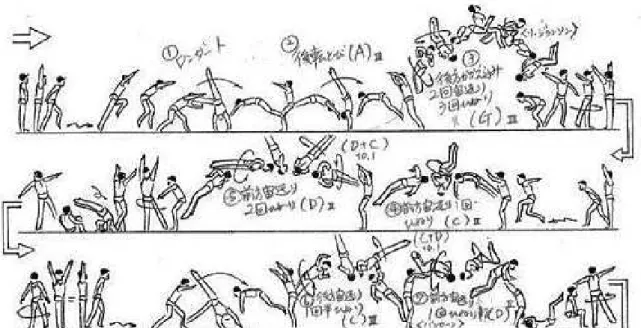
FIGURE 1 - Kohei Uchimura’s Floor Exercise.
TABLE 1 - Elastic equipment/technology patents for AG.
Title Patent Date
Roll-fold fl oor mat for gymnastic and athletic purposes US Patent 3636576 1972
Resilient fl oor, especially for gymnasiums US Patent 3828503 A 1973
Arrangement for Floor Gymnastics/Floor Panel System US Patent 4135755 1977 Gymnastic fl oor structure having vertical elasticity US Patent 4648592 1985 Gymnastic apparatus for performing vaulting exercises European Patent EP 0885634A2 1997 Gymnastics springboard with adjustable elasticity
designed for training and competition
European Patent EP 7175567 Germany Patent DE 2103315 A1
2003
Gymnastic fl oor structure US Patent 7849646 B2 2007
Air-cushion fl oor China Patent CN 201099969 Y 2007
Flexible mat with multiple foam layers US Patent 20130017372 A1 2011
By examining the catalogues of the main manufactures of AG equipment, as well as the activities conducted in high-performance gymnastics training centers3, we can observe a great variety of ES (trampoline, fast-track, tumble track, pit foam, Because of these technological advancements, some acrobatic elements, unexpected a short while ago, have become common. Th ese elements are often presented alongside others, allowing the execution of
acrobatic sequences of higher complexity with precision and safety, as seen in the Japanese gymnast Kohei Uchimura’s (FIGURE 1) in the fi rst three tumble passes of his FX in the World Championship in Tokyo, 2011.
mats), equipment that has become essential for the development of contemporary MAG.
Th e gymnasts practiced from Monday through Friday in two periods (morning and afternoon) and on Saturday mornings, divided into the following age groups (categories): ages 9-10, ages 11-12, ages 13-15 (junior) and age 16+ (adult or senior). Th is is one of the few clubs in Brazil that has gymnasts in each one of the offi cial age groups, many of whom are participants of the national teams. Th e junior and senior gymnasts have had experience in international championships, including, in some cases, World Championships and the Olympic Games, in which the adults were fi ve-times champions and
Results
Th e coaches have between 10-20 years of experience, including international camps and competitions, and the most experienced of them is one of the coaches of the Brazilian Senior National Team.
Although it is one of the leading gyms in Brazil, with all the offi cial MAG apparatus (all imported), in the category of ES, it only has one Trampoline (TRA), an acrobatic track known as Tumble Track (TT), as well as three additional offi cial apparatus installed on the pit foam - an insuffi cient structure compared to those available in renowned gyms in the international scene.
Th e fi eld research was conducted in a MAG club in the state of São Paulo (Brazil), with high level gymnasts (national and international champions), whose competition results over the last ten years placed the gymnasium within the best nationwide.
Th e observations took place over a period of nine months (2013-2014), with 25 sessions (approximately 175 hours of direct observation), adapting the visits to the gym’s training and competition schedule. Th e study had the prior authorization of the head coach and from those responsible for the institution.
It is worth noting that, although female gymnasts trained in the same gym on a daily basis, the activities of these gymnasts were not analyzed.
Th e data were collected using two instruments: direct observation, duly registered in a “fi eld diary” (notebook), following the model proposed by Ludke and André23 adapted by Bortoleto3; and semi-structured interviews which were conducted with the three MAG coaches, following the guidelines proposed by Severino24. It is worth noting that, in the opinion of Triviños25, this approach “[...] at the same time that it values the presence of the investigator, it off ers all possible perspectives for the informant to reach the necessary freedom and spontaneity, thus enriching the investigation” (p.146).
As an inclusion criteria, the interviewee had to be acting offi cially as a coach for over a year at the institution and, as exclusion criteria, they could not
be under license or in an irregular work situation for any reason.
Th e data obtained underwent a thematic and interpretive analysis24, through which the collected data were reduced through a system of categories elaborated in accordance with the objectives proposed in this study. Th us, a qualitative analysis of the data was conducted by tabulating the categories as suggested by Souza Junior et al.26 for a categorical thematic analysis. At last, the Content Analysis was utilized as an organizational and data reduction methodology27, a procedure understood to be “like a set of techniques for communication analysis, which uses systematic and objective procedures for content description of messages”27 (p.38).
Since the fi eld study was conducted during the gym’s regular activities, data collection needed to be adjusted to the training context3, considering the club’s offi cial calendar. For this reason, some observations were cancelled or had their dates changed for reasons such as: competition, festivities, trips and other commitments, which kept the athletes out of the gym. Th e fi rst ten observation sessions map the training sessions of all the gymnasts who attended the gym (a panoramic vision). In the second phase, over a period of 15 sessions, the specifi c activities that used the ES available in the gym were analysed.
Th e research was approved by the Research Ethics Committee of the Faculty of Medical Sciences of the University of Campinas (UNICAMP).
I believe the elastic surfaces are really very important, indispensable today, something that was noticed abroad a long time ago, but not here in Brazil. In the US, you won’t fi nd a gym without at least one tumble track, 4 or 5 elastic beds and all the apparatus geared towards the pit. Over there, children learn almost naturally, because they play a lot, gaining a huge notion of space. Afterwards, transferring that to the offi cial apparatus is very simple (C1).
TABLE 2 - Gymnastic/acrobatic elements trained on ES.
Discussion
Among the acrobatic elements within the MAG COP29, the use of ES for the purpose of teaching and
or improvement that we most frequently observed were the following:
Elements Apparatus ES
Cross, Unlock, dismounts (somersaults). Rings (SR) TRA Sequence of backward somersaults; Tempo; Sequences of forward somersaults;
Cartwheel, Round off , Flic-Flac/Backward Handspring. Floor (FX)
TT
Pirouette (rotations in longitudinal axis); Somersaults (simple; double). All apparatus
(except Pommel Horse)
TRA, TT
Front Handspring Vault, Round off , Flic-Flac/Backward Handspring,
Yurchenko, Triple forward somersault. Vaulting (VT)
TT
Suarez, Somersaults inside the bars, Diamidov, Carballo, Belle. Parallel Bars (PB) TRA Yamawaki, Tkatchev, Kovacs, Giant, Jäger, Gaylord, Endo/Stalder (upswing). Horizontal Bar (HB) TTA
The coaches confirm that the use of the ES contributes to the transfer11 of the learning of
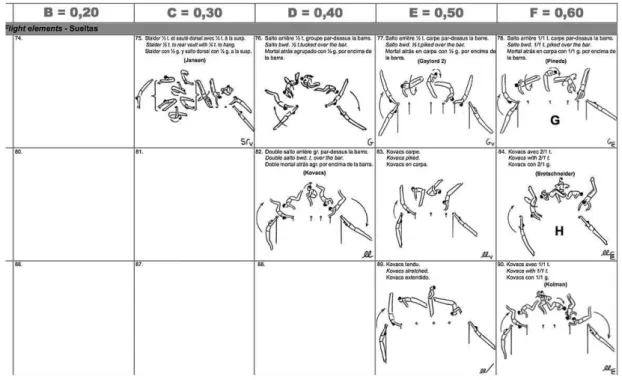
diff erent skills, for example, in the back somersaults performed on the TRA, and learning the Kovacs elements and its variations (among them, the Kolman), currently very common in the HB routines. In the words of C2:
In our gym, we don’t work with elastic surfaces very much, I think we can work with them more. Th e younger gymnasts train more in the elastic equipment (track, elastic bed), and that helps a lot. In the future, you will see the diff erence, because a gymnast who has greater spatial command can better perform elements that are more diffi cult. If he doesn’t learn an element, he shifts to another easier one. I think we could use the ES more (C3).
(morning and afternoon). Th is timeline may vary depending on the training period and that amount may be even reduced during pre-competitive periods, for instance. In the fi rst three age groups, its use is more frequent and regular than the seniors
(C3), given that the senior gymnasts practice more on the offi cial apparatus.
Gymnasts who are treating injuries, especially on the superior limbs, who could not use the apparatus, would have a greater use of the ES, trying not to completely interrupt their activities and maintaining them “active”28 in the gymnasium
(integrated with the group and the training routine). Th e pit foam, in particular, is frequently utilized during technical training, given that coaches prefer to use the apparatus over it, since it off ers greater
safety. Coach 1’s discourse reveals the general opinion regarding the use of the ES:
Although coaches recognize the importance of using the ES for the preparation of gymnasts, its systematic use (quantifi ed and temporalized) is still diffi cult due to the scarcity of equipment, their inferior quality and, mainly, by the lack of habit of its use. Th is contradiction can be noted in the discourse of the coaches:
Th e TT is used almost daily for training acrobatic sequences - tumbling (Round Off - Backward Handspring - Back Somersault; Forward Handspring - Front Somersault; Front Somersault - Front Somersault Full Twist, among others) signifi cantly increasing the number of repetitions completed. When one compares the acrobatic sequences completed on the fl oor with those on the TT, one clearly notices that, on the TT, a greater height is achieved in acrobatics, with less impact, and less demand of power from the lower limbs, making learning as well as improvement easier (C1). In fact, Coach 3 stated that: “[...] we use the Tumble Track more than the Trampoline, because it better simulates the Floor, greatly improving the acrobatic elements training”. Coach 1’s opinion helps to understand this process:
FIGURE 2 - MAG COP22 - Kovacs and its variations on the HB.
I frequently use the Tumble Track. To learn a new element, you use the track fi rst and then go to the Floor. When the gymnast has some
On the other hand, to train high difficult acrobatic elements, like dismounts in double somersault, the TRA is used on a more frequent basis, corroborating Turoff ’s11 position (p.238-9). An example that was observed repeatedly was the element Suarez of the PB, executed at fi rst on the TRA in order to master the activity and subsequently, reproduced on the apparatus itself. Coach 3 confi rms stating: “It is possible to work 50% of the Parallel Bars elements and almost all the elements of the Horizontal Bar on the Trampoline, and then transfer to the apparatus”.
In addition, using the TT is also common for the general physical preparation of gymnasts, with the execution of exercise sequences (vertical jumps, somersaults sequences (tucked; piked; stretched), hands repulsion off , cartwheels, round off s, forward and backward handspring, reverse vaults, etc.). Th e use of the TT is not more common because
Th ere’s an exercise that we call “kabum” - hitting your back and then throwing your ankles to make a countermovement. Many exercises, as like, the Diamidov for the Parallel Bars are trained this way. Th ere’s also the “Codis”, which is falling belly down and executing a somersault, a very common exercise for training the Tsukahara or
MAG has changed in many ways. Th e Horizontal Bar used to be rigid and today it is flexible so that it launches/bounce the gymnast.The improvement in the material assisted in the increase of the technical level; gymnasts today
perform more diffi cult elements than in the past. Today, the amount of movements is greater - some competitions have ten diffi cult elements - so the elastic surfaces have permitted the increase of training volume. In short, the elastic equipment (mats, trampoline, etc.) has improved greatly, and we need to accompany this (C3).
It seems clear that the diffi culty coaches’ face in incorporating the use of ES in training can also be attributed to the nonexistence of continued education as mentioned by C1 and C2. For this reason, due to the lack of instruction in the use of ES, this use depends on the knowledge acquired by coaches during visits, special trainings and other activities conducted in institutions abroad, as highlighted by C2:
Last year, I was in Russia and noticed that they frequently use the Trampoline, the Tumble Track, and other elastic surfaces. Recently, the coach of the Russian National Team was here in our gymnasium and talked extensively about the elastic surfaces. I also recall that in the American National Congress of AG (USA) there are always two or three lectures on the use of the Trampoline or the Tumble Track for technical training.
Although this is a case study, in dealing with a nationally renowned gymnasium, it suggests that this situation may point to the reality in regards to the nation-wide diffi culty in acquiring the ES (C3),
and also to the non-existence of specifi c continuing education (C2) and, consequently, to the lack of systematic use of the ES (C1).
Th erefore, we suggest clubs, state federations, should give greater attention and, mainly, by the Brazilian Gymnastics Federation, to the promotion of specific education program, as well as to encourage the national manufacture of ES with adequate quality for high-performance training. It is contradictory that a country that desires to become a world class international power in AG does not have national providers of approved apparatus by FIG and also ES training equipment, as Europe, USA, Japan, and Australia do.
Another recreational use for the ES was observed, allowing gymnasts “to play” during or at the end of training sessions particularly during non-competitive periods. Although they have been rare, these activities proved to be an interesting ludic option, in the middle of the strict and rigorous training system, typical of high-performance3.
MAG has shown a tendency to value acrobatic and fl ight elements increasingly using aerial space and making more “spectacular” routines, adjusting to the model of spectacular sports. A move towards more dynamic exercises can be observed, with the exception of the pommel horse, according to the sporting development logic reported by Vigarello5 in the 1980’s.
Technological development, in particular of the ES, can be viewed as a response to this tendency, noticeably modifying MAG’s training system21. As mentioned above, the ES are already a part of the day-to-day of the main AG high-performance training centers9. Nevertheless, the reality of the gym analyzed in this study shows the challenge for Brazilian clubs to follow this tendency, very likely due to the diffi culty of importing the equipment, given that Brazilian-made materials have not been approved by FIG for not off ering the same quality. Th is delay does not permit Brazilian clubs to follow the international tendency, as stressed by the discourse of the coaches:
Note
a. Patent registered in 1988: Nichols-Ketchum, M. Gymnastics bar and method of making the same. American Sports International, Ltd. (Jeff erson, IA) US Patent 6,475,118.
References
1. Bertalanff y LV. Teoria dos sistemas. Rio de Janeiro: Fundação Getúlio Vargas; 1976.
2. Parlebas P. Contribution à un lexique commenté en sciencie de l´action motrice. Paris: INSEP; 1981.
3. Bortoleto MAC. La lógica interna de la gimnasia artística masculina (GAM) y estudio etnográfi co de un gimnasio de alto rendimiento [tese]. Lleida (ESP): Institut Nacional d’Educació Física de Catalunya, Universutat de Lleida; 2004. 4. Bortoleto MAC. A Ginástica artística estudada a partir da óptica da praxiologia motriz: refl exões preliminares. In: Ribas
JMF, organizador. Jogos e esportes: fundamentos e aplicações da praxiologia. Santa Maria: UFSM; 2008. v.1, p.125-44. 5. Vigarello G. Une histoire culturelle du sport: techniques d’hier... et d’aujourd’hui. Paris: R. Laff ont/Revue EPS; 1988. 6. Oliveira MS, Bortoleto MAC. Apontamentos sobre a evolução histórica, material e morfológica dos aparelhos da ginástica
artística masculina. Rev Educ Fís/UEM. 2011;22:10-20.
7. Th omas L, Fiard J, Soulard C, Chautemps G. Gimnasia deportiva: de la escuela… a las asociaciones deportivas. Lérida: Agonos; 1997. 8. Smoleuskiy V, Gaverdouskiy I. Tratado general de gimnasia artística deportiva. Barcelona: Editorial Paidotribo; 1996. 9. Sands AW, Kimmel LW, Mcneal RJ et al. Kinematic and kinetic tumbling take-off comparisons of a spring-fl oor and
an air fl oor: a pilot study. Sci Gymnastics J. 2013;5:31-46.
10. Arkaev L, Suchilin NG. Gymnastics: how to create champions; the theory and methodology of training top-class gymnasts. Oxford: Meyer & Meyer; 2009.
11. Turoff F. Artistic gymnastics: a comprehensive guide to performance and teaching skills for beginners and advanced beginners. Dubuque: Brown; 1991.
12. Leglise M. Some medical observations on the development of high-level gymnastics. World Gymnastics. 1985;23:27. 13. Fink H. Some considerations for gymnastics conditioning. World Gymnastics. 1985;25:48.
14. Karacsony I, Cuk, I. Floor exercises: methods, ideas, curiosities, history. Ljubljana: University of Ljubljana Press; 2005. 15. Pérez P, Llana S, Alcántara E. Standard tests ability to measure impact forces reduction on mats. Int J Sports Sci Eng.
2008;2:162-8.
16. Kerwin DG, Yeadon MR, Harwood MJ. High bar release in triple somersault dismounts. J Appl Biomech. 1993;9:279-86. 17. Seele MK, Bressel EA. Comparison of upper-extremity reaction forces between the Yurchenko vault and fl oor exercise.
J Sports Scie Med. 2005;4:85-94.
18. JcNitt-Gray L, Yokoi T, Millward C. Landing strategies used by gymnasts on diff erent surfaces. J Appl Biomech.
Resumo
Ginástica artística masculina: é sistemático o uso das superfícies elásticas no processo de treinamento?
Em alguns esportes, o espaço de jogo representa o componente sistêmico de maior relevância: esse é o caso da Ginástica Artística (GA). Desse modo, quando nos empenhamos em compreender a lógica interna dessa modalidade precisamos dedicar especial atenção à relação ginasta-aparelho. Observamos uma mudança no paradigma de treinamento em que o uso das Superfícies Elásticas constitui um componente essencial, visando atender às características contemporâneas desse esporte, como a hipervalorização das acrobacias e a maior presença dos elementos ginásticos com “fase aérea”. Nessa oportunidade, analisamos, a partir de estudo de caso de um ginásio de treinamento de alto rendimento de Ginástica Artística Masculina, o emprego de diferentes Superfícies Elásticas (SpE) na preparação dos ginastas. Embora os treinadores reconheçam o papel fundamental das SpE para o desenvolvimento dos ginastas, seu uso cotidiano ainda é restrito a poucos
equipamentos e realizado de modo assistemático. Essas difi culdades se devem principalmente à ausência de programas formativos que desenvolvam metodologias específi cas e à inexistência de fornecedores de equipamentos nacionais com qualidade certifi cada pela Federação Internacional de Ginástica.
Acknowledgements
Th is study was partially funded with resources from CNPQ (Brazilian National Research Council) and CAPES (Coordination for the Improvement of Research and Higher Education) both agencies of the Federal Government of Brazil.
ENDEREÇO Marco Antonio Coelho Bortoleto Departamento de Educação Física e Humanidades Faculdade de Educação Física Universidade Estadual de Campinas R. Érico Veríssimo, 701 - Caixa Postal 6134
13083-970 - Campinas - SP - BRASIL e-mail: [email protected]
Recebido para publicação: 03/11/2015 Aceito: 17/12/2015
20. Piard C. Fondements de la gymnastique: technologie et pedagogie. Paris: Vigot; 1982. 21. Pozzo T, Studeny C. Th éorie et pratique des sports acrobatiques. Paris: Vigot; 1987.
22. International Gymnastics Federation. Apparatus norms. Lausanne: FIG; 2015. Available from: http://www.fi g--gymnastics.com/site/rules/app-norms.
23. Lüdke M, André ME. Investigação em educação: abordagens qualitativas. São Paulo: EPU; 1986. 24. Severino AJ. Metodologia do trabalho científi co. São Paulo: Cortez; 1989.
25. Triviños ANS. Introdução à pesquisa em ciências sociais: a pesquisa qualitativa em educação. São Paulo: Atlas; 1992. 26. Souza Júnior MB, De Melo MST, Santiago ME. A análise de conteúdo como forma de tratamento dos dados numa
pesquisa qualitativa em educação física escolar. Movimento. 2010;16:29-47. 27. Bardin L. Análise de conteúdo. Lisboa: Ediç õ es 70; 2008.
28. Chase MA, Magyar MT, Drake BM. Fear of injury in gymnastics: self-effi cacy and psychological strategies to keep on tumbling. J Sport Sci. 2005;23:465-75.