Fisioter. Mov., Curitiba, v. , n. , p. - , Jan./Mar. Licenciado sob uma Licença Creative Commons DO): http://dx.doi.org/ . / - . . .AO
[T]
Portraying the amputation of lower limbs: an approach using ICF
Retratando a amputação de membros inferiores:
uma abordagem por meio da CIF
Erádio Gonçalves Junior[a], Rodrigo José Knabben[b], Soraia Cristina Tonon da Luz[a]*
[a] Universidade do Estado de Santa Catarina UDESC , Florianópolis, SC, Brazil [b] Universidade Federal de Santa Catarina UFSC , Florianópolis, SC, Brazil
Abstract
Introduction:Amputation is a trauma that involves important functional, psychological and social
sequel-ae. The )nternational Classi ication of Functioning, Disability and (ealth )CF is based on the biopsychoso-cial model and enables understanding functioning and disability through the interaction of its components. Objective: This study’s aim was to depict functioning and disability using the )CF conceptual interaction
model from the perspective of individuals who suffered a lower limb amputation.Methods: The qualitative
approach was used and included a semi-structured interview held with six participants.Results:All the
participants used assistive devices such as crutches, wheelchairs or walkers: three used prostheses and the other three emphasized their dif iculty in acquiring prostheses from the Social Security Service or Public (ealth System. Social support, especially that provided by family and friends, is a major facilitator. The im-portance of acquiring and adapting prostheses to enable the rehabilitation of amputees became clear; how-ever, rehabilitation is not restricted to the acquisition of prostheses. A rehabilitation program directed to restoring functionality is needed. Conclusion: The multidirectional approach using the )CF’s conceptual
interaction model enabled important insights concerning public health issues, such as obstacles related to the access to rehabilitation services and a lack of preparedness on the part of health professionals in rela-tion to care provided to amputees.
Keywords:Amputation. )nternational Classi ication of Functioning, Disability and (ealth )CF . Rehabilitation.
* EGJ: MS, e-mail: [email protected]
Resumo
Introdução: A amputação é um trauma que envolve sequelas funcionais, psicológicas e sociais importantes. A Classiϔicação Internacional de Funcionalidade, Incapacidade e Saúde (CIF) baseia-se no modelo biopsicos-social e permite a compreensão dos processos de funcionalidade e incapacidade através da interação dos seus componentes. Objetivo: O objetivo deste estudo foi retratar o processo de funcionalidade e de incapaci-dade por meio do Modelo de Interação Conceitual da CIF a partir da percepção de pessoas que sofreram am-putação de membro inferior. Métodos: Utilizou-se abordagem qualitativa com realização de uma entrevista semiestruturada, aplicadas em seis sujeitos. Resultados: Todos os entrevistados faziam uso de dispositivos auxiliares de marcha como muletas, cadeira de rodas, andadores sendo que três deles possuíam prótese, e os outros três destacaram diϔiculdades de aquisição da mesma por meio do SUS ou Previdência Social. O suporte social, sobretudo aquele oferecido pelos familiares e amigos, é importante facilitador. Ficou evidenciada a importância da aquisição e adaptação à prótese para reabilitação da pessoa amputada, porém reabilitar não é somente adquirir a prótese, pois é preciso da reabilitação para a funcionalidade. Conclusão: A abordagem multidirecional, por meio modelo de interação conceitual da CIF, permitiu reϔletir questões importantes da saúde pública, como os obstáculos relacionados ao acesso aos serviços de reabilitação e o despreparo dos proϔissionais de saúde no cuidado à pessoa amputada.
Palavras-chave: Amputação. Classiϔicação Internacional de Funcionalidade, Incapacidade e Saúde (CIF). Reabilitação.
Introduction
The amputation of lower limbs is a trauma that involves important functional, psychological and social sequelae that interfere in the individual’s quality of life , . )t is a public health problem faced around the globe. Amputations of lower limbs are estimated to account for % of all amputations, though there is no precise information concerning this epidemiology in Brazil .
Looking at the amputee from the perspective of functionality broadens horizons and contextualizes the individual, family, and community from a social perspective, giving priority to aspects related to social inclusion, the performance of activities and the participation of the individual in his/her family, community and society , . The Amputee National Guidelines recommend that the )nternational Classi ication of Functioning, Disability and (ealth )CF be used in research, surveillance and reports, and also by workers from the public health system to monitor the functional status of amputees , . The use of the )CF among individuals who experienced amputations ensures their right to move through different functional conditions, clarifying, for instance, the bene its accruing from the use of prostheses provided by the Brazilian Public (ealth System SUS during daily living activities. Rehabilitation actions stand out and provide a feasible alternative for the government, together with social support mechanisms, to qualitatively assess the
process in which individuals with disabilities recover their autonomy and quality of life .
)n addition to a universal coding scheme, the )CF proposes a model to think of functioning and disability based on the junction of two dichotomous models: interest in disability biomedical model and social interest social model . The biomedical model considers disability a problem of the person directly caused by a disease, trauma or any other health condition that requires medical care under the form of individual treatment provided by healthcare workers . The social model considers disability to be primarily a problem created by society, in which disability is not an attribute of the individual, rather a complex set of conditions, many of which are created by the social environment itself. (ence, the solution for the health problem, in that understanding, requires social action and is the responsibility of society to make the necessary environmental changes .
The )CF also enables assessing the impact of the pres-ence or abspres-ence of facilitators and barriers that positively or negatively in luence an amputee’s functional perfor-mance. Environmental barriers, such as inaccessible physi-cal environment, lack of appropriate assistive technology, negative attitudes of people toward disability, as well as
99
The study was approved by the )nstitutional
Review Board at UDESC No. . in accordance
to Resolution No. / . All the participants were
informed of the study’s objectives and data collection procedures and voluntarily signed free and informed consent forms and agreed with being recorded so that all ethical precepts concerning con identiality, anonym-ity and freedom to withdraw from the study at any time were complied with.
Data were collected in two stages: a questionnaire addressing personal information and history of amputa-tion was completed and then a semi-structured interview was conducted.
The interviewer was a physical therapist with six years of experience in the ield of collective health and two years caring for patients with amputated lower limbs. A pilot test was initially conducted with interviews held with three individuals in order to be familiarized with the instrument and the dialogical approach with the population under study.
)mmediately after the pilot test, the interviews were individually conducted in a private room. )nterviews were audio recorded and guided by a script addressing the study’s questions in order to capture the perceptions and opinions of the participants concerning the main barri-ers and facilitators involved in the process of therapeu-tic choices: access to health services, including Primary (ealth Care P(C , and average and high complexity services; access to assistive devices and prostheses; and access to rehabilitation, in order to portray functioning and disability as experienced after an amputation.
As part of the methodological process, the authors transcribed the audio-recorded interviews and checked the transcriptions. At this point, data analysis was initi-ated through pre-analysis, exploration of material, treat-ment and interpretation of data. )n this process, the raw material was organized into categorized thematic units based on the )CF components. The thematic units can be seen as units of meaning that naturally emerge from a text . To adapt the narratives so that they correspond to the standardized )CF language, transcription and coding of data was based on the model provided by Cieza et al. . The transcription is a resource, through which the researcher makes the context more accessible to readers, re-elaborating the text and giving emphasis to each
inter-view’s vital tone and the most expressive categories .
Data were organized into frames representing the Conceptual Model of )nteraction of )CF components . The diagram shows that disability and functioning are seen as the result of interactions between health The onset of a disability brings with it numerous
bar-riers with the potential to harm an individual’s physical, social and economic wellbeing, aside from potentially hav-ing an adverse impact on education, employment, income and unequal access to health services, political and social participation , , .
The identi ication of barriers to the access of health public services can help explain why people who have experienced amputation wait so long to obtain prosthe-ses and usually are able to access rehabilitation services
provided by the SUS only late in the process .
Few studies explore the perceptions of individuals con-cerning their functioning and also take into account the in-dividuals’ cognitive, emotional, and motivational states and how contextual factors interact in the social environment
to produce disability . Based on the understanding
that the context that emerges when a disability is involved essentially individual and depends on the environment, this study’s objective was to portray the functioning and disability spectrum through the Conceptual )nteraction Model provided by the )CF based on the perceptions of people who had their lower limbs amputated.
Methods
This is a descriptive, exploratory study with a qualitative approach. Qualitative studies focus on the individual as a whole and on the context of the world s/he experiences, trusting subjective reports and experiences, enabling a greater range of meanings and unexpected connections. Additionally, they focus on the individual so s/he is able to express personal feelings and experiences,
giving him/her a voice , .
experienced the amputation of a lower limb participated. All the participants reported their perceptions concern-ing the main barriers and facilitators involved in rehabili-tation. Of the interviewees, two were women and four were men, aged from to years old, with an average
age of years SD ± . . )n regard to their marital
statuses, three were married, two were single and one was separated. Regarding the amputation, ive had a transfemoral amputation and only one had a transtibial amputation; three presented traumatic etiology )CD T - caused by traf ic accidents and three presented a vascular etiology )CD ) - . Time since
amputation ranged from to years ± . ; three
in-dividuals used prostheses and three did not.
The participants’ occupations prior to amputation were: one dressmaker, one security guard, one admin-istrative assistant, one truck driver, one cement mason assistant, and one isherman. Currently, most participants are either off work or retired due to the amputation ive participants .
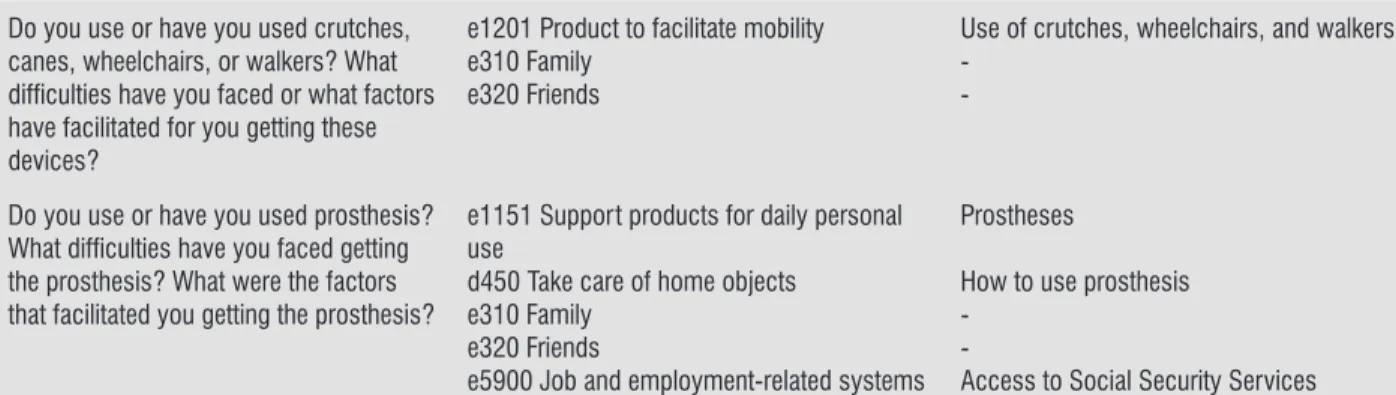
The transcription and coding of primary data were grouped according to the script’s questions and are pre-sented in Table .
The irst diagram Figure depicts the functioning and disability of amputees who did not have prostheses. The health condition generated by the amputation im-pacted the interviewees’ body structures and functions, as reported by the participants and transcribed in accor-dance with standardized )CF language: decreased muscle tone and decreased movement amplitude; changes in tactile function itching and change in stump sensitiv-ity ; and change in emotional functions moments of discouragement .
conditions diseases, disorders, injuries and contextual factors. Contextual factors include external factors e.g., social attitudes, architectural characteristics, legal and social structures, as well as climate, terrain, and so on , while internal factors include gender, age, lifestyle, social status, education, occupation, past and present experi-ences, general behavior, character, and other factors that in luence the way disability is experienced by individuals.
The participants’ individual diagrams enable depict-ing and interpretdepict-ing the interaction among the biopsy-chosocial )CF model’s components involved in the dis-ability of each amputee. To facilitate the presentation of data, we created two diagrams unifying data provided by the three interviewees with prostheses and the three without prostheses. Data were presented according to the important role prostheses play in one’s health con-dition, to facilitate both the physical and psychological
rehabilitation of individuals .
The theoretical framework was based on the )nternational Classi ication of Functioning, Disease and (ealth from the W(O Collaborative Center for the Classi ication of Diseases in Portuguese, University of
São Paulo, and published in Brazil by EDUSP in .
This study was inancially supported by the Research Support Foundation of Santa Catarina State FAPESC ,
process No. / and by CNPq, Brazil, process No.
/ .
Results
The interviews generated minutes of recording
and lasted minutes, on average. Six individuals who
Table 1 - Description of ICF categories based on the Interview Script
Item ICF category Additional Information
Which health services have you been through since your amputation? What do you think of the access to these places?
e5801 Health-related systems d470 Using transportation
e5400 Transportation-related systems
Diffi cult access to rehabilitation services
-Diffi culty in using public transportation services
Have you ever been to the Health unit after the amputation? How do you see your health unit?
e5801 Health-related systems d5209 Caring for body parts
Care provided to amputees, professionals’ technical background, distance from the health unit
Guidance on stump bandaging
Have you ever consulted with experts, such as orthopedists, physiatrists, vascular, physical therapists,
occupational therapists, psychologists or nutritionists?
e5801 Health-related systems d4602 Mobility outside home
Participation in UDESC’ extension project and professionals’ technical background
101
Do you use or have you used crutches, canes, wheelchairs, or walkers? What diffi culties have you faced or what factors have facilitated for you getting these devices?
e1201 Product to facilitate mobility e310 Family
e320 Friends
Use of crutches, wheelchairs, and walkers
-Do you use or have you used prosthesis? What diffi culties have you faced getting the prosthesis? What were the factors that facilitated you getting the prosthesis?
e1151 Support products for daily personal use
d450 Take care of home objects e310 Family
e320 Friends
e5900 Job and employment-related systems
Prostheses
How to use prosthesis
-Access to Social Security Services
Note: Interviews with the participants and coding based on the Model adapted by Cieza (2005).
Note: Structured Interview Script organized according to the ICF Conceptual Model (World Health Organization, 2003).
Figure 1 - ICF Conceptual Interaction Model – Amputees who do not use prostheses.
(Conclusion)
The study’s participants report various limitations, especially those related to self-care, home tasks, speci ic dif iculties regarding stump bandaging, and exercis-ing. Limitations regarding mobility, such as dif iculties moving within and outside the home, even with the help of assistive devices to facilitate gait, dif iculty using transportation driving a motor vehicle or using public transportation . Additionally, the reports indicated indi-viduals are signi icantly restricted in their participation in their social milieu, which is evidenced by abandon-ment of leisure activities and sports, loosing their jobs, and social isolation.
)n terms of environmental factors, most reports present the following facilitators: the physical ther-apy provided in the extension Project: Amputees Multidisciplinary Rehabilitation UDESC , family and friends support, the quality of health care provided
in the hospital setting and in health units. Assistive devices such as wheelchairs, walkers and crutches were other environmental factors considered to facili-tate functioning.
The interviewees who did not use prostheses also reported barriers in the health system, obstacles that are faced accessing specialized services expected within a rehabilitation program e.g., physical and psychologi-cal therapy and in access to prostheses. Other barriers involve a lack of preparedness of healthcare workers to provide care to amputees, such as not providing guid-ance on stump bandaging. Dif icult access to health units, given geographical distance, as well as dif iculty obtaining medication in these places also stood out.
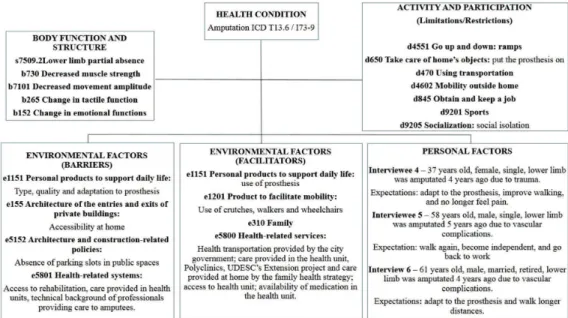
impact on the interviewees’ body structures and func-tions such as: partial absence of lower limb; cardiore-spiratory function; pain in the stump; and decreased movement amplitude.
The participants who use prostheses pointed out limitations regarding mobility for short and long dis-tances, or even leaving home, emphasizing dif iculties going down ramps using prosthesis, using public trans-portation and driving a motor vehicle. Limitations in putting the prosthesis on and participating in sports were also reported. )n regard to restricted participa-tion, similar to the irst diagram, the participants re-ported losing their jobs and social isolation caused by the disability.
lack of welfare bene its. The interviewees who do not use prostheses noted that the public transportation is an environmental barrier that mainly impedes partici-pation in social situations.
When we analyze personal factors, expectations concerning rehabilitation stand out, especially the ac-quisition of prostheses, and, therefore, the possibility of walking again, of being able to perform household chores and leisure activities. Another expectation fre-quently mentioned by the participants was related to the possibility of retiring.
The second diagram Figure represents the functioning and disability spectrum of amputees using prostheses. Also, the amputation continues to have an
Note: Structured Interview Script organized according to the ICF Conceptual Model (World Health Organization, 2003)
Figure 2 - ICF Conceptual Interaction Model – Amputees who use prostheses.
)n regard to the environmental factors, the par-ticipants reported that a prosthesis is an important facilitator of the rehabilitation process, as well as the care provided by the Extension Project: Amputee Multidisciplinary Rehabilitation UDESC . They also reported the care provided at home by the family health teams after amputation, in addition to access to healthcare and medication provided by the health units. Transportation provided by the city government or their own means of transportation stood out as important facilitators of an individual’s mobility.
Barriers faced in health services, access to reha-bilitation and physical therapy treatment, a lack of
preparedness on the part of healthcare workers, and lack of guidance stood out. )n regard to personal prod-ucts provided to support daily life, barriers included the quality of prostheses provided by the SUS and lack of guidance on how to use these devices, which hinder adaptation to equipment in daily life.
103
Family support is an important facilitator of the regaining the ability to function because it enables social participation and encourages self-care. Pedrinelli states that support, especially that provided by the family, is one of the most important aspects on a patient’s recovery, because the family is one of the human being’s main groups of reference. This fact was also evidenced in other studies in which individuals receiving greater social support present better health conditions, and better physical and psychological performance, in addition to greater treatment adherence , . A study conducted with patients who had lower limbs amputated reports a high correlation between )CF quali iers and the results of a quality of life scale
SF-, especially in the social function domain.
)n regard to products intended to facilitate mobility, the interviewees reported that assistive devices such crutches, walkers, and wheelchairs provided by the SUS are accessible. Access to prostheses, however, as well as their quality, requires attention. While those who did not have prosthesis reported a long wait to acquire them, those who already had prostheses reported various barriers related to the type and quality of these devices, and a lack of appropriate training that hindered adaptation to the equipment, and both of which caused pain and premature tiredness when walking. Therefore, these devices end up interfering in daily activities and
limiting the participation of individuals in society .
Despite the technological advancements achieved in prosthetic components that enable tailored itting systems according to the pro ile of each patient, the devices provided by the SUS are still traditional devices with little technology in terms of precision, quality, comfort or use. The material used does not always follow scienti ic technical criteria and, when meeting resistance criteria, they present problems related to excess weight that causes signi icant inconvenience to users and added
costs to the SUS .
According to Salawu et al. , the manufacturing
of prostheses requires speci ic knowledge, especially in regard to itting a prosthesis, otherwise the individual may experience wounds on the stump caused by a poor it, eventually requiring the interruption of its use, restricting the individual’s activities, and even preventing him/her from working. Tonon da Luz concluded that wounds and weariness related to a stump cause functional limitations directly affecting amputees’ quality of life.
Prostheses play an important role in rehabilitation because they compensate for functional loss and architecture and construction due to a lack of parking
spaces and accessible areas for disabled individuals ar-riving at specialized outpatient services.
Personal factors of those using prostheses included expectations for the rehabilitation process and adapta-tion to the prosthesis, the possibility of walking longer distances, and becoming independent. Additionally, one interviewee highlighted his desire to be rehired and have a paid job.
Discussion
Two speci ic diagrams were developed Figures and and portray the functioning and disability of amputees using the )CF Conceptual )nteraction Model. The hypothesis was that individuals who used prostheses would face fewer personal and environmental barriers and fewer dif iculties performing activities and engaging in social participation. The functional portraits, however, show various inter-relationships among the functioning components proposed by the )CF, with many causes and effects experienced by both those using prostheses and those who did not. All the amputees experienced limitations in activities and restrictions on social participation, suggesting that the process faced after
an amputation includes many functional losses , .
)n general, the participants who used prostheses presented similar characteristics, even given a health condition that impacts body structures and functions, while aspects such as pain, changed sensitivity, decreased strength and movement amplitude, become a common aspect seen as components that restrict an individual’s activities. This shows the negative effect of amputation on one’s body structures and functions that result in dif iculties faced in the individuals’ performance of daily living activities and in their mobility, as observed by other
studies , . These limitations, in turn, in luence
the participation of the individuals in the community, as they induce a process of becoming socially isolated, both for those using prostheses and those who do not. These negative responses may interfere in one’s recovery and self-care, as well as possibly leading to a feeling of discouragement and hopelessness regarding
the recovery process . Additionally, shame and
social stigma and a feeling of suffering discrimination due to one’s physical condition can result in aversion to one’s own body. For that, social support networks are extremely important in the coping process and in
There are also dif iculties regarding the possibility of going back to work related to professional rehabilitation. )n the )CF Activity and Participation component, only one of the interviewees continues to work after amputation. The others reported being off work or retired. Considering that the average age of the participants was years, thus considered to be in a productive age bracket, professional rehabilitation has not been effective. This aspect may be related to barriers found in the Social Security Service due to failures in the professional rehabilitation model provided by the state. The service does not comply with what is provided in the Social Security Law regarding professional habilitation and rehabilitation in order to professionally and socially re insert individuals, victims of some injury or sequelae,
and his/her dependents , .
Guarino observed this situation when he
analyzed the rate of return to work among individuals with lower limb amputations. (e veri ied that of these individuals were retired and only resumed work, while the remaining had some continued bene it or were seeking a job.
Despite considerable spending on disability compensation and early retirement, which could often be avoided, there is a lack of speci ic and well-planned actions, the implementation of which depends on political-administrative will and a paradigm shift regarding an increased focus on the etiology of all these
health conditions .
The way the )CF was structured, with its dimensions that comprise various health conditions, healthcare workers are able to see the patient individually and to identify situations that are not normally identi ied in routine assessments, but which end up interfering in the lives of these individuals and in their social participation. The importance of using the )CF across disciplines becomes clear and this study facilitates its use in various settings, such as clinical practice, teaching and research.
Conclusion
This study clari ied the following interactions among )CF components: the amputation of a lower limb changes one’s body structure and functions, as it decreases mus-cle tone and movement amplitude, in addition to chang-es directly related to the stump, such as decreased local sensitivity. These changes directly affect participation in activities, especially those regarding mobility, leading to social isolation. Various environmental barriers were improve mobility. Their quality in luences adaptation
so that the heavier the prosthesis, the greater one’s energetic expenditure and the poorer is mobility, which impairs quality of life and decreases satisfaction , . Additionally, aspects such as prosthesis alignment and symmetry contribute to better adaptation and functionality, enabling the individual to more rapidly
resume work and social life .
Nonetheless, the rehabilitation of an amputee does not necessarily include prostheses; as shown in this portrayal of the )CF, having a prosthesis is not synonymous of independence. There is a need for a rehabilitation process focused on functionality to enable individuals to perform daily living activities within their social environments, regardless the use of prostheses
, .
These individuals experience many barriers in the health system and services, which negatively affect their activities and participation, hindering access to the specialized care necessary for those with an amputation and to their rehabilitation multidisciplinary treatment . The reports indicate a lack of preparedness on the part of healthcare workers when providing care to amputees, not providing appropriate guidance regarding stump care and bandaging. This situation harms the delivery
of integral care and effective rehabilitation .
)n contrast, access to the Extension Project: Amputee Multidisciplinary Rehabilitation UDESC appears as a facilitating environmental factor for functioning. The university extension project makes an effort to provide care to amputees in an attempt to compensate for barriers faced when accessing rehabilitation services within the Brazilian health system. The Amputee National Guidelines, a document sanctioned by the Ministry of (ealth, reinforces the importance of the early implementation of rehabilitation actions and of preventing disabilities through an integrated rehabilitation services network; in practice, however, there are many gaps caused by a lack of resources and effective implementation of policies directed to disabled people, in which care delivery, when available,
is disconnected and disorganized , .
Additionally, many disabled individuals cannot leave their homes due to architectural problems both in their own abodes and in public areas, due to mobility
problems and transportation, among others , .
105
. Fréz AR, Abdallah AA, Riedi C, Galindo J, Ruaro JA, Ribeiro SC. Proposed use of the international classi ication of functioning, disability and health to evaluate quality of life after an amputation.Fisioter Mov. ; : - . . Araujo ES. C)F: Uma Discussão sobre Linearidade no Mod-elo Biopsicossocial. Rev Fisioter S Fun. ; : - . . Araujo ES, Buchalla CM. Uma proposta de uso da C)F em
Fisioterapia. FisioBrasil. ; : - .
. Stucki G, Reinhardt JD, Grimby G, Melvin J. O desen-volvimento da Pesquisa em funcionalidade humana e reabilitação a partir de uma perspectiva abrangente. Acta Fisiatr. ; : - .
. Siqueira FCV, Facchini LA, Silveira DSD, Piccini RX, Thumé E, Tomasi E. Barreiras arquitetônicas a idosos e portadores de de iciência ísica: um estudo epide-miológico da estrutura ísica das unidades básicas de saúde em sete estados do Brasil. Cienc Saude Coletiva.
; : - .
. Algurén B, Lundgren-Nilsson A, Sunnerhagen KS. Facili-tators and barriers of stroke survivors in the early post-stroke phase. Disabil Rehabil. ; : - . . Gallagher P,O'Donovan MA,Doyle A,Desmond D.
Envi-ronmental barriers, activity limitations and participation restrictions experienced by people with major limb am-putation. Prosthet Orhot )nt. ; : - . . Schoeller SD, Silva DMGV, Vargas MAO, Borges AMF, Pires
DEP, Bonetti A. Características das Pessoas Amputadas Atendidas em um Centro de Reabilitação. REUOL.
; : - .
. Lima A, Viegas CS, Paula MEM, Silva FCM, Sampaio RF. A qualitative approach of interactions between the do-mains of the )nternational Classi ication of Functionality, Disability, and (ealth. Acta Fisiatr. ; : - . . Minayo MCS. O desa io do conhecimento: pesquisa
quali-tativa em saúde. th ed. São Paulo: (ucitec; . . Bragaru M, van Wilgen CP,Geertzen J(,Ruijs SG,Dijkstra
PU,Dekker R. Barriers and facilitators of participation in sports: a qualitative study on Dutch individuals with lower limb amputation. PloS One. ; :e . . Bardin L. Análise de conteúdo. Lisboa: Edições ; . . Cieza A, Geyh S, Chatterji S, Kostanjsek N, Ust“n B, Stucki G. )CF linking rules: an update based on lessons learned. J Rehabil Med. ; : - .
reported regarding dif icult access to health services or lack of preparedness on the part of healthcare workers in regard to the care provided to amputees. A family and friends support network can ease the social reinsertion of individuals who expect to be able to resume indepen-dent daily living activities and work.
The multidirectional approach, through the use of the )CF conceptual interaction model, enabled re lection upon important issues from the public health sphere, such as obstacles related to access to specialized ser-vices necessary when there is a condition of amputa-tion. The relevance of having access to prostheses for the rehabilitation of amputees became clear; however, rehabilitation does not necessarily mean acquiring prostheses. There is a need to implement a rehabilita-tion process directed to the individual’s funcrehabilita-tioning.
We suggest that future studies include instruments or scales that enable assessing functioning and disabil-ity through )CF coding and quali iers to measure and compare data among health services, countries and at different points of the rehabilitation process. We also veri ied the need for studies addressing and compar-ing perceptions of amputees who use prostheses and those who do not.
References
. Pedrinelli A. Tratamento do Paciente com Amputação. st ed. São Paulo: Roca, . Portuguese.
. (awkins AT,(enry AJ,Crandell DM,Nguyen LL. A Sys-tematic Review of Functional and Quality of Life Assess-ment after Major Lower Extremity Amputation. Ann Vasc Surg. ; : - .
. Brasil. Ministério da Saúde. Secretaria de Atenção à Saúde. Departamento de Ações Programáticas Estraté-gicas. Diretrizes de atenção à pessoa amputada / Minis-tério da Saúde, Secretaria de Atenção à Saúde, Depar-tamento de Ações Programáticas Estratégicas. st ed. Brasília: Ministério da Saúde; [cited Nov ]. Available from: http://tinyurl.com/h xjd . Portuguese. . Organização Mundial da Saúde. Classi icação )nternacio-nal de Funcio)nternacio-nalidade, )ncapacidade e Saúde. São Paulo: Edusp; . Portuguese.
. Burger (. Can the )nternational Classi ication of Func-tioning, Disability and (ealth )CF be used in a prosthet-ics and orthotprosthet-ics outpatient clinic? Prosthet Orthot )nt.
. Carvalho JA. Amputações de membros inferiores: em busca da plena reabilitação. São Paulo: Manole; . Portuguese.
. Nunes MAP, Resende KF, Castro AA, Pitta GBB, Poli de Figueiredto LF, Miranda Jr F. Fatores predisponentes para amputação de membro inferior em pacientes di-abéticos internados com pés ulcerados no estado de Sergipe. J Vasc Bras. ; : - .
. Walcker LP. Erro humano: diretrizes para um centro de referência em medicina ísica e reabilitação do Sistema Único de Saúde [dissertation]. Florianópo-lis Brazil : Universidade Federal de Santa Catarina;
. Portuguese.
. Souza CCBX, Rocha EF. Portas de entrada ou portas fechadas? O acesso à reabilitação nas unidades básicas de saúde da região sudeste do município de São Paulo – período de a . Rev. Ter. Ocup. Univ Sao Paulo.
; : - .
. Brasil. Decreto n. . , de de maio de . Aprova o regulamento da Previdência Social e dá outras providên-cias. Diário O icial da União, Brasília, DF, Maio [cited Jun ]. Available from: http://tinyurl. com/ uey w . Portuguese.
. Brasil. Lei n. . , de de julho de . Dispõe so-bre os Planos de Bene ícios da Previdência Social e dá outras providências. [cited Jun ]. Available from: http://www.planalto.gov.br/ccivil_ /leis/L cons. htm. Portuguese.
. Guarino P, Chamlian TR, Masiero D. Retorno ao trabalho em amputados dos membros inferiores. Acta Fisiatr.
; .
. Oliveira ACB. Promoção de saúde e a funcionalidade humana. Rev Bras Promoc Saude. ; : - .
Received in / /
Recebido em / /
Approved in / /
Aprovado em / /
. Osinaga VLM, Vieira MJ, Armelin MVAL, Furegato ARF. Trabalhando com histórias de vida de familiares de paci-entes psiquiátricos. Rev Esc Enf USP. ; : - . . Franchini MG, Savoia, MG. Psicoterapia de grupo para
pacientes diabéticos amputados e seus cuidadores. Arq Med (osp Fac Cienc Med Santa Casa Sao Paulo.
; : - .
. Schoppen T, Boonstra A,Groothoff JW,de Vries J,Göeken LN,Eisma W(. Physical, mental, and social predictors of functional outcome in unilateral lower-limb ampu-tees. Arch Phys Med Rehabil. ; : - . . Dornelas LF. Funcionalidade de pessoas amputadas por
acidentes de trânsito após adaptação protética: série de casos. Rev Neurocienc. ; : - .
. Wald J, Alvaro R. Psychological factors in work-related amputation: considerations for rehabilitation counsel-ors. J Rehabil. ; : .
. Gabarra LM, Crepaldi MA. Aspectos psicológicos da cirurgia de amputação. Aletheia. ; : - . . Queiroz WF. Desenvolvimento de métodos construtivos
e de novos materiais empregados na confecção de car-tuchos de próteses de membros inferiores [dissertation]. Natal Brazil : Universidade Federal do Rio Grande do Norte; . Portuguese.
. Salawu A, Middleton C, Gilbertson A, Kodavali K, Neu-mann V. Stump ulcers and continued prosthetic limb use. Prosthet Orthot )nt. ; : - .
. Tonon da Luz SC. Valoración del daño corporal en am-putados de miembros inferiores [dissertation]. Sevilla
Spain : Universidad Pablo de Olavide; . Spanish. . Zidarov D, Swaine B, Gauthier-Gagnon C. Quality of life of
persons with lower-limb amputation during rehabilita-tion and at -month follow-up. Arch Phys Med Rehab.
; : - .
. Pavani R, Pavani G, Ribeiro J. Ressigni icando o uso de materiais em próteses totais de membros inferiores. Uberlândia Brazil : Enebi – Encontro Nacional de En-genharia Biomecânica; . Portuguese.