www.jped.com.br
ORIGINAL ARTICLE
Validation of transcutaneous bilirubin nomogram for identifying
neonatal hyperbilirubinemia in healthy Chinese term and
late-preterm infants: a multicenter study
夽
Zhangbin Yu
a, Shuping Han
a, Jinxia Wu
b, Mingxia Li
c, Huaiyan Wang
d,
Jimei Wang
e, Jiebo Liu
f, Xinnian Pan
g, Jie Yang
h, Chao Chen
i,∗aDepartment of Pediatrics, Nanjing Maternity and Child Health Care Hospital of Nanjing Medical University, Nanjing, China
bDepartment of Neonatology, Inner Mongolia Maternal and Child Health Care Hospital, Huhehot, China
cDepartment of Neonatology, The First Affiliated Hospital of Xinjiang Medical University, Urumqi, China
dDepartment of Neonatology, Changzhou Maternal and Child Health Care Hospital, Changzhou, China
eDepartment of Neonatology, Gynecology and Obstetrics Hospital, Fudan University, Shanghai, China
fDepartment of Pediatrics, The Fifth People’s Hospital of Shenzhen, Shenzhen, China
gDepartment of Neonatology, Guangxi Maternal and Child Health Hospital, Nanning, China
hDepartment of Neonatology, Guangdong Maternal and Children’s Hospital, Guangzhou Medical College, Guangzhou, China
iDepartment of Neonatology, Children’s Hospital of Fudan University, Shanghai, China
Received 18 July 2013; accepted 20 August 2013 Available online 5 February 2014
KEYWORDS
Hyperbilirubinemia; Jaundice;
Neonatal; Bilirubin; Newborn
Abstract
Objective: to prospectively validate a previously constructed transcutaneous bilirubin (TcB) nomogram for identifying severe hyperbilirubinemia in healthy Chinese term and late-preterm infants.
Methods: this was a multicenter study that included 9,174 healthy term and late-preterm infants in eight hospitals of China. TcB measurements were performed using a JM-103 biliru-binometer. TcB values were plotted on a previously developed TcB nomogram, to identify the predictive ability for subsequent significant hyperbilirubinemia.
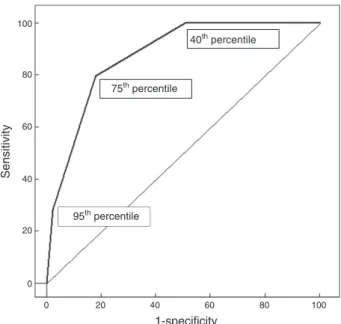
Results: in the present study, 972 neonates (10.6%) developed significant hyperbilirubinemia. The 40thpercentile of the nomogram could identify all neonates who were at risk of significant hyperbilirubinemia, but with a low positive predictive value (PPV) (18.9%). Of the 453 neonates above the 95th percentile, 275 subsequently developed significant hyperbilirubinemia, with a high PPV (60.7%), but with low sensitivity (28.3%). The 75thpercentile was highly specific (81.9%) and moderately sensitive (79.8%). The area under the curve (AUC) for the TcB nomogram was 0.875.
夽 Please cite this article as: Yu Z, Han S, Wu J, Li M, Wang H, Wang J, et al. Validation of transcutaneous bilirubin nomogram for identifying neonatal hyperbilirubinemia in healthy Chinese term and late-preterm infants: a multicenter study. J Pediatr (Rio J). 2014;90:273---8.
∗Corresponding author.
E-mail:[email protected] (C. Chen).
Conclusions: this study validated the previously developed TcB nomogram, which could be used to predict subsequent significant hyperbilirubinemia in healthy Chinese term and late-preterm infants. However, combining TcB nomogram and clinical risk factors could improve the predictive accuracy for severe hyperbilirubinemia, which was not assessed in the study. Further studies are necessary to confirm this combination.
© 2014 Sociedade Brasileira de Pediatria. Published by Elsevier Editora Ltda. All rights reserved.
PALAVRAS-CHAVE
Hiperbilirrubinemia; Icterícia;
Neonatal; Bilirrubina; Neonatos
Validac¸ão de um nomograma de bilirrubina transcutânea para identificac¸ão de hiperbilirrubinemia neonatal em neonatos a termo e pré-termo tardios saudáveis na China: um estudo multicêntrico
Resumo
Objetivo: validar de forma prospectiva um nomograma de bilirrubina transcutânea (BTc) para identificar hiperbilirrubinemia grave em neonatos a termo e pré-termo tardios saudáveis na China.
Métodos: foi realizado um estudo multicêntrico que incluiu 9174 neonatos a termo e pré-termo tardios saudáveis em oito unidades da China. Foram realizadas dosagens de BTc utilizando um bilirrubinômetro. Os valores de BTc foram trac¸ados em um nomograma de BTc para identificar a capacidade de predic¸ão de hiperbilirrubinemia significativa.
Resultados: 972 recém-nascidos (10,6%) desenvolveram hiperbilirrubinemia significativa. O percentil 40 de nosso nomograma pode identificar todos os recém-nascidos com risco de hiper-bilirrubinemia significativa, porém com baixo valor preditivo positivo (VPP) (18,9%). De 453 recém-nascidos acima do percentil 95, 275 recém-nascidos desenvolveram posteriormente hiperbilirrubinemia significativa, com VPP elevado (60,7%), porém com baixa sensibilidade (28,3%). O percentil de 75 foi altamente específico (81,9%) e moderadamente sensível (79,8%). A área sob a curva (ASC) de nosso nomograma de BTc foi de 0,875.
Conclusões: este estudo validou o nomograma de BTc, que pode ser utilizado para prever hiperbilirrubinemia significativa em neonatos a termo e pré-termo tardios saudáveis na China. Contudo, combinar o nomograma de BTc e fatores de risco clínicos pode melhorar a precisão de predic¸ão da hiperbilirrubinemia grave, o que não foi avaliado neste estudo. São necessários estudos adicionais para confirmar essa combinac¸ão.
© 2014 Sociedade Brasileira de Pediatria. Publicado por Elsevier Editora Ltda. Todos os direitos reservados.
Introduction
Hyperbilirubinemia causes severe damage in term and late-preterm infants; the American Academy of Pediatrics (AAP) has formulated methods of surveillance, prediction, and therapy.1 In China, bilirubin encephalopathy continues to occur, and 348 cases were reported from 28 hospitals from January to December of 2009.2Therefore, the identification of neonates at risk of developing significant hyperbilirubine-mia and prevention of bilirubin encephalopathy remain a high priority among public health institutions.
The total serum bilirubin (TSB) level after birth was plot-ted on an hour-specific nomogram by Bhutani et al., and is a valuable method for assessing the risk of subsequent severe hyperbilirubinemia.3The AAP has recommended the measurement of TSB in a predischarge newborn population for identification of severe hyperbilirubinemia, based on the Bhutani’s nomogram.1However, measurements of TSB levels remain an invasive, stressful, and time-consuming proce-dure. Transcutaneous bilirubin (TcB) is less time-consuming, and can be used to screen for the need for blood sampling for serum bilirubin level, and thus reduce the measure-ments of TSB.4 The values of TcB after birth have also been plotted on an hour-specific TcB nomogram to pre-dict severe hyperbilirubinemia in term and late-preterm
infants.5 These hour-specific TcB nomograms assessed pre-test predictive ability using retrospective data from the same developed TcB nomogram.6Theoretically, a predictive nomogram should be developed in one sample and vali-dated in another, and some studies prospectively assessed the post-test predictivity of TcB nomograms in different samples.7,8 The after-effect evaluation of the constructed TcB nomogram is very important to explore the possibility for future clinical application.
In 2010, the authors developed an hour-specific TcB nomogram based on TcB levels for the first 168 h after birth in 6,035 healthy term and late-preterm infants.9Subsequently, they have conducted a multicenter study to verify the pre-dictive value of the constructed TcB nomogram to identify severe hyperbilirubinemia in healthy term and late-preterm infants.
Methods
Setting
their areas and because they agreed to participate in this study. The Ethics Committee of the Nanjing Maternity and Child Healthcare Hospital of the Nanjing Medical University approved the study and it was adopted by each participating center. The Nanjing Maternity and Child Healthcare Hospital of the Nanjing Medical University performed the statistical analysis of the collaborative data. The Children’s Hospital of Fudan University did not participate in this survey, but served as a coordinating center and supervised the study.
Selection of participants
This multicenter prospective study was conducted between August 1, 2010, and December 31, 2011. Neonates with ges-tational age (GA) ≥ 35 weeks and birth weight ≥2,000 g were included, and all sick neonates who were admitted to the intensive care unit and those who required phototherapy before discharge were excluded. The decision to use pho-totherapy was made by the attending physicians according to AAP guidelines.1No prophylactic intervention for hyper-bilirubinemia was used.
Measurements of TcB and TSB
TcB measurements were performed with a transcutaneous jaundice meter model JM-103 (Minolta - Osaka, Japan). A single device was used for all measurements in each partici-pating unit. All measurements were performed by trained physicians according to the instructions of the manufac-turer and using the standard technique.10 The physicians obtained TcB measurements, which were performed at two sites (the forehead and mid-sternum), and the mean of both measurements was calculated. According to previous stud-ies, the JM-103 is less accurate at TcB levels > 222mol/L, which were confirmed with a TSB measurement.10 The blood samples (50L) were drawn by heel stick, and spe-cial care was taken to avoid exposure of the collected samples to light. TSB assessment was performed in the clin-ical chemistry laboratory of each participating unit. Skilled physicians performed the TSB measurements using a UNI-STAT reflectance bilirubinometer (Reichert-Jung - Buffalo, NY, USA), according to the manufacturer’s instructions. Sig-nificant hyperbilirubinemia was defined as TSB above the 95th percentile for age (high-risk zone), according to the hour-specific percentile nomogram presented by the AAP guidelines.1
Follow-up of studied neonates
In each participating unit, the physicians obtained TcB mea-surements between 7:30 a.m. and 8:00 p.m., and then at time intervals of 12±2 h. At least six measurements were obtained for each infant. A follow-up evaluation within 24 h to 96 h after discharge was offered to all neonates, depend-ing on TcB levels before discharge, which were described in the authors’ previous study.9 All perinatal and postpar-tum data of neonates were recorded in a single database for each unit during the study period. Each participating unit adopted the same clinical protocol study, method for sample collection, patient recruitment, and measurements
Table 1 Number of neonates from each hospital partici-pating in the study.
Collaborative units Participants, n
Nanjing Maternity and Child Healthcare Hospital, Nanjing Medical University
1,796
Inner Mongolia Maternal and Child Healthcare Hospital
1,703
The First Affiliated Hospital of Xinjiang Medical University
1,394
Changzhou Maternal and Child Healthcare Hospital
1,271
Gynecology and Obstetrics Hospital, Fudan University
1,046
The Fifth People’s Hospital of Shenzhen 927 Guangxi Maternal and Child Health
Hospital
565
Guangdong Maternal and Children’s Hospital, Guangzhou Medical College
472
Total 9,174
of TcB and TSB. The coordinating center trained the investi-gators and supervised the implementation, so that the data from each unit could be pooled.
Statistical analysis
Data collected in the eight participating units were pooled by the Nanjing Maternity and Child Healthcare Hospital of the Nanjing Medical University, which conducted the statistical analysis. These data were entered into a custom-designed spreadsheet (Microsoft Excel 2003, Microsoft Corporation - Redmond, WA, USA) and checked for complete-ness, consistency, and accuracy by two researchers (Qing Sun and Xiaoyue Dong). After checking and verifying these data, the TcB values were plotted on the previously constructed TcB nomogram, separately by two researchers (Qing Sun and Xiaofan Sun).9The sensitivity, specificity, positive predictive values (PPV), negative predictive values (NPV), and positive likelihood ratio (PLR) were calculated for the 40th, 75th, and 95th percentile of the TcB nomogram. Receiver operating characteristic (ROC) curve analysis was performed with the Statistical Package for Social Sciences (SPSS), version 16.0 (SPSS Inc. - Chicago, IL, USA), which was used to assess the predictive ability of the TcB nomogram.
Results
Table 2 Predictive characteristics of percentile values of predischarge TcB for subsequent significant hyperbilirubinemia.
Predischarge TcB Significant
hyperbilirubinemia
Predictive characteristics
Percentile Number
(9174)
Present (972)
Absent (8202)
Sensitivity (%) Specificity (%) PPV (%) NPV (%)
Above the 95thpercentile 453 275 178 28.3 97.8 60.7 92.0
Below the 95thpercentile 8,721 697 8,024
Above the 75thpercentile 2,258 776 1,482 79.8 81.9 34.4 97.2
Below the 75thpercentile 6,916 196 6,720
Above the 40thpercentile 5,137 972 4,165 100.0 49.2 18.9 100.0
Below the 40thpercentile 4,037 0 4,037
NPV, negative predictive value; PPV, positive predictive value; TcB, transcutaneous bilirubin.
100
80
60
40
20
0
0 20 40 60 80
1-specificity
100
Sensitivity
40th percentile
75th percentile
95th percentile
Figure 1 ROC curve for predicting significant hyperbilirubine-mia using the predischarge hour-specific TcB nomogram. ROC, receiver operating characteristic curve; TcB, transcutaneous bilirubin.
Regarding the percentiles, 972/9,174 (10.6%) neonates were above the 95th percentile based on AAP guidelines (significant hyperbilirubinemia). In 453 (4.9%) neonates, predischarge TcB was > 95th percentile (Table 2). Of these, 275 neonates subsequently developed significant hyper-bilirubinemia (PPV: 60.7%, sensitivity: 28.3%). In 4,037 (36.8%) neonates, predischarge TcB was < 40th percentile; none of whom developed significant hyperbilirubinemia (NPV: 100.0% and specificity: 49.2%). The 75th percentile curve showed a sensitivity of 79.8% and an NPV of 97.2%; the specificity was 81.9%. The AUC for predischarge TcB percentiles was 0.875 (Figure 1).
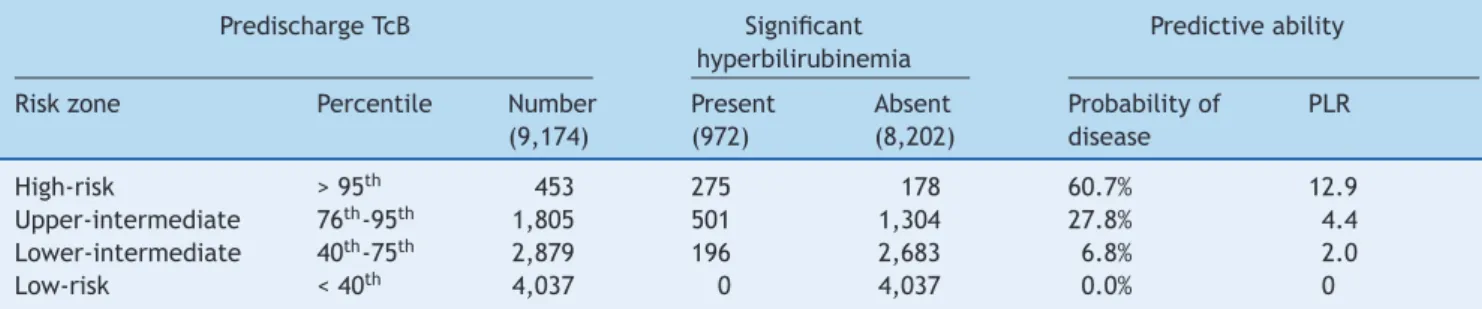
The PLR that determines the risk assessment for sub-sequent significant hyperbilirubinemia for each risk zone is presented in Table 3. Among 453 neonates with pre-discharge TcB in the high-risk zone (> 95th percentile), 275 (60.7%) subsequently developed significant hyperbiliru-binemia. Conversely, 178 newborns in the 95th percentile did not develop significant hyperbilirubinemia (PLR = 12.9) (Table 3). Of the 1,805 newborns in the upper-intermediate
risk zone (76th to 95th percentile), 501 (27.8%) jumped to the high-risk zone (PLR = 4.4). Of the 2,879 neonates in the lower-intermediate risk zone (40th to 75th percentile), 196 (6.8%) climbed to the high-risk zone (PLR = 2.0). Of the 4,037 neonates in the low-risk zone (< 40thpercentile), none moved upwards into the high-risk zone (Table 3).
Discussion
TSB measurements are an invasive procedure that involves pain, neonatal stress, and risk of infection. A noninvasive determination of bilirubin concentrations (TcB) is advanta-geous, and is suitable for universal neonatal screening.11 The new generation of noninvasive TcB-measuring devices (BiliCheckTM and JM-103) have presented good correla-tions with TSB measurements (BiliCheckTM: 0.8212, JM-103: 0.8686).12 Recently, some studies developed predictive nomograms based on measurements of TcB or TSB to assess the risk for significant hyperbilirubinemia in healthy term and late-preterm infants.13---18 The results showed that the TcB nomogram was equivalent to the TSB nomogram, and both could be used to identify subsequent significant hyper-bilirubinemia.
A predictive nomogram should be developed in one sam-ple and validated in another. The present study was a multicenter study to verify the predictive value of the TcB nomogram constructed in 2010.9The result showed that the AUC was 0.875, which was lower than the test pre-dictive ability in the previous study (AUC = 0.920). The previously constructed TcB nomogram was developed from a single hospital, which could not represent the demo-graphic characteristics of the Chinese neonatal population. The multicenter study included eight units, which showed different genetic and environmental features. Therefore, a population-based TcB nomogram should be constructed, which should show a better predictive ability.
exclu-Table 3 Predictive ability of percentile values of predischarge TcB for subsequent significant hyperbilirubinemia.
Predischarge TcB Significant
hyperbilirubinemia
Predictive ability
Risk zone Percentile Number
(9,174)
Present (972)
Absent (8,202)
Probability of disease
PLR
High-risk > 95th 453 275 178 60.7% 12.9
Upper-intermediate 76th-95th 1,805 501 1,304 27.8% 4.4
Lower-intermediate 40th-75th 2,879 196 2,683 6.8% 2.0
Low-risk < 40th 4,037 0 4,037 0.0% 0
PLR, positive likelihood ratio; TcB, transcutaneous bilirubin
sive breastfeeding, blood type incompatibility, and jaundice extent) was better (AUC = 0.95).21Another study evaluated the predictive performance of predischarge bilirubin risk zone (AUC = 0.88); however, combined clinical risk factors (GA, and percentage of weight loss per day on the first two days) showed better accuracy (AUC = 0.96).22Thus, the risk factors for developing significant hyperbilirubinemia in the Chinese neonatal population should have been investigated in combination with a TcB nomogram, which could improve the predictive accuracy.
The study has some limitations. Firstly, the previous TcB nomogram was constructed from a single, tertiary-care cen-ter, which does not represent population-based study data. Secondly, the previous TcB nomogram did not combine the TcB nomogram with other clinical risk factors, such as GA and exclusive breastfeeding, which may improve the prediction of subsequent hyperbilirubinemia. Due to the relative limi-tations of previous TcB nomogram, the authors are currently conducting a multicenter study (ClinicalTrials.gov Identifier: NCT01763632), in which 17 hospitals in China will participate from January to December, 2013, to develop an hour-specific TcB nomogram. The constructed TcB nomogram, which will combine predischarge TcB with other clinical risk factors, may better represent the Chinese neonatal population.
Conclusion
The multicenter study validated the TcB nomogram, which is a useful tool for predicting subsequent severe hyperbiliru-binemia in Chinese healthy term and late-preterm infants. However, the study did not combine predischarge TcB with clinical risk factors (such as GA, exclusive breastfeeding, cephalhematoma, significant bruising, or previous sibling with jaundice) to determine the risk for healthy term and late-preterm infants developing subsequent severe hyper-bilirubinemia. Further studies are necessary to confirm this combination.
Funding
This work was supported by grants from the Key Medi-cal Personnel Foundation of Jiangsu Province (Grant No. RC2011021), the Nanjing Medical Science and Technique Development Foundation (QRX11107), and the Nanjing Municipal Medical Science Development Foundation, Nan-jing, Jiangsu, China (ZKX12044).
Conflicts of interest
The authors declare no conflicts of interest.
Acknowledgements
The authors are grateful to the staff of the Affiliation for their support and comments during the preparation of this manuscript. The authors would like to thank the following investigators who participated in the multicenter study: Jin Wang (Department of Neonatology, Children’s Hospital of Fudan University, Shanghai, China), Qing Sun (Department of Pediatrics, Nanjing Maternity and Child Health Care Hos-pital of Nanjing Medical University, Nanjing, China), Xiaoyue Dong (Department of Pediatrics, Nanjing Maternity and Child Health Care Hospital of Nanjing Medical University, Nan-jing, China), Xiaofan Sun (Department of Pediatrics, Nanjing Maternity and Child Health Care Hospital of Nanjing Medi-cal University, Nanjing, China), Hongyun Wang (Department of Neonatology, Inner Mongolia Maternal and Child Health Care Hospital, Hohehot, China), Yanping Zhu (Department of Neonatology, The First Affiliated Hospital of Xinjiang Medical University, Urumqi, China), Ying Wang (Depart-ment of Neonatology, Changzhou Maternal and Child Health Care Hospital, Changzhou, China), Xiaolei Zhuang (Depart-ment of Neonatology, Gynecology and Obstetrics Hospital, Fudan University, Shanghai, China), Jun Long (Department of Pediatrics, The Fifth People’s Hospital of Shenzhen, Shenzhen, China), and Qiufen Wei (Department of Neonatol-ogy, Guangxi Maternal and Child Health Hospital, Nanning, China).
References
1. American Academy of Pediatrics Subcommittee on Hyper-bilirubinemia. Management of hyperbilirubinemia in the newborn infant 35 or more weeks of gestation. Pediatrics. 2004;114:297---316.
2. Subspecialty Group of Neonatology, Society of Pediatrics, Chinese Medical Association; Chinese Multicenter Study Coor-dination Group for Neonatal Bilirubin Encephalopathy. Clinical characteristics of bilirubin encephalopathy in Chinese newborn infants-a national multicenter survey. Zhonghua Er Ke Za Zhi. 2012;50:331---5.
4. Mishra S, Chawla D, Agarwal R, Deorari AK, Paul VK, Bhutani VK. Transcutaneous bilirubinometry reduces the need for blood sampling in neonates with visible jaundice. Acta Paediatr. 2009;98:1916---9.
5. Dalal SS, Mishra S, Agarwal R, Deorari AK, Paul V. Does measuring the changes in TcB value offer better prediction of Hyperbiliru-binemia in healthy neonates? Pediatrics. 2009;124:e851---7. 6. Mishra S, Chawla D, Agarwal R, Deorari AK, Paul VK.
Transcuta-neous bilirubin levels in healthy term and late preterm Indian neonates. Indian J Pediatr. 2010;77:45---50.
7. De Luca D, Romagnoli C, Tiberi E, Zuppa AA, Zecca E. Skin bilirubin nomogram for the first 96 h of life in a European normal healthy newborn population, obtained with multiwave length transcutaneous bilirubinometry. Acta Paediatr. 2008;97: 146---50.
8. Maisels MJ, Kring E. Transcutaneous bilirubin levels in the first 96 hours in a normal newborn population of > or = 35 weeks’ gestation. Pediatrics. 2006;117:1169---73.
9. Yu ZB, Dong XY, Han SP, Chen YL, Qiu YF, Sha L, et al. Transcutaneous bilirubin nomogram for predicting neonatal hyperbilirubinemia in healthy term and late-preterm Chinese infants. Eur J Pediatr. 2011;170:185---91.
10. Ho HT, Ng TK, Tsui KC, Lo YC. Evaluation of a new transcuta-neous bilirubinometer in Chinese newborns. Arch Dis Child Fetal Neonatal Ed. 2006;91:F434---8.
11. Wainer S, Rabi Y, Parmar SM, Allegro D, Lyon M. Impact of skin tone on the performance of a transcutaneous jaundice meter. Acta Paediatr. 2009;98:1909---15.
12. Romagnoli C, Tiberi E, Barone G, Curtis MD, Regoli D, Paolillo P, et al. Development and validation of serum bilirubin nomogram to predict the absence of risk for severe hyperbilirubinaemia before discharge: a prospective, multicenter study. Ital J Pedi-atr. 2012;38:6.
13. Bental YA, Shiff Y, Dorsht N, Litig E, Tuval L, Mimouni FB. Bhutani-based nomograms for the prediction of significant
hyperbilirubinaemia using transcutaneous measurements of bilirubin. Acta Paediatr. 2009;98:1902---8.
14. Kaur S, Chawla D, Pathak U, Jain S. Predischarge non-invasive risk assessment for prediction of significant hyperbiliru-binemia in term and late preterm neonates. J Perinatol. 2012;32:716---21.
15. Romagnoli C, Tiberi E, Barone G, De Curtis M, Regoli D, Paolillo P, et al. Validation of transcutaneous bilirubin nomogram in identi-fying neonates not at risk of hyperbilirubinaemia: a prospective, observational, multicenter study. Early Hum Dev. 2012;88:51---5. 16. Sarici SU, Serdar MA, Korkmaz A, Erdem G, Oran O, Tekinalp G, et al. Incidence, course, and prediction of hyperbilirubinemia in near-term and term newborns. Pediatrics. 2004;113:775---80. 17. Keren R, Bhutani VK, Luan X, Nihtianova S, Cnaan A, Schwartz JS. Identifying newborns at risk of significant hyperbilirubi-naemia: a comparison of two recommended approaches. Arch Dis Child. 2005;90:415---21.
18. Newman TB, Liljestrand P, Escobar GJ. Combining clinical risk factors with serum bilirubin levels to predict hyperbilirubinemia in newborns. Arch Pediatr Adolesc Med. 2005;159:113---9. 19. Mantagou L, Fouzas S, Skylogianni E, Giannakopoulos I,
Karatza A, Varvarigou A. Trends of transcutaneous bilirubin in neonates who develop significant hyperbilirubinemia. Pedi-atrics. 2012;130:e898---904.
20. Maisels MJ. Risk assessment and follow-up are the keys to preventing severe hyperbilirubinemia. J Pediatr (Rio J). 2011;87:275---6.
21. Bhutani VK, Stark AR, Lazzeroni LC, Poland R, Gourley GR, Kazmierczak S, et al. Predischarge screening for severe neonatal hyperbilirubinemia identifies infants who need pho-totherapy. J Pediatr. 2013;162, 477-82.e1.