1. M estre em Ciências da Reabilitação, UFM G, Professora do Curso de Fisioterapia da Fundação Educacional de Divinópolis.
2. Fisioterapeuta, Aluna do curso de Especialização em Fisioterapia, ênfa-se em Ortopedia e Esportes, do Departamento de Fisioterapia da Esco-la de Educação Física, Fisioterapia e Terapia Ocupacional da Universida-de FeUniversida-deral Universida-de M inas Gerais.
3. Doutor em Ciências, Boston University, Professor Adjunto do Departa-mento de Fisioterapia da Escola de Educação Física, Fisioterapia e Tera-pia Ocupacional da Universidade Federal de M inas Gerais.
4. Doutora em Ciências, Boston University, Professora Adjunta do Depar-tamento de Terapia Ocupacional da Escola de Educação Física, Fisiote-rapia e TeFisiote-rapia Ocupacional da Universidade Federal de M inas Gerais. Received in 17 / 8 / 05. Final version received in 25/ 11/ 05. Approved in 12 / 5 / 06.
Correspondence to: Cecília Ferreira de Aquino, Rua Grão M ogol, 320 / 601, Sion – 30310-010 – Belo Horizonte, M G. E-mail: cferaquino@yahoo. com.br
Analysis of the relation betw een flexibility
and passive stiffness of the hamstrings
Cecília Ferreira de Aquino1, Gabriela Gomes Pavan Gonçalves2,
Sérgio Teixeira da Fonseca3 and M arisa Cotta M ancini4
O
RIGINALA
RTICLEKeyw ords: M uscle. Energy. Injury.
ENGLISH VERSION
ABSTRACT
Introduction: The terms stiffness and flexibility, w hich refer to muscle properties, are frequently used as synonymous in the lite-rature. How ever, these tw o muscle properties have distinct defini-tions. Objective: To investigate the contribution of the measure of flexibility to the passive stiffness of the hamstrings. M ethods: Stiff-ness and flexibility w ere measured in 33 healthy individuals. An isokinetic dynamometer registered the resistance torque offered by the hamstrings during knee passive extension at 5ooooo/////s. M uscle
activity w as monitored during the tests to guarantee electromyo-graphic silence. The slope of the torque-angle curve w as used to determine the hamstrings passive stiffness. The range of the test w as divided into three portions to calculate the stiffness of the 1st,
2nd and 3rd thirds of knee movement. Flexibility w as assessed by
having the examiner move the lever of the dynamometer in the direction of knee extension. The final measure w as determined as the angle at w hich movement w as interrupted because the exam-iner perceived a resistance to further movement and the volunteer reported a sensation of discomfort. Simple regressions w ere used for statistical analysis. Results: The regression analysis demon-strated correlation values of r = –0.48 (R2 = 0.23; p = 0.005), r = –
0.54 (R2 = 0.29; p = 0.001), r = –0.46 (R2 = 0.21; p = 0.007) and r =
–0.45 (R2 = 0.20; p = 0.008) betw een flexibility and total, 1st, 2nd
and 3rd third stiffness, respectively. Conclusion: Despite
signifi-cant associations betw een the analyzed variables, flexibility explains only a low percentage of the variability of the stiffness measure. Stiffness and flexibility are not equivalent and should be analyzed independently.
INTRODUCTION
The passive stiffness and flexibility muscular properties are fre-quently investigated in rehabilitation and sports studies fields(1-2),
being considered synonyms and indistinctly used by many authors of these fields(3). How ever, these properties present differences in
relation to their definitions found in the literature. Passive muscu-lar stiffness is defined as the reason betw een the change in the muscle tension by change unit in its length, w hen it is elongated
w ithout contraction activity(4). On the other hand, flexibility is
de-fined as the ability of the muscular tissue to elongate, allow ing t hat t he art iculat ion m oves t hrough t he w hole m ovem ent ’s breadth(5). These conceptual definitions of stiffness and flexibility
guide the investigations about the contribution of these muscular properties to the functional and sports performance.
M uscular stiffness is a mechanical property of the muscle relat-ed to the resistance of this tissue to deformation, being graphically represented by the slope of the stress-strain curve(6). The area
be-low this curve represents the amount of energy absorbed by the muscle w hen it is elongated, either in rest or contracted(7). Thus,
the stiffness contributes to the muscle’s ability to absorb energy under mechanical forces(8-9). The amount of energy applied on the
musculoskeletal structures during the sports and functional activi-ties seems to determine the occurrence of lesion of these struc-tures(7,10). Therefore, the bigger the stiffness of the muscular
tis-sue, the bigger its ability to absorb energy and the low er its susceptibility to lesion. M oreover, the absorbed energy by the mus-cular tissue can be stored and, then, reused in the subsequent movement in order to trigger the muscular action(1,11). Thus, the
stiffness and the energy absorption ability of the muscle can help not only in the prevention of muscular lesions, but also in the per-formance improvement during the movement.
Flexibility property is frequently used as a means of inference over the muscular length(12). Although the maximum excursion of
the muscle is not usually necessary in routine activities(13),
signifi-cant losses of this property may compromise the suitable execu-tion of the movement(2,14). Despite some authors’ suggestion that
the flexibility reduction w ould be associated to a higher muscu-loskeletal lesions frequency(15-17), it is not proved that the flexibility
gain has influence on these lesions prevention(18-19). The lack of
demonstration of this effect may be explained by the use of differ-ent evaluation methods of the flexibility(17), varied criteria to
deter-mine muscular shortening(19), besides the lack of standardization in
the definition of the term lesion(17). Therefore, the real impact of
the flexibility as means of the muscular length, in the occurrence of lesions and in the functional performance, needs to be better investigated.
Clinical and research data suggest that the stiffness is inversely related to the muscular flexibility, that is, more rigid muscles w ould invariably be less flexible and, on the contrary, less passively rigid muscles w ould have more flexibility(15,17,20). These data are based
on the mathematical formula that defines stiffness, expressed as the force variation (∆F) divided by the length variation (∆L). Once this length variation can be considered as a flexibility measure-ment, the presence of this common denominator w ould imply in an inversely proportional relation betw een these tw o properties. Some authors also consider the passive stiffness as being a flexi-bility component, using similar operational w ays to measure both properties(16,21). The flexibility usually functions as the movement’s
other hand, due to the direct measurement impossibility, the mus-cle’s passive stiffness in humans is quantified through the relation betw een the resistance torque offered by the articulation and the breadth of movement during the passive articulator dislocation(23).
Thus, the operational definitions of stiffness and flexibility demon-strate that the investigation of these properties contribution for the functional and sports performance should consider the exist-ing conceptual differences betw een these properties and use measurement procedures corresponding to such differences.
Further studies w hich precisely determine the existing relation betw een flexibility and muscular stiffness, using operational means compatible w ith the definition of each property are still needed. Thus, the aim of the present study w as to investigate the contribu-tion of the measurement of the hamstrings flexibility for the pas-sive stiffness of this muscular group.
M ETHODS
Sample
The sample of this study consisted of 33 healthy university stu-dents, of both sexes (6 males and 27 females), w ith age range betw een 18 and 26 years (average of 21,7 ± 1,8). The volunteers could not present lumbar pain history or lesion of the low er limbs. This research w as approved by the Ethics Committee in Research from the Universidade Federal de M inas Gerais, having all pants signed a free and clarified consent form, agreeing to partici-pate in the study.
Procedures
After the study’s procedures explanation and consent form’s sig-nature, the determination of the volunteer’s dominant low er limb w as done, since the measurements w ere done only in the non-dominant limb, as a means of standardizing the measures among the volunteers. The limb considered dominant w as that chosen by the participant to kick a ball(17). After that, the participants w ere
submitted to the measurement of the body mass and the leg and foot segments length of this side. The anatomic references used for the measurement of the lengths of the segments w ere accord-ing to the descriptions of the anthropometrical table by Dempster(24).
Evaluation of the passive stiffness
Pairs of surface active electrodes (Biopac System Inc., Goleta, CA), w ith diameter of 11,4 mm and inter-electrodes distance of 20 mm, w ere placed over the area of the biggest muscular part of the lateral vast (LV) and femoral biceps (FB) of the non-dominant limb, follow ing the fibers orientation. Before the electrodes placement, the trichotomy and cleansing of the skin w ith alcohol w as done. A land electrode w as placed on the acromio.
During the passive stiffness test, the electromyographic activity of the LV and FB w as simultaneously collected, w hich allow ed the monitoring of the muscular activity and guaranteed that the test w as passively conducted. A M P 150WSW electromyographic w as used (Biopac System Inc., Goleta, CA) connected to a computer, w ith collection frequency of 1000 Hz, entrance avoidance of 2 mega ohms (MΩ) and Rejection of the Common M ode potency of 1000 MΩ. Only the measures in w hich the activity of both muscles did not exceed the average activity registered during resting increased of tw o standard deviations above the average w ere accepted for analysis(25). A computer program w as developed in order to
com-pare the muscular activity presented during the test w ith resting electromyographic signal, in intervals of 50 ms. The program w as applied right after each measurement, in the interval betw een the repetitions, hence allow ing or rejecting the test.
The passive stiffness w as evaluated through a isokinetic dyna-mometer (Biodex M edical System Inc., Shirley, NY). Such device has a passive mode of operation, w hich moves the desired articu-lation at a constant velocity, in predetermined breadths,
register-ing the resistance torque offered against the movement. The indi-vidual w as sat at the isokinetic dynamometer, w ith the pelvis sta-bilized and the chest perpendicular to the seat. The thigh of the non-dominant limb w as placed on a lever set on the knee proximal region, raising it at an horizontal position so that the hip w as at 110 degrees of flexion during the test. This positioning w as used in order to guarantee that none of the participants w ould reach the complete breadth of the knee extension, avoiding that the tension of the articular structures, such as the posterior capsule, w ould influence in the measure(23). The knee articular axis w as aligned
w ith the rotation axis of the dynamometer and the lever arm posi-tioned above the lateral malleoli.
After the positioning of the volunteer, the dynamometer lever w as placed in the horizontal position and a level measuring device w as used in order to determine the 0 degree position. The maxi-mum knee flexion position, according to the device permission, w as determined as the initial test position. The final position w as defined w ith the knee articulation being displaced by the examiner in the extension direction and the displacement being interrupted w hen the participant reported discomfort related to the posterior muscles of the thigh. The passive mode of the dynamometer at a 5°/s velocity w as used in order to perform the pass ive articulation movement in the extension direction(23). Five consecutive
prelimi-nary measures w ere taken so that the individual could experience the movement and in order to decrease the viscoelastic effects of the muscle’s stretching before the stiffness measure(9,23,26).
After-w ards, three measures of the passive stiffness After-w ere performed, w ith one minute interval betw een them, w ith the aim to apply the program of muscular activity verification. The average of the ob-tained values in these three measures w as used. During the pas-sive movements, the isokinetic dynamometer softw are registered the resistance torque of the articulation, w ithout correction by the effects of the torques produced by the lever mass and the leg and foot segments. At the end of this test, a complete repetition of the lever movement of the dynamometer in the extension orientation w as performed, w ithout the participant’s low er limb placement, w ith the aim to register the torque generated by the lever mass for later correction of this torque over the stiffness measure.
Reliability tests (test-retest) presented an intra-class correlation coefficient (ICC) of 0.889 for the test total breadth stiffness (total stiffness) and of 0.849, 0.872 and 0.934 for the stiffness values in the 1st, 2nd, and 3rd thirds of the total movement breadth used in
the test, respectively.
Flexibility evaluation
The hamstrings flexibility w as evaluated after the passive stiff-ness test, keeping the same positioning of the participants. During this test, the electromyographic data of the LV and FB w ere also registered, w hich allow ed the monitoring of these muscles activi-ty. Only the measures in w hich the activity of both muscles did not exceed the average activity registered in resting increased in tw o standard-deviations w ere analyzed(25). In this evaluation, the
exam-iner passively displaced the knee articulation in the extension di-rection. The participants w ere told not to voluntarily resist to the lever displacement, w ith the movement beginning at maximum flexion allow ed by the knee. The final position of the articular move-ment, used to determine the muscle’s flexibility, w as defined w hen the volunteer reported discomfort related to the thigh posterior muscles stretching and the examiner perceived a firm resistance to additional movement of the knee articulation. At that moment, the examiner interrupted the lever displacement, w ith the flexibil-ity being defined as the articular angle in w hich this movement w as interrupted. Three measures w ere taken, being the average of these values analyzed.
lation values r = –0.48 (p = 0.005), r = –0.54 (p = 0.001), r = –0.46 (p = 0.007) and r = –0.45 (p = 0.008) betw een flexibility and total passive stiffness, 1st, 2nd and 3rd thirds, respectively. The
determi-nation coefficients w ere R2 = 0.23, R2 = 0.29, R2 = 0.21 and R2 =
0.20 for the respective comparisons (figure 2).
The averages and standard deviations of the flexibility and stiff-ness values, in degrees and Nm/rad, respectively, are presented in table 1.
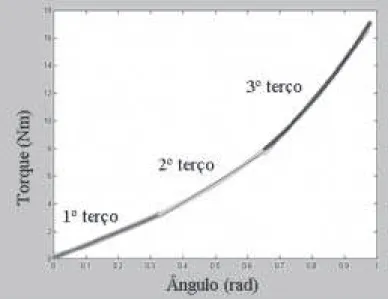
Figure 1 – Illustration of the slope of the torque angle curve of the
ham-strings in the test total breadth and in the 1st, 2nd and 3rd thirds of the
angular movement
Figure 2 – Dispersion demonstrating the association betw een flexibility and: A) total passive stiffness; B) passive
stiffness of the 1st third; C) passive stiffness of the 2nd third and D) passive stiffness of the 3rd third.
Data reduction
The total stiffness calculation and of the 1st, 2nd and 3rd thirds
w ere performed from the isokinetic dynamometer softw are data obtained during the passive stiffness test, collected at a 100 Hz frequency. The articular angle w as measured in degrees and the resistance torque w as measured in New ton-meters (Nm), w ithout gravity’s effects correction. The torque values and angles regis-tered by the dynamometer w ere transferred to a computer for data analysis. The hamstrings stiffness w as determined through a pro-gram specially developed for this reason. The data w ere filtered w ith an ordinary Butterw orth filter of 4th order and a cut-off of 0.025
Hz. The program calculated the torques produced by the leg’s and foot’s w eight and by the foot’s w eight over the leg for the w hole breadth, from the data related to the body mass and the segments‘ length, according to the anthropometrical table by Dempster(24).
The values of these torques and of the torque produced by the w eight of the lever in the w hole breadth of the movement w ere subtracted from the passive torque provided by the dynamometer, w ith the resulting torques being used for the calculation of the passive stiffness of the hamstrings. The measure of the angle w as changed to radians (rad) and the passive torque offered by the ham-strings w as plotted in relation to the angular dislocation. The stiff-ness w as defined as the torque variation (Nm) divided by the angle variation (rad) and w as calculated through an analysis of simple linear regression betw een the test angles and the passive torque of the hamstrings. The slope of the torque angle curve resulting from the analysis of regression w as used in order to determine the passive stiffness of the hamstrings, being expressed in Nm/rad. The test breadth w as divided in three equal portions and a calcula-tion of the total stiffness and of the slope of the curves in the 1st,
2nd and 3rd thirds of the angular movement w as done (figure 1).
The dynam om et er sof t w are provided t he value of the knee articu-lar angle in w hich the le-ver movement w as inter-rupted, used to evaluate the hamstrings flexibility. The angulation in w hich the movement w as inter-rupted, determined in de-grees, and correspon-dent t o t he f lexibilit y value, w as determ ined from the figure provided by the softw are.
Statistical analysis Sim ple regression analyses w ere used to determine the contribu-tion of the flexibility mea-sure for the passive stiff-ness m easures of t he ham strings in the total breadth of the test (total stiffness) and in the 1st,
2nd and 3rd portions of the
angular movement (stiff-ness of the 1st, 2nd and 3rd
thirds). The significance level w as established in α = 0,05.
RESULTS
corre-DISCUSSION
The present study w as conducted w ith the aim to investigate the relation betw een the flexibility and passive stiffness relation of the hamstrings. According to the obtained results, a percentage relatively small of the total passive stiffness variability measures, of the 1st, 2nd and 3rd thirds (23% , 29% , 21% and 20% ,
respective-ly) may be explained by the flexibility measure of this muscular group, despite the associations betw een these variables being sig-nificant.
The R2 values found in this study suggest the existence of other
variables as predicting factors of the passive muscular stiffness. Among these variables, the transversal section area of the mus-cle(27) and the passive articular structures should be considered(28).
Chelboun et al. (1997) demonstrated that the muscular volume is responsible for 84% of the stiffness measure variation of the el-bow flexion muscles(27). M oreover, Blackburn et al. (2004) suggest
that muscles w ith bigger tropism w ould have a greater number of crossed bridges betw een the actin and miosine filaments, w hich w ould contribute for the muscle resistance to deformation(4). On
the other hand, there is evidence that the muscular atrophy ob-served after a period of immobilization is associated to a decrease of the muscular stiffness(29-30). M oreover, some authors suggest
that a bigger muscular mass indicates a bigger amount of connec-tive tissue, w hich implies in a bigger number of collagen fibers paralleling positioned, influencing in the resistance to the muscle’s deformation as w ell(14,31). Thus, the amount of contraction and
con-nective tissue present in the muscle seems to be crucial to the passive stiffness, w hich possibly limits the contribution of the flex-ibility to the stiffness measure.
The passive stiffness measure can also be influenced by the resistance offered by articular structures to the articulation dislo-cation. In the present study, the muscular stiffness w as operated as the resistance passive torque found in different articular angles. In this case, on should observe that the knee articulation stiffness w as used as synonym for the hamstrings stiffness. Therefore, the measure of the variable passive muscular stiffness also included a possible resistance offered by structures such as skin, connective tissue and articular capsule. Johns and Wrigth (1962) observed in guinea pigs that the muscular tissue is responsible for 41% of the total passive articular stiffness, w ith the capsule contributing w ith 47% and the tendon w ith 10% of the total value(28). Thus, the
indi-viduals‘ positioning during the evaluation of the stiffness w as per-formed to guarantee that the complete breadth of the knee exten-sion w ould not be reached, consequently avoiding that the tenexten-sion of the passive components of the articulation influenced in the measure(23). How ever, due to the impossibility of directly measure
the muscular stiffness in humans, the participation of the passive articular structures may have been favored, minimizing the contri-bution of the flexibility in the evaluated measure.
The flexibility measure, different from the passive stiffness, can be influenced by the individual’s tolerance to the muscle’s stretch-ing(22,32-33). The individual w ho presents a higher tolerance to the
stretching allow s the application of a bigger amount of strength over the articulation, leading to higher movement breadth values in the determination of flexibility(34). The mechanism and structures
responsible for the increased tolerance are not know n, how ever,
some authors speculate that the free nociceptive terminations present in the articulation and in the muscle w ould play a role in this process(35). Thus, the flexibility gain w ithout modifications of
the passive stiffness observed after a muscular stretching program, w ould be more related to an increase of the individual’s tolerance to stretching(23,31-32,34). Some authors justify that stretching does
not influence in the passive stiffness due to the non-existence of alterations in the muscle’s structure and by the fact that this char-acteristic dos not suffer influence of the tolerance to stretch-ing(23,32,34). These findings reinforce the lack of strong association
betw een flexibility and stiffness; once the flexibility, evaluated through the breadth of the articulation’s movement changes, may occur in the absence of modification of the passive stiffness.
A proposal of an inverse relation betw een flexibility and stiff-ness is base don the mathematical formula that defines stiffstiff-ness (∆F/∆L), w hich show s that less flexible muscles that is, w hich present a low value in the formula’s denominator, are stiffer, and w ould be more prone to lesions(3,15,17,32). How ever, one should
con-sider that the formula for the stiffness definition characterizes a relation betw een strength and length. Therefore, an increase of the ∆L may be observed, w hich w ould characterize an increase in flexibility, accompanied by a simultaneous increase in the ∆F. In this case, even if the muscle presented a variation in its length, the stiffness w ould not alter, w hich w ould justify the findings in the study w hich evaluate changes in flexibility w ithout modification in stiffness Thus, contrary to w hat has been reported in the litera-ture(3), the flexibility and passive stiffness properties are not
syn-onyms and should be independently analyzed.
The found values in this study are similar to the ones reported by Wilson et al, w ho investigated the association betw een flexibil-ity and stiffness of the muscles of the shoulder articulation, obtain-ing a R2 value of de 0.30(36). Blackburn et al (2004) reported values
of moderate and positive correlation betw een flexibility and pas-sive stiffness of the hamstrings(3). Although a discrepancy betw een
the studies in relation to the correlations direction due to differ-ences in the measurement techniques is found, the interpretation of these results is similar. How ever, differently from the studies mentioned before, the present study has chosen to analyze the total curve of the stiffness and the three parts of the curve divided according to the articular angle, once the stiffness behavior is non-linear during the movement(22-23,27). In the first third of the curve,
the torque values w ere low and the variation coefficients w ere high. The second third consisted of a transition zone and the third third represented the linear portion of the curve. Hence, there w as the possibility that the correlation values betw een flexibility and passive stiffness w ould be different according to the portion of the curve analyzed. How ever, the determination coefficients w ere sim-ilar, w ith the analysis considering the w hole stiffness curve and each one of its three portions. Consequently, even considering the methodological differences in the studies, the results of the present investigation are according to the other findings in the literature.
A possible limitation of this study is related to the method used in order to measure the flexibility. The obtained measure w ith the use of such method is influenced by the individual’s tolerance to stretching and also by variations in the muscle’s resistance(23,32).
Another possible limitation refers to the passive stiffness mea-sure of the hamstrings, w hich as mentioned before, w as used as synonym to the knee articulation stiffness, being able to suffer influence from other passive structures. M oreover, the findings of the present study may have been influenced by the higher number of female individuals present in the sample, w hich limits the gen-eralization of the results. Despite the mentioned limitations in rela-tion to the measurement of the stiffness and flexibility variables and the sample’s composition, a factor w hich contributes to guar-antee these measures validation w as the monitoring of the elec-tromyographic activity of the muscles w hich could have influenced in the measure during the tests. Trials in w hich the
electromyo-TABLE 1
Valores médios de flexibilidade (graus) e rigidez passiva (Nm/ rad) Variáveis M édias Desvio-padrão
Flexibilidade 08,15 3,98 Rigidez passiva total 11,99 3,92 Rigidez passiva 1o terço 06,38 2,48
Rigidez passiva 2o terço 10,28 3,57
graphic activity w as higher than the one registered in resting, ac-cording to criteria established in the literature, w ere not analyzed(25).
Therefore, the stiffness and flexibility properties evaluated repre-sent properties intrinsic to the muscle in resting, and not a func-tion of the contracfunc-tion or reflex muscle activity.
The results of the present study show that other variables, dif-ferent from the flexibility, may be used in order to predict the mus-cular stiffness. The low correlation values found betw een flexibili-ty and passive stiffness possibly justify the absence of evidence in the literature in relation to the effects of the flexibility gain in the prevention of musculoskeletal lesions(18-19). Thus, changes in the
tropism and muscular length, more than changes in flexibility, eval-uated through the maximum breadth of the articulation movement, should lead future studies w ith the aim to modify the muscular stiffness trying to optimize the sports performance and decrease the number of musculoskeletal lesions. Little stiff muscles present greater deformation in response to an applied strength(13), w hich
results in a greater amount of articular dislocation, decreasing the articulation’s stability w hich they cross and increasing the proba-bility of articular and ligament lesion(4). Furthermore, muscles w hich
present a bigger transversal section area and consequently great-er stiffness, can absorb bigggreat-er amounts of engreat-ergy, decreasing the susceptibility of the musculoskeletal structures to lesion(8-9).
There-by, studies that investigate the impact of intervention programs, such as the muscular strengthening and stretching, in the passive stiffness and their potential benefits in the lesions prevention are needed.
CONCLUSION
Although the associations betw een the variables have been sig-nificant, a relatively small percentage of the variability of the total, 1st, 2nd and 3rd thirds of the passive stiffness measures (23% , 29% ,
21% and 20% , respectively) can be explained through the mea-sure of the flexibility of this muscular group. Such result indicates the possibility of influence of other variables, such as transversal section area of the muscle, in the determination of the passive muscular stiffness. Finally, one may come to the conclusion that the flexibility and stiffness properties are not synonyms and should be independently analyzed.
All the authors declared there is not any potential conflict of inter-ests regarding this article.
REFERENCES
1. Wilson GJ, Elliot BC, Wood GA. Stretch shorten cycle performance enhance-ment through flexibility training. M ed Sci Sports Exerc 1992;24(1):116-23. 2. Sahrmann SA. Concepts and principles of movement. In: Sahrmann SA.
Diagno-sis and treatment of movement impairment syndromes. M osby, 2002;9-50. 3. Blackburn JT, Padua DA, Riemann BL, Guskiew icz KM . The relationships
be-tw een active extensibility, and passive and active stiffness of the knee flexors. J Electromyogr Kinesiol 2004;14:683-91.
4. Blackburn JT, Riemann BL, Padua DA, Guskiew icz KM . Sex comparison of ex-tensibility, passive, and active stiffness of the knee flexors. Clin Biomech 2004; 19(1):36-43.
5. M alone TR, Garret WE, Zachazew ski JE. M uscle: deformation, injury, repair. In: Zachazew ski JE, M agee DJ, Quillen WS. Athletic injuries and rehabilitation. Phil-adelphia: WB Saunders, 1996;71-91.
6. Latash M L, Zatsiorsky VM . Joint stiffness: M yth or reality? Hum M ov Sci 1993; 12:653-92.
7. Garret WE, Jr. M uscle strain injuries: clinical and basic aspects. M ed Sci Sports Exerc 1990;22(4):436-43.
8. Garret WE, Jr, Safran M R, Seaber AV, Glisson RR, Ribbeck BM . Biomechanical comparison of stimulated and nonstimulated skeletal muscle pulled to failure. Am J Sports M ed 1987;15(5):448-54.
9. Taylor DC, Dalton JD, JR, Seaber AV, Garret WE. Viscoelastic properties of mus-cle-tendon units. The biomechanical effects of stretching. Am J Sports M ed 1990; 18(3):300-9.
10. M air SD, Seaber AV, Glisson RR, Garret WE, Jr. The role of fatigue in susceptibil-ity to acute muscle strain injury. Am J Sports M ed 1996;24(2):137-43. 11. Lindstedt SL, Reich TE, Keim P, LaStayo PC. Do muscles function as adaptable
locomotor springs? J Exp Biol 2002;205:2211-6.
12. Bandy WD, Irion JM . The effect of time on static stretch on the flexibility of the hamstring muscles. Phys Ther 1994;74(9):845-50.
13. Singer BJ, Jegasothy GM , Singer KP, Allison GT. Evaluation of serial casting to correct equinovarus deformity of the ankle after acquired brain injury in adults. Arch Phys M ed Rehabil 2003;84(4):483-91.
14. Gajdosik RL. Passive extensibility of skeletal muscle: review of the literature w ith clinical implications. Clin Biomech 2001;16(2):87-101.
15. Hartig DE, Henderson JM . Increasing hamstring flexibility decreases low er ex-tremity overuse injuries in military basic trainees. Am J Sports M ed 1999;27(2): 173-6.
16. Krivickas LS, Feinberg JH. Low er extremity injuries in college athletes: relation betw een ligamentous laxity and low er extremity muscle tightness. Arch Phys M ed Rehabil 1996;77(11):1139-43.
17. Witvrouw E, Danneels L, Asselman P, D’Have T, Cambier D. M uscle flexibility as a risk factor for developing muscle injuries in male professional soccer players. A prospective study. Am J Sports M ed 2003;31(1):41-6.
18. Herbert RD, Gabriel M . Effects of stretching before and after exercising on mus-cle soreness and risk of injury: systematic review. BM J 2002;325:1-5. 19. Thacker SB, Gilchrist J, Stroup DF, Kimsey CD, Jr. The impact of stretching on
sports injury risk: a systematic review of the literature. M ed Sci Sports Exerc 2004;36(3):371-8.
20. Halbertsma JPK, Goeken LNH, Hof L, Groothoff JW, Eisma WH. Extensibility and stiffness of the hamstrings in patients w ith nonspecific low back pain. Arch Phys M ed Rehabil 2001;82:232-8.
21. M cHugh M P, Connolly DAJ, Eston RG, Kremenic IJ, Nocholas SJ, Gleim GW. The role of passive muscle stiffness in symptoms of exercise-induced muscle damage. Am J Sports M ed 1999;27(5);594-9.
22. M agnusson SP, Simonsen EB, Aagaard P, Sørensen H, Kjœ r M . A mechanism for altered flexibility in human skeletal muscle. J Physiol 1996;497(Pt 1):291-8. 23. M agnusson SP, Simonsen EB, Aagaard P, Sørensen H, Kjœ r M . Biomechanical
responses to repeated stretches in human hamstring muscle in vivo. Am J Sports M ed 1996;24(5):622-8.
24. Winter DA. Anthropometry. In: Winter DA. Biomechanics and motor control of human movement. New York: Wiley and Sons Inc, 1990;51-74.
25. Lamontagne A, M alouin F, Richards CL. Contribution of passive stiffness to an-kle plantarflexor moment during gait after stroke. Arch Phys M ed Rehabil 2000; 81(3):351-8.
26. M cHugh M P, M agnusson SP, Gleim GW, Nicholas JA. Viscoelastic stress relax-ation in human skeletal muscle. M ed Sci Sports Exerc 1992;24(12):1375-82. 27. Chleboun GS, How ell JN, Conatser RR, Giesey JJ. The relationship betw een
elbow flexor volume and angular stiffness at the elbow. Clin Biomech 1997;12(6): 383-92.
28. Johns RJ, Wright V. Relative importance of various tissues in joint stiffness. J Appl Physiol 1962;17(5):824-8.
29. Jarvinen M J, Einola SA, Virtanen EO. Effect of the position of immobilization upon the tensile properties of the rat gastrocnemius muscle. Arch Phys M ed Rehabil 1992;73:253-7.
30. Gajdosik RL, Vander Linden DW, M cNair PJ, Riggin TJ, Albertson JS, M attick DJ, et al. Slow passive stretch and release characteristics of the calf muscles of older w om en w it h lim it ed dorsif lexion range of m ot ion. Clin Biom ech 2004;19:398-406.
31. Halbertsma JPK, M ulder I, Goeken LNH, Hof L, Eisma WH. Repeated passive stretching: acute effect on the passive muscle moment and extensibility of short hamstrings. Arch Phys M ed Rehabil 1999;80:407-14.
32. Halbertsma JPK, Goeken LNH. Stretching exercises: effect on passive extensi-bility and stiffness in short hamstrings of healthy subjects. Arch Phys M ed Re-habil 1994;75(9):976-81.
33. M agnusson SP, Simonsen EB, Aagaard P, Dyhre-Poulsen P, M cHugh M P, Kjœr M. M echanical and physical responses to stretching w ith and w ithout preisometric contraction in human skeletal muscle. Arch Phys M ed Rehabil 1996;77(4):373-8.
34. Halbertsma JPK, Van Bolhuis AI, Goeken LNH. Sport stretching: effect on pas-sive muscle stiffness of short hamstrings. Arch Phys M ed Rehabil 1996;77(7): 688-92.
35. M archettini P, Simone DA, Caputi G, Ochoa JL. Pain from excitation of identified muscle nociceptors in humans. Brain Res 1996;740(1-2):109-16.