ABSTRACT
BACKGROUND AND OBJECTIVES:Pain is a severe world health problem, making its management a challenge for health professionals. he study of pain has been supericially ad-dressed during health professionals’ qualiication, relecting in inefective clinical practices. his study aimed at evaluating the level of neurophysiologic pain knowledge of physiotherapy stu-dents after using active teaching-learning strategies to address the subject.
METHODS: his was an uncontrolled experimental study with 14 students of the ifth period of the Physiotherapy course. Dur-ing the school year, pain neurophysiology teachDur-ing was based on active teaching-learning strategies, focused on problems and practical application of possible solutions by students. Neuro-physiologic Pain Questionnaire was used to evaluate pain neuro-physiology knowledge before and after the discipline.
RESULTS: here has been signiicant improvement (p=0.002) in the number of right answers to the Neurophysiologic Pain Questionnaire at intervention completion as compared to base-line evaluation.
CONCLUSION: Physiotherapy students have improved their knowledge about pain neurophysiology with the use of active teaching-learning strategies.
Keywords:Active learning, College education, Educational eval-uation, Pain, Physiotherapy.
Evaluation of physiologic pain knowledge by physiotherapy students
Avaliação do conhecimento fisiológico da dor de estudantes de fisioterapia
Elen Soares Marques1,2, Thiago Xarles3, Thuany Medeiros Antunes3, Karla Kristine Dames da Silva3, Felipe José Jandre Reis3,4, Laura
Alice Santos de Oliveira2,3, Leandro Alberto Calazans Nogueira2,3
1. Faculdade de Ciências Médicas e da Saúde, Juiz de Fora, MG, Brasil.
2. Centro Universitário Augusto Motta, Mestrado em Ciências da Reabilitação, Rio de Ja-neiro, RJ, Brasil.
3. Instituto Federal do Rio de Janeiro, Departamento de Fisioterapia, Rio de Janeiro, RJ, Brasil. 4. Universidade Federal do Estado do Rio de Janeiro, Departamento de Clínica Médica, Instituto Federal do Rio de Janeiro, Rio de Janeiro, RJ, Brasil.
Submitted in September 04, 2015. Accepted for publication in January 20, 2016.
Conlict of interests: none – Sponsoring sources: Partially carried out with the support of Instituto Federal do Rio de Janeiro and the Coordenação de Aperfeiçoamento de Pessoal de Nível Superior (CAPES), Brazil.
Correspondence to:
Leandro Alberto Calazans Nogueira Rua Carlos Wenceslau, 343 – Realengo 21715-000 Rio de Janeiro, RJ, Brasil. E-mail: [email protected]
© Sociedade Brasileira para o Estudo da Dor
RESUMO
JUSTIFICATIVA E OBJETIVOS: A dor é um grave problema mundial de saúde, tornando o gerenciamento dessa condição um desaio para os proissionais de saúde. O estudo da dor tem sido abordado de maneira supericial durante o processo de formação desses proissionais, reletindo-se em práticas clínicas ineicazes. O objetivo deste estudo foi avaliar o grau do conhecimento neu-roisiológico da dor de estudantes de isioterapia, após serem uti-lizadas estratégias ativas de ensino-aprendizagem na abordagem do tema.
MÉTODOS: Foi conduzido um estudo experimental não controlado com 14 estudantes do quinto período do curso de Fisioterapia. Durante o período letivo, o aprendizado da neu-roisiologia da dor foi baseado em estratégias ativas de ensino-aprendizagem, com foco problematizador e aplicação prática das possíveis soluções por parte dos estudantes. O Questionário Neuroisiológico da Dor foi utilizado para avaliar o conhecimen-to da neuroisiologia da dor, antes e após o curso da disciplina. RESULTADOS: Foi observada melhora signiicativa (p=0,002) do percentual de acertos no Questionário Neuroisiológico da Dor inal da intervenção quando comprado à avaliação inicial. CONCLUSÃO: Os alunos de isioterapia obtiveram melhora do conhecimento neuroisiológico da dor com a utilização de estra-tégias ativas de ensino-aprendizagem.
Descritores: Aprendizagem ativa, Avaliação educacional, Dor, Educação superior, Fisioterapia.
INTRODUCTION
Pain may be considered a major health problem, represent-ing 70% of emergency assistance and one third of medical consultations1. Musculoskeletal disorders (MSD) correspond to approximately 80% of outpatient physiotherapeutic ser-vices consultations being pain the most prevalent complaint2. MSD is the second most common condition contributing for years lived with incapacity, being second only to mental and behavioral disorders. Among musculoskeletal disorders, lum-bar and cervical pain are the second and the fourth, respec-tively3. Chronic pain is classiied as pain persisting beyond normal tissue healing time, lasting more than three months and without apparent biological value1. Considered a world-wide public health problem, chronic pain afects approxi-mately 60 million people, corresponding to 10% of the world population4,5.
Scarce knowledge about pain mechanisms, as well as its in-adequate management, may generate major human resources
costs for patients, their families and society6. he understand-ing of biological, social and psychological factors involved in pain evaluation and management should be acquired during health graduation programs7. However, deicits in the con-struction of knowledge they have been observed in the forma-tion of health professionals7-9. Once graduated, such profes-sionals consider themselves unprepared to assist patients with persistent pain and attribute this to the period of professional qualiication9,10. he teaching of pain for health professionals in all qualiication levels has been identiied as an important measure to change inefective pain management practices. However, most educational programs, especially for gradu-ation students, include minimum or no content about pain and/or its management11,12.
Aiming at minimizing the lack of knowledge about pain (acute, chronic or cancer-related) among health profes-sionals, the International Association for the Study of Pain (IASP) has established since 1994 curriculum recommenda-tions for different health courses, among them physiothera-py. The curriculum highlights four components to measure biological and psychosocial factors contributing to pain, dysfunction and incapacity: 1) multidimensional nature of pain (mechanisms and basic concepts); 2) pain evaluation and measurement; 3) pain management (rehabilitation and interdisciplinary management); and 4) clinical conditions (commonly treated clinical conditions)13. Notwithstand-ing IASP recommendations, few courses in the health area have an exclusive discipline for education on pain, rather addressing this content along other disciplines14,15. In Brazil, there is a proposal to include a “Minimum program on Pain mechanisms and Analgesia” as independent discipline16, however there are no studies evaluating the implementation of such program.
In addition to this gap in health professionals qualifica-tion aimed at understanding pain, there is also a deficit in the use of pedagogic methodologies encouraging the active knowledge building by students, as well as the incentive to health education proposals giving priority to pain preven-tion and management by patients. In this context, in light of the professional qualification deficit about pain and the major relevance of the subject, it is necessary that health students and professionals have advanced knowledge about pain concepts, mechanisms, evaluation, quantification and management.
his study aimed at evaluating the level of neurophysiologic knowledge of pain of physiotherapy students using active teaching-learning strategies to address the subject.
METHODS
his is an experimental, uncontrolled study carried out with a convenience sample of 14 students of the ifth period of a physiotherapy course. Exclusion criteria were individuals not participating in the activities proposed by the discipline. All participants have signed the Free and Informed Consent Term (FICT).
Neurophysiologic Pain Questionnaire (NPQ) was used to evaluate knowledge about pain neurophysiology before and after attending the ifth period of physiotherapy. NPQ is a self-applied tool, originally developed with 19 items to evalu-ate knowledge relevalu-ated to pain neurophysiology, where each item has three options of answer: true, false or not sure. Af-ter evaluating NPQ psychometric properties, it was observed that just 12 items are needed to reach the same results of the original questionnaire17. Final result is described in absolute and relative values of correctly answered items. he reviewed questionnaire, made up of 12 items, was adapted to the Por-tuguese language and answered by students of the discipline. Scores equal to or above 65% of NPQ right answers, in 90% of participants, were considered satisfactory to evaluate the acquisition of neurophysiologic pain knowledge18.
During one semester, there have been 12 formative meet-ings among students and professors, where active teaching-learning strategies were used aimed at providing knowledge building about pain neurophysiology. Before and after such meetings, students have answered the NPQ. he number of right answers was compared for both evaluation moments. Students learning about pain neurophysiology was based on active teaching-learning strategies, which have led students to reflection and afterward to practical application of pos-sible solutions. In such strategies, two active education el-ements were stressed, professor-facilitator and students as protagonists in knowledge building. Professors have the role of facilitators, favoring students’ autonomy in the learning process, while students are the active part of the process, which helps them to become reflexive, creative and indepen-dent professionals in the future18. Within active learning ap-proach carried out by students, different teaching-learning strategies were adopted to build knowledge about pain neu-rophysiology, namely:
a) Text study – activity characterized by critical text study and active search for information and ideas of the studied author19. In our case, it was the reading and discussion of the book “Explaining Pain”20. his book has a wide variety of educative interventions aiming at changing the understand-ing of people about pain and its function, promotunderstand-ing pain neurophysiology knowledge, pain rehabilitation based on biopsychosocial model, in addition to decreasing kinesiopho-bia and pain catastrophizing21.
chronic pain patients24. The use of metaphors and histories during pain education techniques is effective for presenting complex information in a simple way and with everyday elements25.
d) Strategies of Health Education – students as protagonists, in the role of professor/facilitator of the teaching process for users of the Single Health System (SUS). This strategy consisted of two meetings lasting approximately 60 minutes each, being held in consecutive weeks, and having as target audience musculoskeletal patients of the Hospital Univer-sitário Gaffrée e Guinle and of the Instituto de Neurologia Deolindo Couto. Meetings consisted of presentations and chats about health education, recommending actions for health education and promotion. Meetings were developed, prepared and presented by students. During health educa-tion meetings, emphasis was given to pain, its neurophysiol-ogy, pain-related psychosocial risk factors, benefits and ideal intensity of physical exercises and guidance about improving quality of life. Presentations were made in a playful manner, using visual resources of slides presentation, animated vid-eos, drawings and metaphors.
Statistical analysis
Data were stored in electronic ile using the program Excel and were processed with the Statistical Package for the So-cial Sciences (SPSS). Success rate of each student and of each NPQ question were calculated and statistical analysis was ap-plied to each one of them. Results are presented in percentag-es, as well as mean and standard deviation. For being a single population evaluated in two diferent moments, we decided to use paired Student t test due to the parametric nature of data distribution. Scores before and after evaluation of results were compared, considering statistically signiicant less than 5% p<0.05.
his study was carried out according to guidelines of Resolu-tion 466-12, of the NaResolu-tional Health Council, in compliance with the Declaration of Helsinki of 1975 and was approved by the Research Ethics Committee, Instituto Federal do Rio de Janeiro, under CAAE number 47161015.7.0000.5268.
RESULTS
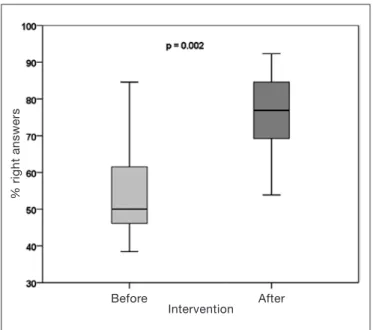
All students (n=14) have participated in proposed activities and have answered the questionnaire, with no losses during the study. Figure 1 shows distribution of scores obtained by students in the NPQ in evaluation moments. At baseline evaluation, students have answered correctly in average 7.5 (SD=4.8) items of the questionnaire, representing 62.5% of success. Just 21.4% of students had scores above 65% of right answers, showing a dissatisfactory level of knowledge about pain neurophysiology in the beginning of the study. In the inal assessment, the average of the items was 10.8 (SD=3.7) representing 90% right answers. Scores above 65% of right answers were observed in 90% of students. here has been statistically signiicant diference (p=0.002) between students’ scores before and after attending the discipline (Figure 2).
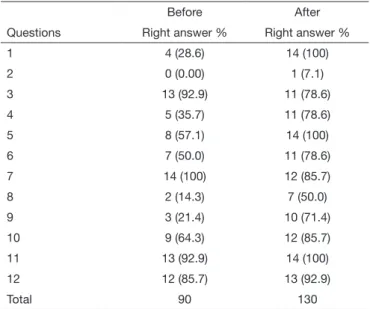
Table 1 shows absolute and percentage values of the number of right answers per item. Four items (3, 7, 11 and 12), had high initial success rate, above 85%, while seven items (1, 2, 4, 5, 6, 8 and 9) had success rate below 60%. Items 1, 5, 7, 10, 11 and 12 of the questionnaire, after intervention, had success rate above 85%. Success rate before and after intervention was higher for items 1, 4, 5 and 9, while items 3 and 7 had a slight decrease in success rate.
Before After
Students
Per
centage of right answers
(%
)
Figure 1. Success rate of students observed before and after atten-ding the discipline
Figure 2. Boxplot indicating the percentage of right answers by items observed before and after intervention
Before
% right answers
Table 1. Absolute and percentage values of right answers by items observed before and after attending the discipline
Before After
Questions Right answer % Right answer %
1 4 (28.6) 14 (100)
2 0 (0.00) 1 (7.1)
3 13 (92.9) 11 (78.6)
4 5 (35.7) 11 (78.6)
5 8 (57.1) 14 (100)
6 7 (50.0) 11 (78.6)
7 14 (100) 12 (85.7)
8 2 (14.3) 7 (50.0)
9 3 (21.4) 10 (71.4)
10 9 (64.3) 12 (85.7)
11 13 (92.9) 14 (100)
12 12 (85.7) 13 (92.9)
Total 90 130
DISCUSSION
Pedagogic teaching-learning strategies used to build neuro-physiologic pain knowledge of physiotherapy students were successful as shown by the higher number of right answers for most items of the questionnaire applied at the end of the discipline. At baseline evaluation, students had a low level of neurophysiologic pain knowledge. After intervention there has been improvement in scores being reached moderate scores on pain knowledge. Most students (79%) have im-proved their neurophysiologic pain knowledge with strategies used along the period. From 12 evaluated items, nine items had a higher number of right answers at inal evaluation. Baseline evaluation of pain neurophysiologic knowledge has shown a supericial knowledge of students about the subject. Alves et al.9 have investigated pain physiology and manage-ment knowledge of physiotherapy students with a 27-ques-tion ques27-ques-tionnaire.
Questions were divided in groups addressing diferent charac-teristics, such as pain pathophysiology, pain subjectivity and evaluation, physiotherapeutic resources to control pain, non pharmacological and pharmacological therapy to control pain. Low success rates were observed both for pain pathophysiol-ogy and multidimensionality and therapy. hese indings are in line with our study which has shown lack of knowledge about the relationship between pain intensity and injury se-verity, in addition to lack of understanding of pain trigger-ing and maintaintrigger-ing mechanisms on part of students. Results might be justiied by the way in which pain is addressed dur-ing graduation, bedur-ing seen as a complementary concept for diferent disciplines rather than a central subject14.
he set of strategies used in the discipline has provided ex-pressive improvement of neurophysiologic pain knowledge in our study. Latimer, Maher and Refshauge26, using the Health Care Providers Pain and Impairment Relationship Scale ques-tionnaire (HC-PAIRS), have also observed improved chronic
pain knowledge through the change in beliefs and attitudes of physiotherapy students after the holding of a chronic pain teaching module, being observed a lower association by stu-dents between pain and functional incapacity or limitation. he efect of education could be perceived immediately after the module and one year after it.
Students beliefs about pain may be inluenced by professors’ beliefs, especially those conducting the clinical practice, and by social representations built throughout life. Educative ap-proaches, promoting adequate knowledge about pain physiol-ogy and its management, should be provided not only to stu-dents, but also to professors and to the clinical team26, since learning is associated to education institutions, to professors-facilitators and to professional models with which they in-teract.
A study by Ferreira et al.27 has evaluated beliefs and attitudes of physiotherapy students with regard to chronic low back pain using the HC-PAIRS questionnaire. Authors have iden-tiied the belief that pain justiies functional incapacity and limitation of these patients. Results found by the authors may be justiied by the low level of knowledge about pain neuro-physiology, as observed in our study before attending the dis-cipline. Deiciencies on basic knowledge about pain were also observed among medical students28, young anesthesiologists29 and nursing students30.
Students with high scores in the test about pain management had positive attitudes to manage pain30. So, it is believed that beliefs and attitudes may be changed after the building of knowledge based on a biopsychosocial model31 or after a chronic pain course26. hese indings conirm our study re-sults, which have observed increased knowledge about pain neurophysiology after attending a discipline addressing the subject. Physiotherapists’ beliefs and attitudes are also able to inluence the prognosis of patients with chronic pain, due to long interaction times during treatment32. his way, adequate knowledge of neurophysiologic pain mechanisms may favor the use of a broader evaluation of chronic pain patients, pro-viding a humanized approach and, as a consequence, a more favorable prognosis.
he use of active teaching-learning strategies in the discipline, as well as the problem-based methodology, may favor the qualiication of independent students able to relect about the process and to develop adequate skills to apply this knowl-edge33. As from this experience, it was possible to observe positive results in knowledge building about pain neurophysi-ology among students of the ifth period of the Physiotherapy course. So, it is necessary to think about curriculum changes to implement basic disciplines and diferentiated pedagogic strategies aiming at improving the understanding of pain physiology and management34,35.
active teaching-learning process has also been observed. Our study may indicate the need for the implementation of new strategies to favor the learning of chronic pain mechanisms and management of Brazilian physiotherapists, in order to improve the quality of assistance to chronic pain patients.
CONCLUSION
he level of neurophysiologic pain knowledge of Physiother-apy students was enhanced by disciplines speciically address-ing contents about pain. Active teachaddress-ing-learnaddress-ing strategies were able to favor this knowledge building.
REFERENCES
1. IASP International Association for the Study of Pain. Disponível em <www.iasp-pain. org> Acesso em: 08 julho 2015.
2. Nogueira LA, Urtado CB, Chaves AM, Ferreira M, Santos C, Casarin CA, et al. Peril epidemiológico do ambulatório de isioterapia de um hospital universitário. Ter Man. 2011;9(1):45-50.
3. Vos T, Flaxman AD, Naghavi M, Lozano R, Michaud C, Ezzati M, et al. Years li-ved with disability (YLDs) for 1160 sequelae of 289 diseases and injuries 1990– 2010: a systematic analysis for the Global Burden of Disease Study 2010. Lancet. 2012;380(9859):2163-96.
4. IASP/EFIC Unrelieve Pain is a Major Global. Disponível em <www.eic.org/useriles/ Pain Global Healthcare Problem.pdf> Acesso em: 08 julho 2015.
5. Goldberg DS, McGee SJ. Pain as a global public health priority. BMC Public Health. 2011;11:770.
6. Fishman SM, Young HM, Lucas Arwood E, Chou R, Kerr K, Murinson BB, et al. Core competencies for pain management: results of an interprofessional consensus summit. Pain Med. 2013;14(7):971-81.
7. Sereza TW, Dellaroza MS. O que está sendo aprendido a respeito da dor na UEL? Semina Ciênc Biol Saúde. 2003;24(1):55-66.
8. Steglitz J, Buscemi J, Ferguson MJ. he future of pain research, education, and treat-ment: a summary of the IOM report “Relieving pain in America: a blueprint for trans-forming prevention, care, education, and research”. Transl Behav Med. 2012;2(1):6-8. 9. Alves RC, Tavares JP, Funes RA, Gasparetto GA, Silva KC, Ueda TK. Evaluation
of pain knowledge of Physiotherapy students from a university center. Rev Dor. 2013;14(4):272-9.
10. Clenzos N, Naidoo N, Parker R. Physiotherapists’ knowledge of pain: a cross-sectional correlational study of members of the South African Sports and Orthopaedic Manipu-lative Special Interest Groups. South Afr J Sport Med. 2013;25(4):95-100. 11. Simpson K, Kautzman L, Dodd S. he efects of a pain management education
program on the knowledge level and attitudes of clinical staf. Pain Manag Nurs. 2002;3(3):87-93.
12. Watt-Watson J, Hunter J, Pennefather P, Librach L, Raman-Wilms L, Schreiber M, et al. An integrated undergraduate pain curriculum, based on IASP curricula, for six health science faculties. Pain 2004;110(1-2):140-8.
13. IASP Disponível em <http://www.iasp-pain.org/Education/CurriculumDetail. aspx?ItemNumber=2055> Acesso em 15 setembro 2015.
14. Hoeger Bement MK, Sluka KA. he current state of physical therapy pain curricula in the United States: a faculty survey. J Pain. 2015;16(2):144-52.
15. Briggs EV, Battelli D, Gordon D, Kopf A, Ribeiro S, Puig MM, et al. Current pain edu-cation within undergraduate medical studies across Europe: Advancing the Provision of Pain Education and Learning (APPEAL) study. BMJ Open. 2015;5(8):e006984. 16. Castro CE, Parizotto NA, Barboza HF. Programa mínimo sobre mecanismos de dor e
analgesia para cursos de graduação em Fisioterapia. Rev Bras Fisioter. 2003;7(1):85-92. 17. Catley MJ, O’Connell NE, Moseley GL. How good is the neurophysiology of pain
questionnaire? A Rasch analysis of psychometric properties. J Pain. 2013;14(8):818-27. 18. Dolphens M, Nijs J, Cagnie B, Meeus M, Roussel N, Kregel J, et al. Eicacy of a modern neuroscience approach versus usual care evidence-based physiotherapy on pain, disability and brain characteristics in chronic spinal pain patients: protocol of a randomized clinical trial. BMC Musculoskelet Disord. 2014;8(15):149.
19. Anastasiou LGC. Ensinar, aprender, apreender e processos de ensinagem. In: Anasta-siou LGC, Alves LP, organizadores. Processos de ensinagem na universidade: pressu-postos para estratégias de trabalho em aula. Joinville (SC): UNIVILLI; 2003. 11-38p. 20. Butler DS, Moseley GL. Explain Pain. Adelaide, Australia: Noigroup Publications,
2003.130p.
21. Bostick GP, Toth C, Dick BD, Carr EC, Stitt LW, Moulin DE. An adaptive role for ne-gative expected pain in patients with neuropathic pain. Clin J Pain. 2015;31(5):438-43. 22. Vídeo educativo desenvolvido por Pain Australia e disponível gratuitamente. Disponí-vel em: <https://www.youtube.com/watch?v=RWMKucuejIs> Acesso em 15 setembro 2015.
23. Dobson D, Dobson KS. A terapia cognitivo comportamental baseada em evidências. Porto Alegre: Artmed; 2009. 17p.
24. Phillips K, Clauw DJ. Central pain mechanisms in chronic pain states--maybe it is all in their head. Best Pract Res Clin Rheumatol. 2011;25(2):141-54.
25. Gallagher L, McAuley J, Moseley GL. A randomized-controlled trial of using a book of metaphors to reconceptualize pain and decrease catastrophizingin people with chro-nic pain. Clin J Pain. 2013;29(1):20-5.
26. Latimer J, Maher C, Refshauge K. he attitudes and beliefs of physiotherapy stu-dents to chronic back pain. Clin J Pain. 2004;20(1):45-50.
27. Ferreira PH, Ferreira ML, Latimer J, Maher CG, Refshauge K, Sakamoto A, et al. At-titudes and beliefs of Brazilian and Australian physiotherapy students towards chronic back pain: a cross-cultural comparison. Physiother Res Int. 2004;9(1):13-23. 28. Tauben DJ, Loeser JD. Pain education at the University of Washington School of
Medicine. J Pain. 2013;14(5):431-7.
29. Bakshi SG, Jain P, Kannan S. An assessment of basic pain knowledge and impact of pain education on Indian Anaesthesiologists - a pre and post questionnaire study. Indian J Anaesth. 2014;58(2):127-31.
30. Latchman J. Improving pain management at the nursing education level: evaluating knowledge and attitudes. J Adv Pract Oncol. 2014;5(1):10-6.
31. Overmeer T. Implementing psychosocial factors in physical therapy treatment for pa-tients with musculoskeletal pain in primary care. Örebro; 2010. Tese [doutorado]. Örebro Universite.
32. Houben RM, Ostelo RW, Vlaeyen JW, Wolters PM, Peters M, Stomp-van den Berg SG. Health care providers’ orientations towards common low back pain predict per-ceived harmfulness of physical activities and recommendations regarding return to normal activity. Eur J Pain. 2005;9(2):173-83.
33. Moseley L. Unraveling the barriers to reconceptualization of the problem in chronic pain: the actual and perceived ability of patients and health professionals to unders-tand the neurophysiology. J Pain. 2003;4(4):184-9.
34. Watt-Watson J, Murinson BB. Current challenges in pain education. Pain Manag. 2013;3(5):351-7.