260
Rev Dor. São Paulo, 2014 oct-dec;15(4):260-3
ABSTRACT
BACKGROUND AND OBJECTIVES: Fibromyalgia
syn-drome is a chronic condition causing spontaneous widespread pain associated with hypersensitivity. his study aimed at investi-gating the pressure pain endurance in women with ibromyalgia syndrome to determine the range of painful stimulation that an individual with ibromyalgia syndrome can resist acceptably.
METHODS: We conducted an observational, descriptive, cross-sectional study with 60 subjects (51.23±8 years), who met the American College of Rheumatology/1990 (ACR) criteria for ibromyalgia syndrome, and 42 healthy volunteers (48.33±9 years) as the control group. Algometry was performed to record pressure pain detection threshold and pressure pain tolerance, and ibromyalgia impact questionnaire was used to determine the impact of ibromyalgia syndrome. Pressure pain endurance was calculated as the arithmetic diference between pressure pain tolerance and pressure pain detection threshold.
RESULTS: A signiicant diference in ibromyalgia impact ques-tionnaire (p<0.0001), pressure pain detection threshold, and pressure pain tolerance (p<0.0001) was found between both groups. Furthermore, a signiicant diference in pressure pain endurance (p<0.0001) for each of the 18 points identiied by ACR was noted between both groups, with the highest range of physical stimulation observed in the control group. A cor-relation between pressure pain endurance and pressure pain de-tection threshold (r=0.8334; p<0.0001) and pressure pain tol-erance (r=0.8387; p<0.0001) was observed in the ibromyalgia syndrome group.
CONCLUSION: Pressure pain endurance of the ibromyalgia syndrome group was extremely lower, when compared with that
Pressure pain endurance in women with fibromyalgia*
Amplitude de dor à pressão em mulheres com fibromialgia
Rodrigo Pegado de Abreu Freitas1, Sandra Cristina de Andrade1, Ranulfo Fiel Pereira Pessoa de Carvalho2, Maria Bernardete
Cordeiro de Sousa1
*Received from Federal University of Rio Grande do Norte, Natal, RN, Brazil.
1. Federal University of Rio Grande do Norte, Natal, RN, Brazil. 2. University Potiguar, Natal, RN, Brazil.
Submitted in August 21, 2014.
Accepted for publication in October 07, 2014. Conlict of interests: none.
Correspondence to: Rodrigo Pegado de Abreu Freitas
Universidade Federal do Rio Grande do Norte, Faculdade de Ciências da Saúde do Trairí Rua Trairí, s/n, Centro
59200-000 Natal, RN, Brasil. E-mail: [email protected]
© Sociedade Brasileira para o Estudo da Dor
of healthy controls, and may be used as an additional component to measure the disturbance in pain perception and to determine the range of painful stimulation that an individual with ibromy-algia syndrome can acceptably resist.
Keywords: Fibromyalgia, Musculoskeletal pain, Pain measure-ment, Pain perception, Women.
RESUMO
JUSTIFICATIVA E OBJETIVOS: A síndrome da ibromialgia é caracterizada por uma condição crônica que causa dor gen-eralizada espontânea associada a hipersensibilidade. Este estudo teve como objetivo investigar a amplitude de dor à pressão em mulheres com síndrome da ibromialgia para determinar o início da sensação dolorosa e o máximo suportado e comparar com controles saudáveis.
MÉTODOS: Foi realizado um estudo observacional, descritivo transversal, conforme os critérios do Colégio Americano de Reuma-tologia/1990 (ACR), com 60 mulheres (51.23±8 anos) com diag-nóstico de síndrome da ibromialgia e 42 (48.33±9 anos) voluntárias saudáveis como grupo controle. A algometria foi realizada para reg-istro do limiar e tolerância à dor à pressão e aplicado o Questionário de Impacto da Fibromialgia para determinar a funcionalidade. A amplitude de dor à pressão foi calculada como a diferença aritmética entre o registro do limiar e a tolerância à dor à pressão.
RESULTADOS: Foi encontrada diferença signiicativa no Ques-tionário de Impacto da Fibromialgia e nas variáveis de sensibi-lidade dolorosa (registro do limiar e tolerância à dor à pressão) entre os grupos (p<0,0001). Veriicou-se diferença signiicativa (p<0,0001) na amplitude de dor à pressão para cada um dos 18 pontos identiicados pelo ACR entre o grupo síndrome da i-bromialgia e o grupo controle, com maior amplitude de dor à pressão no grupo controle. Foi encontrada forte correlação entre a amplitude de dor à pressão com o registro do limiar (r=0,8334, p<0,0001) e a tolerância à dor à pressão (r=0,8387, p<0,0001) no grupo ibromialgia.
CONCLUSÃO: A amplitude da percepção de dor na sín-drome da ibromialgia é extremamente baixa quando com-parada com controles saudáveis. Portanto, sugere-se que essa relação poderia ser utilizada como um componente adicional para avaliar as perturbações na percepção da dor e determinar o intervalo aceitável de um estímulo doloroso que indivíduo pode suportar.
Descritores: Dor musculoesquelética, Fibromialgia, Mensura-ção da dor, Mulheres, PercepMensura-ção da dor.
ORIGINAL ARTICLE
261
Pressure pain endurance in women with ibromyalgia Rev Dor. São Paulo, 2014 oct-dec;15(4):260-3
INTRODUCTION
Fibromyalgia syndrome (FMS) is a chronic condition that causes pain, stifness, and tenderness of muscles, tendons, and joints. It is also characterized by restless sleep, tiredness, fatigue, anxi-ety, depression, and disturbances in bowel functions1. he major
symptom could be characterized by spontaneous, widespread, and unexplained pain associated with hypersensitivity, hyper-algesia (decreased mechanical pain threshold), and/or allodynia (pain induced by non-nociceptive stimuli)2. Previous studies3,4
had described that an abnormality in the central pain processing system results in central ampliication of pain signals. he persis-tence of nociceptive receptors stimulation in the peripheral tis-sue may lead to plastic alterations in the central nervous system, causing central ampliication and increase in pain sensitivity3,4.
hus, many methods to assess hypersensitivity in patients with FMS have been developed5-7. Apart from a heightened sensitivity to
pres-sure, the responses of patients with FMS to other types of stimuli, such as heat, cold, and electrical stimuli, have been found to be simi-lar to those of the controls8-10. Many clinical centers routinely
mea-sure presmea-sure pain threshold while assessing chronic pain patients, but not pain range11. Pressure pain detection threshold (PPdt) is
deined as the point at which a steadily increasing non-painful pres-sure stimulus turns into a painful prespres-sure sensation. Prespres-sure pain tolerance (PPt) is deined as the highest level of pain that a subject is prepared to tolerate12. Pressure pain endurance (PPe) (pain range)
is deined as the pressure stimuli because pain is reported (PPdt) until pressure pain increases to a maximum endured level (PPt)13.
Monitoring of PPe, not only PPdt or the number of tender points, is important to predict the increase or decrease in pain sensitivity by drug or physical therapy5. he fact that PPe could be increased
with-out any change in PPdt is important because even with pain, the patient can still perform many daily activities and rehabilitation pro-grams. Similarly, we can increase PPdt without changing PPe. hese data are important for physical rehabilitation, including stretching, muscle strength, and aerobic exercise14.
he advances in understanding the biology of pain character-istics in FMS could provide rational platforms for treatment target identiication and limits for exercise and physical therapy modalities to control chronic musculoskeletal pain. herefore, this study aimed at investigating PPe in women with FMS to determine the range of painful stimulation that an individual can resist acceptably, and compare it with that of healthy controls.
METHODS
An observational, descriptive, cross-sectional study was conduct-ed. Patients who met diagnostic criteria14 for FMS were recruited
from the Medical Clinic of the Onofre Lopes University Hospi-tal and Physiotherapy Clinic at the University Potiguar, NaHospi-tal, Brazil. Informed consent was obtained from all subjects, and the study protocols complied with ethical guidelines.
A total of 60 adult women aged 32 to 71 years, who met the 1990 American College of Rheumatology (ACR) criteria14 for FMS, were
recruited. he control group (CT) consisted of 42 healthy volun-teers chosen randomly among hospital personnel and teachers.
Inclusion criteria adopted were: (a) medical diagnosis of FMS; (b) ability to understand the study objective and answer the questions; and (c) not participating in physical therapy or re-habilitation programs in the previous 3 months. he CT group met all the inclusion criteria, except diagnosis of FMS and ab-sence of both rheumatic and endocrine diseases. Exclusion cri-teria for both the groups were: (a) conirmed cognitive deicit; (b) physical and/or organic diiculties that compromised ques-tionnaire application and analgesic tests; (c) endocrine, rheu-matic, and/or autoimmune diseases, including chronic fatigue syndrome, chronic pelvic pain, atypical depression, irritable bowel syndrome, rheumatoid arthritis, gout, and lupus; and (d) use of corticosteroids, analgesics, and anti-inlammatory drugs. Subjects were also asked if they had sufered from any stressful experiences in the last 2 weeks, such as quarrels or receiving bad news, or if they had engaged in intense physical activity.
Assessement of pain sensitivity and symptoms of ibromyalgia
he experiment was performed in a quiet setting without any in-terruptions and in isolation from other patients. Algometry was conducted to record PPdt and PPt. A total of 18 tender points were marked with a dermographic pencil and assessed while the patients were in orthostatic position, with their feet slightly sepa-rated. Pain sensitivity tests were performed on the 18 identiied points by ACR14, perpendicular to the skin at intervals of 5-10 s by
the same qualiied examiner. A pressure algometer was used (Pain Diagnostics and hermography®, Great Neck, NY, USA) through
a 1cm diameter rubber extremity. Pain threshold and tolerance to pressure were quantiied in kg/cm2. he examiner positioned the
rubber point above the area to be examined and gradually increased the pressure by 1kg/cm2/s. PPdt was measured when the patient said
“I am starting to feel pain.” To measure PPt, the patient was asked to bear the maximum amount of pressure from the algometer and use the sentence “Stop, I cannot take anymore” when she could no longer tolerate pain. Patients were asked to use these exact sentences for standardization of the test. PPe was calculated as the arithmetic diference between PPt and PPdt, i.e., PPt − PPdt=PPe.
Functional capacity was evaluated using the Brazilian version of the Fibromyalgia Impact Questionnaire (FIQ)15, which is a
self-administered questionnaire that measures the functional aspects of the patient over the last few weeks. he FIQ contains three Likert-scale-type questions (levels of response) and seven visual analog questions. All the scales vary from 1 to 10 and a high score indicates negative impact and more severe symptoms. To-tal FIQ score is graded from 1 to 100 points. Higher scores are related to greater impact of the disease on patients’ functionality and a corresponding reduction in their quality of life15.
Statistical analysis
262
Freitas RP, Andrade SC, Carvalho RF and Sousa MB
Rev Dor. São Paulo, 2014 oct-dec;15(4):260-3
well as between PPe and PPdt in the FMS group. he value of p for statistically signiicant results was set at ≤0.05.
he Research Ethics Committee of the Federal University of Rio Grande do Norte has approved all procedures described in this study (274/2010).
RESULTS
No diference in age between groups was found. A signiicant in-crease in FIQ scores was observed in the FMS group (p<0.0001) (Table 1). he FMS group showed a decrease in PPdt and PPt, indicating extreme sensitivity to pain. Furthermore, a sig-niicant decrease in the values of PPdt (FMS=1.88±0.45kg/ cm2; CT=4.76±1.2kg/cm2) and PPt (FMS=2.49±0.52kg/cm2;
CT=5.91±1.5kg/cm2) was found (p<0.0001) (Table 1).
Table 1. Age and differences in pain and functionality between i-bromyalgia and control groups
Groups
Variables Fibromyalgia
(n = 60)
Control (n = 42)
Value-p
Age 51.23±8 48.33±9 0.1178
FIQ 68.96±16.4 18.12±12.3 <0.0001*
PPdt 1.88±0.45 4.76±1.2 <0.0001*
PPt 2.49±0.52 5.91±1.5 <0.0001*
Mann-Whitney test. FIQ; Fibromyalgia Impact Questionnaire; PPdt: pressure pain detection threshold; PPt: pressure pain tolerance; Pain values in kg/cm2.
*Signiicant at 5%.
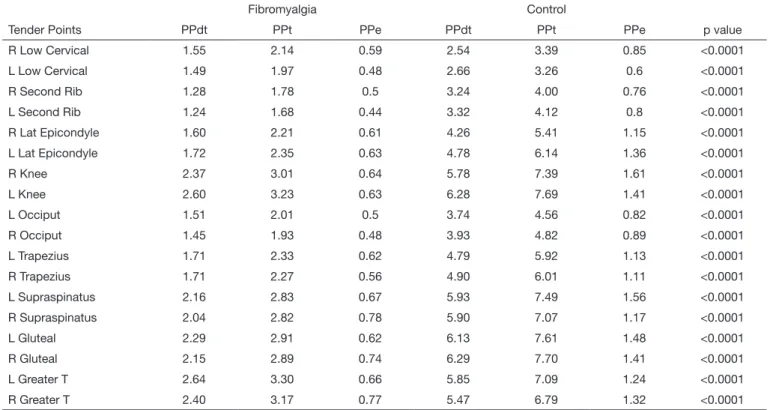
Table 2 shows signiicant diferences (p<0.0001) between FMS and CT groups in PPdt, PPt, and PPe for each of the 18 points examined by ACR; values of all variables were signiicantly low-er for the FMS group. PPe of FMS group showed a signiicant decrease (p<0.0001) (0.60±0.09kg/cm2), when compared with
that of CT groupe (1.14±0.3kg/cm2), with the highest range
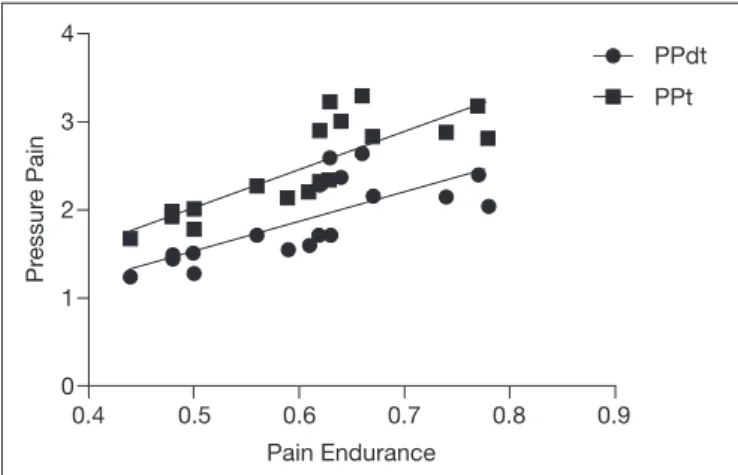
of physical stimulation found in the CT groupe (Figure 1). A strong positive correlation between PPe and PPdt (r=0.8334; p<0.0001) as well as between PPe and PPt (r=0.8387; p<0.0001) was noted in the FMS group (Figure 2).
Table 2. Pressure pain means for each of the18 points identiied by ACR between ibromyalgia and control group
Fibromyalgia Control
Tender Points PPdt PPt PPe PPdt PPt PPe p value
R Low Cervical 1.55 2.14 0.59 2.54 3.39 0.85 <0.0001
L Low Cervical 1.49 1.97 0.48 2.66 3.26 0.6 <0.0001
R Second Rib 1.28 1.78 0.5 3.24 4.00 0.76 <0.0001
L Second Rib 1.24 1.68 0.44 3.32 4.12 0.8 <0.0001
R Lat Epicondyle 1.60 2.21 0.61 4.26 5.41 1.15 <0.0001
L Lat Epicondyle 1.72 2.35 0.63 4.78 6.14 1.36 <0.0001
R Knee 2.37 3.01 0.64 5.78 7.39 1.61 <0.0001
L Knee 2.60 3.23 0.63 6.28 7.69 1.41 <0.0001
L Occiput 1.51 2.01 0.5 3.74 4.56 0.82 <0.0001
R Occiput 1.45 1.93 0.48 3.93 4.82 0.89 <0.0001
L Trapezius 1.71 2.33 0.62 4.79 5.92 1.13 <0.0001
R Trapezius 1.71 2.27 0.56 4.90 6.01 1.11 <0.0001
L Supraspinatus 2.16 2.83 0.67 5.93 7.49 1.56 <0.0001
R Supraspinatus 2.04 2.82 0.78 5.90 7.07 1.17 <0.0001
L Gluteal 2.29 2.91 0.62 6.13 7.61 1.48 <0.0001
R Gluteal 2.15 2.89 0.74 6.29 7.70 1.41 <0.0001
L Greater T 2.64 3.30 0.66 5.85 7.09 1.24 <0.0001
R Greater T 2.40 3.17 0.77 5.47 6.79 1.32 <0.0001
Results of Mann-Whitney test. Signiicant at 5%.
R: right; L: left; Lat: lateral; Greater T: Greater trochanter; PPe: pressure pain endurance; PPe: pressure pain tolerance; PPdt: pressure pain detection threshold. Pres-sure pain values in kg/cm2. There is a signiicant intergroup PPdt, PPt and PPe difference for each of the18 points identiied by ACR14.
Fibromyalgia *
Pr
essur
e Pain
2.0
1.5
1.0
0.5
0.0
Control
Figure 1. Boxplot comparing pressure pain endurance means betwe-en ibromyalgia and control groups
263
Pressure pain endurance in women with ibromyalgia Rev Dor. São Paulo, 2014 oct-dec;15(4):260-3
DISCUSSION
When compared with the CT group, PPe (pain range) of the FMS group was signiicantly reduced. his indicated that FMS led to a signiicant decrease in PPe that was extremely lower, when compared to that of healthy controls, and was associated with the initial painful pressure sensation and maximum en-dured level.
Pain perception was clearly altered in the FMS group, resulting in lower functionality, impairment of physical activities, and in-creased depressive or anxiety states. An understanding of PPe in FMS could provide rational platforms for treatment and limits for exercise and physical therapy modalities to control chronic musculoskeletal pain2.
Psychological and biological factors that may be responsible for these alterations have been fairly discussed. Some authors have described that in normal pain process, perception of pain in-volves two main groups of neural pathways, namely, ascending and descending pathways4. he peripheral nerves transmit
sen-sory signals, including nociceptive stimuli, to the spinal cord for transmission via the ascending nociceptive pathway to the brain for processing. Descending pain modulatory pathways send both facilitatory and inhibitory signals from the encephalon to the spinal cord and periphery, either increasing or decreasing the “volume control” on incoming nociceptive signals reaching the brain2,4. In patients with FMS, these two pain pathways appear
to operate abnormally, resulting in central ampliication of pain signals and lower PPe4,9.
We suggest that even with low PPdt, patients with FMS may present an improved PPt. herefore, patients with FMS should be given better support in physical therapy, including aerobic exercises, muscle strengthening, electrotherapy, and hydrothera-py3,8. Although regular exercise is clearly associated with higher
pain tolerance, pain thresholds are afected more ambiguously, possibly producing clinical implications. Tesarz et al.16 indicated
that regular physical activity is associated with speciic alterations
in pain perception. Studies on the efect of physical exercise on pain patients have demonstrated a consistent impact on qual-ity of life and functioning without improvement in pain scores. hus, in the exercise treatment for pain patients, it may be ad-visable to focus on the development of pain-coping skills that would afect tolerance, rather than direct alleviation of PPe9,16.
With this strategy, it may be possible to increase PPe in patients with FMS and improve their quality of life and functionality. Further research is needed to clarify the relationship between modiications in pain perception, psychological factors, and neu-robiological processes in patients with FMS.
CONCLUSION
Patients with FMS have reduced functionality and decreased PPe, indicating that this variable should be used as an additional component to measure the disturbance in pain perception and to determine the range of painful stimulation that an individual can resist acceptably. hus, the knowledge of PPe in patients with FMS may provide rational platforms for treatment and limits for exercise and physical therapy modalities, improving both quality of life and functionality.
REFERENCES
1. Jahan F, Nanji K, Qidwai W, Qasim R. Fibromyalgia syndrome: an overview of patho-physiology, diagnosis and management. Oman Med J. 2012;27(3):192-5. 2. Clauw DJ. Fibromyalgia: an overview. Am J Med. 2009;122(12 Suppl):S3-S13. 3. Yunus MB. Central sensitivity syndromes: a new paradigm and group nosology for
ibromyalgia and overlapping conditions, and the related issue of disease versus illness. Semin Arthritis Rheum. 2008;37(6):339-52.
4. Clauw DJ, Arnold LM, McCarberg BH; FibroCollaborative. he science of i-bromyalgia. Mayo Clin Proc. 2011;86(9):907-11.
5. Jespersen A, Dreyer L, Kendall S, Graven-Nielsen T, Arendt-Nielsen L, Bliddal H, et al. Computerized cuf pressure algometry: A new method to assess deep-tissue hyper-sensitivity in ibromyalgia. Pain. 2007;131(1-2):57-62.
6. Marques AP, Assumpção A, Matsutani LA, Pereira CA, Lage L. Pain in ibromyalgia and discrimination power of the instruments: Visual Analog Scale, Dolorimetry and the McGill Pain Questionnaire. Acta Reumatol Port. 2008;33(3):345-51. 7. Ablin K, Clauw DJ. From ibrositis to functional somatic syndromes to a bell-shaped
curve of pain and sensory sensitivity: evolution of a clinical construct. Rheum Dis Clin North Am. 2009;35(2):233-51.
8. Marques AP, Ferreira EA, Matsutani LA, Pereira CA, Assumpção A. Quanti-fying pain threshold and quality of life of ibromyalgia patients. Clin Rheumatol. 2005;24(3):266-71.
9. Helfenstein Junior M, Goldenfum MA, Siena CA. Fibromyalgia: clinical and occupa-tional aspects. Rev Assoc Med Bras 2012;58(3):358-65.
10. Petzke F, Clauw DJ, Ambrose K, Khine A, Gracely RH. Increased pain sensiti-vity in ibromyalgia: efects of stimulus type and mode of presentation. Pain. 2003;105(3):403-13.
11. Nielsen LA, Henriksson KG. Pathophysiological mechanisms in chronic musculoske-letal pain (ibromyalgia): the role of central and peripheral sensitization and pain disi-nhibition. Best Pract Res Clin Rheumatol. 2007;21(3):465-80.
12. Eglof N, Klingler N, von Känel R, Cámara RJ, Curatolo M, Wegmann B, et al. Algo-metry with a clothes peg compared to an electronic pressure algometer: a randomized cross-sectional study in pain patients. BMC Musculoskelet Disord. 2011;25(12):174. 13. Dagtekin O, König E, Gerbershagen HJ, Marcus H, Sabatowski R, Petzke F. [Me-asuring pressure pain thresholds. Comparison of an electromechanically controlled algometer with established methods]. Schmerz. 2007;21(5):439-44. German. 14. Wolfe F, Smythe HA, Yunus MB, Bennett RM, Bombardier C, Goldenberg DL,
et al. he American College of Rheumatology 1990 Criteria for the Classiication of Fibromyalgia. Report of the Multicenter Criteria Committee. Arthritis Rheum. 1990;33(2):160-72.
15. Marques AP, Santos AM, Assumpção A, Matsutani LA, Lage LV, Pereira CA. Valida-tion of the brazilian version of the Fibromyalgia Impact QuesValida-tionnaire (FIQ). Rev Bras Reumatol. 2006;46(1):24-31.
16. Tesarz J, Schuster AK, Hartmann M, Gerhardt A, Eich W. Pain perception in athletes ompared to normally active controls: a systematic review with meta-analysis. Pain 2012;153(6):1253-62.
Pain Endurance
0.4 0.5 0.6 0.7 0.8 0.9 4
3
2
1
0
PPdt
PPt
Pr
essur
e Pain
Figure 2. Spearman correlation between pressure pain endurance with pressure pain tolerance (r=0.8387; p<0.0001) and pressure pain detection threshold (r=0.8334; p<0.0001) in ibromyalgia group. It was
used the 18 points identiied by ACR14