Fatigue in colorectal cancer patients:
prevalence and associated factors
Dálete Delalibera Corrêa de Faria Mota
1Cibele Andrucioli de Mattos Pimenta
2Ricardo Caponero
3Corresponding Author:
Dálete Delalibera Corrêa de Faria Mota
Universidade Federal de Goiás. Faculdade de Enfermagem Rua 227 Qd 68, S/N
Setor Leste Universitário
CEP: 74605-080, Goiânia, GO, Brasil E-mail: [email protected] Rev. Latino-Am. Enfermagem
2012 May.-June;20(3):495-503 www.eerp.usp.br/rlae
Original Article
1 PhD, Profesor Adjunto, Faculdade de Enfermagem, Universidade Federal de Goiás, Brasil. 2 PhD, Profesor Titular, Escola de Enfermagem, Universidade de São Paulo, Brasil. 3 Oncologista, Hospital Santa Helena, São Paulo, Brasil.
This study identiied the prevalence and predictors of fatigue in colorectal cancer (CRC) patients. Cross-sectional study with 157 adult CRC outpatients (age 60±11.7 years; 54% male; cancer stage
IV 44.8%). The Piper Fatigue Scale-revised was used to assess fatigue scores. Socio-demographic,
clinical, depression, performance status, pain and sleep disturbance data were assessed. Associations
between fatigue and these data were analyzed through logistic regression models. Fatigue was
reported by 26.8% patients. Logistic regression identiied three predictors: depression (OR: 4.2; 95%CI 1.68-10.39), performance status (OR: 3.2; 95%CI 1.37-7.51) and sleep disturbance (OR: 3.2; 95%CI 1.30-8.09). When all predictors were present, the probability of fatigue occurrence was 80%; when none were present, the probability was 8%. The model’s speciicity and sensitivity
were 81.9% and 58.6%, respectively. Through the assessment of depression, performance status
and sleep disturbance, the probability of fatigue occurrence can be estimated, and preventive and
treatment strategies can be rapidly implemented in clinical practice.
Descriptors: Colorectal Neoplasms; Odds Ratio; Regression Analysis; Risk Factors; Signs and
Fadiga em pacientes com câncer colorretal: prevalência e fatores associados
Os objetivos deste estudo foram identiicar a prevalência e os preditores de fadiga em pacientes com Câncer Colorretal (CCR). Trata-se de estudo seccional com 157 pacientes ambulatoriais com CCR (idade 60±11,7 anos; 54% homens; estádio câncer IV 44,8%). A Escala de Fadiga de Piper - Revisada foi utilizada para avaliar fadiga. Dados sociodemográicos, clínicos, depressão, funcionalidade, dor e sono foram avaliados. A associação entre variáveis foi realizada por regressão logística. Fadiga foi reportada por 26,8% pacientes. Pela regressão logística identiicaram-se três preditores: depressão (OR: 4,2; 95%IC 1,68-10,39), funcionalidade (OR: 3,2; 95%IC 1,37-7,51) e prejuízo do sono (OR: 3,2; 95%IC 1,30-8,09). Quando todos preditores estavam presentes, a probabilidade de ocorrência de fadiga foi de 80%; quando nenhum estava presente, a probabilidade foi de 8%. A especiicidade e sensibilidade do modelo foram, respectivamente, 81,9 e 58,6%. Conhecendo-se a probabilidade de fadiga, por meio da avaliação de depressão, funcionalidade e prejuízo do sono, torna-se possível a implementação de estratégias de prevenção e tratamento na clínica.
Descritores: Neoplasias Colorretais; Razão de Chances; Análise de Regressão; Fatores de
Risco; Sinais e Sintomas.
Fatiga en pacientes con cáncer cuello rectal: superioridad y factores asociados
Los objetivos de este estudio fueron la identiicación de la superioridad y los predictores de fatiga en pacientes con Cáncer Cuello rectal (CCR). Se trata de estudio seccional con 157 pacientes de ambulatorio con CCR (edad 60±11,7 años; 54% hombres; estadio cáncer IV 44,8%). La Escala de Fatiga de Piper - Revisada fue utilizada para evaluar fatiga. Datos sociodemográicos, clínicos, depresión, funcionalidad, dolor y sueño fueron evaluados. La asociación entre variables fue realizada por regresión logística. Fatiga fue reportada por 26,8% pacientes. Por la regresión logística se identiicaron tres predictores: depresión (OR: 4,2; 95%IC 1,68-10,39), funcionalidad (OR: 3,2; 95%IC 1,37-7,51) y perjuicio del sueño (OR: 3,2; 95%IC 1,30-8,09). Cuando todos predictores estaban presentes, la probabilidad de ocurrencia de fatiga fue del 80%; cuando ninguno estaba presente, la probabilidad fue del 8%. La especiicidad y sensibilidad del modelo fueron, respectivamente, 81,9 y 58,6%. Conociéndose la probabilidad de fatiga, por medio de la evaluación de depresión, funcionalidad y perjuicio del sueño, se vuelve posible la implementación de estrategias de prevención y tratamiento en la clínica.
Descriptores: Neoplasias Colorrectales; Oportunidad Relativa; Análisis de Regresión; Factores de Riesgo; Signos y Síntomas.
Introduction
For a long time, fatigue in cancer has been studied
as an isolated symptom. There were studies that aimed
to identify its prevalence, the evolution according to the
course of the disease, different treatments for cancer
and treatments for fatigue. As these pieces of knowledge
seemed relevant, new studies tried to identify the factors
that could predict the presence and intensity of fatigue.
Studies that investigate the tumor site as a risk factor
for fatigue or focus on patients with a single disease site
are important for the development of diagnostic strategies
and targeted fatigue interventions. Few studies have
investigated fatigue in colorectal cancer patients, and none has identiied predictors of fatigue in these patients. Thus, aiming to ill this gap, this study was undertaken to identify predictive factors of fatigue in patients with
Mota DDCF, Pimenta CAM, Caponero R. 497 The prevalence of fatigue is undoubtedly high.
In a systematic review that included 27 studies, the
prevalence ranged from 4% to 91%, depending on
the cancer population and assessment instruments(1). Speciically in patients under cancer treatment, it ranged from 32% to 99%(2). The intensity of the symptom is
also considerable, with mean scores ranging from 2.6
to 6.9, depending on the cancer site and staging(3-4).
Fatigue seems to persist even after the “cure” of cancer,
since 19% to 58% of treated people without evidence of
cancer reported the symptom(5-6).
Fatigue is a deleterious symptom that causes
suffering, distress, functional limitation and predicts
overall survival and quality of life(7-9). Many factors
may be related to the occurrence or aggravation of
the symptom and recent studies have investigated predictors of cancer-related fatigue in non-speciic site groups, such as advanced cancer, outpatients
and cancer survivors. It shows that, according to the
disease stage, the associated factors may vary. It
seems that, in outpatients, the predictors include a
reasonable amount of socio-demographic variables (female gender, high education, having a regular job and living without a partner), besides depression and performance status(10-12). On the other hand,
fatigue-associated factors in patients with advanced cancer are
basically related to other signs and symptoms present in terminally ill patients (e.g. pain, dyspnea, decreased appetite, depression, weakness sensation, anxiety, low hemoglobin levels and others)(3-4,13-14). Interestingly,
among cancer survivors, fatigue predictors include not
only performance and symptoms, but also cognitive impairment (stress, coping, self-eficacy)(5).
From the description, a vast variety of physiological,
physical, emotional, affective, socio-demographic and
treatment-related predictive factors are noted. Yet, it
was observed that many studies involved patients with
cancer in various sites and that, in those that included
patients with different tumors, the tumor site was not a predictive factor. Therefore, this paper speciically focused on colorectal cancer patients’ fatigue experience, aiming
to investigate its prevalence and independent associated
factors.
Methods
Cross-sectional study, involving 157 Brazilian adults
with primary colon or rectal cancer. Inclusion criteria were:
age 18 or more, being treated or followed in outpatient oncology services (inpatients were not included). To have or not fatigue was not an inclusion criteria. These
subjects composed a convenience sample and were
recruited from four outpatient oncology services at Sao Paulo city (1 public, 2 private and 1 both), July/2006 to July/2007. The sample representation from each service ranged between 15.3% and 33.1%. The number of
patients that refused to participate was considered low (8 patients).
Oncologists identiied the subjects at the participating oncology services. After a medical appointment, the
researcher recruited the patients, checked the inclusion
criteria and invited them to participate in the study. All
participants signed the informed consent term and the ethics
committees of each of the institutions involved approved
the study. Socio-demographic data and data related to the
cancer, its treatment, concomitant medication and clinical
signs/symptoms were obtained through interview and
medical chart analysis. Pain and sleep disturbance were assessed on a numerical scale (0-10 scale). Performance status (ability to perform daily activities) was assessed using the Karnofsky Performance Status Scale (KPS). Depression was assessed through the Beck Depression Inventory (BDI). It is a self-report instrument that consists of 21 items to evaluate depressive symptoms. Each item is
scored from 0 to 3 and the total BDI score varies between
0 and 63. Scores between 16 and 20 account for dysphoria
and above 21 for depression(15). In the current study,
Cronbach’s alpha equaled 0.83.
The Piper Fatigue Scale (PFS) - revised is a 22-item self-report instrument with three dimensions (behavioral, affective and sensorial/psychological). Each item is scored on a numerical scale (0-10). The dimension scores and total score vary between 0 and 10 and are obtained by adding
up the score of each item and dividing this by the number
of items on each dimension, or by 22 when calculating
the total score. This instrument was validated for use in
Brazilian cancer patients and the internal consistencies for the total scale (Cronbach’s alpha=0.94) and its dimensions (Cronbach’s alpha between 0.84 and 0.94) were very good in this study sample(16). The correlation between fatigue intensity on the numerical scale (0 to 10) and the Piper Fatigue Scale-revised (0 to 10) was also very good (Pearson r=0. 748; p<0.001). Fatigue was analyzed as a nominal variable and the cut-off point was established at score 4 (<4 = no fatigue; ≥4 = with fatigue), based on the
consensus of the National Comprehensive Cancer Network (2007)(17) and on the percentile distribution of the Piper scores, based on the present study indings.
When the subjects inished answering the self-report instruments, the researcher checked for missing data
and, in case data were missing, the researcher handed
the items back to the subjects so they could complete the
instrument. Nevertheless, missing data occurred. On the
of that item all other subjects had answered was used to
replace the missing data. On the PFS, three items were
blank and the patient’s mean subscale score of all items
in the same dimension was used to replace the missing
data. Missing socio-demographic, clinical, treatment data
were left blank.
For univariate analysis, Chi-Square test, Likelihood Ratio, Mann-Whitney test or T-Test were done. The variables that were associated to fatigue were inserted in
the logistic regression model. The quantitative variables
were analyzed through ROC curves to establish cut-off scores based on these study indings, and they were pain (cut-off score=6.0), sleep disturbance (cut-off score=5.0), performance status (cut-off score=80%), and depression (cut-off score=13). The variables were inserted in the logistic regression model, using forward stepwise. The
Statistical Package for the Social Sciences-version 15.0 was used to perform the analyses and p<0.05 was preset for statistical signiicance.
Results
Socio-demographic, clinical, disease and treatment characteristics
There was a slight predominance of men (n=85; 54.1%), married (n=107; 68.2%) and white (n=102; 65.0%). Most subjects were middle-aged adults (41-64 years), and the mean age was 60.0 (±11.7), varying from
28 to 84. In terms of formal education, over half of the participants studied over 9 years (n=102; 65.0%). Most of them were not employed (n=112; 71.3%) and 113 (72.0%) were being assisted in private oncology clinics. The clinical
characterization of the participants is presented in Table 1.
In Table 1, a signiicant portion of subjects with altered BMI (57.6%) can be observed. Of 157 subjects, 110 (70.1%) had colon tumors (data not shown in Table), and the others had rectal cancer. Many of the subjects had advanced stage disease (III and IV) and almost all received chemotherapy and/or radiotherapy. Nearly half of the patients (55%) had co-morbidities and 20% used antidepressants and/or
anxiolytics. Scores compatible with dysphoria and depression
were present in 15.4% of the subjects.
Prevalence of fatigue
Almost half of the patients (n=78; 49.7%) reported no fatigue at all (zero score). Mild, moderate and severe fatigue was reported by 37 (23.5%), 35 (22.4%) and 7 (4.4%) patients, respectively. Considering that clinically signiicant fatigue was present when the total PFS score ≥4, 26.8% (n=42) of the patients reported fatigue.
Among those who reported fatigue, the mean score was 5.8 (SD=1.3), the median 5.4 and the minimum and maximum scores 4.2 and 9.6.
Patients
N %
- Anxiolytics 16 13.3
- Antidepressants 16 13.3
Colostomy (n=155)
No 99 63.9
Clinical staging (n= 134)
I 12 9.0
II 29 21.6
III 33 24.6
IV 60 44.8
Present treatment for cancer (n=157)
Not undergoing treatment 54 34.4
Receiving treatment 103 65.6
- Chemo and/or radiotherapy 99 96.1
- Other treatments (hormone,
bisphosphonate, etc) 4 3.9
Surgery (n=156)
Undergone surgery (n=148) 148 94.9
Mean time in months since surgery
(SD); median; min-max 23.5 (±37.0); 7.0; 1-240
Performance Status (n=153)
Mean (SD); median; min-max 86.7 (±12.4); 90.0; 50-100
Presence of pain (n=157)
Yes 55 35.0
Mean (SD); median; min-max 4.6 (±2.1); 4.0; 1- 10
Sleep Disturbance (n=156)
Yes 60 38.5
Mean (SD); median; min-max 5.9 (±2.4); 6.0; 1 -10
Depression (n=156)
Mean (SD); median; min-max 9.3 (±7.1); 9.0; 0-37 Table 1 - (continuation)
(continue...) Table 1- Patients’ clinical characteristics
Patients
N %
BMI (n=151)
Underweight (<18.5) 3 2.0
Normal (18.5 – 24.9) 64 42.4
Overweight (25.0-29.9) 63 41.7
Obese (30.0-39.9) 21 13.9
Mean (SD); median; min-max 25.5 (±4.0); 25.6; 13.6-36.3
Hemoglobin level (n=124)
No anemia 88 71.0
Mean (SD); median; min-max 13.1 (±1.7); 13.1; 9.8-17.0
Co-morbidities (n=157)
Yes 87 55.4
Medication (n=157)
Mota DDCF, Pimenta CAM, Caponero R. 499
Associated and predictive factors
In univariate analysis, fatigue showed association with ive out of twenty investigated variables: to be assisted at a public hospital, pain, sleep disturbance, depression and performance status. These ive variables
The sensitivity of the model identiied in this study was 58.6%. The speciicity level equaled 81.9%. These data indicate that, by using the Fatigue Prediction Table,
constructed in this study, the chance to correctly identify a
fatigued person is approximately 60%, against approximately
82% to correctly identify a person who is not fatigued.
Discussion
The identiication of fatigue predictors permits the prevention, early diagnosis and development of speciic actions for its control. Little was known on the prevalence
of fatigue in colorectal cancer patients and there were no
studies on fatigue predictors in this population, which was
achieved in this search.
In general, the study sample is similar to other
studies on colorectal cancer patients concerning
socio-demographic, clinical and treatment data(18-19). The data
was collected at four oncology services with different characteristics (public and private, hospitals and outpatient clinics) and this improved the representation of patients with colorectal cancer. Although a randomization of the
sample was desirable, that was not feasible. Thus, the
option of using four different oncology services increased
external validity.
Variable Estimated error (β) Standard error Odds Ratio 95% CI P
Health service 0.429
Private (0) x Public (1)
Pain 0.302
No (0) x Yes (1)
Pain 0.093
Score <6 (0) x Score ≥6 (1)
Sleep disturbance 0.964
No (0) x Yes (1)
Sleep disturbance 1.176 0.467 3.241 1.299 8.087 0.012
Score <5 (0) x Score ≥5 (1)
Depression 0.670
W/O depression(0) x Dysphoria(1) 0.543
x Depression (2) 0.868
Depression 1.430 0.465 4.180 1.681 10.393 0.002
Score <13 (0) x Score ≥13 (1)
Performance status 1.167 0.433 3.212 1.373 7.511 0.006
Score >80% (0) x Score <80% (1)
Table 2- Logistic regression model for fatigue (n= 151)
(1) Reference category
Sleep Disturbance
Performance
status Depression
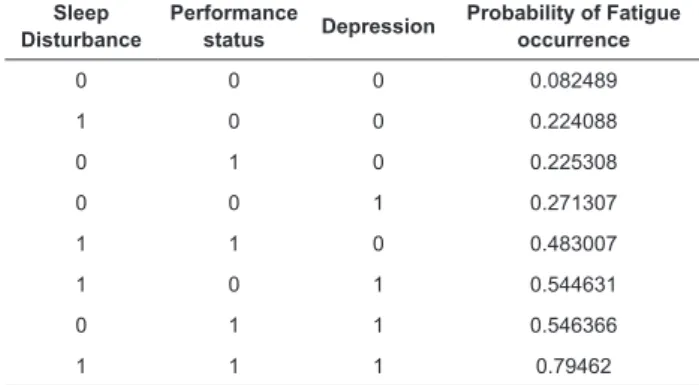
Probability of Fatigue occurrence
0 0 0 0.082489
1 0 0 0.224088
0 1 0 0.225308
0 0 1 0.271307
1 1 0 0.483007
1 0 1 0.544631
0 1 1 0.546366
1 1 1 0.79462
Table 3 - Fatigue Prediction Table: probability of fatigue
occurrence in the presence of independent predictive factors*
*0 = no; 1= Yes
Utilizing the estimated error for each of the
independent predictive variables, the Fatigue Prediction Table (Table 3) could be constructed. This Table shows the probability of the individual to have fatigue based
on the presence/absence of each variable. Patients who
do not have any of these predictors have approximately
8% chance of having fatigue and those with the three
independent predictors have approximately 80% chance.
It is observed that not only the number of factors, but also their nature inluences the likelihood of having fatigue. Depression increases the likelihood of having fatigue more than the other factors (Table 3).
The cut-off score of 4 or higher, which refers to the
percentile 25 of the fatigue score distribution and meets
National Comprehensive Cancer Network criteria(17),
represents the fatigue present in 75% of the sample. In
the literature review, it was noted that other authors also
adopted the same cut-off score(20), which is beneicial to
standardize and compare assessments. In addition, having
fatigue cut-off scores higher than 1, 2 or 3 contributes
to assuring that fatigue has clinical relevance, which may
not occur with lower cut-off scores related to minimum
discomfort.
No studies on fatigue predictors in colorectal cancer
patients were found, but the study data on fatigue
prevalence and intensity were similar to those used in
this search(18-19,21). When fatigue prevalence (26.8%) and intensity (mean=5.8; SD=1.3; median=5.4) in this research were compared to studies involving other
cancer patients, it was noted that fatigue was less
frequent than in studies on patients in palliative care and
receiving adjuvant chemotherapy or radiotherapy(1-2),
and higher than some cancer survivors’ experience,
who reported 26%(8). A slightly higher prevalence of fatigue (33%), using the same cut-off score as this study, was observed among colorrectal cancer patients
in the United Kingdom(22). This higher prevalence might
be due to the instrument used for fatigue assessment.
In a Turkish study that proposed an intervention for
cancer-related fatigue among intervention group
patients undergoing chemotherapy, the baseline
fatigue score assessed through the Piper Fatigue
Scale was 3.5(23). These researchers probably included
scores from all patients, lowering the mean score when
compared to the present study.
The univariate and multivariate analysis identified
the risk and predictive fatigue factors. The only
socio-demographic risk factor was the “public health service”.
No study was found that analyzed the relationship
between fatigue and health service, probably because
the majority of published studies include subjects who
live in developed countries, where the quality of health
services is similar, independently of the provider.
Pain, sleep disturbance and depression were risk
factors for fatigue. The mean scores of these symptoms
among fatigued patients were higher than among
non-fatigued patients. In the same manner, performance
status was worse among fatigued than among
non-fatigued subjects. Various studies in different scenarios
also identified performance status, pain, depression
and sleep alteration, among others, as factors related
to fatigue(4,6,11,14).
The discussion on the relation between fatigue
and depression should be raised. Studies have
attempted to identify cause-effect relations between
these symptoms, but no conclusion has been reached. What is clear is that there is a positive and moderate/ strong correlation between them and that the rate of
comorbidity fatigue/depression is harmful. Yet, some
may consider the assessment of depression in cancer
patients through the BDI as doubtful, due to the
number of items that investigate somatic issues, which
might cause confusion between depression and cancer
symptoms. But this instrument was chosen because of
its wide acceptance and utilization in cancer research.
The variables gender, age, marital status, skin
color, education, employment status, family income,
clinical cancer site, medical treatments, body mass
index, level of hemoglobin, presence of illnesses in
co-morbidities, use of antidepressants or anti-anxiety
drugs and colostomy did not relate to fatigue. There
are studies that observed some of these variables
as risk factors for fatigue, such as female gender(18),
young age(2,19), the absence of regular job(5), cancer
treatment(2), among others. In other studies, other
variables were also not observed, such as cancer
staging, presence of some co-morbidities, concomitant
medications, etc.(4,24).
The greater or minor likelihood of a factor to predict an outcome (fatigue) can be calculated using logistic regression. Thus, by evaluating sleep,
depression and performance status, the probability
of the patient having fatigue can be observed in the Fatigue Predictors Table (Table 3). If the three predictive factors are present (sleep disturbance, depression and performance status), the chance a patient has fatigue is approximately 80%, and if none
is present, the probability of fatigue occurrence is only
8%. No study that presented the probability of fatigue
could be found. The fact that only three variables were able to predict fatigue so accurately (80%) drew our attention and indicated that the model proposed in this
paper is very useful to identify fatigue. Yet, there is
still a need to investigate the factors that predict the
fatigue of the other 20% of the patients.
The specificity of the model was good (81.9%), but the sensitivity of the model was moderate (58.6%), increasing chances of not diagnosing a fatigued
patient. New studies are necessary, which attempt to
identify other risk factors that increase the sensitivity
of the model. No study with logistic regressions for the
predictive factors identifying fatigue in patients with
rectal cancer was found and, among the three studies
Mota DDCF, Pimenta CAM, Caponero R. 501 patients with other tumors, only one mentioned the
discriminatory capacity of the model = 0.88(3). In that
study, conducted with men with cancers in several
sites, the predictors were sadness, dizziness, pain,
appetite loss, irritability and dyspnea(3).
The risk factors “public health service” and pain
were excluded from the logistic regression models.
Not every risk factor is a predictive factor, because
regression analysis distinguishes those that are important for an outcome occurrence (fatigue), in an independent way, from those that seem to be
important for the phenomenon, but which in fact are
surrogate to others.
The findings of this search raised some issues: 1) If the sleep disturbance, the presence of depression
and injury in performance status indicate the likelihood
of a patient with colorectal cancer to have fatigue and if, 2) in oncology patients’ consultations, their sleep, depressive symptoms and functionality are quite often
evaluated, it raises questions on the real need of using
multidimensional scales, such as the Piper Fatigue
Scale - revised, to diagnose fatigue.
Based on the sleep, depression and performance
status assessment results, the professional may, in
fact, estimate the probability of the patient havinh fatigue or not, with high specificity (81.9%). However, in view of the model’s moderate sensitivity (58.6%), which increases the chance of a false negative, a
strategy to deal with this situation is necessary.
The use of a numerical scale for the evaluation of
fatigue may be an alternative to the long instruments
that exist to confirm the presence and severity of
fatigue. It has the advantage of being fast and feasible,
reducing the barriers for symptom assessment and
streamlining the diagnosis in care and research. In this
study, the correlation between the numerical fatigue
scale and the Piper Fatigue Scale – revised was tested and a high correlation (r=0.748; p<0.001) was noted, which indicates that it can be useful on a daily base
during care delivery to cancer patients. The main
limitation of the numerical scale is the lack of details
about the symptom, which could be obtained with the
help of multidimensional instruments.
Some limitations of this study can be appointed.
The study was cross-sectional and the sample was not
randomized; the way the variable “cancer treatment”
was dichotomized - receiving adjuvant chemotherapy
or radiotherapy or not - might have covered some
difference between individuals receiving specific
anti-cancer treatments; and there was no investigation on gastrointestinal symptoms (e.g. diarrhea, constipation).
The inclusion of patients using concomitant
medications, such as antidepressants and anti-anxiety
medications, may be questioned, since these may
influence the presence and intensity of fatigue. Still,
the inclusion of inpatients with colorectal cancer is
desirable, considering that the results of the predictors
and risk factors might be broader in this population.
Such limitations need to be overcome in future studies.
Despite these limitations, the researchers believe that
the results can be generalized to other Brazilian or
non-Brazilian cancer patients, as the patients included in
this study showed a profile similar to patients included
in other international studies. The identification of
fatigue predictors in colorectal cancer outpatients from
other countries could help to validate the findings of
this study. Yet, future research might as well test the
Fatigue Prediction Table. A cohort study would be the
ideal method to validate the findings of this search and
improve the fatigue diagnostic strategies in clinical
practice.
Based on this study, some progress can be pointed
out and the implications for the practice are diverse.
The first nursing publication about fatigue in Brazil was
on laryngeal cancer(25). Now, for the first time in our
country, the prevalence of fatigue was determined in
patients with colorectal cancer, and a cut-off score for
fatigue diagnosis was established. In an international
scope, some results are innovative, as the independent
fatigue predictors were not known in outpatients with
colorectal cancer. This study presents the Fatigue
Prediction Table, which permits investigating the
probability of fatigue occurrence and contributes to
symptom control. Sleep disturbance, depression and
poor performance status together predicted 80% of
fatigue cases in colorectal cancer situations, which is
very good. Depression increased the risk of fatigue by
four times, and sleep disturbance and performance
status by three times. Due to the moderate sensitivity result of the model (58%), there is a considerable chance of having false negatives, which perhaps can
be minimized by using a numerical scale from 0 to 10,
in which score ≤4 indicates fatigue.
Conclusions
The prevalence of fatigue among colorectal cancer
patients was 26.8%. Fatigue predictors were sleep
fatigue was 8%. Depression increased the risk of fatigue
fourfold, and sleep disturbance and performance status
threefold. The specificity of the prediction model was
very good, and the sensitivity was moderate.
References
1. Lawrence DP, Kupelnick B, Miller K, Devine D, Lau J. Evidence report on the occurrence, assessment, and treatment of fatigue in cancer patients. JNCI Monographs. 2004;32:40-50.
2. de Jong N, Courtens AM, Abu-Saad HH, Schouten HC. Fatigue in patients with breast cancer receiving adjuvant
chemotherapy: a review of the literature. Cancer Nurs. 2002;25(4):283-97.
3. Hwang SS, Chang VT, Rue M, Kasimis B. Multidimensional independent predictors of cancer-related fatigue. J Pain Symptom Manage. 2003;26(1):604-14.
4. Wang XS, Giralt SA, Mendoza TR, Engstrom MC, Johnson BA, Peterson N, et al. Clinical factors associated with cancer-related fatigue in patients being treated for leukemia and non-Hodgkin’s Lymphoma. J Clin Oncol. 2002;20(5):1319-28.
5. Young KE, White CA. The prevalence and moderators of fatigue in people who have been successfully treated for cancer. J Psychosom Res. 2006;60:29-38.
6. Servaes P, Verhagen S, Schreuder B, Veth RP, Bleijenbert
G. Fatigue after treatment for malignant and benign bone and soft tissue tumors. J Pain Symptom Manage. 2003;26(6):1113-22.
7. Llobera J, Esteva M, Rifá J, Benito E, Terrasa J, Rojas C, et al. Terminal cancer: duration and prediction of survival time. Eur J Cancer. 2000;36:2036-43.
8. Groenvold M, Petersen MA, Idler E, Bjorner JB, Fayers PM, Mouridsen HT. Psychological distress and fatigue
predicted recurrence and survival in primary breast cancer patients. Breast Cancer Res Treat. 2007;105(2):209-19. 9. Dagnelie PC, Pijls-Johannesma MCG, Lambin P, Beijer S, De Ruysscher D, Kempen GI. Impact of fatigue on overall
quality of life in lung and breast cancer patients selected
for high-dose radiotherapy. Ann Oncol. 2007;18:940-4.
10. Akechi T, Kugaya A, Okamura H, Yamawaki S, Uchitomi
Y. Fatigue and its associated factors in ambulatory cancer patients: a preliminary study. J Pain Symptom Manage. 1999;17(1):42-8.
11. Dimeo F, Schmittel A, Fietz T, Schwartz S, Kohler
P, Boning D, et al. Physical performance, depression,
immune status and fatigue in patients with hematological
malignancies after treatment. Ann Oncol. 2004;15:
1237-42.
12. Ahlberg K, Ekman T, Gaston-Johansson F. Fatigue, psycholocial distress, coping resources, and functional
status during radiotherapy for uterine cancer. Oncol Nurs Forum. 2005;32(3):633-40.
13. Echteld MA, Passchier J, Teunissen S, Claessen S, de Wit R, van der Rijt CC. Multidimensional fatigue and its correlates in hospitalised advanced cancer patients. Eu J Cancer. 2007;43:1030-6.
14. Brown DJF, McMillan DC, Milroy R. The correlation between fatigue, physical function, the systemic inlammatory response, and psychological distress in patients with advanced lung cancer. Cancer. 2005;103(2):377-82.
15. Gorentein C, Andrade L. Validation of a Portuguese
version of the Beck Depression Inventory and the State-Trait Anxiety Inventory in Brazilian subjects. Braz J Med Biol Res.1996;29:453-7.
16. Mota DDCF, Pimenta CAM, Piper BF. Fatigue in
Brazilian cancer patients, caregivers, and nursing
students: a psychometric validation study of the
Piper Fatigue Scale – Revised. Support Care Cancer. 2009;17(6):645-52.
17. National Comprehensive Cancer Network (NCCN). [Internet]. Cancer-related fatigue: NCCN Clinical Practice
Guidelines in Oncology. [acesso 29 março 2011]. Disponível em: http://www.nccn.org/professionals/ physician_gls/pdf/fatigue.pdf
18. Schmidt CE, Bestmann B, Kuchler T, Longo WE, Kremer B. Ten-year historic cohort of quality of life and
sexuality in patients with rectal cancer. Dis Colon Rectum.
2005;48:483-92.
19. Arndt V, Merx H, Stegmaier C, Ziegler H, Brenner
H. Quality of life in patients with colorectal cancer
1 year after diagnosis compared with the general population: a population-based study. J Clin Oncol. 2004;22(23):4829-36.
20. Chang YJ, Lee JS, Lee CG, Lee Ws, Lee KS, Bang SM, et al. Assessment of clinical relevant fatigue level in
cancer. Support Care Cancer. 2007;15:891-6.
21. Galloway SC, Graydon JE. Uncertainty, symptom distress, and information needs after surgery for cancer of the colon. Cancer Nurs. 1996;19(2):112-7.
22. Storey, DJ, Waters RA, Hibberd CJ, Rush RW, Cargill AT, Wall LR, et al. Clinically relevant fatigue in cancer outpatients: the Edinburgh Cancer Centre symptom study.
Ann Oncol. 2007;18:1861-9.
23. Yeşilbalkan OU, Karadakovan A, Göker E. The Effectiveness of Nursing Education as an Intervention
Mota DDCF, Pimenta CAM, Caponero R. 503
Received: Apr. 2nd 2011
Accepted: Sep. 20th 2011 24. Ness RM, Holmes A, Klein R, Greene J, Dittus R.
Outcome states of colorectal cancer: identiication and description using patient focus group. Am J Gastroenterol. 1998;93(9):1491-7.
25. Coelho FMR, Sawada NO. A fadiga nos pacientes