BREAST FEEDING AS A PROTECTION FACTOR
TO AVOID NON-NUTRITIVE SUCKING HABITS
Aleitamento materno como fator de proteção
contra a instalação de hábitos bucais deletérios
Maria Helena Monteiro de Barros Miotto(1), Fernanda Pereira Caxias(2), Denise Maria Kroeff de Souza Campos(3), Lúcia de Fátima Paixão Emery Ferreira(4),
Ludmilla Awad Barcellos(5)
(1) Dental surgeon; Professor at the Graduate Program
in Public Health, Federal University of Espírito Santo; Doctor’s degree in Dentistry (Public Health), University of Pernambuco.
(2) Dental surgeon; Volunteer professor at the Undergraduate
Program in Dentistry, Federal University of Espirito Santo.
(3) Dental surgeon; Professor at the Undergraduate Programa
in Dentistry, Federal University of Espírito Santo; Master’s Degree in Dentistry (Orthodontics), FO/UNICAMP, Piraci-caba, SP.
(4) Dental surgeon; Professor at the Undegraduate Program
in Dentistry, Federal University of Espirito Santo; Master’s Degree in Dentistry (Oral and Maxillofacial Surgery), PUC, RS.
(5) Dental surgeon; Professor at the Undegraduate Program
in Dentistry, University of Vila Velha; Master’s Degree in Dentistry (Social and Preventive Dentistry), São Leopoldo Mandic Dentistry Research Center, Campinas, SP. Conlict of interest: non-existent
offering advantages not only for the baby, but also for the mother1. Mothers’ milk has been considered
the best feed for infants, acting as an immuno-logical reinforcement against infectious and allergic diseases, playing animportant role in reducing child mortality2-4.
Breastfeeding is not only related to the
nutri-tional aspects but also fulills the emonutri-tional needs
of the baby through the closeness established between mother and child5,6. Breastfeeding also
brings beneits to women6; this practice promotes
better uterine involution in postpartum period1,6,
with consequent reduction in bleeding 1. Incidence
of breast cancer1,6 is minimized as well, besides its
contraceptive effect, practicability, and inexpen-siveness for families6.
In addition to the nutritional7, immunological3,4,7
and emotional beneits, breastfeeding promotes
stomatognathic system’s health7, stimulating
ortho-pedic normal growth of the jaws3. It allows the correct
establishment of nasal breathing and normal devel-opment of the entire craniofacial complex7. It also INTRODUCTION
Breastfeeding constitutes one of the fundamental pillars for children’s health promotion worldwide,
ABSTRACT
Purpose: evaluate association between social and demographic variables, breastfeeding interruption and deleterious oral habits and the prevalence of non-nutritive sucking habits in 03 to 05 years old school children in Vitória, Espírito Santo. Method: this is a retrospective longitudinal study with a inal random sample of 903 children from a universe of 9.829 students. The comparison between predictive
variables and non-nutritive sucking habits used Fisher Exact test and strength of association veriied
by Odds Ratio. Results: 12,4% of the children present or had presented inger sucking habit and
37,7% of sucking paciier. There was no statistically signiicant association between inger sucking with weaning. Female children had 20% more chance to have habit of sucking paciier (p=0,000).
Children that had early breast feeding interruption presented approximately 4 times more chance of
developing the habit of sucking paciiers (p= 0.000). Conclusions: the association of paciier sucking
habit and weaning was veriied. Early weaning can be considered a risk factor for maintenance of paciiers sucking habit.
Inclusion criteria involved 3 to 5 years old children enrolled in one of Vitória public schools with complete primary dentition. Syndromes with oral manifestation, especially related to dentition/ occlusion motivated exclusion of the research.
Two questionnaires were used for data collection.
The irst contained six open and eighteen closed
items regarding the following variables: sex, age, mothers’ education level, deleterious oral habits –
digital sucking and paciier use – and data about
breastfeeding style. The second questionnaire is the Brazilian instrument used to classify families in a social scale (A, B, C, D, E), based on consumer goods possession.
Parents were informed about the aim of the research and after signature of Informed Consent Form, the interview was carried out when children were entering or leaving school.
It was used as the dependent variable, preva-lence oforal habits (digital sucking and paciier use)
and as explanatory variables, gender, age, breast-feeding and socioeconomic status (SES). Early weaning was considered when breastfeeding was partially or completely interrupted before six months and substituted by another feed. When interviewing parents about deleterious oral habits, the time of starting and the duration of the habit were registered.
Collected data was organized in frequency tables. The possible association between delete-rious oral habits and sociodemographic and early
weaning variables was veriied by Fisher Exact test.
The strength of association was measured by Odds
Ratio with respective 95% conidence intervals. Signiicance level adopted was 5%. Statistical
package SPSS version 15 was used for analysis.
RESULTS
The inal sample was of 903 children and there
was no loss due to the increase of 20% performed on the sample size calculation.
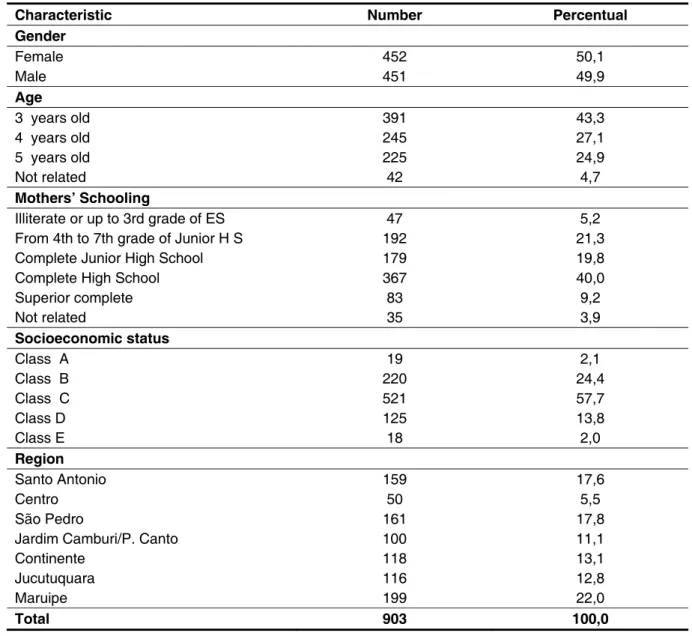
Table 1 presents a well distribution between boys and girls. Three years old was the most frequent age (43,3%) and social class C was over half the sample (57,7%).
When analyzing distribution related to geographic area in Vitoria, it was observed that proportionality was maintained as the sample plan criteria was based at random and proportional to the number of children enrolled in each school. Schools which had more children were more substantially represented. presents positive action in preventing non-nutritive
sucking habits8.
Moyers9 relates that after the irst dentition
is completed, no sucking habits may persist, as sucking instinct must be substituted by biting and catching behaviors. Prolonged oral phase is not physiological and everlasting sucking habits may become harmful. Such habitsmust contribute as a risk factor for malocclusions and can be considered a deleterious habit according tofrequency, intensity and movement duration7,10, individual susceptibility,
age, nutrition conditions and consequent general health10.
Most common deleterious oral habits or non
nutritive sucking habits are paciier and digital
sucking; persistence of these may affect normal development of stomatognathic system8.
Early weaning can stimulate the development of
deleterious oral habits as paciier and digital sucking,
children in this situation developa risk seven times greater than children in exclusive breastfeeding6.
Although early weaning exert an indirect role on malocclusion development in primary dentition7,10,
longitudinal studies are necessary to appreciate the
beneits of exclusive breastfeeding as a protection
factor against deleterious oral habits set up, which are considered risk factors on the etiology of malocclusion.
The aim of this research was to evaluate possible association between sociodemographic variables, early weaning and the development and mainte-nance of non-nutritive sucking habits in 03 to 05 years old school children in Vitória, Espírito Santo.
METHOD
The research project was approved by the Ethics Research Committee from Federal University of Espírito Santo, on July 23rd 2010, register number
084/10.
This observational retrospective study with a longitudinal design was made in Vitória, Brazil, 2010. Target population included 9.829 children born between 2005 and 2007 and, in 2010 enrolled in public schools. Sample calculation was based on
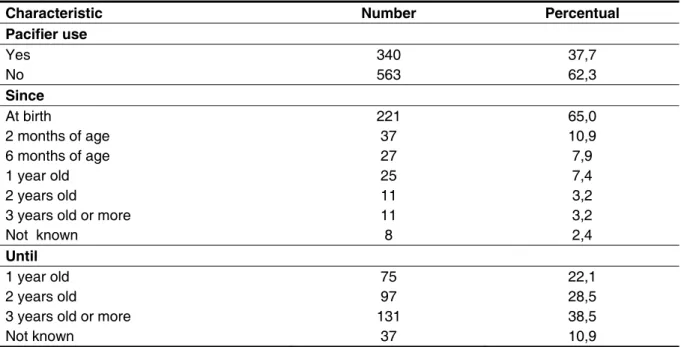
As can be seen in Table 3, it could be veriied that 37,7% of the infants used or had used paciier and
65% initiated the habit at birth; a frequency of 38,5% still had the habit until three years old or more. In relation to deleterious oral habits, it was
observed that 12,4% children had digital sucking
inger habit in some time of life, and 56,3% of these
had prolonged the habit until 3 years old or more (Table 2).
Table 1 – Sociodemographic data of 3 to 5 years old from Vitória, Espírito Santo state
Characteristic Number Percentual
Gender
Female 452 50,1
Male 451 49,9
Age
3 years old 391 43,3
4 years old 245 27,1
5 years old 225 24,9
Not related 42 4,7
Mothers’ Schooling
Illiterate or up to 3rd grade of ES 47 5,2
From 4th to 7th grade of Junior H S 192 21,3
Complete Junior High School 179 19,8
Complete High School 367 40,0
Superior complete 83 9,2
Not related 35 3,9
Socioeconomic status
Class A 19 2,1
Class B 220 24,4
Class C 521 57,7
Class D 125 13,8
Class E 18 2,0
Region
Santo Antonio 159 17,6
Centro 50 5,5
São Pedro 161 17,8
Jardim Camburi/P. Canto 100 11,1
Continente 118 13,1
Jucutuquara 116 12,8
Maruipe 199 22,0
Total 903 100,0
strength of association veriied by Odds, showed that female (OR = 1,274, IC 95%= 0,973-1,669)
had 1,2 times more chances to prolong the habit; while the ones who had early weaning presented Observing results in Table 4, there were no
signiicant associations between independent
variables – sex, age, SES, mothers’ schooling level, early weaning – and digital sucking habit. In Table
Characteristic Number Percentual Digital sucking
Yes 112 12,4
No 791 87,6
Since
At birth 72 64,3
2 months of age 10 8,9
6 months of age 6 5,4
1 year old 3 2,7
2 years old 5 4,5
3 years-old or more 9 8,0
Not know 7 6,3
Until
1 year old 11 9,8
2 years old 13 11,6
3 years old or more 63 56,3
Not known 25 22,3
Table 2 – Digital sucking habit in 3 to 5 year old children from Vitória, Espírito Santo state
Characteristic Number Percentual Pacifier use
Yes 340 37,7
No 563 62,3
Since
At birth 221 65,0
2 months of age 37 10,9
6 months of age 27 7,9
1 year old 25 7,4
2 years old 11 3,2
3 years old or more 11 3,2
Not known 8 2,4
Until
1 year old 75 22,1
2 years old 97 28,5
3 years old or more 131 38,5
Not known 37 10,9
Characteristic Digital sucking No sucking p-value Odds Ratio CI Nº % Nº %
Sex
Female 64 14,2 388 85,8
0,066 1,385
0,929-2,065
Male 48 10,6 403 89,4
Age
3 anos 41 10,5 350 89,5
0,059 1,419
0,938-2,147
4 e 5 anos 67 14,3 403 85,7
SES
A/B 34 14,2 205 85,8
0,188 1,246
0,808-1,921
C/D/E 78 11,7 586 88,3
Mothers’ schooling
Up to Junior High 28 11,7 211 88,3
0,442 1,067
0,673-1,690
Junior H S or higher 78 12,4 551 87,6
Early Weaning
Sim 31 13,5 199 86,5
0,320 1,139
0,730-1,775
Não 81 12,0 592 88,0
Table 4 – Association between digital sucking habit and sociodemographic data, mothers’ schooling and early weaning in 3 to 5 year old children in Vitória, Espírito Santo state
Legend: CI: Conidence interval 95%; SES: Socioeconomic status; Junior H S: Junior High School; Statistical analyzes: Chi-Square test (p≤0,05).
Table 5 – Association between paciier sucking habit and sociodemographic data, mothers’ schooling and early weaning in 3 to 5 year old children in Vitória, Espírito Santo state
Characteristic Pacifier No pacifier p-value Odds Ratio
CI Nº % Nº %
Sex
Female 183 40,5 269 59,5
0,045 1,274
0,973-1,669
Male 157 34,8 294 65,2
Age
3 years old 151 38,6 240 61,4
0,340 1,070
0,812-1,411
4 e 5 years old 174 37,0 296 63,0
SES
A/B 100 41,8 139 58,2
0,070 1,271
0,940-1,719
C/D/E 240 36,1 424 63,9
Mothers’ schooling
Up to Junior High 84 35,1 155 64,9
0,230 1,138
0,835-1,553
Junior H S or higher 240 38,2 389 61,8
Early weaning
Yes 142 61,7 88 38,3
0,000 3,871
2,830-5,296
No 198 29,4 475 70,6
Legend: CI: Conidence interval 95%; SES: Socioeconomic status; Junior H S: Junior High School;
an association between paciier use and short-term
breastfeeding18. Children exclusively breastfed
showed lower risk of acquiring non-nutritive sucking habits19.
It was observed in the present study relevant
differences between digital sucking and paciier use. Paciier is much used as an instrument to calm children. This research veriied a low prevalence of children with a digital inger habit (12,4%). One
hypothesis suggested to explain the difference
in relation to the use of paciier (37,7%) is social
acceptance. Digital sucking habit can be considered not socially adequate and can be easily associated with “twisted teeth”.
In Rio de Janeiro it was observed a positive association between short-term breastfeeding and
more frequency of paciier sucking and malocclusion
development14. This relation was also observed in a
study made in Pelotas city, Rio Grande do Sul state
20, where the prevalence of non-nutritive sucking
habits in children between 12 months and 4 years old period was revealed as a risk factor for anterior open bite. Removing sucking habits from children in primary dentition can stimulate self-correction or minimize anterior open bite, besides adequacy of structures and redirecting functions of stomato-gnathic system21.
A study conducted in the schools of Florianópolis city, Santa Catarina state5, observed an association
between breastfeeding period and non-nutritive sucking habits development. Infants with an exclusive breastfeeding pattern were less likely to develop harmful habits. In this research conducted in Vitória, it was observed that 56,3% of the children with digital sucking habit and 38,5% of those that
used paciier, prolonged the habit until 3 years old
or more. These data suggests that, once acquired,
digital sucking habit is more dificult to remove.
Sociocultural aspects must be considered as determinants of breastfeeding patterns. Access to information and mothers’ consciousness of the
importance of breastfeeding may relect on the
practice and patterns7.
Internet information available must be useful to disseminate knowledge, but in a responsible way. Many health websites offer inaccurate guidance, considered correct by lay population. Besides that,
this information is not suficient to breastfeeding
promotion22.
Another relevant points could be observed in this research related to socioeconomic status of the
DISCUSSION
Nowadays, the literature about oral habits prevention has appreciated breastfeeding for an adequate time. Cultural aspects related to the
paciier use or feeding bottle are so deep-rooted in
collective subconscious that many families cannot avoid the habit and others even encourage it11.
It has been suggested that the greater frequency
of paciier sucking habit compared with digital sucking occurs due to social acceptance of paciier use. Paciier introducing in the very irst days of age is very common. This can be conirmed in this study:
65% of the parents who had children that used or
had used paciier said they acquired the habit at
birth. It has been suggested that children that had early weaning are more likely to supply sucking necessity and as an alternative parents offer the
paciier.
Another reinforcement to the social acceptance hypothesis is the fact that in this study there had been no difference in the prevalence of sucking
paciier habit among children from all social classes.
An observational study conducted in Paraná
had not found signiicant statistical differences in paciier use prevalence and mothers’ schooling
level12. However, in Porto Alegre city13, most of the
infants who had paciier habits came from adverse
social classes and were male. In contrast with this
research which found that most infants with paciier sucking habit were female (40,5%, p= 0,045), what
suggests variation in different populations.
Exclusive breastfeeding until six months of age can be considered a protective factor against
constant paciier use. Similar results were found
in Porto Alegre city13, which veriied a weaning
incidence between irst and sixth months of age of 22,4% for infants with no paciier use habits and
50,8% for users (p<0,001).
Almost 2/3 of the paciier users had breast -feeding interrupted until the end of the second month of age. These results support those found by other studies2,3,8,14. Paciier using has been
associated with less breastfeeding duration15.
Infants in exclusive breastfeeding pattern presented
more prevalence of no paciier. On the other hand, for those infants who had initiated weaning, paciier
use was more frequent3,16.
Maternity leave allows mothers to take care of their children more thoroughly, what can contribute to exclusive breastfeeding until six months of age. In Brazil, there is a project to be analyzed by the House of Representatives that increases to 180
days maternity leave, a beneit already granted
to public employees24. Brazilian societal changes
revealed in census 201025 showed a greater number
of householder women not included in formal work. According to this fact, they do not receive the
governmental beneit, which increases the disad -vantages for this social group.
It can be suggested a great dificulty for this
group of women to carry exclusive breastfeeding until 6 months of age regarding their needs to cater for their family. Probably these mothers are the ones that face barriers to get a vacancy in public schools.
CONCLUSION
This research found association between early
weaning and paciier sucking habit. Infants exposed
to early weaning had a chance almost four times
greater to acquire paciier sucking habits.
This data leads to a question about social distri-bution of the children that had a vacancy in public schools, there is a high percentage of families inserted in social class B in contrast with a low frequency of the ones from class E. So the question is: does this distribution correspond to the real social distribution of the population or children from poorly families have been excluded from school? More researches must be done to highlight this point.
In Itapeva, São Paulo state, a study observed
no signiicant differences between breastfeeding
duration among social groups. It is important to consider the relevance of social determinants when implementing strategies for breastfeeding promotion, which may include information about
harmful effects related to the paciier use or bottle
feeding23.
Veriication of the relation between socioeco -nomic status and non-nutritive sucking habits was impaired by the small number of participants representing social classes A and E. This could be considered a limitation of this study and open possi-bilities for new researches to evaluate the amount of children out of school; these childrenprobably carry the weight of the object of this study.
RESUMO
Objetivo: avaliar a possível associação entre as variáveis sociodemográicas, desmame precoce e o desenvolvimento e manutenção dos hábitos bucais deletérios em crianças de três a cinco anos de idade das creches públicas de Vitória/ES. Método: trata-se de um estudo longitudinal, retrospectivo,
com uma amostra inal de 903 escolares, aleatorizada e representativa das 9.829 crianças matricula -das. Para a comparação entre as variáveis predictoras e hábitos foi utilizado o teste exato de Fisher e a força da associação medida pelo Odds Ratio. Resultados: 12,4% das crianças apresentaram
hábito de sucção digital e 37,7%, o de chupeta. Não foi veriicada associação estatisticamente signi
-icante do hábito de sucção digital com desmame precoce. As crianças do sexo feminino (p=0,045)
demonstraram 20% mais chance de adquirir e permanecer com o hábito de chupeta, e as que tiveram o desmame precoce apresentaram aproximadamente quatro vezes mais a chance de desenvolver o
hábito de chupetas (p= 0.000). Conclusão: associação entre hábito de chupeta e desmame precoce
foi veriicada. O desmame precoce pode ser considerado fator de risco para a permanência do hábito
de chupeta.
chupeta e mamadeira a seus ilhos. Rev CEFAC.
2012;14(4):610-5.
13. Soares MEM, Giugliani ERJ, Braun ML, Salgado ACN, Oliveira, AP, Aguiar PR. Uso de chupeta e sua relação com o desmame precoce em população de crianças nascidas em Hospital Amigo da Criança. J Pediatr. 2003;79(4):309-16.
14. Oliveira AB, Souza FP, Chiappetta ALML. Relação entre hábitos de sucção não nutritiva, tipo de aleitamento e má oclusões em crianças com dentição decídua. Rev CEFAC. 2006;8(3):352-9. 15. Lozano de La Torre MJ, Alonso CR, Aguilar MT, Maldonado JA, Ansotegui JA, Segura AS et
al. Use of paciiers and breastfeeding. Ann Pediatr.
2011;74(4):271-5.
16. Araújo CMT, Silva GAP, Coutinho SB. A utilização da chupeta e o desenvolvimento sensório motor oral. Rev CEFAC. 2009;11(2):261-7.
17. Medeiros APM, Ferreira JTL, Felício CM. Correlação entre métodos de aleitamento, hábitos de sucção e comportamentos orofaciais. Pró-Fono R. Atual. Cient. 2009;21(4):315-9.
18. O’Connor NR, Tanabe KO, Siadaty MS, Hauck
FR. Paciiers and breastfeeding: a systematic review.
Arch Pediatr Adolesc Med. 2009;163(4):378-82. 19. Montaldo L, Montaldo P, Cuccaro P, Caramico N, Minervine G. Effects of feeding on non-nutritive sucking habits and implications on osclusion in mixed dentition. Int J Paediatr Dent. 2011;21:68-73. 20. Peres KG. Barros AJD, Peres MA, Victora CG. Effects of breastfeeding and sucking habits on malocclusion in a birth cohort study. Rev Saúde Pública. 2007;41(3):343-50.
21. Zapata M, Bachiega JC, Marangoni AF, Jeremias JEM, Ferrari RAM, Bussadori SK et al. Ocorrência de mordida aberta anterior e hábitos bucais deletérios em crianças de 4 a 6 anos. Rev CEFAC. 2010;12(2):267-71.
22. Silva RQ, Gubert MB. Qualidade das informações sobre aleitamento materno e alimentação
complementar em sites brasileiros de proissionais
de saúde disponíveis na internet. Rev Bras Saude Mater Infant. 2010;10(3):331-40.
23. Fujimori E, Minagawa AT, Laurenti D, Montero RMJM, Borges ALV, Oliveira IMV. Duração do aleitamento materno em menores de dois anos de idade em Itupeva, São Paulo, Brasil: há diferenças entre grupos sociais? Rev Bras Saude Mater Infant. 2010;10(1):39-49.
24. Brasil. Lei nº 11.770, de 9 de setembro de 2008.
Diário Oicial da República Federativa do Brasil,
Brasília, 9 set 2008.
REFERENCES
1. Carrascoza KC, Costa Júnior AL, Moraes ABA.
Fatores que inluenciam o desmame precoce e a
extensão do aleitamento materno. Estud Psicol. 2005;22(4):433-40.
2. Furtado ANM, Vedovello Filho M. A inluência do
período de aleitamento materno na instalação dos hábitos de sucção não nutritivos e na ocorrência de maloclusão na dentição decídua. Rev Gauch Odontol. 2007;55(4):335-41.
3. Gonçalves E, Garbin CAS, Garbin AJI, Pavan AFG. Amamentamiento versus hábitos bucales deletérios. ¿Existe una relación causal? Acta Odontológica Venezolana. 2007; 45(2):182-6. 4. Ichisato SMT, Shimo, AKK. Revisitando o desmame precoce através de recortes da história. Rev Latinoam Enferma. 2002;10(4):578-85.
5. Pereira LT, Bussadori SK, Zanetti AL, Höling
RTB, Bueno CES. Avaliação da associação do período de amamentação e hábitos bucais com instalação de más oclusões. Rev Gauch Odontol. 2003;51(4):203-9.
6. Serra-Negra JMC, Pordeus IA, Rocha Júnior JF. Estudo da associação entre aleitamento, hábitos bicais e maloclusöes. Rev Odontol Univ Cid São Paulo. 1997;11(2):79-86.
7. França GVA, Brunken GS, Silva SM, Escuder MM, Venancio SI Determinantes da amamentação no primeiro ano de vida em Cuiabá, Mato Grosso 2007. Rev Saúde Pública. 2007;41(5):711-8. 8. Albuquerque SSL, Duarte RC, Cavalcanti EL,
Belträo EM. A inluência do padrão de aleitamento
no desenvolvimento de hábitos de sucção não nutritivos na primeira infância. Ciênc Saúde Coletiva. 2010;15(2):371-8.
9. Moyers, R. E. .Ortodontia. 4 ed. Rio de Janeiro: Guanabara Koogan. 1991.
10. Voi Trawitzki LV, Anselmo-Lima WT, Melchior MO, Grechi TH, Valera FCP. Aleitamento e hábitos orais deletérios em respiradores orais e nasais. Rev Bras Otorrinolaringol. 2005;71(6):747-51.
11. Corrêa MSNP. Odontopediatria na primeira infância. 3 ed. São Paulo: Ed. Santos; 2009.
12. Silvério KCA, Ferreira APS, Johanns CM, Wolf A, Furkim AM, Marques JM. Relação de escolaridade,
faixa etária e proissão das mães com a oferta de
Received on: January 23, 2013 Accepted on: May 14, 2013
Mailing Address: