Luiza do Nascimento Cezar Magalhães
1, Maria José Rodrigues
2, Mônica Vilela Heimer
3, André Suliano de Alencar
4Prevalence of non-nutritive sucking habits and its relation with
anterior open bite in children seen in the Odontopediatric Clinic of
the University of Pernambuco
Objective:
The aim of this work was to establish the prevalence of non-nutritive sucking habits (pacifier and/or
digit sucking) and to assess its relation with anterior open bite.
Methods:
The sample consisted of 980 records of children of both genders, with ages between 3 and 12 years, who
were treated at the Pediatrics Clinic of the University of Pernambuco (FOP/UPE), from February 2000 trough
De-cember 2005, both sexes. Pearson’s Chi-square test at 5% level of significance was used for statistical assessment.
Results:
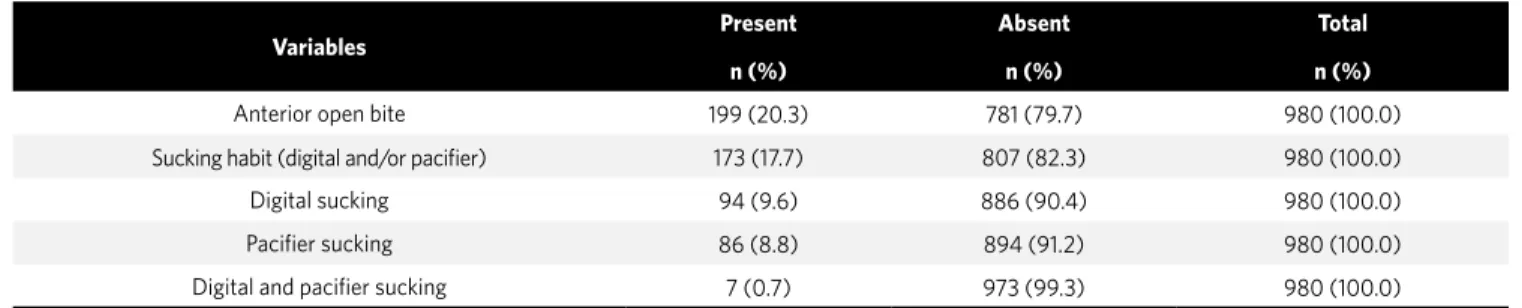
It was observed that 17,7% of the sample had some habit at the moment of the anamnesis (9,6% of digit
sucking habit, 8,8% of pacifier sucking habit and 0,7% of both habits) and that the prevalence of open bite was
20,3%. The prevalence of sucking habits in girls was much higher than in boys (22,6% and 12,9%, respectively)
and this difference was statistically significant (p = 0,000). A correlation between habits and open bite was proved
statistically (p = 0,000): Children with sucking habits had 8 times more chances of developing anterior open bite.
Conclusions:
Anterior open bite was associated to the presence of non nutritive sucking habits; sucking habits
were more prevalent in girls and in children between three and six years of age.
Keywords:
Habits. Open bite. Suction. Prevalence.
How to cite this article: Magalhães LNC, Rodrigues MJ, Heimer MV, Alencar AS. Prevalence of non-nutritive sucking habits and its relation with anterior open bite in children seen in the Odontopediatric Clinic of the University of Pernambuco. Dental Press J Orthod. 2012 Mar-Apr;17(2):119-23.
Submitted: October 23, 2008 - Revised and accepted: March 9, 2009
» The authors report no commercial, proprietary, or financial interest in the products or companies described in this article.
Contact address: Mônica Vilela Heimer
Av. General Newton Cavalcanti, 1650 – Tabatinga – Camaragibe/PE – Brazil CEP: 54.753-220 – E-mail: [email protected]
1 MSc in Orthodontics, UNICID.
2 PhD. Professor, Department of Social Dentistry, Pediatric Dentistry, Dentistry
School of Pernambuco University.
3 PhD and Professor of Public Health, FOP/UPE.
INTRODUCTION
Suction is a primitive and innate reflex, which
starts on the 29
thweek of intrauterine life and is
one of the earliest patterns of behavior exhibited
by the newborn.
33It is crucial for the survival of
the newborn and is responsible for the first
emo-tional link with the mother.
8In the early years of life, muscle exercises
car-ried out by suction during breastfeeding promotes
the correct development of the structures of
mas-ticatory system, through the balance of muscular
forces of inner and external containment.
4Whenever there is a disturbance of these forces,
dentofacial deformations will occur in regions of
atypical pressures. It is what happens in the
pres-ence of non-nutritive sucking habits, bringing a
se-ries of disorders to the stomatognathic system, i.e.,
a reduced vertical growth of the anterior portion of
alveolar process, upper incisors proclination and
anterior displacement of maxilla due to horizontal
force. The lower incisors can undergo proclination
or even retroinclination, in owing to the tension of
lower lip, to the tongue during swallowing and/or
to the presence of the digital pressure.
35Therefore, the dental arch form depends on a
harmonious balance between all the soft tissues
that surround it. Any change in this muscular
bal-ance, along with the other causes, may cause a
mal-occlusion, especially when this balance is broken
by a detrimental oral habit.
2The habit, on its turn,
is originated by the repetition of an act, which
be-comes unconscious and starts to be incorporated
into the personality of an individual.
29Some oral habits are part of the behavior of
small children, however they may become harmful
or damaging when occurring in a extensive or
in-appropriate way. Nevertheless, the harmful effect
of prolonged sucking habits in the development of
occlusion and facial growth of the child depends on
some parameters like: Duration, frequency and
in-tensity of sucking habits (Graber’s triad), position
of the pacifier in the mouth, age when the habit
was ceased and growth pattern of the child.
11,16The extensive duration of non-nutritive
suck-ing habit has been strongly associated with
ante-rior open bite,
1,9,15,18,23,37,42,43which is defined as the
presence of negative overbite existing between the
incisal edges of upper and lower anterior teeth.
31Children in pre-school age, presenting
non-nu-tritive sucking habits, have four-fold risk in
devel-oping open bite compared to children not
present-ing such habits
41. Worth noting, however, is that the
self-correcting of this malocclusion is observed if
the deleterious habits cease during the period the
deciduous dentition and beginning of mixed.
18,22,27Within this context, This study aimed to verify
the prevalence of non-nutritive sucking habits and
its relationship to anterior open bite in children
assisted in the clinic of Pediatric Dentistry, Faculty
of Dentistry of Pernambuco (UPE/FOP).
MATERIALS AND METHODS
The sample consisted of 980 records of children
from 3 to 12 years of age, of both genders, who were
treated at the pediatric clinic of Dental School of
the University of Pernambuco (FOP/UPE) from
February of 2000 to December of 2005. The
le-gal guardians of the patients signed a free and
in-formed consent allowing the analysis and
publica-tion of data collected.
The database was composed of information about
gender, date of birth, year of anamnesis, presence
or absence of non-nutritive sucking habits, type of
sucking habit (pacifier and/or digital sucking), type
of dentition (deciduous or mixed), and presence or
absence of anterior open bite. In order to simplify
data analysis, it was decided to divide the sample
into age (3 - 6 years, 7 - 9 years and 10 - 12 years).
The results were analyzed using the software
Statistical Package for the Social Sciences
(SPSS),
version 11.0. Pearson’s Chi-square test (x
2) and
Fish-er’s exact test, whenever x
2couldn’t be performed, a
significance level of 5% were used for data analysis.
RESULTS
The sample consisted of all patients seen in the
Pe-diatrics Clinic of FOP/UPE, from 3 to 12 years old with
the purpose of obtaining a representative sample.
After data analysis it was verified that 17.7% of
children were exposed to non-nutritive sucking
habits (9.6% digital sucking, 8.8% pacifier
suck-ing and 0.7% digital and pacifier sucksuck-ing) and that
20.3% presented anterior open bite.
genders regarding the prevalence of non
nutrition-al sucking habits, with the girls showing a higher
prevalence of sucking habit (Table 2).
In Table 3, the prevalence of sucking habits
ac-cording to age group can be seen. It was
signifi-cantly greater in the age group between 3 and 6
years of age (p = 0.022) and there was a reduction
of habits prevalence with age increase.
A significant association could be observed (p
= 0.000) between sucking habits and the previous
open bite.
The anterior open bite was more prevalent in
females (24.4%) than in males (16.3%), and this
difference was statistically significant (Table 5).
Variables
Present
n (%)
Absent
n (%)
Total
n (%)
Anterior open bite
199 (20.3)
781 (79.7)
980 (100.0)
Sucking habit (digital and/or pacifier)
173 (17.7)
807 (82.3)
980 (100.0)
Digital sucking
94 (9.6)
886 (90.4)
980 (100.0)
Pacifier sucking
86 (8.8)
894 (91.2)
980 (100.0)
Digital and pacifier sucking
7 (0.7)
973 (99.3)
980 (100.0)
Table 1
- Prevalence of anterior open bite and non-nutritive sucking habits.
Table 2
- Prevalence distribution of sucking habits, according to gender.
(1) By Pearson’s chi-square test. OR = 0.507; IC = 0.362 - 0.711.
Gender
Sucking habit
p Value
Present
n (%)
Absent
n (%)
Total
n (%)
Male
64 (12.9)
433 (87.1)
497 (100.0)
p = 0.000
(1)Female
109 (22.6)
374 (77.4)
483 (100.0)
Table 3
- Prevalence distribution of non-nutritive sucking habit according to age.
(1) By Pearson’s chi-square test
Age
Pacifier sucking habit
p Value
Present
n (%)
Absent
n (%)
Total
n (%)
3 to 6 years
76 (22.1)
268 (77.9)
344 (100.0)
p = 0.022
(1)7 to 9 years
62 (16.1)
323 (83.9)
385 (100.0)
10 to 12 years
35 (13.9)
217 (86.1)
251 (100.0)
Table 4
- Association between anterior open bite and non-nutritive sucking habits.
(1) By Pearson’s chi-square test. OR = 7.955; IC = 5.535 - 11.453.
Sucking habit
Anterior open bite
p Value
Present
n (%)
Absent
n (%)
Total
n (%)
Present
94 (54.3)
79 (45.7)
173 (100.0)
p = 0.000
(1)Table 5
- Anterior open bite prevalence, according to gender.
(1) By Pearson’s chi-square test. OR = 0.602; IC = 0.439 - 0.826
Gender
Anterior open bite
p value
Present
n (%)
Absent
n (%)
Total
n (%)
Male
81 (16.3)
416 (83.7)
497 (100.0)
p = 0.002
(1)Female
118 (24.4)
365 (75.6)
483 (100.0)
DISCUSSION
Digital and pacifier sucking habits have been the
subject of research for many years. In this study, the
prevalence of sucking habits was lower than what
other have reported,
21,23this was probably due to the
wide-range of ages in the studied sample, since
chil-dren from 3 to 12 years of age were evaluated.
Girls showed a higher prevalence of sucking
habits than boys. These results agree with other
papers which point out the existence of a cultural
feature of differentiation between genders in
rela-tion to sucking habits.
19,25,32,34Studies show that the non-nutritive sucking
habits are common among children in pre-school
age.
6,23,40,41These data have been ratified by the
re-sults found in this study. It was possible to see a
reduction of habits prevalence with age increase,
indicating a natural tendency of the children to
cease such habits.
1,18,22The results of this study clearly showed the
in-fluence of non-nutritive sucking habits in the
pres-ence of anterior open bite. Children with sucking
habits had almost 8 times more chance of showing
anterior open bite.
There is a consensus on the literature, that
non-nutritive sucking habits increase the risk
fac-tors for skeletal malocclusions, particularly on the
anterior open bite.
1,5,6,10,14,17,23,24,37,40,41,43The
presum-able cause of anterior open bite in children with
sucking habits is the vertical growth inhibition in
the anterior part of alveolar process, but if the
hab-it ceases during the growth phase, the possibilhab-ity
of spontaneous correction could be very
satisfac-tory.
28A gradual reduction in the prevalence of
an-terior open bite was observed, possibly due to
oc-clusal development itself by the maturation of the
individual, what facilitates the elimination of
del-eterious habits by the adenoids size decrease and
by the establishment of a normal adult swallowing,
due to the removal of external causal factors.
7,13,38Differences were found between the genders in
regards to the prevalence of malocclusion, differing
from the findings of other authors.
20,36This difference
can be explained by the higher prevalence of sucking
habits observed in girls, since the presence of
maloc-clusion was strongly associated with such habits.
Due to the transversal nature of this study, it
was not possible to verify if children without
suck-ing habit and that showed anterior open bite had
some kind of sucking habit before the examination.
Given the results found and in regards to
pre-ventive measures, an early intervention on these
habits is suggested. This can be done through
guid-ance and awareness of patient and/or guardians,
44in order to prevent or intercept the appearance
of unwanted occlusal changes, which can become
more complex and may involve more expensive
treatments.
39Moreover, the elimination of sucking
habits between four and six years of age can allow a
self-correction of anterior open bite.
3,12,22,26,30CONCLUSIONS
Based on obtained results it can be concluded
that:
» The prevalence of digital and pacifier sucking
habits were 9.6 and 8.8%, respectively.
» Non-nutritive sucking habits were more
prevalent in females, in children ranging
from three to six years of age.
1. Bishara SE, Warren JJ, Broffitt B, Levy SM. Changes in the prevalence of nonnutritive sucking patterns in the first 8 years of life. Am J Orthod Dentofacial Orthop. 2006;130(1):31-6.
2. Black B, Kã–Vesi E, Chusid IJ. Hábitos bucais nocivos. Ortodontia. 1990;23(2):40-4. 3. Boni RC, Ameida RC, Veiga MCFA. Remoção do hábito de sucção sem uso de recurso
ortodôntico: método de esclarecimento. Rev Paul Odontol. 2000;12(4):14-7. 4. Carvalho GD. A amamentação sob a visão funcional e clínica da Odontologia. Rev
Secr Saúde. 1995;2(10):12-3.
5. Charchut SW, Allred EN, Needleman HL. The effects of infant feeding patterns on the occlusion of primary dentition. J Dent Child. 2003;70(3):197-203.
6. Chevitarese ABA, Valle DD, Moreira TC. Prevalence of malocclusion in 4-6 year old Brazilian children. J Clin Pediatr Dent. 2002;27(1):81-5.
7. Clemens C, Sanches MF. Prevalência de mordida aberta anterior em escolares de Porto Alegre. Rev Fac Odontol. 1979-1982;(21-24):139-52.
8. Coletti JM, Bartholomeu JAL. Hábitos nocivos de sucção de dedo e / ou chupeta: etiologia e remoção do hábito. JBP: J Bras Odontopediatr Odontol Bebê. 1998;1(3):57-73.
9. Duncan K, McNamara C, Ireland AJ, Sandy JR. Sucking habits in childhood and the effects on the primary dentition: findings of the Avon Longitudinal Study of Pregnancy and Childhood. Int J Paediatr Dent. 2008;18(3):178-88. Epub 2008 Mar 6. 10. Farsi NM, Salama FS. Sucking habits in Saudi children: prevalence, contributing
factors and effects on the primary dentition. Pediatr Dent. 1997;19(1):28-33. 11. Ferreira SH, Ruschel HC, De Bacco G, Ulian J. Estudo da prevalência de mordida
aberta anterior em crianças de zero a cinco anos de idade, nas creches municipais de Bento Gonçalves/RS. JBP: J Bras Odontopediatr Odontol Bebê. 2001;4(17):74-9. 12. Fields HW. O tratamento de problemas não esqueléticos em pré-adolescentes.
In: Profft WR, Fields HW. Ortodontia contemporânea. 2ª ed. Rio de Janeiro: Guanabara Koogan; 1995. p. 342-84.
13. Fote FD, Bosco VL. Prevalência de hábitos de sucção não nutritiva em crianças na cidade se Florianópolis/SC. Rev Fac Odonto Univ Fed Bahia. 2000;20:25-8. 14. Gimenez CMM, Moraes ABA, Bertoz AP, Bertoz FA, Ambrosano GB. Prevalência de
más oclusões na primeira infância e sua relação com as formas de aleitamento e hábitos infantis. Rev Dental Press Ortod Ortop Facial. 2008;13(2):70-83. 15. Góis EG, Ribeiro-Júnior HC, Vale MP, Paiva SM, Serra-Negra JM, Ramos-Jorge ML,
et al. Influence of nonnutritive sucking habits, breathing pattern and adenoid size on the development of a occlusion. Angle Orthod. 2008;78(4):647-54. 16. Graber TM. Etiología de la maloclusión: factores generales. In: Ortodoncia: teoría y
práctica. 3ª ed. México: Interamericana; 1974. p. 269-310.
17. Heimer MV. Fatores de risco para mordida aberta anterior: um estudo caso-controle [tese]. Camaragibe (PE): Universidade de Pernambuco; 2007. 18. Heimer MV, Katz CRT, Rosenblatt A. Non-nutritive sucking habits, dental
malocclusions, and facial morphology in Brazilian children: a longitudinal study. Eur J Orthod. 2008;30(6):580-5.
19. Infante PF. An epidemiologic study of finger habits in preschool children, as related to malocclusion, socioeconomic status, race, sex and size of community. ASDC J Dent Child. 1976;43(1):33-8.
20. Kharbanda OP, Sidhu SS, Shukla DK, Sundaram KR. A Study of the etiological factors associated with the development of malocclusion. J Clin Pediatr Dent. 1994;18(2):95-8.
21. Karjalainen S, Rönning O, Lapinleimu H, Simell O. Association between early weaning, non-nutritive sucking habits and occlusal anomalies in 3-year-old Finnish children. Int J Paediatr Dent. 1999;9(3):169-73.
22. Katz CRT, Rosenblatt A. Nonnutritive sucking habits and anterior open bite in Brazilian children: a longitudinal study. Pediatr Dent. 2005;27(5):1-5. 23. Katz CRT, Rosenblatt A, Gondim PPC. Nonnutritive sucking habits in Brazilian
children: effects on deciduous dentition and relationship with facial morphology. Am J Orthod Dentofacial Orthop. 2004;126(1):53-7.
REFERENCES
24. Larsson E. Dummy and finger sucking habits with special attention to their significance for facial growth and occlusion. 4 - Effects on facial growth and occlusion. Sven Tandlak Tidskr. 1972;65(12):605-34.
25. Larsson E. Dummy and finger sucking habits in 4-year-olds. Swed Dent J. 1975;68(6):219-24.
26. Larsson E. The prevalence and aetiology of prolonged dummy and finger-sucking habits. Eur J Orthod. 1985;(3):172-6.
27. Larsson E. Sucking, chewing, and feeding habits and the development of crossbite: a longitudinal study of girls from birth to 3 years of age. Angle Orthod. 2001;71(2):116-9.
28. Larsson E, Rã–Nnerman A. Clinical crown length in 9-, 11- and 13-year-old children with and without finger-sucking habit. J Orthod. 1981;8(4):171-3.
29. Monguilhott LMJ, Frazzon JS, Cherem VB. Hábitos de sucção: como e quando tratar na ótica da Ortodontia x Fonoaudiologia. Rev Dental Press Ortod Ortop Facial. 2003;8(1):95-104.
30. Moyers RE. Etiologia da maloclusão. In: Moyers RE. Ortodontia. 4ª ed. Rio de Janeiro: Guanabara Koogan; 1991. p. 127-40.
31. Ngam P, Fields HW. Open bite: a review of etiology and management. Pediatr Dent. 1997;19(2):91-8.
32. Ogaard B, Larsson E, Lindsten R. The effect of sucking habits, cohort, sex, intercanine arch widths, and breast or bottle feeding on posterior crossbite in Norwegian and Swedish 3 year-old children. Am J Orthod Dentofacial Orthop. 1994;106(2):161-6.
33. Peterson JE, Schneider PE. Oral habits. A behavioral approach. Pediatr Clin North Am. 1991;38(5):1289-307.
34. Silva Filho OG, Silva PRB, Rego MVNN, Capelozza Filho L. Epidemiologia da mordida cruzada posterior na dentadura decídua. JBP: J Bras Odontopediatr Odontol Bebê. 2003;6(29):61-8.
35. Siqueira VCV, Negreiros PE, Benites WRC. A etiologia da mordida aberta na dentadura decídua. RGO: Rev Gaúcha Ortod. 2002;50(2):99-104. 36. Souza RLS, Lima RB, Florêncio Filho, Lima KC, Diógenes AMN. Prevalência de
fatores de risco da mordida aberta anterior na dentadura decídua completa em pré-escolares na cidade de Natal/RN. Rev Dental Press Ortod Ortop Facial. 2007;12(2):129-38.
37. Tomita NE, Bijella VT, Franco LJ. Relação entre hábitos bucais e má oclusão em pré-escolares. Rev Saúde Pública. 2000;34(3):299-303.
38. Ursi WJS, Almeida RR. Mordida aberta anterior: conceito, etiologia, características, classificação e casos clínicos. Rev Gaúcha Odontol. 1990;38(3):211-8.
39. Van Normam RA. Digit-sucking: a review of the literature, clinical observations and recommendations. Int J Orofacial Myology. 1997;23:14-34.
40. Vazquez-Nava F, Quezada-Castillo JA, Oviedo-Treviño S, Saldivar-González AH, Sánchez-Nuncio RH, Beltrán-Guzmán FJ, et al. Association between allergic rhinitis, bottle feeding, non-nutritive sucking habits, and malocclusion in the primary dentition. Arch Dis Child. 2006;91(10):836-40.
41. Viggiano D, Fasano D, Monaco G, Strohmenger L. Breast feeding, bottle feeding, and non-nutritive sucking: effects on occlusion in deciduous dentition. Arch Dis Child. 2004;89(12):1121-3.
42. Warren JJ, Levy SM, Nowak AJ, Tang S. Non-nutritive sucking behaviors in preschool children: a longitudinal study. Pediatr Dent. 2000;22(3):187-91. 43. Warren JJ, Bishara SE. Duration of nutritive and nonnutritive sucking behaviors and
their effects on the dental arches in the primary dentition. Am J Orthod Dentofacial Orthop. 2002;121(4):347-56.