ORAL AND NON-ORAL SENSORIMOTOR STIMULATION
IN PRETERM INFANTS: BIBLIOGRAPHIC REVIEW
Estimulação sensoriomotora intra e extra-oral em neonatos
prematuros: revisão bibliográfica
Esther Ferreira Lemes (1), Thais Helena Marçal Morais Silva (1), Aline de Morais Arieta Correr (1),
Elizabeth Oliveira Crepaldi de Almeida (1), Karen Fontes Luchesi (2)
(1) Pontifícia Universidade Católica de Campinas, Campinas, São Paulo, Brasil.
(2) Secretaria de Urgência e Emergência da Prefeitura
Munici-evaluates newborns that do not coordinate sucking, swallowing and breathing (SSB), lethargic neonates with weak sucking, apnea, declining saturation levels
while feeding, gastroesophageal relux episodes,
coughing while or after swallowing and those who are on gastric tube3.
Prematurity is one of the main factors that provoke neonatal complications, because retains newborn’s (NB) natural development. Besides, the preterm infant is inclinedto other future complications, as cognitive function development compromising4.
According to World Health Organization (WHO), the preterm newborn (PTNB) or premature is the one that was born before the 37th gestational week.
The classiication for those neonates is based on
the gestational age (GA),birth weight, on the relation weight and GA and also corrected gestational age
INTRODUCTION
Speech therapy performed in hospitals focusing newborns under risk has reaching more space. It aims to detect problems and propose solutions to
neonates presenting dificulties with oral feeding
(OF), due to their organic immaturity1.
The speech pathology therapist is part of the minimum team of professionals working with newborns under risk in Neonatal Intensive Care Units (NICU). Their participation is determined by the Ministry of Health under regulation no 930,in
force since May 10thof 20122. The professionals
ABSTRACT
Prematurity is one of the most prevalent factors in children’s hospital. The speech therapy performed in hospitals focusing on premature newborn has gained more space. This intervention had as main purpose the detection of problems related with feeding and provides solutions to newborns that
use enteral tubes due to organic immaturity. The use of techniques has been exploited aiming the
maturation of oral sensorimotor system in a more accelerated way, besides a safe transition to full oral feeding. The purpose of this study is to conduct a systematic review of national and international literature in order to list the different techniques and elucidate their effectiveness to the maturation of oral sensorimotor system in preterm neonates who remain in hospital. According to the literature, the
most used techniques in Brazil were the non-nutritive sucking with minimal gloved inger or orthodontic paciier. In other countries, the most cited techniques were non-nutritive sucking on paciier and stimulation of the oral sensorimotor system. The techniques used in Brazil and abroad have relected
positively on the development of oral functions of neonates. Taking into account the need to promote
exclusive breastfeeding, recent publications have shown alarming and disturbing percentage of use of
synthetic nozzles for stimulation in neonatal intensive care.
Electronic Library” (SciELO) and “Medical Literature Analysis and Retrieval System Online” (MEDLINE).
Afterconsulting Health Science Descriptors (DECs), it was selected the keywords: newborn, oral stimulation and feeding. The descriptors were inserted isolated and combined in all possible manners, respecting the restrictors: humans, newborns and publication language, Portuguese or English.
Two researchers read the texts and it was
selected only articles that emphasize techniques applied in neonatal hospital environment with preterm newborns, published among 2006 and 2013.
Data were analyzed qualitatively andquan-titatively. The qualitative analysis was made by disposing the results in the following categories: techniques used in Brazil; techniques used in other countries; techniques consider being effective; techniques consider being not effective or not
statis-tically signiicant. The classiication regarding the effectiveness of the techniques was justiied in the
conclusion of the publications analyzed.
The quantitative analysis was based on obtaining the absolute and relative frequency (percentage) of
the results classiied on the categories above cited. It was disqualiied articles published out of the
period proposed, repeated articles, not available-online or that did not attend the research objectives.
LITERATURE REVIEW
General View
First, it was found 47 articles, though, only 17
fulilled the inclusion criteria and they were analyzed
(Figure 1).
The majority of the studies, both conducted in national and international scope, had their sample constituted from the subjects with prematurity, absence of head and neckmalformation, genetic syndromes, intracranial hemorrhage level III and
IV, perinatal asphyxia,bilirubin encephalopathy,
sepsis, severe bronchodysplasia, periventricular Leucomalácia and necrotizing enterocolitis.
The intrauterine fetal growing is fast and the organs are constantly through cellular division necessary to complete development, therefore the prematurity or interruption of the proper gestational
time exposes the NB to factors that compromise
their pulmonary maturation, the oral sensorimotor system (OSS) and the thermoregulatory function, in addition to restrict the nutritive reserve of fat due to anatomic-physiologic issues5.
Other authors complement that deiciency of
organic maturity causes incoordination in sucking, swallowing and breathing (SSB) and submit the PTNB less than 34 gestational weeks to the use gastric tube as feeding alternative. This invasive procedure is necessary, but retain the infant of receive sensorial stimuli important for OSS development1.
The speech therapy in NICU is based on the
stimulation of the stomatognathic system to it
oral functions, aiming to enable NB, as soon as possible,to be fed orally and to be placed in maternal breast1. The early stimulation of these functions on
PTNB presents satisfactory results globally6.
Knowing the techniques used in children’s hospital and also of the impact in child’s life is
essential to promote exclusive breastfeeding,
contributing not only to early discharge of the preterm neonate, but also to a proper alimentation, safe and effective.
Regarding the speech pathology therapy, this article aims to develop the systematic review of national and international literature in order to stablish different techniques of OSS maturation and discuss about their effectiveness in preterm neonates that remain in hospital environment.
METHODS
It is a systematic review of national and inter-national literature. In September of 2013 were
selected articles published in journals indexed on
the basis “Latin-American and Caribbean Center on
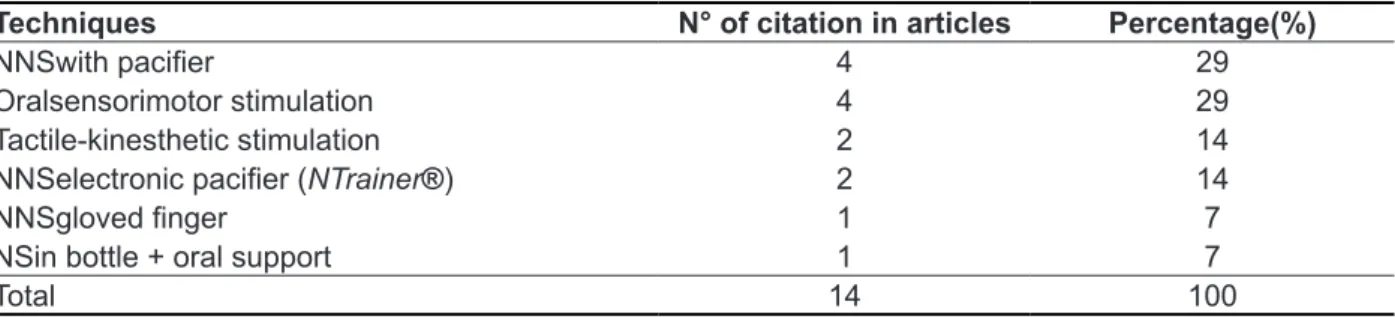
The international articles mentioned the NNS technique with synthetic nipple and the oral senso-rimotor stimulation as the most present in the stimu-lation of preterm neonates. The NNS with synthetic nipple also was performed with new technologic
device, a pressured electronic paciier named NTrainer® (Table 2).
Among national articles it was evident the practice
of non-nutritive sucking (NNS) with gloved inger as
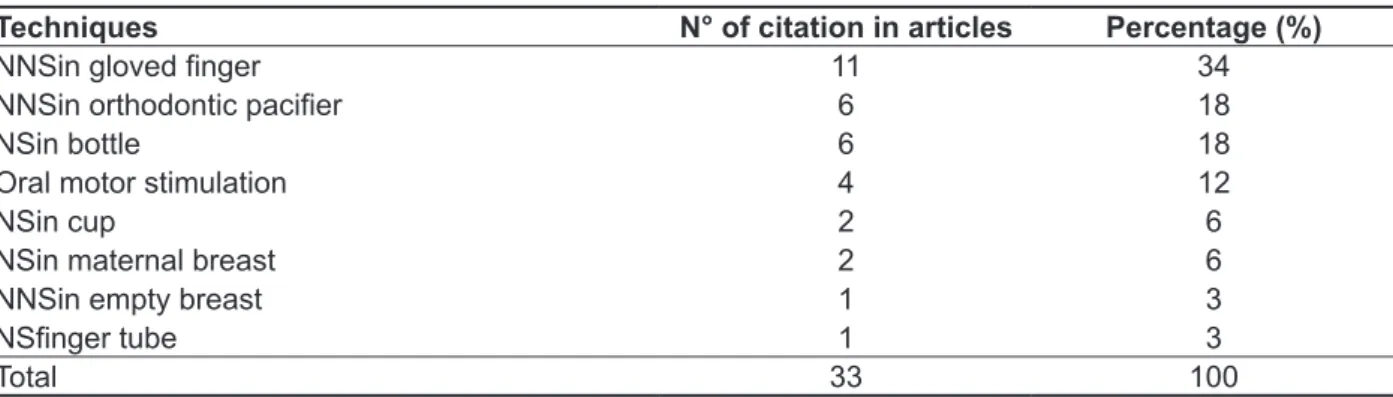
main technique applied in NICUs. Also, the NNS using synthetics nipples and the nutritive sucking (NS) with bottle presented to be an alternative to oral stimulation and feeding. Those interventions were cited as the most applied and the NNS in empty breast and the NS in maternal breast are the techniques less referred by authors (TABLE1).
Figure 1 – Research Strategy and Publications Selection
Table 1 – National Journals Citation of techniques performed with preterm newborns in neonatal therapy cares (2006-2013)
Techniques N° of citation in articles Percentage (%)
NNSin gloved inger 11 34
NNSin orthodontic paciier 6 18
NSin bottle 6 18
Oral motor stimulation 4 12
NSin cup 2 6
NSin maternal breast 2 6
NNSin empty breast 1 3
NSinger tube 1 3
Total 33 100
Palavras-chave: recém-nascido (newborn), estimulação oral (oral stimulation) e alimentação (feeding).
Limitadores: humanos, recém-nascidos e idioma de publicação, português ou inglês.
Bases de dados: “Literatura Latino-Americana e do Caribe em Ciências da Saúde” (LILACS), “Scientific Electronic Library” (SciELO) e “Medical Literature Analysis and Retrieval System Online” (MEDLINE).
Período de publicação: 2006 – 2013.
ARTIGOS INCLUÍDOS (n=17)
11 Nacionais (brasileiros);
6 Internacionais.
ARTIGOS EXCLUÍDOS (n=30)
12 publicados antes de 2006;
10 repetidos;
6 não disponíveis online;
2 não atenderam aos
objetivos da pesquisa.
Keywords:newborn, oral stimulation and feeding.
Restrictors:humans, newborns and language of publication, Portuguese and English
Data basis: “Latin-American and Caribbean Center on Health Sciences Information” (LILACS), “Scientiic Electronic Library” (SciELO) e “Medical Literature Analysis and Retrieval System Online” (MEDLINE).
Publication Period: 2006 – 2013.
INCLUDED ARTICLES (n=17)
11 National (Brazilian);
6 International.
EXCLUDED ARTICLES (n=30)
12 published before 2006; 10 repeated;
6 not available online; 2 do not attend the aim
Table 2 – International Journals Citation of techniques performed with preterm newborns in neonatal therapy cares(2006-2013)
Techniques N° of citation in articles Percentage(%)
NNSwith paciier 4 29
Oralsensorimotor stimulation 4 29
Tactile-kinesthetic stimulation 2 14
NNSelectronic paciier (NTrainer®) 2 14
NNSgloved inger 1 7
NSin bottle + oral support 1 7
Total 14 100
Legend: NNS=Non-nutritive suction; NS=Nutritive Suction.
Contrary to Brazil the NSS in gloved inger was
less cited by international authors. The natural feeding or techniques similar to this practice was not described in the international articles analyzed.
Although there are differences on the described interventions in national and international articles, all the studies emphasized that techniques closer
to natural feeding are rarely used with preterm neonates.
Most of the analyzed studies agreed that the oral stimulation in PTNB provides the acceleration in the maturation of oral functions and, therefore, decreasehospitalization time (Table 3).
Table 3 – Eficacy of combined techniques for maturation of the oral sensorimotor system applied in
preterm neonates, according bibliographic review (2006-2013)
Authors (publication year) Applied techniques Conclusion
Neiva and Leone (2006) NNSgloved inger, NNSpaciier, NS bottle E
Boiron et.al (2007) NNSgloved inger, NSbottle with oral support, oral
sensorimotor stimulation E
Neiva and Leone (2007) NNSgloved inger, NNSpaciier NE
Rocha and Delgado (2007) NNSgloved inger, NNSpaciier, NSbottle, NSmaternal
breast E
Barlow et.al (2008) NNSelectronic paciier (NTrainer®) E
Pimenta et.al. (2008) NNSgloved inger, NNSpaciier E
Poore et.al (2008) NNSelectronic paciier (NTrainer®) E
Bauer et.al. (2009) oral sensorimotor stimulation, NNSgloved inger E
Delgado (2009) NNSgloved inger, NNS paciier, NSbottle E
Yamamoto et al. (2009) NSbottle NE
Hwang et.al (2010) NNS paciier, oral sensorimotor stimulation NE
Yamamoto et al. (2010) NNSgloved inger, oral sensorimotor stimulation E
Costa et al. (2011) oral sensorimotor stimulation, NNSgloved inger NE
Fucile et.al (2011) oral sensorimotor stimulation, tactile-kinesthetic stimulation, NNS paciier E
Medeiros and Bernardi (2011) NNSgloved inger, NNSempty breast, NSmaternal
breast, NScup, NSbottle E
Calado and Souza (2012) oral sensorimotor stimulation, NNSgloved inger, NSbottle, NSinger tube E
Fucile et.al (2012) oral sensorimotor stimulation, NNSgloved inger,
tactile-kinesthetic stimulation(body and limbs) E
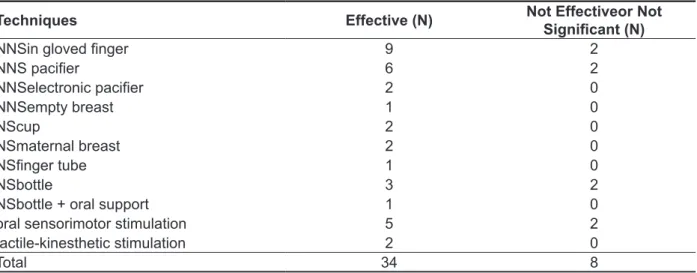
Table 4 – Number of publications evaluating the eficacy of the techniques for maturation of the oral
sensorimotor system, according to the conclusion of the authors studied.
Techniques Effective (N) Not Effectiveor Not
Signiicant (N)
NNSin gloved inger 9 2
NNS paciier 6 2
NNSelectronic paciier 2 0
NNSempty breast 1 0
NScup 2 0
NSmaternal breast 2 0
NSinger tube 1 0
NSbottle 3 2
NSbottle + oral support 1 0
oral sensorimotor stimulation 5 2
tactile-kinesthetic stimulation 2 0
Total 34 8
Legend: NNS=Non-nutritive suction; NS=Nutritive Suction.
The effectiveness of the techniques applied
was quantiied in Table 4. The NNS with gloved inger once more is presented as ahead the other techniques, characterizing the beneits for
OSS maturation in PTNB. Few authors relate the
improvement on the PTNB oral pattern exclusively
to natural development process, which suggest the importance of speech therapy intervention on these babies.
National View
The literature describe the NNS stimulation as
beneic since it its the oral muscles, contributes to
NB’s weight gain, stables the awareness states and simplify the digesting process, enabling to anticipate the transition of feeding tube to OF7.
The speech therapy intervention on babies under risk is initiated usually by NNS to evaluate and stimulate sucking. The technique also has the objective of observe the rhythm, strength and the number of bursts accomplished by babies8.
The NNS is normally performed using the
little inger gloved. This technique is described as effective to promote NB oral relexesmatu -ration, providing proper coordination on sucking,
swallowing and breathing3. The NNS also helps
the cerebral oxygenation, soothes and improve the
organization of preterm babies6.
The literature review highlighted that NNS in little
inger gloved associated to intra oral manipulation -accelerates the transition of tube to oral via, without compromise the weight gain in preterm newborns. To verify the effectiveness of this intervention on PTNB is necessary sensible observations of breathing and
The intervention enhanced neonates maturation process and muscles coordination used in sucking9,10. The NNS in gloved little inger and oral
motor stimulation of OSS enhance the responses of
oral relexes, the NS pattern and the beneits of oral diet, contributing to exclusive breastfeeding11.
Pimenta et al.12 used NNS technique in little
inger gloved to evaluation and stimulation of 98
PTNB of very low weight and concludedthere was
signiicant beneits to those NB.
Rocha and Delgado13 discussed the oral-tactile
stimulation in PTNB suffering of gastroschisis (gastric pathology) associated to prematurity.
Authors concluded the NNS in inger associated
gloved to non-oral stimulation provided adequacy of the stomatognathic system and contributed to promoting breastfeeding.
Delgado14 reports positive results for the transition
of gastric to OF by stimulation the PTNB stomato-gnathic system presenting genetic syndromes (Popliteal Pterygium Syndrome). The results were
not attributed speciically to the technique of NNS with little ingergloved, but to the association to orthodontic paciier and bottle sucking.
oral-In consonance to the studies defending the
use of paciier as an effective oral motor stimulus,
Volkmer19 reinforce the use as stimulus source, in
order to maintain the PTNB in alert, what can be associated to a better feeding and greater
behav-ioral organization. Besides, he afirms the NNS stimulation with paciier do not provoke alteration
on breathing patterns, which is essential for these babies, that since very early need to be submitted to
oxygen therapy and the use of surfactants.
The paciier is an instrument much used for NNS
stimulation, however, it is preconized the used of
gloved inger and cup so the newborn do not make
confusion with synthetic and maternal nipples3.
Studies show that the synthetic nipples sucking is frequently associated to the early weaning20,21.
Unfortunately, according to Venson et al.22,
oral-tactile stimulation has been a technique hardly used. The technique of the empty breast NNS is an alternative so the PTNB do not make confusion with nipples and the breastfeeding isencourage. At the same time it stimulates the NNS, is safe to the baby that does not coordinate the SSB and stablishes an affective bound between mother and son23.
It is known that inadequate use of paciier
causes damages on speak development, since it reduces the babbling, sound imitation and words evoke. Castilho and Rocha24 add that, regarding
the stomatognathic system, this NNS modiies the
tongue mobility and its rest position in oral cavity,
making it dificult the swallowing and also chewing. The tongue anteriorization modiies the intra oral
pressure resulting in teeth protusion collaborating to oral breathing in the future The PTNB who use
paciier during stimulation period is predispose to
the addiction of this type of NNS and susceptible to the alteration mentioned above through childhood24.
It is recommended to offer OF to the PTNB when presenting favorable conditions as proper sucking, SSB coordination and proper gastric feeding weaning. The NS in bottle or maternal breast is also an option to feeding and stimulates the PTNB. The natural stimulation in maternal breast is preferred to bottle feeding, since it provides the perioral
muscles exercise for proper development of the stomatognathic system, satisies baby emotionally
narrowing the bound between mother and son and anticipates hospital discharge25.
A study conducted with PTNB suffering from popliteal pterygium syndrome which also causes craniofacial anomalies presented improvement on oral patterns after speech therapy intervention. The transition from gastric feeding to OF was developed with NS in bottle. Results presented mouth opening
normalization, adequacy of biting and gag relexes,
increasing in the number of strong sucking and
transference index (value obtained from dividing
the ingested volume by the prescribed volume in milliliters), time on the transition gastric feeding to
exclusive oral feeding and PTNB weight gain; the
conclusion was among the 13 stimulated infants and the 15 of control group there were no
statisti-cally signiicant differences.
Bonifácio16 also cited the NNS in gloved inger
or the oral-tactile stimulation associated to oral and non-oral manipulationas promoting the coordination of the SSB, not compromising the behavioral state of babies and contributing to a better neurological organization.
It is preconized to perform the oral and non-oral stimulation before the NB feeding time and the sucking stimulation occurs during gastric feeding so the baby associates satiation to the sucking act. Some authors6,12,13 defend the usage of gloved
inger and orthodontic paciier in this interventions.
Delgado et al.14 used the NNS technique with
little inger gloved only to evaluate the PTNB pattern
of sucking. Focusing the development of the OSS they choose to use orthodontic nipples as main stimulation resource. Therefore, the success of
intervention was associated to the use of artiicial
nipple and no to oral-tactile stimulation.
The impact of the paciier on the PTNB’s life
during the hospitalization period and also after discharge has been focus of several discussions
about the beneit and malefaction of using the artiicial nipple in this kind of stimulation.
By the sample of the publications analyzed, it was possible to observe that many professionals use the
paciier as NNS technique in preterm neonates.
Pimenta et al.12 report that the PTNB of very low
weight can be beneiciated by NNS with gloved inger
and synthetic nipple, proved by the improvement in sucking process, development in OSS and hospital discharge with breastfeeding allowed. The authors observed shorter time SSB in newborns submitted
to paciier sucking during gastric feeding.
It is important to say that the NNS stimulation with
paciiers should follow speciic criteria. The majority of the articles refer to the speciic paciier for preterm
of the brand Nuk®, as ideal to stimulation.
Neiva and Leone17 inferred that thesucking of
paciiers with such speciications may contribute to
the lip closure, tongue central groove formation and coordination among SSB, important aspects to early OF diet and hospital discharge.
In a different study Neiva and Leone18 suggest
that the evolution post-birth of the sucking rhythm is mainly attributed to the maturation process, that is,
although the beneits highlighted about the sucking
Calado and Souza11quote that this technique can be
applied to evaluation of the sucking, swallowing and
coordination relexes among SSB. The study was
based on the amount of diet ingested by NB and
it was proved enhancing on oral relexes and NNS
patterns, presenting better use of the OF diet. According to Almeida and Modes3,the inger tube
technique can be indicated to newborns that did not receive the diet in cup, that need longer hospital-ization time or presented neurologic complications. For this technique is necessary to use gastric tube
(number six) attached to little inger gloved and
placed inside a cup of milk. It aims to provide the
exercise of orofacial muscles, promoting the sucking
pattern maturation3.
Fujinaga et al.29 reported that the inger tube
technique can be applied with the gastric tube connected to a syringe with plunger and attached
to little inger gloved. According to authors, this technique should help to itting the sucking patternof
PTNB or on term NB who presented oral disorders. Human milk should always be priority during offering, so the technique becomes closer to natural feeding29.
International View
The techniques more evident in international scope followed, in general, a combination of proce-dures of oral motor stimulation associated to tactile-kinesthetic stimulation.
Fucile et al.30 developed an experimental study
with 75 PTNB, based on speech intervention with stimulation techniques of OSS and body tactile-kinesthetic stimulation. The OSS stimulation consisted in caress cheeks, lips, gums and tongue, while the tactile stimulation was developed by touching head, neck, arms and legs. The results showedthat groups which received both isolated and combined stimulation presented enhancing in SSB coordination and anticipated the transition of tube feeding diet to OF.
Another study was conducted by these authors using the same techniques and the same sample,
specifying the NNS using paciier. This research
indicated a positive result of tactile-kinesthetic stimulation on the OSS pattern of the PTNB. Results showed that the isolated practice of the techniques provide positive effects, however, only the combi-nation between them is indeed satisfactory31.
Boirion et al.32leda trial with 43 PTNB. The
newborns were divided in three groups, one group using oral sensorimotor stimulation, the other stimu-lation and oral support, and the third group only oral support - considered by authors as control group. proper coordination, breathing stability and
completely OF diet. Is important to say that in this study, it was developed the NNS stimulation before offering the OF diet, which contributed essentially on results14.
Delgado14 suggests when, besides prematurity,
the baby carries any pathology that dificult or make
impossible the positioning in maternal breast, the techniques can be adapted, regarding the charac-teristics of every newborn. It is emphasized that breastfeeding should be priority since it is essential for baby in this phase.
In according, Pedras et al.26 emphasize that
breast milk is essential for neonates, because it feeds fully, the sucking movements provide craniofacial development, enhancing breathing-chewing-swallowing and speaking functions. Also contributing to affective bound between mother and baby, reduces costs and overall, results on
decreasing the infant morbi-mortality index26.
Concerning the effective breastfeeding, the NS in bottle used in NICU can be applied as favorable technique, when developed properly23. According
to Medeiros and Bernardi21, the bottle can be used
to verify the presence or absence of sucking, but does not contribute to the OSS maturation in PTNB. Some authors17,27 believe that the OSS maturation
and the early hospital discharge also are results of the GAC advance. Therefore, it is questionable for
these authors if the bottle use brings any beneits
during the hospitalization period of these babies. Neiva28 enounce that using the bottle can put
the NB life in risk, since the nipples have bigger
low of milk and can cause chocking. Besides,
synthetic nipples contribute to an early weaning and
therefore, is directed connected to noxious habits that inluence negatively chewing, swallowing,
breathing and phoneme articulation28.
World Health Organization, aiming to promote
exclusive breastfeeding and following “ten steps to
succeed in breastfeeding” includes the use of cup in this issue.
It is an alternative method for OF inmother’s absence, so the NB does not confuse the bottle and the maternalnipple26
In addition, the cup is described as a technique that helps babies there are in transitory phase from gastric feeding to OF in maternal breast and also as a evaluative tool of SSB on PTNBs11,23.
In an anatomy-physiologic view, the use of cups is not the proper method for NB feeding. Although, according to Almeida and Modes3, it is an alternative
to avoid using bottles and providingmothers coni
of the PTNB that presented weak sucking. They
described that the resource relects in the increase
of cerebral skills, organization of the oral dynamic system and non-nutritive pattern (skills that is initial
to the complexity that involves oral feeding and the
success of other skills as chewing and speaking). The fast advent of NNS in children submitted to
NTrainer®therapyaccelerated the transition to OF diet34,35. Similar NTrainer®technology was not
reported in any national article analyzed.
Four articles30,33-35 out pf the six international
studies analyzed, used the paciier as resource for
the non-nutritive sucking stimulation. Two articles31,32
used the non-nutritive sucking in gloved inger. None
of the studies used non-nutritive sucking in empty
breast or nutritive sucking in inger tube.
Boiron et al.32 used bottle in nutritive sucking, but
did not use synthetic nipple to non-nutritive sucking.
It was applied the NNS stimulation in little inger
gloved in less than half of the international articles analyzed, thatisdisagreeing compare to Brazilian
indings, in which there is priority to practice this
technique.
FINAL CONSIDERATIONS
The analyzed sample of national articles attested the non-nutritive sucking technique with
the little inger gloved as the most current practice
in neonatal intensive care units, followed by the
non-nutritive sucking with paciier. Both techniques
presented to be effective in the OSMS maturation process, providing an early the hospital discharge of the preterm newborns.
The sample of international articles showed that the practice of the non-nutritive sucking technique associated to body and oral and non-oral
manipu-lation relect positively on neonates’ development of
the oral function. Further, it brings further knowledge about technologies aiming to improve the sucking patterns in preterm newborns.
Breastfeed should be promoted on children hospital environment and the techniques of NNS and NS performed in PTNB may contribute to the success of breastfeed or provoke an early weaning process, when occurs the use of synthetic nipples.
New studies should be developed focusing the
impacts of NNS with orthodontic paciier and NS
in bottle during the lactation process. There is a
necessity of systematic and scientiic data about the beneits or malefaction of these instruments during
the period of PTNB hospitalization and after hospital discharge.
With the other hand pushed the other side of the
cheek with third inger. While the little inger gave support to mandible under chin, the other ingers
supported the bottle. The stimulation was described as cheeks, lips and tongue manipulations, NNS in
gloved inger to motivate sucking and swallowing relexes and NS in bottle. The therapist should
make regular pauses, placing the bottle nipple in the corner of the neonate’s mouth, this way was observed better SSB control.
It was used the pressured paciier to collect
information about neonate’s sucking rhythm.
This paciier was connected to pressure ampliier
device, sending information about sucking pattern to a computer,for further analysis. The research concluded that oral stimulation increased salivation and made the swallowing process easier. The study focused on NS techniques in bottle associated to
oral support and the results veriied that oral support had apositive inluence on feeding routine and
sucking patterns of the studied population32.
Hwang et al.33 proposed the effectiveness of
transition from tube to OFdiet, under intervention with perioral and intra oral motor stimulation in 90
preterm babies. It was offered the paciier as NNS
stimuli. Both stimulated PTNB and control group did
not presented performance statistically signiicant,
but regarding the NNS work, the stimulated group presented greater number of sucking than control group.
The technology also is a great allied of PTNB interventions. Pooreet al.34 and Barlow et al.35
developed trials in order to evaluate the
effec-tiveness of NNS with electronic paciier (pressured)
named NTrainer® in PTNB.
According to authors, the NTrainer® is a
biomedical device which develop the function of a NNS synthetic, in which pulsing stimulus are sent
to paciier (as a pulsing nipple) attached to an
electronic device. This device promotes sucking stimuli and captures information about rhythm, number of pauses and blurts and sends information for computer analysis.
Poore et al.34and Barlow et al.35 developed a
trial and cohort research, respectively, both with
31 PTNB sample, using NTrainer®as oral motor
intervention. The results were satisfactory, since the stimulation was associated to the acceleration of the sucking process, the increasing in the number of blurts, to the enhancing of the oral dynamic system and early hospital discharge.
Clínica; 1999 [acesso em 2013 out 19]. Disponível em: http://www.cefac.br/library/teses/d555217e5bc 712c7723b0fa257d9e975.pdf.
7. Caetano LC, Fujinaga CI, Scochi CGS. Sucção não
nutritiva em bebês prematuros: estudo bibliográico.
Rev Latino-Am Enfermagem. 2003;11(2):232-6. 8. Moura LTL, Tolentino GM, Costa TLS, Aline A. Atuação fonoaudiológica na estimulação precoce da sucção não-nutritiva em recém-nascidos pré-termo. Rev CEFAC. 2009;11(Suppl 3):448-56.
9. Bauer MA, Yamamoto RCC, Weinmann ARM, Keske-Soares M. Avaliação da estimulação sensório-motora-oral na transição da alimentação enteral para a via oral plena em recém-nascidos pré-termo. Rev Bras Saude Mater Infant. 2009;9(4):429-34.
10. Yamamoto RCC, Bauer MA, Häeffner LSB, Weinmann ARM, Keske-Soares M. Os efeitos da estimulação sensório-motora-oral na sucção nutritiva na mamadeira de recém-nascidos pré-termo. Rev CEFAC. 2010;12(2):272-9.
11. Calado DFB, Souza R. Intervenção fonoaudiológica em recém-nascido pré-termo: estimulação oromotora e sucção não-nutritiva. Rev CEFAC. 2012;14(1):176-81.
12. Pimenta HP, Moreira MEL, Rocha AD, Gomes Junior SC, Pinto LW, Lucena SL. Efeitos da sucção
não-nutritiva e da estimulação oral nas taxas de
REFERENCES
1. Prade SR. Recém-nascidos pré-termo: critérios para a introdução da alimentação por via oral [Dissertação]. Santa Maria (RS): Universidade Federal de Santa Maria; 2006.
2. Brasil. Ministério da Saúde. Deine as diretrizes
e objetivos para a organização da atenção integral e humanizada ao recém-nascido grave ou
potencialmente grave e os critérios de classiicação
e habilitação de leitos de Unidade Neonatal no âmbito do Sistema Único de Saúde (SUS). Portaria
n.930, 10 maio 2012. Diário Oicial da União; 2012.
3. Almeida EC, Modes LC. Leitura do prontuário: avaliação e conduta fonoaudiólogica com recém-nato de risco. Rio de Janeiro: Revinter; 2005. 4. Zuanetti PA, Fukuda MTH. Aspectos perinatais, cognitivos e sociais e suas relações com as
diiculdades de Aprendizagem. Rev CEFAC.
2012;14(6):1047-56.
5. Macedo FH. Recém-nascido pré-termo: limites
da intervenção fonoaudiológica. [Monograia
na Internet]. São Paulo (São Paulo):Centro de Especialização em Fonoaudiologia Clínica; 1998 [acesso em 2013 jul 17]. Disponível em: http://www. cefac.br/library/teses/5f20e3736d19de32fb847362 9bf5c5b8.pdf.
6. Piazza FB. O trabalho da fonoaudiologia hospitalar
em UTI neonatal [Monograia na Internet]. Curitiba RESUMO
A prematuridade é um dos fatores mais incidentes no ambiente hospitalar infantil. O trabalho fono-audiológico realizado em hospitais com foco no recém-nascido prematuro tem conquistado cada vez mais espaço e apresenta como proposta principal a detecção de problemas relacionados à degluti-ção, proporcionando recurso aos neonatos que fazem uso de via alternativa de alimentadegluti-ção, devido à imaturidade orgânica. O uso de técnicas para maturação do sistema sensório-motor-oral vem sendo
explorado a im de que o recém-nascido pré-termo realize transição, mais segura e em menor tempo,
para alimentação plena por via oral. O objetivo deste estudo é realizar revisão sistemática da literatura
nacional e internacional a im de elencar diferentes técnicas e elucidar sobre a eicácia das mesmas,
quanto à maturação do sistema sensório-motor-oral em neonatos prematuros que permanecem em ambiente hospitalar. Segundo a literatura, a técnica mais utilizada no Brasil é a sucção não nutritiva com dedo mínimo enluvado ou chupeta ortodôntica. Em outros países, as técnicas mais citadas foram a sucção não nutritiva com chupeta seguida da estimulação do sistema sensório-motor-oral. Tanto as
técnicas utilizadas no Brasil quanto no exterior têm reletido positivamente no desenvolvimento das
funções orais de neonatos. Levando em conta a necessidade de promoção do aleitamento materno
exclusivo, publicações recentes evidenciaram alarmante e preocupante percentual de uso de bicos
sintéticos para estimulação em unidades de terapia intensiva neonatal.
23. Medeiros AMC, Bernardi AT. Alimentação do recém-nascido pré-termo: aleitamento materno, copo e mamadeira. Rev Soc Bras Fonoaudiol. 2011;16(1):73-9.
24. Castilho SD, Rocha MAM. Uso de chupeta: história e visão multidisciplinar. J Pediatr. 2009;85(6):480-9.
25. Costa CN, Lima GRS, Jorge RM, Malta RACG, Nemr K. Efetividade da intervenção fonoaudiológica no tempo de alta hospitalar do recém-nascido pré-termo. Rev CEFAC. 2007;9(1):72-8.
26. Pedras CTPA, Pinto EALC, Mezzacappa MA. Uso do copo e da mamadeira e o aleitamento materno em recém-nascidos prematuros e a termo: uma revisão sistemática. Rev Bras Saude Mater Infant. 2008;8(2):163-9.
27. Yamamoto RCC, Keske-Soares M, Weinmann ARM. Características da sucção nutritiva na liberação da via oral em recém-nascidos pré-termo de diferentes idades gestacionais. Rev Soc Bras Fonoaudiol. 2009;14(1):98-105.
28. Neiva FCB. Crescimento e desenvolvimento estomatognático. In. Issler H. O aleitamento
materno no contexto atual: políticas, prática e bases cientíicas. São Paulo: Sarvier; 2008. P.238-40.
29. Fujinaga CI, Duca AP, Petroni RACL, Rosa CH. Indicações e uso da técnica “sonda-dedo”. Rev CEFAC. 2012;14(4):721-4.
30. Fucile S, Gisel EG, Mcfarland DH, Lau C. Oral and non-oral sensoriomotor interventions enhance oral feeding performance in preterm infants. Dev Med Child Neurol. 2011;53(9):829-35.
31. Fucile S, Gisel EG, Mcfarland DH, Lau C. Oral and nonoral sensorimotor interventions facilitate suck-swallow-respiration functions and their coordination in preterm infants. Early Hum Dev. 2012;88:345-50.
32. Boiron M, Nobrega LD Nobrega, Roux S,
Henrot A, Saliba E. Effects of oral stimulation and oral support on non-nutritive sucking and feeding performance in preterm infants. Dev Med Child Neurol. 2007;49:439-44.
33. Hwang Y, Vergara E, Lin C, Coster WJ, Bigsby R, Tsai W. Effects of prefeeding oral stimulation on feeding performance of preterm infants. Indian J Pediatr. 2010; 77(8):869-73.
34. Poore M, Zimmerman E, Barlow SM, Wang J, Gu F. Patterned ococutaneous therapy improves sucking an oral feeding in preterm infants. Acta Pediatr. 2008;97(7):920-7.
35. Barlow SN, Finan DS, Lee j, Chu S. Synthetic orocutaneous stimulation entrains preterm infants
with feeding dificulties to suck. J Perinatol.
2008;28:541-8.
muito baixo peso ao nascer: um ensaio clínico
randomizado. J Pediatr. 2008;84(5):423-7.
13. Rocha MS, Delgado SE. Intervenção fonoaudiológica em recém-nascido pré-termo com gastrosquise. Rev Soc Bras Fonoaudiol. 2007;12(1):55-62.
14. Delgado SE. Atuação fonoaudiológica na unidade de terapia intensiva em bebê com síndrome de pterígeo poplíteo. Rev Soc Bras Fonoaudiol 2009;14(1):123-8.
15. Costa PP, Ruedell AM, Weinmann ARM,
Keske-Soares M. Inluência da estimulação
sensório-motora-oral em recém-nascidos pré-termo. Rev CEFAC. 2011;13(4):599-606.
16. Bonifácio T. Atuação Fonoaudiológica com bebê prematuro: estimulação sensório-motora-oral
[Monograia na Internet]. São Paulo (SP):
Centro de Especialização em Fonoaudiologia Clínica; 1999 [acesso em 2013 set 11]. Disponível em: http://www.cefac.br/library/teses/ a9e11e10ba75e134d3e55d717c1e1fe5.pdf.
17. Neiva FCB, Leone CR. Sucção em recém-nascidos pré-termo e estimulação da sucção. Pró-Fono R Atual Cient. 2006;18(2):141-50.
18. Neiva FCB, Leone CR. Evolução do ritmo de
sucção e inluência da estimulação em prematuros.
Pró-Fono R Atual Cient. 2007;19(3):241-8.
19. Volkmer ASF. O efeito do uso da sucção não nutritiva com chupeta na apneia da prematuridade [Tese]. Porto Alegre (RS): Faculdade de Medicina da Pontifícia Universidade Católica de Porto Alegre; 2011.
20. Lamounier JA. O efeito de bicos e chupetas no aleitamento materno. J Pedriatr. 2003 ;79(4):284-6. 21. Pedras CTPA, Pinto EALC, Mezzacappa MA. Uso do copo e da mamadeira e o aleitamento materno em recém-nascidos prematuros e a termo: uma revisão sistemática. Rev Bras Saude Mater Infant. 2008;8(2):163-9.
22. Venson C, Fujinaga CI, Czluniak GR. Estimulação da sucção não nutritiva na “mama vazia” em bebês prematuros: relato de casos. Rev Soc Bras Fonoaudiol. 2010;15(3):452-7.
Received on: April 23, 2014 Accepted on: October 25, 2014
Mailing address: Esther Ferreira Lemes
Rua Brigadeiro Faria Lima 260, Jardim Calegaris Paulínia - SP – Brasil
CEP: 13140-105