NOISE AND ITS IMPACT ON BRAZILIAN HOSPITALS:
A LITERATURE REVIEW
Ruído e seus impactos nos hospitais brasileiros:
uma revisão de literatura
Walderes Aparecida Filus(1), Liane Fuhr Pivatto(2), Francisca Pinheiro Fontoura(3), Marilu Rita Villa Koga(4), Evelyn Joice Albizu(5), Vânia Muniz Néquer Soares(6), Adriana Bender Moreira de Lacerda(7), Cláudia Giglio de Oliveira Gonçalves(8)
(1) Department of Nursing, University of Tuiuti – UTP, Curitiba, Parana, Brazil.
(2) University of Tuiuti – UTP, Curitiba, Parana, Brazil. (3) University of Tuiuti – UTP, Curitiba, Parana, Brazil. (4) University of Tuiuti – UTP, Curitiba, Parana, Brazil. (5) University of Tuiuti – UTP, Curitiba, Parana, Brazil. (6) University Tuiuti, UTP, Curitiba, Parana, Brazil. (7) University of Tuiuti – UTP, Curitiba, Parana, Brazil. (8) Master’s and Doctoral Programs in Communication
Disor-ders at University of Tuiuti – UTP, Curitiba, Parana, Brazil. Conlict of interest: non-existent
INTRODUCTION
Hospitals have become in noisy places due to different factors, including the large-scale incorpo-ration of equipment1. In intensive care units (ICUs) there are numerous sources of noise, such as vacuum cleaners, monitors, mechanical ventilators, computers, printers, and compressed air vents2-8.
The noises from this equipment as well as those from air conditioning units, instruments, areas where people group and move, transportation of patients, and physical infrastructure remodeling, are among
the occupational risk factors that can compromise the health of nurses9-14.
Increased noise in hospitals further relates to non-compliance of silence by the work teams and service users. In addition, silence is necessary for the proper functioning of the hospital routine, including patient recovery15,16.
The National Health Surveillance Agency from the Ministry of Health (ANVISA/MS)17 recognizes the occupational hazard in the hospital setting, calling attention to the high noise levels in the central air compression and vacuum units, the maintenance workshops, as well as in the maintenance and laundry areas18, due to the large number of existing machines in these locations. ANVISA mentions that in ICUs, modern equipment with audible alarms, even though they make noises of lower intensity, can cause problems.
Health teams perform various tasks in the hospital environment, requiring constant attention so that there are no errors in the work process. A study in a hospital setting found that the process of preparation and administration of drugs occurring ABSTRACT
The increase in noise levels at hospitals could be attributed to many factors as incorporation of new
technologies, concentration and low of people and non-compliance of silence by the workers and
patients. Noise provokes negatively impact the work process and people’s health. This study aimed a review the national literature on noise in hospital services in Brazil, by the analysis of the follow aspects:
scientiic research, measuring methods, noise levels in hospitals, and the indings and proposed
strategies in studies. The noise level in Brazilian hospitals is above the recommended levels. There is
an increasing knowledgement of this subject in Brazil. In order to expand this knowledge, intervention studies were recommended to eliminate the excessive noise into the hospitals. The noise control in
hospitals should be considered as a priority to improve their surroundings.
related to scientiic production related to the topic,
the methods that were used to measure noise in hospitals, the results obtained, and the conclusions and proposed strategies analyzed in the study.
METHODS
The literature review was carried out using MEDLINE, LILACS, and SCIELO online databases, based on the keywords: noise and hospital and environment, hospital noise and sound pressure in the hospital. Inclusion criteria were quantitative studies of hospital noise in Brazil, published in full, in Portuguese, from January 2000 to March 2011. Studies not available in full in the searched
databases were excluded, as well as those that were
not in the time frame in question and not measure noise levels. After analyzing the inclusion criteria, 17 studies that were considered relevant for this
study were identiied. Of this total, 14 are published
articles and 3 are dissertations.
The studies were numbered from 1 to 17, and for the collection and synthesis of data, a protocol was developed with the relevant variables for analysis and discussion, such as year of publication, educa-tional background of the authors of the studies,
methodology used to measure noise, scientiic
standards, and the main conclusions and recom-mendations found. The analyses of the studies also included descriptions of procedures, parameters for noise assessment, the results regarding noise levels in different hospital environments, and strat-egies proposed actions for noise reduction.
LITERATURE REVIEW
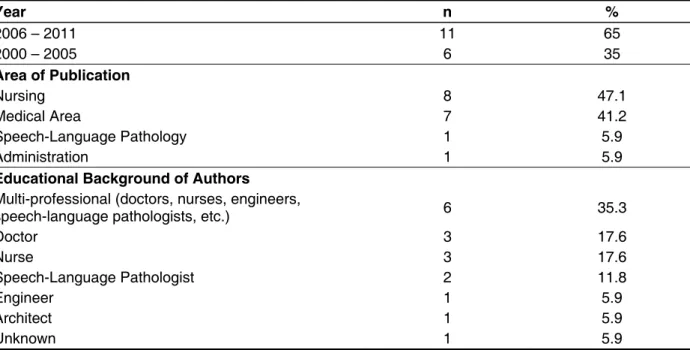
Table 1 shows the distribution of articles according to year of publication, and educational background of the authors. It was found that in the
last ive years, there has been increasing amount
of research on hospital noise in Brazil. In the period
2000-2005, we identiied 6 studies, while in the
period 2006-2011, that number almost doubled to 11 publications. The highest number of publications occurred in nursing journals (47.1%) and medical journals (41.2%). Studies published in journals in
the ield of speech-language pathology and admin -istration accounted for 5.9% of the total analyzed. Regarding the educational backgrounds of the authors, it was found that 35.3% of the publications were developed by research groups from different backgrounds.
in a noisy environment hinders concentration of professionals and induces errors19.
Regarding noise levels, the World Health Organization20 recommends that sound levels in
the hospital setting should not exceed 30 dBA.
The Brazilian Association of Technical Standards (ABNT)21 regulates normal levels at between 35 and 55 dBA for hospitals.
The Brazilian Standard, NBR 10152/8722, registered with the National Institute of Metrology, Standardization, and Industrial Quality (INMETRO), provides for hospitals to have sound levels of 35 dBA for comfort, and 45 dBA as acceptable for
rooms, inirmaries, surgical centers and nurseries;
laboratories and areas for public use should be at 40 dBA for comfort and 50 dBA as an acceptable level for those spaces; services are at 45 and 55 dBA.
In relation to worker health, Chapter V of the Consolidation of Labor Laws (CLT), through Regulation 3214/78, establishes, via Norm 15 (NR-15)23, the tolerance limits or occupational
exposure limits to noise, for continuous or inter -mittent noise, a level criterion of 85 dBA for an
eight-hour work-day exposure. In workplaces where
activities are performed that require attention and intellectual activity, it is recommended via Norm 17 (NR-17)24 to follow the acoustic comfort conditions established by Brazilian Standard (NBR) 10115222, with an acceptable level of 65 dBA.
High noise levels can cause behavioral disorders, resulting in physiological responses to stress in hospitalized patients. The intensity of sound pressure of 65 dBA can affect the hypothalamus and pituitary, raising levels of secretion of adrenaline, noradrenaline, and corticosteroids as well as cause increased blood pressure and changes in heart rate and peripheral vasoconstriction3,25. There are reports in the literature on the relationship between high levels of sound pressure and hearing loss, stress, as well as psychological and sleep abnormalities that can cause memory lapses and greater mental
effort to accomplish tasks, exposing the group to risks of accidents and errors in the execution of their
work2,26.
Because of the potential risk that noise poses to patients and health care teams in hospitals, the measurement of sound levels is proscribed, which will facilitate the implementation of changes in effective control and noise reduction27,28.
Table 1 – Distribution of articles according to year of publication, area, and profession of the authors (n = 17)
Year n %
2006 – 2011 11 65
2000 – 2005 6 35
Area of Publication
Nursing 8 47.1
Medical Area 7 41.2
Speech-Language Pathology 1 5.9
Administration 1 5.9
Educational Background of Authors
Multi-professional (doctors, nurses, engineers,
speech-language pathologists, etc.) 6 35.3
Doctor 3 17.6
Nurse 3 17.6
Speech-Language Pathologist 2 11.8
Engineer 1 5.9
Architect 1 5.9
Unknown 1 5.9
The increase in the number of studies in the period 2006-2011 occurred possibly as a result of interest from different health professionals
related to the perception of the changing proile of
noise in hospital settings, but also because of the advancement of engineering about noise and the knowledge of its effects on hearing and general health. It was observed that the highest number of publications occurred in nursing journals. This can
be justiied by the expanding role of the nurse within
the area of Occupational Health, in that the nurse needs to be in constant pursuit of development and
deepening of knowledge to be properly qualiied.
Moreover, nurses plan actions based on the work process, which are relevant for the implementation of awareness programs about the effects of noise in the hospital environment29.
It was also observed that most of the papers came from multidisciplinary teams. This indicates
the interaction of professionals from various ields,
setting up a reciprocal relationship between multiple
technical interventions and agent interaction30. One
of the examples of collective work can be seen in
the various professional areas, creating a network of relationships between people, power, knowledge, feelings, and desires in which it is possible to identify the group processes31. This constitutes a strategy to improve quality of life, because it seeks comprehen-siveness in health care.
Variable n %
Location of Study
Public Teaching Hospital 9 52.94
Public General Hosptial 5 29.41
Private Hospital 2 11.76
Not described 1 5.88
Hospital Area Studied
Neonatal ITU (Neonatal Intensive Therapy Unit) 5 29.4
ITU (Intensive Therapy Unit) 4 23.5
Various Areas 2 11.8
NICU (Neonatal Intensive Care Unit) 2 11.8
Laundry 2 11.8
Pediatric ICU 1 5.9
Surgical Center 1 5.9
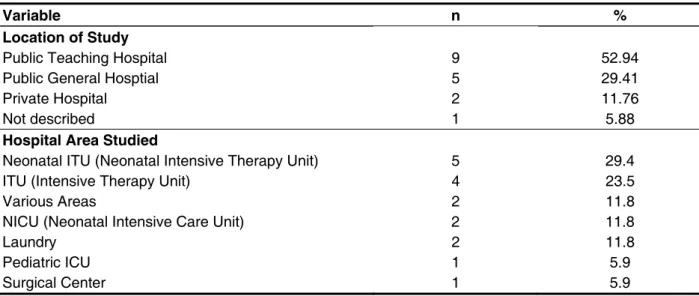
Table 2 – Distribution of articles according to study location and the hospital area (n = 17)
Teaching hospitals or universities are the main institutions that, in practical terms, complement the practical training of health professionals. In addition,
they are meant for medium and high complexity
care, and have more equipment and a larger number of people in them. Referring to the areas of hospitals studied, ICUs are sites that are particularly affected by noise. They have a lot of equipment with essential acoustic alarms to alert doctors and nurses about changes in patients’ clinical conditions or equipment malfunction2. Thus, these environments, which should be silent and quiet, become noisy and stressful. For the patient, it can also increase the
perception of pain and anxiety, decrease sleep, and
prolong convalescence32,33.
In neonatal ICUs, according to some research34, an overly stimulating environment may undermine the process of development and growth, especially in premature infants whose sensory receptors
are extremely environmentally sensitive. There is
evidence that the auditory system of a premature
baby, because of its general immaturity, is probably more susceptible to injuries that can be normally caused by this environment because of the
combi-nation of noise with the use of ototoxic medications
that increase the risk even further. Because of this, from the 1970s in some countries – Brazil, only in the 1990s – studies were carried out that addressed
the issue of noise in neonatal environments, specii -cally in incubators. Other researchers28 note that the technological environment of the Intensive
Care Unit provides beneits in terms of biological
balance, however, it is physically and psychologi-cally aggressive, in which the noise level is one of the harmful interactions.
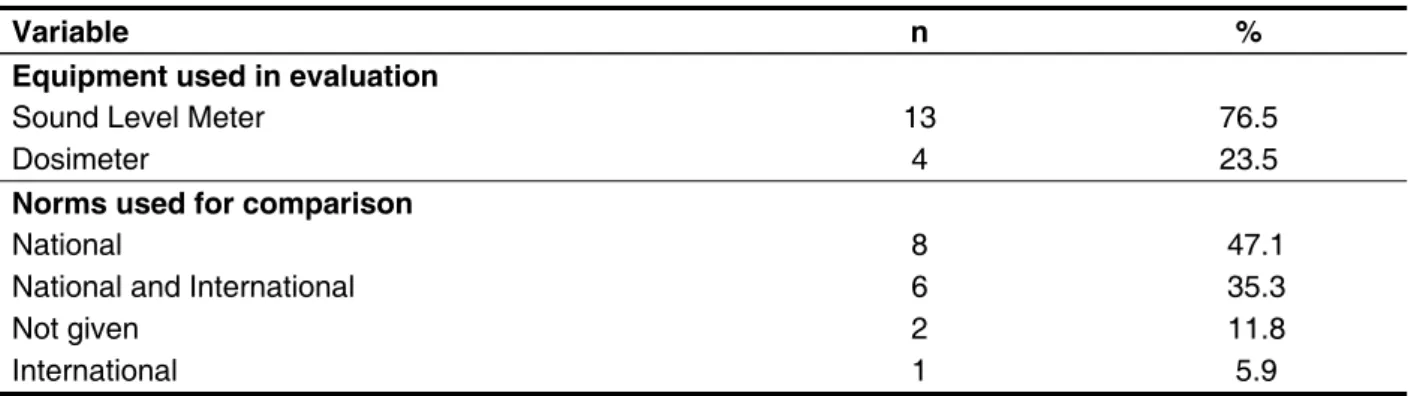
The data presented in Table 3 refer to the noise assessment protocol used in national articles. In
the studies reviewed, in approximately ¾ of them
were carried out at the times considered peak, i.e., in the morning. The measuring time varied from 27, 30, and 60 seconds to 5, 10, and 15 minutes. In four studies, sounds were measured continuously (24 hours per day). With regard to the standards used for the analysis of data from the studies, it was found that 47.1% chose to compare the values of noise levels recommended in national standards, while 35.3% of the researchers chose to use both national and international standards.
Another factor considered was the time of measurement recorded in studies, shown in Figure 1. Observe that each researcher used a different authority, in accordance with the needs and requirements of the site and subject of study, and/ or measuring equipment used, it may be noted the diversity of measurement times, the intervals between measurements, and the duration of the measurements. It was found that most measure-ments were performed at three times (morning, afternoon, and night). In three studies, measurements
Variable n %
Equipment used in evaluation
Sound Level Meter 13 76.5
Dosimeter 4 23.5
Norms used for comparison
National 8 47.1
National and International 6 35.3
Not given 2 11.8
International 1 5.9
Table 3 – Evaluation of the data protocols used in noise studies (n = 17)
Time measured in minutes/ by study (E number)*
Interval between measurements
Duration of measurements
in days/ hours
6000 (E.1) 27 s 8,12 or 24h
8640 (E.2) 0 6d – 24h
2400 (E.3) 1 m 7d – 24h
5160 (E.4) 0 7d – 12h
5040 (E.5) 0 14d – 12h
360 (E.6) N/A 1d – 6h
10080 (E.7) 5 s 7d – 24h
Instantaneous (E.8) 10 m 3d – 3h
69 measurements/registry (E.9) 30 s 14d – 12h
3480 (E.10) 15 m N/C
(E.11) N/A 1d – 4h
(E.12) N/A 13d – 2 - 4h
51840 (E.13) 0 9d – 24h
33 m (E.14) 1 m 11d – 6h
45 m (E.15) 5 m 3d – 3h
5760 registries (E.16) 0 4d – 24h
(E.17) N/A 2d – 12h
* Number of STUDY ** Scoring: impact noise N/A: Not applicable information
for Newborn ICU Design, states that the usual noise of the Neonatal Intensive Care Unit (NICU) and the Neonatal Intensive Therapy Unit (NITU), shall
not exceed the equivalent level of 50 dBA. The
American Academy of Neonatology, based on the Environmental Protection Agency 74 Guidelines in the United States, recommends a sound pressure
level not exceeding 45 dBA daytime and 35 dBA nighttime. It can be veriied that the recommended
levels are very close, both domestically and interna-tionally, with a consensus on the values indicated.
In Figure 2, we present the noise levels for the study area, where we used sound level meters as well as noise dosimeters. In the measurement of sound pressure levels, it was found that the
minimum average was 50.1 dBA and the maximum
was 96.0 dBA. NBR 1015121 states that the measuring time
should be chosen so as to enable the charac-terization of noise. The measurement may involve a single sample or a series of them. This
explains the great diversity of patterns used in
the studies. National standards include Norm NR 15 of Regulation 3214/78 of the Ministry of Labor and Employment when the risk is occupational, i.e., with noise levels above 85 dBA for 8 hours of
exposure23, and NBR 10152/1987 of the ABNT, which recommends 35 to 45 dBA for acoustic comfort (ABNT, 1996). International standards used were the recommendations of the World Health Organization (WHO), which states that equivalent sound levels for different hospital environments
should not exceed 40 dBA for daytime and 35 dBA
for nighttime. Another international standard, the Committee to Establish Recommended Standards
Hospital Area Maximum
dBA
Minimum dBA
Average Leq dBA
Observation dBA
SOUND LEVEL METER
(E.1)* General ITU 108.4 40
65.36
Day- 65.23
Night – 63.89
Varied: 62.9to 69.3
(E.2)* Pediatric ITU 120.0 60.0 to 70.0 Base level
(E.3)* Various hospital areas 58.0 101.0
63.7
ER Reception – 64.2
Cast Room – 60.6
Neonatal ITU – 61.4
ITU – 62.7
Surgery Center – 59.1
Sterilization Center – 66.0
Pharmacy – 63.3
Pediatrics – 60.0
Kitchen – 62.9
Laundry – 71.5
(E.6)* ITU
1 – 80.4
2 – 82.4
Coronary - 73.3
1 – 80.4
2 – 82.4
Coronary - 73.3
1 – 64.1
2 – 64.0
Coronary – 58.9
(E.7)* ITU
Day – 60.86 ± 4.90 Night – 55.60 ± 5.98
Business Days - 58.21 ± 5.93
Weekends - 56.83 ± 5.90 Shift Change:
Day – 61.35 ± 5.08
Night – 62.31 ± 4.70
Visiting: Morn.- 60,50 ± 4.59
Afternoon- 62.04 ± 4.48
Night – 60.05 ± 4.27
(E.7)*Surgery Center 96,0 steam on
Reception - 73.6 a 83.6
Hallway - 68.2 a 85.0
Operating Room - 66.4 a 79.2
Recovery - 79.9 a 83.8
Material Prep - 68.1 a 83.6
Sterilization - 69.6 a 96.0
86.5 at CM
(E.9)*Incubators –(impact) 116 dBC 76,1 dBC (E.10)*Health Establishments 94.9 O² Supply 45.9 Patient
---Hospital Area Maximum dBA
Minimum dBA
Average Leq dBA
Observation dBA
(E.11)* NIHL in Laundry
Entire Hospital – 75.0
Laundry Morning– 91.0
Laundry Evening – 90.0
Kitchen Morning – 81.0
Kitchen Evening – 80.0
Maintenance Morning – 80.0
Maintenance Evening – 75.0
Hallway Morning – 75.0
Hallway Evening – 55.0
(E.12)* Neonatal ITU
Morning - 80.4 (hand wash)
Night 78.1 (equipment change)
Morning 84.5 Afternoon 76.6
Night 76.6
(E.14)* Neonatal ITU 50.1 to 62.0
(E.15)* Laundry
Morning - 98.0
Afternoon – 97.0
Night – 101.0
Morning - 81.0
Afternoon – 76.0
Night – 70.0
---(E.17)* ITU
Day – 89.3
Morning – 89.3
Evening – 83.4
Day - 55.6
Morning – 61.4
Evening – 55.6
Day – 71.0
Morning – 71.6
Evening – 70.4 DOSIMETER
(E.4)*NICU (Neonatal)
Shift Change:
Nursing - 55.3 a 72.2
Morning – 55.3 a 72.2 Afternoon – 57.4 a 70.9 Night – 55.2 a 70.5
Shift Change:
Doctors – 57.2 a 70.5
Morning – 57.2 a 70.5 Afternoon – 60.7 a 67.8 Night – 58.3 a 67.6
Medical Visit:56,0 a 75.7
Morning – 56.0 a 69.9 Afternoon – 56.2 a 75.7 Night – 58.3 a 75,7
NICU limit: 50 dBA
(E.5)* NICU (Neonatal)
Friday – 54,5 a 82,2
Saturday – 54,2 a 86,0
Sunday – 52,6 a 72,6
Monday – 52,7 a 76,2
Tuesday – 53,0 a 71,6
Wednesday – 51,8 a 71,6
Thursday - 52,8 a 71,6
Friday- 52,0
Saturday- 51,9
Sunday- 51,7
Monday - 51,9
Tuesday - 50,7
Wednesday
- 51,2
Thursday - 52,1
Friday - 61,1
Saturday - 59,5
Sunday - 60,9
Monday - 60,1
Tuesday - 62,3
Wednesday - 59,6
Thursday - 6 1,6
(E.13)* NITU (Neonatal)
Intensive Care -114.1
Intermediate Care -90.2
Isolation - 100.8
Hallway - 104.9
Intensive Care - 64.8
Intermediate Care – 62.1
Isolation – 63.8
Hallway – 61.9
(E.16)* NITU (Neonatal)
96.8 a 121.0 dBC 90.8 a 100.3 dBC 98.9 a 123.4 dBC 103,4 a107.6 dBC
Thursday - 62,2
Friday - 61.3
Saturday - 66,0
Sunday- 66.6
Night
123.4dBC
Morning
103.4dBC
Evening
90.8 dBC
N* Number of Study
NICU = Neonatal Intensive Care Unit
energy produced by recorded sound events. Some meters provide a direct reading of Leq at intervals chosen by researchers35. Some models of sound level meters have this feature, as well as some models of noise dosimeters. Therefore, these two types of equipment can be used in the evaluations provided they meet the standards recommended
by regulatory bodies. By deinition35, the noise dosimeter was designed to be a monitoring device for personal use, allowing measurement of the noise dose and other quantities that characterize worker
exposure to noise. But currently these devices can
provide much information regarding the assessment of noise in work environments, meeting different standards and legislation, as well as for environ-mental reviews considering acoustic comfort.
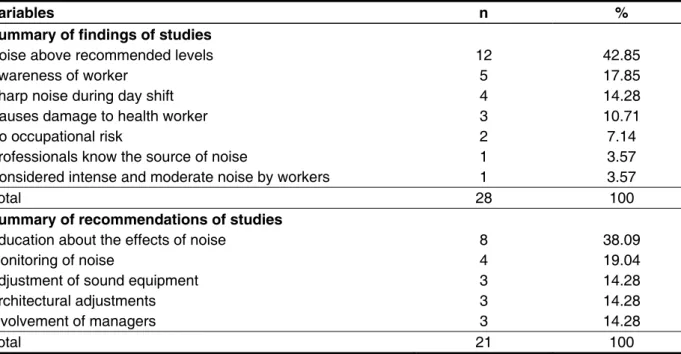
To conclude this review of the literature, we
included the synthesis of the indings and recom -mendations related to hospital noise studies, as shown in Table 4. Observing different outcomes or conclusions, noise levels above the recommended standards in Brazilian hospitals are dominant (in 42.85% of the studies), the need for greater worker awareness (in 17.85% of the studies), and the noise that is more pronounced in daytime (in 14.28% of the studies).
As for noise levels detected in different studies, it was observed that they are within recommended ranges based on both national and international standards for occupational health and for acoustic comfort values. It appears that there are sound pressure levels which can cause noise-induced hearing loss, since they are above the tolerance limits indicated in Norm NR 15, being an occupa-tional hazard for workers in hospital laundries as well as for users in standard and neonatal ICUs and other hospital areas. The studies also show that the noise levels that are below the tolerance limit set out in NR 15 should be compared to the limits recom-mended by ABNT standards for acoustic comfort given by NBR 1015222.
For the speciication of the measurement
equipment, the method and procedures for evalu-ation are listed in NBR 1015121, in June 2000. The standard recommends that the sound level meter or
other measuring system meets the speciications of
IEC 60651 for type 0, type 1, or type 2 and that the evaluation device has features for the measurement of equivalent weighted “A” (Leq) sound pressure levels.
The equivalent level (Leq) is deined as the
steady sound level that occurs during the regis-tered interval, and would produce the same sound
Variables n %
Summary of findings of studies
Noise above recommended levels 12 42.85
Awareness of worker 5 17.85
Sharp noise during day shift 4 14.28
Causes damage to health worker 3 10.71
No occupational risk 2 7.14
Professionals know the source of noise 1 3.57
Considered intense and moderate noise by workers 1 3.57
Total 28 100
Summary of recommendations of studies
Education about the effects of noise 8 38.09
Monitoring of noise 4 19.04
Adjustment of sound equipment 3 14.28
Architectural adjustments 3 14.28
Involvement of managers 3 14.28
Total 21 100
Table 4 – Summary of conclusions and recommendations related to hospital noise according to the studies analyzed
on health. It is recommended, therefore, to perform
intervention studies, with experimentation and experience reports on strategies for mitigation of excessive noise in different hospital settings, which
would broaden the knowledge and contributes positive results in practice. Observed by the studies in this review, was that noise control in hospitals should be considered a priority for improving the surroundings. Thus, an important investment should be made in studies that show different forms of noise
exposure in the hospital environment that are affect
both professionals and users, as well as the impact on the health of this population, in order to correct the situation and implement preventive measures.
CONCLUSION
The highest number of publications occurred in the period 2006-2011, in nursing journals and developed by multidisciplinary groups of researchers, mostly in public teaching hospitals, and predominantly in ICUs. The most measuring equipment used was a sound level meter, and each researcher developed a different approach to systematic measurements, as well as the time of measurement. Most measurements were done at three time periods. Most data were compared with national standards. In all studies, the noise in Brazilian hospitals was above the recommended levels.
In relation to the recommendations made by the authors, more than one third (39.09%) of the research cited the need for education about the effects of noise. The need for noise monitoring was reported in 19.04% of the studies. Three other suggestions mentioned were the adequacy of sound equipment, architectural adjustments, and the involvement of managers respectively in 14.28% of the studies.
Finally, studies indicate that health facilities should have physical space with basic conditions of environmental comfort, including acoustic comfort,
which would beneit the patient and everyone
involved in the process10. As recommendations for reducing noise in the observed areas, the vast majority of studies cited education and awareness about the effects of noise, the need for adaptations of the physical environment for greater comfort, and preventive sound maintenance for equipment, as well as the purchase of equipment with reduced noise emission levels. These factors enable the hospital staff to act more effectively in reducing
noise pollution which is beneicial to labor and the
recovery of patients, reducing noise’s impact on Brazilian hospitals.
FINAL CONSIDERATIONS
This review showed that there is a relative accumulation of knowledge about hospital noise in Brazil, noise generating sources, and their effects
RESUMO
O aumento dos níveis de ruído nos hospitais, atribuído a diferentes fatores, dentre eles a grande
incorporação de tecnologias, a concentração e o luxo de pessoas e a não observância do silêncio
pela própria equipe de trabalho e usuários do serviço, pode impactar negativamente no processo de
trabalho e na saúde de proissionais e usuários. Este estudo teve como objetivo realizar revisão de
literatura nacional sobre ruído em serviços hospitalares no Brasil, analisando aspectos referentes à
produção cientíica, aos métodos de mensuração, aos níveis de ruído presentes nos hospitais, e às conclusões e estratégias propostas nos estudos analisados. O nível de ruído nos hospitais brasileiros
está acima dos padrões recomendados acarretando impactos nesses serviços. Existe um relativo
acúmulo de conhecimento sobre o tema no Brasil. Para ampliação desse conhecimento foram
reco-mendados estudos de intervenção para mitigação do excesso de ruídos nos hospitalais. O controle do ruído nos hospitais deve ser considerado como uma das prioridades para melhoria de sua ambiência.
Janeiro, Rio de Janeiro, 2003. Disponível em: http:// pesquisa.bvsalud.org/regional/resources/lil-398409 13. Curado JAF, Rabelo WCSV, Alves W, Perini RF,
Siqueira PH. A incidência de PAIR na lavanderia de
um hospital universitário. Arq. Otorrinolaringol. 2001 Abr/Jun; 5(2):113-6.
14. Muniz LMN, Stroppa MA. Desconfortos dos pacientes internados na UTI,quanto a poluição sonora. Revista de Administração Hospitalar e Inovação em Saúde. jul./dez. 2009 disponível em
:http://www.face.ufmg.br/revista/index.php/rahis/
article/viewFile/808/682
15. Freitas SF, Clímaco RSC. Análise do conforto sonoro em hospitais de Brasília. V Encontro Nacional em Ambiente Construído, 1999.
16. Corrêa A L.Ruído: Níveis de pressão sonora captados no interior e exterior
de incubadora em unidade de cuidados
intensivos neonatal[dissertação]. São José
dos Campos(SP):programa de pós-graduação em bioengenharia do Instituto de Pesquisa e Desenvolvimento da Universidade do Vale da Paraíba; 2005.disponível em: http://biblioteca. univap.br/dados/000001/00000111.pdf
17. ANVISA: Agência Nacional de Vigilância
Sanitária. Segurança no ambiente hospitalar. [Manual na Internet]. [s.d.] [acesso em 2011 Maio
9]; [aproximadamente 172 p.]. Disponível em:
http://www.anvisa.gov.br/servicosaude/manuais/ seguranca_hosp.pdf
18. Silva MC, Orlandi CG, Chang EM, Siviero J, Pinto MM, Armellini PFS et al. Níveis de ruído na lavanderia de um hospital público Rev. CEFAC. São Paulo disponível em: http://www.scielo.br/pdf/ rcefac/2010nahead/180-09.pdf
19. Miasso AI, Silva AEB de CS, Cassiani SH de BC, Grou CR, Oliveira RC de, Fakih FT. O processo
de administração de medicamentos: identiicação
de problemas para propor melhorias e prevenir erros de medicação. Rev Latino-am Enfermagem. 2006 Maio/jun;14(3):354-63.
20. WHO: World Health Organization. Guidelines for Community Noise. Noise sources and their measurement. 1999. [acesso em: 2011 Ago 10]. Disponível em: http://www.who.int/docstore/peh/ noise/guidelines2.html
21. ABNT: Associação Brasileira de Normas
Técnicas-NBR 10151. Avaliação do ruído em
áreas habitadas visando o conforto acústico da comunidade. Rio de Janeiro; 2000.
22. ABNT: Associação Brasileira de Normas
Técnicas-NBR 10152. Níveis de ruído para conforto
acústico. Rio de Janeiro;1987.
23. Brasil. Ministério do Trabalho. Limite de tolerância. Portaria 3214 de 08 de junho de 1978 –NR 15 Anexos 1 e 2 [Norma regulamentadora
REFERENCES
1. Otenio MH, Cremer E, Claro EMT. Intensidade de ruído em hospital de 222 leitos na 18ª Regional de Saúde – PR. Rev. Bras. Otorrinolaringol. 2007; 73(2):245-50.
2. Pereira RP, Toledo RN, Amaral JLG, Guilherme
A. Qualiicação e quantiicação da exposição sonora
ambiental em uma unidade de terapia intensiva geral. Rev. bras. Otorrinolaringol. 2003 Nov.dez; 69(6):766-71.
3. Carvalho WB, Pedreira MLG, Aguiar MAL. Nível de ruídos em uma unidade de cuidados intensivos pediátricos. J. pediatr. 2005 Nov/dez;81(6):495-8. 4. Kakehashi TY, Pinheiro EM, Pizzarro G, Guilherme A. Nível de ruído em unidade de terapia intensiva neonatal. Acta Paul. Enferm. 2007; 20:404-9. 5. Sampaio Neto RA, Mesquita FOS, Junior MDSPJ, Ramos FMDA, Junior MAVC. Ruídos na Unidade
de terapia Intensiva: quantiicação e percepção dos proissionais de saúde. Revista Brasileira de
Terapia Intensiva. 2010 Oct/Dec;22(4):369-74.
6. Aurélio FS, Tochetto TM. Mensuração do ruído
em uma Unidade de Terapia Intensiva Neonatal. Acta Pediátrica Portuguesa. 2010;41(2):64-8. 7. Cardoso MVLM, Chaves EMC, Bezerra MGA. Ruídos e barulhos na unidade neonatal. Rev Bras Enferm. Brasília [periódico internet] 2010 jul-ago; [acesso em 2011 dez 16];63(4):561-6. Disponível em: http://www.scielo.br/pdf/reben/v63n4/10.pdf 8. Rodarte MDO, Scochi CGS, Leite AM, Fujinaga CL, Zamberlan NE, Castral TC. O ruído na manipulação das incubadoras: implicações para o cuidado de enfermagem. Rev. latino-am. enfermagem. 2005 Jan./fev;13(1):79-85.
9. Felli VEA, Tronchin DMR. A Qualidade de vida no trabalho e a saúde do trabalhador de enfermagem. In: Kurcgante P (Coord). Gerenciamento de Enfermagem. Rio de Janeiro: Guanabara Koogan; 2005.
10. Fress MFR. Avaliação dos níveis de ruído em estabelecimentos assistenciais de saúde: estudo de caso [dissertação]. Santa Maria(RS): Universidade de Federal de Santa Maria;2006 [acesso em 2011Jul 20]. Disponível em:
http://w3.ufsm.br/ppgec/wp-content/uploads/diss_ maria_de_fatima.pdf
11. Ichisato SMT, Scochi CGS. Ruídos na unidade de cuidado intensivo neonatal durante as
passagens de plantão (enfermagem e/ou médica) e visita médica. Rev.Ciência, Cuidado e Saúde.
2006;5(supl):127-33.
Hospital Universitário. Cuidado Ciência e Saúde.
2008 Out/Dez;4(7):431-8.
29. Baggio MCF, Marziale MHP. A participação da enfermeira do trabalho no programa de conservação auditiva. Rev Latino-am Enfermagem. 2001 Set./ out. 9(5):97-9.
30. Peduzzi M. Equipe multiproissional de saúde:
conceito e tipologia. Rev Saúde Pública [periódico na Internet]. 2001 Fev [acesso em: 2011 Jul
26];35(1): [aproximadamente 7 páginas]. Disponível
em: <http://www.scielosp.org/scielo.php?script=sci_
arttext&pid=S0034-89102001000100016&lng=en&
nrm=iso>. access on 26 July 2011. doi: 10.1590/ S0034-89102001000100016.
31. Fortuna CM, Mishima SM, Matumoto S, Pereira MJB. O trabalho de equipe no Programa de Saúde da
Família: relexões a partir de conceitos do processo
grupal e de grupos operativos. Rev. latino-am. Enfermagem. 2005 Mar./abr;13(2):262-8.
32. Falk AS, Woods NF. Hospital noise – levels and potential health hazards. N Engl J Med. 1973 Oct;289(15):774-81.
33. Hilton A. The hospital racket: how noisy is your unit? Am J Nurs.1987 Jan; 87(1):59-61.
34. Tamez RN, Silva MJP. Enfermagem na UTI
neonatal: Assistência ao recém-nascido de alto
risco. Rio de Janeiro: Guanabara Koogan, 2002. 35. Bistafa S. Acústica aplicada ao controle do ruído. 2 edição. São Paulo: Blucher, 2011.
na internet]; 1978 Jun [acesso em: 2011 Set.
28]:[aproximadamente 3 páginas]. Disponível
em: http://portal.mte.gov.br/legislacao/norma-regulamentadora-n-15.htm
24. Brasil. Manual de aplicação da norma
regulamentadora n.0 17. Brasília: Ministério do
Trabalho, 2002.
25. Macedo ISC, Mateus DC, Costa EMGC, Asprino ACL, Lourenço EA. Avaliação do ruído em Unidades de Terapia Intensiva. Braz. j. otorhinolaryngol. (Impr.); 2009 Nov./dez;75(6):844-6.
26. Oliveira EB, Lisboa MTL. The impact of noise for the nursing workers health and the work process. Online Brazilian of Nursing [periódico na internet] 2007;6(3):1237- 266. Available from:http://
www.uff.br/ objnursing/index.php/nursing/article/
view/j.1676- 4285.2007.1237/266.
27. Nogueira MFH, DI Piero KC, Ramos EG, Souza MN, Dutra MVP. Mensuração de ruído sonoro em unidades neonatais e incubadoras
com recém-nascidos: revisão sistemática de
literatura. Rev. latino-am. enfermagem [periódico na Internet]. 2011 Jan./fev. [acesso em: 2011
Maio 10];19(1):[aproximadamente 10 páginas].
Disponível em: http://www.scielo.br/pdf/rlae/v19n1/ pt_28.pdf.
28. Zamberlan NE, Ichisato SMT, Rodarte MDO, Fujinaga CI, Hass VJ, Scochi CG S. Ruído em uma Unidade de Cuidado Intermediário Neonatal de um
Received on: January 17, 2012 Accepted on: August 09, 2012
Mailing address:
Walderes Aparecida Filus Rua Padre Agostinho, 2677 Curitiba – PR
CEP: 80710-000