Optimum Gain Analysis Using the Principle of Game Theory
Musa Danjuma SHEHU1 and Sunday A. REJU2
1
Department of Mathematics and Computer Science, Federal University of Technology Minna, Nigeria
2
National Open University of Nigeria, Lagos, Victoria Island, Lagos, Nigeria
[email protected], [email protected]
Abstract
The formulation of game problems is one of the most important tools that is being used to solve many practical problems. For example, organisations need to make decisions about how to locate their branches in different locations for optimum profit. This paper employs the principle of game theory to provide strategies required for optimal location of two competitive organisational branching systems.
Keywords
Pay Off; Discrete; Continuous; Matrix Games; Maximizer; Minimizer.
Introduction
net outcome of all the strategies chosen by all the players may represent a gain or loss or a
draw to any particular player.
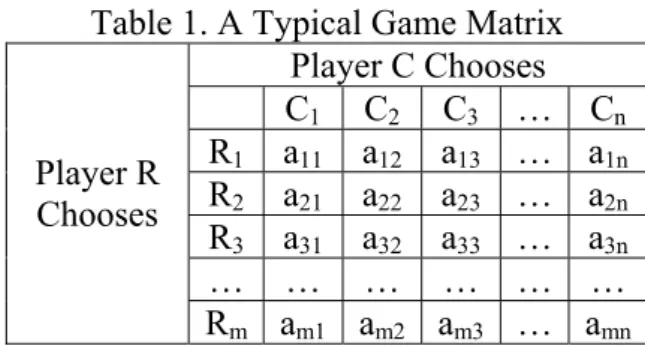
Game theory is concerned with discrete optimization problems involving two players with conflicting interests. Game problems can be classified into Discrete and Continuous. Discrete game problems are often represented in matrix forms, which take the form of either n x n or m x n matrix as illustrated below [1], [6]:
Table 1. A Typical Game Matrix Player C Chooses C1 C2 C3 … Cn R1 a11 a12 a13 … a1n R2 a21 a22 a23 … a2n R3 a31 a32 a33 … a3n
… … …
Player R Chooses
Rm am1 am2 am3 … amn
In a continuous game the choices of R and C are continuous instead of discrete [2]. Therefore there must be a continuous pay-off function G(R,C) instead of a pay-off matrix Gij as explained in discrete games.
We look for a pair of choices
G(Ro,C) ≤ G(Ro,Co) ≤ G(R,Co) for all R, C (1) The necessary and sufficient conditions for R°,C° are
∂G/∂R =0, ∂G/∂C =0 (2)
∂2
G/∂R2≥0, ∂2G/∂C2 ≤ 0 (3)
Any R°, C° satisfying the sufficient condition is called a game-theoretic saddle point
[2],[5].
MINI MAX (MAXMIN) Principle
Due to the immense significance of the maxmin (minmax) principle to the focus of
this paper, we illustrate this principle using an example as described below: We consider a two person game shown in Table 2.
Table 2. A (3 × 4) Discrete Game Matrix Player C
C1 C2 C3 C4
R1 G11=6 G12=1 G13=7 G14=3 R2 G21=4 G22=3 G23=5 G24=6 Player R
R3 G31=5 G32=1 G33= -2 G34=5
If Player R, (the Maximizer) selects his first strategy (R1) he may gain; 6, 1, 7 or 3 depending on the strategy selected by Player C.
Thus player R is guaranteed a gain of at least 1 = min(6,1,7,3) if he selects strategy R1 irrespective of the strategy selected by player C.
Similarly, R is guaranteed a gain of at least
3 = min (4,3,5,6) for strategy R2 selection and -2 = min (5,1,-2,5) for strategy R3 selection.
Thus for Player R to maximize his gain irrespective of the strategies of C, he has to maximize his minimum gain i.e.
3 = max (1,3,-2)
Similarly, if Player C chooses strategy C1 he loses 6, 4 or 5 depending on the strategy selected by the Player R.
Thus Player C loses no more than 6 = max(6,4,5) for C1 strategy 3 = max(1,3,1) for C2 strategy 7 = max(7,5,-2) for C3 strategy
6 = max(3,6,5) for C4 strategy
Therefore for Player C to minimize his loss, irrespective of Player R, he has to minimize his maximum losses by selecting
3 = min(6,3,7,6) from strategy C4
This is called the minimax value of the game for Player C. Therefore:
maxmin Gij = 3 = minmax Gij
Methodology
Game theory can be used to solve problems in a situation of conflict and competition between two or more opponents. The approach here is the consideration of opponents in terms of organizations under particular feasibility studies.
We consider two competing banks, one large and one small, planning to open their branches in a city with two business locations (locality 1 and locality 2) ,[4],[6].
If according to a feasibility study about 70% of the population of the city live near the locality 1 and the remaining 30% live near the locality 2, the two banks estimate that if both are located in the same locality, the larger one will get 60% of the business of the city. On the other hand if the two banks are located in different localities, the larger one will get 80% of the business of the locality in which it is located, and 40% of the business of the locality in which the smaller one is located.
We employ the principle of game theory in determining the optimal strategies for the two banks with the assumption that the banks have no other competitors in the city.
The pay-off matrix for the game can be set up as follows:
Table 3. (2×2 Matrixes) Game Representation Smaller Bank (S) C1=locality 1 C2=locality 2 R1=locality 1 a11 a12
Larger Bank (L)
R2 = locality 2 a21 a22
Let L = larger bank and S = smaller bank
The pay-off aij represents the total percentage of business that the larger bank gets if the larger one is located in locality i and the smaller one in locality j. The elements a11 and a22 correspond to the cases where both banks are located in the same locality. Hence the larger bank will get 60% of the total business of the city i.e
a
11 =a
22 = 60If L is located in locality 1 and S in locality 2 then;
L gets 80% of the business of locality 1 (70% population) and 40% of that of locality 2 (30% population) which gives a total of:
a
12 = 68Similarly, if L is located in locality 2 and S in locality 1, then L gets 80% of the business of locality 2 (30% population) and 40% of that of locality 1 (70% population) which gives a total of:
80(0.3) + 40(0.7) = 52% That is,
a
21 = 52The result can be represented in the pay-off matrix of Table 4 as follows;
Table 4. (2×2 Matrixes) Game Representation Smaller Bank (S) C1=locality 1 C2=locality 2 R1=locality 1 a11 = 60 a12 = 68 Larger Bank (L)
R2 = locality 2 a21 = 52 a22 = 60
Conclusion
The larger bank’s optimal strategy is to locate its branch in locality 1 where it gets 8% more business. Similarly, the smaller bank’s optimal strategy is also to locate its branch in locality 1. That is, the smaller bank does this to minimize the larger bank’s business. Then it will get 8% more business (since the larger bank will have less business).
Thus the optimal strategy of both banks is to locate their branches in locality 1. In this case, the larger bank gets 60% of the business of the city whereas the smaller one gets the remaining 40% of the business.
References
1. Emilio O. R., Modern Optimal Control, Books/Cole Publishing Company, California, 1989.
4. Raifla L. Games and Decisions, Princeton University Press, N.J., 1957.
5. Straffin Philips D., Game Theory and Strategy, MIT Press Cambridge, 1993.
6. Rao S. S., Optimization Theory and Application, Second Edition, Willey Eastern Limited, 1984.