Association between XPD (Lys751G1n) Polymorphism and
Lung Cancer Risk: A Population-Based Study in Iran
Majid Motovali-Bashi, Ph.D.*, Hojatollah Rezaei, M.Sc., Fariba Dehghanian, M.Sc., Halimeh Rezaei, M.Sc.
Genetics Division, Department of Biology, Faculty of Sciences, University of Isfahan, Isfahan, Iran
*Corresponding Address: P.O.Box: 73441-81746, Genetics Division, Department of Biology, Faculty of Sciences, University of Isfahan, Isfahan, Iran
Email: [email protected]
Received: 12/Apr/2013, Accepted: 24/Aug/2013
Abstract
Objective: People are usually susceptible to carcinogenic aromatic amines, present in cigarrette smoke and polluted environment, which can cause DNA damage. There-fore, maintenance of genomic DNA integrity is a direct result of proper function of DNA repair enzymes. Polymorphic diversity could affect the function of repair enzymes and thus augment the risk of different cancers. Xeroderma pigmentosum group D (XPD) gene encodes one of the most prominent repair enzymes and the polymorphisms of this gene are thought to be of importance in lung cancer risk. This gene encodes the helicase, which is a component of transcription factor IIH and an important part of the nucleotide excision repair system. Studies reveal that individuals with Lys751Gln
polymorphism of XPD gene have a low repairing capacity to delete the damages of ultraviolet light among other XPD polymorphisms.
Materials and Methods: In this case-control study, irst Lys751Gln polymorphism was genotyped, then its association with lung cancer risk was analyzed. Genomic DNA was extracted from the whole blood sample of 640 individuals from Iran (352 healthy individu-als and 288 patients). Allele frequencies and heterozygosity of Lys751Gln polymorphism were determined using polymerase chain reaction-restriction fragment length polymor-phism method.
Results: According to statistical analyses, lung cancer risk in individuals with Lys751Gln polymorphism (Odd Ratio=1.8, 95% Conidence Interval 0.848-3.819) is approximately
twice as high as that of Lys/Lys genotype, however 751Gln/Gln genotype did not relate to
lung cancer risk (Odd Ratio=0.7, 95% Conidence Interval 0/307-1/595).
Conclusion: This study suggests that heterozygous polymorphism (Lys/Gln) increases the sensitivity of lung cancer risk, while homozygous polymorphism (Lys/Lys) probably decreases its risk and C allele frequency shows no remarkable increase in the patients.
Keywords:XPD, Lung Cancer, Polymorphism, Iranian, RFLP, NER
Cell Journal(Yakht eh), Vol 16, No 3, Aut um n 2014, Pages: 309- 314
Citation: Motovali-Bashi M, Rezaei H, Dehghanian F, Rezaei H. Association between XPD (Lys751G1n) polymorphism and lung cancer risk: a population-based study in Iran. Cell J. 2014; 16(3): 309-314.
Introduction
Lung cancer is one of the most common cancers in the world, killing more than one million peo-ple a year (1). The majority of lung cancer is at-tributed to carcinomas, i.e., the malignant cancers originating from epithelial cells. Based on clinical and pathological properties lung carcinomas are divided into two groups of small cell lung carcino-ma and non-scarcino-mall cell lung carcinocarcino-ma. One of the serious problems in lung cancer is its prognosis in late stages (metastasis), making its treatment very
dificult. Therefore, the analysis of effective fac
-tors in this kind of cancer is of great signiicance
DNA repair capacity in patients with lung cancer shows a general defect in DNA repair system, lead-ing to low repair capacity and increase in lung can-cer risk (8, 9). Malfunctioning of the enzymes in-volved in DNA repair or their low expression level can be considered as one of the probable factors of low DNA repair capacity (10). Among repair systems, nucleotide excision repair (NER) is very important. The system is responsible for repairing bulky adducts and Ultraviolet (UV) light-induced DNA damage. Cis-Syncyclobutane pyrimidine di-mers, pyrimidine (6-4) pyrimidone photoproducts (6-4PPs) and multi ring aromatic hydrocarbons (caused by the components in smoke) can be men-tioned among NER substrates (11). NER enzymes with polymorphic diversity have different func-tions, affecting lung cancer risk. One of the most important of these enzymes is Xeroderma Pig-mentosum group D (XPD), a helicase encoded by
XPD gene. This protein has 761 amino acids and a molecular weight of 86,900 Da which has ATP dependent 5´to 3´ helicase activity. XPD protein is a member of transcription factor IIH (TFIIH), the role of which is to unwind DNA around the damaged region. XPD sequence changes (point mutation, deletion, insertion, inversion and dupli-cation) are seen generally in different populations (12, 13). The 751st amino acid which is located in the C-terminal of XPD protein, is responsible for the interaction of the protein with helicase ac-tivators. In this polymorphism, polar Gln amino acid with CAG codon (C allele) is replaced by basic Lys amino acid with AAG codon (A allele) (14). Therefore, this polymorphism in XPD gene, changes the structure of the C-terminal, which in turn increases lung cancer risk by changing the XPD protein function (15).
Materials and Methods
Study population
The lung cancer patients recruited to this case-control and retrospective study included 288
people who were irst diagnosed by standard his -topathological procedures at chronic respiratory disease research center in Masih Daneshvari Hos-pital, Tehran, Iran. To avoid any possible errors in choosing primary lung cancer cases, blood col-lection was always performed under the supervi-sion of a medical oncology specialist. The control groups consisted of 352 cancer free volunteers,
un-related to patients, gender, age and smoking status-matched, randomly selected among those referring to clinics for regular health check-ups. Prior to blood sample collection, a previously prepared questionnaire was completed during a brief face to face interview to obtain demographic character-istics. Blood sampling was done based on patient consent and an agreement signed between the Uni-versity of Isfahan and Masih Daneshvari Hospital.
DNA Genotyping
Genomic DNA was extracted from peripheral white blood cells using the salting out method pub-lished by Miller (16). To analyze Lys751Gln poly-morphism, a distinct region with 476 bp length of
XPD gene [GenBank: NG-007067], which
includ-ed the polymorphic site, was ampliiinclud-ed with PCR. Primers sequences for ampliication of this region
are listed as follow:
FP: 5´- ATCCTGTCCCTACTGGCCATTC -3´ RP: 5´- CCACTAACGTCCAGTGAACTGC -3´
Each 25 µl PCR reaction mixture contained 2 µl of each forward and reverse primers (10 pM), 2.5 µl of ×10 solution buffer, 0.5 µl of four mixed dNTPs (10 mM), 0.75 µl of Mgcl2 (50 mM), 0.3 µl of 5 u/µl Taq DNA polymerase (Cinnagene, Co., Iran), 2 µl (100-200 ng/µl) of genomic DNA. The
ampliication reaction was carried out under the
following conditions: initial denaturation at 95˚C for 4 minutess, followed by 33 cycles, melting at 95˚C for 30 seconds, annealing at 62˚C for 30 sec -onds and primer extension at 72˚C for 40 seconds,
followed by a inal extension at 72˚C for 10 min
-utes. Then, the ampliied products were separated
by electrophoresis on a 1% agarose gel and visual-ized by ethidium bromide staining.
PCR ampliied products were digested to deter -mine genotypes. PstI restriction enzyme was used to distinguish the Lys751Gln polymorphism. PCR products (5 µl) were digested with 2.5-5 units of
PstI enzyme in a 10 µl reaction mixture suggested by the manufacturer for 5 hours of incubation at 37˚C. The digested fragments were analyzed by electrophoresis under the condition of 2% agarose gel for 80 minutes at 45V.
bp, whereas C allele because of an additional recognition site for the enzyme was expected to display three DNA bands with sizes of 63, 105 and 308 bp. Individuals carrying heterozygote alleles were expected to show the combination of both alleles.
Using Image J software
To prove complete enzyme digestion, the num-ber and intensity of the formed bands were ana-lyzed before and after enzyme digestion and were compared using Image J software. Accuracy of en-zyme digestion can be examined by comparing the sum area under curve before and after digestion.
Statistical analyses
C and A allele frequencies of Lys751Gln poly-morphism was calculated using the genotype obtained from restriction fragment length poly-morphism polymerase chain reaction (PCR-RFLP). In the next step, XPD genotype
distri-bution frequency difference was analyzed by χ2
test. Next, Odd Ratio (OR) with 95% confidence interval (CI) as the association index of XPD
genotype polymorphism with lung cancer was calculated in case and control groups. Analy-sis of all stratified data (based on age, gender, smoking habit and so on) was done with SPSS software version 16. A P value less than 0.05 was considered statistically significant.
Results
Among 288 cases, 13.89% (40 cases) had a di-agnosis of small cell carcinoma, 41.66% (120) of adenocarcinoma, 16.67% (48) of squamous cell carcinoma, 11.11% (32) of large cell car-cinoma and the remaining 16.67% (48) were of other or unknown histological types. To investi-gate whether the XPD genotype has association with lung cancer, we used individuals who were control and did not carry the C allele (AA ho-mozygote) as a reference group. As mentioned above, in the reference group, the digestion re-action by PstI enzyme results in 63, 105 and 308 bp bands. In contrast, digestion reaction re-sults in two DNA bands with sizes of 105 and 371 bp in CC homozygote individuals and com-bination of 63, 105, 308 and 371 bands in AC
homozygote individuals (Fig1).
Fig 1: Electrophoresis of PCR-RFLP products with PstI re-striction enzyme for analyzing Lys751Gln polymorphism. B; un-digested PCR product, I; recessive homozygous (63, 105, and 308-bp fragments), II; heterozygous (63,105, 308, and 371-bp fragments) and III; dominant homozygous (105 and 371-bp fragments).
The association between allelic frequency and genotype of AC polymorphism and lung cancer
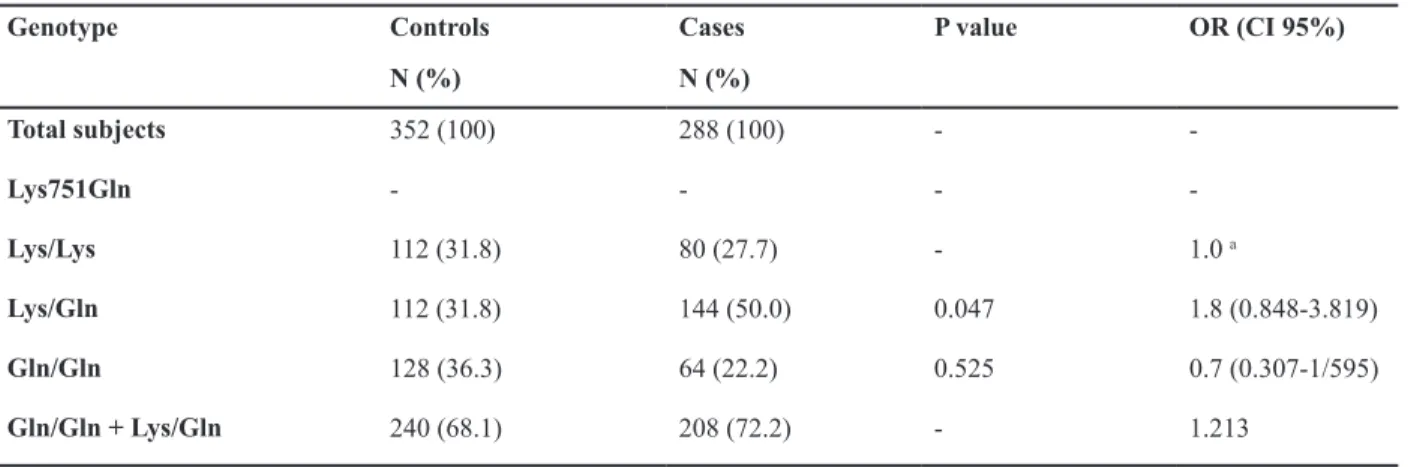
In this study, meaningful difference was observed between case and control groups in genotype distribution of AC polymorphism in
Lys751Gln site (p value=0.047). This shows that
probably there exists an association between this polymorphism and lung cancer risk in the study population. However, C allele frequency did not differ significantly between the case and control groups (52.3% in control group and 47.3% in case group, p value=0.525). In other words, C allele frequency in Lys751Gln poly-morphism was 72.2% in the case and 68.1% in the control group, showing no remarkable in-crease in the patients in this study. Considering the above allele frequencies, obtained OR was 0.817. It indicates that C allele in Lys751Gln pol-ymorphism has no association with lung cancer risk. In general, the potential for lung cancer in
AC heterozygous individuals is higher than AA
homozy-gous ones. The difference can be due to C allele presence beside the A allele (AC) among all af-fecting factors that alter its activity (Table 1).
Analysis of RFLP results using Image J Software
For accurate assessment of enzyme digestion, bands resulting from electrophoresis were eval-uated using Image J software. This software has the ability to eliminate the color and bright-ness in the background gel and compare the
intensity of bands. First, gel photo was intro-duced into the software, and then graphs were drawn based on level of darkness in the dia-gram window. Measuring the exact area under curve provided three numbers in the result part which showed relatively equal area under the graph. Thus, light emitted from non-restricted band and emitted light resulting from restricted bands were relatively equal and enzyme diges-tion was properly carried out (4539/154+1620/6 69=6159/823~6141/184) (Fig 2).
Table 1: XPD codon 751 polymorphism genotype frequencies and lung cancer risk
OR (CI 95%) P value
Cases Controls
Genotype
N (%) N (%)
-288 (100) 352 (100)
Total subjects
-Lys751Gln
1.0 a
-80 (27.7)
112 (31.8)
Lys/Lys
1.8 (0.848-3.819) 0.047
144 (50.0) 112 (31.8)
Lys/Gln
0.7 (0.307-1/595) 0.525
64 (22.2) 128 (36.3)
Gln/Gln
1.213
-208 (72.2) 240 (68.1)
Gln/Gln + Lys/Gln
OR: Odd ratio, CI; Conidence interval and a; Reference value.
Discussion
The study shows that there is meaningful differ-ence between case and control groups in distribu-tion of AC polymorphism. Although C allele (CC
homozygous + AC heterozygous) frequency in the patient group in Iranian population was 4% more than the control group, this difference was not
suf-icient for an association between the above poly -morphism and lung cancer. we suggest that this difference can be due to C allele presence beside
A allele (AC) and molecular interaction between them. According to similar results reported by Zhan et al. (17) suggested that the AC polymor-phism of XPD gene is associated with lung cancer risk and the C allele of XPD AC genotype is an increased risk factor for developing lung cancer in
a meta-analysis study. Signiicantly elevated lung
cancer risk was associated with C allele, based on Feng et al. (18) study. In contrast, there exists no
signiicant association between having AC het-erozygous genotype or CC homozygous genotype with lung cancer patients in different populations. For instance, the studies done in Asia reveal that the average OR for individuals with CC homozy-gous genotype is 1, whereas it is 0.91 for AC het-erozygote genotype individuals. The research in Europe (19, 20) and America (21, 22) showed
sim-ilar indings. In the above studies, OR is 1.25 for
CC homozygous genotype and 1 and 1.04 for AC heterozygous in Europe and America respectively. Also, According to the study by Liang and et al. in-dividuals having CC homozygous genotype show lung cancer about 2.7 times more than individuals with the AA genotype (23).
Conclusion
The chance to treat lung cancer is so low because of the prognosis of the disease in late stages (me-tastasis). Therefore, studying this cancer and its related genotype states is of great importance for the early diagnosis of the susceptible individuals. The present study analyzes AC polymorphism fre-quency in Lys751Gln of XPD gene in the Iranian population and also its association with lung can-cer risk. Our results suggest Lys/Gln heterozygous genotype increases lung cancer risk, while Lys/Lys
homozygous genotype probably decreases its risk
and Gln/Gln homozygous polymorphism shows no
remarkable increase in risk of cancer. These kinds of studies help the experts with timely diagnosis
of the cancer and employing effective therapeutic measures particularly in individuals with patients in immediate family members and couples in con-sanguineous marriages. It is our hope that the as-sociation between this polymorphism and lung cancer will be determined more clearly with statis-tical analyses in diverse populations. In addition,
with the completion of proiling the above poly -morphism, this technique is suggested as a strong diagnostic biomarker in lung cancer patients.
Acknowledgments
This study was done at University of Isfahan and supported by Departments of Research/Technolo-gy and Graduate Studies. The authors are grateful
to these Departments for their inancial support.
We would also like to acknowledge the help of all the physicians and nurses of the Masih Daneshvari
Research Center. There is no conlict of interest in
this study.
References
1. Hecht SS. Cigarette smoking and lung cancer: chemical mechanisms and approaches to prevention. Lancet On-col. 2002; 3(8): 461-469.
2. Shanbeh Z, Vidar S. Single nucleotide polymorphisms as susceptibility,prognostic and therapeutic markers of non smallcell lung cancer. Lung Cancer. 2012; 3: 1-14.
3. Talor R, Najai F, Dobson A. Meta-analysis of studies of
passive smoking and lung cancer: effects of study type and continent. Int J Epidemiol. 2007; 36(5): 1048-1059.
4. Darby S, Hill D, Auvinen A, Barros- Dios JM, Baysson H,
Bochicchio F, et al. Radon in homes and risk of lung cancer: collaborative analysis of individual data from 13 European
case-control studies. BMJ. 2005; 330(7485): 223.
5. Darby S, Whitley E, Doll R, Key T, Silcocks P. Diet, smok-ing and lung cancer: a case-control study of 1000 cases and 1500 controls in South-West England. Br J Cancer. 2001; 84(5): 728.
6. Cooper DN. The molecular genetics of lung cancer: an introduction to the molecular basis of cencer. 1st ed. Berlin: Springer-Verlag; 2005; 1-17.
7. Rodenhuis S, Slebos RJ. Clinical signiicance of ras onco
-gene activation in human lung cancer. Cancer Res. 1992; 52(9 Suppl): 2665s-2669s.
8. Wei Q, Cheng L, Hong WK, Spitz MR. Reduced DNA re
-pair capacity in lung cancer patients. Cancer Res. 1996; 56(18): 4103-4107.
9. Spitze MR, Wei Q, Dong Q, Amos CI, Wu X. Genetic sus
-ceptibility to lung cancer: the role of DNA damage and repair. Cancer Epidemiol Biomarkers Prev. 2003; 12(8): 689-698.
10. Shridhar V, Siegfried J, Hunt J, Del Mar Alonso M, Smith
DI. Genetic instability of microsatellite sequence in many non-small cell lung carcinomas. Cancer Res. 1994; 54(8): 2084-2087.
11. De Boer J, Hoeijmakers JH. Nucleotide excision repair and human syndromes. Carcinogenesis. 2000; 21(3): 453-460.
re-pair and cancer. J Mol Histol. 2006; 37(5-7): 225-238.
13. Behamou S, Sarasin A. ERCC2/XPD gene polymor
-phisms and lung cancer: A HuGE review. Am J Epidemiol. 2005; 16(1): 1-14.
14. Butkiewicz D, Rusin M, Enewold L, Sheilds PG, Chora
-zy M, Harris CC. Genetic polymorphisms in DNA repair
genes and risk of lung cancer. Carcinogenesis. 2001; 22(4): 593-597.
15. Monaco R, Rosal R, Dolan MR, Freyer G, Brandt-rauf PW.
Conformational effects of a common codon 751 polymor-phism on c-terminal domain of xerodermapigmentosum D protein. J Carcinog. 2009; 8: 12.
16. Miller SA, Dykes DD. and Polesky HF. A simple salting out
procedure for extracting DNA from human nucleated cells. Nucleic Acids Res. 1988; 16(3): 1215.
17. Zhan P, Wang Q, Wei SZ, Wang J, Qian Q, Yu LK, et al.
ERCC2/XPD Lys751Gln and Asp312Asn gene polymor
-phism and lung cancer risk: a meta-analysis involving 22 case-control studies. J Thorac Oncol. 2010; 5(9): 1337-1345.
18. Feng Z, Ni Y, Dong W, Shen H, Du J. Association of
ERCC2/XPD polymorphisms and interaction with tobacco
smoking in lung cancer susceptibility: a systemic review
and meta-analysis. Mol Biol Rep. 2011; 39(1): 57-69.
19. Matullo G, Peluso M, Polidoro S, Guarrera S, Munnia A,
Krogh V, et al. Combination of DNA repair gene single nucleotide polymorphisms and increased levels of DNA adducts in a population-based study. Cancer Epidemiol Biomarkers Prev. 2003; 12(7): 674-677.
20. Spitz MR, WY X, Wang Y, Wang LE, Shete S, Amos CI,
et al. Modulation of nucleotide excision repair capacity by
xpd polymorphisms in lung cancer patients. Cancer Res. 2001; 61(4): 1354-1357.
21. Caggana M, Kilgallen J, Conroy JM, Wiencke JK, Kelsey
KT, Miike R, et al. Association between ERCC2 polymor
-phisms and gliomas. Cancer Epidemiol Biomarkers Prev. 2001; 10(4): 355-360.
22. Stern MC, Johnson LR, Bell DA, Taylor JA. XPD codon
751 polymorphisms, metabolism genes, smoking and bladder cancer risk. Cancer Epidemiol Biomarkers Prev. 2001; 11(10 pt 1): 1004-1011.
23. Liang G, Xing D, Miao X, Tan W, Yu C, Lu W, et al. Se