Handover Optimization with User Mobility
Prediction for Femtocell-based Wireless
Networks
Tae-Hyong Kim1, Jae-Woo Kim2
Computer Eng. Department, Kumoh National Institute of Technology 1 Yangho-dong, Gumi, Gyeongbuk 730-701 Republic of Korea
1
Abstract—Prediction of user mobility can assist resource and mobility management of wireless and mobile networks by optimizing handover execution, resource utilization, and so on. There have been extensive studies on mobility prediction for handovers between macrocells but little work for femtocell-based networks yet due to their complicated characteristics. This paper proposes handover optimization methods by developing mobility prediction techniques for femtocell-based wireless networks. To decide the handover target and execution time, special conformance index and prediction assurance are calculated. The proposed handover optimization methods can cope with various handover conditions with pingpong handovers minimized and throughput maximized. Simulation results show the effectiveness of the proposed methods.
Keyword-mobility prediction, handovers management, self-optimization, femtocells, throughput
I. INTRODUCTION
Recent big advances of wireless network technologies and mobile devices have brought about explosive growth of the number of mobile users and the amount of data they use. Although not a few radio access technologies have been newly produced, satisfying the needs of users is still a challenge. Optimization of network resources, accordingly, has become a big issue in wireless mobile networks. Self-configuring and self-optimizing networks (SON) are hot topics in the long term evolution (LTE) and LTE-advanced standards of the third generation partnership project (3GPP) [1]. Among several envisioned functionalities in SON, optimizations related to mobility are currently hot issues such as mobility robustness optimization and mobility load balancing optimization [1]. Load balancing is a useful technique in cellular networks to increase resource utilization and thus to reduce handover call blocking and drop rates. There are various load balancing techniques, which can be categorized into hardware-based [2,3] and software-based ones [4,5]. Software-based techniques are considered lightweight and cheaper solutions as they can obtain similar load balancing performance to hardware-based techniques such as resource borrowing or signal power control just by adjusting handover parameters dynamically [5]. Optimization of cell reselection or handover parameters is therefore a popular method for load balancing optimization [1]. Such a load balancing optimization basically makes mobile users in a hot cell perform handovers to a cool cell earlier in order to retrieve resources required to serve new users of the hot cell on time. Actually cellular networks usually use some techniques such as handover hysteresis and time-to-trigger to ensure handover necessity in order to avoid so-called wasteful pingpong handovers, even if those techniques naturally delay handover time for a while and thus cost a little loss of throughput. Accordingly software-based load balancing techniques causing earlier handovers are likely to face the risk of pingpong handovers. A famous approach coping with this problem is to predict user mobility to check if each early handover is necessary [5].
By the way, femtocells are currently hot issues to extend service coverage indoors for mobile users in cellular networks. They mainly focus on frequency reuse methods, resource management, interference management, mobility management, and so on. Optimization of those managements however have scarcely been studied yet due to special characteristics of femtocells, e.g., small size and resources, and outdoor and indoor walls. This paper tries to optimize handovers with prediction of user mobility. The proposed approach is mostly based on a current movement prediction technique considering movement speed and directions, and femtocells properties. With that prediction technique, handover time and target cell are decided optimizingly for inbound, outbound, and inter-femtocells access points (inter-FAPs) handovers in order to obtain maximal throughput and minimal number of pingpong handovers.
The rest of this paper is organized as follows. In section II, special properties of mobility prediction for femtocells-based networks are briefly discussed. The proposed handover optimization methods are presented with mobility prediction techniques in section III. Section IV describes evaluation process and results of the proposed methods. Finally, section V concludes this paper with short discussion of future work.
II. PROPERTIES OF FEMTOCELL PREDICTION
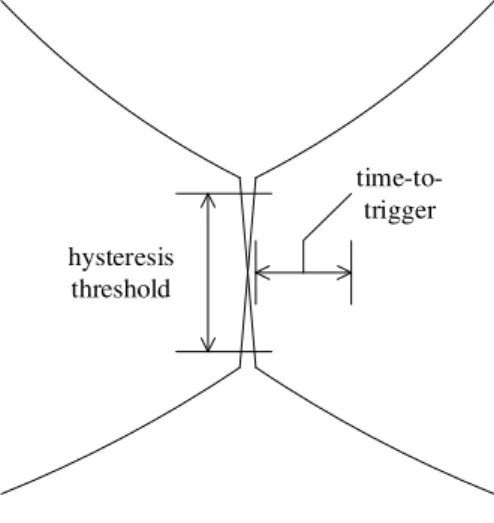
Femtocells have very specific features unlike macro cells: much smaller size, much weaker signal transmission power, and much smaller resources. Especially a femtocell has normally surrounding square walls. The received signal strength (RSS) is weakest at the corners in a square room and it drops down or jumps up rapidly when passing through walls. Sojourn time of a femtocell is also very short when that femtocell is just for transit. In such cases, so-called pingpong handovers are likely to happen. Regarding handovers between macro cells, both hysteresis threshold and time-to-trigger are used to avoid unnecessary handovers. On the other hand, hysteresis threshold could not be used for femtocell-related handovers since indoor and outdoor walls bring about sudden big changes of the RSS as shown in Fig.1.
hysteresis threshold
time-to-trigger
Fig. 1. The concept of our handover optimization
The above discussion on femtocell-related handovers shows that there is not so enough time to avoid pingpong handovers in femtocells. This fact requires an efficient user mobility prediction to examine the necessity of handovers related to femtocells. User mobility predictions are usually used to estimate sojourn times of possible handover target cells and the best handover cell and time in order to optimize the mobility management system. Here we consider two application areas of the mobility prediction to restrain pingpong handovers in femtocell-based networks. First, mobility predictions can be used for advancing handovers on demand. As described in the introduction, mobility predictions are often used with software-based load balancing techniques. Such load a balancing can be also used in femtocell-based networks. As it adjusts handover parameters dynamically according to the level of load imbalance between neighboring cells, user mobility and handover target cells should be predicted on the fly. However, gains of load balancing with femtocells may be limited because radio resources and the load balancing zone is much smaller in femtocells.
sacrificing the throughput. In this paper we design those two mobility prediction-based handover methods for femtocell-based cellular networks, and evaluate them by comparison.
III.THE PROPOSED HANDOVER OPTIMIZATION
The goal of this work is to decide the best target cell and handover time for optimal handovers in femtocell-based cellular networks. In order to obtain that goal, a mobility prediction algorithm is required which was designed for femtocells. As discussed in the introduction, there have been a lot of studies on user mobility prediction based on mobility history and/or current movements. Basically the current movement based prediction has been chosen for our method as this approach appears cheaper and thus more practical. In order to reduce false alarms and to increase the prediction accuracy, some simple history-based techniques can be easily combined in the proposed method.
A. Prediction-Based Handover Concept
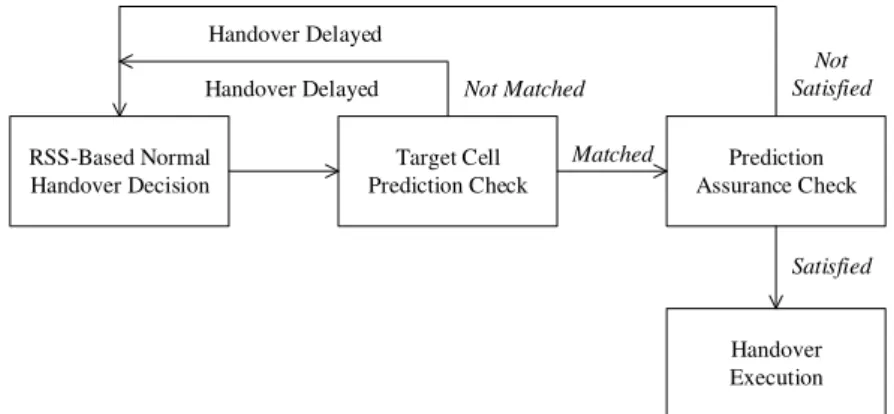
Current movement based predictions usually use the RSS, the moving speed and direction of a mobile user, and/or variations of those values as input parameters of the algorithms. In the proposed method, we basically use moving direction estimation to predict the target handover cell. Even if we derive the handover target by prediction, it may not be adequate to directly perform a handover as a wrong target cell prediction causes a worthless pingpong handover and performance degradation. In order to cope with this problem, we check the necessity of handover to the predicted cell at that time. Fig.2 briefly shows the concept of our handover optimization process. When a handover to a certain cell is requested by the conventional RSS-based handover decision process, that target cell is verified by the target cell prediction check. If that target cell is not the predicted target, the handover process is delayed. In case the target cell is verified, the assurance of that prediction is checked. If the assurance does not satisfy a certain level, handover process is also delayed. In this approach, the algorithms for target cell prediction and its assurance check should be carefully designed for the optimal performance.
RSS-Based Normal Handover Decision
Target Cell Prediction Check
Prediction Assurance Check
Handover Execution Handover Delayed
Handover Delayed
Matched Not Matched
Satisfied Not Satisfied
Fig. 2. The concept of our handover optimization B. Target Cell Prediction and Prediction Assurance
In our previous work, some target handover cell prediction algorithms were presented for handovers between macro cells [5,10]. Similar to those algorithms, we calculate the variance of relative distance from a mobile user to each of the candidate target cell, ∆ , where W is the size of moving average window and
denotes the estimated difference from mobile node x to cell i. is generated by / √ , where is the RSS of mobile node x from cell i of the common pilot channel in wattage, k1 and k2 are specific distance coefficients according to the type of handover cells. Those values are required for calibrating the distance by considering signal loss due to several types of walls. From various calculation and simulation experiences, some relevant coefficient values are decided in as shown in Table I.
TABLE I
Distance Coefficient Values According to Handover Types
Current Cell Type Target Cell Type k1 k2
Macrocell Macrocell 5.6 37.6
Macrocell Femtocell 1.64 37.6
Femtocell Macrocell 0.00074 20 Femtocell Femtocell
(different group)
0.00234 20
Femtocell Femtocell (same group)
The variance of relative distance to a candidate target cell is used to decide the best target cell for handover with the RSS or the estimated distance as follows. We define a special target conformance index for the candidate cell i for mobile node x, , . This index can be generated according to the type of target candidate cell as follows:
, ·∆∆ · , if
· , if
, where and are the sets of macro cells and femtocells respectively, and k3 is a femtocell scaling factor and 2 is used in our configuration. The best target cell is decided as the cell whose target conformance index is the biggest.
The assurance of a target cell prediction of mobile mode x to for cell i, denoted by , , considers the difference among target conformance indices is generated as follows:
, | , , , | ,
, if , max
, where max is the biggest index among all , in which is one of three neighboring cells of i having bigger RSS values than the other neighboring cells, and denotes a neighboring cell such that , is the biggest among all , except the target cell i. , is the calibration value from the mobility history on cell i and mobile node x, and various history information could be used as this values such as pingpong handover rate or user/geo-profile information. Note that during mobile node x is outside the boundary of current cell i without handover, cell i should be included in deriving and , .
Finally, a handover of mobile node x to cell i is executed when , , where indicates the prediction assurance threshold for the final handover decision. In order to mask the situation an instant higher value of prediction assurance makes a wrong handover, prediction assurance should be satisfied continuously during a certain time, called prediction assurance time (tHA), for handover execution.
C. Prediction-based Handover Algorithms
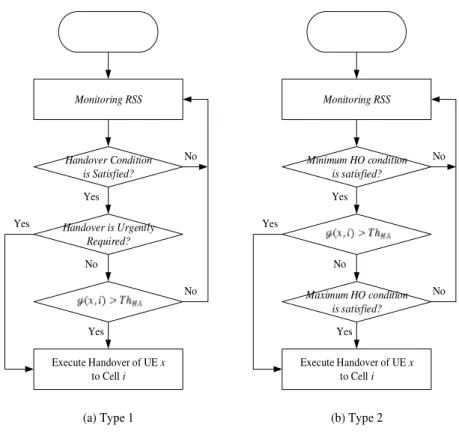
As discussed in the first subsection, the proposed mobility prediction method is basically used to delay handovers. While delayed handovers may normally reduce the number of handovers including pingpong handovers, they may experience some throughput decrease and service degradation. This trade-off relation between handover frequency and throughput should accordingly considered in handover optimization with mobility predictions. We propose two different prediction-based handover algorithms based on application areas of mobility predictions presented in Section II as shown in Fig.3.
1) Optimized Adaptive Handovers (Type 1): This type of handovers are for optimization of early handovers where handover condition is dynamically changed for a certain purpose such as load balancing. This algorithm mainly focuses on reducing unnecessary pingpong handovers caused by changes of handover conditions.
2) Optimized Timely Handovers (Type 2): This type of handovers are for optimization of early handovers where handover condition is fixed. Sometimes the handover condition is fixed to a certain minimal condition for fast and timely handovers. This algorithm tries to increase the throughput while controlling the number of handovers.
We could select an appropriate prediction-based handover algorithm according to the goal and requirements of early handovers.
IV.EVALUATION
In order to evaluate the proposed prediction-based handover algorithms, we implemented a simulation system of femtocell-based cellular networks in the specification and description language (SDL), a standard formal description technique [11]. The following three parameters are used to examine the performance and effectiveness of the proposed algorithms:
• The number of handovers (p1),
• The number of pingpong handovers (p2),
Monitoring RSS
Handover Condition is Satisfied?
Execute Handover of UE x
to Cell i Handover is Urgently
Required?
No
Yes
No
Yes
No Yes
(a) Type 1
Minimum HO condition is satisfied?
Execute Handover of UE x
to Cell i
No
Yes
No
Maximum HO condition is satisfied?
Yes
No Yes
Monitoring RSS
(b) Type 2
Fig. 3. The proposed prediction-based handover algorithms
A handover is considered: (1) a pingpong handover when previous cell sojourn time is less than 25 seconds and the maximum RSS in the previous cell is less than -68dB (2) an urgent handover when that handover was urgently required, that is to say when the RSS is less than -78 dB (in a macrocell) or -80dB (in a femtocell) in type 1 prediction-based handover configuration (3) a prediction-based handover when that handover was executed with the prediction assurance satisfied.
A. Simulation Models
The simulation system configuration for macrocells and femtocells is shown in Fig.4.
(a) Macrocells layout
20m
(b) Femtocells construction
Fig. 4. Macrocells and femtocells layouts for simulation
next waypoint. At a linear path along macrocells only, the speed of mobile node changes as follows: 0.25x(0~10%), 0.5x(10~20%), x(20~80%), 0.5x(80~90%), and 0.25x(90~100%), where x is the full speed and the range in each parenthesis indicates the section of the path. If a mobile node approaches to a group of femtocells, it reduces its speed to a certain small value. Inside a femtocell, the moving speed is fixed to a walking speed and points inside the same femtocell are given somewhat high weight to emulate staying of a mobile node. Values of simulation parameters are described in Table II.
TABLE II
Simulation Parameters and Their Values
Parameters Values in
macrocells
Values in femtocells The number of cells 19 40 Cell diameter 500m 20m (max) Movement speed 12~50km/h 1km/h Max hysteresis threshold 10dB 5dB Min hysteresis threshold 0 0 Max time-to-trigger 5sec 1sec Min time-to-trigger 0 0
h(x,i) 0 0
ThHA 0.5 0.5
tHA 0.5sec 0.5sec
Simulation time 2 hours 2 hours
In order to estimate the effects of the proposed prediction-based handover algorithms according to handover decision conditions, 5 different simulation scenarios with hysteresis threshold and time-to-trigger are used as shown in Table III.
TABLE III
Simulation Scenarios Configurations Scenario Hysteresis
threshold
Time-to-trigger
1 0 0
2 0.5Max 0.5Max
3 0 Max
4 Max 0
5 Max Max
B. Simulation Results
As for the number of handovers (p1), we here focus on the femtocell-related handovers only. The simulation results of that performance parameter are shown in Fig.5, where A, B, and C indicate conventional handover method, optimized adaptive handover method, and optimized timely handover method respectively. As expected, the optimized adaptive handover method reduces the number of handovers about 10% there is no difference between conventional handover method and optimized timely handover method.
Fig. 5. The number of femtocell-related handovers
optimized timely handover method slightly increased the number of pingpong handovers between macrocells when hysteresis threshold is greater than 0, that is, at scenarios 2, 4, and 5.
Fig. 6. The number of femtocell-related pingpong handovers
Fig. 7. The number of pingpong handovers between macrocells
As we expect also, the optimized timely handover method increased the throughput (p3) while the throughput is reduced with the optimized adaptive handover method. Contrary to the case of handovers between macrocells as shown in Fig.9, the improvements was very small in femtocell-related handovers as shown in Fig.8. This result came from the fact that hysteresis threshold is meaningless in femtocell-related handovers due to walls and thus time-to-trigger is the only factor to delay handovers in femtocell-related handovers. In addition to that, time-to-trigger in a femtocell is 5 times smaller than that in a macrocell in our simulation, which also reduces the handover delay margin in a femtocell. Fig.9 shows that the improvement by the optimized timely handovers is about 10% in case of macrocell handovers at the usual maximal handover decision parameters (scenario 5).
Fig. 9. Throughput (macrocells only)
In our simulation, we used 0.5 as the prediction assurance threshold by intuition. There was no analysis to decide the optimal value for this threshold. Thus we examined the influence of this threshold value by simulation. Fig.10 shows the results of throughput for scenario 5 with various prediction assurance threshold values. B, B1, and B2 indicate the optimized adaptive handover methods with prediction assurance threshold 0.5, 0.4, and 0.3 respectively, and C, C1, and C2 indicate the optimized timely handover methods with prediction assurance threshold 0.5, 0.4, and 0.3 respectively. According to the simulation results for macrocells, there was no difference between the methods with different threshold values, which indicates that threshold 0.5 is enough for macrocell handovers. As for femtocell-related handovers, smaller threshold values slightly increased the throughput without increase of the number of pingpong handovers. This result shows that deciding and assuring the next optimal target cell is very difficult in femtocells due to their small sizes.
Fig. 10. Comparisons with different prediction assurance thresholds V. CONCLUDING REMARKS
This paper proposed a couple of handover optimization methods with mobility prediction techniques for based wireless cellular networks. In order to develop mobility prediction techniques for femtocell-based handovers, we analyzed the properties of femtocells and derived the target conformance index and handover prediction assurance. The proposed prediction-based handover algorithms based on those indices could lead to optimized adaptive handovers or optimized timely handovers by trying to minimize pingpong handovers and to maximize the throughput.
The proposed handover optimization techniques could be easily applied to current femtocell-based cellular networks such as LTE or LTE-Advanced networks. They may be combined with load balancing techniques or existing self-optimizing techniques. In this work, by the way, we used two current movement information for handover prediction and little work has been done yet to use mobility history information together for increasing the preciseness of prediction. Such enhancements would be thus good targets for future work.
ACKNOWLEDGMENT
REFERENCES
[1] 3GPP, Evolved Universal Terrestrial Radio Access Network (E-UTRAN); Self-configuring and self-optimizing network (SON) use
cases and solutions, TR 36.902, Release 9, 2011.
[2] Turkka, J., Nihtila, T., and Viering, I., Performance of LTE SON uplink load balancing in non-regular network. The 22nd International Symposium on Personal Indoor and Mobile Radio Communications (PIMRC), IEEE, pp.162-166, Sep. 2011.
[3] Lee, K., Kim, S., Lee, S., & Ma, J. Load balancing with transmission power control in femtocell networks, The 13th International
Conference on Advanced Communication Technology (ICACT), pp.519-522, Feb. 2011.
[4] Lobinger, A., Stefanski, S., Jansen, T., & Balan, I., Load Balancing in Downlink LTE Self-Optimizing Networks, The 71st Vehicular Technology Conference, IEEE, pp.1–5. 2010.
[5] Qi-Ping Yang, Jae-Woo Kim, Tae-Hyong Kim, Mobility Prediction and Load Balancing Based Adaptive Handovers for LTE Systems, International Journal on Computer Science and Engineering, Vol.4, No.4, pp.665-674, April 2012.
[6] P. Prasad and P. Agrawal, A generic framework for mobility prediction and resource utilization in wireless networks, The 2nd
International Conference on Communication Systems and Networks (COMSNETS), pp. 1–10, Jan. 2010.
[7] P. Fazio and S. Marano, A new Markov-based mobility prediction scheme for wireless networks with mobile hosts, International Symposium on Performance Evaluation of Computer and Telecommunication Systems (SPECTS 2012), pp. 1–5, 2012.
[8] D. Barth, S. Bellahsene, and L. X. E. La Kloul, Mobility Prediction Using Mobile User Profiles, IEEE 19th Annual International Symposium on Modelling Analysis and Simulation of Computer and Telecommunication Systems. pp. 286–294, 2011.
[9] Sithitavorn, K., Bin Qiu, Mobility Prediction with Direction Tracking on Dynamic Source Routing, TENCON 2005 2005 IEEE Region 10, Nov. 2005.
[10] T.-H. Kim, Q. Yang, J.-H. Lee, S.-G. Park, and Y.-S. Shin, A Mobility Management Technique with Simple Handover Prediction for
3G LTE Systems, IEEE 66th Vehicular Technology Conference, pp. 259–263, 2007.