SUPERVISOR Mon-Chu Chen
Sara Patrícia Fernandes Tranquada
MASTER IN INFORMATICS ENGINEERINGHospital Hero
A Game for Reducing Stress and Anxiety
Acknowledgments
______________________
First I want to thank my advisor, Mon-Chu Chen, for the guidance and the encouragement provided throughout the project, resulting in this game.
I would like to thank all my friends, colleagues, the testers and parents’ testers for the time and help that allowed me to complete this thesis.
I also want to thank Dr. Pedro Ramos and the rest of the staff at the Hospital Dr. Nélio Mendonça for their cooperation and granting permission to perform the play tests in the children’ emergency room. For the support and permission provided by the ARDITI (Agência regional para o Desenvolvimento da Investigação Tecnologia e Inovação) to use the data obtained in the playtests, I would like to offer my thanks.
Resumo
_____________________________
Este relatório conta uma história que teve o seu início numa ideia que nos ocorreu numa tentativa de combater este sentimento conhecido por todos como stress e ansiedade. Mas antes de criarmos a solução para este problema, temos de primeiro apreender os sentimentos subjacentes e os seus efeitos no nosso bem-estar.
Ao longo das nossas vidas, experimentamos momentos de fraqueza e medo. Estes sentimentos podem surgir, por exemplo, enquanto estamos no serviço de urgência de um hospital. Claro que os efeitos em crianças, completamente alheias a este ambiente, serão inimagináveis. Nós analisamos uma serie de cenários para encontrarmos a solução mais adequada, entre as quais o estudo do Dr Baldwin sobre interacção com expressões positivas, que provou ser um valioso aliado. Naturalmente, teve que ser reajustado para o propósito e o público em mente.
O jogo foi então criado tendo como objectivo reduzir e até mesmo eliminar os níveis de stress e ansiedade em crianças. Ao longo do projecto, o jogo sofreu varias alterações, mas a ideia inicial – interacção com expressões positivas – manteve-se.
Quando chegou a altura própria, pedimos às crianças que jogassem uma das duas versões do jogo enquanto aguardavam no serviço de urgências. Isto não só provou ser uma distracção para elas, mas também uma experiencia educativa uma vez que baseia-se integralmente em equipamento hospitalar. Uma das versões do jogo tem expressões e a outra não, sendo isto o que as diferencia.
Depois de todo o nosso trabalho e esforço, sentimo-nos recompensados porque o nosso projecto era válido e pelas expressões nos rostos das crianças enquanto jogavam. Mas mais importantes ainda, os seus níveis de ansiedade reduziram significativamente durante esse curto espaço de tempo.
Palavras-Chave
________________________
Abstract
_____________________________
This report tells a story which started as an idea that came to us to fight the battle-cry feeling commonly known as stress and anxiety. Before creating the solution of the idea, we first need to understand the feelings underneath and its effects on our well-being.
Throughout the course of our lives, we experience states of weakness and fear. These feelings can arise, for instance, while we are in an emergency room. Needless to say, how much it would have imaginable effects on children, who are unfamiliar to such environments. We ran through a serious of scenarios to find the most suitable solution, among them the study of interaction with positive expressions by Dr. Baldwin, proved to be a valued resource. It was reduced due to its length and to be suitable to our public audience.
The game was then created in order to reduce or even eliminate the stress and anxiety of children. Since the game was initially released, some modifications had been made but the original idea - interaction with positive expressions – remained.
When the time came, we asked children to play one of the two versions of the game while waiting in the emergency room. This not only created a diversion for them but also a learning experience as it displayed some hospital equipment. The difference between the two versions is that one provides expressions, while the other does not.
After all our hard work, we felt rewarded because the project proved its worth and we would see that in the expressions on children’s faces while they played. Most importantly, their anxiety level numbers were significantly reduced during that short period of time.
Keywords
____________________________
List of Figures
_________________________
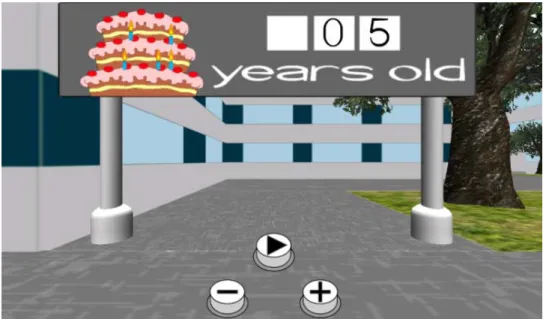
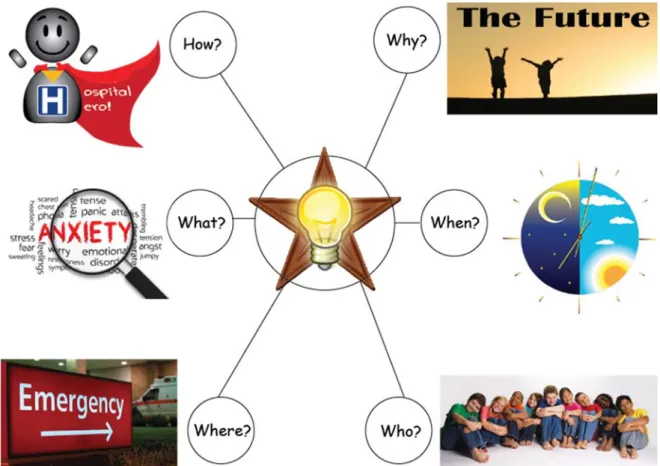
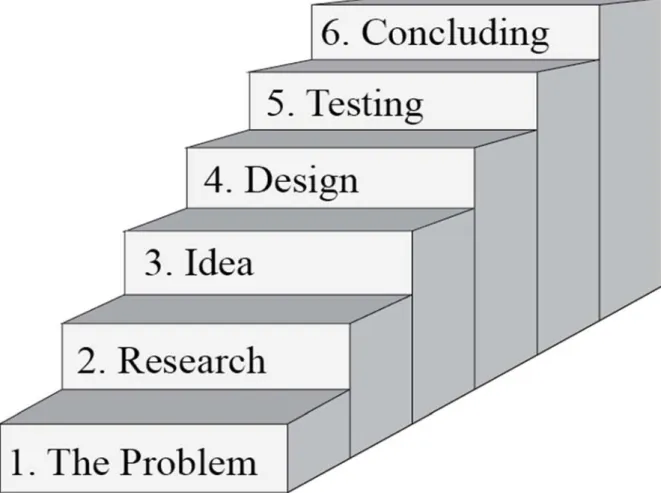
Figure 1 – The Five Ws and the one H represent the questions. The answers help us create a story. [1,2,3,4,5,6] ______________________________________________________ 1 Figure 2 – A Schematic of a staircase, making each step stand as an achievement, a chapter in our life’s journey. _______________________________________________________ 2 Figure 3 - All of these expressions are universal. Children and adults have similar emotions.
[14] __________________________________________________________________ 4 Figure 4 - A game where the goal is to get more gems than the other player on the bottom
row. [20] ______________________________________________________________ 6 Figure 5 – The Conclusions that were taken by the observation of a glass with water [34] _ 12 Figure 6 - STAI-6[40] ______________________________________________________ 13 Figure 7 - Talking Mats [42] _________________________________________________ 14 Figure 8 - The modified short State-Trait Anxiety Inventory (STAI) using a modified Talking Mats method [41] ______________________________________________________ 15 Figure 9- The m-YPAS [47] __________________________________________________ 17 Figure 10- Color Emotion Guide [51] __________________________________________ 18 Figure 11 – Color Wheel [52] ________________________________________________ 19 Figure 12–The mental state in relation to a challenge and skill level. [64] ______________ 21 Figure 13 - Picture grid with 15 rejecting and one accepting face. [71] ________________ 24 Figure 14 – The flow channel - a state where our challenge and skill levels are in the same
Figure 35 - The sheet and sea elements that was provided to the children ______________ 52 Figure 36 - The children painting ______________________________________________ 52 Figure 37 – The transformation of the child’s picture for the wall of the level ___________ 53 Figure 38 - The basic arrow (front, back, left and right) was created but being a 3D maze and
for better visualization of the arrow (reducing risk 6), the angle of the button and
additional arrow for rotation (to the left and right) was required to interact with possible characters appearance. __________________________________________________ 54 Figure 39 – The logo though _________________________________________________ 55 Figure 40 – The recording process with a female and male child for the voices of the game 56 Figure 41– The first decision of the player is to choose the language represented here through flags of both countries __________________________________________________ 58 Figure 42 – The genre section where the buttons with the genre sign are indicated to better
understand the purpose of the arrows _______________________________________ 59 Figure 43 – The anxiety test where three button are showed for Yes/No/Maybe answers __ 60 Figure 44 – Having every time the plus sign is touch a number is increased as a candle is
inserted in the cake _____________________________________________________ 61 Figure 45- In the genre selection, after touch the male or female button, an illusion of pressed
is showed ____________________________________________________________ 62 Figure 46 - With seven keys and instruments to find, a box was created to inform the number
of instruments found, accessible to them by touch (see Figure 48). Seven holders were created to place the missing keys that when found appear with the designated color. And a book was created as way to help how to play when touch (see Figure 47) _________ 63 Figure 47 – Four points are showed demonstrating that the instruments are in safes and to
open them a key is needed. Each key is associated to positive expressions __________ 63 Figure 48 – The box at the beginning and the end of the level _______________________ 64 Figure 49- Several points in the maze were created only stopping where a decision on
direction was required, having each point an orientation, starting the level in 0N and ending in 20N, having different time stamps (see Figure 50). As a way to present some challenge in the level, the maze was separated into three parts (7 points each). ______ 65 Figure 50 - The time in second of the transition from one point to another without rotations,
having 90 degrees rotation 1.3 seconds and 180 degrees 3 seconds (reducing or even eliminating risk 2). _____________________________________________________ 65 Figure 51- To facilitate the children navigation through the maze, only the arrows possible to
make that happen would appear. In this particular case, every arrow was a possibility except going forward (eliminating risk 8) ___________________________________ 65 Figure 52- Having a map location revealed as it passes, avoiding being lost (reducing or even
eliminating risk 1), plus having record of the passing of the color safes. ___________ 66 Figure 53 - Each point is composed by an orientation, and each orientation has a left (L) and
right side (R)) _________________________________________________________ 66 Figure 54- In point 0 we have four positive expressions against one, in point 8 it’s two for
two, while in point 17 it’s four negative and one positive. ______________________ 67 Figure 55 - The negative expressions do not give you a hint and turn their back on you ___ 67 Figure 56- In this case being in the point 0North and receiving a hint to rotate right suggest
Figure 57– As the key is show to the player, the character does a backflip ______________ 69 Figure 58 - To have the options on the table, the hint of the key and safe can be showed at the same time, and the safe can also be found through the map _____________________ 69 Figure 59 - The exit can also be found thought the map ____________________________ 70 Figure 60- Opening the red safe, in this point the arrows disappear for the preparation of a
small slice show _______________________________________________________ 71 Figure 61– A warning in showed indicating that the corresponding key color is missing___ 71 Figure 62- The credits are showed followed by a children’ song _____________________ 72 Figure 63 – The space used to test the game [110] ________________________________ 74 Figure 64 – Players comprehension of the game __________________________________ 75 Figure 65 – Having 14 minutes 5 sec and 13 minutes 48 sec the fastest time for boy and girl 75 Figure 66 – A decrease of time (in seconds) of the transition from one point to another
without rotations, having 90 degrees rotation 0.3 seconds and 180 degrees 1 second (reducing or even eliminating risk 3) Also decreasing the time of explaining the story of the game to 30 seconds. _________________________________________________ 76 Figure 67 –Restricting each color key to a close by perimeter of his safe and for a more
homogeneous map, the safes were distributed through the three parts of the map, having the point 1W, 2E, 3N, 4W, 5S and 6E possible positions for the red and orange, 7W, 9W, 10W, 11E, 12S and 13N for the yellow, green and blue, 14W, 15E, 16W, 17S, 18E and 19N for the purple and pink (reducing risk 5). ________________________________ 77 Figure 68 - The six arrows are reviewed with the point of leaving the more important,
remaining three arrows (to move forward, to rotate to the left and right) (eliminating risk 4) ___________________________________________________________________ 77 Figure 69 - In the three part of the map (points 14 to 20) there is only one positive character
per point, not providing the enough information where the key is located. In this example the positive character is in the 16W and the key is on 17S, the hint only would say a rotation (reducing risk 2) ________________________________________________ 78 Figure 70 - As the player passes to a part of the map, the number of negative character
doubles, having in part I (points 0 to 6) each point with one negative character, part II (points 7 to 13) with two and part III(points 14 to 20) with four. _________________ 78 Figure 71 - For fedback information, the color of the keys when used turn grey, providing the
information of already being used, like in this case, having found the red, yellow and blue key, already used the orange, green and purple only missing the pink key. _____ 79 Figure 72 - To provide a clear understanding of how to play, a guideline was provided with
the indication of a hand that the child had to touch, having this help until he/she finds the first key. _____________________________________________________________ 79 Figure 73 – To provide a clear understanding of how to play, a guideline was provided by
indicating a halo for moving the corresponding button. _________________________ 80 Figure 74 – An example of a child setting of each instruments corresponding to each gender81 Figure 75 – The gardens of Santa Luzia [112] ____________________________________ 82 Figure 76 - Each character shows a specific emotion (happy, sad, scared and calm) and they
were all given to the child one at a time to place them in the middle of the three possible square representing the three answers (no, maybe, yes), having a female and male
List of Tables
_________________________
List of Acronimus
______________________
A-State - State AnxietyA-Trait - Trait Anxiety E.R. - Emergency Room ED - Emergency Department
EMSA - European Medical Students’ Association GAD - Generalized Anxiety Disorder
M-ITI - Madeira Interactive Technologies Institute
mSTAI-TM - The Modified State-Trait Anxiety Inventory using a Modified Talking Mats Method
m-YPAS - Modified Yale Preoperative Anxiety Scale OCD - Obsessive-Compulsive Disorder
PTSD - Post-Traumatic Stress Disorder STAI - State-Trait Anxiety Inventory STAI-6 - modified short-form STAI
STAIC - State-Trait Anxiety Inventory for Children VPT - Visual Probe Task Demonstration
List of Appendix
_______________________
I –Inspiration and descriptions of ideas ______________________________________ 110
II – Representing the instruments __________________________________________ 113
III – The route of the menu _______________________________________________ 117
IV – Example of a log file created in end of the game __________________________ 118
V – Installation Process __________________________________________________ 123
VI – 1st Usability questionnaire ____________________________________________ 125 VII – 2st Usability questionnaire ___________________________________________ 129 VIII – Playtest questionnaire ______________________________________________ 130
IX – All playtest data ____________________________________________________ 135
Index
_______________________________
1. Introduction _______________________ ___________________________________ 11.1.Analyzing the Situation ______________________________________________ 2 1.1.1.Our Jeopardized Future ___________________________________________ 2 1.1.2.The Full Image of the Emergency Room _____________________________ 3 1.1.3.Child’s Real Feelings ____________________________________________ 4 1.1.4.The Problem at Hand: Stress and Anxiety ____________________________ 5 1.1.5.Game: Possible solution? _________________________________________ 5 1.2.What holds ahead ___________________________________________________ 7
2. Literature review ____________________ __________________________________ 8
2.1.Stress and Anxiety __________________________________________________ 8 2.1.1.In more Detail __________________________________________________ 8 2.1.2.Previous Work ________________________________________________ 17 2.2.Game Design _____________________________________________________ 25 2.2.1.The Goal _____________________________________________________ 25 2.2.2.What Consists _________________________________________________ 27
3. Design Process ______________________ _________________________________ 32
3.1.Creative Process ___________________________________________________ 32 3.1.1.The ideas _____________________________________________________ 33 3.1.2.Requirements _________________________________________________ 34 3.2.The refinement ____________________________________________________ 37 3.2.1.Focusing _____________________________________________________ 38 3.2.2.The final choice ________________________________________________ 38
4. Game Overview _____________________ _________________________________ 40
4.1.Preparation Phase __________________________________________________ 40 4.1.1.Elements of Game Design _______________________________________ 40 4.1.2.Software Tools ________________________________________________ 41 4.2.Building phase ____________________________________________________ 45 4.2.1.Design _______________________________________________________ 46 4.2.2.Sound _______________________________________________________ 55 4.2.3.Implementation ________________________________________________ 57
5. Testing Begin _______________________ _________________________________ 73
5.1.Usability Testing __________________________________________________ 73 5.2.Play testing _______________________________________________________ 85
6. Conclusion ________________________ __________________________________ 95
6.4.Future Work ______________________________________________________ 96
7. Reference ________________________ ___________________________________ 97
1.
Introduction
_______________________
Behind our project, there was a thought (see Figure 1) that in time lead to an idea, an attempt to answer the problem at hand. Children’ stress and anxiety was that problem, children’ Emergency Room (E.R.) was the source place that originated the problem and Hospital Hero was the proposed solution, a game which had as main goal the interaction with positive characters.
All of the processes were connected with each other, starting with the brief analysis of the future, continuing to the most important subject by finding its weaknesses, exploring them, pointing them out as a problem and finding a mean to transmit the solution. When we knew every little detail of the problem, the ideas came flying in, but ultimately we needed to choose and develop one of them that reduced or even eliminated the problem at hand.
1.1.
Analyzing the Situation
We climb mountains not only for a sense of perseverance or challenge that it provides us, but rather for an objective: it could be as simple as experiencing that breathtaking view at the end of the climb or leave your mark by writing your initials on a rock. This feeling of accomplishment is not only applicable to climbing mountains but to every challenge we come across in our lives. In order for us to achieve success in anything, we needed to “climb” but bearing in mind that what we climb is not as important as the climbing itself [7] (see Figure 2).
Before taking the first steps we needed to know exactly what the problem was and what we aimed to do.
1.1.1.
Our Jeopardized Future
The future depend on what we do in the present and that future belongs to the children. So as they grow, every moment they experience affects their relationship with their surroundings ultimately changing the world. [8]
Children learn by three main ways:
By association of a stimulus to a response. An experiment of the Russian physiologist Ivan Pavlov, proved that associating the ringing of a bell to the moment when he feed the dog for instance, caused the dog to associate the sound to the food. After the association was made, the very sound of the bell would mean for the dog the anticipation of a meal. The same happens to children, when the sight of a baby’s bottle is associate with being fed, developing the children’ association between objects in their own environment.[9]
By rewarding a behavior: if children were rewarded when cleaning the room, probably their behavior will be repeated again in the future. The opposite occurs when they were not so well behaved: punishing them would prevent this action from happening again.[9]
By observing: their brains are like a blank piece of paper, so everything they watch is imprinted on their minds. [9]
This last one – observation - is how a child’s learns the most, affecting their behavior as they are very sensitive, and everything they see, smell and fell is a factor to their future. Hence a new place, an unfamiliar place, like the E.R. could be literally a hell for them.
1.1.2.
The Full Image of the Emergency Room
“What happens in Vegas, stays in Vegas”, a famous slogan used since 2005 that has been the origin point of new slogans like “what happens on the road, stays on the road”, “what happens in here, stays in here”, we found it adequate to describe the situation but with the following variation: WHAT HAPPENS IN THE E.R., DOES NOT STAY IN THE E.R.. [10]
The child’s first visit to the E.R. could be a dramatic event if she/he is not prepared. [11] The E.R., for some is an unknown word and since we are in a technologic world, the first thing people do when they do not know the meaning of the word, is to google it. [12] In this case the first thing they would see is a reference to a Television (TV) show, the E.R. (TV Series 1994-2009). This would fill the blacks to some questions raised and would provide some entertainment, but life is not a TV show as we all know.
1.1.3.
Child’s Real Feelings
Our faces are a mirror of our emotions: we have 43 face muscles that when combined can produce up to 10,000 expressions. Even if we tried to hide our feelings, we could not get away with it (see Figure 3). [14]
The way a child feels is not always perceptible: “How are you?” is a simple question but sometimes the child does not answer you back and expressions alone are not enough to have the correct feedback. We then have to decipher the child’s body language: is he/she having stomachaches or headaches? Behavioral changes such as moodiness, short temper, development of a nervous habit, such as nail biting, tone of voice, gestures and facial expressions, can indicate an altered meaning all together: “I am scared!”, “I want to go home!”, “I do not want to see the strange man”. [15] This behavior is normal, because children have little information of what an E.R. really is or how they operate. This gives us our problem.
1.1.4.
The Problem at Hand: Stress and Anxiety
If you have ever been stuck in traffic, struggled with keeping a deadline or had to face speaking in public, then you have experienced some degree of stress in your life. Usually the stress is a temporary sensation and it ends once the situation you have faced is resolved. If the feeling does not pass, but rather becomes constant and worrying (caused by financial problems for instance), then we are talking about anxiety. [22]
Anxiety is an overwhelming feeling best described by trying to save someone from drowning and having that person instead attempting to “strangle” us with his/her panic. [23]
Knowing the problem a mean to transmit the solution was though up.
1.1.5.
Game: Possible solution?
Life is like a game board, filled with pieces, being one of them, us and the rest, obstacles. To achieve victory we need to make a move. [18] Making a move means making a choice and those choices are what defines our personality. We consider a game to be like an oyster, when we open it we receive a pearl, games are like that, when we finish the game we receive the experience that the game provided us and most important, the feeling of success, of finishing something that we started. An example is an image puzzle; why do we do puzzles? We already know the image it will give us. We first start with the corner pieces of the puzzle and work our way through it as our aim in the end, is that feeling of success or rush. [17]
Figure 4 - A game where the goal is to get more gems than the other player on the bottom row. [20]
Evolution is a gradual process in which something changes into a different and more complex or better form. That is the process of life. Everyday new things and equipment are being invented: a 3d printer, can do amazing things these days like printing tiny strips of organ tissue and maybe one day we be able to print human organs. [21]
1.2.
What holds ahead
The name of the chapter alone is not enough. This section is very important to clarify or even awaken curiosity and interest about the events that follow. This project is divided into 6 sections:
Chapter 1 is the analysis for the theme of this project, starting with the choosing of the subject, the problem at hand and a way to transmit the solution.
Chapter 2 is about what was learned, starting with the meaning of stress and anxiety until different aspects that where discovered as means of detecting, examining resources already tested and learning game design principles.
Chapter 3 is the start of the project, where the game is thought up in a visual way, beginning with several ideas originated through requirements and resources. A later elimination process occurred and only one remained.
Chapter 4 is where the idea transforms into a project, starting with the sequence of events that will be unfold and the necessary components (drawing, programming, sound) to fulfill the project.
Chapter 5 is where the project is tested in three groups: university students plus two children that volunteered then children in a comfortable place for usability purpose and children in the children E.R. for validation of the project.
2.
Literature review
____________________
The first step had been made and one by one, the project starts to unfold and reveal its real appearance, accomplishing each challenge with patience and time. We then continued by researching the problem at hand: Stress and Anxiety and finding guidance to designing games.
2.1.
Stress and Anxiety
To solve a mystery we first need to check its background. The same applies Stress and Anxiety, to understand it we first need to know its strengths and weaknesses, its sources and ways to detect any existing way to reduce or even eliminate Stress and Anxiety.
2.1.1.
In more Detail
We experience life through our five senses: sight, hearing, taste, smell and touch. All of them are used together or individually to identify objects in our life: an apple for instance, is simply an apple because we can see it, touch it and taste it, but does the same apply to stress and anxiety? [24] Can we see, hear, taste, smell or even touch it? Recognizing stress and anxiety is much like a blind person seeing for the first time: can he/she identify an apple or a representation of an apple through the sense of sight alone? He/she will have to learn to develop this sense in combination with the other senses – touch, taste, smell and hearing. [25] We all need to learn how to use our senses but for us to see it we first need to understand it.
Seeing the Signs
Stress and anxiety are like an invisible cape, you cannot sense it until you see some sort of distortion that enables you to behold it. [27] The signs guide our way and we need to look carefully for them as they can literally be anything.
Signs are at the center of stress and anxiety because they provide us the answer to the question “is the child suffering from stress and anxiety”? Hitting, kicking, insomnia, stuttering, indigestion, thumb sucking, pounding heart, grinding teeth, fingernail biting, respiratory tract illness, tattling; are amongst the most common signs that indicates that the child suffers from stress and anxiety but every day we discover new ones. [28]
The Source
Stress and anxiety are a response of the body to a given situation. That situation is what we need to know in order to reduce or even eliminate the stress and anxiety. Our body has two body sections: the internal - brain, bone, heart, etc. - and the external - hands, eyes, head, etc.- so it is logical to assume that we can be affected by stress and anxiety in an internal and external way.[29]
External sensations are often inflicted by other people: conflicts with family and friends, changes in one’s family; or events: being attacked by an animal can bring about a considerable amount of stress and anxiety. Internal sensations, on the other hand, are the result of our own inflictions and struggles: doing well in school, being popular or joggling a heavy schedule like running from one activity to another. [29]
Each one of these can have a huge impact in one’s life, especially a child’s, causing a type of anxiety.
Types of Anxiety
Growing up, a child faces many fears, especially fear of the unknown. In time these feelings tend to go away but when it does not, then you have a problem. [22]
For every association there is a type: type of apple, type of computer, etc. It is not that different with anxiety as there are eight distant kinds of anxiety: Generalized Anxiety Disorder (GAD), Obsessive-Compulsive Disorder (OCD), Panic Disorder, Post-Traumatic Stress Disorder (PTSD), Separation Anxiety Disorder, Social Anxiety Disorder, Selective Mutism and Specific Phobias. [30]
Generalized Anxiety Disorder (GAD)
Perfection is something that we always want but cannot have. What separates the children with the generalized anxiety disorder from the other is the fact that they do not know that perfection cannot be achieved, despite working the extra mile for grades, having a good performance in sports, receiving the approval or reassurance of others, etc.[30]
Obsessive-Compulsive Disorder (OCD)
Panic Disorder
Before an accident happens there is a reaction time where the driver has to make his/her mind to avoid the accident. [31] If we suffer from this type of disorder, we don’t have that reaction time as we get into a panic state and are afraid the event may happen again. [30]
Post-traumatic Stress Disorder (PTSD)
Events are what define us and so is the way we face them or are prepared for them. Sometimes the event is so traumatic that it breaks us psychologically in such a way that a person that suffers from this disorder becomes irritable, emotionally numb, unsociable, avoiding activities, people or places. [30]
Separation Anxiety Disorder
As we are born, we create a special bond with our parents, especially with our mother who gave birth to us. As we grow older, we get used to having them around, but there comes a time when the child needs to attend a pre-school. Being the first time they have been separated more than a few hours from the parents, the child may think that he/she is being abandoned. That moment is critical and if not handled properly it could create Separation Anxiety Disorder which includes crying, clinging and calling out the parents many times, refusing to go to school, to bed or to playdates. [30]
Social Anxiety Disorder
Have you ever felt that you were the center of attention or thought you were and did not like it, afraid of saying or wearing the wrong thing, not embracing one’s self? Social Anxiety Disorder can make a child avoid human contact in any situation like presentations, using phone, eating out, birthday parties, etc. [30]
Selective Mutism
Comfort is the key word here. If a child suffers from this disorder he/she feels is not in a comfortable place, he/she may refuse to talk, be motionless and expressionless, avoid eye contact, etc. This behavior obstructs the child from making friends and having a good performance at school. [30]
Specific Phobias
A phobia is a constant fear of an object or situation that causes the person to avoid the area or situation but still trying to endure the fear.
bee, trapped on an elevator for some time, or almost having an airplane crash or losing someone to an airplane crash. [30]
We found out that sometimes stress and anxiety is not necessarily a bad thing depending on the situation you are faced with.
A Two Way Street
Anxiety is like the Dr. Henry Hyde, a fictional character from the book “Strange Case of Dr. Jekyll and Mr. Hyde” written by the Scottish author Robert Louis Stevenson, that tells us about a split personality, one body and two personalities, with different morals, one good and the other evil, Dr. Jekyll and Mr. Hyde. [32]
We can say that anxiety has a split personality, good and bad, it can help us to be better or it can crush us. Since we are born, we face many challenges, first day at school, public-speaking, test evaluation, car accident, or animal attack, etc. Every person is different because of their past experiences, so each person will react differently to a given situation. [33]
“Flight-fight-freeze” is the type of response that will be triggered in a threatening situation; sometimes that trigger can help us define our line of work as every worker suffers from anxiety. What makes a person enjoy their work is how they use the anxiety to help them. A way to do that is to prepare oneself for the task at hand: a police officer, for instance, needs to undergo fire arms training/practice in order to do his/her job properly. [33]
A car is on fire and a person is inside, what you would do: “flight” help the person, “fight” yell for help or “freeze” become very alert. Thinking of our reaction in that situation is different from actually being there, and even if you think that you would have that same reaction it does not mean that particular situation would happen again: it could be with two persons trapped in a car, or have two cars each with one person inside. Every situation is different, it is like a child talking for the first time, the child will eventually talk again but it will not be the same. The first word moment is gone. [33]
Ways to Measure
“Is the glass half-full or half-empty” (see Figure 5), it’s a well-known phrase that defines one’s personality as optimist or pessimism. This of course is measured by the eye alone, if measured with the help of any kind of measure objects, you would only get one type of personality: an engineer. [35]
We use many types of measures during our day, even if we do not realize it: measuring the time left until the bus arrives, measuring the portions of food we eat, etc. it is a subconscious method, like biting your nails when we are nervous, we are not aware of it until somebody points it out. [36]
Measures can be qualitative or quantitative they just need the right question to be answered: from one to five how many animals do you have? Or in three words (sad, neutral and happy) how are you feeling today? Or in seven colors (red, orange, yellow, green, blue, purple and pink) which is your favorite? [37]
In this project the question is “Do you suffer from stress and anxiety?” The answer of course would be YES or NO, but as we mentioned before we need to see the signs, or answer to some relevant questions that lead to the first question.
The Modified State-Trait Anxiety Inventory using a Modified Talking
Mats Method (mSTAI-TM)
For every end, there is always a beginning: 1970 is the year were Spielberger, Gorsuch and Lushene created State-Trait Anxiety Inventory (STAI), a Self-Evaluation Questionnaire that contains 40 items that are divided into distinct anxiety concepts (see Table 1). [38]
Table 1– STAI [39].
STAI Statements Single
choice Weight1
Minimum Score Maximu m Score State Anxiety (A-State) 20 (about how they feel at a particular moment in
time)
1-Not at all 2-Somewhat 3-Moderately 4-Very much so 1-1 2-2 3-3 4-4 20 80 Trait Anxiety (A-Trait) 20 (about how they generally fell) 1-Almost never 2-Sometimes 3-Often 4-Almost always 20
Years passed and STAI was still being used as the best measure study of anxiety for psychology research, but it was just too long. In 1992 Marteau and Bekker developed a short-form, a six-item form of (STAI-6) also known as the modified short-form STAI that was created to know the feeling at the moment, that is why they only based on the state anxiety (A-state) of the STAI (see Figure 6). [40]
Figure 6 - STAI-6[40]
1 except for the items 1, 2, 5, 8, 10, 11, 15, 16, 19, 20, 21, 23, 26, 27, 30, 33, 34, 36, 39
The STAI-6 has proven to have similar scores to the full-form but also due to its size it minimizes the number of error responses, unanswered question and its’ less time consuming to fill it out. [40]
More and more people are trying and sometimes succeeding in uniting two objects to create something new to overcome their own failures: the wristwatch is a good example. It solves the problem of transport of a watch as you carried it with you on your wrist using a bracelet. In this case we merged the watch, an informative tool with the bracelet, essentially a piece of jewelry with a fashion sense, thus creating the wristwatch. This new piece still continues to keep his fashionable side and combine it with a more practical/informative side. This tactic was used by Nilsson, Buchholz and Thunberg when they combined the modified short-form STAI with talking mats in order to enable children to express themselves without the help of the parents. [41]
Talking mats it is a way to communicate through images that are divided into three parts (see Figure 7), the topic (the subject of the conversion), the options (the choices relevant to that subject) and the visual scale (what are they feeling about the options of the topics, like happy, unsure or unhappy). All of these parts are displayed on a space of your choice: a board, a tablet or even a computer screen. [42]
Both modified short-form STAI and Talking Mats are completely different, one is expressed through words and the other through images, and one of them went through some changes.
The modified short-form STAI were transformed into 4 faces, two negatives (tense and fear) and two positive (happy and calm) and instead of 4 answers (not at all, somewhat, moderately and very much), the “somewhat” was eliminated, reducing to three that were transformed to circles with different sizes (small, medium, large) (see Figure 8). This will make the scores of the child’s level of anxiety measure from a range of 4 - no anxiety - to 12 - high anxiety. [41]
Figure 8 - The modified short State-Trait Anxiety Inventory (STAI) using a modified Talking Mats method [41]
Modified Yale Preoperative Anxiety Scale (m-YPAS)
A little competition is healthy but going overboard can create a war. We are not talking about the card game “War”, more about like World War III competition for space, sales, customer. A good example is the competition between Pepsi and Coca Cola or more locally, between Nos Madeira and Meo, but strangely enough this did not happen with the State-Trait Anxiety Inventory for Children (STAIC), the golden standard and m-YPAS, their relationship is more like of a master and a pupil, where the pupil is in search of validation. [44]
This need only emerged after the creation of an observational instrument (YPAS - Yale Preoperative Anxiety Scale) for children undergoing surgery, during induction of anesthesia, with 22 specific behaviors. The age range was from two to six and they only had less than a minute to complete the form with good inter and intra observer reliability data. Later it becomes a need to expand the applicability to a preoperative holding area with children’s of ages from two to twelve. [45]
Nothing is perfect, there are always limitations and the STAIC is no exception to this fact: its long duration (10 to 15 minutes) to fill the questionnaire, not being very practical in the settings of a busy operative room, only created for children over five years, where due to the age some may not yet be able to read. [46]
The Yale Preoperative Anxiety Scale (YPAS) was modified, not in quantity but rather in quality: maintaining the 22 behaviors, divided into 5 groups (activity, emotional expressivity, state of arousal, vocalization and use of parents) only modifying nine behaviors (see Figure 9), with values between 23.4 and 30 without anxiety and greater than 30 with anxiety. [47]
Knowing how to see and measure what remains are the solutions created for different reasons but with the same purpose: the reduction or elimination of stress and anxiety.
2.1.2.
Previous Work
We live in a world of inventions: a simple empty plastic bottle can be turned into a jar; the act of putting plastic on top of a banana can be used to preserve it for more time. [48] Inventions are made for a purpose: on the TV show MacGyver, the main character always used what was around, even a bubble gum, to help him or somebody else escape, to save the day. For us,
inventions are more like little tricks, allowing us to save money in order to have a better live. [49]
That is the goal of these resources: make our lives better. Science never tries to fix the problem in only one way [50]:
Color
Have you ever thought if there was a meaning behind the choice of color for products containers: 7up for instance, is green, Fanta is orange and Coca Cola is red. Color speaks louder than words. In this case the manufacturers had in mind one thing: they wanted the client to associate a particular emotion to their product; peace, growth or heath for 7up, friendship, cheerful or confidence for Fanta; and excitement, youthful or boldness for Coca Cola (see Figure 10). [51]
How many colors do you think exist? Too many, if you consider that the source is tree primary colors that originate the secondary colors and so on (see Figure 11). [52] Each color even with short exposure time can provide change in emotion. Keith W. Jacobs and James F. Suess study proves just that: they had four groups of people looking at the screen with one of the four illuminating colors (red, yellow, green, blue) and after each 5 minute complete
the state scale of the State-Trait Anxiety Inventory (Spielberg, Gorsuch & Lushene, 1970).It did not matter if the test’s duration was 5 min or 15 minutes, the results were always the same: the red and yellow groups had higher A-state scores than the green and blue group.[53]
It is not an accident that green and blue were the colors that provided the lowest values of A-state, because green is not only the color of hope it is also the color of nature. Nature is a place where we, human do not control with roads, or any other human made constructions; it is a place where we go to relax and forget our problems. Others prefer long walks in the country side or just spending some time outdoors. As for the color blue, a beach with clear waters and blue skies is very peaceful for some. Blue is also the dominant color of the planet earth seen from space. [54]
Sound
When playing hiding and seek, the purpose of the game is that everybody has to hide, except for the one that has to find them. Hiding, despite what you might think, it is not that easy, that is why some people are very
good at hiding while others, not so much. [55] It all depends on one thing, “Do not make a sound”, a vibration that is transmitted through the air or other mean. [56] Any sound can literally expose us, even a sigh, so we need to be very quiet.
Sound and music are sometimes confused with each other, but a sound can be music while music is always a sound. Music is a set of sounds arranged in a way that is enjoyable to listen to. [57] Sometimes music is all you need to relax, to be at peace.
The problem is to listen to the right music: Weiland, Jelinek, Macarow, Samartzis, Brown, Grierson, Winter knew that, but practice is better than theory. Patients in the emergency room where divided into five groups and to each group a specific sound was assigned and heard through headphones. But how do we know if the music makes us feel better, that it really provides relaxation for the patients in the emergency room. Through the Spielberger State-Trait Anxiety Inventory, a self-report measure, filled before and after hearing the sound for 20 minutes, a pre and post intervention, making the first result the base to compare with the second were the Emergency Department (ED) ambient sound increase between 0% to 5%, the headphones stay the same, the electroacoustic composition decrease by 10%, audio field recording + binaural beat decrease between 10% and 15% and audio field recordings decrease 15%, seeing that original sound can reduce the anxiety of patients in the emergency department. [58]
Game
There was a time when children or teenagers would spend some time outside playing in parks with their friends, but then the arcade games came. [59] Games such as Pac-man, Tetris and Space Invaders, became very popular in the 80s, but evolution did not stop there; portable consoles (Nintendo, Wii, Xbox, PlayStation, Gameboy, Sega, tablets) arrived later enabling the children to play those games directly from home. [60] If parents complained before that their children spent too much time outside playing; now they would say that they were always in their rooms playing with the computer. [59]
the East Carolina University after performing a study where three no violent games made by PopCap Games (Bejeweled 2, Peggle and Bookworm Adventures) provided a 57 percent of reduction in depression and anxiety, improvement in all aspects of mood. [63]
Flow, losing the appearance of time
We are all human, but that does not mean that we are all alike. As individuals we have different tastes in games: some people enjoy puzzles and mysteries while others prefer shooting and strategic games. Enjoying the game is the first step to say “I am in the zone”, the common expression that signifies that we are so immersed and involved in an activity, that we do not even notice the time passing by. This is called a flow, a state where our challenge and skill levels are in the same standard (see Figure 12). [64]
But the enigma is to understand the effects of motivation: Inal and Cagiltay wonder why that in children, that flow occurs more in boys than girls, and that girls where more motivated when the game had an interesting story while boys were more concentrate in winning and passing the challenges. [65]
Touch
The child is behavior inside their own house cannot be compare to their behavior outside; indoors they have already discovered and touched a lot of
elements, while outdoors represents an unknown element, a new place all together. Being an unknown environment, the only way a child can understand it, is by touching, picking it up and maybe playing it with. [66] This often irritates the parents, especially when they are playing in a store where all of its elements are fragile, but that is not the concern of the Morgan Stanley Children’s Hospital, as they encourage touching, specially the iPads. “Whether a child comes to us with a broken arm, severe asthma or any medical emergency, we need to do all we can to eliminate the pain they are feeling and get them the care they need” said by the vice president of operations at the hospital by creating the Children’s Comfort Program that has many ways to eliminate or even reduce the pain. The best strategy found was the iPad that provided patients of all ages and developmental stages with innumerable entertainments (videos, games, image, etc.).[67]
Teddy bear
Do you remember the old Nokia mobile phones? We are referring to the Nokia 3310 for example; known now as an “indestructible” phone in comparison with the most recent models. The fact is as new technologies evolved throughout the years providing better picture quality, touch ability, etc., the new models are however more fragile than the old Nokia mobile phones. [68] Sometimes new things do not necessary means that they are better than the old things. A teddy bear for instance, probably one the oldest toys in existence, still provides unique comfort and support to children worldwide. Their soft fur and irresistible face are to blame and that is the reason why the European Medical Students’ Association (EMSA) chooses the teddy bear as a way for children to overcome their fear of doctors and hospital environment.
The approach is a simple one: a role-play where the child is the parent, the teddy bear is the patient and the medical student is the doctor. As a way to overcome their fear, they go to different sections of the hospital where they talk or express their fears .Consultation, surgery, ward, dentist, pharmacy, ER and even a visit inside an ambulance are among the highlights of the visit. This did not just help them reduce their fear of hospitals and doctors, but aided them to increase their knowledge of what happens there. [69]
Expressions
Mark W. Baldwin, Stéphane D. Dandeneau and Jens C. Pruessner were interested in cognitive mechanism of attention to rejection that could be the cause of social stress and individual self-esteem. They pursued it by having three major researches. [71]
Starting by examining the association between attentional process and physiological reactivity through one study where they included cortisol (a critical stress hormone and a endocrine marker of the stress response) reactivity to an acute stressor and the rejection information measured by the Visual Probe Task Demonstration (VPT2 - measures reactions to rejecting,
accepting and neutral faces).The findings provided evidence that the social rejection is linked to the late-stage physiological process of increased production of cortisol response to psychosocial stress. [71]
Continuing to the second research by modified through repetition of training task through two studies: [71]
Using the rejection Stroop3 task and the Rosenberg Self-Esteem
Scale4as a measure, each participant was introduced to one of these
three conditions: the experimental condition find-the-smile, where they were instructed to tap in a touch screen the accepting face as quick as possible (see Figure 13); the control condition find-the-flower was identical to the previous experimental with the exception of having to find the five-petaled flower in the matrix of seven-petaled flower instead of the accepting face; the third and last one was the same as the first experimental condition but you only had to look to the faces and then in the end answer to some questions. [71]
The results of all three conditions determinate that a more active engagement was necessary to train people’s attentions to acceptance. [71]
Using the VPT and the Rosenberg Self Esteem Scale, each
participant was introduced to one of two conditions: the experimental find-the-smile and the control find-the-flower. This showed that it is possible to produce at least short-term modifications of cognitive responses. [71]
Figure 13 - Picture grid with 15 rejecting and one accepting face. [71]
They finishing by examining the real-world consequences of this training task on people’s perceived stress self-esteem and physiological reactivity in stressful situations. [71]
stressor - Exam performance – only implicitly become a social threat. [71]
A Telemarketing representative having to face rejection from clients was considered the ideal setting. For five consecutive workdays they were assigned to the experimental or control condition, filing four-item Rosenberg Self-Esteem Scale, four-four-item Perceived Stress Scale, providing five cotton swab saliva samples in five different times of the day and daily sales were gathered for 2 weeks before the testing week. The experimental condition provided a significant increase in self-esteem, decrease in self-report stress, lower levels of cortisol release, greater self-confidence, and improved sales performance, compared with the control condition.[71]
Sometime later, they launched MindHabits5, an online game available
for PC. [70]
Leaving in the end the process of game design.
2.2.
Game Design
Every day we make decisions that affect our lives, work wise or personal. Sometimes we make mistakes but the trick is not to discourage but rather learn from them. Game design is not that different as we keep making decisions of what the game should be. To make a decision, first we need knowledge: skills such as animation, business, communication, economics, music, history are very useful but for one person to master it all it is impossible. Still, if we can master a small percentage of that knowledge, even if in an imperfect manner, if we persist and practice, it will improve in time. [17]
2.2.1.
The Goal
A game has two types of roles, one is the player, who plays the game and the other is the game designer, who makes the game. Each one has different goals towards the game. The goal of the players is to complete the game, while the game designer has as main objective to hold the player’s attention by providing a remarkable experience. [17]
Experience is Everything
Information does not give us knowledge. [16] The moment itself and the choices we make in order to achieve something are the experiences we receive, and that is knowledge.
Experience is actually fictional: if you throw a coin in a well and do not hear it reaching the end, it does not mean that the well has no end, just means that the splash sound was not loud enough for you to hear it, resulting in no experience at all. On the other hand if you do hear it, echoing towards the top of the well, reaching you, that results in an experience, the experience of hearing a sound. [17] The important thing is not how the coin reaches the bottom of the well, but the experience that provides when it does reach it and that is the reason why people play games. The game does not provide the experience but rather supports it.
Flow
A person’s sense of fun and enjoyment is a peculiar sensation: when the game is easy we get bored, but when it gets hard we get frustrated. The oscillating between both feelings gives us excitement and relaxation, thus entering in a flow zone. (See Figure 14) [17]
Figure 14 – The flow channel - a state where our challenge and skill levels are in the same standard [17]
The flow state can emerge in a player with the help of four components found in the game: clear goals, no distractions, direct feedback and continuous challenges. [17]
The question now is how to provide the experience and flow state.
2.2.2.
What Consists
The most common learning method since our early years till adulthood is trial and error. To be the best at something, requires two things: understanding the principles and a lot of practice. What makes a game design different from other existing designs, is the knowledge that the game designer has.
Development Process
Let’s picture the game as a spiral: the idea of the game is a dot, which gets progressively further and further away from the point of origin as the idea evolves into the game. As the spiral has a perfect shape, the game must not have any detours despite of the complications that may appear along the way.
We learn from repetition: starting with basic design, risks appear as we advance, making it necessary to create prototypes to overcome them and test to prove that the original idea still remains there. The process repeats itself but with a more evolved design based on what was missing from the previous design. (see Figure 15) [97]
A game is assembled with the help of specific elements.
Elements of Game Design
Earth, Fire, Water and Air are what we call the elements of life, and each one has a purpose; fire to keep us warm, air which enables us to breathe, earth for us to grow food and water to survive. Each one of these elements is unique in their own way but together they support life. [84] The same happens to the elements that create games; mechanics, story, aesthetic and technology are what we need (see Figure 16). [17]
Mechanics are the actions that the players can do in the game; Story is the sequence of events that will be revealed during the game; Aesthetics is the appearance that it will provide including sound, looks, feels, smells (it is the player’s firsts connection with the game); and Technology is the resources that make the game. [17]
Technology is the physical objects that together create the game, from constructing to the actual game. There are two types of objects: foundational and decorative but often the two get confused with each other. The difference
between them is that one creates and the other one just makes it nicer. Let’s consider for instance a cupcake: a cupcake is a small cake intended to be served to one person. The baking part is the foundational, and it includes both the ingredients and the instruments (without them the cupcake would not exist), while the upper part, the cherry on top is the decorative part, it only serves to attract and appeal. [17]
Aesthetics is what we call the surface details; it is what makes the experience more pleasant. Aesthetics come with the ability to see, for example a glass, we know what it is and what it is for, but not in an aesthetic way; to really see it we need to see its shape, colors, proportions, shadows, reflections and textures. [17]
The Story is the journey of the player’s route; it can be divided throughout the game, but it always has a beginning and an end. [17]
We may say that the story is the answer to the simple questions: what happens, how did it happen and why did it happen. To have all of them is not really necessary to grasp the player’s full attention; what happens is enough. The how and why are not significant or relevant to the outcome of the game. If we take the example of a conversation between two friends, where one of them mentions an event at work, like a promotion, the other person does not really need to know why or how it happened, just the fact that it happened is sufficient [17]
Mechanics is the actual core of the game: it is what we call the internal pieces that make the game work; not the physical pieces like screws or metal but rather the rules and actions, making the player interact and give a specific response. [17]
To reach a given destination by car we need to follow rules and directions; it is not just the action of driving the car forward, hitting everything in front, endangering our lives and everyone else’s we encounter in our way. We may not even notice it, but we are surrounded by sets of rules, and they apply to driving, work, etc. [17]
Having in each element the necessary component of design.
Basic Element of Creativity
In Super Mario Bros what’s the first character that comes to mind? Mario, right?
catch and objects to jump to. [98] These elements need to be well defined before creating the scenario in order for them to work together. The source of each element is found through creativity (see Figure 17). [82]
Figure 17 – The basic Elements of Creativity [82]
But sometimes creativity is not enough.
The Visual Magic of Comics
The specific of a cartoon character makes it easily recognizable in another context, such as Tomb Raider. The main character, Lara Croft, originally created as a video game character, is now also a part of the movies’ scenario, easily identified through her clothes, hair and guns. [99]
Scott McCloud, a comic’s theorist believes that the less detail the character has, the more it looks as oneself (see Figure 18).
Each player has a different approach playing a game.
Player Types
Different behavior patterns means different preferences, where a game designer Richard Bartle created The Bartle’s Taxonomy of the Player Types (see Figure 19) that explains the player game pleasure preference, through four elements, Acting, World, Players and Interacting. [17]
Figure 19 - The Bartle’s Taxonomy of the Player Types [115]
Whereas the Achievers are players that want to complete the challenge (goal of the game), the Explorers are players that want to discover everything about the game, the Socializers are players that want interacting with other players and the Killers are players that want to be the best by defeating the others players. [17]
3.
Design Process
______________________
The point of having an idea is to solve or replace something in the world that is not working. In this case we wanted to reduce anxiety and stress in children in the E.R. by using a game, a short game with simple design and rules, relaxing music, no aggression and easy to win. [72]
The idea was originated over the flow of ideas with no limitations. As the only source of ideas was our imagination, requirements were created to go through them and during the elimination process only a few ideas remained but in the end only one was chosen.
3.1.
Creative Process
Idea or rather the concept of having a light bulb appear on top of the head indicating the birth of an idea, good or bad, needs to evolve to a point where we throw the idea out or use it for our purposes. [73] Ideas are like objects, when you absolutely need them they are hard to find. The more you try the harder it gets.
3.1.1.
The ideas
In a universe of a million ideas, this is what escapes (see Figure 20):
The ideas were written in post it of different colors in order to separate the type of games: shooter, puzzle, platform, adventure and rhythm. The ideas may not be very clear, because we wrote them in a way that we can understand, they are composed of key words for us to remember, it’s much like when you listen to a song or see an object and you remember the exact moment when it happened.
In total there were 20 ideas, each one will be explained in detail to better understand and visualize them, some may look similar to one another or to an already existing game but if chosen, can be transformed to become something unique. These ideas were just starting points. It may even occur
that in the end, the game will be completely different from the starting idea. (see Appendix I)
When we came up with ideas for the game, there were no limitations, so anything was possible, but it was time to enforce those limitations, and go through the requirements based on the facts mentioned before, as they will help us reduce the number of ideas.
3.1.2.
Requirements
Did you ever notice that when you are in a hurry for something to finish, it does just the opposite: it goes extremely slow. Time is a funny thing; five minutes can sometimes feel like one hour. This is very true in the emergency room, as you are waiting for your turn to be called, but if you are occupied playing a game available there and enjoying it, one hour can feel like five minutes. You may be at any time, it can be quick or take a long time. (see section 2.1.2, Flow: losing the appearance of time, page 21 and section 2.2.1, Flow, page 26)
R1: The game will have a maximum duration of 15 minutes
As our grandparents used to talk about those days before us, and the machines they used, so do their grandchildren talk about the new inventions, specially the touch technology. Children may be small in size but their curiosity is endless, they want to touch everything then see. As we evolve so does technology, from board games to computer games, to tablet games. (see section 2.1.2, Touch, page 21)
R2: the game will work on a tablet
The tablet was a unique input device (see Figure 21). Our fingers do all the work on the screen: touching, holding, dragging, separating two fingers or uniting the two fingers. [75] As simple as this is, in a game it can be confusing for the children. In this case simple is better, which is why we created another requirement.
R3: the game will only support single touch
Our purpose was to provide experience that helps the children to be more comfortable and at ease in the emergency room, and what better way to do that than to have a theme, a design around a single theme that makes all the elements reinforce each other, working together to a common goal, to a better Hospital experiment. [17] No other than having a theme about a hospital.
R4: the game will be about a hospital
A hospital from the outside was just a building, but on the inside is filled with elements that really make a hospital: the people, the equipment, the corridors, etc.
R5: The game will have characters and equipment of the hospital
Seeing is believing. In this case seeing the aspect of the instruments is just one step to reduce anxiety, they needed to see their purpose and how they were used on them. (see section 2.1.2, Teddy Bear, page 22)
R6: The game will have some means of showing how the instruments are used
There is a difference between a real smile and a fake one (see Figure 22). A real smile could be contagious as it makes you and the other person feel better, while a fake one, a smile that is forced, doesn’t provoke any emotion. (see section 2.1.2, Expressions, page 22) [76]
R7: The game will have an important expression: the happy face.
When you have being working a lot, have not had a vacation in a long time, your mind starts imagining a deserted beach with yellow sand and calm water, hearing only the sound of the waves and the birds (see section 2.1.2, Color, page 18 and Sound, page 19)
R8: The game will have a calm and relaxing environment R9: The game will have relaxing Music
Nobody likes to lose, especially when we’re under stress as it can create some sort of aggression. Having problems at work or at home or even when your favorite club is playing and they lose the game, can trigger violent behavior, such as throwing the remote control against the wall. (see section 2.1.2, Game, page 20)
R10: The game will be easy to win R11: The game will have no Aggression
Where’s Wally/Waldo? A collection of children books that consists in finding a character named Wally/Waldo, easily identified by a red and white striped shirt, a bobble hat and glasses. Knowing what the character looks like make it easier to find him as he is always surrounded by a crowd of people.(see Figure 23) [77]
Did you find him? If you did, how long did it take you? More than a minute? It’s normal because at first you only see the confusing. The author somehow wanted you to pay full attention in finding Wally/Waldo and while you’re looking for Wally/Waldo, you will see the story and characters that the image offers. [77] Visualization was an important part of the game, but a game has to be like a photograph. At first you see what all is about, and then you take your time exploring that world.
R12: The game will have a simple Design
In every game there are rules, that’s what makes a game, for example tic tac toe. This is a two player game where on each turn the player has to mark on a grid 3x3 with a cross or circle, the first to have 3 cross or circles in a horizontal, vertical or diagonal wins. [79] If there were no rules, there would have been a lot of arguments to see who won the game, but even if these exist, sometimes they are not interpreted correctly or are too complicated to begin with.
R13: The game will have simple Rules
All of these requirements are not about the game itself, they are about what the game needs to provide the children with: a calm, relaxed and prepared state to see the doctor. Any idea that didn’t fill all of the requirements was eliminated.
3.2.
The refinement
“You are the Weakest Link, goodbye!” a famous catch phrase from a game show The Weakest Link, that uses this phrase to eliminate a person from the game, with no emotion. [80] That’s what we had to do with the ideas, only one can survive.


![Figure 5 – The Conclusions that were taken by the observation of a glass with water [34]](https://thumb-eu.123doks.com/thumbv2/123dok_br/15681618.625776/26.892.133.782.150.524/figure-conclusions-taken-observation-glass-water.webp)
![Figure 14 – The flow channel - a state where our challenge and skill levels are in the same standard [17]](https://thumb-eu.123doks.com/thumbv2/123dok_br/15681618.625776/40.892.159.744.637.920/figure-flow-channel-state-challenge-skill-levels-standard.webp)