The association between educational level
and dementia in rural Tanzania
Stella-Maria Paddick1,3, Anna Longdon2, William K. Gray3,Catherine Dotchin1,3, Aloyce Kisoli4, Paul Chaote4,Richard Walker3,5
ABSTRACT. The majority of people with dementia worldwide live in developing countries. Studies from the developed world have reported an association between lower educational attainment and dementia, but there are few data from the developing world where literacy and educational levels are frequently much lower. In this study we assessed the association between education and dementia prevalence in a rural Tanzanian setting. Methods: In phase I, 1198 individuals aged 70 and over were assessed using the Community Screening Instrument for Dementia (CSI-D). In phase Ii a stratified sample of those seen in phase I were fully assessed and a clinical diagnosis based on DSM-IV criteria was made where appropriate. Information regarding literacy, highest attained educational level and occupation were also collected. Results: The median subject cognitive score on the CSI-D was 25.7 (IQR 22.7 to 28.0) for females and 27.7 (IQR 25.7 to 29.4) for males. This difference was significant (U=117770.0, z= –9.880, p<0.001). In both males and females a lower CSI-D subject cognitive score was significantly associated with having had no formal education (U=34866.5, z= –6.688, p<0.001, for females; U=20757.0, z= –6.278, p<0.001, for males). After adjusting for the effect of age, having no formal education was significantly associated with greater odds of having ‘probable dementia’ by CSI-D, as was illiteracy. Amongst those interviewed in phase II, there was no significant difference in literacy or education between those with diagnosed DSM-IV dementia and those without. Conclusion: In this rural Tanzanian population, we found a significant association between low levels of education and dementia by CSI-D. This relationship was not significant in cases meeting DSM-IV criteria for dementia.
Key words: dementia, education, schooling, Tanzania, Africa.
ASSOCIAÇÃO ENTRE NÍVEL EDUCACIONAL E DEMÊNCIA NA ZONA RURAL DA TANZÂNIA
RESUMO. A maioria das pessoas com demência no mundo vivem em países em desenvolvimento. Estudos realizados em países desenvolvidos têm relatado uma associação entre baixa escolaridade e demência, onde os níveis de alfabetização e educação são frequentemente muito mais baixos. Neste estudo avaliou-se a associação entre a educação e a prevalência de demência em um cenário rural da Tanzânia. Métodos: Na fase I, 1.198 indivíduos com 70 anos ou mais foram avaliados utilizando o Instrumento de Rastreamento Comunitário para Demência (CSI-D). Na Fase II uma amostra estratificada dos pacientes avaliados na fase I foram totalmente avaliados e um diagnóstico clínico baseado em critérios do DSM-IV foi feito quando necessário. Resultados: A mediana do escore cognitivo no CSI-D foi de 25,7 (IQR 22,7-28,0) para o sexo feminino e 27,7 (IQR 25,7-29,4) para o sexo masculino. Esta diferença foi significativa (U=117770,0, z= –9,880, p <0,001). Em ambos os sexos, masculino e feminino a pontuação cognitiva menor no CSI-D foi significativamente associada com ausência de educação formal (U=34866,5, z= –6,688, p <0,001, para as mulheres; U=20757,0, z= –6,278, p<0.001, para o sexo masculino). Após o ajuste para o efeito da idade, ausência de educação formal foi significativamente associada com maiores chances de ter provável demência pelo CSI-D, como foi para o analfabetismo. Entre os entrevistados na fase II, não houve diferença significativa na alfabetização ou de educação entre aqueles com ou sem diagnóstico de demência do DSM-IV .
Conclusão: Nesta população da Tanzânia rural, encontramos uma significativa associação entre baixos níveis de educação e demência pelo CSI-D. Esta relação não foi significativa em casos que preencheram os critérios do DSM-IV para demência.
Palavras-chave: demência, educação, escolaridade, Tanzânia, África.
1Institute of Ageing and Health, Newcastle University, Newcastle upon Tyne, UK. 2South Devon Healthcare Trust, Exeter, UK. 3Northumbria Healthcare NHS Foun-dation Trust, North Tyneside General Hospital, North Shields, UK. 4Hai District Hospital, Boma’ngombe, Kilimanjaro, Tanzania. 5Institute of Health and Society, Newcastle University, Newcastle upon Tyne, UK.
Stella-Maria Paddick. Department of Medicine, North Tyneside General Hospital, Rake Lane, North Shields, Tyne and Wear, NE29 8NH, UK. E-mail: [email protected]
Disclosure: The authors report no conflicts of interest.
INTRODUCTION
D
ementia is becoming a worldwide public health is-sue, with 44.35 million people currently estimated to have the condition.1 he resultant disease burden isconsiderable in terms of disability and health resource utilisation. Since curative treatment is not currently available, preventive strategies and identiication of po-tentially modiiable risk factors are the priority. Strate-gies to improve quality of life for people with dementia and their carers are also urgently needed.
In sub-Saharan Africa (SSA), it is estimated that there are currently 2.1 million people with dementia.2
Recent data suggest that prevalence of dementia in the elderly is currently similar to that reported in high income countries3-6 and will continue to rise as
demo-graphic transition continues. In fact, 71% of people with dementia will live in low and middle income countries (LMIC) by 2050.1 Identiication of potentially
modii-able risk factors relevant to these settings is therefore even more pressing.
Cognitive reserve is a potentially modiiable risk fac-tor which is currently the subject of much research inter-est.7-10 he concept originates from evidence that there
is often little relationship between observed degree of neuropathology and cognitive impairment, with some individuals able to tolerate a much greater degree of disease burden without demonstrating clinical evidence of dementia.7,11,12 Educational exposure is thought to
increase cognitive reserve through neuroplasticity and creation of more complex neural networks, resulting in the ability to compensate for greater degrees of neuro-pathology in later life.11 Education is therefore
frequent-ly used as a proxy for cognitive reserve in studies.13
In high-income countries, educational attainment is consistently associated with reduced dementia risk14-17
as well as a delay in onset of the dementia syndrome. Meta-analyses report relative risk (RR) of 1.59 for all de-mentias for those with lower education and pooled OR of 2.61 (95% CI 2.21-3.07).13-18 he association appears
greater for Alzheimer’s disease (AD) with a RR of 1.88.18
he majority of these studies include subjects with rela-tively high levels of education in high-income countries. It follows that they cannot be generalised to low-income countries where signiicant numbers of elderly people are illiterate. Nevertheless, illiteracy appears to also have a consistent association with dementia.19
In LMICs, data on education and dementia risk are few and the association appears less consistent.20 In
general, the relationship between dementia and educa-tion level appears to be weaker in settings where access to education is lower. Studies from Korea, China,21-23
Egypt24 and Arab populations in Israel25 have reported
illiteracy or less than one year of school attendance to be associated with dementia, whereas studies from In-dia26,27 did not ind a signiicant association. hese
stud-ies report overall illiteracy or ‘no education’ rates of be-tween 11%27 and 73%.26
In SSA, data on educational level and dementia is even more limited. Of the small number of studies which have been published, the majority report no sig-niicant relationship between educational level and de-mentia,28-32 with the exception of one study.33 he
over-all educational level reported in dementia prevalence studies from SSA is also low, with quoted illiteracy rates of 47%31 to 96.6%.4
In low literacy settings the situation is further com-plicated by diiculties in assessing cognition with the possibility of false positives on dementia screening if assessment tools designed in high-income settings with higher educational levels are used.34,35
Low education may also be a marker of general so-cial disadvantage and may be diicult to separate from other socioeconomic factors associated with dementia risk such as rural residence. In settings where access to education is low across the population, other markers of cognitive reserve have been suggested. hese include occupational attainment and self-reported literacy as these may relect learning outside formal educational settings.
he aim of this study was therefore to assess the relationship between measures of cognitive reserve in-cluding self-reported education, literacy, occupational level and dementia risk in a rural Tanzanian population of similar socio-economic background using cognitive assessment tools designed for low-literacy settings.
METHODS
hese data were collected as part of a two phase com-munity-based dementia prevalence study in the Hai dis-trict, Northern Tanzania. his study and full methods have been published elsewhere,3 so only a brief
sum-mary will be presented here.
aged 70 and over residing in six representative villages to take part in the study.
Assessments. All participants were screened for
demen-tia in phase one using the Community Screening In-strument for Dementia (CSI-D)36 by local village health
workers who had been trained in its use by members of our team. his screening tool was speciically designed for use in developing countries and in low literacy set-tings and includes an informant interview. he CSI-D has been used extensively in developing countries more recently as part of the 10/66 dementia research group protocol35 and has been validated in Swahili in
neigh-bouring Kenya.37 he CSI-D has two parts; a patient
cognitive screen (COGSCORE) in which the subject is asked a series of questions and asked to complete cog-nitive tasks and a second section completed by a close relative or friend acting as an informant, which includes questions related to functional performance, such as activities of daily living (RELSCORE). he scores for the two sections can be completed to give an overall score that can be used to rank individuals into ‘prob-able dementia’, ‘possible dementia’ and ‘no dementia’ categories.
All participants were asked speciically about educa-tional attainment in terms of grade reached in school and whether they had ever learned to read or write. Lit-eracy was speciically asked about separately to take into account the fact that some participants might have been taught informally by family members despite never hav-ing attended formal school. All participants were asked to give primary and secondary occupation, if applicable, in view of the fact that most people worked in agricul-ture even if they had another source of income.
In phase II, we aimed to fully assess all people with ‘probable dementia’, at least 50% of people with ‘pos-sible dementia’ and at least 5% of people with ‘no de-mentia’. During clinical assessments subjects were interviewed by a research doctor using the 10/66 De-mentia Research Group protocol.35 his includes the
Geriatric Mental State (GMS),38 a neurological
exami-nation, a detailed background risk factor interview and the neuropsychiatric inventory (NPI).39 he Consortium
for Research into Alzheimer’s Disease (CERAD) 10 word learning list40 was also administered as part of the
pro-tocol. his task has been extensively validated across de-veloping countries and scores appear consistent across cultures. A diagnosis of dementia was made according to the DSM-IV criteria41 using all information available.
Diagnoses were subsequently checked by a UK-based specialist in old age psychiatry.
Ethics. his study was approved by the National Institute
of Medical Research, Dar-es-Salaam, Tanzania and by the Newcastle and North Tyneside Joint Ethics Com-mittee in the UK. Signed informed consent was ob-tained from each participant. We obob-tained a thumbprint for those that could not read and write. he purpose and implications of the study were verbally explained. In cases where patients were unable to give valid consent, written assent was obtained from a close relative.
Statistics. Data were analysed using standard
statisti-cal software, PASW-18 for windows (PASW, Chicago, IL, USA). All data were non-normally distributed and so non-parametric tests were used. Data are described in terms of the median and inter-quartile range (IQR). Mann-Whitney U test (ordinal, interval and ratio data) and odds ratios (categorical data) were used to test dif-ferences between groups. Logistic regression modelling was used to investigate the inluence of multiple vari-ables on key outcomes. he signiicance level was set at 5% and two-tailed tests were used throughout.
RESULTS
Phase I screening. he six villages had a population of
these variables by gender are presented in Table 1. he association between literacy and schooling was strong. Only 12 subjects (1.0%) with no formal education were able to read and write suggesting that informal educa-tion was uncommon in this setting. Of those who had attended school, only 44 subjects (3.7%) were unable to read and write. Both schooling and literacy were signii-cantly associated with higher CSI-D cognitive scores in both males and females.
In both genders a lower CSI-D COGSCORE was sig-niicantly associated with having had no formal
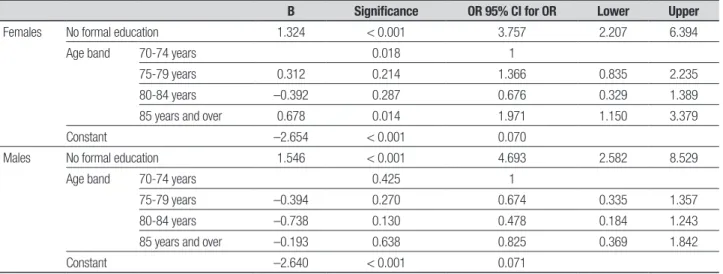
edu-cation (U=34866.5, z= –6.688, p<0.001, for females; U=20757.0, z= –6.278, p<0.001, for males). After ad-justing for the efect of age, having no formal education was signiicantly associated with greater odds of having ‘probable dementia’ by CSI-D, see Table 2.
Phase II assessments. In phase II we fully assessed 168
(91.3%) of the people with ‘probable dementia’, 56 (53.8%) people with ‘possible dementia’ and 72 (7.9%) people with ‘no dementia’ according to CSI-D score, giv-ing a stratiied sample of 296.
Table 1. Literacy, schooling and life experience data in relation to CSI-D cognitive score
Yes No
Significance Number
CSI-D score
(median, IQR) Number
CSI-D score (median, IQR)
Females
Ever attended school (n=668) 249 (37.3%) 26.9 (24.7 to 28.9) 419 (62.7%) 24.8 (21.6 to 27.4) U=34866.5, z= –6.688, p<0.001
Can read and write (n=668) 232 (34.7%) 26.9 (24.7 to 28.7) 436 (65.3%) 24.9 (21.8 to 27.5) U=34449.5, z= –6.791, p<0.001
Born outside Hai (n=673) 70 (10.4%) 25.2 (23.6 to 27.3) 603 (89.6%) 25.8 (22.6 to 28.1) U=19397.0, z= –1.109, p=0.267
Ever lived outside Hai (n=673) 96 (14.3%) 26.1 (24.1 to 28.0) 577 (85.7%) 25.6 (22.6 to 28.0) U=26581.0, z= –0.632, p=0.527 Males
Ever attended school (n=518) 352 (68.0%) 28.3 (26.3 to 29.9) 166 (32.0%) 26.5 (24.0 to 28.0) U=20757.0, z= –6.278, p<0.001
Can read and write (n=518) 337 (65.1%) 28.2 (26.3 to 29.8) 181 (34.9%) 26.8 (24.0 to 28.6) U=21481.5, z= –6.039, p<0.001
Born outside Hai (n=525) 66 (12.6%) 27.1 (26.1 to 28.3) 459 (87.4%) 27.9 (25.5 to 29.5) U=13771.5, z= –1.194, p=0.233
Ever lived outside Hai (n=525) 157 (29.9%) 28.0 (26.2 to 29.6) 368 (70.1%) 27.5 (25.3 to 29.4) U=26422.5, z= –1.549, p=0.121
IQR: inter quartile range.
Table 2. Logistic regression model of education as a predictor of having ‘probable dementia’ by ‘CSI-D’.
B Significance OR 95% CI for OR Lower Upper
Females No formal education 1.324 < 0.001 3.757 2.207 6.394
Age band 70-74 years 0.018 1
75-79 years 0.312 0.214 1.366 0.835 2.235
80-84 years –0.392 0.287 0.676 0.329 1.389
85 years and over 0.678 0.014 1.971 1.150 3.379
Constant –2.654 < 0.001 0.070
Males No formal education 1.546 < 0.001 4.693 2.582 8.529
Age band 70-74 years 0.425 1
75-79 years –0.394 0.270 0.674 0.335 1.357
80-84 years –0.738 0.130 0.478 0.184 1.243
85 years and over –0.193 0.638 0.825 0.369 1.842
Constant –2.640 < 0.001 0.071
Gender speciic regression models were constructed to investigate the inluence of schooling on various mea-sures of cognitive function. CSI-D COGSCORE, CERAD 10 word list score and DSM-IV dementia diagnosis were all investigated in univariate and age-adjusted models, see Table 3. Males with no formal education were signif-icantly more likely to perform poorly on the CSI-D COG-SCORE and on the CSI-D overall. his efect was not seen in females, and this is likely to be due, in part, to the lower levels of schooling in females limiting statistical power.
Interestingly, performance on the CERAD 10-word learning list and diagnosis of DSM-IV dementia were not associated with having attended school. Perfor-mance on the 10-word list was similar in men and wom-en with a median of two words recalled in both groups (U=9142.0, z= –0.603, p=0.547), despite the lower edu-cation levels and greater age of the female group, sug-gesting a lack of educational bias in this assessment.
Of those dementia cases with education data avail-able (n=75), 31 had vascular dementia and 36 had Alzheimer’s disease. Rates of education did not vary between these two subtypes, with 10 (32.3%) and 11 (30.6%), respectively, having attended school, odds ra-tio 1.08 (95% CI 0.38 to 3.04).
Other markers for cognitive reserve. Other potential mark-ers of cognitive reserve were also assessed including highest occupation and markers of childhood disadvan-tage such as head circumference and leg length. here was no association between highest occupation and DSM-IV dementia, although overall 88.6% of those with dementia and 93.7% of those without dementia were agricultural workers, with only 5.8% of those with dementia and 2.5% of those without dementia having previously had a clerical, administrative or professional occupation. Head circumference and leg length did not difer between those with and without DSM-IV demen-tia for either gender.
DISCUSSION
his population of older adults in rural Tanzania had a strikingly low overall level of education, particularly so in women. Illiteracy and low educational level were both associated with ‘probable dementia’ by CSI-D but not with dementia by DSM-IV criteria following a detailed clinical interview and further cognitive assessment. We will now consider possible reasons for this inding.
Cognitive assessment by CSI-D. he CSI-D was developed
and validated in low literacy settings,42 more recently
forming part of the 10/66 international dementia re-search group protocol used across LMIC.35
In other studies of dementia in SSA, the CSI-D has been used alone to assess for dementia,28 cognitive
im-pairment4 and as a screening tool for dementia.29 CSI-D
COGSCORE totals of 28/3328 and 25.5/334 have been
used as indicative of cognitive impairment or dementia respectively in SSA studies of dementia prevalence. In Hai, overall cognitive performance on the CSI-D COG-SCORE was lower than might be expected, with median COGSCORE totals of only 25.7 for women and 27.7 for men.
In the original validation of the CSI-D across high and low literacy settings, mean COGSCORES for those who did not have dementia ranged from 28-30 with the exception of a cohort in Nigeria who had similar educational levels to our cohort in Hai and mean COG-SCORES of 25.42
Although the 10/66 protocol has been developed for use in LMIC countries, those with increased educational level, particularly secondary education and higher, are recognised to perform better that those without educa-tion on cognitive testing using this protocol.10 In Hai,
the overall level of literacy and school attendance was low in comparison with sites such as India and China, included in the published study. Normative data have not been published for the SSA 10/66 study cohort,
Table 3. Association between markers for cognitive function and schooling in phase II cohort.
Univariate odds ratio (95% CI, significance) Age adjusted odds ratio (95% CI, significance)
Females CSI-D patient cognitive score 1.01 (0.96 to 1.05, p=0.786) 1.00 (0.95 to 1.04, p=0.858)
CERAD 10 word list score 1.13 (0.97 to 1.31, p=0.115) 1.08 (0.92 to 1.26, p=0.339)
Probable dementia by CSI-D 0.83 (0.61 to 1.11, p=0.211) 0.85 (0.63 to 1.16, p=0.316)
DSM-IV dementia diagnosis 0.91 (0.47 to 1.77, p=0.776) 1.11 (0.55 to 2.22, p=0.774)
Males CSI-D patient cognitive score 1.11 (1.03 to 1.20, p=0.010) 1.09 (1.01 to 1.18, p=0.028)
CERAD 10 word list score 1.12 (0.91 to 1.37, p=0.273) 1.09 (0.87 to 1.37, p=0.452)
Probable dementia by CSI-D 0.48 (0.31 to 0.75, p=0.001) 0.54 (0.34 to 0.86, p=0.010)
possibly due to the small numbers involved, so direct comparisons are diicult, but low observed CSI-D scores might be due to diferences in population norms for per-formance in a very low literacy setting.
It is recognised that even one year of school atten-dance can markedly inluence performance on cognitive testing, not only in tasks dependent on ability to read or write but in other tests of cognitive ability.43 In Hai,
we found an independent association between school attendance and CSI-D cognitive score in in men, but not in women, possibly due to the low numbers of women who had attended formal education.
he CSI-D also includes a relative interview (REL-SCORE) which is given proportionally more weight in scoring when compared to the cognitive section. Dif-fering baseline cognitive ability cannot therefore be the only factor afecting CSI-D dementia. Nevertheless, those without formal education were more likely to have ‘probable dementia’ by CSI-D indicating that they had some degree of cognitive impairment, which was apparent to their relatives.
Other cognitive assessments. As part of the 10/66 research group protocol, all participants seen in the second phase of the study were assessed using the CERAD 10 word delayed recall learning list.40 his list has been modiied
slightly from its original form prior to inclusion in the 10/66 protocol, and involves reading a list of 10 familiar words to the participant before asking them to imme-diately recall words from the list. he list is presented three times in a similar manner, and participants are then asked to recall these words after an interval of sev-eral minutes. his word list used alone detected demen-tia with a speciicity and sensitivity of 73.5% and 76.9% respectively in the Ibadan-Indianapolis study.30
Perfor-mance on this task has been reported to difer according to literacy status.43 However, population norms of
per-formance on this test across LMIC indicate that although variations in performance exist, delayed recall perfor-mance for cognitively intact elderly is fairly consistent.44
In Hai, we found that in contrast to the CSI-D, perfor-mance on the 10 word learning list did not appear to be inluenced by educational level or literacy with a median score on delayed recall of 2/10. Performance was nota-bly lower than that reported in other LMIC countries,44
but this task did appear to be less educationally biased than other cognitive assessment tools in our cohort.
Comparison with other studies conducted in SSA. In contrast to the majority of studies from high-income countries, those conducted in SSA have, for the most part, not
found an association between dementia on clinical as-sessment and years of education.29,30 Although the
over-all number of conducted studies are few, educational level is broadly similar to that reported in Hai, with il-literacy levels ranging between 47%31 and 97%.4 hose
studies which do report an association describe popu-lations markedly diferent to that in Hai. In an urban, mostly male cohort in Senegal, a signiicant association between illiteracy and dementia was reported.33
Anoth-er study from NigAnoth-eria found that at least some primary education was protective for dementia,28 however this
study used the CSI-D only when making dementia diag-nosis. he proportion of participants having no formal education was 76%, higher than found in Hai and 89% of dementia cases were female. It may therefore be the case that those performing badly on the CSI-D were also those with lower levels of formal education, similarly to those found in our cohort in Hai. In general, in SSA, cognitive impairment assessed using screening tools, rather than clinical diagnosis, is associated with lower levels of formal education.45 Prevalence of cognitive
impairment also appears relatively high45,46 when such
screening tools are used to provide a diagnosis. In con-trast, those studies including a clinical assessment for dementia report a lack of association with educational level and a lower prevalence of dementia than cognitive impairment. Overall in SSA, educational level appears to be associated with lower cognitive performance, de-spite use of tools adapted to low-literacy settings. Since this lower cognitive performance is not generally asso-ciated with higher levels of dementia following clinical assessment, education is unlikely to be a robust marker of cognitive reserve in these settings.
Educational attainment. Most studies of dementia and
ed-ucational level have been conducted in settings where the overall level of education is signiicantly higher than in our cohort. In these settings, years of education are likely to be related to educational attainment, with those continuing with education likely to be more able. Cognitive performance measured at age 1111 or in young
adults47 has been found to correlate with late life
Literacy. Studies of older adults in high-income countries suggest that amongst cohorts with a low educational level, self-reported literacy may be a better measure of educational attainment than years of schooling.48 A
meta-analysis of illiteracy and dementia risk reported a strong association.19 Studies from Nigeria have
re-ported a proportion of individuals learning to read and write through informal methods such as attendance at religious education classes.29,31 In Hai, few participants
reported having attended adult education classes, and only 1% of those who had no formal schooling were able to read and write, suggesting that in Hai informal or al-ternative education was not prevalent. Literacy is there-fore not necessarily a more robust measure of childhood intelligence or cognitive reserve in this setting.
Education and social disadvantage. In high-income settings, low educational level is often associated with other markers of childhood social disadvantage, also afecting cognitive reserve. he Ibadan-Indianapolis study, which compared African Americans living in Indianapolis with Yoruba living in Nigeria, found that low educational at-tainment was associated with dementia in the American cohort but not in the Yoruba. In the Indianapolis cohort low educational level was highly correlated with rural residence and occupation. he prevalence of dementia was also signiicantly lower in the Yoruba despite a com-paratively low level of educational attainment.
In the Ibadan Study of Ageing, in Nigeria, there was a linear relationship between socioeconomic status, ru-ral residence and dementia.30 Educational level did not
show this association. Educational level may therefore be less associated with other markers of disadvantage in this setting.
Since so many women had no schooling it is like-ly that failure to attend school was in part a cultural norm and not the marker of deprivation that it might be in high income countries. During the course of our research it became clear that many older women had married and started a family at ages where they might have been expected to be at school in high-income countries.
Occupation and rural residence. Occupational level has been suggested as an alternative potential measure of cogni-tive reserve due to diiculties in comparing studies of educational level.9 Almost 90% of our participants were
agricultural workers and we did not ind any association between dementia and occupational attainment, pos-sibly due to the small number of individuals recording other occupations. We found no association between
rural residence and dementia risk, again maybe due to the vast majority reporting lifetime rural residence.
Limitations. We relied on self and family report of literacy and educational level and made no attempt to assess this formally. In addition, the phase II cohort was strati-ied, with over-sampling for poor performance on the CSI-D. Although this may have resulted in some bias, the themes explored in this study are unlikely to have been signiicantly afected by this.
Conclusion. As reported from other studies in SSA, we did
not ind an independent association between dementia on DSM-IV criteria and educational level. he reasons for this are unclear. One possibility is that in this ru-ral cohort, most of whom reported having never lived outside the area and having only worked in agriculture, low educational level is not the marker of social and eco-nomic disadvantage that it might be in other settings where access to education is more widespread. Years of education might also not be a good marker of actual educational attainment, or indeed cognitive reserve, in this setting for the same reason. Performance on a screening tool designed for use in developing countries also appeared markedly lower than in other settings even in SSA. Similar indings are reported in other SSA studies where generally cognitive impairment on formal testing appears to be related to years of education, but prevalence of dementia is much lower when diagnosed on clinical assessment and generally not related to edu-cational level. Alternative methods of measuring cogni-tive reserve in SSA and similar settings are therefore likely to be needed for identiication of modiiable risk factors for dementia.
Despite the existence of assessment tools for de-mentia designed for developing country settings, these do appear to remain educationally biased when used in settings such as Hai with a very low level of access to education, and high rate of illiteracy. his results in dif-iculties in assessing the true relationship between de-mentia and education in these settings.
Worldwide, one in ive adults is reported to be illiter-ate with two thirds of these being women (UNESCO).49
Acknowledgements. We wish to acknowledge the help of all health care workers, village enumerators and medical supervisors who assisted in identiication of cases, clini-cal assessment and completion of the census. We are es-pecially grateful to patients, carers and family members for taking part in the study.
Funding. his study was part funded by a British Geriatric
Society SpR start up grant and an Academy of Medical Sciences (UK) Clinical Lecturer start up grant
Role of the Funding Source. he sponsors of this study had
no role in designing the study; in the collection, analysis, and interpretation of data; in the writing of the report; or in the decision to submit the paper for publication.
Contributions. Design/conception – Richard Walker,
Cath-erine Dotchin, Stella-Maria Paddick and Paul Chaote. Literature search - Stella-Maria Paddick. Data collection – Stella-Maria Paddick, Anna Longdon, Aloyce Kisoli. Data analysis - William K. Gray, Stella-Maria Paddick. Interpretation of results - William Gray, Stella-Maria Paddick. Writing of paper - Richard Walker, Catherine Dotchin, William Gray, Stella-Maria Paddick.
REFERENCES
1. Prince M, Guerchet MMP. Policy Brief for Heads of Government: The Global Impact of Dementia 2013-2050. London: Alzheimers Disease International 2013.
2. George-Carey R, Adeloye D, Chan KY, et al. An estimate of the prev-alence of dementia in Africa: A systematic analysis. J Glob Health 2012;2:020401.
3. Longdon AR, Paddick SM, Kisoli A, et al. The prevalence of dementia in rural Tanzania: a cross-sectional community-based study. Int J Geriatr Psychiatry 2013;28:728-737.
4. Guerchet M, Houinato D, Paraiso MN, et al. Cognitive impairment and dementia in elderly people living in rural Benin, west Africa. Dement Geriatr Cogn Disord 2009;27:34-41.
5. Guerchet M, M’Belesso P, Mouanga AM, et al. Prevalence of dementia in elderly living in two cities of Central Africa: the EDAC survey. Dement Geriatr Cogn Disord. 2010;30:261-268.
6. Paraïso MN, Guerchet M, Saizonou J, et al. Prevalence of Dementia among Elderly People Living in Cotonou, an Urban Area of Benin (West Africa). Neuroepidemiology 2011;36:245-251.
7. Whalley LJ, Deary IJ, Appleton CL, Starr JM. Cognitive reserve and the neurobiology of cognitive aging. Ageing Res Rev 2004;3:369-382. 8. Fratiglioni L, Wang HX. Brain reserve hypothesis in dementia. J
Alzheim-ers Dis 2007;12:11-22.
9. Valenzuela MJ, Sachdev P. Brain reserve and dementia: a systematic review. Psychol Med 2006;36:441-454.
10. Prince M, Acosta D, Ferri CP, et al. Dementia incidence and mortality in middle-income countries, and associations with indicators of cognitive reserve: A 10/66 Dementia Research Group population-based cohort study. Lancet 2012;380(9836):50-58.
11. Murray AD, Staff RT, McNeil CJ, et al. The balance between cognitive reserve and brain imaging biomarkers of cerebrovascular and Alzheim-er’s diseases. Brain 2011;134:3687-3696.
12. Mortimer JA, Snowdon DA, Markesbery WR. Head circumference, edu-cation and risk of dementia: findings from the Nun Study. J Clin Exp Neuropsychol 2003;25:671-679.
13. Meng X, D’Arcy C. Education and dementia in the context of the cogni-tive reserve hypothesis: a systematic review with meta-analyses and qualitative analyses. PLoS ONE 2012;7:e38268.
14. Letenneur L, Launer LJ, Andersen K, et al. Education and the risk for Alzheimer’s disease: sex makes a difference. EURODEM pooled anal-yses. EURODEM Incidence Research Group. Am J Epidemiol 2000; 151:1064-1071.
15. Cobb JL, Wolf PA, Au R, White R, D’Agostino RB. The effect of educa-tion on the incidence of dementia and Alzheimer’s disease in the Fram-ingham Study. Neurology 1995;45:1707-1712.
16. Lindsay J, Laurin D, Verreault R, et al. Risk Factors for Alzheimer’s Dis-ease: A Prospective Analysis from the Canadian Study of Health and Aging. Am J Epidemiol 2002;156:445-453.
17. Stern Y, Gurland B, Tatemichi TK, Tang MX, Wilder D, Mayeux R. In-fluence of education and occupation on the incidence of Alzheimer’s disease. JAMA 1994;271:1004-1010.
18. Caamano-Isorna F, Corral M, Montes-Martinez A, Takkouche B.
Edu-cation and dementia: a meta-analytic study. Neuroepidemiology 2006; 26:226-232.
19. Brucki SMD. Illiteracy and dementia. Dement Neuropsychol 2010;4: 153-157.
20. Sharp ES, Gatz M. Relationship between education and dementia: an updated systematic review. Alzheimer Dis Assoc Disord 2011;25: 289-304.
21. Dong MJ, Peng B, Lin XT, Zhao J, Zhou YR, Wang RH. The prevalence of dementia in the People’s Republic of China: a systematic analysis of 1980-2004 studies. Age Ageing 2007;36:619-624.
22. Zhou DF, Wu CS, Qi H, et al. Prevalence of dementia in rural China: impact of age, gender and education. Acta Neurol Scand 2006;114: 273-280.
23. Zhang MY, Katzman R, Salmon D, et al. The prevalence of dementia and Alzheimer’s disease in Shanghai, China: impact of age, gender, and education. An Neurol 1990;27:428-437.
24. Farrag A, Farwiz HM, Khedr EH, Mahfouz RM, Omran SM. Prevalence of Alzheimer’s disease and other dementing disorders: Assiut-Upper Egypt study. Dement Geriatr Cogn Disord 1998;9:323-328.
25. Afgin AE, Massarwa M, Schechtman E, et al. High prevalence of mild cognitive impairment and Alzheimer’s disease in arabic villages in north-ern Israel: impact of gender and education. J Alzheimers Dis 2012; 29:431-439.
26. Chandra V, Ganguli M, Pandav R, Johnston J, Belle S, DeKosky S. Prevalence of Alzheimer’s disease and other dementias in rural India. The Indo-US study. Neurology 1998;51:1000-1008.
27. Shaji S, Bose S, Verghese A. Prevalence of dementia in an urban popu-lation in Kerala, India. Brit J Psychiatry 2005;186:136-140.
28. Ochayi B, Thacher TD. Risk factors for dementia in central Nigeria. Ag-ing Ment Health 2006;10:616-620.
29. Ogunniyi A, Baiyewu O, Gureje O, et al. Epidemiology of dementia in Nigeria: results from the Indianapolis-Ibadan study. Eur J Neurol 2000;7:485-490.
30. Gureje O, Ogunniyi A, Kola L. The profile and impact of probable de-mentia in a sub-Saharan African community: results from the Ibadan Study of Aging. J Psychos Res 2006;61:327-333.
31. Yusuf AJ, Baiyewu O, Sheikh TL, Shehu AU. Prevalence of dementia and dementia subtypes among community-dwelling elderly people in northern Nigeria. Int Psychogeriatr 2011;23:379-386.
32. Guerchet M, Mouanga AM, M’Belessoa P, et al. Factors associated with dementia among elderly people living in two cities in central Africa: The EDAC multicenter study. J Alzheimers Dis 2012;29:15-24.
33. Coume M, Toure K, Thiam MH, et al. [Estimate of the prevalence of cognitive impairment in an elderly population of the health center of Senegalese national retirement institution]. GeriatrEt Psychol Neuropsy-chiatr Vieil 2012;10:39-46.
34. Chandra V, Ganguli M, Ratcliff G, et al. Practical issues in cognitive screening of elderly illiterate populations in developing countries. The Indo-US Cross-National Dementia Epidemiology Study. Aging (Milano) 1998;10:349-357.
diag-nosis in developing countries: a cross-cultural validation study. Lancet 2003;361:909-917.
36. Hall KS, Hendrie HC, Brittain HM. The Development of a Dementia Screening Interview in 2 Distinct Languages. Int J Meth Psychiatr Res. 1993;3:1-28.
37. Chen CH, Mizuno T, Elston R, et al. A comparative study to screen dementia and APOE genotypes in an ageing East African population. Neurobiol Aging 2010;31:732-740. PubMed PMID: 18703255. 38. Copeland J, Dewey M, Griffith-Jones H. A computerised psychiatric
diagnostic system and case nomenclature for elderly subjects: GMS and AGECAT. Psychol Med 1986;16:89-99.
39. Cummings JL, Mega M, Gray K, Rosenberg-Thompson S, Carusi DA, Gornbein J. The Neuropsychiatric Inventory: comprehensive assess-ment of psychopathology in deassess-mentia. Neurology 1994;44:2308-2314. 40. Welsh KA, Butters N, Mohs RC, et al. The Consortium to Establish a Registry for Alzheimer’s Disease (CERAD). Part V. A normative study of the neuropsychological battery. Neurology 1994;44:609-614. 41. American Psychiatric Association. Diagnostic and statistical manual of
mental disorders. 4th ed. Washington DC: American Medical Associa-tion; 1994.
42. Hall KS, Gao S, Emsley CL, Ogunniyi AO, Morgan O, Hendrie HC. Com-munity screening interview for dementia (CSI ‘D’); performance in five disparate study sites. Int J Geriatr Psychiatry 2000;15:521-531.
43. Nitrini R, Caramelli P, Herrera EJr., et al. Performance of illiterate and literate nondemented elderly subjects in two tests of long-term memory. J Int Neuropsychol Soc 2004;10:634-638.
44. Sosa AL, Albanese E, Prince M, et al. Population normative data for the 10/66 Dementia Research Group cognitive test battery from Latin America, India and China: a cross-sectional survey. BMC Neurology. 2009;9:48.
45. Onadja Y, Atchessi N, Soura BA, Rossier C, Zunzunegui M-V. Gender differences in cognitive impairment and mobility disability in old age: A cross-sectional study in Ouagadougou, Burkina Faso. Arch Gerontol Geriatr 2013;57:311-318.
46. Clausen T, Romoren TI, Ferreira M, Kristensen P, Ingstad B, Holmboe-Ottesen G. Chronic diseases and health inequalities in older persons in Botswana (southern Africa): a national survey. J Nutr Health Aging 2005;9:455-461.
47. Riley KP, Snowdon DA, Desrosiers MF, Markesbery WR. Early life lin-guistic ability, late life cognitive function, and neuropathology: findings from the Nun Study. Neurobiol Aging 2005;26:341-347.
48. Manly JJ, Schupf N, Tang M-X, Stern Y. Cognitive Decline and Literacy Among Ethnically Diverse Elders. J Geriatr Psychiatry Neurol 2005; 18:213-217.