Dement Neuropsychol 2017 September;11(3):297-300
297
Contador et al. High education accelerates cognitive decline
Short Communication
High education accelerates
cognitive decline in dementia
A brief report from the population-based NEDICES cohort
Israel Contador1, Félix Bermejo-Pareja2,3,4, D. Lora Pablos5, Alberto Villarejo6, Julián Benito-León3,4,6
ABSTRACT. High education has been associated with faster cognitive decline after diagnosis of Alzheimer’s disease (AD), but it is unclear whether these findings extend to other dementia subtypes. Objective: We investigated whether educational attainment influences the cognitive trajectories of older adults with different dementia subtypes. Methods: All participants were selected from NEDICES, a prospective population-based cohort study of Spanish older adults. A total sample of 53 individuals with dementia completed the MMSE-37 at Times 1 and 2 (mean follow-up=2.8±0.5 years) to assess cognitive decline. Results: At folup, MMSE-37 scores had decreased by 3.34±4.98 points in low-educated individuals with dementia versus 7.90±4.88 points in high-low-educated subjects (effect size (r)=0.32, p=0.02). Conclusion: Educational level influenced the cognitive trajectories of patients with dementia assessed by the MMSE-37. Key words: dementia, education, cognitive decline, population-based.
MAIOR EDUCAÇÃO ACELERA O DECLÍNIO COGNITIVE EM DEMÊNCIA: RELATO BREVE DA COORTE DE BASE POPULACIONAL NEDICES RESUMO. A educação mais alta tem sido associada com um declínio cognitive mais rápido após o diagnóstico de doença de Alzheimer (DA), mas não está claro se estes achados podem ser extendidos a outros subtipos de demência. Objetivo: Nós investigamos se o nível educacional alcançado influencia as trajetórias cognitivas de adultos idosos com diferentes subtipos de demência. Métodos: Todos os participantes foram selecionados do NEDICES, um estudo de coorte prospectivo de base populacional de idosos adultos espanhóis. Uma amostra total de 53 indivíduos com demência completaram o MEEM-37 nos momentos 1 e 2 (acompanhamento médio de 2.8± 0.5 anos) para avaliação do declínio cognitive. Resultados: No seguimento, o MEEM-37 declinou 3.34±4.98 pontos em indivíduos de baixa escolaridade com demência versus 7.90±4.88 pontos entre os altamente escolarizados (tamanho do efeito (r)=0.32, p=0.02). Conclusão: O nível educacional influenciou as trajetórias cognitivas de pacientes com demência avaliados pelo MEEM-37. Palavras-chave: demência, educação, declínio cognitivo, base populacional.
INTRODUCTION
I
t is known that lower education is associ-ated with an increased risk of dementia.1However, high-educated individuals with dementia have a poorer prognosis (e.g., mortality) due to the accumulation of more pathological changes after diagnosis.2 In this
respect, a recent review has indicated that high education leads to more rapid cognitive decline,3 but conlicting results have emerged
from mixed samples (i.e., diferent dementia subtypes) using global cognitive measures.4,5
he present study explored the efect of edu-cational attainment on cognitive decline in individuals with dementia from a population-based longitudinal cohort.
METHODS
Participants. his analysis is drawn from the “Neurological Disorders in Central Spain”
This study was conducted at the University Hospital “12 de Octubre”, Madrid, Spain.
1Department of Basic Psychology, Psychobiology and Methodology of Behavioral Science. University of Salamanca, Salamanca, Spain. 2Clinical Research Unit
(Imas12), University Hospital “12 de Octubre”, Madrid, Spain. 3The Biomedical Research Centre Network for Neurodegenerative Diseases (CIBERNED), Carlos III
Research Institute, Madrid, Spain. 4Faculty of Medicine, Complutense University, Madrid, Spain. 5Research Institute of Hospital “12 de Octubre” (i+12),
Epidemiol-ogy Section, Madrid, Spain.6Department of Neurology. University Hospital “12 de Octubre”, Madrid, Spain.
Israel Contador. Facultad de Psicología / Universidad de Salamanca – Av. de la Merced 109-131. Postal code: ES-37005; Salamanca, Spain. E-mail: [email protected].
Disclosure: The authors report no conflicts of interest.
Received May 22, 2017. Accepted in final form July 31, 2017.
Dement Neuropsychol 2017 September;11(3):297-300
298 High education accelerates cognitive decline Contador et al.
(NEDICES), a population-based survey of the main age-related health problems of older Spaniards (65 years or older) in central Spain (Lista, Arévalo and Margaritas). Detailed information about the study (assessments, waves) is available elsewhere.6,7 Each participant or their
caregivers (in the case of individuals with severe cogni-tive impairment) signed a written informed consent form, and two ethical standards committees on human research (University Hospitals “12 de Octubre” and “La Princesa”, Madrid) approved the protocol of the study.
Measures. he extended 37-item Spanish version of the Mini-Mental State Examination (MMSE-37) was used as the outcome measure to assess global cognitive decline from the baseline survey (1994-1995) to the follow-up (1997-1998). Levels of educational attain-ment were registered as follows: illiteracy, can read and write, primary education, and secondary and higher education. Finally, the adapted Charlson index was used to assess participants’ comorbidity.8
Procedure. he NEDICES study was carried out in two phases: door-to-door screening of eligible people (Phase 1) and neurological examination of those individuals who screened positive (Phase 2). A total of 5278 older citizens were assessed at baseline (1994–1995) using a 500-item screening questionnaire to collect data on demographics, medical conditions and current medi-cation. In addition, participants underwent the World Health Organization (WHO) screening protocol for dementia, which included the MMSE-37 and the 11-item Spanish version of Pfefer’s Functional Activi-ties Questionnaire.9,10 his (in person) assessment was
done by trained interviewers in two cross-sectional surveys: baseline wave (1994-5) and incidence wave (1997-8).
Each person underwent initial screening for cogni-tive impairment and if testing posicogni-tive, a neurological examination was performed at the National Health Ser-vice clinics or at home. he initial screen was considered positive if: [1] the individual scored <24 points on the 37-item version of the MMSE and >5 points on the Pfef-fer questionnaire; or [2] the individual could not provide an answer on the 37-item version of the MMSE or on the Pfefer questionnaire (direct screening); or [3] the individual or proxy gave information pointing to sus-pected cognitive decline. he diagnosis of dementia was subsequently made by the consensus of two neurolo-gists according to the Diagnostic and Statistical Manual of Mental Disorders (DSM–IV). Alzheimer-type demen-tia (AD) was diagnosed according to NINCDS-ADRDA
criteria, whereas for vascular dementia (VaD), the DSM-IV was employed. Other categories, such as dementia associated with Parkinson’s disease, dementia with Lewy bodies, or longstanding Parkinsonism (more than six months) and secondary dementia (known or probable cause of speciic dementia), were also established.7 he
neurological examination comprised a clinical history concerning cognitive decline, a general neurological examination and a mental status interview.
Statistical analysis. In this study, education level was dichotomized into high (1=individuals with a primary school certiicate or higher) and low (0=illiterate subjects and individuals who can only read and write) for the analysis. he groups (high vs. low educational attainment) were compared using the Chi-square test (nominal variables) and Student’s t-test for indepen-dent samples (quantitative variables). he change in MMSE-37 score was calculated as follows: baseline score (1994-1995=Time 1) – follow-up score (1997-1998=Time 2). Due to the absence of normality of the MMSE-37 scores, the signiicance of the change was analyzed using nonparametric comparisons (Mann-Whitney test). Speciic efect sizes (r) for non-normal distributions were computed as r=z/√n, where z is the standardized statistic (with normal distribution) and n is the sample size.11 Analyses were performed with SPSS
(IBM SPSS Statistics version 21).
RESULTS
Of the 306 participants with a diagnosis of dementia at baseline (1994-1995), 128 did not complete the MMSE-37 because they refused or were unavailable for face-to-face evaluation. hese subjects were excluded from the statistical analyses. Of the 178 remaining indi-viduals, 53 (35 with Alzheimer’s disease, 10 VaD and 8 other types) completed the MMSE-37 assessments at Time 2 (mean follow-up=2.8±0.5 years). Individuals with dementia who did not complete the MMSE-37 in both waves were older (83.1 vs. 80.2, t=2.67, p<0.01), higher educated (83 with secondary school or higher (33.9%) vs. 10 (18.9%), c2=4.57, p<0.05) and showed
greater cognitive impairment at baseline (14.78±6.82 vs. 16.85±6.67, t= –1.88, p=0.05) versus participants who completed the two assessments.
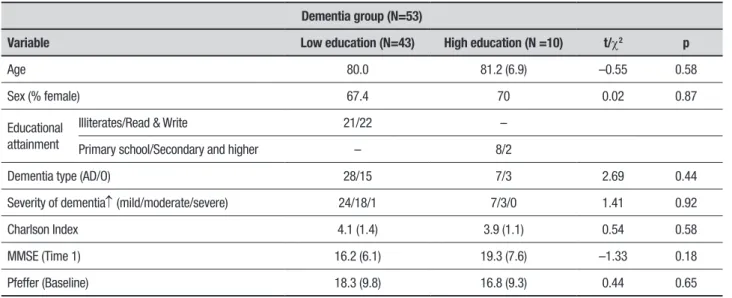
Table 1 shows the descriptive statistics of the indi-viduals with dementia stratiied by educational level. No signiicant diferences in any characteristics emerged between high and low education groups at baseline.
Dement Neuropsychol 2017 September;11(3):297-300
299
Contador et al. High education accelerates cognitive decline Table 1. Descriptive characteristics of the population with dementia.
Dementia group (N=53)
Variable Low education (N=43) High education (N =10) t/c2 p
Age 80.0 81.2 (6.9) –0.55 0.58
Sex (% female) 67.4 70 0.02 0.87
Educational attainment
Illiterates/Read & Write 21/22 –
Primary school/Secondary and higher – 8/2
Dementia type (AD/O) 28/15 7/3 2.69 0.44
Severity of dementia↑ (mild/moderate/severe) 24/18/1 7/3/0 1.41 0.92
Charlson Index 4.1 (1.4) 3.9 (1.1) 0.54 0.58
MMSE (Time 1) 16.2 (6.1) 19.3 (7.6) –1.33 0.18
Pfeffer (Baseline) 18.3 (9.8) 16.8 (9.3) 0.44 0.65
AD: Alzheimer disease; O: Other dementia types; ↑Clinical severity of dementia was established according to DSM–III–R criteria.
Figure 1. Cognitive evolution of participants with dementia according to educational level: 3-year follow-up.
7.90±4.88 points in patients with high educational level (efect size (r)=0.32, Mann-Whitney p=0.02). MMSE-37 scores (Times 1 and 2) of patients with dementia accord-ing to level of education are shown in Figure 1.
DISCUSSION
his scientiic report found that high-educated indi-viduals with dementia had signiicantly faster cogni-tive decline compared to the low-educated group at the 3-year follow-up. Our indings are consistent with previous studies based on AD and mixed samples with other subtypes of dementia.5,12 Basically, these
observa-tions suggest a more advanced level of neuropathology in high-educated individuals with dementia at similar levels of dementia severity. However, Aguero-Torres et al.4 failed to conirm this efect using an adjusted
multiple regression model with only 74 individuals who completed the follow-up.
sub-Dement Neuropsychol 2017 September;11(3):297-300
300 High education accelerates cognitive decline Contador et al.
jects could not be reached at follow-up, and sample size was reduced. Essentially, non-selected individuals were older, more highly educated and more cognitively impaired than the selected sample. All these factors have been linked to an increased risk of mortality, supporting an explanation of attrition in population-based studies.1
In any case, the inluence of education was signiicant (i.e., small-medium efect size) in two population-based groups (high vs. low education) well-matched for other sociodemographic and clinical characteristics.
To sum up, high-educated individuals with dementia showed faster cognitive progression at the 3-year follow-up. his research encourages us to investigate the role of education and other cognitive reserve proxies in cogni-tive changes related to other neurological conditions. hus, education-corrected norms are needed to evaluate cognitive performance in people with Parkinson’s dis-ease or essential tremor, but its inluence on cognitive changes over time has been little investigated in these conditions.14 he ultimate aim of this approach would
be to verify whether modulating factors of cognitive tra-jectories in people with AD can be applied to individuals with PD or other neurological conditions.
Author contributions. Dr. Israel Contador: study design, statistical analysis and drafting of the manuscript. Dr. Bermejo-Pareja: conception, organization and execu-tion of the research project. Dr. David Lora: statis-tical analysis and interpretation of data. Dr. Alberto Villarejo: interpretation of data and drafting of the manuscript. Dr. Benito-León: conception, organization and execution of the research project. Critical revision of the manuscript: all authors.
Acknowledgments. he authors thank all collaborators and institutions for their involvement in the NEDICES study (www.ciberned.es/estudio-nedices).
Funding. he NEDICES study was supported by grants from the World Health Organization Age-Associated Dementia Project (WHO-AAD), the EPICARDIAN study, the oicial Spanish Research Agencies (FIS 93/0773; 96/1993; 00-0011-01; CAM 94/0032) and the Spanish Oice of Science and Technology (PB 1225-C04).
REFERENCES
1. Contador I, Bermejo-Pareja F, Puertas-Martín V, Benito-León J. Child-hood and adultChild-hood rural residence increases the risk of dementia: NEDICES study. Curr Alzheimer Res. 2015;12:350-7.
2. Contador I, Stern Y, Bermejo-Pareja F, Sánchez-Ferro Á, Benito-León J. Is educational attainment associated with increased risk of mortality in people with dementia? A population-based study. Curr Alzheimer Res. 2017;14:571-6.
3. Meng X, D’Arcy C. Education and dementia in the context of the cogni-tive reserve hypothesis: a systematic review with meta-analyses and qualitative analyses. PLoS ONE. 2012;7:e38268.
4. Agüero-Torres H, Fratiglioni L, Guo Z, Viitanen M, Winblad B. Prognostic factors in very old demented adults: a seven-year follow-up from a popu-lation-based survey in Stockholm. J Am Geriatr Soc. 1998;46:444–52. 5. Chaves ML, Camozzato AL, Köhler C, Kaye J. Predictors of the progres-sion of dementia severity in Brazilian patients with Alzheimer’s disease and vascular dementia. Int J Alzheimers Dis. 2010; pii: 673581 6. Morales JM, Bermejo FP, Benito-León J, Rivera-Navarro J, Trincado R,
Gabriel S R, et al. Methods and demographic indings of the baseline survey of the NEDICES cohort: a door-to-door survey of neurological disorders in three communities from Central Spain. Public Health. 2004;118:426-33.
7. Bermejo-Pareja F, Benito-León J, Vega S, Olazarán J, de Toledo M, Díaz-Guzmán J, et al. Consistency of clinical diagnosis of dementia in
NEDICES: a population-based longitudinal study in Spain. J Geriatr Psychiatry Neurol. 2009;22:246-55.
8. Romano PS, Roos LL, Jollis JG. Adapting a clinical comorbidity index for use with ICD-9-CM administrative data: differing perspectives. J Clin Epidemiol. 1993;46:1075-9. discussion 1081-90.
9. Contador I, Bermejo-Pareja F, Fernández-Calvo B, Boycheva E, Tapias E, Llamas S, et al. The 37 item version of the Mini-Mental State Exami-nation: Normative data in a population-based cohort of older Spanish adults (NEDICES). Arch Clin Neuropsychol. 2016;31:263-72. 10. Olazarán J, Mouronte P, Bermejo F. Clinical validity of two scales of
instru-mental activities in Alzheimer’s disease. Neurologia. 2005;20:395-401. 11. Fritz CO, Morris PE, Richler JJ. Effect size estimates: current use,
calcu-lations, and interpretation. J Exp Psychol Gen. 2012;141:2-18. 12. Teri L, McCurry SM, Edland SD, Kukull WA, Larson EB. Cognitive decline
in Alzheimer’s disease: a longitudinal investigation of risk factors for accelerated decline. J Gerontol A Biol Sci Med Sci. 1995;50A:M49-55. 13. Stern Y, Albert S, Tang MX, Tsai WY. Rate of memory decline in AD
is related to education and occupation: cognitive reserve? Neurology. 1999;53:1942-7.