CLINICAL SCIENCE
Frequency of genetic polymorphisms of
PXR
gene in
the Brazilian population
Ricardo P. P. Moreira,IAlexander A. L. Jorge,II Berenice B. Mendonca,I Taˆnia A. S. S. BachegaI
IUnidade de Endocrinologia do Desenvolvimento, Laborato´rio de Hormoˆnios e Gene´tica Molecular LIM 42, Disciplina de Endocrinologia da Faculdade de
Medicina da Universidade de Sa˜o Paulo, Sa˜o Paulo, Brazil.IIUnidade de Endocrinologia Gene´tica LIM 25, Disciplina de Endocrinologia da Faculdade de Medicina da Universidade de Sa˜o Paulo, Sa˜o Paulo, Brazil.
INTRODUCTION:PXR polymorphisms have been implicated in modulatingCYP3A4and PXR expression, potentially accounting for interindividual differences in drug metabolism. The prevalence of PXR polymorphisms varies among ethnic groups and data on the allelic distribution in the highly mixed Brazilian population is lacking. The aim of this study was to analyze genetic variations in the PXR gene in Brazilians and to compare the results to other ethnic groups.
METHODS:DNA samples from 117 healthy Brazilians underwent PCR amplification and sequencing.
RESULTS:Eleven polymorphisms were identified, 3 of which are highly associated with differences inCYP3A4expression. We also identified 1 new synonymous variant in 1.3% of the alleles. Among the functional polymorphisms, –25913 C.T and –6994T.C occurred at a higher frequency compared to the African alleles (p, 0.05) but at a lower frequency compared to Caucasian alleles. The 8055 C.T allele was found at a similar frequency to those described in Caucasians and Africans (p.0.05).
CONCLUSION: We observed that functional variants of the PXR were frequent in our sample of the Brazilian population. Our results suggest that PXR gene variants may be of interest in pharmacogenetic studies involving Brazilians.
KEYWORDS: Pharmacogenetics; Allelic distribution; Brazilian population; Genetic variation.
Moreira RPP, Jorge AAL, Mendonca BB, Bachega TASS. Frequency of genetic polymorphisms ofPXRgene in the Brazilian population. Clinics. 2011;66(6):1041-1044.
Received for publication onFebruary 25, 2011;First review completed onMarch 16, 2011;Accepted for publication onMarch 16, 2011
E-mail: [email protected]
Tel.: 55 11 30697512
INTRODUCTION
The interindividual variability in human drug metabo-lism may be genetically determined by allelic variance in genes encoding P450 proteins and nuclear receptors.1-4 Cytochrome P450s metabolize approximately 80% of clinical drugs and polymorphisms in theCYP3A4 gene have been
previously investigated due to its involvement in the metabolism of more than 50% of drugs. Despite the large interindividual differences in CYP3A4 expression,
poly-morphisms that impair enzyme activity seem to be rare.5-7
CYP3A4expression is mainly induced by the pregnane X
receptor (PXR),8-10a member of the orphan nuclear receptor subfamily and the main transcriptional regulator of cyto-chrome P4503A enzymes.8,9The activation of PXR initiates in the cytoplasm. After exposure to ligands, PXR dimerizes with the retinoic acid receptor (RXR) and binds to nuclear receptor response elements in the upstream regulatory
regions of target genes. These genes encode drug-metabo-lizing enzymes such as CYP3A4 and drug transporters,11
which are the main regulators in the uptake and transfor-mation of many prescribed medicines.
Several PXR (also known asNR1I2) polymorphisms have
been identified that influence the level ofPXRexpression and,
therefore, indirectly regulate its target genes.4,12 These
poly-morphisms account for the wide variability of CYP3A4 levels in the population.4,13The functional effects of these polymorph-isms include aberrant DNA binding and alterations in the transactivation and expression of downstream target genes.4,12 While the allelic distribution of the PXR gene varies
widely among different ethnic groups,13-17it has yet to be studied in the highly mixed Brazilian population. Here we analyze the frequency of PXR variants in a sample of
healthy Brazilian subjects. We also compare the frequencies of PXR polymorphisms to those described in Asians,
Caucasians, and Africans in order to determine whether
PXR variants should be evaluated in pharmacogenetic
studies involving Brazilian subjects.
Subjects
The study protocol was approved by the Ethical Committee of Sa˜o Paulo University. Written consent was
Copyrightß2011CLINICS– This is an Open Access article distributed under
the terms of the Creative Commons Attribution Non-Commercial License (http:// creativecommons.org/licenses/by-nc/3.0/) which permits unrestricted non-commercial use, distribution, and reproduction in any medium, provided the original work is properly cited.
CLINICS 2011;66(6):1041-1044 DOI:10.1590/S1807-59322011000600020
obtained from all subjects. Healthy volunteers consisted of 76 females and 41 males with a mean age 25.8¡11.8 years. The self-reported ethnicity of this cohort was 87.2% Caucasian and 12.8% African. In addition, 88% were from the southeast, 8.5% from the northeast, and 3.5% from the southern region of Brazil.
METHODS
DNA samples from all subjects were obtained from peripheral blood leukocytes using a salting out procedure. All coding regions of thePXRgene were analyzed in addition
to three variants in non-coding regions that had a minor allele frequency of at least$0.10 in other ethnic groups. We also looked for three variants, which modified the PXR and/or CYP3A4 expression, previously described in non-coding regions with a minor allele frequency$0.10 in other ethnic groups.4,17 The PXR gene was amplified as previously
described.4,18The amplified products were sequenced using the Big Dye Terminator Sequencing KitTM (Applied Biosystem, Inc., Foster City, CA, USA) and capillary electro-phoresis was conducted on an ABI PRISM 3100 sequencer (Applied Biosystem, Inc.). Sequence traces were analyzed using Sequencher (version 4.5 build 1416) and assembled to the reference (NCBI accession number AF364606).
Statistical Analysis
When appropriate, identified allele frequencies were compared to the expected normal distribution in a popula-tion (Hardy-Weinberg equilibrium) by using a goodness-of-fitx2test.
Differences in allele frequencies between ethnic groups were analyzed using the x2 test. Values of p, 0.05 were
considered to be significant.
RESULTS
The allelic frequencies of PXR polymorphisms that we
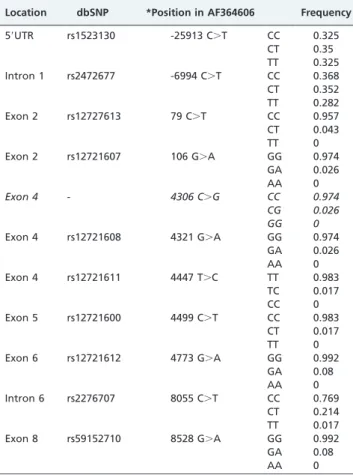
identified in this study are shown in Table 1 along with previously published data from Asian, Caucasian, and African populations. The genotypic frequencies that we found are listed in Table 2. All polymorphisms were in Hardy-Weinberg equilibrium. We identified 11 polymorphisms (Tables 1 and 2), one of which is a new synonymous variant located in exon 4
(4306 C.G) that was present in 1.3 % of Brazilian alleles. Eight polymorphisms were identified in the coding regions of the
PXRgene and 3 polymorphisms in non-coding regions. Of the
variants identified, 8055 C.T, -25913 C.T, and -6994 C.T are known to be associated with functionality.
The 8055 C.T (rs2276707) variant was found in 12.5% of alleles, which is similar to its frequencies in Caucasian and African alleles of 15% and 18% (p.0.05),12respectively, but
lower than its frequency in Chinese alleles of 45% (p ,
0.05).19The -25913 C.T (rs1523130) variant occurred in 50% of the Brazilian alleles, which is less frequent than in Caucasians (70%, p = 0.003, 95% CI: 0.66-0.76) but more frequent than in Africans (28%, p,0.001, 95% CI: 0.49-0.61). The -6994 C.T (rs2472677) polymorphism was found in 46% of the Brazilian alleles, which is a higher frequency than in Africans (38.1%, p = 0.03, 95% CI: 0.80-0.85) but a lower frequency than in Caucasians (62%, p = 0.01, 95% CI: 0.70-0.79).
The 79 C.T (rs12727613) polymorphism was found in 2.1% of Brazilian alleles. This variant is significantly more frequent in African alleles (20%, p,0.001) and not present in Caucasians or Asians. The 106 G.A (rs12721607) polymorphism, which is absent in Asians, was found in 1.3% of alleles in this population, similar to its frequencies in Caucasians and Africans of 5% and 4%, respectively (p,
0.05). The 4321 G.A (rs12721608) polymorphism is absent in Africans but present in Brazilians at a similarly low frequency as that found in Caucasians (p,0.05). The other five polymorphisms were detected at a frequency lower than 1% [4447 T.C (rs12721611), 4499 C.T (rs12721600), 4773 G.A (rs12721612), and 8528 G.A (rs59152710)].
DISCUSSION
PXRpolymorphisms have been implicated in modulating CYP3A4 and PXR expression, potentially accounting for
interindividual differences in drug metabolism.20 These variants impact drug response and some types of drug interactions by affecting serum levels of the medicines and endogenous compounds, which can include PXR ligands and substrates of enzymes and drug transporters.13 The
distribution of allelic variants in thePXRgene varies widely
among different ethnic groups,12,14which helps to explain variations in the pharmacokinetics and pharmacodynamics of drugs that are PXR ligands.
Table 1 -Allelic frequency of polymorphisms in thePXRgene in Brazilians compared to Asians, Caucasians, and Africans.
Location dbSNP
*Position in AF364606
Amino Acid
Change Asians Caucasians Africansa This study
n˚ Frequency n˚ Frequency n˚ Frequency n˚ Frequency
59UTR rs1523130 -25913 C.T - 801 0.67 801 0.70 801 0.28 234 0.50
Intron 1 rs2472677 -6994 C.T - 924 0.62 714# 0.381 234 0.457
Exon 2 rs12727613 79 C.T Pro27Ser 801 0 3002 0 663 0.20 234 0.021
Exon 2 rs12721607 106 G.A Gly36Arg 801 0 801 0.05 801 0.04 234 0.013
Exon 4 - 4306 C.G Arg156Arg 234 0.013
Exon 4 rs12721608 4321 G.A Gln122Arg 1443 0.01 714# 0 234 0.012
Exon 4 rs12721611 4447 T.C Thr164Thr 801 0 801 0 801 0.03 234 0.008
Exon 5 rs12721600 4499 C.T Gly220Gly 234 0.008
Exon 6 rs12721612 4773 G.A Gly317Gly 234 0.004
Intron 6 rs2276707 8055 C.T - 801 0.51 1505 0.15 225 0.18 234 0.125
Exon 8 rs59152710 8528 G.A Ala370Thr 3122 0 642 0.016 234 0.004
aAfrican-American population. n
˚: number of alleles. Data from Asians, Caucasians, and Africans was obtained from1King et al. 2007,2Hustert et al. 2001, 3Wang et al. 2008,4Lamba et al. 2008, and5Zhang et al. 2008.#
Data from sub-Saharan Africans (Svard et al. 2010). Italics: new variant. *Position in relation to translation start site of PXR (NR1I2): GenBank Accession AF364606.
Genetic polymorphisms ofPXRin Brazilians
Moreira RPP et al. CLINICS 2011;66(6):1041-1044
This study was carried out in order to determine the frequency of variants of thePXRgene in a sample of the
Brazilian population. We found 11 polymorphisms in the
PXRgene, including the 4306 C.G substitution in exon 4
that has not been previously described. This variant is not predicted to alter the splice site in exon 4 of thePXRgene
and is unlikely to alter protein function.
The Brazilian population is highly heterogeneous, result-ing from centuries of interbreedresult-ing among peoples from three continents: European colonizers (mostly Portuguese), African slaves, and native Indians.21 Although Brazilians contain approximately 28% of African alleles, we found that the variant C79T (rs12727613), which occurs in 20% of alleles Africans, occurred at a much lower than expected frequency in our sample (2.1%). On the other hand, the –25913 C.T (rs1523130) polymorphism that is present in 28% of African alleles was present at a significantly higher frequency in our population (50%, p = 0.003). We also found that the -6994T.C (rs2472677), which is present in 38% of African alleles, was significantly more frequent in the Brazilian alleles (46%, p = 0.03). Finally, the –25913 C.T and – 6994T.C polymorphisms were not as frequent in the Brazilian alleles as in Caucasian alleles (p,0.05).
Our results are distinctly clustered. This could represent the unique admixture of the regional subpopulation from the southeast region of Brazil, which has similar ancestral
contributions from African (34%), European (31%), and Native American (33%) alleles, in contrast to the higher proportion of African lineages observed in the northeast region.21-23
Our study emphasizes the population-dependent fre-quency of PXR polymorphisms. The polymorphism
fre-quencies found in our sample differ greatly from those previously described in Caucasians and Africans. Our results suggest that variants in the PXR gene should be
considered in pharmacogenetic studies involving Brazilians from the southeast region, since the miscegenation varies from region to region.
ACKNOWLEDGEMENTS
The authors gratefully acknowledge Mr. Ricardo de Paula for language editing.
This research was supported by grants from FAPESP#05/04726-0 and 09/54238-2, RPP Moreira by FAPESP#08/50959-4 and 09/54394-4, and Bachega TASS, Jorge AA, and Mendonca BB by CNPq#305117/ 2009-2,#301477/2009-4, and#301339/2008-9, respectively.
REFERENCES
1. Ingelman-Sundberg M, Oscarson M, McLellan RA. Polymorphic human cytochrome P450 enzymes: an opportunity for individualized drug treatment. Trends Pharmacol Sci. 1999;20:342-9, doi: 10.1016/S0165-6147(99)01363-2.
2. Ozdemir V, Kalow W, Tang BK, Paterson AD, Walker SE, Endrenyi L, et al. Evaluation of the genetic component of variability in CYP3A4 activity: a repeated drug administration method. Pharmacogenetics. 2000;10:373-88, doi: 10.1097/00008571-200007000-00001.
3. Evans WE, Relling MV. Pharmacogenomics: translating functional genomics into rational therapeutics. Science. 1999;286:487-91, doi: 10. 1126/science.286.5439.487.
4. Lamba J, Lamba V, Strom S, Venkataramanan R, Schuetz E. Novel single nucleotide polymorphisms in the promoter and intron 1 of human pregnane X receptor/NR1I2 and their association with CYP3A4 expression. Drug Metab Dispos. 2008;36:169-81, doi: 10.1124/dmd.107. 016600.
5. Rebbeck TR, Jaffe JM, Walker AH, Wein AJ, Malkowicz SB. Modification of clinical presentation of prostate tumors by a novel genetic variant in CYP3A4. J Natl Cancer Inst. 1998;90:1225-9, doi: 10.1093/jnci/90.16.1225. 6. Ball SE, Scatina J, Kao J, Ferron GM, Fruncillo R, Mayer P, et al. Population distribution and effects on drug metabolism of a genetic variant in the 59 promoter region of CYP3A4. Clin Pharmacol Ther. 1999;66:288-94, doi: 10.1016/S0009-9236(99)70037-8.
7. Eiselt R, Domanski TL, Zibat A, Mueller R, Presecan-Siedel E, Hustert E, et al. Identification and functional characterization of eight CYP3A4 protein variants. Pharmacogenetics. 2001;11:447-58, doi: 10.1097/ 00008571-200107000-00008.
8. Bertilsson G, Heidrich J, Svensson K, Asman M, Jendeberg L, Sydow-Backman M, et al. Identification of a human nuclear receptor defines a new signaling pathway for CYP3A induction. Proc Natl Acad Sci U S A. 1998;95:12208-13, doi: 10.1073/pnas.95.21.12208.
9. Kliewer SA, Moore JT, Wade L, Staudinger JL, Watson MA, Jones SA, et al. An orphan nuclear receptor activated by pregnanes defines a novel steroid signaling pathway. Cell. 1998;92:73-82, doi: 10.1016/S0092-8674(00)80900-9.
10. Lehmann JM, McKee DD, Watson MA, Willson TM, Moore JT, Kliewer SA. The human orphan nuclear receptor PXR is activated by compounds that regulate CYP3A4 gene expression and cause drug interactions. J Clin Invest. 1998;102:1016-23, doi: 10.1172/JCI3703.
11. Synold TW, Dussault I, Forman BM. The orphan nuclear receptor SXR coordinately regulates drug metabolism and efflux. Nat Med. 2001;7:584-90, doi: 10.1038/87912.
12. Zhang J, Kuehl P, Green ED, Touchman JW, Watkins PB, Daly A, et al. The human pregnane X receptor: genomic structure and identification and functional characterization of natural allelic variants. Pharmacogenetics. 2001;11:555-72, doi: 10.1097/00008571-200110000-00003.
13. Svard J, Spiers JP, Mulcahy F, Hennessy M. Nuclear Receptor-Mediated Induction of CYP450 by Antiretrovirals: Functional Consequences of NR1I2 (PXR) Polymorphisms and Differential Prevalence in Whites and Sub-Saharan Africans. J Acquir Immune Defic Syndr.
14. Wang XD, Deng XY, Chen J, Li JL, Chen X, Zhao LZ, et al. Single nucleotide polymorphisms of the pregnane x receptor gene in Han Table 2 -Genotypic frequency of polymorphisms in the
PXRgene in Brazilians.
Location dbSNP *Position in AF364606 Frequency
59UTR rs1523130 -25913 C.T CC 0.325
CT 0.35
TT 0.325
Intron 1 rs2472677 -6994 C.T CC 0.368
CT 0.352
TT 0.282
Exon 2 rs12727613 79 C.T CC 0.957
CT 0.043
TT 0
Exon 2 rs12721607 106 G.A GG 0.974
GA 0.026
AA 0
Exon 4 - 4306 C.G CC 0.974
CG 0.026 GG 0
Exon 4 rs12721608 4321 G.A GG 0.974
GA 0.026
AA 0
Exon 4 rs12721611 4447 T.C TT 0.983
TC 0.017
CC 0
Exon 5 rs12721600 4499 C.T CC 0.983
CT 0.017
TT 0
Exon 6 rs12721612 4773 G.A GG 0.992
GA 0.08
AA 0
Intron 6 rs2276707 8055 C.T CC 0.769
CT 0.214
TT 0.017
Exon 8 rs59152710 8528 G.A GG 0.992
GA 0.08
AA 0
Italics: new variant, *Position in relation to translation start site of PXR (NR1I2): GenBank Accession AF364606.
CLINICS 2011;66(6):1041-1044 Genetic polymorphisms ofPXRin Brazilians
Moreira RPP et al.
Chinese and a comparison with other ethnic populations. Pharmacology. 2008;81:350-4, doi: 10.1159/000123687.
15. Wang XD, Li JL, Su QB, Deng XY, Lu Y, Chen J, et al. A pharmacogenetic study of pregnane X receptor (NR1I2) in Han Chinese. Curr Drug Metab. 2007;8:778-86, doi: 10.2174/138920007782798199.
16. King CR, Xiao M, Yu J, Minton MR, Addleman NJ, Van Booven DJ, et al. Identification of NR1I2 genetic variation using resequencing. Eur J Clin Pharmacol. 2007;63:547-54.
17. Zhang B, Xie W, Krasowski MD. PXR: a xenobiotic receptor of diverse function implicated in pharmacogenetics. Pharmacogenomics. 2008;9:1695-709, doi: 10.2217/14622416.9.11.1695.
18. Hustert E, Zibat A, Presecan-Siedel E, Eiselt R, Mueller R, Fuss C, et al. Natural protein variants of pregnane X receptor with altered transactiva-tion activity toward CYP3A4. Drug Metab Dispos. 2001;29:1454-9. 19. Sandanaraj E, Lal S, Selvarajan V, Ooi LL, Wong ZW, Wong NS, et al.
PXR pharmacogenetics: association of haplotypes with hepatic CYP3A4
and ABCB1 messenger RNA expression and doxorubicin clearance in Asian breast cancer patients. Clin Cancer Res. 2008;14:7116-26, doi: 10. 1158/1078-0432.CCR-08-0411.
20. Siccardi M, D’Avolio A, Baietto L, Gibbons S, Sciandra M, Colucci D, et al. Association of a single-nucleotide polymorphism in the pregnane X receptor (PXR 63396C--.T) with reduced concentrations of unboosted atazanavir. Clin Infect Dis. 2008;47:1222-5, doi: 10.1086/592304. 21. Parra FC, Amado RC, Lambertucci JR, Rocha J, Antunes CM, Pena SD.
Color and genomic ancestry in Brazilians. Proc Natl Acad Sci U S A. 2003;100:177-82, doi: 10.1073/pnas.0126614100.
22. Alves-Silva J, da Silva Santos M, Guimaraes PE, Ferreira AC, Bandelt HJ, Pena SD, et al. The ancestry of Brazilian mtDNA lineages. Am J Hum Genet. 2000;67:444-61.
23. Carvalho-Silva DR, Santos FR, Rocha J, Pena SD. The phylogeography of Brazilian Y-chromosome lineages. Am J Hum Genet. 2001;68: 281-6.
Genetic polymorphisms ofPXRin Brazilians
Moreira RPP et al. CLINICS 2011;66(6):1041-1044