Association among depression,
cognitive impairment and executive
dysfunction after stroke
Luisa Terroni1, Matildes F.M. Sobreiro1, Adriana B. Conforto2, Carla C. Adda3, Valeri D. Guajardo1,3, Mara Cristina S. de Lucia3, Renério Fráguas1
ABSTRACT. The relationship between depression and cognitive impairment, frequent after stroke, is complex and has not been sufficiently elucidated. Objective: To review the relationship between post-stroke depression and cognitive impairment. Methods: We performed a PubMed database search spanning the last ten years, using the terms post-stroke depression, cognitive dysfunction, cognitive impairment and neuropsychological tests. Our target studies were original quantitative studies that investigated the relationship between post-stroke depression (PSD) and cognitive impairment in stroke patients. Articles published in English, Spanish, Italian and Portuguese were considered. Selection criteria were the use of neuropsychological tests to assess cognitive function, and of either instruments to diagnose major depression, or scales to assess depressive symptoms, within the first three months after stroke. Results: Six original quantitative studies fulfilled the criteria. The prevalence of PSD within the first three months after stroke ranged from 22% to 31%. Incidence ranged from 25% to 27% and was evaluated in only two studies. PSD was associated with increased cognitive impairment. Cognitive impairment was reported in 35.2% to 87% of the patients. Post-stroke cognitive deficits were reported mostly in executive function, memory, language, and speed of processing. Conclusion: Executive dysfunction and depression occur in stroke survivors, are frequently coexistent, and also associated with worse stroke prognosis. Healthcare professionals need to address and provide adequate treatment for depression and executive dysfunctions in stroke patients early in the first three months after stroke. Future studies should evaluate the efficacy of programs evaluating the early detection and treatment of PSD and executive dysfunction in stroke survivors.
Key words: stroke, depression, cognition impairment, cognition, executive function, dysfunction, neuropsychological assessment.
ASSOCIAÇÃO ENTRE DEPRESSÃO, COMPROMETIMENTO COGNITIVO E DISFUNÇÃO EXECUTIVA APÓS ACIDENTE VASCULAR CEREBRAL RESUMO. A depressão e o déficit cognitivo são frequentes após o acidente vascular cerebral. A relação entre as duas condições é complexa e não tem sido suficientemente elucidada. Objetivo: Fazer uma revisão da relação entre a depressão pós-AVC e prejuízo cognitivo. Métodos: Foi realizada uma pesquisa no banco de dados PubMed nos últimos dez anos. Nosso foco foi estudos quantitativos originais que investigaram a relação entre depressão e comprometimento cognitivo em pacientes com AVC. Os termos depressão, disfunção cognitiva, comprometimento cognitivo e testes neuropsicológicos foram usados para pesquisa. Foram considerados artigos publicados em Inglês, Espanhol, Italiano e Português. Os critérios de seleção foram o uso de testes neuropsicológicos para avaliar a função cognitiva com também o uso de instrumentos para diagnosticar a depressão maior ou escalas para avaliar sintomas depressivos nos primeiros três meses após o AVC. Resultados: Seis estudos quantitativos originais preencheram os critérios de seleção. A prevalência de depressão pós-AVC nos primeiros três meses após o pós-AVC variou de 22% a 31%. A incidência de depressão pós-pós-AVC variou de 25% a 27% e foi avaliada apenas em dois estudos. A depressão pós-AVC esteve associada com comprometimento cognitivo mais acentuado. Disfunção cognitiva pós-AVC foi relatada em 35,2% a 87% dos pacientes. Déficits cognitivos pós-AVC foram encontrados principalmente em função executiva, memória, linguagem e velocidade de processamento. Conclusão: A disfunção executiva e a depressão ocorrem em pacientes de AVC, sendo frequentemente concomitantes e associadas a um pior prognóstico. Os profissionais de saúde devem diagnosticar e fornecer um tratamento adequado para a depressão e disfunção executiva nos primeiros três meses após o AVC. Mais estudos devem avaliar a efetividade de programas de detecção precoce e tratamento da depressão e disfunção executiva pós-AVC.
Palavras-chave: acidente vascular cerebral, depressão, comprometimento cognitivo, cognição, função executiva, testes neuropsicológicos.
1Consultation-Liaison Psychiatry Group, Department and Institute of Psychiatry, Clinics Hospital, Medical School, University of São Paulo, São Paulo SP, Brazil. 2Neurology Department, Clinics Hospital, Medical School, University of São Paulo, Teaching and Research Israeli Institute, Albert Einstein Israeli Hospital, São Paulo SP, Brazil. 3Division of Psychology, Clinics Hospital, Medical School, University of São Paulo, São Paulo SP, Brazil.
Luisa Terroni. Rua Dr. Ovidio Pires de Campos, 785 / 3º andar / sl 13 – 05403-903 São Paulo SP – Brazil. E-mail: [email protected]
INTRODUCTION
D
epression is the most common psychiatric compli-cation of stroke with signiicant prevalence and in-cidence rates. he reported prevalence of major depres-sion within three months after stroke ranges from 22% to 31%.1-5 he incidence rates of major depression afterstroke (PSD) are little explored in the literature because most studies have included patients with past history of depression.2,6-9 hree studies have investigated the
in-cidence of PSD after a stroke, Gainotti et al., reported an incidence of 27% 2-4 months after the stroke;10
Spal-letta et al., found a rate of 25% between 3 weeks and 3 months after stroke,3 and Terroni et al. reported an
in-cidence of 28.8% 3-4 months after irst stroke.11 Besides
its high frequency, depression has a negative impact in the post-stroke phase. PSD, or even depressive symp-toms after stroke, have been associated with increased mortality, greater impairment in physical functioning and language, longer hospitalization, reduced quality of life and cognitive impairments.12-14 Studies have
sup-ported that PSD has underlying biological and psycho-social etiologic factors such as cognitive impairment, fe-male sex, hypercortisolism, poor social network, living alone and previous depression.2,6,9,15-17
Studies on cognitive impairment after stroke have reported rates ranging from 35.2% to 87%.18-20 Similarly
to PSD, cognitive impairment in stroke has been associ-ated with negative outcomes such as reduced functional recovery and increased risk of mortality.18,21-23 Moreover,
cognitive impairment may represent a sign of changes in evolution to degenerative diseases.24 It has been
re-ported that 55% of patients have impairment in at least one cognitive domain,25 and frontal network syndromes
have been found in 51% of subjects.20 Notably,
execu-tive dysfunction has been reported to range from 18% to 40%.26-29
Considering the high prevalence of depression and cognitive impairment, particularly cognitive dysfunc-tion after stroke, their negative impact on prognosis and mortality, and the fact they are comorbid, render it important to study their relationship. hus, the aim of this study was to review the literature on the association between PSD and cognitive impairment.
METHODS
Key words used for this review were “post-stroke depres-sion”, “cognitive impairment”, “cognitive dysfunction”, and “neuropsychological tests”. All studies in PubMed published between 2002 and 2012 retrieved based on these key words by the electronic search were reviewed for inclusion. Reference lists of studies included in the
present review were also searched in order to identify additional citations. Studies in English, Portuguese, Spanish and Italian languages were included. Our target studies were original quantitative studies investigating the relationship between post-stroke depression and cognitive impairment. Inclusion criteria for the present review were as follows: [A] original quantitative study; [B] studies examining cognitive function using neu-ropsychological tests, not only the Mini-Mental State Examination (MMSE); [C] the presence/absence of de-pression determined using a standardized diagnostic interview procedure or valid rating scale for depression; [D] study participants limited to stroke patients; and [E] evaluation performed within the irst three months of stroke. Review articles, case reports and unpublished data were excluded. he search was limited to studies involving adult human participants.
RESULTS
he electronic search yielded forty potential studies for inclusion. Selection of studies involved initial screen-ing of titles and abstracts to determine whether each study might meet the inclusion criteria stated above. A total of 37 studies were excluded. he reasons for exclu-sion were: [A] time period of evaluation longer than 3 months, N=5; [B] Chinese, Romanian, German, Rus-sian, French languages, N=7; [C] reviews, N=5; [D] not depression and cognitive function investigation study, case report study, randomized clinical trial or no use of neuropsychological tests for cognitive evaluations, N=19; and [E] study participants with transient isch-emic attack, N=1. Based on the stated inclusion criteria, three original quantitative studies were identiied for the present review. After manual search, a further three studies were included that also met the inclusion crite-ria for the present review despite having been published before the previously established publication search pe-riod. he reasons behind the decision to include them were: [1] the study performed by Bolla-Wilson et al.30
was the irst to use neuropsychological tests to assess cognitive function; [2] the studies of Pohjasvaara et al.27
and Vataja et al.31 included partially the same cohort of
patients but given the diferent aims and methods em-ployed by the two studies they were both included.
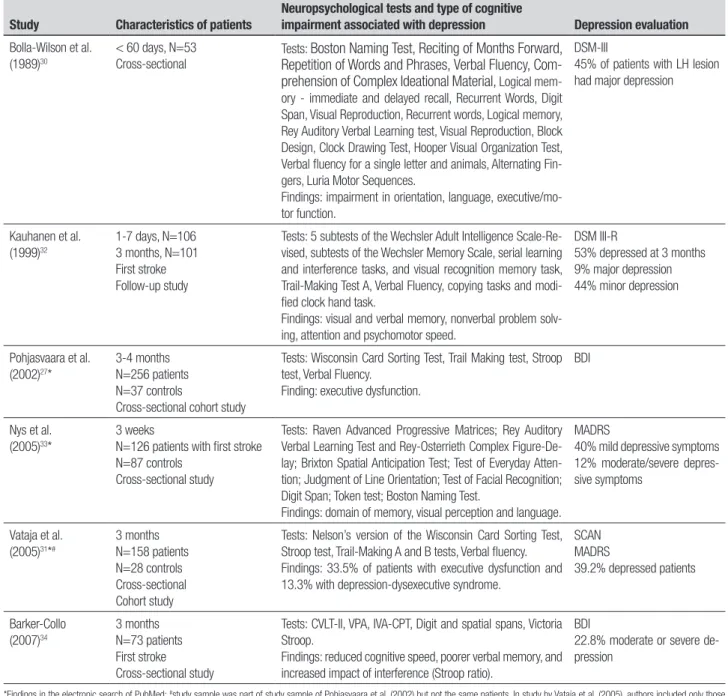
he four original quantitative studies identiied for the present review, as well as the two earlier studies that used neuropsychological tests within three months of stroke,27,31-34 are listed in Table 1.
Association between post-stroke depression and cognitive
relation-ship between depression and cognitive domains (Table 1). he irst found that patients with left hemisphere lesions and major depression performed signiicantly worse compared with non-depressed patients in four of nine cognitive domains.30 he authors concluded that
post-stroke major depression appeared to produce a de-cline in cognitive performance dependent on the lateral-ity of the lesion. Along the same lines, Kauhanen et al.32
examined 106 patients with irst stroke at 1 to 7 days, 3 months and 12 months, after stroke using an extensive battery of neuropsychological tests. he presence of ma-jor depression after stroke was associated with impaired visual and verbal memory, nonverbal problem solving, attention and psychomotor speed at 12 months after stroke.
Recently, the association between depression symp-tomatology and cognitive impairment was investigated in 126 patients with irst stroke at 3 weeks post-stroke.33
Of the included patients, 40% demonstrated mild, and 12% moderate to severe, depressive symptoms. Even after adjusting for lesion size, the neuropsychological proile of patients with moderate to severe depressive symptoms primarily showed compromise of memory, visual perception and language. A signiicant relation-ship was found in this study between severity of depres-sive symptoms and cognitive impairment. Patients with severe depressive symptoms had three times more cog-nitive impairment compared to patients with mild de-pressive symptoms. Interestingly, the authors suggested that depressive symptoms early after stroke are, at least in part, a reactive phenomenon secondary to severe cog-nitive deicits. Along the same line, Barker-Collo found that 74.6% of variance in depression after stroke was explained by signiicant relationships between reduced cognitive speed, poorer verbal memory, and increased impact of interference (Stroop ratio) besides other fac-tors. Cognitive performance explained the greatest pro-portion of variance, 51.3%, in depression. he author concluded that “he indings suggest that cognition and mood are linked over and above physical independence and that both should be addressed as part of the reha-bilitative process”.34
Pohjasvaara et al. initially published a study that included 256 patients, aged 55-85 years, evaluating pa-tients 3 and 4 months after stroke. he authors reported that 40.6% (N=104) of patients had executive dysfunc-tion. Also, executive dysfunction was shown to be as-sociated with depression symptoms.27 Recently, Vataja
et al. described the depression-executive dysfunction syndrome after stroke. hese authors reported that pa-tients with depression-executive dysfunction had more
severe depressive symptoms. hree months after isch-emic stroke, brain infarcts afecting the frontal-subcor-tical circuit structures were signiicantly more frequent in patients with depression-executive dysfunction than in post-stroke subjects without depression-executive dysfunction.31
DISCUSSION
he early studies assessing cognitive function using neuropsychological tests in the irst three months after stroke reported associations between speciic neuropsy-chological proiles and depression. Impairment in ori-entation, language, executive/motor function, memory, attention and psychomotor speed have been associated with depression.30,32 More recently, executive function
impairment has been associated with depression after stroke and some authors have considered the existence of depression-dysexecutive syndrome within three to four months of stroke.27,31 Depression-executive
dys-function syndrome has been deined as late-onset de-pression associated with executive dysfunction.35 he
executive function refers to a set of complex functions some of which include initiation / volition, planning, survey hypotheses, lexibility of thought, decision mak-ing, regulation, judgment, use of feedback and self-perception, amongst others.
Other studies have described the association be-tween severity of PSD and magnitude of cognitive dei-cits.32 Cognitive impairment was shown to be three times
more frequent in patients with more severe depression compared to those with mild symptoms.33 In addition,
depression was more intense in patients with depres-sion-executive dysfunction than in those without.31
Some studies have found that cognitive impairment after stroke is an important predictor of long-term de-pressive symptoms.34 he prognostic value of cognition
suggests a reactive component in the development or continuation of long-term depressive symptoms.36 On
this matter, some authors have proposed that depres-sive symptoms are, at least in part, a secondary reaction to cognitive deicits in post-stroke patients32,37 although
the subject remains controversial. Studies evaluating the efects of treatment of depression on cognitive func-tion have yielded some contribufunc-tions to this quesfunc-tion.
Treatment of PSD has been associated with cogni-tive improvement suggesting that cognicogni-tive impairment is a symptom or consequence of depression.38-42 For
in-stance, Narushima et al.43 reported that in patients with
Further-more, cognitive function remained unchanged in non-depressed patients over a 2-year follow-up. Even when only mood was considered, patients with post-stroke major depression whose mood improved at follow-up had signiicantly greater recovery in cognitive function than patients whose mood did not improve.44
Ameliora-tion of depressive symptoms and cognitive impairment was described after anodal stimulation to the left dorso-lateral prefrontal cortex (DLPFC).40 In this case report,
it was not possible to conclude whether the
improve-ment in cognitive function was secondary to depression improvement or whether the efects were independent of each other. On the other hand, improvement in glob-al cognitive function, speciicglob-ally in verbglob-al and visuglob-al memory functions, was found to be independent of ef-fects on depression after treatment with escitalopram in a randomized trial.45 herefore, we conclude that the
beneicial efect of treatment of depression in the pro-cess of cognitive post-stroke recovery should be further investigated by prospective studies and clinical trials.
Table 1. Studies investigating the association between depression and cognitive function within three months of stroke.
Study Characteristics of patients
Neuropsychological tests and type of cognitive
impairment associated with depression Depression evaluation
Bolla-Wilson et al. (1989)30
< 60 days, N=53 Cross-sectional
Tests: Boston Naming Test,Reciting of Months Forward, Repetition of Words and Phrases,Verbal Fluency, Com-prehension of Complex Ideational Material, Logical mem-ory - immediate and delayed recall, Recurrent Words, Digit Span, Visual Reproduction, Recurrent words, Logical memory, Rey Auditory Verbal Learning test, Visual Reproduction, Block Design, Clock Drawing Test, Hooper Visual Organization Test, Verbal fluency for a single letter and animals, Alternating Fin-gers, Luria Motor Sequences.
Findings: impairment in orientation, language, executive/mo-tor function.
DSM-III
45% of patients with LH lesion had major depression
Kauhanen et al. (1999)32
1-7 days, N=106 3 months, N=101 First stroke Follow-up study
Tests: 5 subtests of the Wechsler Adult Intelligence Scale-Re-vised, subtests of the Wechsler Memory Scale, serial learning and interference tasks, and visual recognition memory task, Trail-Making Test A, Verbal Fluency, copying tasks and modi-fied clock hand task.
Findings: visual and verbal memory, nonverbal problem solv-ing, attention and psychomotor speed.
DSM III-R
53% depressed at 3 months 9% major depression 44% minor depression
Pohjasvaara et al. (2002)27*
3-4 months N=256 patients N=37 controls
Cross-sectional cohort study
Tests: Wisconsin Card Sorting Test, Trail Making test, Stroop test, Verbal Fluency.
Finding: executive dysfunction.
BDI
Nys et al. (2005)33*
3 weeks
N=126 patients with first stroke N=87 controls
Cross-sectional study
Tests: Raven Advanced Progressive Matrices; Rey Auditory Verbal Learning Test and Rey-Osterrieth Complex Figure-De-lay; Brixton Spatial Anticipation Test; Test of Everyday Atten-tion; Judgment of Line OrientaAtten-tion; Test of Facial RecogniAtten-tion; Digit Span; Token test; Boston Naming Test.
Findings: domain of memory, visual perception and language. MADRS
40% mild depressive symptoms 12% moderate/severe depres-sive symptoms
Vataja et al. (2005)31*#
3 months N=158 patients N=28 controls Cross-sectional Cohort study
Tests: Nelson’s version of the Wisconsin Card Sorting Test, Stroop test, Trail-Making A and B tests, Verbal fluency. Findings: 33.5% of patients with executive dysfunction and 13.3% with depression-dysexecutive syndrome.
SCAN MADRS
39.2% depressed patients
Barker-Collo (2007)34
3 months N=73 patients First stroke Cross-sectional study
Tests: CVLT-II, VPA, IVA-CPT, Digit and spatial spans, Victoria Stroop.
Findings: reduced cognitive speed, poorer verbal memory, and increased impact of interference (Stroop ratio).
BDI
22.8% moderate or severe de-pression
Although treatment of depression is efective and can be associated with cognitive recovery, underdiag-nosis of PSD and cognitive disorders after stroke has been reported. Depression may be diagnosed in only 20% to 50% of depressed stroke patients.46 Cognitive
impairments are often inaccurately diagnosed. After ap-plying a screening battery of tests for cognitive evalua-tion, thirty-ive percent of patients was found to have more cognitive impairments than previously diagnosed by the assisting treatment team.47 It should be
remem-bered that programs of cognitive rehabilitation have been proven to be efective.48 hese indings, combined
with high prevalence rates of depression and cognitive impairment, support the need for programs that in-clude interventions to treat both stroke complications, particularly those evaluating the prognostic usefulness and eicacy of treatment over the long-term.21
From a clinical perspective, knowing which patients are at increased risk of developing PSD associated with cognitive impairment may ameliorate prevention, de-tection, and early treatment of both conditions, con-sequently reducing their negative impact on recovery. Both depression and cognitive impairment are
associ-ated with worse stroke outcomes.23,27,49,50 In particular,
impairment of executive function is a robust predictor of poor functional recovery after stroke.27,29 he
depres-sion-executive dysfunction syndrome is a stronger pre-dictor of poor long-term survival than depression itself. Patients with both depression and executive dysfunc-tion have shorter median survival than patients with neither depression nor executive dysfunction (6.6 versus 10.3 years).51
In conclusion, the present review suggests that the asso-ciation between depression and cognitive impairment in the irst three months after stroke is frequent and often underdiagnosed. Based on the current state of knowledge on the association between depression and cognitive impairment after stroke, we propose the fol-lowing plan of action: (a) Implementation of programs to increase diagnosis and treatment of PSD by non-psy-chiatrist physicians; (b) Monitoring and evaluation of programs that include identiication and interventions related to cognitive impairment; (c) Deinition of execu-tive dysfunction as a possible element of a depressive syndrome or a predictor of PSD.
REFERENCES
1. Robinson RG, Starr LB, Lipsey JR, et al. A two-year longitudinal study of post-stroke mood disorders: dynamic changes in associated vari-ables over the first six months of follow-up. Stroke 1984;15:510-517. 2. Astrom M, Adolfsson R, Asplund K. Major depression in stroke patients.
A 3-year longitudinal study. Stroke 1993;24:976-982.
3. Spalletta G, Ripa A, Caltagirone C. Symptom profile of DSM-IV major and minor depressive disorders in first-ever stroke patients. Am J Geriatr Psychiatry 2005;13:108-115.
4. Terroni L, Leite CC, Tinone G, et al. [Poststroke depression: risk factors and antidepressant treatment]. Rev Assoc Med Bras 2003;49:450-459. 5. Hackett ML, Anderson CS. Frequency, management, and predictors of abnormal mood after stroke: the Auckland Regional Community Stroke (ARCOS) study, 2002 to 2003. Stroke 2006;37:2123-2128.
6. Vataja R, Pohjasvaara T, Leppavuori A, et al. Magnetic resonance imag-ing correlates of depression after ischemic stroke. Arch Gen Psychiatry 2001;58:925-931.
7. Aben I, Verhey F, Strik J, et al. A comparative study into the one year cumulative incidence of depression after stroke and myocardial infarc-tion. J Neurol Neurosurg Psychiatry 2003;74:581-585.
8. Robinson RG, Price TR. Post-stroke depressive disorders: a follow-up study of 103 patients. Stroke 1982;13:635-641.
9. Provinciali L, Paolucci S, Torta R, et al. Depression after first-ever isch-emic stroke: the prognostic role of neuroanatomic subtypes in clinical practice. Cerebrovasc Dis 2008;26:592-599.
10. Gainotti G, Azzoni A, Marra C. Frequency, phenomenology and ana-tomical-clinical correlates of major post-stroke depression. Br J Psy-chiatry 1999;175:163-167.
11. Terroni L, Fraguas R, Lucia M, et al. Importance of retardation and fa-tigue/interest domains for the diagnosis of major depressive episode after stroke: a four months prospective study. Rev Bras Psiquiatr 2009; 31:202-207.
12. Parikh RM, Robinson RG, Lipsey JR, et al. The impact of poststroke depression on recovery in activities of daily living over a 2-year follow-up. Arch Neurol 1990;47:785-789.
13. Burvill PW, Johnson AK, Jamrozik KD, et al. Prevalence of Depres-sion After Stroke: The Perth Community Stroke Study. Br J Psychiatry 1995;166:320-327.
14. King RB. Quality of life after stroke. Stroke 1996;27:1467-1472. 15. Andersen G, Vestergaard K, Ingemann-Nielsen M, et al. Risk factors for
post-stroke depression. Acta Psychiatr Scand 1995;92:193-198. 16. Robinson RG, Kubos KL, Starr LB, et al. Mood disorders in stroke
pa-tients. Importance of location of lesion. Brain 1984;107 ( Pt 1):81-93. 17. Aben I, Verhey F. Depression after a cerebrovascular accident. The
im-portance of the integration of neurobiological and psychosocial patho-genic models. Panminerva Med 2006;48:49-57.
18. Tatemichi TK, Desmond DW, Stern Y, et al. Cognitive impairment af-ter stroke: frequency, pataf-terns, and relationship to functional abilities. J Neurol Neurosurg Psychiatry 1994;57:202-207.
19. Hoffmann M. Stroke in the young: The multiethnic prospective durban stroke data bank results. J Stroke Cerebrovasc Dis 1998;7:404-413. 20. Hoffmann M, Schmitt F, Bromley E. Vascular cognitive syndromes:
relation to stroke etiology and topography. Acta Neurol Scand 2009; 120:161-169.
21. Barker-Collo S, Feigin V. The impact of neuropsychological deficits on functional stroke outcomes. Neuropsychol Rev 2006;16:53-64. 22. Farner L, Wagle J, Engedal K, et al. Depressive symptoms in stroke
pa-tients: a 13 month follow-up study of patients referred to a rehabilitation unit. J Affect Disord 2010;127:211-218.
23. Hobson P, Meara J. Cognitive function and mortality in a community-based elderly cohort of first-ever stroke survivors and control subjects. J Stroke Cerebrovasc Dis 2010;19:382-387.
24. O’Brien JT, Erkinjuntti T, Reisberg B, et al. Vascular cognitive impair-ment. Lancet Neurol 2003;2:89-98.
25. Madureira S, Guerreiro M, Ferro JM. Dementia and cognitive impair-ment three months after stroke. Eur J Neurol 2001;8:621-627. 26. Nys GM, van Zandvoort MJ, de Kort PL, et al. Cognitive disorders in
27. Pohjasvaara T, Leskela M, Vataja R, et al. Post-stroke depression, exec-utive dysfunction and functional outcome. Eur J Neurol 2002;9:269-275. 28. Ballard C, Stephens S, Kenny R, et al. Profile of neuropsychological def-icits in older stroke survivors without dementia. Dement Geriatr Cogn Disord 2003;16:52-56.
29. Lesniak M, Bak T, Czepiel W, et al. Frequency and prognostic value of cognitive disorders in stroke patients. Dement Geriatr Cogn Disord 2008;26:356-363.
30. Bolla-Wilson K, Robinson RG, Starkstein SE, et al. Lateralization of demen-tia of depression in stroke patients. Am J Psychiatry 1989;146:627-634. 31. Vataja R, Pohjasvaara T, Mantyla R, et al. Depression-executive dys-function syndrome in stroke patients. Am J Geriatr Psychiatry 2005; 13:99-107.
32. Kauhanen M, Korpelainen JT, Hiltunen P, et al. Poststroke depression correlates with cognitive impairment and neurological deficits. Stroke 1999;30:1875-1880.
33. Nys GM, van Zandvoort MJ, van der Worp HB, et al. Early depressive symptoms after stroke: neuropsychological correlates and lesion char-acteristics. J Neurol Sci 2005;228:27-33.
34. Barker-Collo SL. Depression and anxiety 3 months post stroke: preva-lence and correlates. Arch Clin Neuropsychol 2007;22:519-531. 35. Alexopoulos GS, Meyers BS, Young RC, et al. Clinically defined
vascu-lar depression. Am J Psychiatry 1997;154:562-565.
36. Nys GM, van Zandvoort MJ, van der Worp HB, et al. Early cognitive impairment predicts long-term depressive symptoms and quality of life after stroke. J Neurol Sci 2006;247:149-156.
37. Verdelho A, Henon H, Lebert F, et al. Depressive symptoms after stroke and relationship with dementia: A three-year follow-up study. Neurology 2004;62:905-911.
38. Kimura M, Robinson RG, Kosier JT. Treatment of cognitive impairment after poststroke depression: a double-blind treatment trial. Stroke 2000; 31:1482-1486.
39. Simis S, Nitrini R. Cognitive improvement after treatment of depres-sive symptoms in the acute phase of stroke. Arq Neuropsiquiatr 2006;64:412-417.
40. Bueno VF, Brunoni AR, Boggio PS, et al. Mood and cognitive effects of transcranial direct current stimulation in post-stroke depression. Neuro-case 2011;17:318-322.
41. Sato S, Yamakawa Y, Terashima Y, et al. Efficacy of milnacipran on cog-nitive dysfunction with post-stroke depression: preliminary open-label study. Psychiatry Clin Neurosci 2006;60:584-589.
42. Spalletta G, Guida G, Caltagirone C. Is left stroke a risk-factor for selec-tive serotonin reuptake inhibitor antidepressant treatment resistance? J Neurol 2003;250:449-455.
43. Narushima K, Chan KL, Kosier JT, et al. Does cognitive recovery after treatment of poststroke depression last? A 2-year follow-up of cogni-tive function associated with poststroke depression. Am J Psychiatry 2003;160:1157-1162.
44. Murata Y, Kimura M, Robinson RG. Does cognitive impairment cause post-stroke depression? Am J Geriatr Psychiatry 2000;8:310-317. 45. Jorge RE, Acion L, Moser D, et al. Escitalopram and enhancement
of cognitive recovery following stroke. Arch Gen Psychiatry 2010;67: 187-196.
46. Schubert DS, Taylor C, Lee S, et al. Detection of depression in the stroke patient. Psychosomatics 1992;33:290-294.
47. Edwards DF, Hahn MG, Baum CM, et al. Screening patients with stroke for rehabilitation needs: validation of the post-stroke rehabilitation guidelines. Neurorehabil Neural Repair 2006;20:42-48.
48. Miotto EC, Sato J, Lucia MC, et al. Development of an adapted version of the Boston Naming Test for Portuguese speakers. Rev Bras Psiquiatr 2010;32:279-282.
49. Zhou B, Zhao Q, Teramukai S, et al. Executive function predicts sur-vival in Alzheimer disease: a study in Shanghai. J Alzheimers Dis 2010;22:673-682.
50. Johnson JK, Lui LY, Yaffe K. Executive function, more than global cog-nition, predicts functional decline and mortality in elderly women. J Gerontol A Biol Sci Med Sci 2007;62:1134-1141.