Kanji and Kana agraphia in mild cognitive
impairment and dementia
A trans-cultural comparison of elderly Japanese
subjects living in Japan and Brazil
Kyoko Akanuma
1, Kenichi Meguro
1, Mitsue Meguro
1,
Rosa Yuka Sato Chubaci
2, Paulo Caramelli
3, Ricardo Nitrini
4Abstract – This study verifies the environmental effects on agraphia in mild cognitive impairment and dementia. We compared elderly Japanese subjects living in Japan and Brazil. Methods: We retrospectively analyzed the database of the Prevalence Study 1998 in Tajiri (n=497, Miyagi, Japan) and the Prevalence Study 1997 of elderly Japanese immigrants living in Brazil (n=166, migrated from Japan and living in the São Paulo Metropolitan Area). In three Clinical Dementia Rating (CDR) groups, i.e., CDR 0 (healthy), CDR 0.5 (questionable dementia), and CDR 1+ (dementia) , the Mini-Mental State Examination (MMSE) item of spontaneous writing and the Cognitive Abilities Screening Instrument (CASI) domain of dictation were analyzed with regard to the number of Kanji and Kana characters. Formal errors in characters and pragmatic errors were also analyzed. Results: The immigrants in Brazil wrote similar numbers of Kanji or Kana characters compared to the residents of Japan. In spontaneous writing, the formal Kanji errors were greater in the CDR 1+ group of immigrants. In writing from dictation, all the immigrant CDR groups made more formal errors in Kana than the Japan residents. No significant differences in pragmatic errors were detected between the two groups. Conclusions: Subjects living in Japan use Kanji frequently, and thus the form of written characters was simplified, which might be assessed as mild formal errors. In immigrants, the deterioration in Kanji and Kana writing was partly due to decreased daily usage of the characters. Lower levels of education of immigrants might also be related to the number of Kanji errors. Key words: agraphia, mild cognitive impairment, dementia, Kanji, Kana.
Agrafia para Kanji e Kana em comprometimento cognitivo leve e demência: comparação transcultural de indivíduos idosos morando no Japão e Brasil
Resumo – Este estudo verifica os efeitos do meio ambiente sobre a agrafia em comprometimento cognitivo leve e demência. Nós comparamos indivíduos idosos vivendo no Japão e Brasil. Métodos: Nós, retrospectivamente, analisamos a base de dados do Estudo de Prevalência 1998 em Tajiri (n=497, Miyagi, Japão) e do Estudo de Prevalência 1997 de imigrantes idosos japoneses vivendo no Brasil (n=166, imigrados do Japão e residindo na área metropolitana da cidade de São Paulo). Em três grupos de CDR (Clinical Dementia Rating), isto é, CDR 0 (saudáveis), CDR 0.5 (demência questionável) e CDR1+ (demência), o item de escrita espontânea do Mini-Exame do Estado Mental (MEEM) e o domínio de ditado do Cognitive Abilities Screening Instrument (CASI) foram analisados em relação ao número de caracteres em Kanji e Kana. Erros formais nos caracteres e erros pragmáticos foram também analisados. Resultados: Os imigrantes no Brasil escreveram número similar de caracteres de Kanji e Kana comparados aos residentes no Japão. Na escrita espontânea, os erros formais de Kanji foram maiores no grupo de CDR1+ em imigrantes. Na escrita sob ditado, todos os grupos de CDR de imigrantes fizeram mais
1Department of Geriatric Behavioral Neurology, Tohoku University Graduate School of Medicine, Sendai, Japan. 2Department of Nursing, University of
São Paulo School of Medicine, São Paulo SP, Brazil. 3Behavioral and Cognitive Neurology Unit, Department of Internal Medicine, Faculty of Medicine,
Federal University of Minas Gerais, Minas Gerais BH, Brazil. 4Department of Neurology, University of São Paulo School of Medicine, São Paulo SP, Brazil.
Kenichi Meguro – Department of Geriatric Behavioral Neurology, Tohoku University Graduate School of Medicine, 2-1, Seiryo-machi, Aoba-ku, 980-8575 Sendai, Japan. E-mail: [email protected]
Disclosure: The authors report no conflicts of interest.
erros formais em Kana do que os residentes no Japão. Nenhuma diferença foi encontrada em erros pragmáticos entre os grupos. Conclusões: Sujeitos vivendo no Japão usam Kanji freqüentemente, e então, a forma de caracteres escritos foi simplificada, o que pode ser avaliado como discretos erros formais. Em imigrantes, a deterioração na escrita em Kanji e Kana foi parcialmente devida ao uso diário restrito dos caracteres. Baixos níveis educacionais dos imigrantes podem estar relacionados ao número de erros em Kanji.
Palavras-chave: agrafia, comprometimento cognitivo leve, demência, Kanji, Kana.
Agraphia, or impairment of the ability to write, is clas-sified into central or peripheral types in the classic cog-nitive model.1 Namely “central agraphia” means spelling
errors in legible words associated with disrupted word se-lection. “Peripheral agraphia” consists of mechanical dis-tortions of writing. This includes “constructive agraphia,” which involves omissions or additions of letters.2 Recently,
the term “dysexecutive agraphia”3 was proposed for a form
of peripheral dysgraphia in which complex aspects of writ-ing, such as plannwrit-ing, narrative coherence, and maintained attention, are significantly disturbed in cases of impair-ment of executive functions. Frontal lobe damaged patients not only have difficulties in maintaining the effort required for writing, but also in organizing ideas when writing texts.
Language disorders are major neuropsychiatric symp-toms of degenerative dementia4 and Alzheimer’s disease
(AD).5 Due to semantic memory impairment, patients with
AD show “surface dysgraphia”, in which the writing of dic-tated words with an irregular or atypical sound-spelling correspondence (e.g. blood) is significantly impaired rela-tive to regular words (e.g. bland).6 This is because irregular
words generally cannot be correctly written without know-ing the meanknow-ing. The majority of errors are thus phonolog-ically plausible renderings of the target words (e.g. honor
to ONER).7 Luzzatti et al.8 have reported multiple patterns
of impairment in AD. However, no studies in a community have reported on dysgraphia of mild cognitive impairment (MCI),9 which is considered to be the prodromal stage of
AD and other dementia.10
There are two kinds of scripts in the Japanese writing system, i.e., Kanji (logogram) and Kana (morphogram). Generally, Kanji words are thought to correspond to ir-regular words, whereas Kana words are considered to cor-respond to regular words in Western languages. We pre-viously reported Kanji-predominant dyslexia, or reading impairment, in advanced AD.11 However, dysgraphia,
es-pecially Kanji writing impairment, should be considered in relation to educational levels and the language environ-ment. In this regard, it would be useful to examine mi-grants who received education at elementary schools in the mother land before emigrating to another language environment.
Brazil is the country with the largest population of Japanese immigrants. In 1997, we surveyed elderly Japa-nese immigrants from Miyagi Prefecture, Japan, currently living in the São Paulo Metropolitan Area, and reported on the prevalence of dementia.12-14 The elderly immigrants
had received education at elementary schools in Japan and emigrated to Brazil with their parents at the mean age of 14. In mostly the same year, we also surveyed Japanese el-derly subjects in Tajiri, Miyagi Prefecture, Japan.15 The two
populations were examined systematically with the same neuropsychological tests. In this study we further analyzed the two sets of data, focusing on writing tasks. This is the first comparative community-based study of agraphia in elderly Japanese subjects living in Japan and in another country with a different language environment. To study the environmental effects on agraphia in mild cognitive impairment and dementia, we compared elderly Japanese subjects living in Japan and Brazil.
Methods
Japanese elderly subjects in Miyagi Prefecture
We retrospectively analyzed the database of Prevalence Study 1998 (n=625) in Tajiri, Miyagi Prefecture, Japan. The detailed methodology for selecting subjects was described previously.15 There were 412 subjects with Clinical
De-mentia Rating (CDR) [16] 0 (healthy), 168 with CDR 0.5 (questionable dementia), and 45 with CDR 1+ (dementia). Compared to the CDR 0 group, the CDR 0.5 group was older and had a lower educational level, and the CDR 1+ group was older.
Japanese elderly immigrants from Miyagi Prefecture living in the São Paulo Metropolitan Area
We also analyzed the database of Japanese elderly im-migrants from Miyagi Prefecture living in the São Paulo Metropolitan Area (n=166). The detailed methodology for selecting subjects was described previously.12-14 They
in Brazil do not receive systematic learning. They received Japanese education in Japan before immigration at their mean age of 14 and their language environment had been dramatically changed. In the Japanese community they can use Kanji and Kana for writing letters, but it depends on the subjects.
Writing tasks
Spontaneous writing
The spontaneous writing item of the Mini-Mental State Examination (MMSE)17 was used. An A4-sized sheet
of white paper was presented to the subjects for them to write whatever sentence they imagined.
Writing from dictation
The dictation domain of the Cognitive Abilities
Screen-ing Instrument (CASI)18 was used. Subjects were asked to
write the dictated words “Watashi wa ie ni kaeritai” which means “I would like to go home.” This sentence is written with three Kanji and five Kana characters.
Analyses
The numbers of Kanji and Kana characters were counted and analyzed with two-way (subjects, CDR groups) ANOVA, so did formal errors of characters. We herein defined the “formal” errors as any types of incorrect patterns of Kana and Kanji characters. They included “central agraphia” which means spelling errors in legible words associated with disrupted word selection, as well as “peripheral agraphia “which consists of mechanical distortions of writing.
Number of Kanji characters Formal errors of Kanji 12
8
4
0
CDR 0 CDR 0.5 CDR 1+ CDR 0 CDR 0.5 CDR 1+ 15%
Taijiri
10%
5%
0
Immigrants
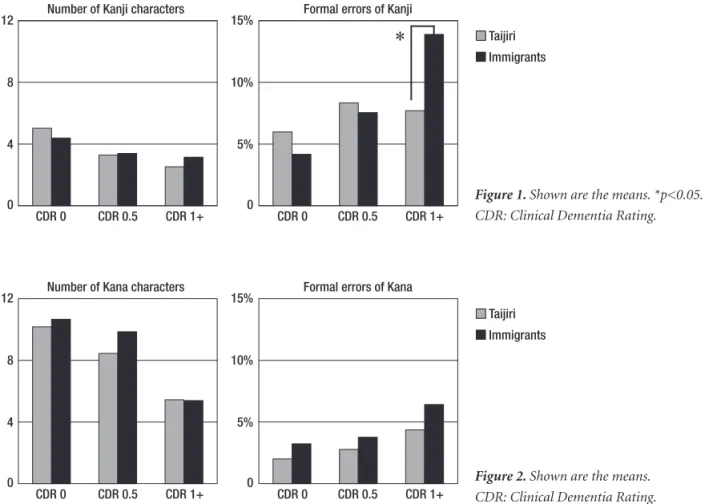
Figure 1. Shown are the means. *p<0.05. CDR: Clinical Dementia Rating.
Number of Kana characters Formal errors of Kana
CDR 0 CDR 0.5 CDR 1+ CDR 0 CDR 0.5 CDR 1+ 12
8
4
0
15%
10%
5%
0
Taijiri
Immigrants
Figure 2. Shown are the means. CDR: Clinical Dementia Rating.
Table 1. Demographics of two study populations.
CDR 0 CDR 0.5 CDR 1+
n age education n age education n age education
Tajiri 412 72.2 8.3 168 76.4* 7.5* 45 81.4* 8.0
Immigrants 104 76.1 8.8 49 78.4 6.4 13 85.5** 5.3**
Results
Spontaneous writing task
Figure 1 shows the Kanji results for the spontaneous writing task. For the number of Kanji characters, a two-way ANOVA disclosed that there was no subjects (Tajiri vs immigrants) difference (F=0.917, p=0.339); however, there was a CDR group difference (F=5.669. p=0.004). For the formal errors of Kanji, there was no subjects dif-ference (F=0.519, p=0.476); however, there was a CDR group difference (F=4.005, p=0.019). Post hoc chi-square test showed that there were more errors in the migrant CDR 1+ group (p<0.05).
Figure 2 shows the Kana results for the spontaneous writing task. For the number of Kana characters, a two-way ANOVA disclosed that there was no subjects (Tajiri vs immigrants) difference (F=0.822, p=0.365), nor did a CDR group difference (F=1.513, p=2.222). For the formal errors of Kana, there was no subjects difference (F=0.713, p=0.399), nor did a CDR group difference (F=0.599, p=0.550). The migrants in Brazil and residents of Japan wrote a similar number of characters.
Dictation task
Figure 3 shows the Kanji results for the dictation task.
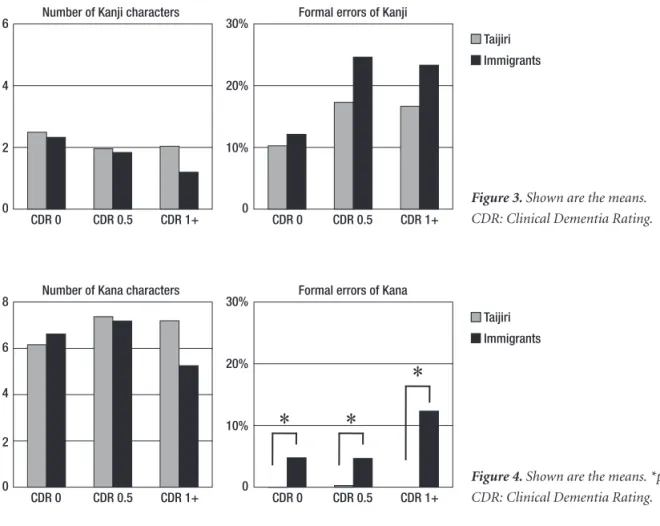
For the number of Kanji characters, a two-way ANOVA disclosed that there was no subjects (Tajiri vs immigrants) difference (F=0.263, p=0.259); however, there was a CDR group difference (F=28.014, p<0.001). For the formal er-rors of Kanji, there was no subjects difference (F=0.384, p=0.536); however, there was a CDR group difference (F=5.020, p=0.007). The migrants in Brazil and residents of Japan wrote a similar number of characters, however, there tended to be more errors in the migrant CDR 0.5 and CDR 1+ groups.
Figure 4 shows the Kana results for the dictation task. For the number of Kana characters, a two-way ANOVA disclosed that there was no subjects (Tajiri vs immigrants) difference (F=3.356, p=0.068); however, there was a CDR group difference (F=14.396, p<0.001). For the formal er-rors of Kana, there was a subjects difference (F=21.264, p<0.001); however, there was no CDR group difference (F=2.853, p=0.059). Post hoc chi-square test showed that there were more errors in the migrant with all CDR groups (p<0.01).
“Watashi wa ie ni kaeritai” which means “I would like
to go home,” of which the “wa” should be written 「は」
pronounced as “HA” as a particle. This was the most com-mon error by the immigrants.
Number of Kanji characters Formal errors of Kanji
CDR 0 CDR 0.5 CDR 1+ CDR 0 CDR 0.5 CDR 1+ 6
4
2
0
30%
20%
10%
0
Taijiri
Immigrants
Number of Kana characters Formal errors of Kana
CDR 0 CDR 0.5 CDR 1+ CDR 0 CDR 0.5 CDR 1+ 8
6
2 4
0
30%
20%
10%
0
Taijiri
Immigrants
Figure 3. Shown are the means. CDR: Clinical Dementia Rating.
Discussion
We should note the methodological issues first. We herein retrospectively analyzed the databases of two stud-ies, Prevalence Study 1998 in Tajiri (Miyagi Prefecture, Japan)15 and Prevalence Study 1997 in the São Paulo
Met-ropolitan Area (Japanese immigrants from Miyagi Prefec-ture).12-14 The two surveys were performed mostly in the
same year, and the tasks were standardized items systemati-cally performed in the same way. Since the two databases were from standard epidemiologic studies, we were only able to compare the MMSE item of spontaneous writing and the CASI domain of dictation. More sophisticated neuropsychological tasks would provide a better basis for comparison. Despite these limitations, we were able to pro-vide some useful findings regarding the writing of Kanji and Kana characters in different language environments.
According to the classic cognitive model of Kanji and Kana, spontaneous writing and writing from dictation are both initiated in Wernicke’s area, which then gives rise to two separate pathways to motor areas. Kanji writing de-pends on the pathway that passes to the posterior inferior temporal gyrus, and then through the occipital lobe and angular gyrus. This pathway is presumed to be involved in phoneme-semantic matching (Wernicke’s area and left temporal lobe), selection of Kanji graphemes according to the meaning (left posterior inferior temporal lobe),19
retrieval of physical forms of the target letter (occipital lobe), and eliciting corresponding motor engrams. Kana writing may be elicited by activation in Wernicke’s area that passes directly to the angular gyrus and then to the anterior speech-motor areas.20,21
Usually Japanese people learn 47 Kana characters at home and learn Kanji at school. More than 2,000 Kanji are taught at elementary school. Kanji are more visually complex than Kana. The angular gyrus is thought to be as-sociated with the recall of both Kanji and Kana characters. Our previous study indicated that the posterior inferior temporal cortex is also involved in the recall of Kanji, since this area is involved in visual information processing.
The “formal” errors in this study included “central agraphia” which means spelling errors in legible words associated with disrupted word selection, as well as “pe-ripheral agraphia” which consists of mechanical distortions of writing. The “central agraphia” patterns were noted in immigrants probably due to their problems of Japanese Kanji and Kana words selection. The “peripheral agraphia” patterns were found in Japanese subjects, probably due to frequent usage of their own writings, seemingly assessed as the “formal errors.”
This study showed that elderly people living in Tajiri, Japan, were able to write Kana almost perfectly, with a slight
deterioration in Kanji writing. They used Kanji frequently, and thus the form of written characters was slightly simpli-fied, which might be assessed as a mild formal error. For elderly migrants from Japan living in Brazil, the deteriora-tion of Kanji and Kana writing was partly due to less fre-quent daily usage of the characters. Lower levels of school education might also affect their writing, especially of Kan-ji characters. Also, the environment of Portuguese language and writing, and Roma-ji writing (alphabetical writing of Japanese) might also distort the writing of Kana characters.
Acknowledgments – We wish to thank all the Japanese
immigrants and their families who cooperated with our study. We also appreciate the cooperation of the officials of the Miyagi Kenjinkai Association, especially Mr. Y. Sato, Mr. K. Nakazawa, and Mr. U. Suzuki.
References
1. Rapcsak SZ. Disorders of writing. In LJG Rothi, KM. Heilman (Eds), Apraxia: The neuropsychology of action. East Sussex: Psychology Press; 1997:149-172.
2. Ardila A, Rosselli M. Spatial agraphia. Brain Cogn 1993;22: 137-147.
3. Ardila A, Surloff C. Dysexecutive agraphia: a major executive dysfunction sign. Int J Neurosci 2006;116:653-663.
4. Fukui T, Lee E. Progressive agraphia can be a harbinger of degenerative dementia. Brain Lang 2008;104:201-210. 5. Hughes JC, Graham N, Patterson K, Hodges JR. Dysgraphia in
mild dementia of Alzheimer’s type. Neuropsychologia 19997; 35:533-545.
6. Rapcsak SZ, Arthur SA, Bliklen DA, Rubens AB. Lexical agraphia in Alzheimer’s disease. Arch Neurol 1989;46:65-68. 7. Glosser G, Kaplan E. Linguistic and non-linguistic impair-ments in writing: A comparison of patients with focal and multifocal CNS disorders. Brain Lang 1989;37:357-380. 8. Luzzatti C, Laiacona M, Agazzi D. Multiple patterns of
writ-ing disorders in dementia of the Alzheimer’s type and their revolution. Neuropsychologia 2003;41:759-772.
9. Petersen RC, Smith GE, Waring SC, Ivnik RJ, Kokmen E, Tan-gelos EG. Aging, memory, and mild cognitive impairment. Int Psychogeriatr 1997;19:65-69.
10. Morris JC, Storandt M, Miller JP, et al. Mild cognitive impair-ment represents early-stage Alzheimer disease. Arch Neurol 2001;58:397-405.
11. Nakamura K, Meguro K, Yamazaki H, et al. Kanji-predom-inant alexia in advanced Alzheimer’s disease. Acta Neurol Scand 1998;97:237-243.
13. Meguro K, Meguro M, Caramelli P, et al. Elderly Japanese emigrants to Brazil before World War II: II. Prevalence of senile dementia. Int J Geriatr. Psychiatry 2001;16:775-779. 14. Meguro K, Meguro M, Caramelli P, et al. An environmental
change does not affect dementia prevalence but affects de-pressive state and physical activity: A trans-cultural study of Japanese elderly subjects and Japanese elderly immigrants in Brazil. Psychogeriatrics 2001;1:201-208.
15. Meguro K, Ishii H, Yamaguchi S, et al. Prevalence of demen-tia and dementing diseases in Japan: The Tajiri Project. Arch Neurol 2002;59:1109-1114.
16. Hughes CP, Berg L, Danziger WL, Coben LA, Martin RL. A new clinical scale for the staging of dementia. Br J Psychiatry 1986;140:566-572.
17. Folstein MF, Folstein SE, McHugh PR. “Mini-Mental State”
A practical method for grading the cognitive state of patients for the clinician. J Psychiatr Res 1975;12:189-198.
18. Teng EL, Hasegawa K, Homma A, et al. The Cognitive Ability Screening Instrument (CASI): A practical test for cross-cul-tural epidemiological studies of dementia. Int Psychogeriatr 1994;6:45-58.
19. Nakamura K, Honda M, Okada T, et al. Participation of the left posterior inferior temporal cortex in writing and mental recall of kanji orthography. Brain 2000;123:954-967. 20. Iwata M. Kanji versus Kana: Neuropsychological correlates
of the Japanese writing system. Trends Neurosci 1984;8: 290-293.