FREE THEMES
1 Instituto Federal de Educação, Ciência e Tecnologia de São Paulo. Av. Zélia de Lima Rosa 100, Portal dos Pássaros. 18550-000 Boituva SP Brasil. [email protected] 2 Universidade Estadual de Londrina. Londrina PR Brasil.
3 Universidade Norte do Paraná. Londrina PR Brasil.
4 Brunel University London. Uxbridge Londres Reino Unido.
Overweight and obesity are not associated
to high blood pressure in young people sport practitioners
Abstract The aim of this study was to analyze the association between overweight and obesi-ty with high blood pressure (HBP) according to sports practice in young people. Took part in this study 636 young people aged 10 to 17 years of Londrina, Parana State, Brazil. Sex, age, paren-tal education, sedentary behavior, sports prac-tice, nutritional status and blood pressure were analysed. Poisson regression was used to estimate the prevalence ratio (PR) and 95% confidence intervals. Overweight and obesity young people showed higher prevalence of HBP compared to eutrophics when analysed the total sample (25,7 e 29,5 vs 15,2%) and non sport practitioners (29,7 e 33,3 vs 15,1%), which did not occur with sports practitioners (17,1 e 18,2 vs 15,5%). Positive as-sociations were found between overweight and obesity with HBP in total sample (PR = 1,60, 1,02-2,52 and 1,93, 1,15-3,25) and on non sport practitioners (RP = 1,80, 1,05-3,14 and 2,15, 1,10-4,16). For young people sports practitioners were not found associations between overweight and obesity with HBP (PR = 1,01, 0,36-2,82 and 1,09, 0,48-2,48). Weight excess was not associated with HBP in young people sports practitioners, suggesting cardiovascular protection in young people with overweight and obesity.
Key words Adolescent, Motor activity,
Nutri-tional status, Hypertension
Diogo Henrique Constantino Coledam 1
Philippe Fanelli Ferraiol 2
Raymundo Pires Júnior 3
João Paulo de Aguiar Greca 4
C
ole
dam DHC Introduction
High blood pressure (HBP) is an important health risk because it increases the likelihood of being affected by cardiovascular disease in
adults1 and presents the highest risk fraction
at-tributed to mortality2. HBP is also an indicator
of cardiovascular health in young people because it is positively associated with arterial stiffness, reduced diastolic function, intima-media carotid artery thickness, and cardiac hypertrophy of the
left ventricle3-6. As well as presenting health risks
to young people, HBP is related to resistance to
insulin, leptin and blood pressure in adult life7,
which suggests the importance of preventing HBP in childhood and adolescence.
Despite the risks that are known to be
asso-ciated with HBP, a systematic review8
demon-strated that the prevalence of HBP ranged from 2.7 to 30.9% in children and adolescents from different regions of Brazil. Of the 21 studies in-cluded in the review, 12 reported a prevalence of
HBP higher than 10%8. Studies conducted after
the aforementioned systematic review reported a
prevalence of HBP ranging from 12.4 to 19.4%
9-11.
It has been reported that HBP is associat-ed with behavioral, biological and herassociat-editary
characteristics12. One of the behavioral aspects
that have been widely studied in young people is physical activity, which can be defined as any bodily movement produced by skeletal muscles
that result in expending energy13. The physical
activity of children and adolescents is
predomi-nantly conducted via sports14
, which are defined
as games using rules regulated by a federation and which have various objectives such as
edu-cation, recreation, health or performance15. The
literature contains controversial findings regard-ing the association between physical activity and HBP. Some studies have shown an inverse association between physical activity and blood
pressure in young people16-20
, while others have
shown no such association9,11,21-23. A systematic
review showed that the number of studies that showed an association between physical activity with blood pressure was lower than the studies
that showed no association24.
Among other associated factors, the condi-tions of being overweight and obese are consid-ered to be the determing factors of HBP because they trigger several physiological mechanisms
that result in HBP in young people25. For this
reason, overweight young people are 1.66 to 4.30 while obese are 5.19 to 5.40 more likely to have
HBP compared to eutrophic9-11,18,22,26. The studies
that are available in the literature have not inves-tigated the association between overweight and obesity with HBP according to sports practice. It prevents to infer whether overweight and obese young people are more likely to suffer from HBP even if they practice sports.
Thus, the aim of this study was to analyze the association between overweight and obesity with HBP according to sports practice in young people.
Methods
This transversal study was conducted in state schools in the city of Londrina, Paraná, Brazil from April to July 2012. According to the Region-al Education Center, the number of students in the sixth year of elementary school to the third year of secondary school was 55,475. The stu-dents who participated in the study were aged 10-17. The study sample was performed using the probabilistic method utilizing two clusters (school and classroom), which were stratified by regions of the city (north, south, east, west and center) and gender. The study was performed in two stages. In the first stage, one school was ran-domly chosen from each region. In the second stage, the number of students in each school was evaluated in order to select the ratio that repre-sented the region.
The sample calculation was performed using the following parameters: population of 55475 students; 14.1% prevalence of of high blood
pressure22
; sampling error of 4%; 97% confidence
interval and design effect of two. The sample of students required to perform the study was 636 participants. The calculations were performed using OpenEpi, version 3.03a software.
The inclusion criteria were as follows: to be enrolled in a state school, in schools selected for the study; to be aged between 10-17; to agree to participate voluntarily in the study; and to pres-ent authorization and informed conspres-ent to par-ticipate in the study. The exclusion criteria were to have any physical, metabolic or neurological injury that would prevent the implementation of the procedures of the study.
con-aúd
e C
ole
tiv
a,
22(12):4051-4060,
2017
sent form which set out all procedures, as well as the possible risks and benefits of the study. The study was approved by the Ethics Committee for Research Involving Human Beings of the State University of Londrina, in accordance with reso-lution 196/96 of the National Health Council. At the end of the study the results were presented to each participating school through an individual report.
All the research procedures were performed in the school in which the students were enrolled. The questionnaires were completed in the class-room as well as anthropometric and blood pres-sure meapres-surements. The data collection was per-formed in the schools in which the participants were enrolled during a single day. All the infor-mation was collected by six researchers who were previously trained to perform all the procedures in a standardized manner, which was carried out under the supervision of the coordinator of the study.
The sports practice was estimated by the fol-lowing question, which referred to the previous
12 months: In terms of leisure activities and
oc-cupation of your free time do you practice sports?
The options for reply were as follows: never;
rarely; sometimes; often and always27. The young
people were considered to practice sports if they
answered often or always. At the time of data
col-lection the study participants were informed that practicing sports was defined as any formal or informal sport which demanded physical effort.
Sedentary behavior was estimated by the
fol-lowing question: How many hours on average do
you watch TV, play video games or use the
comput-er? The options for reply were as follows: less than
one hour per day; one hour per day; two hours per day; three hours per day; four hours per day; and five or more hours per day. The level of education of the head of the household was analyzed by the questionnaire used by the Brazilian Association
of Research Companies28.
Nutritional status was assessed by body mass index. A tape measure attached to the wall (San-ny, São Paulo, Brazil) with an accuracy of 1 mm, and an electronic weighing machine, which was accurate to 100 g and had a capacity of 150 kg (Plenna, model MEA-03140, São Paulo, Brazil), were used to perform the height and weight mea-surements respectively. The meamea-surements were performed according to previously described
standardizations29. The cut-off points for being
overweight and obese that were adopted were those proposed by the International Obesity Task
Force (IOTF)30
.
Blood pressure was measured according to the guidelines contained in the “Fourth Report on the Diagnosis, Evaluation, and Treatment of High Blood Pressure in Children and
Adoles-cents”31. Prior to the implementation of the
mea-sures, all the young people were instructed not to
use any stimulating substance12. They remained
seated with their feet on the floor and the lower back supported by a chair for five minutes. Two measurements were performed with an interval of 10 min between them, using an
oscillome-tric device (Omron® model HEM 742), which
was validated in a sample similar to the present
study32. The young people were considered to
have HBP if they had blood pressure above the 90th percentile, according to their gender, height and age group.
The description of the results was performed using the absolute and relative frequency. The bi-variate association was performed using the chi-square test, adopting Fisher’s exact test when nec-essary. Poisson regression was used to estimate the crude and adjusted prevalence ratio (PR), as well as the confidence intervals of 95% of the association between nutritional status and HBP. The independent variables that presented an as-sociation that was P < 0.20 in the bivariate anal-ysis were included in the adjusted analanal-ysis. Be-cause of the complex sample design used in the study and analysis according to practicing sports, the design effect (deff) was estimated. The analy-ses were performed considering the stratum, the primary sampling unit, and the sample weight, using the “survey” (svy) of Stata 11.0 software.
Results
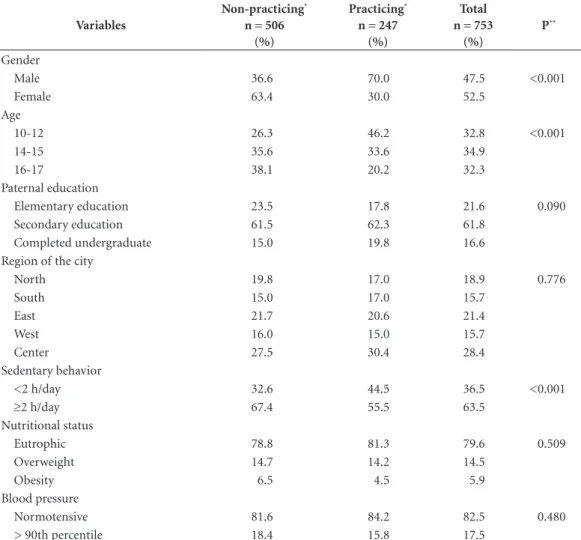
Of the 965 young people who were invited to vol-untarily participate in the study, 78% accepted and performed all the procedures. Table 1 shows the characteristics of the study participants. There was a similar frequency of students in terms of gender and age in the total sample. The prevalence of youngsters who were overweight and obese was respectively 14.5 and 5.9%, while 17.5% had HBP.
practi-C
ole
dam DHC
tioners and those who did not practice sports did not differ with respect to paternal education.
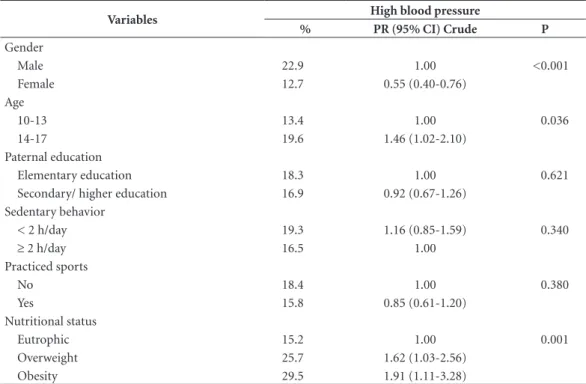
The bivariate association between the inde-pendent variables with HBP in the total sample is presented in Table 2. The female participants had a negative association (PR = 0.55, 0.40 to 0.76) while the variables age (PR = 1.46, 1.02-2.10), overweight (PR = 1.62, 1.03-2.56) and obesity (PR = 1.91, 1.11-3.28) were positively associated with HBP.
Table 3 shows the bivariate associations be-tween the independent variables of the study with HBP in relation to practising sports. The fe-male participants had a negative association (PR = 0.47, 0.32-0.68) while overweight (PR = 1.92,
1.03-3.61) and obese (PR = 2.22, 1.13-4.42) were positively associated with HBP in young people who did not practice sports. None of the ana-lyzed variables was significantly associated with HBP in young people sports practitioners.
After the adjustment of the models, the as-sociations were upheld between overweight and obesity with HBP in the total sample (PR = 1.60, 1.02-2.52; and 1.93, 1.15-3.25) and in the young people who did not practice sports (PR = 1.80, 1.05-3.14; and 2.15, 1.10-4.16). There were no significant associations between overweight (PR = 1.01, 0.36-2.82) and obesity (PR = 1.09, 0.48-2.48) with HBP in those who practice sports (Ta-ble 4).
Table 1. Characteristics of study participants according to leisure time sports practice.
Variables
Non-practicing* n = 506
(%)
Practicing* n = 247
(%)
Total n = 753
(%)
P**
Gender
Male 36.6 70.0 47.5 <0.001
Female 63.4 30.0 52.5
Age
10-12 26.3 46.2 32.8 <0.001
14-15 35.6 33.6 34.9
16-17 38.1 20.2 32.3
Paternal education
Elementary education 23.5 17.8 21.6 0.090
Secondary education 61.5 62.3 61.8
Completed undergraduate 15.0 19.8 16.6
Region of the city
North 19.8 17.0 18.9 0.776
South 15.0 17.0 15.7
East 21.7 20.6 21.4
West 16.0 15.0 15.7
Center 27.5 30.4 28.4
Sedentary behavior
<2 h/day 32.6 44.5 36.5 <0.001
≥2 h/day 67.4 55.5 63.5
Nutritional status
Eutrophic 78.8 81.3 79.6 0.509
Overweight 14.7 14.2 14.5
Obesity 6.5 4.5 5.9
Blood pressure
Normotensive 81.6 84.2 82.5 0.480
> 90th percentile 18.4 15.8 17.5
aúd
e C
ole
tiv
a,
22(12):4051-4060,
2017
Table 2. Bivariate association between the independent variables of the study with high blood pressure in the total sample.
Variables High blood pressure
% PR (95% CI) Crude P
Gender
Male 22.9 1.00 <0.001
Female 12.7 0.55 (0.40-0.76)
Age
10-13 13.4 1.00 0.036
14-17 19.6 1.46 (1.02-2.10)
Paternal education
Elementary education 18.3 1.00 0.621
Secondary/ higher education 16.9 0.92 (0.67-1.26) Sedentary behavior
< 2 h/day 19.3 1.16 (0.85-1.59) 0.340
≥ 2 h/day 16.5 1.00
Practiced sports
No 18.4 1.00 0.380
Yes 15.8 0.85 (0.61-1.20)
Nutritional status
Eutrophic 15.2 1.00 0.001
Overweight 25.7 1.62 (1.03-2.56)
Obesity 29.5 1.91 (1.11-3.28)
PR: Prevelance ratio; 95% CI – confidence interval of 95%; P refers to chi-square test.
Table 3. Bivariate association between the independent variables of the study with high blood pressure according to sports practice.
Variables
High blood pressure
Non-practicing Practicing
% Crude PR
PR (95% CI) P %
Crude PR
PR (95% CI) P
Gender
Male 27.6 1.00 <0.001 17.9 1.00 0.160
Female 13.1 0.47 (0.32-0.68) 10.8 0.60 (0.29-1.25) Age
10-13 13.5 1.00 0.093 13.2 1.00 0.294
14-17 20.1 1.48 (0.92-2.38) 18.0 1.37 (0.75-2.48) Paternal education
Elementary education 22.7 1.00 0.165 15.8 1.00 0.981 Secondary/ higher education 17.1 0.75 (0.50-1.11) 15.9 1.01 (0.70-2.13)
Sedentary behavior
<2 h/day 17.9 1.00 0.682 13.1 1.00 0.202
≥2 h/day 19.4 1.08 (0.73-1.59) 19.1 1.45 (0.81-2.59) Nutritional status
Eutrophic 15.1 1.00 <0.001 15.5 1.00 0.746
Overweight 29.7 1.92 (1.03-3.61) 17.1 1.04 (0.37-2.91) Obesity 33.3 2.22 (1.13-4.42) 18.2 1.17 (0.33-4.08)
C
ole
dam DHC
Discussion
To the best of our knowledge, this was the first study that has examined whether an associa-tion between overweight and obesity with HBP occurred in both young people who practiced sports and those who did not practice sports. The main result was that overweight and obesity was positively associated with HBP in the total sample and also in the young people who did not practice sports, whereas the same was not true for those sports practitioners.
A higher prevalence of HBP was found in young people who were overweight and obese compared to those who were eutrophic within the total sample (25.7 and 29.5 vs 15.2%) and those who did not practice sports (29.7 and 33.3 vs 15.1%), respectively. With regard to the par-ticipants who practiced sports, the prevalence of HBP was similar in young people who were over-weight and obese compared to the eutrophic par-ticipants (17.1 and 18.2 vs 15.5%). In the adjusted analysis, young people who were overweight and obese in the total sample and those who did not practice sports showed a prevalence ratio of HBP which ranged from 1.60 to 2.15 higher than their eutrophic counterparts, results that corroborate
those in previous studies9-11,18,22,26. No significant
associations were found for young people who practice sports. These results epidemiologically demonstrate the cardiovascular protection pre-sented by the overweight and obese individuals who practice sports compared to their peers who did not practice sports.
When the total sample was analyzed the re-sults of this study corroborated previous stud-ies that showed no association between physical
activity and HBP in young people9,11,21-23. The
present study examined the practice of sports because the physical activity of young people is
largely performed through sports15. Although
no association was found between the practice
of sports and HBP in young people, the pres-ent study showed a similar prevalence of HBP among young people sports practitioners who were overweight and obese compared to their eu-trophic counterparts. This result may explain the lack of association between physical activity and
HBP described in previous studies9,11,21-23. Thus,
the following two aspects should be considered in relation to the ways in which physical activity may protect young people from HBP: the
protec-tion independent of overweight18,20and the
pro-tection that only occurs in overweight and obese individuals who practice sports.
The protection in relation to HBP present-ed by the overweight individuals who practicpresent-ed sports can be explained by the chronic reduction
in blood pressure caused by physical exercise33-36.
As a result, there was a decrease in the
preva-lence of HBP in obese children33. Although there
were methodological differences between the two studies, the present study corroborated
pre-vious results33, given that overweight and obese
individuals reduced the prevalence of HBP from 50% to 37% in three months and to 29% in six months after physical activity intercention. Con-sequently, regular sports practice means that it was possible for young people exposed to one of the main determinants of HBP, overweight and obesity, to be able to present a similar prevalence to their eutrophic counterparts.
Although the cross-sectional design of this study, the results partially corroborated the ex-perimental studies and randomized clinical trials that had previously been conducted. Significant reductions in blood pressure in training
pro-grams lasting three months33 and six months34
have been reported. Exercise programs that are effective in reducing the blood pressure of young people have consisted of at least three weekly
sessions that lasted more than one hour35. The
young people who practice sports in the present study probably practice on a daily basis similar
Table 4. Multivariate analysis of the association between overweight and obesity with high blood pressure.
Variables % All
*
PR (95% CI) %
Non-practicing **
PR (95% CI) %
Practicing *** PR (95% CI)
Eutrophic 15.2 1.00 15.1 1.00 15.5 1.00
Overweight 25.7 1.60 (1.02-2.52)a 29.7 1.80 (1.05-3.14)c 17.1 1.01 (0.36-2.82)e
aúd
e C
ole
tiv
a,
22(12):4051-4060,
2017
to those described in previous studies33,35, given
that in the present study the participants were categorized as young people who stated that they practiced sports either often or always.
The lack of an association between over-weight and obesity with HBP in young people sports practitioners in the present study occurred because young people who were overweight and obese presented a prevalence of HBP similar to the eutrophic participants. Similarly, the preva-lence of HBP in the eutrophic participants was similar, regardless of sports practice, and was approximately 15%. This result was contrary to a previous study which showed that physical ac-tivity protected non-obese young people from
HBP37. One aspect that should be considered is
that there is a greater reduction in blood pressure resulting from physical activity in young people
who have HBP33. This can be explained by the
attenuation that physical activity exerts on sym-pathetic activation mechanisms, insulin resis-tance, arterial stiffness, endothelial dysfunction, increased heart rate and vascular resistance that
occur on overweight36. Overweight and obese
young people who participated in the present study probably benefited from a reduction in blood pressure resulting from regularly practic-ing sports.
On the other hand, the similar prevalence of HBP among the eutrophic young people in this study, regardless of sports practice, may have been due to the fact that HBP is a multifactorial risk factor in young people. In addition to over-weight, HBP is positively associated with heredi-ty, low birth weight, high salt intake and alcohol
consumption12, factors which were not analyzed
in the present study.
Another important result that should be con-sidered is the similar prevalence of young people who were overweight, obese and with HBP, in-dependent of sports practice (Table 1). Although the relationship between physical activity and
HBP has previously been discussed16-20, the
larg-est body of evidence indicates no association
be-tween physical activity and HBP24. The results of
the present study corroborated previous studies that indicated no association between practicing
sports and HBP in young Brazilians9,11,21-23. As
al-ready mentioned, the main determinant of HBP
in young people is being overweight and obese25,
and overweight young people are more likely to
present HBP9-11,18,22,26. Thus, a similar proportion
of overweight and obese young people in both strata of sports practice may explain why the the prevalence of HBP was also similar.
The promotion of physical activity and sports practice is an aspect of lifestyle that has been strongly recommended in order to prevent
over-weight and obesity in young people38. However, a
systematic review gathered together studies that examined the association between sports prac-tice with overweight and obese, and the results
were inconclusive39. A study that was conducted
after the aforementioned review found that par-ticipation in sports teams protected adolescents
from overweight and obesity40, a result which was
contrary to that found in the present study. One aspect to be considered is that in both the
sys-tematic review39 and in the present study, sports
practice was considered on both the formal and informal levels, while in the study by Drake et
al.40 sports practice was defined as as the amount
of participation by young people in sports teams during the previous year. One characteristic that may explain the differences between these studies is that participation in sports teams is performed systematically and probably present higher vol-ume of training.
Considering that being overweight and obe-sity are two major public health problems in young people, given that they are the main
fac-tors associated with HBP25 and that HBP results
in different threats to the health of young
peo-ple and adults3-7, the results of the present study
demonstrated that sports practice protects young people with overweight and obesity from HBP compared to eutrophic counterparts. Thus, it is suggested that sports practice is one of the strat-egies that can be used within intervention pro-grams designed to prevent HBP in young people. As a result, the complications associated with HBP in overweight and obese young people may be prevented.
The limitations of this study should be con-sidered in order to analyze its results with caution and also to provide guidance for future studies. Some variables that have previously been
de-scribed as being associated with HBP12 were not
com-C
ole
dam DHC pared to informal sports practice. Finally, due to
the fact that this was a cross-sectional study there is a need for experimental and longitudinal stud-ies to confirm these results.
Conclusion
According to the results presented in this study it can be concluded that overweight and obesity
were not associated with high blood pressure in adolescents who practice sports. The prevalence of overweight and obese young people who had HBP was similar to their eutrophic counterparts, which suggested that there was a cardioprotective effect of sports practice in individuals who were overweight. Thus, it is suggested that overweight individuals regularly practice sports in order to prevent future health risks that result from HBP at a young age.
Collaborations
aúd e C ole tiv a, 22(12):4051-4060, 2017 References
1. Mancia G, Fagard R, Narkiewicz K, Redón J, Zanchet-ti A, Böhm M, ChrisZanchet-tiaens T, Cifkova R, De Backer G, Dominiczak A, Galderisi M, Grobbee DE, Jaarsma T, Kirchhof P, Kjeldsen SE, Laurent S, Manolis AJ, Nils-son PM, Ruilope LM, Schmieder RE, Sirnes PA, Sleight P, Viigimaa M, Waeber B, Zannad F. Task Force Mem-bers. Guidelines for the management of arterial hyper-tension. Eur Heart J 2013; 31(7):1281-1357.
2. Yang Q, Cogswell ME, Flanders WD, Hong Y, Zhang Z, Loustalot F, Gillespie C, Merritt R, Hu FB.Trends in Cardiovascular Health Metrics and Associations With All-Cause and CVD Mortality Among US Adults. Jama 2012; 307(12):1273-1283.
3. McNiece KL, Gupta-Malhotra M, Samuels J, Bell C, Garcia K, Poffenbarger T, Sorof JM, Portman RJ; Na-tional High Blood Pressure Education Program Work-ing Group. Left ventricular hypertrophy in hyperten-sive adolescents: analysis of risk by 2004 National High Blood Pressure Education Program Working Group staging criteria. Hypertension 2007; 50(2):392-395. 4. Deda L, Sochett EB, Mahmud FH. Physiological
changes in blood pressure impact peripheral endothe-lial function during adolescence. Cardiol Young 2015; 25(4):777-779.
5. Kollias A, Psilopatis I, Karagiaouri E, Glaraki M, Gram-matikos E, GramGram-matikos EE, et al. Adiposity, blood pressure, and carotid intima-media thickness in greek adolescents. Obesity 2013; 21(5):1013-1017.
6. Urbina EM, Khoury PR, McCoy C, Daniels SR, Kim-ball TR, Dolan LM. Cardiac and vascular consequences of pre-hypertension in youth. J Clin Hypertens 2011; 13(5):332-342.
7. Campana EMG, Brandão AA, Pozzan R, Magalhães MEC, Fonseca FL, Pizzi OL, Freitas EV, Brandão AP. Blood pressure in adolescence, adipokines and inflam-mation in young adults. The Rio de Janeiro study. Arq Bras Cardiol 2014; 102(1):60-69.
8. Magalhaes MGP, Oliveira LMFT, Christofaro DGD, Ritti-Dias RM. Prevalência de pressão arterial elevada em adolescentes brasileiros e qualidade dos procedi-mentos metodológicos empregados : revisão sistemáti-ca. Rev Bras Epidemiol 2013; 16(3):849-859.
9. Corrêa Neto VG, Sperandei S, Silva LAI, Maranhão Neto GA, Palma A. Hipertensão arterial em adoles-centes do Rio de Janeiro : prevalência e associação com atividade física e obesidade. Cien Saude Colet 2014; 19(6):1699-1708.
10. Rosaneli CF, Baena CP, Auler F, Nakashima ATA, Netto-Oliveira ER, Oliveira AB, Guarita-Souza LC, Olandoski M, Faria-Neto JR. Elevated Blood Pressure and Obesity in Childhood: A Cross-Sectional Evalu-ation of 4,609 Schoolchildren. Arq Bras Cardiol 2014; 103(3):238-244.
11. Silva DAS, Lima LRA, Dellagrana RA, Bacil EDA, Rech CR. Pressão arterial elevada em adolescentes: prevalência e fatores associados. Cien Saude Colet 2013; 18(11):3391-3400.
12. Spagnolo A, Giussani M, Ambruzzi AM, Bianchetti M, Maringhini S, Matteucci MC, Menghetti E, Salice P, Si-mionato L, Strambi M, Virdis R, Genovesi S. Focus on prevention, diagnosis and treatment of hypertension in children and adole scents. Ital J Pediatr 2013; 39(1):20.
13. Caspersen CJ, Powell KE, Christensen GM. Physical activity, exercise, and physical fitness: definitions and distinctions for health-related research. Public Health Rep 1985; 100(2):126-131.
14. Wickel EE, Eisenmann JC. Contribution of youth sport to total daily physical activity among 6-to 12-yr-old boys. Med Sci Sports Exerc 2007; 39(9):1493-1500. 15. Tubino MJG. Dimensões sociais do esporte. 2ª ed. São
Paulo: Cortez Editora; 2001.
16. Carson V, Ridgers ND, Howard BJ, Winkler EA, Healy GN, Owen N, Dunstan DW, Salmon J. Light-intensity physical activity and cardiometabolic biomarkers in US adolescents. PLoS One 2013; 8(8):e71417.
17. Giussani M, Antolini L, Brambilla P, Pagani M, Zuccotti G, Valsecchi MG, Lucini D, Genovesi S. Cardiovascular risk assessment in children: role of physical activity, family history and parental smoking on BMI and blood pressure. J Hypertens 2013; 31(5):983-992.
18. Gomes B, Alves J. Prevalência de hipertensão arterial e fatores associados em estudantes de ensino médio de escolas públicas da Região Metropolitana do Recife, Pernambuco. Cad Saúde Pública 2009; 25(2):375-381. 19. Menezes AMB, Hallal PC, Araújo CL, Barros FC,
Vic-tora CG. Concurrent determinants of blood pressure among adolescents: the 11-year follow-up of the 1993 Pelotas (Brazil) birth cohort study. Cad Saude Publica 2010; 26(10):1972-1979.
20. Christofaro DGD, Ritti-Dias RM, Chiolero A, Fer-nandes RA, Casonatto J, Oliveira AR. Physical activ-ity is inversely associated with high blood pressure independently of overweight in Brazilian adolescents. Scand J Med Sci Sport 2013; 23(3):317-322.
21. Silva KS, Lopes AS. Excesso de peso, pressão arterial e atividade física no deslocamento à escola. Arq Bras Car-diol 2008; 91(2):93-101.
22. Pinto SL, Silva RDCR, Priore SE, Assis AMO, Pinto EDJ. Prevalência de pré-hipertensão e de hipertensão arterial e avaliação de fatores associados em crianças e adolescentes de escolas públicas de Salvador, Bahia, Brasil. Cad Saude Publica 2011; 27(6):1065-1075. 23. Moreira NF, Muraro AP, Brito FDSB, Gonçalves-Silva
RMV, Sichieri R, Ferreira MG. Obesidade: principal fator de risco para hipertensão arterial sistêmica em adolescentes brasileiros participantes de um estudo de coorte. Arq Bras Endocrinol Metab 2013; 57(7):520-526. 24. Corrêa Neto VG, Palma A. Pressão arterial e suas as-sociações com atividade física e obesidade em adoles-centes: uma revisão sistemática. Cien Saude Colet 2014; 19(3):797-818.
25. Flynn J. The changing face of pediatric hypertension in the era of the childhood obesity epidemic. Pediatr Nephrol 2013; 28(7):1059-1066.
26. Guimarães ICB, Almeida AM, Santos AS, Barbosa DBV. Pressão Arterial: Efeito do Índice de Massa Corporal e da circunferência abdominal em Adolescentes. Arq Bras Cardiol 2008; 90(6):393-399.
C
ole
dam DHC 28. Associação Brasileira de Empresas de Pesquisa
[home-page na Internet]. Critério de Classificação Econômica do Brasil, 2012. [ acessado 2015 Dez 07]. Disponível em: http://www.abep.org/criterio-brasil.
29. World Health Organization (WHO). Physical status: the use and interpretation of anthropometry. Report of a WHO Expert Committee. Geneva: WHO; 1995. (Tech-nical Report Series, nº 854)
30. Cole TJ, Lobstein T. Extended international (IOTF) body mass index cut-offs for thinness, overweight and obesity. Pediatr Obes 2012; 7(4):284-294.
31. National High Blood Pressure Education Program Working Group on High Blood Pressure in Children and Adolescents. The Fourth Report on the Diagnosis, Evaluation, and Treatment of High Blood Pressure in Children and Adolescents. Pediatrics. 2004; 114(2):555-576.
32. Christofaro DGD, Fernandes RA, Polito MD, Roman-zini M, Ronque ERV, Gobbo LA, Oliveira AR. A com-parison between overweight cutoff points for detection of high blood pressure in adolescents. J Pediatr 2009; 85(4):353-358.
33. Farpour-Lambert NJ, Aggoun Y, Marchand LM, Mar-tin XE, Herrmann FR, Beghetti M. Physical Activity Reduces Systemic Blood Pressure and Improves Early Markers of Atherosclerosis in Pre-Pubertal Obese Chil-dren. J Am Coll Cardiol 2009; 54(25):2396-2406. 34. Farah BQ, Ritti Dias RM, Balagopal P, Hill JO, Prado
WL. Does exercise intensity affect blood pressure and heart rate in obese adolescents? A 6 month multidisci-plinary randomized intervention study. Pediatric obesi-ty 2014; 9(2):111-120.
35. García-Hermoso A, Saavedra JM, Escalante Y. Effects of exercise on resting blood pressure in obese children: a meta-analysis of randomized controlled trials. Obes Rev 2013; 14(11):919-928.
36. Torrance B, McGuire KA, Lewanczuk R, McGavock J. Overweight, physical activity and high blood pressure in children: a review of the literature. Vasc Health Risk Manag 2007; 3(1):139-149.
37. So HK, Li AM, Choi KC, Sung RYT, Nelson EA. Regu-lar exercise and a healthy dietary pattern are associated with lower resting blood pressure in non-obese ado-lescents: a population-based study. J Hum Hypertens 2013; 27(5):304-308.
38. Hills AP, Andersen LB, Byrne NM. Physical activity and obesity in children. Br J Sports Med 2011; 45(11):866-870.
39. Nelson TF, Stovitz SD, Thomas M, LaVoi NM, Bauer KW, Neumark-Sztainer D. Do youth sports prevent pediatric obesity? A systematic review and commen-tary. Curr Sports Med Rep 2011; 10(6):360.
40. Drake KM, Beach ML, Longacre MR, MacKenzie T, Titus LJ, Rundle AG, Dalton MA. Influence of sports, physical eduation, and active commuting to school on adolescent weight status. Pediatrics 2012; 130(2):e296-e304.
Article submitted 08/12/2015 Approved 07/04/2016