Duration effect of desflurane anesthesia and its
awakening time and arterial concentration in
gyne-cologic patients
Tso-Chou Lin,IChih-Cherng Lu,V Che-Hao Hsu,IGwo-Jang Wu,II,IIIMeei-Shyuan Lee,IVShung-Tai HoIII,V
ITri-Service General Hospital/National Defense Medical Center, Department of Anesthesiology, Taipei, Taiwan.IITri-Service General Hospital/National
Defense Medical Center, Departments of Obstetrics and Gynecology, Taipei, Taiwan.IIINational Defense Medical Center, Graduate Institute of Medical Science, Taipei, Taiwan.IVNational Defense Medical Center, School of Public Health, Taipei, Taiwan.VTaipei Veterans General Hospital/National Defense Medical Center, Department of Anesthesiology, Taipei, Taiwan.
OBJECTIVES:To determine the awakening arterial blood concentration of desflurane and its relationship with the end-tidal concentration during emergence from various durations of general anesthesia.
METHOD:In total, 42 American Society of Anesthesiologists physical status class I-II female patients undergoing elective gynecologic surgery were enrolled. General anesthesia was maintained with fixed 6% inspiratory desflurane in 6 l min-1oxygen until shutoff of the vaporizer at the end of surgery. One milliliter of arterial
blood was obtained for desflurane concentration determination by gas chromatography at 20 and 10 minutes before and 0, 5, 10, 15, and 20 minutes after the discontinuation of desflurane and at the time of eye opening upon verbal command, defined as awakening. Concentrations of inspiratory and end-tidal desflurane were simultaneously detected by an infrared analyzer.
RESULTS:The mean arterial blood concentration of desflurane was 1.20% at awakening, which correlated with the awakening end-tidal concentration of 0.96%. The mean time from the discontinuation of desflurane to eye opening was 5.2 minutes (SD = 1.6, range 3-10), which was not associated with the duration of anesthesia (60-256 minutes), total fentanyl dose, or body mass index (BMI).
CONCLUSIONS: The mean awakening arterial blood concentration of desflurane was 1.20%. The time to awakening was independent of anesthetic duration within four hours. Using well-assisted ventilation, the end-tidal concentration of desflurane was proven to represent the arterial blood concentration during elimination and could be a clinically feasible predictor of emergence from general anesthesia.
KEYWORDS: Desflurane; Arterial Blood; End-Tidal; Awakening.
Lin TC, Lu CC, Hsu CH, Wu GJ, Lee MS, Ho ST. Duration effect of desflurane anesthesia and its awakening time and arterial concentration in gynecologic patients. Clinics. 2013;68(10):1305-1311.
Received for publication onDecember 17, 2012;First review completed onFebruary 25, 2013;Accepted for publication onMay 9, 2013
E-mail: [email protected]
Tel.: 886-2-28757155
& INTRODUCTION
Desflurane has been clinically used in anesthesia for two decades (1). The major advantages include rapid induction and recovery (2,3), lower cost (4), and myocardial protection during cardiac surgery (5). Due to its lower blood-gas partition coefficient (0.42), the ratio of the dissolved amount in the blood to the amount in the alveolar gas in contact with the blood, desflurane has been clearly proven to provide a shorter time to extubation compared with sevoflurane (20% reduction) (2)
and isoflurane (34% reduction) (3), especially in those individuals undergoing prolonged surgical procedures (4,6).
Growing evidence (7-12) indicates that a certain time period is needed for inhaled anesthetics to cross the alveolar membrane and enter the body and brain in the beginning of general anesthesia in order to achieve the minimal alveolar concentration (MAC), the point at which no movement is observed in 50% of patients in response to a surgical stimulus. Similarly, elimination of the inhaled anesthetics from the blood to the lungs during emergence is time-dependent (13). Clinically, the end-tidal concentration has been a feasible predictor of awakening from general anesthesia (14). However, irregular respiration during emergence usually results in the fluctuation of end-tidal concentrations of inhaled anesthetics (15). The arterial blood concentration provides a steadier, more reliable representation of the anesthetic concentration in the brain. Thus, we hypothesized that desflurane, with its low coefficient, would not accumulate in Copyrightß2013CLINICS– This is an Open Access article distributed under
the terms of the Creative Commons Attribution Non-Commercial License (http:// creativecommons.org/licenses/by-nc/3.0/) which permits unrestricted non-commercial use, distribution, and reproduction in any medium, provided the original work is properly cited.
No potential conflict of interest was reported.
the blood and delay emergence after a prolonged duration of general anesthesia. In addition, due to the rapid elimination of desflurane, the end-tidal concentration could reflect the arterial blood concentration during well-assisted ventilation and be used to predict awakening during emergence.
The primary aim of this study was to examine the arterial blood concentration of desflurane during emergence and the time to awakening after various durations of general anesthe-sia. The secondary aim was to examine the validity of the noninvasively determined end-tidal concentration of desflur-ane as a reliable indicator of the arterial blood concentration.
& MATERIALS AND METHODS
Patients
After obtaining approval of Institutional Review Board (TSGHIRB-097-05-189) and written informed consent, 42 ASA I or II 20- to 60-year-old gynecologic patients scheduled for elective surgery under general anesthesia were included. Patients with severe cardiopulmonary diseases, irritable airways, such as ongoing asthma or acute upper respiratory infection, hepatic diseases (16), neuropapthy, or regular hypnotic or sedative use were excluded.
Anesthetic management and gas monitoring
In the operating room, after premedication with 100 mcg intravenous fentanyl and 0.5 ml subcutaneous 2% lidocaine,
a 20-gauge catheter was placed into the left radial artery for blood sampling. General anesthesia was induced with 1.5 mg kg-1propofol, and 1.5 mg kg-1succinylcholine was adminis-tered for endotracheal intubation. We maintained anesthesia with 0.1 mg kg-1 cis-atracurium and 6% fixed inspiratory desflurane in 6 l min-1oxygen during the entire procedure.
Nitrous oxide was not used. Fentanyl, 25 or 50 mcg, was titrated to meet the patients’ pain responses beyond desflurane administration. A Datex-Ohmeda Aestiva/5 anesthetic machine (Datex-Ohmeda, Madison, WI) was used with soda lime (CO2absorbent), and the minute ventilation
was adjusted to keep the end-tidal CO2 between 38 and
42 mmHg. The leakage of each system was determined using constant-pressure ventilation with a test lung. The sampled gases (approximately 210 ml min-1) were redirected into the
circuit. Both the inspiratory and the end-tidal concentrations of desflurane were detected by an infrared multi-gas analyzer (Datex-Ohmeda S/5 Anesthesia System; Datex-Ohmeda, Helsinki, Finland) that was calibrated according to the manufacturer’s recommendations. A Finometer (FMS, Finapres Measurement Systems, Arnhem, Netherlands) was used to determine cardiac output. Hypotension, defined as a 25% decrease in blood pressure from baseline, was treated with intravenous fluid and ephedrine (5 mg bolus). A nasophar-yngeal thermometer was used to measure and maintain the body temperature in the range of 36.5-37.5
˚
C. After the operation was completely finished, the vaporizer was turned off, with 6 l min-1oxygen for fresh gas flow. Next,2 mg Neostigmine and 0.4 mg glycopyrrolate were admi-nistered intravenously to reverse the neuromuscular blockade. The end-tidal CO2 was maintained between 38
and 42 mmHg with manually assisted ventilation under quiet circumstances, without additional stimulation. Awakening was defined as eye opening upon verbal command and was tested every 30 seconds after the discontinuation of desflurane until the appropriate response. Extubation was accomplished after brief endo-tracheal suction. The time from the discontinuation of desflurane to awakening and the duration of surgery and Table 1 -Characteristics of patients (N = 42).
Characteristics Mean (SD) Range Median
Age, years 40.8 (9.7) 24-57 41.0
Weight, kg 61.0 (10.1) 45-85 59.5
Height, cm 161.0 (6.0) 148-174 161.0
Body mass index, kg m-2 23.5 (3.6) 17.6-32.0 23.0 Fentanyl, mcg kg-1 2.5 (0.8) 1.4-4.6 2.4 Duration of anesthesia,
min
127.9 (44.0) 60-256 122
Time to eye opening, min 5.2 (1.6) 3-10 5
Table 2 -The arterial blood, inspiratory, and end-tidal concentrations of desflurane during emergence from general anesthesia in gynecologic patients (N = 42).
Time (min) -20 -10 0 5 Eye Opening 10 15 20
Arterial concentration 3.91 (0.37) 3.87 (0.35) 3.82 (0.45) 1.17 (0.29) 1.20 (0.30) 0.73 (0.16) 0.57 (0.18) 0.48 (0.17) Inspiratory
concentration
6.01 (0.14) 6.01 (0.12) 5.99 (0.11) 0.01 (0.04) 0.08 (0.13)
End-tidal concentration 5.62 (0.19) 5.61 (0.18) 5.62 (0.15) 1.02 (0.31) 0.96 (0.32) 0.54 (0.17) 0.43 (0.14) 0.33 (0.15)
The values are presented as means (SD). The mean time to eye opening was 5.2 (1.6) minutes. 0 min: Immediately prior to the discontinuation of 6% desflurane.
Table 3 -Hemodynamic and ventilatory variables during emergence (N = 42).
Time -20 -10 0 5 Eye Opening 10 15 20
HR 71 (14.8) 74 (19.9) 75 (15.5) 110 (21.2) 114 (17.7) 91 (15.0) 82 (14.5) 78 (13.5) MAP 94.8 (17.1) 97.1 (15.5) 95.5 (16.1) 117.4 (16.2) 119.8 (21.7) 104.2 (16.5) 98.3 (16.3) 102.2 (14.6) CO 5.4 (1.7) 5.9 (1.6) 5.3 (1.3) 6.0 (1.8) 5.8 (1.9) 5.9 (1.5) 5.6 (1.7) 5.4 (1.6) CI 2.7 (1.0) 3.1 (0.9) 2.8 (0.7) 3.1 (1.0) 3.1 (1.1) 3.1 (1.0) 3.0 (0.8) 2.7 (0.8) TPR 1576 (446) 1483 (456) 1518 (448) 1803 (633) 1795 (616) 1619 (546) 1668 (547) 1738 (761) ETCO2 39.1 (3.8) 39.8 (2.7) 39.8 (1.8) 41.2 (6.2) 41.3 (6.7) 40.4 (5.7) 40.1 (6.5) 39.9 (6.9)
The values are presented as means (SD). The mean time to eye opening was 5.2 (1.6) minutes.
anesthesia were recorded. Inspiratory concentration, expired concentration, end-tidal CO2, blood pressure, heart
rate, and body temperature data were recorded every 30
seconds by commercial software (Datex-Ohmeda S/5 Collect; Datex-Ohmeda, Madison, WI) until 20 minutes after the discontinuation of desflurane.
Determination of the arterial blood concentration of desflurane during elimination
Prior to induction, 10 ml of blood was collected from each patient to determine the blood-gas partition coefficient (l) of desflurane (8). In each blood sample, Desflurane was converted to the corresponding concentration, based on gas chromatographic measurements, and the blood-gas parti-tion coefficient of desflurane (l) was measured.
Gas chromatography conditions
The HP 6890 series GC system (Hewlett-Packard, Wilmington, DE) consists of a headspace sampler (Agilent G1888), an oven, a flame ionization detector, and an integrator. The carrier gas (helium) flow was 25.0 ml min-1. Separation was achieved with a capillary column (HP-5; 30.0 m?0.32 mm ID, 0.25mm film thickness) (Restek, Bellefonte, PA). An integrator and a data acquisition system were provided by HP CHEMOSTATION software. The method used to create a calibration curve for measuring the blood desflurane concentration was modified according to a previous publication (8).
Statistical analysis
Means (SD), ranges, and medians (for the time to eye opening) were used to describe the patients’ characteristics. Clinical parameters were presented as mean (SD) over time. Bivariate relationships between variables were analyzed by simple linear regressions and Pearson correlations. Moreover, a Bland-Altman agreement analysis was used to determine the degree of agreement between the awaken-ing arterial blood and end-tidal desflurane concentrations at three times to awakening with the aid of MedCalc version 12.2.1.0 (MedCalc Software, Marikerke, Belgium). A p-value,0.05 was considered statistically significant.
& RESULTS
Demographic data and anesthetics are summarized in Table 1. The mean time from the discontinuation of desflurane to eye opening upon verbal command was 5.2 (1.6) minutes (range 3-10, median 5 minutes). In total, 10 mg Ephedrine was administered to each of four patients to lower blood pressure after induction and before surgical incision.
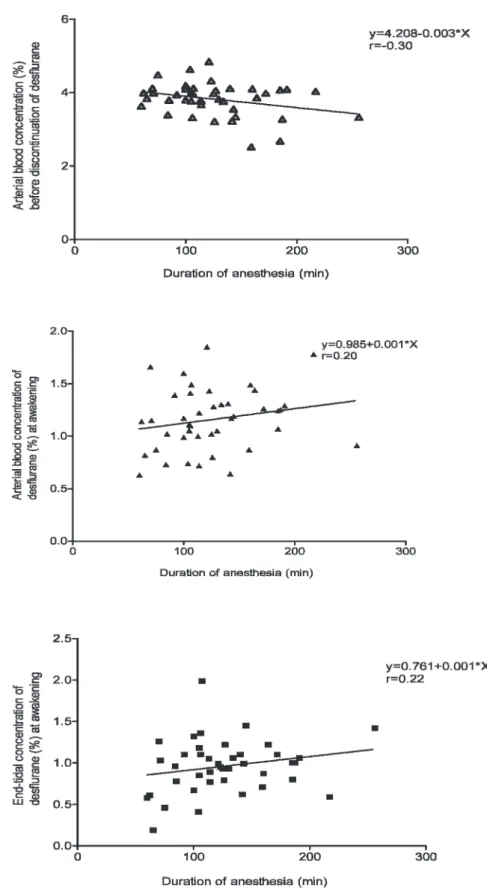
Table 2 lists the arterial blood, inspiratory, and end-tidal concentrations of desflurane before and during emergence. Before the discontinuation of desflurane, the arterial con-centration was 3.82 (0.45) %, and the end-tidal concon-centration was 5.62 (0.15) %. These values decreased to 1.20 (0.30) % and 0.96 (0.32) %, respectively, at awakening. The decrease in the end-tidal concentration was more prominent than the decrease in the arterial concentration in the initial five minutes after discontinuation. The hemodynamic and venti-latory variables during emergence were within 20% of the preoperative baseline, without apparent differences (Table 3). As shown in Figure 1, the arterial concentrations before discontinuing desflurane and at awakening and the awa-kening end-tidal concentration were not significantly correlated with the duration of general anesthesia, with p= 0.056, 0.197, and 0.177, respectively. Despite a larger scale of variation, the awakening end-tidal concentration (range 0.19-1.99%, with a 95% confidence interval of 0.33-1.59%) significantly represented the arterial concentration at awakening (range 0.63-1.85%, with a 95% confidence interval of 0.58-1.74%) (p= 0.001).
The Bland-Altman plot (Figure 2) displays the difference between the arterial and the end-tidal concentrations at awakening plotted against the average of the two concen-trations. The difference ranged from -0.51 to 1.19% and fell into an acceptable range (¡1.96 SD), regardless of the length
Figure 2 -Bland-Altman plot displaying the difference between the awakening arterial blood and end-tidal concentrations plotted
of awakening time. The arterial concentration at awakening was systematically higher than the end-tidal concentration, with a median of 0.2%.
The possible contributing factors upon awakening are also analyzed in Figure 3. The time to awakening was within 3-10 minutes, with a 95% confidence interval of 2.2-8.3 minutes. In
total, 50% of awakening occurred within five minutes, and 90% occurred within seven minutes, which was not prolonged by the duration of anesthesia, ranging from 60-256 minutes, and was not correlated with the total fentanyl dose (p= 0.232) or body mass index (BMI) (p= 0.356).
& DISCUSSION
This is the first study to quantitatively demonstrate an awakening arterial blood concentration of desflurane of 1.20 (0.30) % in gynecologic surgery patients. Increasing the duration of desflurane anesthesia to a maximum of four hours did not elevate the arterial concentration before the disconti-nuation of desflurane and did not prolong the awakening time. During well-assisted ventilation, the end-tidal concentration of desflurane represents the higher arterial concentration at awakening and provides a feasible predictor of eye opening after a surgical procedure completed within 60-256 minutes.
The total body uptake and elimination of inhaled anes-thetics are supposed to be proportional to the duration of general anesthesia (17,18). However, the lower blood-gas and blood-tissue partition coefficients of desflurane theoretically limit total body uptake, facilitating elimination in patients with longer-duration anesthetics and a higher BMI (19,20). Rohm et al. (4) demonstrated that patients undergoing prolonged surgical procedures (.150 min) showed faster recovery and required lower expenditure after a desflurane/ fentanyl regimen than a propofol/remifentanil regimen. Faster recovery following desflurane, compared with iso-flurane, may be desirable after long surgical procedures (.5 hours) (6), enabling the patient’s full cooperation and facilitating the early diagnosis of any potential neurological deficit. Nordmann et al. (21) also demonstrated that increas-ing the duration of inhalation anesthesia is associated with slower emergence and recovery in children, but this effect was less evident with desflurane compared with isoflurane. In this study, the arterial blood concentration of desflurane provided convincing evidence for the above findings. The arterial concentration before the discontinuation of desflur-ane was not correlated with the duration of desflur-anesthesia (60-256 min). In addition, the time to awakening mostly ranged between three and seven minutes in 39 of 42 patients and was not proportionally prolonged by the duration of anesthesia, further indicating limited total uptake and rapid alveolar washout during elimination.
The rate of uptake of inhaled anesthetics is dependent on the alveolar concentration and ventilation, blood solubility, and cardiac output (22). During the elimination phase, desflurane washout progresses from the brain and body to the alveolar space via the circulating blood, allowing the lungs to ventilate the anesthetic into the air. The end-tidal CO2 may depict the status of the minute ventilation and
cardiac output. Hypoventilation delays the alveolar washout of inhaled anesthetics. However, higher blood CO2 levels
elevate cardiac output and cerebral blood flow, which reversely accelerate the elimination of desflurane from the brain. Currently, no direct markers are available to adjust the above impact of alveolar washout and cerebral blood flow in clinical practice. Eventually, when the brain or arterial concentration decreases to a certain level, the patient awakens enough to respond to the verbal command for eye opening. By determining arterial blood concentrations, the clinical influ-ence of the minute ventilation and cardiac output on the elimination of inhaled anesthetics can be clarified. In this
Figure 3 -The time to awakening after discontinuation of 6%
study, the minute ventilation and cardiac index of all patients were kept steady before extubation, which revealed a correlation between the awakening arterial blood and end-tidal desflurane concentrations. The end-end-tidal concentration of desflurane decreased more prominently during the initial five minutes after discontinuation and became persistently lower than the arterial concentration, indicating rapid alveolar washout. Compared with the simultaneous arterial blood level, the end-tidal concentration of desflurane was identified as a feasible predictor of emergence from general anesthesia. There are certain limitations of the current study. First, the minute ventilation could hardly be controlled by a ventilator after the reversal of spontaneous breathing during emergence. We, therefore, manually assisted the ventilation to maintain the end-tidal CO2 level between 38 and 42 mmHg before
extubation. Despite greater fluctuation, the awakening end-tidal concentration represented the actual arterial concentra-tion in this study. Second, all of our patients were female. Women are generally reported to have greater sensitivity to pain than men, and healthy young women require 20% more anesthetics than do healthy age-matched men to prevent movement in response to noxious electrical stimulation (23). A higher MAC has been reported for desflurane-6.2% for women compared to 6.0% for men-although the difference is insignificant (24). Additionally, a longer eye-opening time after general anesthesia with desflurane has been reported-6.0 (1.3) minutes in female patients and 4.9 (0.9) minutes in male patients (p,0.001) (25). Further investigation is needed to verify the gender effect on the awakening arterial blood concentration. Third, the patients received up to four hours of anesthesia, and the maximal BMI was close to 32 kg m22. The clinical inferences should be adjusted based on a patient’s outlying factors, such as morbid obesity and a more prolonged duration of anesthesia.
In conclusion, we are the first to demonstrate the awakening arterial concentration of desflurane in gyneco-logic patients. The arterial concentrations before disconti-nuation and at awakening were not significantly elevated by the increasing duration of desflurane anesthesia (1-4 hours), which was consistent with the rapid awakening time, indicating suitability for a prolonged duration of anesthesia. Using well-assisted ventilation during emergence, the end-tidal concentration of desflurane can be a feasible predictor of awakening from general anesthesia.
& ACKNOWLEDGMENTS
We gratefully acknowledge Miss YF Roa, who assisted us in using the gas chromatography headspace sampler system for blood desflurane determi-nation. This study was funded by a grant (NSC98-2314-B-016-007-MY3) from the Taiwan National Council of Science. This work was performed at the Tri-Service General Hospital/National Defense Medical Center, Taipei, Taiwan.
& AUTHOR CONTRIBUTIONS
Lin TC, Lu CC, and Hsu HC performed this clinical study and drafted the manuscript. Lee MS performed the statistical analysis. Ho ST conceived the study and provided laboratory support to measure the blood desflurane concentration. Wu GJ participated in the study design and coordination. All authors read and approved the final version of the manuscript.
& REFERENCES
1. Jakobsson J. Desflurane: a clinical update of a third-generation inhaled anaesthetic. Acta Anaesthesiol Scand. 2012;56(4):420-32, http://dx.doi. org/10.1111/j.1399-6576.2011.02600.x.
2. Dexter F, Bayman EO, Epstein RH. Statistical modeling of average and variability of time to extubation for meta-analysis comparing desflurane to sevoflurane. Anesth Analg. 2010;110(2):570-80, http://dx.doi.org/10. 1213/ANE.0b013e3181b5dcb7.
3. Agoliati A, Dexter F, Lok J, Masursky D, Sarwar MF, Stuart SB, et al. Meta-analysis of average and variability of time to extubation comparing isoflurane with desflurane or isoflurane with sevoflurane. Anesth Analg. 2010;110(5):1433-9, http://dx.doi.org/10.1213/ANE.0b013e3181d58052. 4. Rohm KD, Piper SN, Suttner S, Schuler S, Boldt J. Early recovery,
cognitive function and costs of a desflurane inhalational vs. a total intravenous anaesthesia regimen in long-term surgery. Acta Anaesthesiol Scand. 2006;50(1):14-8, http://dx.doi.org/10.1111/j.1399-6576.2006.00905.x.
5. De Hert SG, Cromheecke S, ten Broecke PW, Mertens E, De Blier IG, Stockman BA, et al. Effects of propofol, desflurane, and sevoflurane on recovery of myocardial function after coronary surgery in elderly high-risk patients. Anesthesiology. 2003;99(2):314-23, http://dx.doi.org/10. 1097/00000542-200308000-00013.
6. Boisson-Bertrand D, Laxenaire MC, Mertes PM. Recovery after pro-longed anaesthesia for acoustic neuroma surgery: desflurane versus isoflurane. Anaesth Intensive Care. 2006;34(3):338-42.
7. Lu CC, Tsai CS, Ho ST, Chueng CM, Wang JJ, Wong CS, et al. Pharmacokinetics of desflurane uptake into the brain and body. Anaesthesia. 2004;59(3):216-21, http://dx.doi.org/10.1111/j.1365-2044. 2003.03654.x.
8. Lu CC, Lin TC, Hsu CH, Yu MH, Chen TL, Chen RM, et al. Hyperventilation accelerates the rise of arterial blood concentrations of desflurane in gynecologic patients. Clinics. 2012;67(9):1029-34, http://dx. doi.org/10.6061/clinics/2012(09)08.
9. Lu CC, Ho ST, Wong CS, Wang JJ, Tsai CS, Hu OY, et al. Pharmacokinetics of isoflurane: uptake in the body. Pharmacology. 2003;69(3):132-7, http://dx.doi.org/10.1159/000072665.
10. Lu CC, Tsai CS, Ho ST, Chen WY, Wong CS, Wang JJ, et al. Pharmacokinetics of sevoflurane uptake into the brain and body. Anaesthesia. 2003;58(10):951-6, http://dx.doi.org/10.1046/j.1365-2044. 2003.03346.x.
11. Lin TC, Lu CC, Li CY, Chang CC, Ho ST. Arterial blood concentration of sevoflurane during single-breath induction and tracheal intubation in gynecologic patients. J Clin Anesth. 2008;20(7):496-500, http://dx.doi. org/10.1016/j.jclinane.2008.05.011.
12. Lin TC, Lu CC, Kuo CK, Hsu CH, Huang GS, Liu JY, et al. Single vital-capacity and successive tidal-volume breathing of sevoflurane in induction of anesthesia for tracheal intubation in gynecologic patients. Acta Anaesthesiol Taiwan. 2008;46(2):66-70, http://dx.doi.org/10.1016/ S1875-4597(08)60028-4.
13. Lu CC, Tsai CS, Hu OY, Chen RM, Chen TL, Ho ST. Pharmacokinetics of isoflurane in human blood. Pharmacology. 2008;81(4):344-9, http://dx. doi.org/10.1159/000122960.
14. Eger EI, 2nd. Age, minimum alveolar anesthetic concentration, and minimum alveolar anesthetic concentration-awake. Anesth Analg. 2001;93(4):947-53, http://dx.doi.org/10.1097/00000539-200110000-00029. 15. Einarsson SG, Cerne A, Bengtsson A, Stenqvist O, Bengtson JP. Respiration during emergence from anaesthesia with desflurane/N2O vs. desflurane/ air for gynaecological laparoscopy. Acta Anaesthesiol Scand. 1998;42(10):1192-8, http://dx.doi.org/10.1111/j.1399-6576.1998.tb05276.x. 16. Song JG, Cao YF, Yang LQ, Yu WF, Li Q, Song JC, et al. Awakening concentration of desflurane is decreased in patients with obstructive jaundice. Anesthesiology. 2005;102(3):562-5, http://dx.doi.org/10.1097/ 00000542-200503000-00014.
17. Eger EI, 2nd, Shafer SL. Tutorial: context-sensitive decrement times for inhaled anesthetics. Anesth Analg. 2005;101(3):688-96, http://dx.doi. org/10.1213/01.ANE.0000158611.15820.3D.
18. Bailey JM. Context-sensitive half-times and other decrement times of inhaled anesthetics. Anesth Analg. 1997;85(3):681-6.
19. McKay RE, Malhotra A, Cakmakkaya OS, Hall KT, McKay WR, Apfel CC. Effect of increased body mass index and anaesthetic duration on recovery of protective airway reflexes after sevoflurane vs desflurane. Br J Anaesth. 2010;104(2):175-82, http://dx.doi.org/10.1093/bja/aep374. 20. La Colla L, Albertin A, La Colla G, Mangano A. Faster wash-out and recovery for desflurane vs sevoflurane in morbidly obese patients when no premedication is used. Br J Anaesth. 2007;99(3):353-8, http://dx.doi. org/10.1093/bja/aem197.
21. Nordmann GR, Read JA, Sale SM, Stoddart PA, Wolf AR. Emergence and recovery in children after desflurane and isoflurane anaesthesia: effect of anaesthetic duration. Br J Anaesth. 2006;96(6):779-85, http://dx.doi.org/ 10.1093/bja/ael092.
22. Enekvist B, Bodelsson M, Sturesson LW, Johansson A. Larger tidal volume increases sevoflurane uptake in blood: a randomized clinical study. Acta Anaesthesiol Scand. 2010;54(9):1111-6, http://dx.doi.org/10. 1111/j.1399-6576.2010.02291.x.
24. Wadhwa A, Durrani J, Sengupta P, Doufas AG, Sessler DI. Women have the same desflurane minimum alveolar concentration as men: a prospective study. Anesthesiology. 2003;99(5):1062-5, http://dx.doi. org/10.1097/00000542-200311000-00010.