ARQGA/1847
AR
TIGO ORIGINAL / ORIGINAL AR
TICLE
152 Arq Gastroenterol v. 53 no. 3 - jul./set. 2016
DOI: 10.1590/S0004-28032016000300006
INTRODUCTION
The Gram-negative spirochaete and pathogen Helicobacter pylori (H. pylori) may have originated in Africa 58,000 years ago(15). H. pylori was irst re-ported in 1875, when Bottcher and Letulle observed it on margins of peptic ulcers. However, its role in gastrointestinal diseases was not demonstrated until 1983, a discovery which earned Warren and Marshall a Nobel Prize in Physiology or Medicine in 2005 and rekindled interest in the study of this microorganism. Since then, the association of H. pylori and digestive tract diseases has been object of much research(13).
LITERATURE
The H. pylori infection is highly prevalent through-out the world, especially in developing countries. De-spite the decreasing prevalence over the past decades, the pathogen is becoming increasingly resistant to anti-biotics used in therapy(4,18,22,25). In Brazil, the prevalence ranges from 50% to 80% in different populations(8,17,20).
RECURRENCE RATE OF
HELICOBACTER
PYLORI
IN PATIENTS WITH PEPTIC ULCER
FIVE YEARS OR MORE AFTER SUCCESSFUL
ERADICATION
Yuri Costa Farago
FERNANDES
1, Gabriel da Rocha
BONATTO
2and
Mauro Willeman
BONATTO
1,3Received 30/1/2016 Accepted 29/3/2016
ABSTRACT - Background - Infectionwith Helicobacter pylori is highly prevalent worldwide, especially in developing countries. Its presence in the gastroduodenal mucosa is related with development of peptic ulcer and other illnesses. The eradication of
H. pylori improves mucosal histology in patients with peptic ulcers. Objective - This study was aimed to verify if H. pylori recurrence occurs ive years or more after conirmed eradication in patients with peptic ulcer. Moreover, we sought to determine the recurrence rate. Methods - Retrospective and longitudinal, this study was based on a sample of 201 patients from western Paraná, Brazil. The patients were diagnosed with peptic ulcer disease, in the period of 1990-2000, and followed for ive years or more after successful H. pylori eradication. Patients with early recurrence – prior to ive years after eradication – were excluded from the sample.
Results - During an average follow-up of 8 years,180 patients (89.55%) remained negative, and 21 (10.45%) became positive for
H. pylori infection. New ulcers appeared in two-thirds of the patients with H. pylori recurrence. Conclusion - The recurrence of
H. pylori in patients with peptic ulcer can occur in the long-term – even if the infection had been successfully eradicated and the patients had remained free of recurrence in the irst years of follow-up.
HEADINGS - Helicobacter pylori. Peptic ulcer. Recurrence.
Declared conflict of interest of all authors: none Disclosure of funding: no funding received
1 Escola de Medicina, Faculdade Assis Gurgacz, Cascavel, PR, Brasil; 2 Hospital São Lucas, Faculdade Assis Gurgacz, Cascavel, PR, Brasil; 3 Gastroclínica Cascavel. Cascavel, PR, Brasil.
Correspondence: Mauro Willeman Bonatto. Rua Antônio Alves Massaneiro, 414, Centro – CEP 85812-090 – Cascavel, PR, Brasil. E-mail: [email protected] The presence of H. pylori in gastroduodenal muco-sa and its involvement in the development of chronic gastritis, carcinoma, lymphoma and other illnesses are well documented. Moreover, a strong link exist between peptic ulcer disease and H. pylori infection(12).
However, the role of H. pylori in the human organism is not fully understood(10). Recently, the presence of H. pylori in gall bladder mucosa was found to be associated with development of chronic calculous cholecystitis. In fact, H. pylori may be the cause of the chronic inlammation observed in this condition(7). The preliminary results of a Chinese study showed that the infection with H. pylori (es-pecially of the CagA serotype) is a signiicant risk factor for development of pancreatic cancer(2). On the other hand, some authors have questioned whether
the H. pylori colonization could offer beneits to
its human host(1).
Fernandes YCF, Bonatto GR, Bonatto MW. Recurrence rate of Helicobacter pylori in patients with peptic ulcer ive years or more after successful eradication
v. 53 no. 3 - jul./set. 2016 Arq Gastroenterol 153
in stools). Both types can reliably detect the infection and evaluate treatment success(11).
First-line therapy schemes, which currently combine two antibiotics and a proton pump inhibitor, achieve reasonably high cure rates. Yet, sometimes, the infection is refractory, making necessary to consider alternative schemes. In addi-tion, even when the pathogen has been successfully eradicat-ed, recurrence is possible(16,24).
The purpose of this retrospective study was to determine if recurrence of H. pylori infection occurs in the long-term – 5 years or more after conirmed eradication – in patients with peptic ulcer. Moreover, if recurrence occurred, we sought to determine at which rate.
METHODS
In this retrospective and longitudinal study, the popula-tion consisted of patients with peptic ulcer disease treated in the period from 1990 to 2000. The data were collected from an electronic database at the Gastroclínica Cascavel, a referral center in Western Paraná, Brazil. The patients were selected based on codes for peptic ulcer disease presented in the 9th and 10th revision of the International Statistical Clas-siication of Diseases and Related Health Problems (ICD).
To be included in the sample, patients should: I) have a history of duodenal or gastric ulcer (or ulcer scar) on esoph-agogastroduodenoscopy (EGD); II) have a history of infection with H. pylori prior to treatment, conirmed by histological analysis according to the Sydney System and urease test; III) have tested negative for H. pylori on the same tests ap-proximately three months after treatment, indicating successful eradication of the pathogen; and IV) have been followed for at least 5 years after eradication. To test for H. pylori infection – at baseline, at the control evaluation after treatment, and during the follow-up – histological analyses graded according to the Sydney System and urease tests were performed on biopsy fragments (two from the anterior and posterior antrum wall and two from the distal and proximal corpus).
Patients without conirmed eradication of H. pylori or patients that became positive for H. pylori in less than 5 years after the eradication were excluded from the study.
The sample was characterized regarding sex, age and type of mucosal lesion initially presented at EGD. The schemes used to treat the infection were either a triple regimen for 14 days (amoxicillin 1g/day + clarithromycin 500mg/day + proton pump inhibitor) or a bismuth regimen for 14 days (bismuth compound + metronidazole 500 mg/day + tetra-cycline 500 mg/day, sometimes with addition of a proton pump inhibitor). The recurrence of H. pylori and the pres-ence of active ulcers during the follow-up were veriied. Use of non-steroidal anti-inlammatory drugs (NSAIDs) was investigated in patients with new ulcers.
The statistical analysis was performed with the software QuickCalcs (GraphPad Software, Inc. 2015. La Jolla, Cali-fornia, USA). Categorical variables were expressed as relative and absolute values, while numerical variables were expressed as mean and standard deviation (SD). Fisher’s exact test was
used to detect statistically signiicant differences between categorical variables. A two-tailed P-value of less than 0.05 was considered statistically signiicant.
The study protocol was previously approved by the Hu-man Research Ethics Committee of Faculdade Assis Gurgacz and iled under case number 868.091.
RESULTS
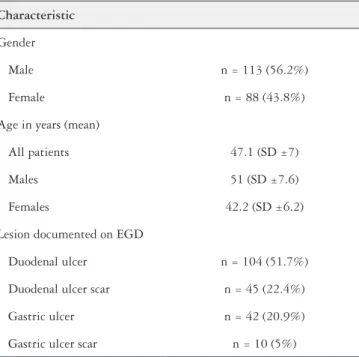
The sample consisted of 201 patients that satisied the study criteria. The average age was 47.1 (SD ±7) years and most individuals were male (n=113; 56.2%). All patients tested positive at baseline for H. pylori infection on histo-logical examination and urease test. The majority had active ulcers documented at baseline EGD (n=146; 72.6%). On the other hand, ulcer scar was found in almost one-third (n=55; 27.4%) of the patients. A large proportion of the individuals had the peptic ulcer disease located at duodenum (n=149; 74.1%). (Table 1).
TABLE 1. Characteristics of 201 patients with peptic ulcer disease treated
for H. pylori infection, in the period of 1990-2000, and followed for 5 years or more after successful H. pylori eradication
Characteristic
Gender
Male n = 113 (56.2%)
Female n = 88 (43.8%)
Age in years (mean)
All patients 47.1 (SD ±7)
Males 51 (SD ±7.6)
Females 42.2 (SD ±6.2)
Lesion documented on EGD
Duodenal ulcer n = 104 (51.7%)
Duodenal ulcer scar n = 45 (22.4%)
Gastric ulcer n = 42 (20.9%)
Gastric ulcer scar n = 10 (5%)
EGD: esophagogastroduodenoscopy; SD: standard deviation.
Fernandes YCF, Bonatto GR, Bonatto MW. Recurrence rate of Helicobacter pylori in patients with peptic ulcer ive years or more after successful eradication
154 Arq Gastroenterol v. 53 no. 3 - jul./set. 2016
On the follow-up, 180 (89.6%) of the 201 patients con-tinually tested negative for H. pylori on histopathological examination and urease test, while 21 (10.4%) patients be-came positive for H. pylori infection.
In two-thirds of the patients with infection recurrence, active ulcers were found during follow-up (n=14; 66.7%). These patients had the new ulcers identiied at EGD at same time the reinfection was documented, and were not taking NSAIDs. No patients in the group without H. pylori recur-rence had new ulcers during follow-up. The relation between H. pylori recurrence and active ulcers on follow-up was sta-tistically signiicant (P<0.05). On the EGD, the 21 patients with H. pylori recurrence presented: duodenal ulcer (n=11; 52.4%); duodenal ulcer scar (n=6; 28.6%); gastric ulcer (n=2; 9.5%); gastric ulcer scar (n=1; 4.8%); or both duodenal and gastric ulcer (n=1; 4.8%). (Table 2).
This study allowed verifying if recurrence of H. pylori infection occurs in the long-term – 5 years or more after conirmed eradication – in patients with peptic ulcer, treated in the period from 1990 to 2000.
The sample was composed by individuals with an average age of 47 years, with a slightly predominance of males. Most patients had active ulcers documented at baseline EGD. This inding is probably related with an increase in the search for medical attention during symptomatic periods of the disease.
The patients received either a triple regimen (amoxicillin, clarithromycin and a proton pump inhibitor) or a bismuth regimen (bismuth compound, metronidazole, and tetracy-cline, sometimes with a proton pump inhibitor) for H. pylori eradication. However, since only patients with conirmed eradication – through histological examination and urease test – joined the study, was impossible to compare eficacy between treatments in eradicating the Helicobacter. The control evaluation to document eradication was performed an average of 81 days after treatment.
This study had focused on long-term recurrence. The patients were followed for an average of 8 years, showing that, recurrence can occur even if the patient had eradication conirmed and had remained free of H. pylori during the irst years of follow-up after treatment. Due to the study design (regarding conirmed eradication and exclusion of patients with early recurrence), is most probable that patients whom became positive again suffered true reinfection. However, only molecular methods can accurately differ between rein-fection and recrudescence(14).
The recurrence rate of H. pylori found (10.5%) is close to igures reported in other Brazilian studies(3,5,6,21). In these re-searches, recurrence rate ranged between 5% and 20%. How-ever, it should be noted that this studies are heterogeneous regarding design. Generally, research on recurrence rate of H. pylori were aimed on the irst 5 years post-treatment.
The H. pylori recurrence is closely associated with an increase in the incidence of new ulcers(9).This is supported by our inding of new ulcers in two-thirds of the patients with H. pylori reinfection. Reinforcing this idea, no patients had active ulcers during follow-up on the group without reinfection. The association between reinfection and new ulcers was statistically signiicant (P<0.05).
This study suffered with limitations, most due to its ret-rospective design. The patients were tested at heterogeneous intervals during follow-up, therefore, was not possible to describe the interval between eradication and reinfection/ development of new ulcers. For example, if a patient had a 3 years interval between tests, with H. pylori recurrence documented on the later evaluation, was not possible to determine when, on this 3 years interval, the reinfection really occurred. Moreover, the incidence of active ulcers was high among patients with reinfection – such patients may have been inclined to seek medical attention due to symptoms, potentially leading to an overestimation of the recurrence rate.
Despite its limitations, few studies were aimed to determine the recurrence rate among Brazilian patients
TABLE 2. Relation between H. pylori recurrence and active peptic ulcer
during follow-up, of 201 patients with peptic ulcer disease treated for H. pylori infection, in the period of 1990-2000, and followed for 5 years or more after successful H. pylori eradication
H. pylori recurrence on follow-up
Active peptic ulcer on follow-up
No Yes
No n = 180 (89.6%) n = 0
Yes n = 7 (3.5%) n = 14 (7%)
Statistically signiicant result (P<0.05).
DISCUSSION
Treatment for peptic ulcer was for many decades surgical. In fact, gastrectomy (Billroth I and II) was introduced already in 1888. Later techniques, such as partial gastrectomy, antrectomy and vagotomy (posteriorly, selective and highly selective vagot-omy), improved outcomes, but the surgical approach continued to be associated with high levels of morbidity and mortality(23).
Fernandes YCF, Bonatto GR, Bonatto MW. Recurrence rate of Helicobacter pylori in patients with peptic ulcer ive years or more after successful eradication
v. 53 no. 3 - jul./set. 2016 Arq Gastroenterol 155
5 years or more after eradication. Our indings suggest that, despite the treatment had effectively reduced the incidence of gastrointestinal ulcer in the long-term – only 7% of the sample had new ulcers – the risk of recurrence cannot be discarded. Even long years after H. pylori eradication, re-infection or recrudescence should be suspected, especially if the patients became symptomatic again. The best way to follow patients with peptic ulcer after successful treatment for H. pylori is discussable. Ideally, the cost-effectiveness of subsequent medical interventions, the local recurrence rate and the individual risk of complications should be considered. Other long-term studies on recurrence of
H. pylori, especially with prospective design, can help
establish follow-up criteria for patients with peptic ulcer and determine to what extent therapy is protective over long periods.
CONCLUSION
The recurrence of H. pylori in patients with peptic ulcer can occur in the long-term – even if the infection had been successfully eradicated and the patients had remained nega-tive during the initial years of follow-up. The recurrence rate of H. pylori was 10.4%. Two-thirds of the patients with H. pylori recurrence also experienced new ulcers. Additionally, patients that had remained negative for H. pylori did not presented active ulcers during follow-up.
Authors’ contributions
Fernandes YCF: study design, data collection, statistical analysis, manuscript writing. Bonatto GR: study design, data collection. Bonatto MW: study design, critical review and corrections of manuscript.
REFERENCES
1. Abadi ATB. Helicobacter pylori: a beneicial gastric pathogen?. Gastroenterology. 2014;1:26.
2. Ai F, Hua X, Liu Y, Lin J, Feng Z. Preliminary study of pancreatic cancer associ-ated with Helicobacter pylori infection. Cell Biochem Biophys. 2014;71:397-400. 3. Coelho LGV, Passos MCF, Chausson Y, Costa EL, Maia AF, Brandao MJCC, et al. Duodenal ulcer and eradication of Helicobacter pylori in a developing country an 18-month follow-up study. Scand J Gastroenterol. 1992;27:362-6.
4. De-Francesco V, Giorgio F, Hassan C, Manes G, Vannella L, Panella C, et al. Worldwide H. pylori antibiotic resistance: a systematic review. J Gastrointestin Liver Dis. 2010;19:409-14.
5. Della Libera E, Rohr MRS, Moraes M, Siqueira ES, Ferrari Jr AP. Eradication of Helicobacter pylori infection in patients with duodenal ulcer and non-ulcer dyspep-sia and analysis of one-year reinfection rates. Braz J Med Biol Res. 2001;34:753-7. 6. Eisig, JN, Zaterka S, Silva FM, Malfertheiner P, Mattar R, Rodriguez TN, et al. Helicobacter pylori recurrence in patients with duodenal ulcer: clinical, endoscop-ic, histologendoscop-ic, and genotypic aspects. A 10‐year Brazilian series. Helicobacter. 2006;11:431-5.
7. Fikry AA, Kassem AA, Shahin D, Shabana HAS, Mostafa S. Helicobacter pylori infection in patients with chronic calcular cholecystitis a cross-sectional study. Journal of Surgery. 2014;2:58-62.
8. Fonseca FM, Etchebehere RM, Oliveira AG. Helicobacter pylori infection in patients undergoing upper endoscopy at University Hospital in Uberaba, Minas Gerais, Brazil. JMPHC. 2013;4:33-5.
9. Gisbert JP, Calvet X, Cosme A, Almela P, Feu F, Bory F, et al. Long-term follow-up of 1,000 patients cured of Helicobacter pylori infection following an episode of peptic ulcer bleeding. Am J Gastroenterol. 2012;107:1197-204.
10. Hagymási K, Tulassay Z. Helicobacter pylori infection: new pathogenetic and clinical aspects. World J Gastroenterol. 2014;20:6386-99.
11. Howden CW. Management of patients with Helicobacter pylori infection. Gas-troenterol Hepatol. 2014;10(7 Suppl 3):13-6.
12. Ierardi E, Goni E, Losurdo G. Di Mario F. Helicobacter pylori and nonmalignant diseases. Helicobacter. 2014;19:27-31.
13. Kidd M, Modlin IM. Century of Helicobacter pylori. Digestion. 1998;59:1-15. 14. Kim SY, Hyun JJ, Jung SW, Koo JS, Yim HJ, Lee SW. Helicobacter pylori
recur-rence after irst- and second-line eradication therapy in Korea: the problem of recrudescence or reinfection. Helicobacter. 2014;19:202-6.
15. Linz B, Balloux F, Moodley Y, Manica A, Liu H, Roumagnac P, et al. An Afri-can origin for the intimate association between humans and Helicobacter pylori. Nature. 2007;445(7130):915-8.
16. Matsuhisa T, Tsukui T. The irst-line eradication rate for Helicobacter pylori infec-tion in funcinfec-tional dyspepsia patients. J Gastroenterol Hepatol Res. 2014;3:1156-61. 17. Oliveira JG, Ferreira CHT, Camerin ACS, Rota CA, Meurer L, Silveira TR. Prev-alence of infection with cagA-positive Helicobacter pylori strains among children and adolescents in southern Brazil. Arquivos de Gastroenterologia. 2014;51:180-5. 18. Papastergiou V, Georgopoulos SD, Karatapanis S. Treatment of Helicobacter pylori infection: past, present and future. World J Gastrointest Pathophysiol. 2014;5:392-9.
19. Rauws EAJ, Tytgat GNJ. Cure of duodenal ulcer associated with eradication of Helicobacter pylori. The Lancet. 1990;335:1233-5.
20. Reis Júnior JDD, Fernandes AB, Santos FS, Silva JHG, Loiola RP, Silva JG, et al. Soroprevalência da infecção por Helicobacter pylori em uma amostra rural do Estado do Amazonas, Brasil. Revista Pan-Amazônica de Saúde. 2012;3:33-6. 21. Silva FM, Navarro-Rodriguez T, Barbuti RC, Mattar R, Hashimoto CL, Eisig JN. Helicobacter pylori reinfection in Brazilian patients with peptic ulcer disease: a 5-year follow-up. Helicobacter. 2010;15:46-52.
22. Smith SM, O’Morain C, McNamara D. Antimicrobial susceptibility testing for Helicobacter pylori in times of increasing antibiotic resistance. World J Gastro-enterol. 2014;20:9912-21.
23. Toneto MG, Oliveira FJM, Lopes MHI. History of peptic ulcer: from etiology to treatment. Scientia Medica. 2011;21:23-30.
24. Vakil NB. Antibiotic resistance in patients with Helicobacter pylori infection. Gastroenterol Hepatol. 2014; 10(7 Suppl 3):9-13.
25. Yazbek PB, Trindade AB, Chin CM, Santos JL. Challenges to the treatment and new perspectives for the eradication of Helicobacter pylori. Dig Dis Sci. 2015;60:2901-12.
Fernandes YCF, Bonatto GR, Bonatto MW. Taxa de reinfecção por Helicobacter pylori em pacientes com úlcera péptica cinco anos após erradicação. Arq Gastroenterol. 2016,53(3):152-5.
RESUMO - Contexto - A infecção por Helicobacter pylori é altamente prevalente no mundo, especialmente nos países em desenvolvimento, e sua presença na mucosa gastroduodenal está associada com o desenvolvimento de úlcera péptica e outras patologias. A erradicação do H. pylori melhora a histologia da mucosa em pacientes com úlcera péptica. Objetivo - Determinar se a recorrência da infecção por H. pylori ocorre cinco anos ou mais após a erradicação conirmada em pacientes com úlcera péptica. Além disso, buscou-se determinar a taxa de recorrência. Método - Retrospectivo e longitudinal, o estudo foi baseado em uma amostra de 201 pacientes oriundos da região Oeste do Paraná, Brasil. Os pacientes foram diagnosticados com úlcera gástrica e/ou duodenal, no período de 1990-2000, e foram seguidos por pelo menos cinco anos após a erradicação com sucesso do