436 Rev. Bras. Pesq. Tur. São Paulo, 11(3), pp. 436-452, set./dez. 2017.
DOI:http://dx.doi.org/10.7784/rbtur.v11i3.1324
The relationship between happiness and the desire for
hospitality mediated by tourist self-image and destination
image
A relação entre a felicidade e o desejo por hospitalidade
mediada pela autoimagem do turista e a imagem do seu
destino
A relacion entre a felicidad y desejo por hospitalidad mediada pela
autoimagem de turista y a imagem do seu destino
Leonardo Aureliano-Silva1 Paulo Sergio Gonçalves de Oliveira2 Carlos Alberto Alves3
Abstract: This research is justified by the need to broaden the theory about consumer behavior in tourism and the importance of improving commercial practices. The main objective of this study is to analyze the relation-ship between the search for happiness in the tourist experience and the desire for local hospitality, mediated by the congruence between the tourist's self-image and the destination image. A survey yielded 221 completed questionnaires. We took a quantitative approach to data analysis using multiple linear regression technique, and the results indicate a significant and positive relationship between the search for happiness in the tourist experience and the desire for local hospitality, mediated by the congruence of tourists self-image (how they see themselves) and tourist destination image. The originality of this study is to identify the self-image of the tour-ist and tourtour-ist destination as factors mediating the perception of local hospitality.
Keywords: Happiness. Hospitality. Tourism. Self-Image. Congruence.
Resumo: Essa pesquisa justifica-se pela necessidade de ampliar a teoria sobre comportamento do consumidor no turismo e a importância do aprimoramento de práticas comerciais. O principal objetivo deste estudo é analisar a relação entre a busca da felicidade na experiência turística e o desejo por hospitalidade local, medi-ada pela congruência entre a autoimagem do turista e a imagem do destino. Por meio de uma survey
1 Anhembi Morumbi University (UAM) and Escola Superior de Propaganda e Marketing (ESPM), São Paulo, SP, Brazil. Development of the theoretical framework, data collection, data analysis and research report.
2 Anhembi Morumbi University (UAM). Development of the theoretical framework, data collection, data analysis and research report.
3 Anhembi Morumbi University (UAM), São Paulo, SP, Brazil. Development of the theoretical framework, data collection, data analysis and final review.
437 Rev. Bras. Pesq. Tur. São Paulo, 11(3), pp. 436-452, set./dez. 2017.
se 221 questionários respondidos. Para análise dos dados, utilizou-se abordagem quantitativa com o uso da técnica de regressão linear múltipla, e os resultados indicaram relação significativa e positiva entre a busca da felicidade na experiência turística e o desejo por hospitalidade local, mediada pela congruência da autoima-gem do turista (como ele se vê) e imaautoima-gem do destino turístico. A originalidade deste estudo está em identifi-car a autoimagem do turista e destino turístico como fatores mediadores da percepção de hospitalidade local.
Palavras-chave: Felicidade. Hospitalidade. Turismo. Autoimagem. Congruência.
Resumen: Esta búsqueda justifica-se en la necesidad de ampliar una teoría sobre el comportamiento del con-sumidor en el turismo y un aumento en el desarrollo de los préstamos comerciales. O principal objetivo este estudio es una relación entre una búsqueda de la felicidad en la experiencia turística y la búsqueda por la hos-pitalidad local, la meditación por la congruencia entre una autoimagen de la turista y una imagen del destino. Por medio de una encuesta obteve-se 221 cuestionarios respondidos. Para la evaluación de los datos, la utili-zación de la cuantitativa con el uso de la técnica de la regresión múltiple lineal, los resultados indicaron la relación significativa y positiva entre la búsqueda de la felicidad en la experiencia turística y el deseo por la hospitalidad local, mediada por la congruencia de la autoimagen del turista (como se ve) y la imagen del desti-no turístico. Una originalidad de este estudio es identificar una autoimagen de turista y de destino mediadores de la percepción de hospitalidad local.
Palabras clave: Felicidad. Hospitalidad. Turismo. Autoimagen. Congruencia.
1 INTRODUCTION
This study discusses the concept of happiness, as a set of positive emotions re-lated to tourism consumption experience and its relationship with the perception of local hospitality.
According to Espinoza and Nique (2003) happiness is important to individuals and is related to positive emotions that in-fluence behavioral intention. The argument is that tourism consumption, as hedonic experience, leads consumers to positive actions, influences the way they see them-selves and how they perceive people with whom they interact (Yampey, 1980).
The term hospitality, which will also be addressed in this article, has different definitions, and is related, for example, to the provision of food and drink, mainte-nance of status and satisfaction of psycho-logical needs (King, 1995; Lynch, Molz, Mcin-tosh, Lugosi, & Lashley, 2011). The term hospitality is also used in the field of
man-agement, whose studies refer to the hospi-tality and meeting the customers' needs in purchasing contexts (Bareham, 2004), hospi-tality, behavior and buying experience (Hemmington, 2007) and in other manage-ment dimensions (Nailon, 1982). A common point on the concept of hospitality which is observed in the literature, refers to its wel-coming nature (Bareham, 2004) in order to make people feel good.
In this way, the concepts of happi-ness and hospitality, are theorized and test-ed in an exploratory model to identify and analyze their relationship.
desti-438 Rev. Bras. Pesq. Tur. São Paulo, 11(3), pp. 436-452, set./dez. 2017.
nation (Ahn, Ekinci, & Li, 2013).
Based on emotional contagion (Hat-field, Cacioppo, & Rapson, 1994), it is be-lieved that the consumers’ self-image and the tourist destination image are mediators of the relationship between the pursuit of happiness on tourist experience and the perception of local hospitality. The purpose of this research is to understand important aspects related to the choice of tourist des-tination, the influence of the congruence of co su ers’ self-image and their choices, and how these aspects influence the percep-tion of hospitality of the tourist destinapercep-tion.
In addition to contributing to the lit-erature on hospitality, tourism and market-ing, this article presents substantial contri-butions that can be considered by managers of tour operators in customer service and applied to tourism marketing campaigns.
After this brief introduction, we pre-sent a theoretical review on happiness, as a set of positive emotions; hospitality from the perspective of hosting; and tourists’ self-image (as they see themselves) and tourist destination image. Subsequently, we pre-sent the method of data analysis, the gen-eral discussion of the results and, finally, the theoretical and practical contributions and limitations of the research.
2 LITERATURE REVIEW
This section present studies on hos-pitality, happiness, and co su er’s self-image which were the basis of the study hypotheses.
2.1 Happiness in tourism
According to Espinoza and Nique (2003) the feeling of happiness is of great importance to individuals and it relates to set of positive emotions that influence be-havioral intention. Nietzsche (2016) has a different vision, as he proclaims that happi-ness is something that humans want only to desire, but not to have it, and every individ-ual who experiences it learns to downright pray for disquietude. This view is somewhat exploited in the marketing field, where it has been argued that consumption is a means of pursuing happiness (DeLeire & Kalil, 2010). According to Braudrillard (2008) there is an ideological system created by the market that strengthens the relationship between consumption and happiness. This vision builds on the concept of happiness pro-posed by Kant, in which everything takes place according to o e’s desire and will, i.e., consumers feel a moment of happiness when they want and buy something.
There is a theoretical corpus report-ed many times in the marketing literature regarding the hedonic consumption per-spective (Ben-Ur, Mai, & Yang, 2015; Hirschman & Holbrook, 1982; Lacher, 1989; Neeley, Sa Mi , & Ke ett‐He sel, ; Nicolao, 2010), i.e. the consumption that generates pleasure and happiness, for ex-ample, consumption of luxury cuisine (Hem-zo & Augusto, 2010), music consumption (Lacher, 1989), and the tourist consumption (Rubio Gil, 1996).
in-439 Rev. Bras. Pesq. Tur. São Paulo, 11(3), pp. 436-452, set./dez. 2017.
teract (Yampey, 1980), resulting in a positive judgment on social interaction.
The importance of this aspect lies in the fact that tourism is an engine of eco-nomic growth, however the happiness gen-erated by it and its ability to contribute to good health is only beginning to be docu-mented (Bojanowska & Zalewska, 2016; Filep & Bereded-Samuel, 2012a; Hofmann, Luhmann, Fisher, Vohs, & Baumeister, 2014).
For this reason, Filep and Bareed-Samuel (2012b) studied among the Ethiopi-an immigrEthiopi-ant community in Australia how positive holiday experiences, involving visits to friends or relatives improves mental health, relieves depression levels, and thus improves the level of happiness of people who travel. They justified this study because the tourism industry is increasingly interest-ed in understanding how travel affects hap-piness of individuals, and thus improving health.
This aspect has become so important that some countries such as Bhutan, have a tourism policy fully guided by the doctrine of Gross National Happiness (GNH), which apparently is more important than other policies, thus enabling this country to gain reputation on the world tourism map. The importance of this policy lies in the fact that there has been a significant investment in socio-economic development, environmen-tal conservation, promotion of culture and good governance (the four pillars of the pol-icy); for people who visit the country feel happy, it is very important that the popula-tion is happy and therefore can transmit that feeling to the visitors, which is very close to the satisfaction provided by the
location (Coffey, Warren, & Gottfried, 2015; Khamrang, 2013; Yang & Srinivasan, 2016).
This is corroborated by the study of Kaliterna-Lipo ča , Brasjša-Žga ec a d Pol-janec-Borić 4 that suggests that the quality of tourist destinations is related to the subjective well-being of people living in those destinations. The authors studied two sets of data: one that mentioned the well-being of the citizens of Croatia and the other that mentioned the quality of tourist desti-nations in the country. Through an analysis of covariance, they found that the higher the level of happiness and satisfaction of citizens, the greater the quality of the tourist destination (Kaliterna-Lipo ča et al., 4 .
Nawijn and Peeters (2010) studied the happiness from the tourists' point of view and realized that what affected directly the indexes of happiness of those tourists was the freedom that they perceived when they moved in the destination, thus the au-thors concluded that if public policies re-strict this freedom, this will negatively affect the happiness of the tourist and possibly the probability that this tourist will return to the destination.
440 Rev. Bras. Pesq. Tur. São Paulo, 11(3), pp. 436-452, set./dez. 2017.
tourists.
Nawijn (2010) observes that the im-portance of studying these aspects lies in the fact that the tourism industry pays little attention to the traveling mood of tourists and how it affects their life satisfaction and how that aspect relates to the increase in revenues of tourism companies.
It is also important to pay attention to the fact that there are subtle differences in the perceived happiness according to the gender social and cultural conditions, the country of origin, religion, and place of resi-dence (rural or urban). Although subtle, it is interesting for tourism operators to pay at-tention to these differences in order to pro-vide a better service to travelers (Meisen-berg & Woodley, 2015).
Ho e er, the tra elers’ change of mood and happiness indexes are temporary aspects that must be always emphasized, but this change occurs to a greater extent in people that travel than in those who do not travel, which can be explained by the fact that the positive memories positively affect the lives of people (Nawijn, 2011).
2.1.2 Hospitality
The term hospitality is reported in the literature in different ways and covers a variety of situations, for example, in the provision of food and drink to the guest, the maintenance ofstatusin social relations and the satisfaction of psychological needs (King, 1995; Lynch et al., 2011). The term hospitali-ty can also be found within the management
field, whose studies refer, for example, to the hospitality and meeting the customers' needs and the factors in purchasing
behav-ior (Bareham, 2004), hospitality, behavbehav-ior and buying experience (Hemmington, 2007) and in other management dimensions (Nailon, 1982). From this perspective, the common point between these studies is the importance given to hosting people to meet their physiological, psychological, and social needs (Bareham, 2004; Hemmington, 2007; Nailon, 1982), i.e. making the consumers feel good emotionally about the buying ex-periences.
To meet these requirements, tourism companies are facing a real challenge. Dur-ing the last decades, there have been pro-found changes as well as the development of countries, due mainly to economic and technological advances (Chand, 2016).
These changes have posed a series of challenges to the educational system, in-cluding the curriculum of educational insti-tutions, learning materials, etc. The tourism and hospitality industry plays a central role in this scenario, because people travel more and more, which leads to new perceptions of hospitality, in addition to the fact this is a labor-intensive industry, which requires skilled and qualified labor in large numbers, which creates an additional challenge for countries (Chand, 2016).
Hospitality educational institutions are considered a key factor for the supply of skilled labor for the industry, contributing significantly to the growth of the operations in this area (Alhelalat, 2015).
441 Rev. Bras. Pesq. Tur. São Paulo, 11(3), pp. 436-452, set./dez. 2017.
customer contact and the key feature of the service is provided face-to-face, often re-quiring creativity and managerial skills.
The importance of tourism to some countries is vital, as in the case of Taiwan for example, mainly because it is a source of revenue and creates jobs in hospitality, and leads these countries to develop the trans-portation and communication systems pro-moting the increase of visitors, whether for business or leisure (Chen, 2015).
Hospitality is the core of many socie-ties; however, the term has many meanings and is interpreted in different ways in dif-ferent countries, according to the ideology, and relationship with God or Gods in some cases (Munasinghe, Hemmington, Schänzel, Poulston, & Fernando, 2017).
For this reason, many countries are being affected, including those who were considered closed and so conservative in the past, such as China, which is facing a big challenge currently, due mainly to its rapid modernization. This country is now focusing on diversity management in its school pro-gram in terms of hospitality in order to meet the new demand, especially when it comes to understand the perceptions of students (future managers) about the importance of diversity in order to generate a sense of hospitality for the client (Yap, Ineson, Tang, & Fong, 2015).
Focusing on the study of diversity is important because customer satisfaction in the hospitality industry is closely linked to the concepts that involve feelings of well-being and pleasure that are a result of what the customer wants and expects from prod-ucts and services. Customer satisfaction can also be based on the results and also on
processes, but above all the perception termines the quality which is currently de-livered by the establishment and thus it is essential for corporate survival, in general, the aspects perceived by customers: courte-sy and efficiency of staff, supplies and amen-ities to guests, courtesy and friendliness, overall condition of the room, room tem-perature, restaurants, service quality, quali-ty and variequali-ty of the meals (Gupta & Shar-ma, 2016; Hornsby & Scott-Halsell, 2015).
In this context Sangode (2016) ana-lyzes the parameters of satisfaction, which are formed primarily by aspects such as: customer service, quality of the food served, the identification of custo ers’ future ex-pectations and the customer self-assessment generate different views in rela-tion to the hotel, causing a positive view of hospitality.
These aspects are a huge challenge for the sector, as Lashley (2015) argues, the concept of Hospitality is something quite ephemeral, and can be proven by the fact that until the end of the 20th century, res-taurants used to be synonymous with ac-commodation, which also led to point out cafes, cafeterias, canteens, school meals as locations that aimed to provide hospitality, and that only from the 1980s, the word started to be used to describe all these es-tablishments and the services provided by them.
obli-442 Rev. Bras. Pesq. Tur. São Paulo, 11(3), pp. 436-452, set./dez. 2017.
gation for the company willing to offer this type of service.
Due to the reasons presented, Luo et al. (2013) argue that strategies to promote staff commitment and employee/leadership relationship are important to enhance the positive behavior of employees, as well as the clear objective to improve the quality of services provided in the hospitality industry, through mainly the behavior of employees with regards to assistance and support to customers, thereby increasing the possibility of improving the customer perception in relation to hospitality and happiness of con-sumers during the consumption of products and services such as: accommodation, cater-ing, travel etc.
Regarding the commitment of the staff, hospitality employment is not always considered as a valid career option, even if it is a developing industry. Thus, it is important to convince young people otherwise, so that industry can develop and attract more pro-fessionals (Williamson, 2017).
According to Mooney (2016), most people do not consider hospitality as a valid career because a large proportion of young people perceive that industry as something ephemeral due to temporary employment and the high levels of turnover, thus young people do not feel attracted. Another aspect is the fact that they feel that their work is not appreciated.
A possible solution might be strengthening the connection between uni-versities and hospitality companies; these can offer a view of the market and the exist-ing possibilities, and in turn schools provide the state of the art and academic capacity that companies lack (Albano, 2013)
The importance of making people see hospitality as a career is to form a bet-ter-quality workforce and therefore invest in the improvement of the quality indicators of accommodation through the provision of services that delight the customer and make them feel welcomed (Gupta & Sharma, 2016).
For achieving this goal, Awadzi-Calloway, Awadzi and Awadizi (2016) claim that the collective knowledge and the con-tributions of the organization members serve as a driving factor for the success of the tourism industry and that companies must be able to polish rough diamonds, i.e. training and selecting employees, aiming to enhance their skills so that they become vital resources for the organization and con-tribute to change the tourism industry itself. The transformation of the tourism industry and the organization, aiming at the satisfaction of the employees, affects their ability to be good hosts and thus create moments of hospitality in their daily interac-tion with tourists (Bethmann, 2017).
For this reason, the aspects related to e ployees’ a d tra elers’ welfare charac-terize the process of emotional contagion, theorized by Hatfield et al. (1994).
443 Rev. Bras. Pesq. Tur. São Paulo, 11(3), pp. 436-452, set./dez. 2017.
According to Hemmington and Gib-bons (2017), the importance of the decon-struction of the hospitality and employee training investment lies in the fact that the perception of the tourist about welfare is very related to reciprocity, generosity, and ability of interaction between the organiza-tion members and visitors and for this rea-son it has managerial implications, becom-ing an emotional contagion process.
Based on the emotional contagion process theorized in Emotional Contagion
(Hatfield et al., 1994) and in the study on hospitality (King, 1995), we present the first study hypothesis: H1 - there will be a
posi-tive and significant relationship between the pursuit of happiness in the tourist experi-ence (set of positive emotions) and the de-sire for local hospitality (projection of posi-tive emotions about the place). Table 1 be-low shows the studies used for the creation of hypothesisH1.
Table 1 –Theoretical framework for hypothesis H1
Authors What they analyzed
Hemmington & Gibbons (2017) Wellness and reciprocity
Bojanowska & Zalewska (2016) Tourism and happiness
Coffey, Warren, & Gottfried (2015) Happiness and local satisfaction
Kaliterna-Lipo ča , Brasjša-Žga ec and Poljanec-Borić 4
Tourist destination and subjective well-being
Gouveia (2013) Tourist destination and psychological demands Hatfield et al., (1994) Wellness and emotional contagion
Source: The authors (2017)
2.1.3 Congruence between the self-image of the tourist and the image of the tourist destination
When choosing a tourist destination, one considers not only the costs of acquisi-tion of the service, such as transportaacquisi-tion, food, and other activities that may be in-volved, but also the consumer judgment about the ability of the tourist destination to meet psychological demands (Carvalho, Sal-azar, & Neves, 2011; Gouveia, 2013). The psychological demands, refers to the per-ception of how consumers see themselves, their self-image, and as they see the tourist destination, in which they project their self-image in the moment of choice (García,
Mo-rales, & Gonzalez, 2007). For example, intro-spective individuals tend to choose tourist destinations that are quieter, including also other activities that at the location.
Nawijn (2010) observes that these aspects are relevant because the tourism industry pays little attention to the mood of tourists when they are traveling and how it affects their life satisfaction and how that aspect relates to the increase in revenues of companies.
444 Rev. Bras. Pesq. Tur. São Paulo, 11(3), pp. 436-452, set./dez. 2017.
fact that the positive remaining memories positively affect the lives of people (Nawijn, 2011).
This phenomenon is called congru-ence (Hosany & Martin, 2012), i.e. con-sistency between consumers' self-image (as they see themselves), and the image of the-tourist destination of their choice (Ahn, Ek-inci, & Li, 1994), that can positively influence the evaluation (Kamins & Gupta, 1994). The second hypothesis of this study is the fol-lowing: H2 -there will be a positive and
sig-nificant relationship between the pursuit of happiness in the tourist experience (positive emotion) and the congruence between the self-image of tourists (as they see them-selves) and the image of the tourist destina-tion.
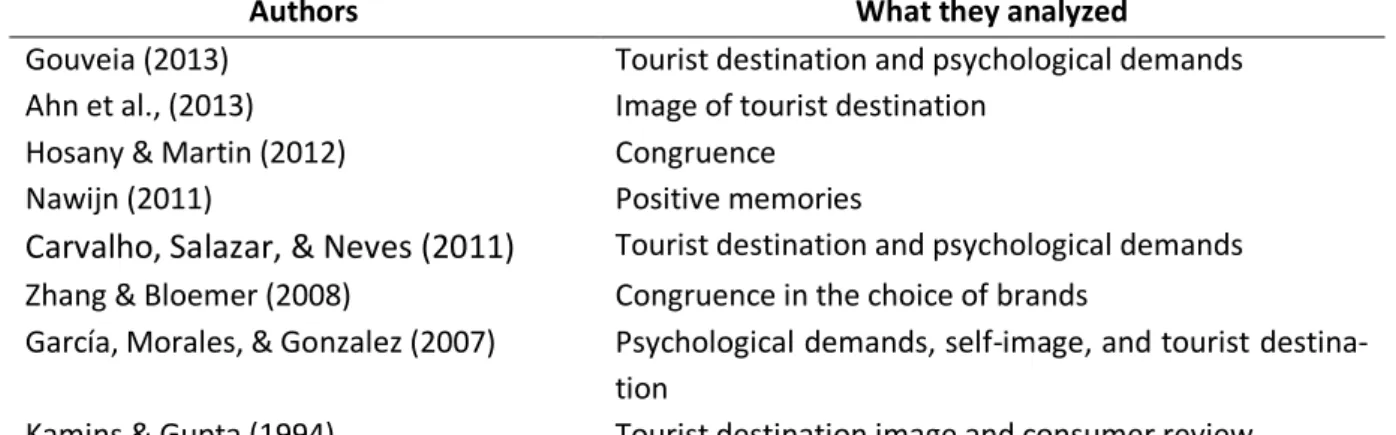
Considering that consumers can as-sess more positively tourist destinations that fit their self-image (García et al., 2007) and that the perception of congruence between self-image and tourist destination generates positive emotions (Choi & Rifon, 2012), it is stated that the phenomenon of congruence will mediate the relationship between the pursuit of happiness on tourist experience and the perception of local hospitality. Thus, we present the third hypothesis of this study: H3 - the congruence of the
consum-ers’ self-image and the image of the destina-tion will be a mediator of the reladestina-tionship between the pursuit of happiness on tourist experience and the perception of hospitality of the tourist destination. Table 2 below shows the studies used for the creation of the hypotheses H2 e H3.
Table 2 – Theoretical framework for hypothesis H2and H3
Authors What they analyzed
Gouveia (2013) Tourist destination and psychological demands Ahn et al., (2013) Image of tourist destination
Hosany & Martin (2012) Congruence
Nawijn (2011) Positive memories
Carvalho, Salazar, & Neves (2011) Tourist destination and psychological demands Zhang & Bloemer (2008) Congruence in the choice of brands
García, Morales, & Gonzalez (2007) Psychological demands, self-image, and tourist destina-tion
Kamins & Gupta (1994) Tourist destination image and consumer review
Source: The authors (2017)
3 METHOD
Data were collected by asurveywith the use of an online research instrument available on the social network Facebook. The instrument was composed of 12 state-ments, 4 of which measured the pursuit of happiness in the tourist destination: <When
445 Rev. Bras. Pesq. Tur. São Paulo, 11(3), pp. 436-452, set./dez. 2017.
destinations that have everything to do with me; I choose tourist destinations that reflect my image; I choose tourist destinations that speak about me; I choose tourist destina-tions that reflect my lifestyle> (Cronbach's alpha = 0.895); and 4 statements that meas-ured desire for local hospitality <When I choose a tourist destination, I prefer those with friendly people; When I choose a tour-ist destination, I prefer those where local residents enjoy exchanging experiences with tourists; When I choose a tourist destina-tion, I prefer those in which locals like to interact with tourists; When I choose a tour-ist destination, I prefer those where local residents are welcoming> (Cronbach's al-pha=0.823).
4 RESULTS
The sample of the study consisted of 221 respondents being 166 women and 55 men. The average age of respondents was 33 years old, and they have traveled, on average, 3 times during 2016. After checking
the conditions for the use of the regression technique (Hair, Black, Babin, & Anderson, 2010), the analysis of the data was carried out.
The pursuit of happiness in the tour-ist experience presented positive relation-ship and significant desire for local hospitali-ty R2= 0.067; F(1.219)=p<0.001. Similarly, a
positive and meaningful relationship was identified between the pursuit of happiness in the tourist experience and congruence of the tourist's self-image and tourist destina-tion R2= 0.240; F(1.219)=p<0.001, and also,
mediation effect of the tourist's self-image and tourist destination in the relationship between pursuit of happiness and desire for local hospitality R2= 0.115; F(2.218)=
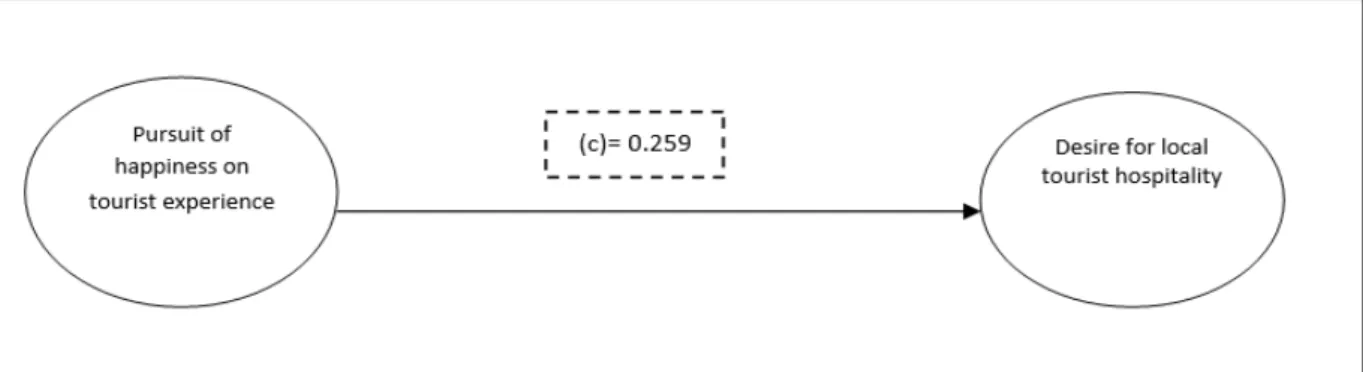
p<0.001. It was observed that the relation-ship between the pursuit of happiness in tourist experience and hospitality presented p=>0.05, therefore, not significant, when the variable of the congruence of the tourist's self-image and the local hospitality desire is added. Figures 1 and 2 present the respec-tive betas of each relationship.
Figure 1 - Pursuit of happiness and hospitality
446 Rev. Bras. Pesq. Tur. São Paulo, 11(3), pp. 436-452, set./dez. 2017.
Figure 2 - Mediation of the congruence of the self-image of the tourist and tourist destination
Source: The Authors
As we can see, the values of the be-tas indicate the nature and strength of the relationship between each item in the mod-el. All betas presented positive values, which indicate positive correlations between the items measured and the strength of their influence on the other items in the model, according to the direction of the relation-ship.
5 GENERAL DISCUSSION OF THE RESULTS
The concept of happiness is subjec-tive in nature and we will hardly reach a single definition for that feeling. Given its importance it became an object of study in this article. Thus, we sought to present the relationship between the pursuit of happi-ness in the tourist experience and the choice of a tourist destination, whose main charac-teristic was the hospitality of the place visit-ed. It is worth mentioning that the term
hospitality, in this study, is used in the sense of accepting the possibility of social interac-tion and exchange of experiences between tourists and residents in the destination.
The analyses show that the pursuit of happiness through tourism has a positive relationship with the desire of hospitality in the tourist destination, in other words, this relationship indicates there is an emotional projection of tourists into the place and on those who receive them. The analysis of the beta of this relationship strengthens this argument (β= 0.259), Figure 1. This finding is consistent with the theoretical explanation already consolidated in Emotional Contagion
(Hatfield et al., 1994), in which the individu-als when in a state of positive emotion tend to project themselves into other situations and different contexts.
447 Rev. Bras. Pesq. Tur. São Paulo, 11(3), pp. 436-452, set./dez. 2017.
Also, it can contribute to the improvement of general health of the people. This aspect has been little studied as evidenced by Filep and Bereed-Samuel’s (2012a) work on a community of Ethiopian immigrants in Aus-tralia, that shows the relief of depression levels and the improvement of mental health of these participants.
This finding corroborates the policy adopted by Bhutan, which base its tourism policy on a strategy fully guided by the doc-trine of the Gross National Happiness, be-cause they believe that the increase of this index contributes to the increase of the tourist flow, promotes good governance and culture, and the happiness of both visitors and visited (Gupta & Sharma, 2016; Khamrang, 2013; Yang & Srinivasan, 2016).
These ideas are corroborated by the studies of Lipo ča , Brasjša-Žga ec a d Pol‐ janec-Borić 4 , Go es, Pinto and Al-meida (2017) and Zucco et al. (2017) which show that the quality of destinations are very much related to the perception of hap-piness of the residents of the locations that are being visited, demonstrating that the higher the perceived happiness, the greater the quality of the tourist destination.
It stands out as the main contribu-tion of this study the identificacontribu-tion of the self-image of tourists (as they see them-selves) and the image of tourist destination (local characteristics and activities), influenc-ing the perception of hospitality. Some evi-dence of these phenomena has already been reported (Femenía Millet, 2011; Menezes, 2010).
This psychological phenomenon shows that one of the most important fac-tors in the choice of tourist destination is
the relationship between the pursuit of happiness and the self-image of the tourist and destination (path (a) β= 0.490), Figure 2. It can be said that the pursuit of happiness is linked to the way the tourists see them-selves (self-image) and it is enhanced by the image of the tourist destination. This con-sistency between both can be explained by studies that have addressed the phenome-non of congruence (Meyers-Levy & Tybout, 1989; Witt & Bruce, 1972).
The congruence of the self-image of the tourist and the tourist destination in relation to the perception of hospitality in the destination presented path (b) β= 0.250. It is the second strongest relationship, indi-cating that the congruence of self-image and destination are important antecedents of the perception of local hospitality.
Finally, it is observed that the pursuit of happiness and hospitality of tourist desti-nation has the smallest beta (path (c') β= 0.137), when the mediator congruence of self-image and tourist destination has been added to the model 2, indicating to be a mediator of the relationship, i.e., if tourists perceive the destination consistent with how they see themselves, they will feel that local residents are more hospitable. The overall effect of (a) * (b) = 0.12, show that the model explains 12% of the perception of hospitality of the tourist destination.
5.1 Theoretical and practical implications and limitations
percep-448 Rev. Bras. Pesq. Tur. São Paulo, 11(3), pp. 436-452, set./dez. 2017.
tion of hospitality. Therefore, this study ad-vances the understanding of the cognitive process of consumers in the choice of tourist destination on the influence of positive feel-ings, and the behavior of the consumer of this type of service.
Regarding the practical implications, tourism managers must identify the motiva-tion for the trip, and the emomotiva-tional state of the consumer when the tourist destinations and costs are presented. Managers should be able to present alternative tourist desti-nations aligned to the way tourists see themselves (self-image).
We acknowledge the limitations of this study, for example, the use of the term happiness, because it is subjective, it can lead to different interpretations on the part of the respondents of the survey. Another limitation is the use of only two explanatory factors in the model, therefore, future re-search may add other factors to improve the explanatory power of the theoretical model tested in this study.
REFERENCES
Ahn, T., Ekinci, Y., & Li, G. (2013). Self-congruence, functional Self-congruence, and destina-tion choice. Journal of Business Research, 66(6), 719–723.
https://doi.org/10.1016/j.jbusres.2011.09.009
Albano, D. (2013). Transitioning Hospitality Management into Professional Studies Within a Liberal Arts Perspective. Consortium Journal of Hospitality & Tourism, 18(2), 1–16.
Alhelalat, J. A. (2015). Consumer Behaviour Analysis of Hospitality Students’ Evaluation and Satisfaction with Their Universities. Tourism & Hospitality Management, 21(2), 127–143.
Awadzi-Calloway, J., Awadzi, C., & Awadzi, W. (2016). The Role of Human Resource Specialists in Motivation, Training and Engagement in the Hospitality Industry. Consortium Journal of Hospitality & Tourism, 20(2), 32–37.
Bareham, J. (2004). Understanding the Hospitali-ty Consumer. International Journal of
Hospitali-ty Management, 23(1), 95–97.
https://doi.org/10.1016/S0278-4319(03)00068-9
Ben-Ur, J., Mai, E. (Shirley), & Yang, J. (2015). Hedonic Consumption in Virtual Reality. Jour-nal of Internet Commerce, 14(3), 406–423.
https://doi.org/10.1080/15332861.2015.1081792
Bethmann, C. (2017). “Getting milk from the chicken”: Hospitality and hospitableness in
Bul-garia’s mass tourism resorts. Hospitality &
So-ciety, 7(1), 19–41
https://doi.org/10.1386/hosp.7.1.19_1
Bojanowska, A., & Zalewska, A. (2016). Lay Understanding of Happiness and the Experience of Well-Being: Are Some Conceptions of Happi-ness More Beneficial than Others? Journal of Happiness Studies, 17(2), 793–815.
https://doi.org/10.1007/s10902-015-9620-1
Carvalho, P. D. da C., Salazar, A. M. P. L. V. B. K., & Neves, J. M. de O. (2011). a Imagem Per-cebida E O Perfil Do Turista De Um Destino Turístico Cultural: O Caso Do Alto Douro Vi-nhateiro, Património Da Humanidade. FCHS (DCEC) - Artigos em Atas de Conferências In-ternacionais, 18.
Chand, M. (2016). Building and Educating To-morrow’s Manpower for Tourism and Hospitali-ty Industry. International Journal of Hospitality & Tourism Systems, 9(1), 53–57.
449 Rev. Bras. Pesq. Tur. São Paulo, 11(3), pp. 436-452, set./dez. 2017.
https://doi.org/10.1080/13683500.2013.854752
Choi, S. M., & Rifon, N. J. (2012). It Is a Match: The Impact of Congruence between Celebrity Image and Consumer Ideal Self on Endorsement Effectiveness. Psychology and Marketing, 29(9), 639–650. https://doi.org/10.1002/mar.20550
Coffey, J., Warren, M., & Gottfried, A. (2015). Does Infant Happiness Forecast Adult Life Satis-faction? Examining Subjective Well-Being in the First Quarter Century of Life. Journal of
Happi-ness Studies, 16(6), 1401–1421.
https://doi.org/10.1007/s10902-014-9556-x
DeLeire, T., & Kalil, A. (2010). Does consump-tion buy happiness? Evidence from the United States. International Review of Economics, 57(2), 163–176. https://doi.org/10.1007/s12232-010-0093-6
Espinoza, Francine; Nique, Walter. Experiências emocionais em situações de consumo de produ-tos: evidências e proposições de pesquisa. In: ENANPAD, 2003. Atibaia (SP). Anais…Atibaia: ANPAD, 2003.
Femenía Millet, O. (2011). La imagen de un destino turístico como herramienta de marketing. Eumed.Net, 122.
Filep, S., & Bereded-Samuel, E. (2012a). Holi-days against depression? An Ethiopian Australi-an initiative. Current Issues in Tourism, 15(3), 281–285.
https://doi.org/10.1080/13683500.2011.594161
Filep, S., & Bereded-Samuel, E. (2012b). Holi-days against depression? An Ethiopian Australi-an initiative. Current Issues in Tourism, 15(3), 281–285.
https://doi.org/10.1080/13683500.2011.594161
García, R. C. P., Morales, L. M., & Gonzalez, Y. D. (2007). La imagen del destino y el
comporta-miento de compra del turista. Teoría y Praxis, 3, 89–102.
Gomes, R. D. S. D., Pinto, H. E. dos R. S. da C., & Almeida, C. M. B. R. de. (2017). Second home tourism in the Algarve – The perception of public managers. Revista Brasileira de Pesquisa Em Turismo, 11(2), 197.
https://doi.org/10.7784/rbtur.v11i2.1246
Gouveia, D. (2013). Perfil e Motivação dos turis-tas praticantes de Surf na escolha do destino Al-garve. Statewide Agricultural Land Use Baseline 2015, 1.
https://doi.org/10.1017/CBO9781107415324.004
Gupta, S. K., & Sharma, N. (2016). Evaluation of Guest Satisfaction about Hospitality Services: A Case of Accommodation Units in Nainital, Utta-rakhand. International Journal of Hospitality & Tourism Systems, 9(2), 47–55.
Hair, J. F., Black, W. C., Babin, B. J., & Ander-son, R. E. (2010). Multivariate Data Analysis. Vectors.
https://doi.org/10.1016/j.ijpharm.2011.02.019
Hatfield, E., Cacioppo, J., & Rapson, R. (1994). Emotional contagion. Current Directions in Psy-chological Science.
https://doi.org/10.1086/322897
Hemmington, N. (2007). From Service to Expe-rience: Understanding and Defining the Hospital-ity Business. The Service Industries Journal, 27(6), 747–755.
https://doi.org/10.1080/02642060701453221
Hemmington, N., & Gibbons, A. (2017). “Pas d”hospitalité’: Derrida and the study of hospitali-ty in higher education. Hospitality & Society, 7(2), 115–131.
https://doi.org/10.1386/hosp.7.2.115_1
Gastro-450 Rev. Bras. Pesq. Tur. São Paulo, 11(3), pp. 436-452, set./dez. 2017.
nomia de Luxo – Entendendo as motivações de consumo. In XXXIV Encontro da Anpad (p. 17).
Hirschman, E. C., & Holbrook, M. B. (1982). Hedonic Consumption: Emerging Concepts, Methods and Propositions. Journal of Marketing, 46(3), 92. https://doi.org/10.2307/1251707
Hofmann, W., Luhmann, M., Fisher, R. R., Vohs, K. D., & Baumeister, R. F. (2014). Yes, but are they happy? Effects of trait self-control on affective well-being and life satisfaction. Journal Of Personality, 82(4), 265–277.
https://doi.org/10.1111/jopy.12050
Hornsby, G. D., & Scott-Halsell, S. A. (2015). Minorities in Hospitality Management: The State of Diversity in Hospitality Education. Journal of Hospitality & Tourism Education, 27(3), 102– 111.
https://doi.org/10.1080/10963758.2015.1064316
Hosany, S., & Martin, D. (2012). Self-image congruence in consumer behavior. Journal of Business Research, 65(5), 685–691.
https://doi.org/10.1016/j.jbusres.2011.03.015
Kaliterna-Lipovčan, L., Brajša-Žganec, A., & Poljanec-Borić, S. (2014). What Is Good for Tourists Should Be Good for Residents Too: The Relationship Between the Quality of the Touris-tic Offer and Subjective Well-Being of Resi-dents. Tourism Analysis, 19(6), 719–730.
https://doi.org/10.3727/108354214X1414684667 9448
Kamins, M. A., & Gupta, K. (1994). Congruence between spokesperson and product type: A matchup hypothesis perspective. Psychology & Marketing, 11(6), 569–586.
https://doi.org/10.1002/mar.4220110605
Kant, I. (2016). Crítica da Razão Prática (1 edi-tion). Martin Claret.
Khamrang, L. (2013). Modernisation,
Globalisa-tion and Development in Bhutan: Tourism as a Catalyst. Journal of Management & Public Poli-cy, 5(1), 5–11.
King, C. A. (1995). What is hospitality? Interna-tional Journal of Hospitality Management, 14(3– 4), 219–234. https://doi.org/10.1016/0278-4319(95)00045-3
Lacher, K. T. (1989). Hedonic Consumption: Music as a Product. Advances in Consumer Re-search, 16(1), 367–373.
Lashley, C. (2015). Hospitalidade e hospitabili-dade. Revista Hospitalidade, 70–92.
Loubser, R., & Steenekamp, C. (2017). Democ-racy, well-being, and happiness: A 10-nation study. Journal of Public Affairs, 17(1–2), e1646.
https://doi.org/10.1002/pa.1646
Luo, Z., Marnburg, E., Øgaard, T., & Larsen, S. (2013). Antecedents for Employee Helping Be-havior in the Hospitality Industry. Journal of China Tourism Research, 9(4), 395–412.
https://doi.org/10.1080/19388160.2013.839411
Lynch, P., Molz, J. G., Mcintosh, A., Lugosi, P., & Lashley, C. (2011). Theorizing hospitality. Hospitality & Society.
https://doi.org/10.1386/hosp.1.1.3_2
Meisenberg, G., & Woodley, M. (2015). Gender Differences in Subjective Well-Being and Their Relationships with Gender Equality. Journal of Happiness Studies, 16(6), 1539–1555.
https://doi.org/10.1007/s10902-014-9577-5
Menezes, P. D. L. de. (2010). Gestão estratégica da imagem: estudo de caso do destino turístico João Pessoa. In SeminTUR Saberes e fazeres no turismo: interfaces (Vol. VI Seminár, p. 13).
evalua-451 Rev. Bras. Pesq. Tur. São Paulo, 11(3), pp. 436-452, set./dez. 2017.
tion. Journal of Consumer Research, 16(1), 39– 54. https://doi.org/10.1086/647521
Mooney, S. (2016). Wasted youth in the hospital-ity industry: Older workers’ perceptions and misperceptions about younger workers. Hospital-ity & Society, 6(1), 9–30.
https://doi.org/10.1386/hosp.6.1.9_1
Munasinghe, S., Hemmington, N., Schänzel, H., Poulston, J., & Fernando, T. (2017). Hospitality: Ideologies, characteristics and conditionality in Theravada Buddhism and Western philosophy. Hospitality & Society, 7(2), 157–180.
https://doi.org/10.1386/hosp.7.2.157_1
Nailon, P. (1982). Theory in hospitality man-agement. International Journal of Hospitality Management, 1(3), 135–143.
https://doi.org/10.1016/0278-4319(82)90002-0
Nawijn, J. (2010). The holiday happiness curve: a preliminary investigation into mood during a holiday abroad. International Journal of Tourism Research, 12(3), 281–290.
Nawijn, J. (2011). Happiness Through Vacation-ing: Just a Temporary Boost or Long-Term Ben-efits? Journal of Happiness Studies, 12(4), 651– 665. https://doi.org/10.1007/s10902-010-9221-y
Nawijn, J., & Peeters, P. M. (2010). Travelling
“green”: is tourists’ happiness at stake? Current
Issues in Tourism, 13(4), 381–392.
https://doi.org/10.1080/13683500903215016
Neeley, C. R., Sam Min, K., & Kennett‐Hensel, P. A. (2010). Contingent consumer decision making in the wine industry: the role of hedonic orientation. Journal of Consumer Marketing, 27(4), 324–335.
https://doi.org/10.1108/07363761011052369
Nicolao, L. (2010). Happiness, consumption and hedonic adaptation. Dissertation Abstracts
Inter-national Section A: Humanities and Social Sci-ences.
Nunkoo, R., Gursoy, D., & Ramkissoon, H. (2013). Developments in Hospitality Marketing and Management: Social Network Analysis and Research Themes. Journal of Hospitality Market-ing & Management, 22(3), 269–288.
https://doi.org/10.1080/19368623.2013.753814
Poulston, J. (2015). Expressive labour and the gift of hospitality. Hospitality & Society, 5(2/3), 145–165.
https://doi.org/10.1386/hosp.5.2-3.145_1
Rubio Gil, M. A. (1996). Producto turistico: marco conceptual y nuevos patrones de consumo. Estudios sobre consumo, (37), 45–52.
Samkange, F., & Dingani, S. (2013). Beyond the glass ceiling: a gendered and cultural hospitality management discourse on the advancement of women based on integrated research paradigms. Para além do tecto de vidro: um discurso da gestão hoteleira centrado no género e na cultura sobre o avanço das mulheres com base em para-digmas integrados de investigação., 9(1), 20–27.
Sangode, P. B. (2016). A Study of Customer Perception of the Service Quality Parameters of Hotels in Nagpur Region. IUP Journal of Opera-tions Management, 15(3), 38–45.
Sisson, L. G., & Adams, A. R. (2013). Essential Hospitality Management Competencies: The Importance of Soft Skills. Journal of Hospitality & Tourism Education, 25(3), 131–145.
https://doi.org/10.1080/10963758.2013.826975
452 Rev. Bras. Pesq. Tur. São Paulo, 11(3), pp. 436-452, set./dez. 2017.
Williamson, D. (2017). Too close to servility? Why is hospitality in New Zealand still a
“Cin-derella” industry? Hospitality & Society, 7(2),
203–209. https://doi.org/10.1386/hosp.7.2.203_7
Witt, R. E., & Bruce, G. D. (1972). Group Influ-ence and Brand Choice CongruInflu-ence. Source Journal of Marketing Research Journal of Mar-keting Research This content downloaded from, 911110(164), 440–443.
https://doi.org/10.2307/3149312
Yampey, N. (1980). [The concept of happiness]. Acta psiquiátrica y psicológica de América lati-na, 26(4), 308–17. https://doi.org/10.1007/978-94-009-6432-7
Yang, C., & Srinivasan, P. (2016). Life Satisfac-tion and the Pursuit of Happiness on Twitter. PLoS ONE, 11(3), 1–30.
https://doi.org/10.1371/journal.pone.0150881
Yap, M. H. T., Ineson, E. M., Tang, C. M. F., & Fong, L. H. N. (2015). Chinese Hospitality Stu-dents’ Perceptions of Diversity Management. Journal of Hospitality & Tourism Education, 27(2), 60–68.
https://doi.org/10.1080/10963758.2015.1033100
Yap, M. H. T., Jung, T. H., & Kisseleff, J. (2015). Educators’ Perspectives of eLearning in Swiss Private Hospitality Institutions. Journal of Hospitality & Tourism Education, 27(4), 180–
187.
https://doi.org/10.1080/10963758.2015.1089509
Zucco, F. D., Quadros, C. M. B. de, Schmitt, J. R., & Fiuza, T. F. (2017). Imagem e identidade turísticas relacionadas às práticas e bens culturais percebidas pelos residentes: perspectivas a partir da cidade de Blumenau, Santa Catarina, Brasil. Revista Brasileira de Pesquisa em Turismo, 11(2), 320.
https://doi.org/10.7784/rbtur.v11i2.1309
_______________
Information on the authors
Leonardo Aureliano-Silva
Professor of the Professional Master's Degree in Food and Beverage Management – Anhembi Morumbi University (UAM) and the undergraduate degree in Business Administration from School of Higher Edu-cation in Advertising and Marketing (ESPM), São Paulo, SP, Brazil. Email: [email protected]
Paulo Sergio Gonçalves de Oliveira
Professor of the Professional Master's Degree in Food and Beverage Management – Anhembi Morumbi University (UAM). Email: [email protected]
Carlos Alberto Alves