480 Rev. Bras. Pesq. Tur. São Paulo, 11(3), pp. 480-502, set./dez. 2017.
“e i e failu es as o ga izatio al ises i usi ess t a el:
o igi s a d ope atio al st ategies as pe ei ed e e ts p
o-fessio als
Falhas no serviço como crises organizacionais no turismo de
negócios: origens e estratégias operacionais percebidas pelos
profissionais de eventos
Fallos de los servicios como crisis organizacionales en los viajes de
negocios: orígenes y estrategias operacionales según perciben los
profesionales del sector de eventos
Cisil Andirin1
Miguel Moital2
Carla Pinto Cardoso3
Abstract: Justified purpose of the topic: Research on crisis management in the meetings industry only focused on the process of crisis preparedness and the perception of meeting planners towards crises, with little research carried out on the strategies adopted to manage crisis within the meetings industry. Objective: This paper ex-plores crisis management perceptions and practices by meetings professionals from two perspectives: origins of crisis and crisis management strategies. Methodology: The study adopted an exploratory perspective through interviewing 11 Turkish meeting planners who were asked to revisit past crisis experiences through the critical incident technique. Results: Meetings were shown to be highly prone to smaller scale, operational crisis in par-ticular. Therefore, according to meeting planners, crises are more about service failures than major disruptive events that question the orga izatio ’s existence as per the traditional definition of crisis. Crises are classified using a matrix that considers the source of the crisis (internal/external) and the degree of control (controlla-ble/non-controllable). Meeting planners tend to attribute crises events to others than themselves and perceive them as mostly uncontrollable, related third party suppliers (including venues/hotels) and clients. Crisis manage-ment strategies employed in each of the four phases of crisis (prevention/preparation, coping, recovery, and
1 Bournemouth University, United Kingdom. Formulation of ideas, research design, literature review, data collection, data analysis and interpretation, writing of the paper.
2 Bournemouth University, United Kingdom. Formulation of ideas, research design, literature review, data analysis and interpretation, writing of the paper.
3 Portuguese Catholic University (Braga), Portugal. Literature review, data analysis and interpretation, writing of the paper.
481 Rev. Bras. Pesq. Tur. São Paulo, 11(3), pp. 480-502, set./dez. 2017.
learning) were carried out at an individual level, with little formalization at the organizational level evident. Neg-ative perceptions about the need for formalization were reflected in the rejection of developing crisis manage-ment plans. Originality: This paper contributes to the literature by demonstrating that crisis managemanage-ment frame-works can be employed to examine crises that are essentially service failures. As a consequence, the distinction between the notions of service failure and crisis may be artificial rather than real. Therefore, researchers planning studies on crises-service failure should consider looking at both literatures in order to integrate both bodies of knowledge.
Keywords: Meeting planners. Business tourism. Crisis management. Service failure. Origins of crisis. Operational strategies.
Resumo: Propósito justificado do tema: As pesquisas sobre gerenciamento de crises na indústria de reuniões tem-se focado no processo de preparação para a crise e na percepção dos planejadores de reuniões em relação às crises, com pouca pesquisas realizada sobre as estratégias adotadas para gerenciar a crise no setor de reuni-ões. Objectivo: Este artigo explora as percepções e práticas de gestão de crises por planejadores de reuniões sob duas perspectivas: origens da crise e estratégias de gestão de crises. Metodologia: o estudo adotou uma perspectiva exploratória através da entrevista de 11 profissionais turcos que foram convidados a revisar as duas experiências de crise passadas através da técnica do incidente crítico. Resultados: As reuniões mostraram-se altamente propensas a crises operacionais de pequena escala. Portanto, para os planejadores, as crises tem mais a ver com falhas no serviço do que grandes eventos perturbadores que questionam a existência da organização, conforme a definição tradicional de crise. As crises são classificadas usando uma matriz que considera a fonte da crise (interna / externa) e o grau de controle (controlável / não controlável). Os planejadores de reuniões tendem a atribuir incidentes de crises mais a outros do que eles mesmos e a perceberem esses incidentes como incontroláveis, relacionados com fornecedores (incluindo espaços de eventos / hotéis) e clientes. As estratégias de gestão de crises usadas em cada uma das quatro fases de crise (prevenção / preparação, enfrentamento, recuperação e aprendizagem) são realizadas a nível individual, com pouca formalização ao nível organizacional. Percepções negativas sobre a necessidade de formalização foram refletidas na rejeição do desenvolvimento de planos de gerenciamento de crises. Originalidade: Este artigo demonstra que a teoria de gerenciamento de cri-ses pode ser empregada para examinar cricri-ses que são essencialmente falhas no serviço. Como conseqüência, a distinção entre as noções de falha de serviço e crise pode ser artificial e não real. Portanto, os pesquisadores que planejam estudos sobre a falha no serviço – crises devem considerar examinar ambas as literaturas para integrar os dois tipos de conhecimento.
Palavras-chave: Planejadores de reuniões. Turismo de negócios. Gerenciamento de crises. Falha no serviço. Ori-gens de crise. Estratégias operacionais.
482 Rev. Bras. Pesq. Tur. São Paulo, 11(3), pp. 480-502, set./dez. 2017.
la necesidad de formalización se reflejaron en el rechazo del desarrollo de planes de gestión de crisis. Originali-dad: Este documento contribuye a la literatura al demostrar que los marcos de gestión de crisis pueden emple-arse para examinar crisis que son esencialmente fallas de servicio. Como consecuencia, la distinción entre las nociones de falla de servicio y crisis puede ser artificial en lugar de real. Por lo tanto, los investigadores que planean estudios sobre el fracaso del servicio - crisis deben considerar considerar ambas literaturas para integrar ambos cuerpos de conocimiento.
Palabras clave: Planificadores de reuniones. Turismo de negócios. Gestión de crisis. Fallo de los servicios. Oríge-nes de crisis. Estrategias operativas.
INTRODUCTION
Owing to its characteristics, tourism is an activity particularly sensitive to crises. Many tourism businesses have gone bank-rupt, or have seen their business highly af-fected by crises resulting from wildfires, earthquakes, tsunamis, health scares, politi-cal and social unrest, economic crises or mis-management, just to name a few. In this con-text, it is not surprising that tourism re-searchers started to devote their attention to the study of crisis management. Research on crisis management in tourism has grown con-siderably over the past 15 years, with this im-petus traced back to the disaster manage-ment framework put forward by Faulkner (2001). As the tourism industry grew and the impacts of crises became more dramatic, so did the interest in the topic. Crisis manage-ment in tourism has recently been the sub-ject of two literature reviews (Hall, 2010; Mair, Ritchie & Walters, 2014), which have attempted to shed light on the progress made so far, as well as to identify research gaps and opportunities. Mair et al. (2014) found six key themes covered by the tourism crisis management literature: communica-tion between stakeholders, media sensacommunica-tion- sensation-alism, marketing messages, disaster-mana-
gement planning, destination image and rep-utation, and the changes in tourist behavior.
Despite receiving much attention in the crisis management literature, the origins of crises in tourism have been little
re-searched. Origins of crisis referred to the
events that trigger a crisis. Understanding the origins and types of crises is very important for several reasons. First, it can help manag-ers to spot a crisis beforehand and prevent it from happening. Secondly, it can make the managers understand what kind of impact the crisis could have. Third, it could show a pathway, in terms of how to react to them (Coombs & Holladay, 1996; Glaesser, 2004). Finally, when the wrong approach has been used to deal with a crisis, it can help manag-ers to identify possible subsequent crises (Tse, So & Sin, 2006). Understanding the ori-gins of crisis is, thus, a fundamental step to prepare an organisation for crises so that it can deal with disruptive crises events on a proactive basis. Therefore, the fundamental part of crisis management is about under-standing the origins and types of crisis (Gun-del, 2005).
483 Rev. Bras. Pesq. Tur. São Paulo, 11(3), pp. 480-502, set./dez. 2017.
wards crises (Hilliard, Scott-Halsell & Pala-kurthi, 2011; Kline & Smith, 2006; Smith & Kline, 2010). Despite their important role in managing crisis, little research has been car-ried out on the strategies adopted to manage crisis within the meetings industry. This pa-per aims to address these gaps and explores crisis management perceptions and practices for the Meetings industry by considering the views of Turkish Meetings managers from two perspectives: origins of crisis and crisis management strategies.
LITERATURE REVIEW
2.1 Crisis Management in Tourism
Crisis management has received in-creasing attention by academics, with the earlier studies tracing back to the 1960s (Her-mann, 1963). Due to the growing number and impact of crisis, research on the topic has intensified the 1990s (Pauchant & Douville, 1993; Faulkner, 2001; Ritchie 2004). Most of these studies have slight different perspec-tives when it comes to the approach adopted. Jacobsen and Samuelsen (2011) have distilled the work of a number of au-thors and identified two main approaches for defining crisis. The organization-centered ap-proach, describes crisis as a disruptive event in the o ga izatio s existence (see, for ex-ample, Fearn-Banks, 1996), while within the stakeholder-focused approach, stakeholders are viewed as playing a central role to the perception and attribution of importance and meaning to a crisis. Within the tourism literature most studies focus on the destina-
tion preparedness and response to crisis events (Faulkner, 2001; Paraskevas & Aren-dell, 2007; Sausmarez, 2013), with stake-holder coordination assuming the key role in the successful management of crises. Fewer studies have been developed from the organ-ization approach, with the existing studies fo-cusing on crisis management policies, prac-tices and procedures (e.g. Cioccio & Michael, 2007; Ghaderi, Puad & Henderson, 2014). Studies on the more atomistic personal ap-proach, whereby the personal attitudes and experiences of tourism professionals to-wards the management of crisis are re-searched, are virtually non-existent. A recent review of the main themes within the tour-ism literature (Mair et al., 2014) confirms this assertion.
484 Rev. Bras. Pesq. Tur. São Paulo, 11(3), pp. 480-502, set./dez. 2017.
2.2Crisis Management in business tourism
While crisis management is tourism has been the focus of several studies over the years, research specifically focusing on crisis management in business tourism is almost absent in the literature. Some research (Hen-derson, 2013; Wu & Walters, 2016) has found that business tourism tends to be more resil-ient in the context of crises than leisure tour-ism. Wu and Walters (2016) suggested that a decrease in business travel flows is related to how essential the trip is, with business travel being more essential than a leisure trip. Given the resilience of business tourism, Wu and Walters (2016) concluded that marketing efforts should initially be focused on business tourism, including the meetings sector. Oth-ers (e.g. Campiranon & Arcodia, 2008) pointed out that business trips, such as to at-tend meetings and conferences, are very sus-ceptible to crisis, and when they happen des-tinations highly dependent on business travel attempt to attract leisure tourists in order to increase tourist flows. According to Hender-son (2013) and Rose, Avetisyan, Rosoff, Burns, Slovic and Chan (2017), business trips are cancelled due to practical reasons as well as fear. Liability is among the most important practical reasons for organizations to reduce or even eliminate business travel to a crisis destination (Campiranon & Arcodia, 2008).
Two empirical studies on crisis man-agement in the meetings sector were found, with both focusing on crisis preparedness. Smith and Kline (2010) focused on under-standing how important meeting planners found planning for crisis preparedness. The
study found that certain types of organiza-tions perceived crisis preparedness as more important than others, notably the larger the number of the meetings organized, the more important crisis preparedness was perceived to be. The study also examined the use of cri-sis preparedness initiatives, which were found to be more used by regulated organi-zations. Hilliard et al. (2011) also focused on the use of crisis preparedness measures, identifying five categories: procedural/tech-nical, relationship-oriented, resource alloca-tion, Internal assessment, expert services. The study also assessed use of these measures across industry segment, organiza-tion size, size of the largest meeting planned, number of meetings planned, and meeting planning experience. Similar to Smith and Kline (2010), some differences in use were found, notably related to the first three of the five variables.
2.3Crisis management strategies
485 Rev. Bras. Pesq. Tur. São Paulo, 11(3), pp. 480-502, set./dez. 2017.
stage separately. The authors cover crisis management in four phases, but can be in-cluded in the above three stages: detection (pre-crisis), crisis and repair & assessment (post crisis). This implies that organizations can be proactive if they focus on preventing the crisis (pre-crisis) or reactive, if their focus is on dealing with crisis once it has occurred (crisis and post crisis).
Within tourism, a number of authors have focused on crisis management strate-gies, with a number of holistic models of cri-sis management built around the cricri-sis life cy-cle (e.g. Faulkner, 2001; Ritchie, 2004; San-tana, 2004; Pforr & Hosie, 2008). Within the meetings context, Kline and Smith (2006) proposed four main phases necessary for meeting planners to understand and strate-gically overcome a crisis: prevention, aware-ness, response, and recovery. These strate-gic-level models assume that a holistic and proactive approach to crisis management is required through three issues: developing proactive scanning and planning before crisis occur (pre-crisis); implementing strategies when crises occur (crisis); and, evaluating the success of these strategies to guarantee con-stant improvement of crisis management strategies (post-crisis) (Ritchie, 2004).
In addition to this work on crisis man-agement holistic models, some tourism re-searchers focused on specific stages of the crisis management process. Research on the earlier stages of the process includes Ander-son (2006) with her study on crisis prepared-ness. Much of the tourism research is de-voted to the long-term post-crisis event man-agement (e.g. Ghaderi et al., 2014; Sausma-
rez, 2014; Mair et al., 2014), with few studies focused on the awareness of a crisis and the immediate response after becoming aware of a crisis. Although not specifically devoted to the latter, Jallat and Shultz (2011) covered
a hotel s e a uatio p o edu es a d i
edi-ate management of the crisis, while one study (Paraskevas & Altinay, 2013) uncov-ered crisis detection practices by hotels.
2.4Origins of crisis
Many crisis typologies have been put forward over the years. These can be broadly divided into two categories: one-dimensional (e.g. Pearson & Mitroff, 1993; Lerbinger, 1997; Coombs, 1999; Coombs, 2004; Sey-mour & Moore, 2000) and bi-dimensional. One of the earliest, and often cited, bidimen-sional typologies was put forward by Mitroff et al. (1987). Their typology established that crises can occur inside (internal) or outside of the organization (external) (the locus of the crisis), and be caused primarily by tech-nical/economic breakdowns and those that are caused by people, organizational or social breakdowns (content of the crisis). It is im-portant to make this classification, because it gives a clear understanding to what extent people have control over the origins of the crisis. For instance, internal and human/so-cial/organizational crises are considered to be more controllable than external and tech-nical/economic crises. A more recent typol-ogy (Coombs & Holladay, 1996) classifies cri-ses on intentionality (intentional or uninten-tional) and control (internal or external).
486 Rev. Bras. Pesq. Tur. São Paulo, 11(3), pp. 480-502, set./dez. 2017.
using classifications may sometimes be
diffi-ult. I thei o e t a out Mit off et al. s
(1987) typology, Choi, Sung and Kim (2010)
oted that i toda s o ld te h i al a d
economic factors are often related to people. Thus, they are integrated to a certain level. For instance, computer break-downs and other technological problems are highly asso-ciated with human failure. In a similar vein, Caldiero, Taylor and Ungureanu (2011) pointed out that fraud crises have been
clas-sified u de diffe e t Coo s t p
olo-gies. Considering the long list and uniqueness factor of potential crises, it is hard for the or-ganizations to form a general framework to prevent them. Nonetheless, it is still im-portant for organization to develop their cri-sis typology in order to fully prepare the or-ganization for the different types of crises (Choi et al., 2010).
As it was noted in the introduction, despite the growth in crisis management re-search over the past 15 years, there is virtu-ally no research on the origins of crisis in tourism. One of the main reasons for this lack of research on the topic is the fact that exist-ing research has focused on crisis manage-ment associated to specific crisis events, such as natural disasters (e.g. Cioccio & Michael, 2007; Rittichainuwat, 2013), terrorism (e.g. Paraskevas & Arendell, 2007) and political events (e.g. Sausmarez, 2013). Naturally, since the crisis under examination was clearly defined from the outset, researchers were not concerned with examining the topic. To date, only two attempts at developing crisis typologies were identified, one unidimen-sional (Tse et al., 2006) and one bidimen-
sional (Faulkner, 2001) typology. A common feature of existing research on crisis manage-ment in tourism is their focus on external cri-sis. Although they are considered as crisis by both the general crisis management litera-ture (Mitroff et al., 1987) and the tourism lit-erature (Tse et al., 2006), internally gener-ated crises have received scant attention in tourism research. Yet, organizations face multiple crisis events that are caused by its activities, whose resolution requires no in-volvement of external stakeholders or per-haps only as a small number (e.g. IT failure, one supplier does not arrive). While some of these crises can have a substantial effect on
the o pa s su i al, ost ill ha e a
short-te effe t o the o pa s ope a-tions.
3 METHODOLOGY
487 Rev. Bras. Pesq. Tur. São Paulo, 11(3), pp. 480-502, set./dez. 2017.
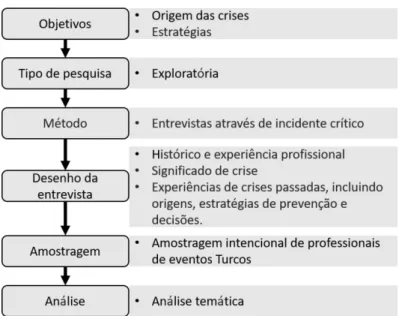
tion but on their entire experiences as a meetings professional. The technique is used in in-depth interviews, in which respondents talk about a significant event and express their feelings accordingly (Gremler, 2004). In this study, participants were asked to revisit crisis events they encountered and reflect on how they originated and how they managed them. One benefit of using the critical inci-dent technique is that the decision about which situations presented a crisis was left to
the participant rather than imposed by the researcher. Moreover, it was a basis for de-veloping rapport between the participants and the interviewer as it made the conversa-tion more personal, which is considered a sig-nificant factor in conducting more sincere in-depth interviews (Berg, 2007). In practice, participants ended up answering most of the questions about crisis management while they were explaining the crisis event.
Figure 1 - Methodological steps
The questions were prepared as open-ended, in order to conduct semi-struc-tured, in-depth interviews. The initial
ques-tio s fo used o the pa ti ipa ts p
ofes-sional background and experience. This was done to make participants feel comfortable by introducing themselves and to collect vital data about the participant was. Next,
partici-pa ts pe eptio s a out hat a isis ea t
were explored. After that, they were asked to talk about a crisis they encountered. This in-cluded exploring a number of issues about
the crisis experience including its origins, pre-vention strategies and decisions they had to make once the crisis had been triggered. The interviewer did not impose a particular defni-tion of crisis to participants in order to cap-ture their understanding of crises rather than a particular academic view on the concept.
mee-488 Rev. Bras. Pesq. Tur. São Paulo, 11(3), pp. 480-502, set./dez. 2017.
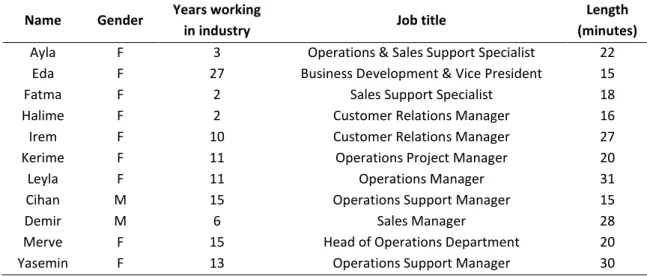
ting planners working for an organization for which one of the researchers had worked in the past were approached. Eight employees of this organization accepted to be inter-viewed. A second organization was contacted and three additional interviews were carried out. Table 1 presents the profile of the partic-ipants. While participants came from two or-ganizations only, the research did not focus on crisis management within that organiza-tion. Many had worked for different organi-zations over their professional lives and used crisis experiences that happened while wor-
king for other organizations. Recordings of the interviews were transcribed before pro-ceeding with manually analyzing the data. In order to identify themes, answers to each question were separated and specified in bul-let point codes. This specification allowed most common answers to appear and main themes to be identified. Translation was car-ried out during the coding by one of the au-thors, who speaks Turkish and English flu-ently. During translation, some sentences were not suitable for word-by-word transla-tion and the meaning had to be translated.
Table 1 – Profile of the sample
Name Gender Years working
in industry Job title
Length (minutes)
Ayla F 3 Operations & Sales Support Specialist 22
Eda F 27 Business Development & Vice President 15
Fatma F 2 Sales Support Specialist 18
Halime F 2 Customer Relations Manager 16
Irem F 10 Customer Relations Manager 27
Kerime F 11 Operations Project Manager 20
Leyla F 11 Operations Manager 31
Cihan M 15 Operations Support Manager 15
Demir M 6 Sales Manager 28
Merve F 15 Head of Operations Department 20
Yasemin F 13 Operations Support Manager 30
4 RESULTS
4.2 Origins of crisis
Meeting planne s pe eptio s a out how crises are originated identifies the cause that led to the crisis. The results showed
sim-ila ities ith Mit off et al. s t polog
of crises and therefore an adapted version of the typology was developed. The internal and external axis was maintained, however, the technical/economic and people/organi-
489 Rev. Bras. Pesq. Tur. São Paulo, 11(3), pp. 480-502, set./dez. 2017.
As showed in the Figure 2, participants iden-tified multiple causes that can trigger a crisis. Using Coombs (2004) typology, the results show that meeting planners viewed crisis as
originating in mainly technical error (technol-ogy or equipment failure) and human error (a person does not perform the job properly).
Figure 2 - Origins of crisis in the Turkish meetings sector
4.2.1 External / Controllable
External / Controllable factors occur outside of the event organizer and have a
soft o te t, su h as people. Hali e s
years experience, Customer Relations Man-ager) answer summarizes the two main ori-gins within this category when she states that
A isis is so ethi g hi h happe s eithe
because of the client or because of the
supplie . P o le s ith thi d pa t supsupplie s i
-clude issues with decoration supplies, wrong printings, and measurements, as well as those involving hotels and venues. Although strictly speaking event organizers cannot fully control the performance of these suppli-ers, buyers regard event organizers respon-
ble for the performance of all suppliers. This is visible i Me e s ea s e pe ie e, Head of Operations) explanation when she
stated that a uet se i es i hotels e
-haust us. Because it is directly related with
us, lie ts do t a e if it s thei fault . Bu e s
ie supplie s se i e deli e issues as the
responsibility of the event organizer and if something goes wrong, then it is their role to sort it out.
490 Rev. Bras. Pesq. Tur. São Paulo, 11(3), pp. 480-502, set./dez. 2017.
Another issue with clients as a source of crisis results from the timings of the approval as demonstrated by Cihan (15 years experience, Operations Support Manager) when he
stated that lie ts al a s app o e late, the
always change their opinions. You need to ex-pect that and get used to it in order to
man-age the isis late o . De i ea s e
pe-rience, Sales Manager) separated crisis into two typologies, real and artificial crisis. He defined real crisis as an unexpected problem. On the other hand, when talking about the artificial crisis, he referred to the clients, which are hard to handle and calm down. He
e phasized this poi t e plai i g that the
most difficult thing about our job is to deal with people. Even though there are no crises, some clients just panic and try to take the control over. This is even harder to handle
tha a eal isis .
4.2.2 Internal / Controllable
Factors over which the extent of con-trol is high and concon-trol is independent of the influence of external organizations are classi-fied as internal/controllable. Four respond-ents mentioned internal-controllable origins, including a lack of information/communica-tion, a lack of individual back-up plans and long working hours of the team. Merve (15 years experience, Head of Operations) pointed out that it is customary for individu-als to have their own back up plans and that they assume that others have them too. Problems may occur when some individuals have not undertaken their individual back-up plans. When this happens, they may fail to
predict any potential problems as well as planning in advance for alternatives. A key point which included in the internal / control-lable originated crisis (Choi et al., 2010) but was not mentioned by respondents was the existence of organizational crisis manage-ment plans. Participants seemed to struggle when asked whether their company had an organizational crisis management plan. The majority of the respondents stated that they did not have one, and also agreed that it was impossible to do them. The reason for that was mainly due to the people factor. Fatma (2 years experience, Sales Support Specialist)
e plai ed E e isis is sol ed at the field, du i g the e e t. We do t k o hat e ill e ou te ; it ould t e ealisti to ha e a pla . ‘espo de ts did ot see to
think the lack of an organizational crisis man-agement plan could be a source for a crisis, due to failing to anticipate any problems and/or planning for when they occurred.
4.2.3 External / Non-controllable
External / Non-controllable factors re-fer to crises, which occur outside of the or-ganization and cannot be prevented. The par-ticipants identified two sources: technical problems and traffic delays. The difference to controllable factors refers to the fact that blame could not be attributed to the organ-izer, third party suppliers or the venues. In fact, Eda (27 years experience, Business De-velopment & Vice-President) stated that
You a al a s e ou te te h i al p o le s, the a e e usual . De i ea s e
491 Rev. Bras. Pesq. Tur. São Paulo, 11(3), pp. 480-502, set./dez. 2017.
a te h i al p o le he e ou te s: If the e
is an event on a venue by the Bosporus and a big ship is passing by, the microphones ways break down. We know that and we al-ways take spare microphones to these
e e ts . I su h ase, hile the passi g of a
ship cannot be controlled, knowing that it is a possibility and the consequences that will be brought, affords the meeting organizer the opportunity to prepare a recovery should it happen. Others causes, such as traffic, are non-controllable and difficult to recover from. Demir referred to this problem when
talki g a out his isis e e t, sa i g The a t-ist ould t a i e e ause of the t affi . The e as othi g to do, othi g . Fou
e-spondents also mentioned the delays be-cause of the suppliers. Merve (15 years expe-rience, Head of Operations) stated this as
The ost o o p o le e e ou te ,
dela s of the t a sfe ehi les .
Natural/man-made disasters, one of the major external/non-controllable sources mentioned in the literature, was only men-tioned by one participant. This is perhaps the most damaging type of crisis as it could in-volve personal in injury or extreme hardship (Laws, Prideaux & Chon, 2007). Only Eda (27 years experience, Business Development & Vice-President), which had worked in the ho-tels industry for several years, mentioned
that the hotel had sta da d p o edu es fo
fi es a d ig disaste s . This esult o t
a-dicts previous studies, notably that of Smith and Kline (2010) o eeti g pla e s pe -ceptions about crisis preparedness, in which respondents associated crisis to natural or man-made disasters, like terrorist attacks or
bomb threats. The reason why participants in this study might not have mentioned natural disasters could be because they do not think it is their responsibility to do a crisis manage-ment plan that deals with this type of exter-nal/non-controllable cause. Meeting plan-ners organize events in different venues, and they expect each venue to have its own crisis management plan, which will be activated should it be necessary.
4.2.4 Internal / Non-controllable
Few participants mentioned inter-nal/non-controllable sources even though
Mit off et al. s t polog i luded se
-eral crises under internal and technical/eco-nomic part. Because the events industry is part of the services industry and is more re-lated with soft concepts than hard ones, the only crisis in the meetings sector that could involve internal/non-controllable causes are technological problems such as computer breakdowns. Participants mentioned techno-logical problems, however they did not refer to these problems as internal since they do not own most of the technical/technological equipment they use in their events. The equipment used in meetings belongs to sup-pliers and therefore any technological prob-lem is blamed on them (hence it is an exter-nal cause). An unexpected illness of a mem-ber of staff was the only internal non-control-lable crisis mentioned by participants.
4.3Operational strategies to manage crises
492 Rev. Bras. Pesq. Tur. São Paulo, 11(3), pp. 480-502, set./dez. 2017.
research focused on the strategies used by meeting planners to manage crises. Respond-ents referred to strategies when they talked about how they dealt with the particular cri-sis event they encountered. There are nu-merous theories and models of crisis man-agement, some of which were covered in the literature review. In this research, the strate-gies employed by meeting planners are orga-nized a ou d Mit off et al. s fou phases of crisis management: preven-tion/preparation, coping, recovery, and learning.
4.3.1 Prevention/Preparation
In theory, prevention/preparation can be made at three levels: individual, event/project team, and organizational. Par-ticipants stated that they engage in individual preparation activities in order to develop their individual back-up plans. Participants mentioned several strategies they employ to reduce the likelihood of any faults in the ser-vice delivery, including establishing contracts with suppliers and carrying out inspections ahead of establishing contracts or, once these are in place, before of the actual ser-vice delivery. At the event/project team level, the majority of the participants stated that they bring together individual-level strategies through writing scenarios for each event in order to create a flow and see the whole picture. Fatma (2 years experience, Sales Support Specialist) highlighted that by
sa i g We ha e p e-operation meetings
be-fore each event, we talk about the scenarios in detail and we go over the flow. This is a
outi e . This is a tuall e o o i
event management, which usually comes in the form of Gantt charts (Shone & Parry, 2010). However, it was noted that these preparation actions are not implemented at the organizational level. Participants agreed that it would be impossible to have an organ-izational crisis management plan for two rea-sons: the length that such plan would take
e [ ould] eed to ite a encyclopedia ;
Demir, 6 years experience, Sales Manager) and the dynamic nature of working
environ-e t it is ot possi lenviron-e to follo a pla ; environ-e
are working in a dynamic enviro e t ; Kerime (11 years experience, Operations Pro-ject Manager). These aspects highlight the breadth, size, complexity. and dynamism of organizing events such as meetings, which according to the participants can only accom-modate adaptable preparation processes that should be dealt with at a more atomized level (individual or team). This attitude
re-fle ts a ea ti e i dset ‘it hie,
which is common in the tourism industry (Mair et al., 2004).
4.3.2 Coping
493 Rev. Bras. Pesq. Tur. São Paulo, 11(3), pp. 480-502, set./dez. 2017.
der to make rational decisions (Hadley et al,
, thus eeti g pla e s pe eptio of
this key trait is congruent with the crisis man-agement literature. Merve (15 years experi-ence, Head of Operations) further noted that it was important avoid denial and instead to
a k o ledge the situatio a d fo us o the solutio .
At the interpersonal level, strategies directed at both the clients and the suppliers were uncovered. At the client level, partici-pants emphasized that they put a lot of effort in preventing clients from understanding a crisis situation was taking place. The
follow-i g uote follow-illust ates thfollow-is o e : If the follow-isfollow-is
would be reflected to the client, it would
ha e ee a igge p o le Cihan, 15 years
experience, Operations Support Manager). Service failures can lead to consumer nega-tive emotional reactions, which in turn can cause operational (or even strategic) con-straints on the organization (Kähr, Nyffeneg-ger, Krohmer & Hoyer, 2016). Meeting plan-ners recognized this and therefore concealed service delivery problems from clients as much as they could, in the hope that they could resolve them before substantial impact on service delivery became evident.
At the supplier level, coping with a cri-sis involved liaising with suppliers in order to find a solution that would attempt to solve the crisis before it became apparent to the client. This often involved resorting to ex-traordinary business practices such as con-tacting suppliers outside normal business hours. Cihan (15 years experience, Opera-tions Support Manager) said he has had to contact suppliers at 3am, a practice that is
not unusual as confirmed by Kerime (11 years experience, Operations Project Manager)
he she stated If e eed to sol e the
i-sis, sometimes we even wake up the supplier and make him/her open the shop in the
mid-dle of the ight . I e (10 years experience,
Customer Relations Manager) highlighted three traits that are required for successful
esolutio of a isis he a supplie s i -ol e e t is e ui ed: good pe suasio skills , e e gi i g up a d to push e e
limit you can until ou ha e a solutio . These answers also clearly indicate the im-portance of maintaining good relationships with suppliers because without them these uncommon business practices would not be possible. This result supports earlier findings that cooperation and communication be-tween stakeholders is vital for successful cri-sis resolution (Mair et al., 2014).
4.3.3 Recovery
494 Rev. Bras. Pesq. Tur. São Paulo, 11(3), pp. 480-502, set./dez. 2017.
tegy by Merve. According to her, by adopting
su h app oa h ou o t lose the fo good . These t o pa ti ipa ts also e
-tioned the issue of locus of responsibility. When it was clear that the crisis originated
due to the o pa s fault, the ie as that
the company should acknowledge responsi-bility and, eventually, compensate the client
e ause to o pe sate is as i po ta t as sol i g it I e . Att i utio has ee fou d
to influence how the consumer reacts (Dab-holkar & Spaid, 2012) and meeting planners seem to be conscious of this when attempt-ing to recover from a service failure. Offerattempt-ing a monetary or in-kind compensation is com-mon when service failure is more serious, with research showing that it has the strong-est recovery effect (Roschk & Gelbrich, 2014).
4.3.4 Learning
Throughout the interviews, there was little evidence of learning about crisis man-agement. It appeared that the participants did not take the evaluation phase and the learning actions into consideration. Any learning activities were carried out automat-ically at an individual level through personal reflections about the crisis event they experi-enced. This was evident when Ayla (3 years experience, Operations & Sale Support Spe-cialist) stated that ises a e a oppo tu it
to … i p o e ou sel es i di iduall . The
use of those experiences to develop a crisis management plan was rejected, mainly be-cause participants argued that each event is unique and it holds the people factor in it. In
addition, a crisis management plan would not be able to contemplate the creativity ele-ment required to crisis decision-making and could prevent people from thinking practi-cally. Leyla (11 years experience, Operations Manager) explained this situation the follow-ing way:
E e though the o pa y de ides to ha e
twenty crisis management plans, I would do what I do on the field. Because I am the one
ho sees lie ts’ respo ses. It’s a out a tio a d rea tio .
Irem (10 years experience, Customer Rela-tions Manager) also emphasized that by
say-i g It say-is ette to take the say-i say-itsay-iatsay-i e. The e
are some crises, which you cannot foresee.
Thus, ou a ot ite the do . Ciha
(15 years experience, Operations Support Manager) emphasized spontaneity issues by saying
Whe you e ou ter a risis, you eed to e
very quick. If there is a handbook for that and you try to follow the rules, you cannot take the initiative; you cannot find the best
solutio for the parti ular situatio . I do ’t
believe these should be standardized .
495 Rev. Bras. Pesq. Tur. São Paulo, 11(3), pp. 480-502, set./dez. 2017.
4.4 Crisis as an opportunity
Participants were clear that they ex-pect crises to happen at every event and that many see them as an opportunity involving both personal and organizational benefits. At a personal level, crises provide a challenge, a shift away from routine. Once a crisis is solved, according to Ayla (3 years experience,
Ope atio s & “ale “uppo t “pe ialist it s the est feeli g i the o ld , aki g hi e happ , suggesti g that ises p o ide pe
-sonal gratification. Demir (6 years experi-ence, Sales Manager) emphasized the organ-izational benefits of crises. According to him
Bei g a le to sol e risis is a added alue
to our job. If everything would go ordinary as it is planned, it will be condemned to stay as average. When we handle a crisis, our credi-bility increases .
This was supported by Halime (2 years expe-rience, Customer Relations Manager) when she stated that
Whe e sol e a risis, lie ts see us as their
solution partners, not only as meeting
plan-ers a d Ayla ho lai ed that it is a
op-portunity to sho our professio al ork .
This finding supports earlier stances that crises are an opportunity for the organi-zation (Ulmer et al. 2007; Pauchant & Dou-ville, 1993; Ghaderi et al. 2014; Rodriguez-Toubes et al., 2014), with the benefits identi-fied both at the individual and organizational level.
5 CONCLUSIONS AND RECOMMENDATIONS
Crisis management research in tou-
rism tends to focus on crisis management af-ter a specific crisis event (or number of events), rather than the study of generic cri-sis management, which is not tied to specific events (Mair et al., 2014). One consequence of such make-up is that research has tended to focus on large-scale crises resulting from natural disasters or political/economic events. However, at an organizational level, managers are confronted with many events on a day-to-day basis that they consider to be crises. In fact, this study shows that when de-void of focus on a specific crisis, meeting or-ganizers emphasize more the operational cri-sis that emerge during the day-to-day opera-tions than highly infrequent crisis events. Therefore, to meeting planners crises are more about service failures than major dis-ruptive events that question the
organiza-tio s existence as per the traditional
defini-tion of crisis (Fearn-Banks, 1996).
496 Rev. Bras. Pesq. Tur. São Paulo, 11(3), pp. 480-502, set./dez. 2017.
vice failures.
Meeting organizers are to some ex-tent crisis prone organizations (Hilliard et al., 2011) and therefore face large and small-scale crises every day due to the large num-ber of stakeholders involved in the planning and managing the processes required to or-ganize meetings (Smith & Kline, 2010). Each stakeholder brings a potential uncertainty, which increases the complexity of meeting planning. The main function of meeting plan-ners is to bring together these stakeholders and therefore, in the case of a crisis or service failure, it is their responsibility to be able to manage it effectively. According to the re-sults of this study, meetings are highly prone to smaller scale, operational crisis in particu-lar for two reasons. First, they are mainly ag-gregators of services offered by a number of external organizations, where services used
a ith ea h deli e e.g. the do t use
the same hotel or conference venue all the time). Second, these external services are op-erated and managed by a variety of staff, making the industry human resource inten-sive and hence prone to human error.
The main findings indicate that the majority of the crises induced by service fail-ures are originated from external and people related factors, even though people related dimension was defined as controllable to a certain extent in the main findings. The re-spondents mostly mentioned third party sup-pliers, as well as the venues and the hotels they work with. Another common agreement was about clients and their last-minute re-quests. However, these were also referred to internal factors, such as lack of communica-
tion by some respondents. Technological problems were seldom mentioned, and they were only related with external parties. Taken together, these results suggest that meeting planners tend to attribute crises events to others than themselves, a process identified in the tourism industry before (As-canio, 2008). Attribution processes are closely related to crisis management and ser-vice failure as it is common for stakeholders to attempt to examine the responsibility for the problem because the locus of responsibil-ity carries potential affective and behavioral consequences for the organization (Coombs, 2007; Dabholkar & Spaid, 2012). For meet-ings organizers, this could involve reputation and financial costs (compensation).
Pre-operation meetings, individual back-up plans, writing action plans and check lists were the most common statements which were referred by meeting planners as strategies to prepare/prevent crises. Strate-gies employed during a crisis were mostly re-lated with their emotional and characteristic states. The examples put forward were stay-ing calm, and not reflectstay-ing the situation to the client, with the main objective when sur-viving a crisis centered on not losing their customers. This focus on customer retention has been previously found elsewhere (Mi-troff & Anagus, 2001). At the recovery stage, right after the crisis occurs, meeting planners tend to compensate the damages to their cli-ents, which is a reputation management strategy (Hargis & Watt, 2010).
497 Rev. Bras. Pesq. Tur. São Paulo, 11(3), pp. 480-502, set./dez. 2017.
that crisis management is carried out at an in-dividual level, but that there are low levels of formalization at the organizational level, to the point that they rejected the idea of devel-oping crisis management plans. This rejection appears to originate on the type of knowledge they perceive to be essential in successfully managing crises, with crisis man-agement associated to tacit rather than
ex-pli it k o ledge. Ta it k o ledge is p a
ti-cal, action-oriented knowledge or k o
-ho ased o p a ti e “ ith, , p.
314), facilitates innovation (Brown & Duguid, 2000) and is deployed using face-to-face (Hansen, Nohria & Tierney, 1999). Partici-pants strongly rejected the idea of develop-ing crisis management plans because the sit-uation they encounter may require creative, and unique solutions that would not feature in such plan. Moreover, dealing with poten-tial issues requires a high level of spontane-ous decision-making, which involves face-to-face contact with suppliers or customers. Deal with crises through formalizing proce-dures and establishing work processes, the essence of explicit knowledge, was viewed as detrimental to successful crisis management, mainly as it would affect their ability to de-ploy tacit knowledge.
5.1Implications for practice
Understanding origins and opera-tional strategies can be useful to meetings professionals, as each crisis type related to service failure could be better tackled through different strategies. For instance, management strategies for external/contro-
lable origins i.e. third-party suppliers, clients; are mostly related with managing individual client/supplier characteristics and event ex-perience. On the other hand, internal/con-trollable originated crises can be managed by training, leading to better prevention and/or preparation. External/non-controllable origi-nated crises require coping and learning strategies. For instance, during a natural dis-aster event, the best strategy a meeting plan-ner could use is keeping people calm and di-recting the participants according to their emergency plan. For the internal / non-con-trollable problems, i.e. computer break-downs at the office, reputation management strategies are suggested, due to the risk of losing confidential data, which can result in
de ease of o pa ies eputatio .
The rejection of crises management plans, while rationally explained, is concern-ing as professionals failed to understand that just preparing those plans could help prevent crises, or even better prepare them for their management should they happen. This may be due to cultural reasons, appearing to
re-fle t the fa t that so ieties i [the Middle
East] have practices that do not engage in fu-ture oriented behaviors such as planning and
i esti g i the futu e Ka asakal &
498 Rev. Bras. Pesq. Tur. São Paulo, 11(3), pp. 480-502, set./dez. 2017.
could be instrumental in demonstrating the benefits of explicit knowledge, ultimately leading Turkish meeting planners to adopt formal crisis management tools such as crisis management plans.
5.2 Implications for research
This paper contributes to the litera-ture by demonstrating that crisis manage-ment frameworks can be employed to exam-ine crises that are essentially service failures. A first implication of the study is that the dis-tinction between the notions of service fail-ure and crisis may be an artificial rather than a real one. Consequently, researchers plan-ning studies on crises-service failure should consider looking at both literatures in order to integrate both bodies of knowledge. With regards to future themes, the cultural influ-ences on perceptions and practices of crisis-service failure management warrants further research. Comparative studies across coun-tries, perhaps linking organizational culture to country culture, could be undertaken in order to further understand how culture in-fluences individual and organizational prac-tice. The individual and organization aspects of crisis-service failure management also de-serve further research. In the Turkish con-text, the meetings professional appears to be largely independent in his/her management of crisis-service failure, but future research could examine differences across organiza-tions and how leadership affects those differ-ences. Finally, scales and questionnaire de-sign, which can be more validly developed
based on the findings of this exploratory re-search, should encourage researchers to un-dertake quantitative research in the area. For example, a detailed list of origins can now be included as elicited in this study.
REFERENCES
Anderson, B. (2006). Crisis management in the Australian tourism industry: Preparedness, per-sonnel and postscript, Tourism Management, 27 (6), 1290-1297.
Ascanio, A. (2008). The opinion in relation to a tourism crisis: the media culture behind the scen-ery, Revista Brasileira de Pesquisa em Turismo, 2 (3), 3-18.
Berg, B. L. (2007). Qualitative Research Methods for the Social Sciences. ed. Boston: Pearson Edu-cation
Brown, J.S. and Duguid, P. (2000), Balancing act: how to capture knowledge without killing it, Har-vard Business Review, May-June, pp. 73-80.
Caldiero, C. T., Taylor, M., & Ungureanu, L. (2009). Image repair tactics and information sub-sidies during fraud crises. Journal of Public Rela-tions Research,21 (2), 218-228.
Campiranon, K., & Arcodia, C. (2008). Market seg-mentation in time of crisis: A case study of the MICE sector in Thailand. Journal of Travel & Tour-ism Marketing, 23(2-4), 151-161.
499 Rev. Bras. Pesq. Tur. São Paulo, 11(3), pp. 480-502, set./dez. 2017.
agement in organizational teams. Social Behav-iour & Personality: An International Journal, 38(6), 805-828.
Cioccio, L. and Michael, E. J. (2007). Hazard or dis-aster: tourism management for the inevitable in Northeast Victoria. Tourism Management, 28:1-11.
Coombs, W. T. (1999). Information and compas-sion in crisis responses: A test of their effects.
Journal of Public Relations Research, 11: 125– 142.
Coombs, W. T. (2004). Impact of past crises on current crisis communications: Insights from situ-ational crisis communication theory. Journal of Business Communication, 41: 265–289.
Coombs, W. T. (2007). Attribution theory as a guide for post-crisis communication research.
Public Relations Review, 33: 135–139.
Coombs, W. T., & Holladay, S. J. (1996). Commu-nication and attributions in a crisis: An experi-mental study of crisis communication. Journal of Public Relations Research, 8(4), 279295.
Dabholkar, P. A., & Spaid, B. I. (2012). Service fail-ure and recovery in using technology-based self-service: effects on user attributions and satisfac-tion. The Service Industries Journal, 32(9), 1415-1432.
Faulkner, B. (2001). Towards a framework for tourism disaster management. Tourism Manage-ment, 22(2), 135-147.
Fearn-Banks, K. (1996). Crisis Communication: A Casebook Approach, Lawrence Erlbaum Associ-ates Publishers, Mahwah, NJ.
Ghaderi Z., Puad A. M. S. and Henderson J. C. (2012). Tourism Crises and Island Destinations: Experiences in Penang, Malaysia. Tourism Man-agement Perspectives. 2/3, 79-84.
Glaesser D. (2004). Crisis Management in the Tourism Industry. Butterworth-Heinemann: Ox-ford.
Gremler, D.D. (2004). The Critical Incident Tech nique in Service Research. Journal of Service Re- search, 7(1), 65-89.
Gundel, S. (2005), Towards a New Typology of Cri-ses, Journal of Contingencies and Crisis Manage-ment, 13 (3), pp. 106–115.
Gundel, S. (2005). Towards a New Typology of Cri-ses. Journal of Contingencies & Crisis Manage-ment, 13(3), 106-115.
Hadley, C., Pittinsky, T., Sommer, S. and Zhu, W. (2011). Measuring the efficacy of leaders to as-sess information and make decisions in a crisis: The C-LEAD scale. Leadership Quarterly, 22(4), 633-648.
Hale, J. E., Hale, D. P. and Dulek, R. E. (2006). De-cision processes during crisis response: An ex-ploratory investigation. Journal of Managerial Is-sues, 18, 301-320.
Hall, C. M. (2010). Crisis events in tourism: Sub-jects of crisis in tourism. Current Issues in Tour-ism, 13, 401–417.
Hansen, M.T., Nohria, N. and Tierney, T. (1999),
500 Rev. Bras. Pesq. Tur. São Paulo, 11(3), pp. 480-502, set./dez. 2017.
Hargis, M. and Watt, J. (2010). Organizational Perception Management: A Framework to Over- come Crisis Events. Organization Development Journal, 28(1), 73-87.
Hart, P., Heyse, L. and Boin, A. (2001). New trends in crisis management practice and crisis manage-ment research: Setting the agenda. Journal of Contingencies and Crisis Management, 9, 181-188.
Heath, R. (2003). Responding to crisis: a rhetorical approach to crisis communication. London: Law-rence Erlbaum.
Henderson, J. C. (2013). The Great East Japan earthquake and tourism: A preliminary case study. Tourism Recreation Research, 38(1), 93-98.
Hermann, C. F. (1963). Some consequences of cri-sis which limit the viability of organizations. Ad-ministrative Science Quarterly, 8, 61-82.
Hilliard, T., Scott-Halsell, S. and Palakurthi, R. (2011). Core Crisis Preparedness Measures Im-plemented by Meeting Planners. Journal of Hos-pitality Marketing & Management, 20(6), 638660.
Jacobsen, J., & Simonsen, D. (2011). Toward a New Understanding of Crises: Defining Organiza-tional Crises Through a Phenomenological Ap-proach. In: Second International Conference in Crisis Communication at the Beginning of 21st Century: Communicating Crisis in the Age of Com-plexity, October (pp. 6-8).
Jallat, F., & Shultz, C. J. (2011). Lebanon: From cataclysm to opportunity—Crisis management lessons for MNCs in the tourism sector of the
Middle East. Journal of World Business, 46(4), 476-486.
Kabasakal, H., & Dastmalchian, A. (2001). Intro-duction to the special issue on leadership and cul-ture in the Middle East. Applied Psychology, 50 (4), 479-488.
Kähr, A., Nyffenegger, B., Krohmer, H., & Hoyer, W. D. (2016). When hostile consumers wreak havoc on your brand: The phenomenon of con-sumer brand sabotage. Journal of market-ing, 80(3), 25-41.
Kline, S. and Smith, S. (2006). Crisis Planning for the Meeting Planning and Convention Industry. Chicago: Professional Convention Management Association
Lalonde, C., & Roux-Dufort, C. (2013). Challenges in teaching crisis management: Connecting theo ries, skills, and reflexivity. Journal of Manage-ment Education, 37(1), 21-50.
Laws, E., Prideaux, B., & Chon, K.S. (2007). Crisis management in Tourism; Cabi Pub
Lerbinger, O. (1997) The Crisis Manager: Facing Risk and Responsibility. Mahwah, N.J: Lawrence Eribaum.
Mair, J., Ritchie, B. W., & Walters, G. (2014). To-wards a research agenda for post-disaster and post-crisis recovery strategies for tourist destina-tions: a narrative review. Current Issues in Tour-ism, 19:1, 1-26.
501 Rev. Bras. Pesq. Tur. São Paulo, 11(3), pp. 480-502, set./dez. 2017.
Mitroff, I. I., Shrivasta, P. and Udwadia, F.E. (1987). Effective Crisis Management. Academy of Management Executive, 1(3), 283-292.
Paraskevas, A. & B. Arendell. (2007). A strategic Framework for terrorism prevention and mitiga-tion in tourism destinamitiga-tion, Tourism Manage-ment, 28 (1), pp. 1560-1573.
Paraskevas, A., & Altinay, L. (2013). Signal detec-tion as the first line of defence in tourism crisis management. Tourism Management, 34, 158-171.
Pauchant, T. and Douville, R. (1993). Recent re- search in crisis management: A study of 24 au-
tho s pu li atio s f o to . Industrial and Environmental Crisis Quarterly, 7(1), 4363.
Pearson, C. M. & Mitroff, I. I. (1993). From crisis prone to crisis prepared: A framework for crisis management. Academy of Management Execu-tive, 7 (1), 48-59.
Pforr, C., & Hosie, P. J. (2008). Crisis Management in Tourism. Journal of Travel & Tourism Market-ing, 23 (2-4), 249-264.
Ritchie, B.W., 2004. Chaos, crises and disasters: a strategic approach to crisis management in the tourism industry. Tourism Management, 25(6), 669-683.
Rittichainuwat B. N.. . Tou ists a d Tou -is “upplie s Pe eptio s to a d C -is-is Ma
age-ment on Tsunami. Tourism Management, 34,112–121.
Rodriguez-Toubes, D., Brea, J. A. F., & Torre, J. Á. D. L. (2014). Experiencias de crisis por desastres en los negocios turísticos: ni se aprende, ni se
prepara. Tourism & Management Studies, 10(2), 50-56.
Rose, A., Avetisyan, M., Rosoff, H., Burns, W. J., Slovic, P., & Chan, O. (2016). The role of behav-ioral responses in the total economic conse-quences of terrorist attacks on US air travel tar-gets. Risk analysis.
Roschk, H., & Gelbrich, K. (2014). Identifying ap-propriate compensation types for service fail-ures: A meta-analytic and experimental analy-sis. Journal of Service Research, 17(2), 195-211. Santana, G. (2004). Crisis management and tour-ism: Beyond the rhetoric. Journal of Travel and Tourism, 15, 299-321.
Sausmarez, N. (2013) Challenges to Kenyan tour-ism since 2008: crisis management from the Ken-yan tour operator perspective, Current Issues in Tourism, 16 (7-8), 792-809.
Seymour, M. and Moore, S. (2000), Effective Cri-sis Management: Worldwide Principles and Prac-tice, Continuum, London.
Shone, A., and Parry, B. (2010). Successful event management: A practical handbook. 3rd ed. Hampshire: CENGAGE Learning.
Smith, S. and Kline, S. (2010). Crisis Preparedness
a d Meeti g Pla e s Pe eptio s. Journal of Convention & Event Tourism, 11(1), 62-78.
Tse, A. C. B., So, S., & Sin, L. (2006). Crisis man-agement and recovery: How restaurants in Hong Kong responded to SARS. International Journal of Hospitality Management, 25, 3–11.
502 Rev. Bras. Pesq. Tur. São Paulo, 11(3), pp. 480-502, set./dez. 2017.
Expanding the parameters of post-crisis dis-course. Public Relations Review, 33(2): 130–134.
Wu, L., & Walters, G. (2016). Chinese travel be-havior in response to disastrous events: the case of the Japan earthquake. Journal of China Tour-ism Research, 12(2), 216-231.
________________
Information on the authors:
Cisil Andirin
MSc in Events Management from Bournemouth University, United Kingdom. The research was undertaken while she was a Student Researcher at the Department of Events & Leisure, Faculty of Management, Bournemouth University. Cur-rently Groups & Events Sales Executive at the
Adana and Mersin Hilton Hotel, Turkey, Email: [email protected]
Miguel Moital
PhD in Tourism, Bournemouth University, United Kingdom. Principal Academic in Events Manage-ment, Department of Events & Leisure, Faculty of Management, Bournemouth University, United Kingdom. Email:[email protected]
Carla Pinto Cardoso