Neurospora crassa
mat A-2 and mat A-3 proteins weakly interact
in the yeast two-hybrid system and affect yeast growth
Carla C. da Silva, Rosana C. Cruz, Mônica Bucciarelli-Rodriguez and Adlane Vilas-Boas
Departamento de Biologia Geral, Instituto de Ciências Biológicas, Universidade Federal de Minas Gerais,
Belo Horizonte, MG, Brazil.
Abstract
Mating-type genes control the entry into the sexual cycle, mating identity and sexual development in fungi. The mat A-2 and mat A-3 genes, present in the mat A idiomorph of the filamentous fungus Neurospora crassa, are required for post-fertilization functions but are not essential for mating identity. Their putative roles as transcription factors are based on the similarity ofmat A-2 with the Podospora anserina SMR1 gene and an HMG motif present in the mat A-3 gene. In this work the yeast two-hybrid system was used to identify transcriptional activity and protein-protein interac-tion ofN. crassa mat A-2 and mat A-3 genes. We observed that the mat A-3 protein alone is capable of weakly acti-vating transcription of yeast reporter genes; it also binds with low specificity to the GAL1 promoter sequence, possibly due to its HMG domain. Our results also indicate that mat A-3 is capable to form homodimers, and interact with mat A-2. Interference on yeast growth was observed on some transformants suggesting a toxic action of the mat A-2 protein. Our data on pattern of interactions of mat proteins contributes towards understanding the control of veg-etative and sexual cycles in filamentous fungi.
Key words: Neurospora crassa, mating-type, yeast two-hybrid system.
Received: November 25, 2008; Accepted: February 3, 2009.
Introduction
Entry into the sexual cycle in fungi is controlled by themating-type (mat)genes which are responsible for sex-ual development and identity in filamentous fungi and yeast (reviewed in Kronstad and Staben, 1997; Souzaet al., 2003). Although it is known that manymatgene products are transcription factors, very little is known about how MAT proteins interact and what are the target genes in fila-mentous ascomycete fungi.
N. crassawas the first filamentous fungus that had its
matsequences cloned and physically characterized (Glass
et al., 1988). Themat Aandmat aare non-homologous se-quences present at themat locus, thus called idiomorphs (Metzenberg and Glass, 1990). Themat aidiomorph con-tains themat a-1gene which is responsible for sexual iden-tity, vegetative incompatibility and perithecium develop-ment (Staben and Yanofsky, 1990). Themat a-1gene has a DNA-binding HMG motif, found in certain transcriptional regulatory proteins, and was shown to regulate themfa-1
pheromone precursor gene among other genes (Kimet al., 2002). A second ORF,mat a-2,is also present in themat a
idiomorph, but is apparently not transcribed (Pöggeler and
Kuck, 2000). Themat Aidiomorph contains three genes:
mat A-1,mat A-2andmat A-3(Glasset al., 1990; Ferreiraet al., 1996). The mat A-1 gene product contains an a 1-domain, similar toSaccharomyces cerevisiaeMATa1 pro-tein. The mat A-1 protein is sufficient and required for vegetative incompatibility, sexual identity, sexual develop-ment and production of A-specific pheromones and a-phe-romone receptors (Glass et al., 1990; Bobrowicz et al., 2002). Ferreiraet al.(1996, 1998) have characterized the additional twoN. crassa matgenes:mat A-2 codes for a novel putative DNA-binding domain protein, andmat A-3, as themat a-1gene, codes for an HMG domain protein. The
mat A-2andmat A-3 genes are similar to the SMR1and
SMR2 matgenes ofP. anserina, respectively (Ferreiraet al., 1996), which are necessary for post-fertilization events in this fungus (Debuchyet al., 1993). Despite the similar-ity,N. crassa matgenes are not capable of complementing
P. anserina SMR1andSMR2mutants for post-fertilization events (Arnaiseet al., 1993). Also, phenotypic analysis of
mat A-2andmat A-3 mutants indicated that these genes function differently from their homologues (Ferreiraet al., 1998), since a mutant phenotype is only observed when both genes are mutated. A question that arises from this triguing observation is whether mat A-2 and mat A-3 act in-dependently or an interaction between them is needed for their function.
Send correspondence to Adlane Vilas-Boas Ferreira. Laboratório de Genética de Microrganismos, Departamento de Biologia Geral, Universidade Federal de Minas Gerais, Av. Antônio Carlos 6627, 1270-901 Belo Horizonte, MG, Brazil. E-mail: [email protected].
Protein-protein interaction in the yeast two-hybrid (Y2H) system has been observed betweenN. crassa mat A-1 and mat a-1 proteins (Badgett and Staben, 1999) and betweenP. anserinaFMR1 and SMR2 proteins (Debuchy and Coppin, unpublished data cited in Coppinet al., 1997). The four mat genes of the homothallic pyrenomycete
Sordaria macrospora (Smta-1, SmtA-1, SmtA-2 and
SmtA-3) are all highly similar to N. crassa mat genes (Pöggeleret al., 1997). The yeast two-hybrid system was also used to demonstrate that Smta-1 and SmtA-1 proteins interact and that these proteins contain domains capable of activating transcription in yeast (Jacobsen et al., 2002). However, molecular interaction data on theN. crassa mat A-2andmat A-3gene products or their homologues are not available. In this work we used the Y2H system to verify possible protein-protein interactions and transcriptional ac-tivation activity of theN. crassa mat A-2andmat A-3gene products.
Materials and Methods
Strains and media
Saccharomyces cerevisiae HF7c (Mat a, ura3-52, his3-200, lys2-801, ade2-101, trp1-901, leu2-3/112, gal4-542, gal80-538, LYS2::GAL1-HIS3, URA3:(GAL4 17-mer3)-CYC-lacZ) and Y190 (MATa trp1-901 his3 leu2-3,112 ura3-52 ade2 gal4 gal80 URA3::GAL1-lacZ LYS2::GAL1-HIS3) strains (Clontech Laboratories, Inc.) were used for the two-hybrid experiments. Isogenic IH 1783 (MATatrp1 leu2 ura3 his4 can1), IH1784 (MATa trp1 leu2 ura3 his4 can1)and diploid IH1788 strains (MAT
a/atrp1 leu2 ura3 his4 can1) (Michaelis and Herskowitz, 1988) were also used. YPD medium was used for propaga-tion and SD medium, with appropriate nutrients, for selec-tion of transformants. Recombinant plasmids were cloned and propagated inEscherichia coliMC1061 strain (Clon-tech Laboratories, Inc.) using standard conditions (Sam-brooket al., 1989).
Construction of recombinant plasmids
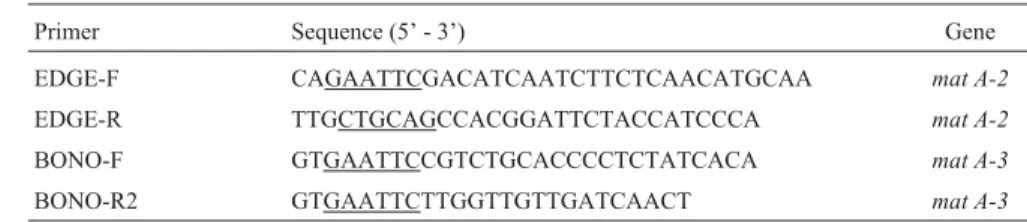
Primers for PCR amplification ofmat A-2andmat A-3genes were designed using themat A idiomorph se-quence (GenBank M33876); restriction enzyme sites were included at their 5’ ends to facilitate cloning (Table 1). Am-plification reactions performed in a PT-100 thermal cycler
(MJ Research, Inc.) were set up in a final volume of 20mL using primers (Imprint do Brazil Ltda, Campinas, Brazil) and one unit ofTaqpolymerase (Phoneutria Biotecnologia & Serviços, Belo Horizonte, Brazil) in a standard protocol. Plasmid pRAUW84 (Aramayo and Metzenberg, 1996), which has theNsiI/NdeImat Aidiomorph fragment con-taining all threemat Agenes, was used as template.
Plasmids pGBT9, pGAD424, pVA3, pCL1 and pTD1 were obtained from Clontech Laboratories, Inc.. The pGBT9, pGAD424 plasmids were used for cloning the PCR fragments for the Y2H experiments. pGBT9 contains the GAL4 DNA-binding domain (BD) sequence and the
TRP1gene as selectable marker, while pGAD424 contains the GAL4 activation domain (AD) sequence and theLEU2
gene as selectable marker. For the cloning of themat A-3
amplicon, both plasmids were restriction digested and treated with calf intestinal alkaline phosphatase (Promega Corp., Madison, WI, USA) after digestion for dephos-phorylation of 5’ overhangs.N. crassa mat A-2andmat A-3
amplicons were purified and digested with the appropriate enzymes for in phase cloning into pGBT9 and pGAD424. Correct cloning was confirmed by PCR using BONO and EDGE primer pairs and restriction analysis.
Two-hybrid experiments
Yeast cells were transformed following the protocol of Schiestl and Gietz (1989). Transformants were selected by screening for tryptophan, leucine or tryptophan/leucine prototrophy and transferred to SD with necessary require-ments. To reduce the number of false positives in the yeast assays, theLacZand theHIS3reporter genes were tested. The X-gal filter assay, to detectLacZexpression, was per-formed based on the protocol described in the MATCHMAKER Random Peptide Library User Manual PT3039-1 (Clontech Laboratories, Inc.) with modifica-tions. Y190 transformants were grown on sterilized filters on solid SD media without tryptophan, leucine or neither amino acids for three days. Filters with yeast colonies were transferred to clean, sterilized plates and yeast cells were lysed using liquid nitrogen followed by thawing at room temperature. When filters were wet, a solution containing 2.81 mL of Z-buffer (60 mM Na2HPO4, 40 mM NaH2PO4, 10 mM KCl, 1 mM MgSO4), 7.6mL ofb-mercaptoethanol and 26.4mL of X-gal (20 mg/mL) per plate was poured over the filters and the plates were incubated at 37 °C for 4-16 h.
Table 1- Sequences ofmat A-2andmat A-3primers used in this study.
Primer Sequence (5’ - 3’) Gene EDGE-F CAGAATTCGACATCAATCTTCTCAACATGCAA mat A-2
EDGE-R TTGCTGCAGCCACGGATTCTACCATCCCA mat A-2
BONO-F GTGAATTCCGTCTGCACCCCTCTATCACA mat A-3
BONO-R2 GTGAATTCTTGGTTGTTGATCAACT mat A-3
Cleavage of X-gal leaves a blue color on and around the yeast colonies, being a good indicator ofLacZgene expres-sion. For the HIS3 reporter assay, HF7c transformants were grown on solid SD media without tryptophan, leucine, or both amino acids, and without histidine. An inhibitor of the enzyme encoded by theHIS3gene, 3-amino-1,2,4-triazole (3-AT), was used at 2.5 mM, 5 mM, 10 mM and 25 mM. This technique (which from now on we will call “3-AT as-say”) allows observing whether there was activation of the
HIS3reporter gene and helps to determine the strength of the activation. Cultures were diluted at 10-2, 10-3and 10-4 and spotted on plates. Plates were incubated at 30 °C for 5-7 days.
Y190 and HF7c cells transformed with plasmids pGBT9 and pGAD424, respectively, were used as negative control of activation. Plasmid pVA3, containing thep53
gene lacking its transcriptional activation domain fused to the GAL4p-BD, was used as the control for no transcription activation. Other control transformants bore: plasmid pCL1 which contains the wholeS. cerevisiae GAL4gene and is thus a strong activator; and pNTMKad4 (Rodrigues LB, MSc Thesis, Universidade Federal de Minas Gerais, Belo Horizonte, MG, Brazil, 2001), containing a mutated form of the mTEAD1 transcriptional activator, a weak activator. pTD1 has theSV40 large T antigengene fused to GAL4p-AD and was used in combination with pVA3 as the positive control for protein-protein interaction in the X-gal assay. Plasmid pCL1 was used as positive control for the HF7c strain in the mono-hybrid experiments.
Growth curves
The different Y190 transformants were grown over-night at 30 °C in an orbital shaker in 5 mL of selective liq-uid SD media. They were then re-inoculated in 5 mL of the same medium at 1 x 10⁶cells/mL and grown for two hours in a shaker (150 rpm) at 30 °C. At first, the same growth conditions were used for HF7c transformants; but, due to the extended lag phase of the latter (see results), the re-ino-culation step was modified as follows: HF7c transformants were grown overnight at 30 °C in an orbital shaker (150 rpm) and cells were counted. HF7c/pGBT9 and HF7c/pBDA-3 transformants were inoculated at 0.5 x 10⁴ cells/mL. HF7c/pBDA-2 and HF7c/pBDA-2/ pADA-3 transformants were inoculated at 0.5 x 10⁵cells/mL. All inocula were set up in 5 mL of selective liquid media lack-ing selected amino acids. Cultures were grown at 30 °C un-der 150 rpm for 16 h. Cells were counted at intervals of two hours in a hemocytometer until obtaining four points in the exponential growth curve. Each growth curve was repeated at least three times. The first point of the exponential growth curve was considered as time zero. The mean dou-bling time of the transformants was calculated using the in-clination of the hypothetical exponential growth curves. Graphs were drawn using the Origin 7.5 software (Ori-ginLab Corporation). Statistical analyses were performed
using Student’st-test at p < 0.05 using the Statistica pro-gram.
Plasmid cure experiments
pGBT9, pBDA2, pBDA3 and pBDA2/pADA3 trans-formants were grown on YPD for 48 h. Then, cells were counted and diluted to attain 300 CFU in an aliquot of 100mL of each culture that were spread over YPD and se-lective SD plates. SD medium lacked histidine, leucine and adenine. Plates were incubated at 30 °C and colonies were counted after 72 h. Relative survival was calculated and shown as percentage.
Results and Discussion
Potential transcriptional activation or silencing of a gene can be detected in yeast reporter gene systems when they are fused to theGAL4 DNA-bindingdomain (Fields and Song, 1989).N. crassa mat A-2andmat A-3gene prod-ucts are thought to be transcription factors (Ferreiraet al., 1996) and since their description, biochemical data such as those from DNA binding assays have not been reported. Thus to investigate the biochemical functions of the mat A-2 and mat A-3 proteins we decided to use the yeast re-porter system. Bothmat A-2andmat A-3sequences were cloned into plasmid pGBT9 fused to the S. cerevisiae
GAL4p DNA-binding domain.
Transformants carrying pBDA-2 (GAL4-BD-mat A-2) failed to show reporter gene expression in the two sys-tems, as shown by the lack of growth in medium without histidine and no production of blue colonies (Figures 1B and 2D, respectively). This indicates thatmat A-2does not act as an activator of the systems by itself. On the other hand, pBDA-3 (GAL4-BD-mat A-3) transformants exhib-ited some transcriptional activation of both reporter genes (Figures 1B, 1C and 2E). The results suggest a weak activa-tion funcactiva-tion format A-3in yeast. Themat A-3gene fused withGAL4-BDled to the growth of HF7c transformants in SD media devoid of tryptophan and histidine (Figure 1B). However, these transformants were unable to grow on the same medium enriched with 2.5 mM 3-AT (Figure 1C). The assay with the Y190 transformants carrying themat A-3sequence fused to GAL4p-BD showed a weakb -galac-tosidase activity in the filter assay (Figure 2E), which sup-ports the proposed transcriptional activity function for mat A-3.
Indication of transcriptional activation in the yeast re-porter system was previously shown forN. crassamat a-1, mat A-1 and mat A-3 proteins (Badgett and Staben, 1999). Using the yeast two-hybrid technique, Jacobsen et al.
(2002) showed transcriptional activity ofS. macrospora
has high similarity to the 5’ end of theN. crassa mat A-3
gene and its 3’ end is more similar to theN. crassa mat a
idiomorph and does not include the HMG domain (Pög-geleret al., 1997). It is probably due to these differences that the two related proteins show a different behavior in the yeast reporter gene system. The homologue ofmat A-3
inP. anserina (the SMR2gene) encodes a protein which, along with FMR1, seems to function as a repressor of the
mat+and as an activator ofmat- specific functions (Ar-naiseet al., 2001). Based on the sequence similarity ofN. crassa mat A-3withP. anserina SMR2this hypothesis sup-ports the potential gene activation observed for the mat A-3 protein (Ferreiraet al., 1996).
Since mat A-2 did not show any transcriptional activ-ity and mat A-3 showed only a weak activation separately, it is possible that an interaction of the mat proteins is neces-sary for activation or repression of transcription, as sug-gested by in vivo analysis (Ferreira et al., 1998). In S. cerevisiae,a1anda2 proteins heterodimerize in the diploid cells, turning off the expression ofa1, which is a positive regulator ofa-specific genes, and of several haploid-spe-cific genes (reviewed in Souzaet al., 2003). Heterodime-rization of mating-type proteins is also observed in Basi-diomycete fungi and the regulatory heterodimer formed is responsible for intracellular recognition of sexual compati-bility (reviewed in Bakkerenet al., 2008). Initially, Glass and Staben (1990) postulated a model forN. crassa mat
genes function where, in the vegetative phase, they regulate A- and a-specific genes along with those involved with vegetative incompatibility. When fertilization occurs, the mat proteins would interact to form a regulatory activator of the perithecium-differentiation genes. Genetic and RNA analysis of mat mutants also indicate that mat proteins form a complex (Ferreiraet al.1998).
Plasmids pADA-2 (GAL4-AD-mat A-2) and pADA-3 (GAL4-AD-mat A-3) were constructed for the two-hybrid analysis. Both plasmids were transformed into yeast in dif-ferent combinations with plasmids pBDA-2 ( GAL4-BD-mat A-2) and pBDA-3 (GAL4-BD-mat A-3). This would al-low identifying hetero or homodimerization ofN. crassa
mat A-2 and mat A-3 proteins. Since theN. crassamat pro-teins were not supposed to bind to theGAL1promoter se-quence, which is the promoter used for the reporter genes, HF7c and Y190 strains were transformed with pADA-2 or pADA-3 to serve as negative control. HF7c and Y190 transformants were then analyzed for expression of their re-spective reporter gene (Figures 3 and 4). In the X-gal assay, pBDA-3/pADA-2 (Figure 3F) showed a weak transcrip-tional activation of theLacZreporter gene, indicating weak interaction between mat A-2 and mat A-3 proteins; pBDA-3/pADA-3 (Figure 3G) resulted in an ambiguous signal, suggesting that a weak mat A-3/mat A-3 interaction may have occurred. This transcriptional activity seemed to be stronger than that observed for themat A-3sequence alone (see Figure 2E for comparison).
HF7c transformants carrying the combinations pBDA-3/pADA-3 and pBDA-3/ pADA-2 were able to grow on SD media lacking tryptophan and histidine and en-riched with 2.5 mM 3-AT; some growth in the presence of 5 mM 3-AT was also observed (Figures 4B-2, 3 and 4). In addition to the suggestion of homodimerization of mat A-3 protein and heterodimerization of mat A-2 and mat A-3 proteins, the 3-AT two-hybrid test also indicated that both interactions are stronger than the transcriptional activation function of the mat A-3 protein alone (see Figure 1C for comparison).
Surprisingly, the pADA-3 transformant (mat A-3
gene fused toGAL4-AD) showed a weak transcriptional ac-Figure 1- Transcriptional activation in 3-AT assay. HF7c transformant cultures carrying plasmids pVA3 (pGBT9-p53), pBDA-3 (GAL4-BD-mat A-3), pBDA-2 (GAL4-BD-mat A-2), pGBT9 (vector) or pCL1 (entireGAL4), were spotted, at 10-4, 10-3and 10-2dilutions of a stationary culture, on SD medium
tivation in the filter assay (Figure 3C) although no growth of HF7c transformed with the same plasmid was observed in SD media lacking histidine (Figure 4A-2). This indicated that theN. crassamat A-3 protein was also capable of bind-ing to DNA, as expected for HMG proteins, but the interac-tion was not very strong. The HMG domain is a DNA-binding motif present in transcriptional regulator proteins involved in cell differentiation and non-histone elements of the chromatin, including the SRY-family; some members of the HMG family of proteins bind to DNA with low se-quence specificity (Grosschedlet al., 1994). Philley and Staben (1994) demonstrated that the HMG sequence of mat
a-1 protein was capable of binding in vitro to the 5’-CTTTG-3’ sequence. It was also reported that the mat A-3 protein could bind in vitro to the same sequence (Philley and Staben, unpublished data cited in Ferreiraet
Figure 2- Transcriptional activation in the X-gal filter assay. Y190 transformant cultures carrying plasmids pCL1 (A; strong transcriptional activator), pNTmKad4 (B; weak transcriptional activator), pGBT9 (C; vector), pBDA-2 (D; GAL4-BD-mat A-2) or pBDA-3 (E; GAL4-BD-mat A-3) were grown on filters laid on solid SD medium lacking tryptophan. Filters were incubated at 37 °C for 4-16 h.
Figure 3- Two-hybrid X-gal filter assay. Transformant Y190/pGAD424 (A; original plasmid) was used as negative control while transformant Y190/pVA3/pTD1 (B;GAL4-BD-p53/GAL4-AD-sv40 large T antigen) was used as positive control for protein-protein interaction. Y190/pADA-3 (C; GAL4-AD-matA-3) and Y190/pADA-2 (D; GAL4-AD-mat A-2) were used as negative controls for transcriptional activation. These transformants were grown on SD media lacking leucine while Y190/pVA3/pTD1, Y190/pBDA-2 (GAL4-BD-matA-2)/pADA-2 (E), Y190/pBDA-3 (GAL4-BD-mat A-3)/pADA-2 (F), Y190/pBDA-3/pADA-3 (G) and Y190/ pBDA-2/pADA-3 (H) were grown on SD me-dia lacking both tryptophan and leucine.
al., 1996). The 907 bp sequence of the GAL1 promoter (GenBank K02115) contains a unique 5’-CTTTG-3’ se-quence at position 121 and its complement (5’-CAAAG-3’) at position 186. These are not included in the GAL1UAS sequence (298-663 bp region) (Guarente et al., 1982; Yocumet al., 1984; GenBank K02115) which is the promoter used for the HIS3 reporter in the HF7c and the lacZ reporter in Y190. However, there are at least three 5’-A/TAACAAT/A-3’ sequences, that are known to be DNA binding motifs for HMG proteins in theGAL1UAS se-quence. It is possible that the HMG domain of the mat A-3 protein recognized one or more of these DNA-binding sites in theGAL1UASpromoter with low sequence specificity.
Not even a low transcription level of the HIS3 re-porter gene was observed in HF7c cells transformed with pADA-3 (GAL4p-mat A-3). Since we are assuming that the mat A-3 protein interacted with low specificity with the DNA-binding sites present in theGAL1promoter, the ab-sence of growth in the HF7c transformant probably oc-curred because the interaction was not strong enough to activate transcription to a level that could allow growth of the transformant in SD – his.
In our two-hybrid experiments, a weak interaction be-tween mat A-2 and mat A-3 was observed when these pro-teins were fused to GAL4p-AD and GAL4p-BD domains, respectively. It may be that the proper folding of mat A-2 and/or mat A-3 was not established when the fusion was made with GAL4p-BD and GAL4p-AD, respectively. Our result, along with that of Badgett and Staben (1999), sup-ports the hypothesis of mating-type proteins working in a complex to activate or repress genes in different develop-mental pathways (Ferreiraet al., 1998). Curiously, inP. anserina protein-protein interaction in two-hybrid assays was only seen between the FMR1 and SMR2 proteins (Debuchy and Coppin, unpublished data cited in Coppinet al., 1997). It is known that all fourP. anserina matgenes are necessary for the post-fertilization events (Debuchyet al., 1993); and FPR1 and the heterodimer FMR1/SMR2 are responsible for internuclear recognition, while SMR1 pro-tein is required for dikaryotic cell formation (Zickleret al., 1995; Arnaiseet al., 1997). The mat A-2 and mat A-3 pro-teins are most likely both involved with multiple nuclei mi-totic divisions before migration into the crozier, since the few progeny observed in crosses with the double mutants is totally biparental (Ferreiraet al., 1998). Thus, our results support the idea thatN. crassaandP. anserinadiffer from one another in the control of post-fertilization events, as was postulated in previous studies (Ferreiraet al., 1996, 1998).
Expression of some proteins in yeast can cause a toxic phenotype which may be detected by growth retardation and even death (Nonaka et al., 2000; Roopchand et al., 2001; Blancoet al., 2003; Boyeret al., 2004; Buryskovaet al., 2004). During our experiments, pBDA-2 ( GAL4p-BD-mat A-2) and pBDA-2/pADA-3 (GAL4p-AD-mat A-3)
transformants grew slower than other transformants. In ad-dition, a new transformation with the pBDA-2/pADA-3 into HF7c cells had to be performed three times for com-pleting the experiments, since the transformants survived less than four weeks in solid media. This is a rather short time compared to the other transformants which were via-ble for over a month under the same conditions. Also, the transformation frequency was always lower with pBDA-2 (not shown). It was thus hypothesized that the pBDA-2 plasmid could be toxic to yeast cells. In an attempt to test this hypothesis, growth of these transformants was ana-lyzed over time.
The lag phase of both pBDA-2 and pBDA-2/pADA-3 transformants was longer, taking at least two additional hours before they achieved the log phase (not shown). This was more noticeable in the HF7c background which nor-mally grows slower than the Y190 strain (data not shown). Conversely, the pBDA-3 transformants showed the short-est lag phase. At this phase, the metabolism of yeast cells changes in order to maximally benefit from the new envi-ronment. This is manifest in the strongly enhanced expres-sion of proteins involved in the metabolism of carbohydrate and amino acids as well as protein synthesis (Brejninget al., 2003). It is possible that the presence of mat A-2 protein fused to the GAL4p-BD domain interferes with the adapta-tion of the yeast cells to the new environment. This could explain the increase in the lag phase observed in trans-formants carrying plasmid pBDA-2. The mat A-3 protein fused to the GAL4p-BD domain, conversely, could be helping the yeast cells in this adaptation, thus shortening the lag phase.
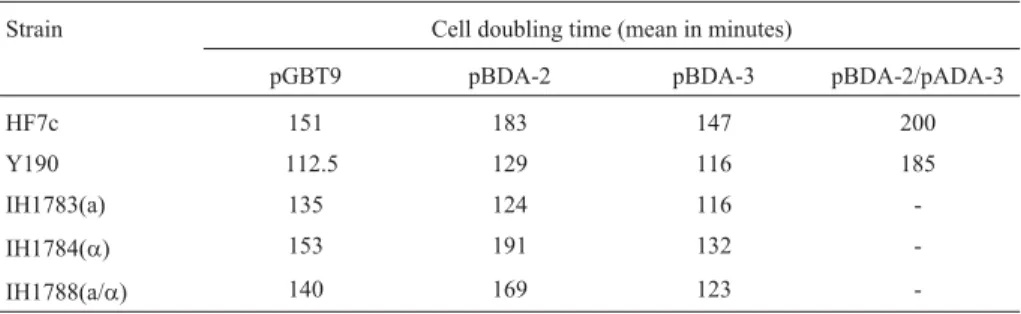
Although the lag phase was increased in all mat A-2 transformants, no significant difference was observed at the exponential phase, as indicated by the cell doubling time (p > 0.05). No difference in doubling time was detected be-tween HF7c transformants bearing 2 and pBDA-2/pADA-3. However, the doubling time of these two trans-formants is longer than the one observed for the HF7c pGBT9 transformants (Table 2).
Being interested in the interference ofN. crassa mat-ing proteins on the growth ofS. cerevisiae, we conducted a plasmid cure experiment. Y190 cells harboring the four dif-ferent constructs were grown without selective pressure (YPD) and then plated on SD lacking the specific marker amino acids and on YPD plates as control (Table 2). Ninety to 100% of the plated pGBT9 transformants were able to grow on selective media. Transformants harboring mat A-3 also had a high survival rate (68%-72%). However, cells initially harboring the mat A-2 gene, either alone or in com-bination with mat A-3, showed a dramatic loss of the mark-ers in the absence of selective pressure (4.8%-13.2%), indicating a toxic effect of this construct on yeast.
cycle (Ferreiraet al., 1996). Our initial experiments were performed using only the mitotic cell cycle of this yeast, and thus both mat proteins were expressed during a cell cy-cle in which they normally would be silenced. Although mat A-2 and mat A-3 do not exhibit a domain similar to the MAT proteins ofS. cerevisiae we wondered whether the mating-type and ploidy state of the yeast receiver would make any difference in the growth of the transformants. Plasmids pGBT9, pBDA-2, pDBA-3 were transformed into isogenic haploid (IH1783a and IH 1784a) and diploid cells (IH1788a/a). These transformants were grown on selective media and their growth rates were measured (Table 3). The ploidy apparently did not make any difference since the doubling time of the diploid transformant was not affected by the presence of the mat genes (p > 0.05). Apparently in the mat a background the doubling times for mat A-2 transformants were higher. However, statistical tests showed no significant difference probably because of the high variance between the repetitions (data not shown). Thus we cannot affirm thatN. crassaproteins have an ef-fect in the yeast cell cycle.
A curious aspect is that, although mat A-2 and mat A-3 proteins seem to have similar functions inN. crassa
(Ferreiraet al.1998), they displayed different behavior in the two-hybrid experiment. Nevertheless, a more clear un-derstanding about the roles of the mat A-2 and mat A-3 pro-teins can only be reached when their target genes are identi-fied. Galgoczyet al. (2004) were able to identify a large number of specific target genes ofS. cerevisiaemat pro-teins using genome-wide chromatin immunoprecipitation, transcriptional profiling and phylogenetic comparisons. Different studies aiming at analyzing mat-regulated genes
in sexual and non-sexual fungi demonstrate the importance of understanding the control of vegetative and sexual cy-cles in filamentous fungi (Nowrousian et al., 2005; Pö-gelleret al.2006; Keszthelyiet al., 2007). In this context, the pattern of interaction of mat proteins studied here con-tributes towards understanding the control of vegetative and sexual cycles inN. crassaand in other fungal species.
Acknowledgments
The authors wish to thank CAPES for the graduate scholarships to CC da Silva and RC Cruz.
References
Aramayo R and Metzenberg RL (1996) Meiotic transvection in fungi. Cell 86:103-113.
Arnaise S, Zickler D and Glass NL (1993) Heterologous expres-sion of mating-type genes in filamentous fungi. Proc Natl Acad Sci USA 90:616-620.
Arnaise S, Debuchy R and Picard M (1997) What is abono fide mating-type gene? Internuclear complementation of mat mutants inPodospora anserina. Mol Gen Genet 256:169-178.
Arnaise S, Zickler D, Bilcot SL, Poisier C and Debuchy R (2001) Mutations in mating-type of the heterothallic fungus Podospora anserina lead to self-fertility. Genetics 159:545-556.
Badgett TC and Staben C (1999) Interaction between and transactivation by mating type polypeptides ofNeurospora crassa. Proceedings of Fungal Genetics Conference 20:127. Bakkeren G, Kämper J and Schirawski J (2008) Sex in smut fungi:
Structure, function and evolution of mating-type complexes. Fungal Genet Biol 45:S15-S21.
Blanco R, Carrasco L and Ventoso I (2003) Cell killing by HIV-1 protease. J Biol Chem 278:1086-1093.
Table 2- Plasmid cure in Y190 cells.
Number of coloniesa
Media pGBT9 pBDA-2 pBDA-3 pBDA-2/pADA-3 YPD 189-208 165-242 161-288 156-280 SD -aa 307**-188 8-32 116-195 2-13
a
Number of colonies per plate in two different experiments. **High number of colonies in this control may be due to plating error. pGBT9 - vector, pBDA-2 -GAL4-BD-mat A-2, pBDA-3 -GAL4-BD-mat A-3, pADA-3 -GAL4-AD-mat A-3.
Table 3- Doubling time of different yeast cells transformed with pGBT9, pBDA-2 and pBDA-3.
Strain Cell doubling time (mean in minutes)
pGBT9 pBDA-2 pBDA-3 pBDA-2/pADA-3
HF7c 151 183 147 200
Y190 112.5 129 116 185
IH1783(a) 135 124 116
-IH1784(a) 153 191 132
-IH1788(a/a) 140 169 123
Bobrowicz P, Pawlak R, Correa A, Bell-Pedersen D and Ebbole
DJ (2002) The Neurospora crassa pheromone precursor
genes are regulated by the mating type locus and the circa-dian clock. Mol Microbiol 45:795-804.
Boyer J, Badis G, Fairhead C, Talla E, Hantraye F, Badis G, Fairhead C, Talla E, Hantraye F, Fabre E et al. (2004) Large-scale exploration of growth inhibition caused by overexpression of genomic fragments in Saccharomyces cerevisiae. Genome Biol 5:R75.1-R75.19.
Brejning J, Jespersen L and Arneborg N (2003) Genome-wide
transcriptional changes during the lag phase of
Saccharomyces cerevisiae. Arch Microbiol 179:278-294. Buryskova M, Pospisek M, Grothey A, Simmet T and Burysek L
(2004) Intercellular interleukin-1a functionally interacts with histone acetyltransferase complexes. J Biol Chem 279:4017-4026.
Coppin E, Debuchy R, Arnaise S and Picard M (1997) Mating types and sexual development in filamentous ascomycetes. Microbiol Mol Biol Rev 61:411-428.
Debuchy R, Arnaise S and Lecellier G (1993) Themat-allele of Podospora anserina contains three regulatory genes re-quired for the development of fertilized female organs. Mol Gen Genet 241:667-673.
Ferreira AV-B, Saupe S and Glass NL (1996) Transcriptional analysis of themtAidiomorph ofNeurospora crassa
identi-fies two genes in addition to mtA-1. Mol Gen Genet
250:767-774.
Ferreira AV-B, An Z, Metzenberg RL and Glass NL (1998) Char-acterization ofmat A-2, mat A-3and DmatA mating-type mutants ofNeurospora crassa. Genetics 148:1069-1079. Fields S and Song O (1989) A novel genetic system to detect
pro-tein-protein interactions. Nature 340:245-246.
Galgoczy DJ, Cassidy-Stone A, Llinás M, O’Rourke S, Hersko-witz I, DeRisi JL and Johnson AD (2004) Genomic dissec-tion of the cell-type-specificadissec-tion circuit inSaccharomyces cerevisiae. Proc Natl Acad Sci USA 101:18069-18074. Glass NL and Staben C (1990) Genetic control of mating in
Neurospora crassa. Dev Biol 1:177-184.
Glass NL, Vollmer SJ, Staben C, Grotelueschen J, Metzenberg RL and Yanofsky C (1988) DNAs of the two mating-type al-leles of Neurospora crassaare highly dissimilar. Science 241:570-573.
Glass NL, Grotelueschen J and Metzenberg RL (1990) Neurospora crassa Amating-type region. Proc Natl Acad Sci USA 87:4912-4916.
Grosschedl R, Giese K and Pagel J (1994) HMG domain proteins: Architectural elements in the assembly of nucleoprotein structures. Trends Genet 10:94-100.
Guarente L, Yocum RR and Giffor P (1982) A GAL10-CYC1 hy-brid yeast promoter identifies the GAL4 regulatory region as an upstream site. Proc Natl Acad Sci USA 79:7410-7414. Jacobsen S, Wittig M and Pöggeler S (2002) Interaction between
mating-type proteins from the homothallic fungusSordaria macrospora. Curr Genet 41:150-158.
Keszthelyi A, Jeney A, Kerényi Z, Mendes O, Waalwijk C and Hornok L (2007) Tagging target genes of the MAT1-2-1 transcription factor inFusarium verticilloides(Gibberella fujikuroiMP-A). Antonie Van Leeuwenhoek 91:373-391.
Kim H, Metzenberg RL and Nelson MA (2002) Multiple func-tions of mfa-1, a putative pheromone precursor gene of Neurospora crassa. Eukaryot Cell 1:987-999.
Kronstad JW and Staben C (1997) Mating type in filamentous fungi. Annu Rev Genet 31:245-276.
Metzenberg RL and Glass NL (1990) Mating type and mating strategies inNeurospora. BioEssays 12:53-59.
Michaelis S and Herskowitz I (1988) The a-factor pheromone of Saccharomyces cerevisiaeis essential for mating. Mol Cell Biol 8:1309-1318.
Nonaka G, Ishikawa T, Liu T and Nakajima H (2000) Genetic analysis of growth inhibition of yeast cells caused by expres-sion of Aspergillus oryzae RNase T1. Biosci Biotechnol Biochem 64:2152-2158.
Nowrousian M, Ringelberg C, Dunlap JC, Loros JJ and Kück U (2005) Cross-species microarray hybridization to identify developmentally regulated genes in the filamentous fungus Sordaria macrospora. Mol Genet Genomics 273:137-149. Philley ML and Staben C (1994) Functional analyses of the
Neurospora crassaMT a-1 mating-type polypeptide. Genet-ics 137:715-722.
Pöggeler S and Kück U (2000) Comparative analysis of the
mat-ing-type loci from Neurospora crassa and Sordaria
macrospora: Identification of novel transcribed ORFs. Mol Gen Genet 263:292-301.
Pöggeler S, Risch S, Kück U and Osiewacz HD (1997)
Mating-type genes from the homothallic fungus Sordaria
macrospora are functionally expressed in a heterothallic ascomycete. Genetics 147:567-580.
Pöggeler S, Nowrousian M, Ringelberg C, Loros JJ, Dunlap JC and Kück U (2006) Microarray and real time PCR analysis reveal mating type-dependent gene expression in a homo-thallic fungus. Mol Genet Genomics 275:492-503. Roopchand DE, Lee JM, Shahinian S, Paquette D, Bussey H and
Branton PE (2001) Toxicity of human adenovirus E4orf4 protein inSaccharomyces cerevisiaeresults from interac-tions with Cdc55 regulatory B subunit of PP2A. Oncogene 20:5279-5290.
Sambrook J, Fritsch EF and Maniatis T (1989) Molecular Clon-ing: A Laboratory Manual. 2nd edition. Cold Spring Harbor Laboratory Press, Cold Spring Harbor.
Schiestl RH and Gietz RD (1989) High efficiency transformation of intact yeast cells using single stranded nuclei acids as car-rier. Curr Genet 16:339-346.
Souza CAJ, Silva CC and Ferreira AV-B (2003) Sex in fungi: Les-sons of gene regulation. Genet Mol Res 2:136-147.
Staben C and Yanofsky C (1990) Neurospora crassa a
mat-ing-type region. Proc Natl Acad Sci USA 87:4917-4921. Yocum RR, Hanley S, West Jr. R and Ptashne M (1984) Use of
LacZfusions to delimit regulatory elements of the inducible
divergent GAL1-GAL10 promoter in Saccharomyces
cerevisiae. Mol Cell Biol 4:1985-1998.
Zickler D, Arnaise S, Coppin E, Debuchy R and Picard M (1995) Altered mating-type identity in the fungus Podospora anserina leads to selfish nuclei, uniparental progeny and haploid meiosis. Genetics 140:493-503.
Associate Editor: Sérgio Olavo Pinto da Costa