w w w . s b f g n o s i a . o r g . b r / r e v i s t a
Original
Article
Stevia
rebaudiana
loaded
titanium
oxide
nanomaterials
as
an
antidiabetic
agent
in
rats
Ariadna
Langle
a,
Marco
Antonio
González-Coronel
b,
Genaro
Carmona-Gutiérrez
a,
José
Albino
Moreno-Rodríguez
a,
Berenice
Venegas
c,
Guadalupe
Mu˜noz
b,
Samuel
Trevi˜no
d,
Alfonso
Díaz
b,∗aDepartamentodeQuímicaGeneral,FacultaddeCienciasQuímicas,BeneméritaUniversidadAutónomadePuebla
bDepartamentodeFarmacia,FacultaddeCienciasQuímicas,BeneméritaUniversidadAutónomadePuebla
cDepartamentodeAnálisisClínicos,FacultaddeCienciasQuímicas,BeneméritaUniversidadAutónomadePuebla
dDepartamentodeBiologíayToxicologíadelareproducción,InstitutodeCiencias,BeneméritaUniversidadAutónomadePuebla
a
r
t
i
c
l
e
i
n
f
o
Articlehistory:
Received25July2014 Accepted4March2015 Availableonline30March2015
Keywords:
Diabetes
Steviarebaudiana
Nanomaterials Hypoglycemic Antihyperlipidemic
a
b
s
t
r
a
c
t
Steviarebaudiana(Bertoni)Bertoni,Asteraceae,isaplantwithhypoglycemicandantihyperlipidemic properties.S.rebaudiana(SrB)hasbecomealeadcandidateforthetreatmentofthediabetes melli-tus.However,chronicadministrationsofS.rebaudianaarerequiredtocausethenormoglycemiceffect. Importantly,nanomaterialsingeneralandtitaniumdioxide(TiO2)inparticularhavebecomeeffective
toolsfordrugdelivery.Inthiswork,weobtainedTiO2nanomaterialswithSrBatdifferent
concentra-tions(10,20and30M)bysol–gelmethod.AfterthisnanomaterialswerecharacterizedbyFourier transforminfraredspectroscopyandtransmissionelectronmicroscopy.Whereitwasdemonstrated,the presenceoftheS.rebaudianainTiO2nanomaterials,whichwereobservedashemisphericalagglomerated
particlesofdifferentsizes.Thenanomaterialswereevaluatedinmaleratswhosediabetes mellitus-phenotypewasinducedbyalloxan(200mg/kg,i.p.).Theco-administrationofTiO2-SrB(20and30M)
inducedasignificantandpermanentdecreaseintheglucoseconcentrationsince4h,until30days post-administration.Likewise,theconcentrationsofinsulin,glycosylatedhemoglobin,cholesterol,and triacylglyceridesshowedasignificantrecoverytobasallevels.Themajorfindingofthestudywasthat theTiO2-SrB(20and30M)hasapotentandprolongedactivityantidiabetic.TiO2canbeconsideredlike
anappropriatedvehicleinthecontinuousfreeingofactivesubstancestotreatofdiabetesmellitus. ©2015SociedadeBrasileiradeFarmacognosia.PublishedbyElsevierEditoraLtda.Allrightsreserved.
Introduction
Traditionalmedicineprincipallyderivedfromplantsand cur-rentlyrepresentsatherapeuticpotentialforDiabetesmellitus(DM) (Laitiffetal.,2010;Malviyaetal.,2010).
Steviarebaudiana(Bertoni)Bertoni(SrB),alsoknownas“sweet herb,”isa shrubbyperennialplantbelongingtotheAsteraceae family(Soejartoetal.,1982).SrBsheetscontainingapproximately 4–15%stevioside,whichhavebeenisolatedandcharacterizedby chemicalandspectralstudies(Starrattetal.,2002).
SrBhasvariouspharmacologicalpropertiesincluding antioxi-dantactivity,antihypertensive,antihyperlipidemicand cardiovas-cularprotector (Chan et al., 1998).Recent studies have shown thattheSrBstimulatesinsulinsecretionfrompancreatic-cells
∗ Correspondingauthor.
E-mail:[email protected](A.Díaz).
and cause normolipidemia and normoglycemia in diabetic rats (Raskovicetal.,2004;Chenetal.,2005).Inthissense,SrBprovides evidenceofhistraditionaluseinthecontrolofDM.However,ithas beendemonstratedthatarerequiredcontinuousadministrations ofSrBtoachievenormoglycemiceffect(CurryandRoberts,2008). Onewaytoaddressthisproblemis,todevelopacontrolledrelease systemofSrB,inordertoreducethedoseandmakeavailableSrB inthetargetsitesandkeepitsprolongedactivity.Avarietyof sys-temshavebeendevelopedandused,includingliposomes,micelles, dendrimers,andcopolymers.
Currently, nanomaterials of titanium dioxide (TiO2) have attractedattentionasdeliverypotentialsystems(Barbetal.,2004). TheTiO2nanomaterialsarechemicallyinert,possesshydrophilic features and its synthesis isn’t complicated, in addition, these presenthighmechanicalstrengthandlowtoxicity(Sonetal.,2007). Recentlythenanomaterialshavebeenimplantedintheamygdalaof ratswithepilepsyandobtainedoptimalresults,andfoundthatthe porousTiO2matrixreleasetheircontentsinacontrolledmanner
http://dx.doi.org/10.1016/j.bjp.2015.03.004
A.Langleetal./RevistaBrasileiradeFarmacognosia25(2015)145–151
foraperiodapproximatelyof500h(h)(Lópezetal.,2010a,b).Here, weperformedthesynthesisofTiO2nanomaterialsfromsolutions oftitaniumn-butoxideandtheaqueousextractofSrBconcentrate obtainedfromthedriedleavesoftheplant.Thiswiththepurposeof usingitasacontrolledreleasesystemSrBextract.Fortheabove,this studyaimedtoevaluatetheantidiabeticactivityofintraperitoneal injectionofTiO2-SrBnanomaterialsinadiabeticratmodel.
Materialsandmethods
PreparationofSrB-extract
Steviarebaudiana(Bertoni)Bertoni,Asteraceae,wasgrownon campus grounds of the Benemérita Universidad Autónoma de Puebla(BUAP),México.Dr.AlbinoMoreno-Rodríguezconfirmed the identification,additionally; a sample was deposited in the botanicalgardenof the BUAP(file21-09/14). Leaves SrB (10g) washedanddriedinanElisa-550ovenfor24h.Thenitpulverized andmaceratedwithasolutionofethanolandwater(witharatioof 80:20).Thesolutionobtainedfromthemashingprocessisfiltered andtheSrBaqueousextractisplacedonarotaryevaporatorofthe ESEVE-402-2brandtoeliminateto80%ofsolvent(waterand alco-hol)underreducedpressure.ThusweobtaintheSrBconcentrated extractto80wt.
PreparationofTiO2-SrBnanomaterialsbysol–gelmethod
The homogeneous solutions were prepared separately with differentconcentrationsoftheSrB concentratedextract (10,20 and 30M). Each homogeneous solution containing 150ml of anhydrous1-butanol(99.8%,Sigma–Aldrich),10ml ofdeionized waterand0.5gofpolyvinylpyrrolidone(withanaveragemolecular weightof40,000,Sigma–Aldrich)andtherequiredconcentration oftheSrBconcentratedextract(10,20and30M).
Foreachhomogeneoussolutionwasadded21.5mloftitanium
n-butoxide(97%,Sigma–Aldrich)inarefluxsystemat70◦Cwith constantagitation.Thefinalsolutionwithpropertiesofgelwas immersedinacontainerwithicefor15minat3◦C.Thesolventwas removedonarotaryevaporatorat50◦Cundervacuumconditions tofinallyobtaintheTiO2-SrBnanomaterials(Lópezetal.,2010a,b).
CharacterizedofTiO2-SrBnanomaterials
Infraredspectroscopy(FTIR)
The TiO2-SrB nanomaterials were mixed with KBr (5wt %) and pressed in transparent wafers. Fourier transform infrared spectroscopywasrecordedusingaPerkin-Elmer1600 spectropho-tometer(Perkin-Elmer,Shelton,CT)inthe4000–400cm−1range, and32scanswererunforeachmeasurement.
Scanningelectronmicroscopy(SEM)
Theparticlesize wasmeasuredusingconventional Scanning electron microscopy (SEM, Zeiss; Carl Zeiss, Oberkochen, Ger-many),operatedat100kV,withentrygoniometeratthesideand 0.4nmpoint-to-pointresolution,andattachedtoaCCDcamera (MegaVision,SantaBarbara,CA).
Animals
AdultmaleLongEvansrats(230–250g)wereobtainedfrom Bio-terio“ClaudeBernard”BUAP.Animalswereindividuallyhoused in anenvironment withcontrolledtemperature, humidity, and lightconditions(12hlight:12hdarkcycle), withfreeaccessto foodandwater.Allproceduresdescribedinthisstudywere per-formedin accordancetotheMexicanLaw ofAnimalTreatment andProtectionGuidelines(NOM-062-ZOO-1999)andtheResearch
Committeeusesoflaboratoryanimalsof theBUAP (VIEP-3450-2013).
Inductionofdiabetesinrats
The animals were injected with alloxan dissolved in 0.1M citratebuffer,pH4.5atadose200mg/kgbodyweight(i.p.).The alloxandosewasselectedbasedonvariousreports(Raskovicetal., 2004;Szkudelski,2001).Threedayafteroftheadministrationof alloxan,bloodsamplesweretakenandbloodglucoselevelswere determined.Animals that had higherconcentrations of glucose (150mg/dl)wereconsidereddiabetic.
SrB-TiO2administrationprotocols
Intheexperimentatotaloffortyratswereused,whichwere dividedinfivegroups(n=8pergroup).
Group1:normal ratstreatedwithTiO2 nanomaterials (vehicle group)
Group2:diabeticgrouptreatedwithTiO2nanomaterials Group3:diabeticratswithTiO2-SrBnanomaterialsto10M Group4:diabeticratswithTiO2-SrBnanomaterialsto20M Group5:diabeticratswithTiO2-SrBnanomaterialsto30M
Thenanomaterialswereinjectedbyi.p.Therouteinallanimals dependingoftreatment.
Subsequently, both theempty TiO2 nanomaterials (1g/kgin sterilewaterat37◦C)andSrB(10,20and30M)(1g/kginsterile waterat37◦C)wereadministered,respectively.
Methodfordeterminationofplasmabloodglucoselevel
Toevaluatetheplasmaticconcentrationofglucosewithrespect atcourseoftimeintheanimalsinjectedwithSrBnanomaterials,the animalsweredeprivedofthefoodfor5hbeforethedetermination. Thebloodglucoselevelsweredeterminedat0,4,8and24aswell asat5,10,15and30daysafteradministrationofeachtreatments. Intheexperimentthebloodglucoseleveloftheanimalswere esti-matedbyGlucoseOxidase–PeroxidaseEnzymaticMethodusinga digitalglucometer(ACCU-CHEKbrandactive).Bloodfromthetail veinwascollected.
EvaluationoftheeffectofTiO2-SrBnanomaterialson hyperglycemiaandhyperlipidemiainducedbyalloxan
At31dayspost-injectionofTiO2andTiO2-SrB,theanimalsof each experimentalgroup weresacrificed by dislocationand by cardiacpuncture.Thebloodsampleswerecollectedtomeasure glucose,insulin,glycatedhemoglobin,cholesteroland triacylglyc-erides.Collectedsampleswerecentrifugedat2×gfor5min.Serum determinationsofglucose,cholesterolandtriacylglycerideswere developedbyenzymaticcolorimetricassay,followingtheprotocols respectivelylabeledaccordingtheBioSystemkitsandanalyzedina semi-automatedspectrophotometer(BayerRA-50).Plasmainsulin concentrationwasdeterminedbyanELISAimmunoassay (Diagnós-ticaInternacional),andantibody-antigencomplexwasdetermined at415nminaStatfax2600platereader(WinerLabgroup).The glycatedhemoglobinmeasuringwascarriedoutby immunofluo-rescencemethod,followingtheprotocolaccordingthei-Chroma kitanditwasanalyzedinadetectorofthesamebrand.
Statisticalanalysis
Thedatawereexpressedasmean±standarderror(SE)forall
A.Langleetal./RevistaBrasileiradeFarmacognosia25(2015)145–151
4000 3500 3000 2500
Wave number (cm–1)
Wave number (cm–1)
2000 1500 1000 500 TiO2
SrB10-TiO2
SrB20-TiO2
SrB30-TiO2
Intensity (a.u.)
Intensity (a.u.)
4000 3500 3000 2500 2000 1500 1000 500
B
A
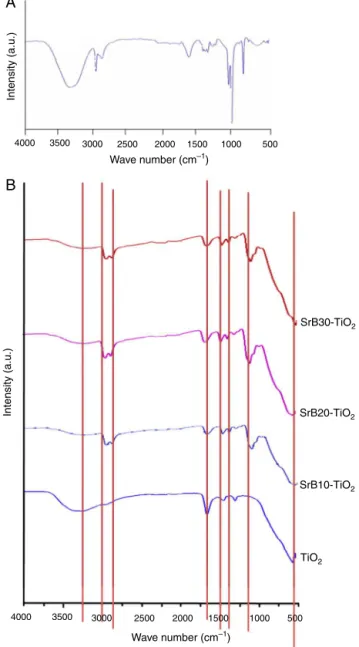
Fig.1.(A)FTIRspectrumofSrBextract80wt%.(B)FTIRspectraofTiO2,SrB/TiO2-10, SrB/TiO2-20andSrB/TiO2-30nanomaterials.
andaconfidencelevelof95%and,whennecessary,themeanswere comparedusingtheBonferronitest.
Results
CharacterizationofTiO2-SrBnanomaterials
InfraredSpectroscopy(FTIR)
The FTIR spectrum of SrB extract is presented in Fig. 1A. The absorptionbandlocated at 3383cm−1, it correspondingto thestretchingvibrationmodeOH,whichidentifiesthehydroxyl groups(OH−),ofwater(H OH),andthealcohol(ethanol,R OH). ThestretchingvibrationmodesCHCH,ofchemicalspeciesC Hare locatedto2988cm−1.ModeCHofasymmetricstretching vibra-tionitlocatesat2900cm−1.Thevibrationbandcorrespondingto thebendingtype interactionsmodeOH oftheOH-groups,it is assigned ofthesurfacehydroxyl groupsof thematerial,to sol-ventandthecoordinateddeformation␦HOHofWaterbelocated at1630cm−1.Thewavenumberto1425cm−1and1410cm−1,they corresponding to the symmetrical stretching vibration COO of theCOO groups and deformation ␦CH3 vibration of modes.The
vibrationbandscorrespondingtotheasymmetricstretching vibra-tiontypeCOOofcarboxylateionsarelocatedat1593cm−1.
TheIRspectrumofTiO2 nanomaterialsshowsintheFig.1B. Theabsorptionbandat3,339.1cm−1,correspondtothestretching vibrationmodeOH,whichidentifiesthehydroxylgroups(OH−)of water(H OH),thesolvent(butylalcohol,R OH)andhydroxylation ofgel(Ti OH).TheasymmetricstretchingvibrationmodesofCHis locatedat2939.2cm−1,correspondtothechemicalspeciesofthe methyl( CH3)(Ti O CH3)andethoxygroups( Ti OCH2CH3).
Thebendingmode(OH)localizedto1635.9cm−1,correspond toOHgroupsofwater,whicharepresentonthesurfaceofTiO2 nanomaterial.Theyare mainlyassociated withthehumidityof thenanomaterial,the solventand thecoordinateddeformation modeofwater.Intherange(from ∼1400cm−1 to∼1300cm−1) ofelectromagneticradiation,arelocalizedthebendingvibrationof symmetricaltypeoftheCOO− groups,thevibrationasymmetric deformationoftheCHgroupsandthevibrationmodeofthe defor-mationscissorofthe␦CH3oftheCH3groups.Inthenearinfrared region,thevibrationmodesTi–Otypebendingofthemetal-oxygen interaction, theylocalized at 745.3cm−1, to 640.2cm−1 and to 498.8cm−1.TheTiO2nanomaterialsdopedwith20Mand30M oftheextractSrB,presentsimilarstretchingvibrationmodes:(OH) and (CH)and bending vibrationmodes: (OH), (␦ HOH), (COO), (CH),(CH3),(␦CC),(CO)and(Ti–O),asthanthoseobservedinthe TiO2nanomaterialundoped.
Thedecreaseinintensityoftheabsorptionbands,mainlyofOH− vibrationmodescorrespondingtothehumidity(at1635.9cm−1) ofSRB-TiO2 with10,20 and30Mnanomaterials,maybedue totheinteractiontoSrBaqueousextractwiththesurfaceofTiO2 nanoreservoir,asshowninschemeofFig.2.Itisalsoimportant tonotethat under theseexperimentalconditions isimpossible totalkabouttheformationofpolymorphsofTiO2 relativetothe concentrationoftheaqueousextractofSrB.
Scanningelectronmicroscopy(SEM)
TheFig.3A,showtheSEMstudiesofTiO2nanomaterialwitha tracedareato100,000magnifications.ThetextureoftheTiO2has showntheformofagglomeratedparticleswithanaverageparticle diameterof100nm.ThemicrographofTiO2nanomaterialwith SrB-10M;presentinasweptareato100,000×.Themicrographofthe
TiO2-SrB-10Mnanomaterialpresentinasweptareaof100,000 magnifications,formlessparticleswithanaverageareaof70nm
Fig.3B,showthemicrographofthenanomaterialofTiO2with 20lof SrB (SrB-TiO2-20l), which presented a swept areato 100,000magnifications,itshowedhemisphericaltypeparticlewith anaverageareaof60nm.Similarly,theFig.3Cshowthemicrograph ofSrB/TiO2-30 nanomaterialwithanaveragesphericalparticles sizeof4nmthatarelocatedwithinthematrixofTiO2.InFig.3D, theincreasingintheconcentrationoftheaqueousextractofSrB inTiO2nanomaterials,wenotethatdecreasestheaverageparticle sizeofnanomaterialsof100nm(forTiO2)to4nm(forSrB-Ti2-30l andweconcludedthatthemoleculesoftheaqueousextractofSrB werepresentinthemeshofTiO2.
EffectofTiO2-SrBnanomaterialstreatmentabouthyperglycemia inducedbyalloxan
A.Langleetal./RevistaBrasileiradeFarmacognosia25(2015)145–151
Tiδ+ Tiδ+ Tiδ+ Oδ– Tiδ+ Oδ– Tiδ+ Tiδ+ Tiδ+
Stevioside Steviol
CH3
H3C 3HC
CH3
CH
3
CH
3
HO O
OH
HO
HO
HO HO
HO
HO
HO O
O
O O
O O
O OH
OH
OH OH Stevioside
Oδ– Oδ–
OH– OH–
–HO
–HO
TiO2
OH– CH2 H
δ+ δ– δ+ δ– δ+ δ– δ+
CH 2 CH2
H H
H O H
O
O
Oδ– Oδ–
Fig.2.SchemeofinteractiontoSrBwiththesurfaceofTiO2nanomaterials.
In treatedrats withalloxantheblood glucose levelsat 4, 8 or24h,increased(160–180mg/dl),respecttothevehiclegroup (80.43mg/dl)(Fig.4B).TreatmentwithTiO2-SrBnanomaterialsin alloxan-treatedanimalsshowedaprogressivedecreaseinglucose levelsat4,8 and24hafteradministration,which, whenitwas comparedwiththealloxan+TiO2 treatedgroup,wasobserveda significantdifferenceintheanimalstreatedwithTiO2-SrB20and 30M(Fig.4B).(OnewayANOVA,Bonferronipost-test,p<0.05).
Moreover,comparingtheglucoseconcentrationat5,10,15and 30days inthehyperglycemic ratsafter administrationofTiO2 -SrB,wasobserved,a significantdecreaseinthetreatedanimals withTiO2-SrBnanomaterialsat20and30Mwithrespecttothe alloxan+TiO2group(Fig.4C).Inthisregard,thedecreaseof glu-coselevelswasobservedduring30daysafteradministrationof
TiO2-SrBataconcentrationof20–30M(one-wayANOVA, Bon-ferronipost-test,p<0.05).
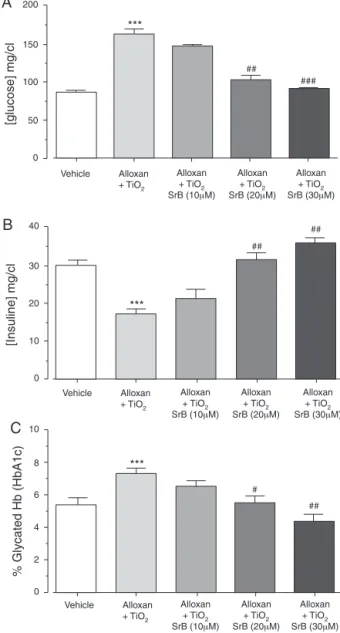
Laboratorystudies,developed31daysafteradministrationof treatments,showasignificantincreaseintheconcentrationof glu-cose (86%) of thehyperglycemic group+TiO2, compared tothe normalratstreatedwithTiO2 (Fig.5AandB).Consequently,the concentration of glycosylated hemoglobin in the alloxan+TiO2 group,washigher(38%)comparedtothenormalrats+TiO2(Fig.5C) (one-wayANOVA,post-Bonferronitest,p<0.05).
Moreover,theanimalsofgroupsofalloxan+TiO2-SrB20and 30M,hadalowerconcentrationofglucose(20%and56%)and glycatedhemoglobin(25%and41%)comparedtothealloxan+TiO2 group (Fig. 5A and C). Also, groups with alloxan+TiO2-SrB 20 and30Mshoweda higherinsulin concentrationcomparedto
A.Langleetal./RevistaBrasileiradeFarmacognosia25(2015)145–151
300
A
275
Vehicle + Ti2O
### ###
*** Alloxan + Ti2O
Week
Alloxan + TiO2-SrB (10μM)
Alloxan + TiO2-SrB (20μM)
Alloxan + TiO2-SrB (30μM)
Vehicle + Vehicle
Hours Alloxan + TiO2
Alloxan + TiO2-SrB (10 μM)
Alloxan + TiO2-SrB (20 μM)
Alloxan + TiO2-SrB (30 μM)
Vehicle + Vehicle Alloxan + TiO2
Alloxan + TiO2-SrB (10 μM) Alloxan + TiO2-SrB (20 μM)
Alloxan + TiO2-SrB (30 μM)
250
225
W
eight (g)
200
1 2 3 4
0 4 8 24
0 4 10 20 25 30
Days 15 175 150 200
B
150 100 50 [Glucose] mg/gl 0 200C
150 100 50 [Glucose] mg/gl 0 ## ### ### ### *** ***Fig.4. EffectofadministrationofTiO2-SrBnanomaterialsontheweightandthe timecourseoftheglycemiclevelsintreatedratswithalloxan.Theanimalswere weighedeveryweekfor4weeks(A).Thebloodglucoselevelsweredeterminedat 0,4,8and24h(B),aswellas5,10,15and30days(C)afteradministrationofthe nano-TiO2SrB(10,20and30M)indiabeticrats(alloxan,200mg/kg).Thevehicle groupwereadministeredwiththevehicle,andwithemptynanomaterials(Vehicle andalloxan+TiO2)underthesameexperimentalconditions(n=8pergroup).The datashowtheaverageweight(g)andglucoseconcentration(mg/dl)±SEofeach grouprespectively.(One-wayANOVA,Bonferronipost-test,***p<0.001:Vehiclevs alloxan+TiO2;# #p<0.01and###p<0.001:alloxan+TiO
2-SrBvsalloxan+TiO2).
the group with alloxan+TiO2 (80% and 100%) (Fig. 5B). (One wayANOVA,Bonferronipost-test,p<0.05).Thisshowedforthe firsttime,thatnanomaterialsTiO2-SrB(20and30M)reversed hyperglycemic effect inducedby alloxan, due tothe biochemi-calparametersmeasured(glucose,glycosylatedhemoglobinand insulin)arestatisticallysimilartothevehiclegroup+TiO2.
TiO2-SrBnanomaterialstreatmenteffectonhyperlipidemiceffects inducedbyalloxan
The resultsshow that the diabetic group treated withTiO2 increasedthecholesterol and triacylglycerides levelsrespectto
Vehicle *** ## ### [glucose] mg/cl 200
A
150 100 50 0 Alloxan + TiO2Alloxan + TiO2
SrB (10μM)
Alloxan + TiO2
SrB (20μM) Alloxan
+ TiO2
SrB (30μM)
Vehicle Alloxan + TiO2
Alloxan + TiO2
SrB (10μM) Alloxan
+ TiO2
SrB (20μM)
Alloxan + TiO2
SrB (30μM)
Vehicle Alloxan + TiO2
Alloxan + TiO2
SrB (10μM)
Alloxan + TiO2
SrB (20μM) Alloxan
+ TiO2
SrB (30μM) [Insuline] mg/cl 40
B
30 20 10 0% Glycated Hb (HbA1c)
10
C
8 6 2 4 0 *** ## ## *** # ##Fig.5. EffectofadministrationofTiO2-SrBnanomaterialsonglucose,insulinand glycosylatedhemoglobininadministeredratswithalloxan.Quantificationwas per-formedinplasmaat31daysafteradministrationofTiO2-SRB(10,20and30M)or TiO2intreatedratswithalloxan(200mg/kg)orvehicle.Thegraph(A)glucose con-centration(mg/ml)inplasmaandshowningraphs(B)and(C)insulinconcentration (mU/ml),andthepercentageofglycosylatedhemoglobin,respectivelyareshown. Thedatashowthemean±SEofeachgrouprespectively.(One-wayANOVA, Bon-ferronipost-test,***p<0.001:Vehiclevsalloxan+TiO2and##p<0.01,###p<0.001: alloxan+TiO2-SrBvsalloxan+TiO2).
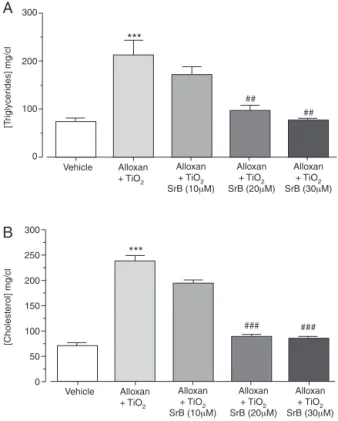
normalratstreatedwithTiO2(227%and185%,respectively)(Fig.6). Moreover the treatmentwith TiO2-SrB nanomaterials to 20 or 30M in diabetic rats decreased the cholesterol (62 and 64%, respectively)andtriacylglycerideslevels(59and63%,respectively) respecttodiabeticratswithTiO2(Fig.6AandB).(OnewayANOVA, Bonferronipost-test,p<0.05).TreatedanimalswithTiO2-SrB nano-materialsto10Mdidnotmodifythebiochemical parameters evaluated.
Discussion
A.Langleetal./RevistaBrasileiradeFarmacognosia25(2015)145–151
Vehicle ***
##
##
[T
riglycer
ides] mg/cl
[Cholesterol] mg/cl
300
A
B
200
100
0
300
200
150 250
100
50
0
Alloxan + TiO2
Alloxan + TiO2
SrB (10μM)
Alloxan + TiO2
SrB (20μM) Alloxan
+ TiO2
SrB (30μM)
Vehicle Alloxan + TiO2
Alloxan + TiO2
SrB (10μM)
Alloxan + TiO2
SrB (20μM) Alloxan
+ TiO2
SrB (30μM) ***
### ###
Fig.6.EffectofadministrationofTiO2-SrB nanomaterialsonconcentrationof cholesterolandtriacylglyceridesinadministeredratswithalloxan.Quantification wasperformedinplasmaat31daysafteradministrationofTiO2-SrB(10,20and 30M)orTiO2intreatedratswithalloxan(200mg/kg)orvehicle.Thegraph (A)isshowncholesterolconcentration(mg/dl)andinthegraph(B) triacylglyc-erides(mg/dl)areshownrespectively.Datashowthemeanconcentration±SEof eachgrouprespectively.(One-wayANOVA,Bonferronipost-test,***p<0.Vehiclevs alloxan+TiO2and##p<0.01,###p<0.001:alloxan+TiO
2-SrBvsalloxan+TiO2).
TiO2-SrBnanomaterialsindiabeticratmodelinducedwithalloxan, which is a toxic hepato-pancreaticagent,togenerate a similar metabolicchangestotheDM.Thealloxanisemployedasan exper-imentaldiabetogenictoevaluatetheeffectivenessofnewdrugs withhypoglycemicproperties(Szkudelski,2001).
Glycemia and lipemiaevaluations,determines thedegree of metabolicdamagethatexistsinexperimentalanimals.Thisstudy showsthatthetreatmentwithTiO2alonehavenoeffectonglucose andlipidsvalues,whileTiO2-SrBat20or30Mcauseda hypo-glycemicand antihyperlipidemiceffect indiabetic ratsinduced withalloxan,which isa toxic glucoseanalog,whichselectively destroys insulin-producing beta cells in the pancreas when is administeredtorodents(Jeppesenetal.,2000),andcausesthat secretedinsulinareinsufficienttoregulatebloodglucose, there-foreinthisstudytheratsexhibitedcontinuoushyperglycemia.This modelproducesadecreaseintheinsulinlevelsintheanimals, simi-lartothereportedinseveralstudies.Whentheratsaretreatedwith TiO2-SrBto20or30Mproduceahypoglycemiceffectfrom4hto 31daysafterthetreatment.Theseresultsrevealtheimportance ofTiO2nanomaterialsascontinuousandsustainedreleasedrugs deliverysystemintothebloodstream.
According to Jeppesen et al. (2000) the SrB exerts a hypo-glycemicaction whichis analogoustosulfonylureas, becauseit blocksK+channelsinpancreatic-cellsremaining,depolarizedthe membraneandpromoteschannelopeningofvoltage-dependent Ca+2. Wherein the increase of intracellular Ca+2 is crucial to induceinsulin secretionfrompancreatic-cellsand thuscause thedecreaseofbloodsugar,reachingnormalvaluesbiologically (Raskovicetal.,2004).
Accordingourresultsit appearsthatthetreatmentwithSrB intoTiO2 nanomaterials ondiabeticratsstimulateofremaining
-pancreaticcellsandinducetheinsulinsecretionconstantly.This insulinpromotesthedecreaseofglucoseandglycatedhemoglobin levels in theplasma of the diabeticrats (Park and Cha, 2010). It is noteworthy that interaction,SrB, withnanomaterials TiO2 decreasesprogressively,oncetheyarein theaqueousmedium, whichprovidesthebloodstream,therefore,theSrBisreleasedand distributedperipherallytoreachingthesitesofactionandexercise therespectivepharmacologicaleffects.Accordingassuggestedby someworkwithnanomaterialsofTiO2(Lópezetal.,2010a,b,2015). However,itisnecessarytodemonstratethisprocessinthefuture. In DM, highlipid levelsare present and play an important toxicrole.Thepresentstudyshowhighlipidlevelsindiabeticrats inducedwithalloxanbutthetreatmentwithnanomaterialsofTiO2 -SrBnormalizetheprofilelipidsdemonstratingthehypolipidemic effectof SrB. However,themolecularmechanism to regulating glucoseorlipidsoftheSrBareunknown.Atthemoment, stud-ies indicate that SrB has antioxidant and antiapoptotic effects (Shivannaetal.,2013),whichprobablyhelpstoenhancetheSrB therapeuticeffect.AccordingtoMisraetal.(2011)suggestthat Ste-viaextractproducedgoodantidiabeticeffectstogetherwithlesser lossinbody weightandproposethatcanbeusedinthe prepa-rationof coughsyrupsand coldbeveragesfor diabetespatients (Himanshuetal.,2011).
Foraboveexpose,thisstudydescribesforthefirsttimesthatis necessarythedeliverysystemlikeTiO2nanomaterialstorelease SrB and generate regulation on hyperglycemia and hyperlipi-demiaindiabeticratsinduced withalloxan.Ourresultsopena new opportunity for the treatment of theDM; however more studiesareneededtobetterunderstandthepotentialuseofTiO2 -nanomaterialsandSrBinmetabolicdiseases.
Authorcontributions
AL,MGC,ST,AD,BV,GI,GCandAMRdesignthestudyandwrote theprotocol.AL,ADandSTperformedtheexperiments.AL,AD, AMR,ST,BVandGCmanagedtheliteraturesearchesand analy-sis;MGCandADundertookthestatisticalanalysis.Allcontributing authorshaveapprovedthefinalmanuscript.
Conflictsofinterest
Theauthorsdeclarenoconflictsofinterest.
Acknowledgments
TheauthorsthankDr.CarlosEscamillaforhishelpwiththe ani-malcareandthankstoThomasEdwards,PhDforeditingtheEnglish languagetext.
References
Barb,C.,Bartlett,J.,Kong,L.,2004.Silicaparticles:anoveldrug-deliverysystem.Adv. Mater.16,1959–1966.
Chan,P.,Xu,D.Y.,Liu,J.C.,Chen,Y.J.,Tomlinson,B.,Huang,W.P.,1998.Theeffect ofsteviosideonbloodpressureandplasmacatecholaminesinspontaneously hypertensiverats.LifeSci.63,1679–1684.
Chen,T.H.,Chen,S.C.,Chan,P.,Chu,Y.L.,Yang,H.Y.,Cheng,J.T.,2005.Mechanism ofthehypoglycemiceffectofstevioside,aglycosideofSteviarebaudiana.Planta Med.71,108–113.
Curry,L.L.,Roberts,A.,2008.SubchronictoxicityofrebaudiosideA.FoodChem. Toxicol.46,11–20.
Himanshu,M.,Manish,S.,Narendra,S.,Darshana,M.,Mehta,B.,Jain,D.C.,2011. Antidiabeticactivityofmedium-polarextractfromtheleavesofStevia
rebau-dianaBert.(Bertoni)onalloxaninduceddiabeticrats.J.Pharm.Bioallied.Sci.3,
242–248.
A.Langleetal./RevistaBrasileiradeFarmacognosia25(2015)145–151
Laitiff,A.A.,Teoh,S.L.,Das,S.,2010.Woundhealingindiabetesmellitus:traditional treatmentmodalities.Clin.Ter.161,359–364.
López,T.D.,Francos,M.A.,González,A.F.,Díaz-García,M.E.,Badía-Laí˜no,R.,2015. Controlled release of nafcillin usingbiocompatible “Dummy” molecularly imprintedsol–gelnanospheres.Curr.Top.Med.Chem.15,262–270. López,T.,Bata-García,J.L.,Esquivel,D.,Ortiz-Islas,E.,González,R.,Ascencio,J.,
Quin-tana,P.,Oskam,G.,Álvarez-Cervera,F.J.,Heredia-López,F.J.,Góngora-Alfaro, J.L.,2010a.TreatmentofParkinson’sdisease:nanostructuredsol–gel silica-dopaminereservoirsforcontrolleddrugreleaseinthecentralnervoussystem. Int.J.Nanomed.6,19–31.
López,T.,Ortiz,E.,Álvarez,M.,Navarrete,J.,Odriozola,J.A.,Martínez-Ortega,F., Páez-Mozo,E.A.,Escobar,P.,Espinoza,K.A.,Rivero,I.A.,2010b.Studyofthe stabilizationofzincphthalocyanineinsol–gelTiO2forphotodynamictherapy
applications.Nanomedicine6,777–785.
Malviya,N.,Jain,S.,Malviya,S.,2010.Antidiabeticpotentialofmedicinalplants.Acta Pol.Pharm.67,113–118.
Misra,H.,Soni,M.,Silawat,N.,Mehta,D.,Mehta,B.K.,Jain,D.C.,2011. Antidia-beticactivityofmedium-polarextractfromtheleavesofSteviarebaudiana Bert.(Bertoni)onalloxan-induceddiabeticrats.J.Pharm.BioalliedSci.3(2), 242–248.
Park, J.E., Cha, Y.S., 2010. Stevia rebaudiana Bertoni extract supplementation improveslipidandcarnitineprofilesinC57BL/6Jmicefedahigh-fatdiet.J.Sci. FoodAgric.90,1099–10105.
Raskovic,A.,Gavrilovic,M.,Jakovljevic,V.,Sabo,J.,2004.Glucoseconcentrationin thebloodofintactandalloxan-treatedmiceafterpretreatmentwithcommercial preparationsofSteviarebaudiana(Bertoni).Eur.J.DrugMetab.Pharmacokinet. 29,87–90.
Shivanna,N.,Naika,M.,Khanum,F.,Kaul,V.K.,2013.Antioxidant,anti-diabeticand renalprotectivepropertiesofSteviarebaudiana.J.DiabetesComplications27, 103–113.
Soejarto,D.D.,Kinghorn,A.D.,Farnsworth,N.R.,1982.Potentialsweeteningagent ofplantoriginIII:organolepticevaluationofStevialeafherbariumsamplesfor sweetness.J.Nat.Prod.45,590–599.
Son,S.J.,Bai,X.,Lee,S.B.,2007.Inorganichollownanoparticlesandnanotubesin nanomedicinePart1.Drug/genedeliveryapplications.DrugDiscoveryToday 12,650–656.
Starratt,A.N.,Kirby,C.W.,Pocs,R.,Brandle,J.E.,Rebaudioside,F.,2002.Aditerpene glycosidefromSteviarebaudiana.Phytochemistry59,367–370.