Effects of nitric oxide inhibitors in mice with bladder outlet
obstruction
_______________________________________________
Marcy Lancia Pereira
1, Carlos Arturo Levi D’ancona
2, Julio Alejandro Rojas-Moscoso
3, Antonio Celso
Saragossa Ramos Filho
3, Fabiola Zakia Mónica
3, Edson Antunes
31 Departamento de Cirurgia, Faculdade de Ciências Médicas - UNICAMP, Campinas, SP, Brasil; 2 Departamento de Urologia, Faculdade de Ciências Médicas - UNICAMP, Campinas, SP, Brasil; 3 Departamento
de Farmacologia, Faculdade de Ciências Médicas - UNICAMP, Campinas, SP, Brasil
ABSTRACT
ARTICLE
INFO
______________________________________________________________ ______________________
Purpose: To investigate the lower urinary tract changes in mice treated with L-NAME, a non-selective competitive inhibitor of nitric oxide synthase (NOS), or aminoguani-dine, a competitive inhibitor of inducible nitric oxide synthase (iNOS), after 5 weeks of partial bladder outlet obstruction (BOO), in order to evaluate the role of constitutive and non-constitutive NOS in the pathogenesis of this experimental condition.
Materials and Methods: C57BL6 male mice were partially obstructed and randomly al-located into 6 groups: Sham, Sham + L-NAME, Sham + aminoguanidine, BOO, BOO + L-NAME and BOO + aminoguanidine. After 5 weeks, bladder weight was obtained and cystometry and tissue bath contractile studies were performed.
Results: BOO animals showed increase of non-voiding contractions (NVC) and bladder capacity, and also less contractile response to Carbachol and Electric Field Stimulation. Inhibition of NOS isoforms improved bladder capacity and compliance in BOO animals. L-NAME caused more NVC, prevented bladder weight gain and leaded to augmented contractile responses at muscarinic and electric stimulation. Aminoguanidine dimin-ished NVC, but did not avoid bladder weight gain in BOO animals and did not improve contractile responses.
Conclusion: It can be hypothesized that chronic inhibition of three NOS isoforms in BOO animals leaded to worsening of bladder function, while selective inhibition of iNOS did not improve responses, what suggests that, in BOO animals, alterations are related to constitutive NOS.
Keywords:
NG-Nitroarginine Methyl Ester; Nitric Oxide; Urinary Bladder; Ureteral Obstruction
Int Braz J Urol. 2017; 43: 356-75
_____________________
Submitted for publication: August 15, 2015
_____________________
Accepted after revision: August 07, 2016
_____________________
Published as Ahead of Print: January 05, 2017
INTRODUCTION
Nitric oxide (NO) is synthesized from its precursor L-arginine via NO synthases (NOS), whi-ch exist in three isoforms: neuronal (nNOS), endo-thelial (eNOS) and inducible (iNOS). The first ones are constitutively expressed and produce small quantities of NO and the last one is induced by cytokines, infection or other stimuli and produces
release were urothelium and afferent nerves (2). Treatment of BOO rats with aminoguani-dine, a competitive inhibitor of iNOS, has shown good results, as decreases in iNOS ameliorated functional and fibrotic changes in the bladder (3, 4). The same consequences have been observed in iNOS knockout mice (1, 4). Treatment with L--NAME, a non-selective competitive inhibitor of NOS, inhibited generation of nitrotyrosine, which is produced by nitrogen reactive species and, as consequence, improved bladder contraction (5). However, another study showed that a feeding diet rich in L-arginine was beneficial for rabbits with 2 weeks of severe BOO (6).
In the current study, we investigated lower urinary tract changes in mice treated with L-NA-ME or aminoguanidine after 5 weeks of BOO, since these drugs represent non-selective and selective NOS inhibitors, respectively.
MATERIALS AND METHODS
Animals and Experimental Groups
The experimental protocols were appro-ved by the Ethical Principles in Animal Research adopted by the Brazilian College for Animal Ex-perimentation (COBEA, No 2030-1). Male C57BL6 mice (25-30g), 8-9 weeks old, were used and ran-domly allocated into six experimental groups: Sham (Sham-operated), Sham + L-NAME (Sham that received L-NAME), Sham + aminoguanidine (Sham that received aminoguanidine), BOO (blad-der outlet obstruction), BOO + L-NAME (BOO that received L-NAME) and BOO + aminoguanidine (BOO that received aminoguanidine). Doses of L--NAME (150mg/Kg) and aminoguanidine (20mg/ Kg) were chosen according to previous study (7). All animals were placed into individual cages with food ad libitum and received drugs given in the drinking water immediately after surgery for a period of 5 weeks, when all in vitro and in vivo studies were performed.
Surgical Procedures
Animals were anesthetized by intraperito-neal injection of ketamine (2mg/Kg) and xylazine (30mg/Kg) and placed in the supine position. A
lower midline abdominal incision was made and, after exposure of the bladder and proximal ure-thra, partial BOO was created by tying a 6-0 nylon suture around the urethra. A 0.6mm diameter tu-bing was used as a guide to prevent total urethral occlusion. In Sham group, identification of bladder and proximal urethra was done, with no further surgical manipulation. Both abdomen muscles and skin were closed with a 6-0 nylon suture.
In vivo and in vitro bladder functional as-sessment
Bladder weights
Bladders were carefully withdrawn and weighted. Also, mice were weighted for normali-zation of values and the ratio bladder weight (mg) to body weight (g) was obtained. This parameter was used to verify if BOO animals exhibited bla-dder weight increase, showing that pathological alterations due to this condition, imposed by sur-gery, has occurred.
Filling Cystometry
frequency was measured considering the number of micturition cycles within 30 minutes. Threshold pressure was defined as the pressure immediately before micturition (8). Bladders of mice used for cystometry were not used in the other experiments.
Tissue bath
Animals were killed by inhalation of CO2. Bladders were rapidly dissected, removed, wei-ghted and put immediately in a physiologic saline solution of Krebs-Henseleit (NaCl 117mM, NaHCO3 25mM, C6H1206 11mM, KCl 4.7mM, NaHPO4 1.2mM, MgSO47H2O 1.2mM and CaCl22H2O 2.5mM, pH 7.4). Two longitudinal muscle strips with intact urothelium were obtained from the bladder body, measuring 2 x 2 x 10mm and were mounted in 10mL organ baths containing Krebs-Henseleit so-lution at 37ºC bubbled with a gas mixture of 95% O2 and 5% CO2. Changes in isometric force were recorded using a computer Software (PowerLab v.7.0 system, AD Instruments, Sydney-NSW, Aus-tralia). The resting tension was adjusted to 5mN at the beginning of the experiments, the equili-bration period was 60 minutes and the bathing medium was changed every 15 minutes.
Cumulative concentration-response cur-ves to the full muscarinic agonist Carbachol (1ƞM to 30µM) were constructed using one-half log unit. Nonlinear regression analysis to determine the pEC50 was carried out using Graph Pad Prism (Graph Pad Software, Inc., San Diego, CA, USA) with the constraint that F=0. All concentration– response data were evaluated for a fit to a logistics function in the form: E = Emax / ([1 + (10c/10x)n] + F), where E is the maximum response produced by agonists; c is the logarithm of the EC50, the con-centration of drug that produces a half-maximal response; x is the logarithm of the concentration of the drug; the exponential term, n, is a curve--fitting parameter that defines the slope of the concentration–response line, and F is the response observed in the absence of added drug. Data were normalized to the wet weight of the respective uri-nary bladder strips, and the values of Emax were represented in mN/mg.
Bladder strips were stimulated with Elec-tric Field Stimulation (EFS at 2, 4, 8 and 16Hz), 50V, during 0.2ms and an interval of 2 minutes
between pulses. Responses were recorded and ma-ximal tensions compared, expressed by mN/mg.
Statistical analysis
The values recorded were mean±SEM, and the statistical significances were determined by One-Way ANOVA followed by the Tukey test. P<0.05 was considered significant. InStat© was used for statistical analysis.
Drugs
No-Nitro-L-arginine methyl ester hydro-chloride (L-NAME), urethane, Carbachol and ami-noguanidine hemisulfate were obtained from Sig-ma Chem. Co. (St Louis, MO).
RESULTS
Bladder weights
Bladder outlet obstruction (BOO) animals showed increased bladder weight to body weight ratio (P<0.001), almost 2-fold when compared to Sham animals. Oral treatment with L-NAME in BOO animals decreased bladder weight to body weight (P<0.001). Treatment with aminoguanidine had no significant effect on this parameter (Figure-1).
Filling Cystometry
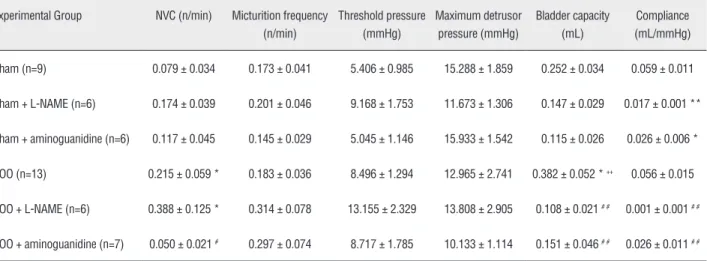
A total of 9 Sham, 6 Sham + L-NAME, 6 Sham + aminoguanidine, 13 BOO, 6 BOO + L-NA-ME and 7 BOO + aminoguanidine were evaluated. Figure-2 represents cystometric profiles obtained after 5 weeks of surgical procedures for all experi-mental groups.
Figure 1 - Bladder weight to body weight ratio in Sham and BOO mice treated or not with L-NAME or aminoguanidine for 5 weeks.
Figure 2 - Representative Cystometrograms in Sham (A), Sham + L-NAME (B), Sham+aminoguanidine (C), BOO - Bladder outlet obstruction (D), BOO + L-NAME (E) and BOO + aminoguanidine (F) groups. Arrows indicate micturition peaks.
***P<0.001 versus Sham. # # # P<0.001 versus BOO.
A
C
E
B
D
* P<0.05 versus Sham; ** P<0.01 versus Sham; # P<0.05 versus BOO;
## P<0.01 versus BOO; ++ P<0.01 versus Sham + L-NAME.
Figure 3 - Cystometric parameters in Sham and BOO mice treated or not with L-NAME or aminoguanidine for 5 weeks: non-voiding contractions (A), threshold pressure (B), maximum detrusor pressure (C), compliance (D), bladder capacity (E) and micturition frequency (F).
A
C
E
B
D
Tissue bath
Cumulative addition of the muscarinic agonist Carbachol (1ƞM to 30µM) to bladder pre-parations produced concentration-dependent con-tractions (Figure-4 and Table-2). Sham + L-NAME mice showed higher responses compared to Sham. BOO and BOO + aminoguanidine groups exhibi-ted a significant decrease in maximal responses to this agonist. The pEC50 values for Carbachol did not change significantly for any group.
Table 1 - Cystometric parameters evaluated for each experimental group. NVC: non-voiding contractions.
Experimental Group NVC (n/min) Micturition frequency (n/min)
Threshold pressure (mmHg)
Maximum detrusor pressure (mmHg)
Bladder capacity (mL)
Compliance (mL/mmHg)
Sham (n=9) 0.079 ± 0.034 0.173 ± 0.041 5.406 ± 0.985 15.288 ± 1.859 0.252 ± 0.034 0.059 ± 0.011
Sham + L-NAME (n=6) 0.174 ± 0.039 0.201 ± 0.046 9.168 ± 1.753 11.673 ± 1.306 0.147 ± 0.029 0.017 ± 0.001 **
Sham + aminoguanidine (n=6) 0.117 ± 0.045 0.145 ± 0.029 5.045 ± 1.146 15.933 ± 1.542 0.115 ± 0.026 0.026 ± 0.006 *
BOO (n=13) 0.215 ± 0.059 * 0.183 ± 0.036 8.496 ± 1.294 12.965 ± 2.741 0.382 ± 0.052 * ++ 0.056 ± 0.015
BOO + L-NAME (n=6) 0.388 ± 0.125 * 0.314 ± 0.078 13.155 ± 2.329 13.808 ± 2.905 0.108 ± 0.021 # # 0.001 ± 0.001 # #
BOO + aminoguanidine (n=7) 0.050 ± 0.021 # 0.297 ± 0.074 8.717 ± 1.785 10.133 ± 1.114 0.151 ± 0.046 # # 0.026 ± 0.011 # #
* P<0.05 versus Sham; # P<0.05 versus BOO; # # P<0.01 versus BOO; ++ P<0.01 versus Sham + L-NAME.
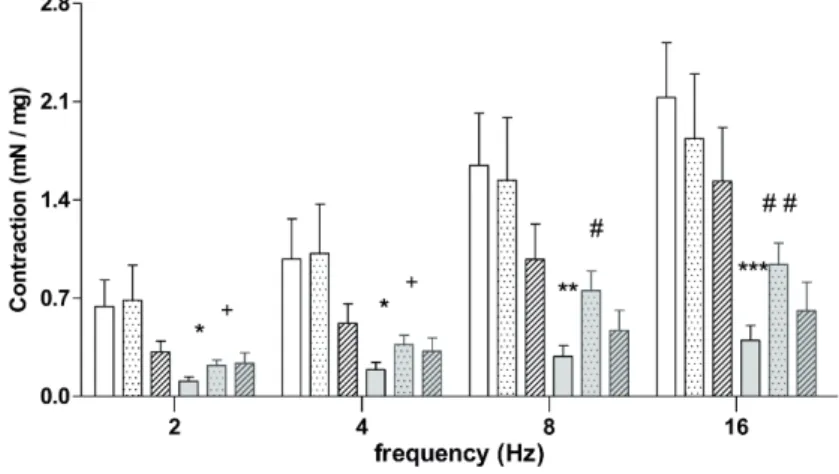
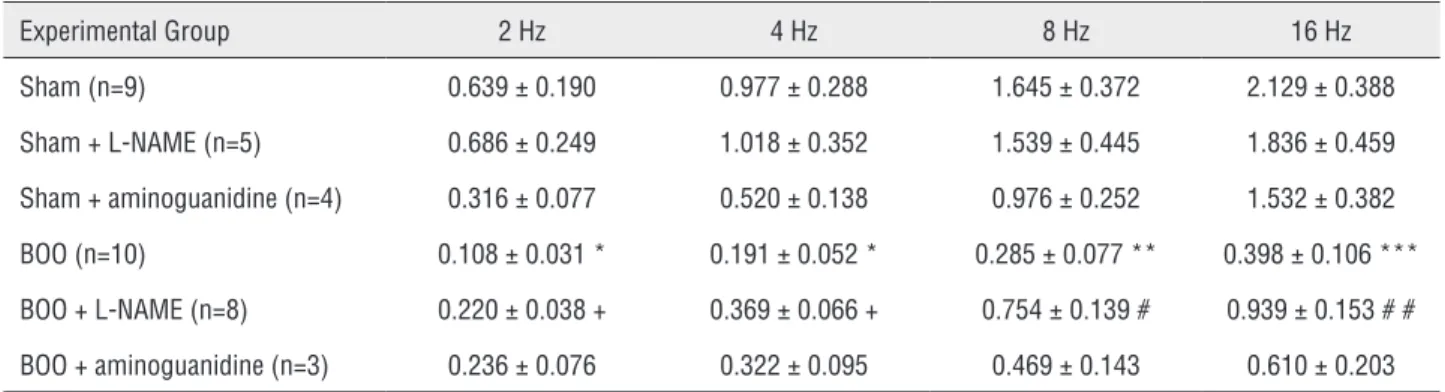
EFS induced a frequency-dependent incre-ase in the amplitude of contractions in isolated bladder smooth muscle. BOO animals showed lo-wer contraction when compared to Sham animals at all frequencies evaluated. L-NAME BOO treated animals showed decreased contraction at 2 and 4Hz compared to Sham + L-NAME and increased contraction compared to BOO mice at 8 and 16Hz. There was no difference for aminoguanidine trea-ted animals (Figure-5 and Table-3).
Figure 4 - Bladder smooth muscle contractions to Carbachol in Sham and BOO mice treated or not with L-NAME or aminoguanidine for 5 weeks.
Table 2 - Maximal responses (Emax) and Potency (pEC50) to Carbachol (Cch) in bladder smooth muscle. Data were obtained
in Sham and BOO animals, treated or not with L-NAME or aminoguanidine.
Experimental group Emax (mN/mg) pEC50 Sham (n=9) 1.29 ± 0.13 6.43 ± 0.21 Sham + L-NAME (n=3) 3.06 ± 0.40*** 6.38 ± 0.17 Sham + aminoguanidine (n=4) 1.40 ± 0.27 6.15 ± 0.16 BOO (n=10) 0.49 ± 0.09* 6.30 ± 0.17 BOO + L-NAME (n=6) 1.08 ± 0.12 +++# 6.04 ± 0.10 BOO + aminoguanidine (n=3) 0.55 ± 0.11* 6.35 ± 0.17
* P<0.05 versus Sham; *** P<0.001 versus Sham; # P<0.05 versus BOO. +++ P<0.001 versus Sham + L-NAME.
Figure 5 - Contractile responses to electrical-field stimulation (EFS; 2-16 Hz) in bladders from Sham and BOO mice, treated or not with L-NAME or aminoguanidine for 5 weeks.
* P<0.05 versus Sham; ** P<0.01 versus Sham; *** P<0.001 versus Sham; # P<0.05 versus BOO; # # P<0.01 versus BOO; # # # P<0.001 versus BOO; + P< 0.05 versus Sham + L-NAME.
DISCUSSION
Despite the high prevalence of benign prostatic hyperplasia among men, the mechanis-ms responsible for voiding dysfunction induced by bladder outlet obstruction (BOO) are not well understood. Research and development of appro-priate therapies include the use of animal models in order to understand the physiological control of
urinary continence, as well as pathophysiological conditions involved in bladder dysfunction (9).
Several studies used rats (3, 4), mice (1, 10, 11), rabbits (12), guinea pigs (13) and pigs (14) to mimic BOO, whose structural and physiological changes of the bladder wall are similar to those observed in men suffering from BPH (9).
Table 3 - Contraction (mN) produced by electric stimulation in isolated bladder smooth muscle.
Experimental Group 2 Hz 4 Hz 8 Hz 16 Hz Sham (n=9) 0.639 ± 0.190 0.977 ± 0.288 1.645 ± 0.372 2.129 ± 0.388 Sham + L-NAME (n=5) 0.686 ± 0.249 1.018 ± 0.352 1.539 ± 0.445 1.836 ± 0.459 Sham + aminoguanidine (n=4) 0.316 ± 0.077 0.520 ± 0.138 0.976 ± 0.252 1.532 ± 0.382 BOO (n=10) 0.108 ± 0.031 * 0.191 ± 0.052 * 0.285 ± 0.077 ** 0.398 ± 0.106 *** BOO + L-NAME (n=8) 0.220 ± 0.038 + 0.369 ± 0.066 + 0.754 ± 0.139 # 0.939 ± 0.153 # # BOO + aminoguanidine (n=3) 0.236 ± 0.076 0.322 ± 0.095 0.469 ± 0.143 0.610 ± 0.203
* P<0.05 versus Sham; ** P<0.01 versus Sham; *** P<0.001 versus Sham; # P<0.05 versus BOO; # # P<0.01 versus BOO; + P<0.05 versus Sham + L-NAME.
bladder weight to body weight ratio, almost 2-fold when compared to Sham animals (2.45±0.17 and 1.25±0.05, respectively), according to 2.5-fold ob-served in a study with female mice (10). In fact, mice 1 week after obstruction already have a rapid increase in bladder mass, which worsened 3 and 5 weeks after the surgical procedure (11). Similarly, rats and rabbits have increased blood flow after 24 hours of obstruction, which could be the first sti-mulus for hypertrophy (12, 15). This event occurs due to stretch of the bladder wall components, lea-ding to thickening of epithelium, muscle layer and serosa (16) and increase in synthesis and deposi-tion of collagen (17). After initial bladder funcdeposi-tion compensation, blood flow tends to diminish (18) and, as the process becomes chronic, more hypo-xic-reperfusion areas can be observed in muscular layer (19). The increased wall thickness and wall tension result in cyclical ischemia-reperfusion du-ring and subsequent to each voiding contraction (19, 20) and cause progressive deterioration of bla-dder function (17). The oxidative stress increases the production of reactive oxygen species (ROS), leading to enhanced malondialdehyde (MDA) and diminished superoxide dismutase (SOD). Free radi-cals originating from ischemia-reperfusion injury are one of primary etiologies in obstructed bladder dysfunction (21). A 4-week BOO female mice study revealed increased edema and lymphocytic infil-trate in the lamina propria, and hypoxia was seen in the urothelium, lamina propria and detrusor (5). Six-week BOO male investigation showed increase in muscular hypertrophy and fibrosis (22).
Treatment with the non-selective NOS inhibitor L-NAME showed decrease in blad-der weight. In rats treated for 4 weeks with the same drug, morphometric studies showed incre-ased thickness of trigone smooth muscle without affecting detrusor smooth muscle (DSM) thick-ness (23). Moreover, although early administra-tion of L-NAME enhances ischemic damage at the beginning of the obstructive process, it inhi-bits the generation of nitrotyrosine and results in preservation of nerve density, reducing initial free radical damage associated with BOO (5). On the other hand, at chronic obstruction, L-NAME also prevents increases in blood flow and ROS generation from the compromised mitochondria, but nitrotyrosine production enhances and leads to worsen in bladder function (24).
In contrast, aminoguanidine treatment did not induce significant reduction of bladder weight in BOO mice, which is in contrast to another study (3), when 2 weeks BOO iNOS knock out and ami-noguanidine treated rats presented less fibrosis. In both 3 and 6 week obstructed rats, eNOS acti-vity decreases when compared to Sham animals, but nevertheless is higher than iNOS activity (21). Hypertrophied rat obstructed bladders exhibited weak nNOS expression after 3 and 6 weeks (3). In our study, this indicate that inhibition of iNOS alone did not affected bladder gain mass, unlike inhibition of the three isoforms of NOS had signi-ficant results.
overac-tivity in BOO animals may develop without an increase in bladder weight, suggesting that major disturbances caused by BOO may lie in the affe-rent signaling pathway (25). Some authors pro-pose that NO may be involved in the regulation of the threshold for bladder afferent firing (26). Moreover, the effects of urothelial NO may not be mediated by a direct action on smooth mus-cle, because DSM lack soluble guanylate cyclase (GC), an important component in NO-mediated relaxation (27, 28).
Although maximum detrusor pressure and capacity did not reveal significant differences be-tween BOO and Sham animals, the first parame-ter tended to increase, following compliance, that was higher in BOO mice. This is in agreement with studies with BOO rats (4, 29-31), but is different from what has previously been demonstrated in the obstructed mouse bladder (9, 11). Moreover, BOO mice had more NVC than Sham, similarly to another studies with mice and rats (4, 11, 31). In the unstable bladder, alterations of the smoo-th muscle can be a consequence of smoo-the “patchy denervation” of the detrusor (32), mediated by oxidative stress, since reduced amount of gluta-thione, the most abundant non-protein thiol with antioxidant capacity, was observed in BOO blad-ders (33). Predominance of protrusions junctions and ultra-close cell abutments in BOO (34) lead to more sensibility and lose of synchronism, what features detrusor overactivity (3).
L-NAME BOO treated animals had more NVCs than BOO, suggesting worsening of bladder function. The same result was found in chronically L-NAME treated rats (35) and was due to DSM super sensitivity to muscarinic agonists via incre-ases in the levels of [3H] inositol phosphate (IP
3),
accompanied by reduction of β3 -adrenoceptor-mediated DSM relaxations (23). Aminoguanidine treatment decreased NVC in BOO mice, as shown in BOO rats treated with the same drug, due to at-tenuation in fibrosis. Studies using iNOS knockout mice instead of aminoguanidine treatment present concordance of results, in which NO contributes to ischemic injury and inhibition of iNOS is of thera-peutic benefit (4).
Although with no significant difference in micturition frequency for L-NAME and
amino-guanidine BOO treated groups, tendency of incre-ase in this parameter was according to the smaller bladder capacity observed for these animals.
In vitro muscle physiology studies showed that BOO strips were able to generate less tension in response to cholinergic stimulation and EFS. Other authors have already demonstrated that bladder function maintains stable until 3 weeks post obstruction, but after 5 weeks there is im-pairment in detrusor function (1, 11). Unstable human bladders frequently show patchy denerva-tion of the muscle bundles. Some muscle fascicles may be completely denervated, while neighboring bundles appear normal. Other regions may show intermediate innervation. The areas of reduced innervation become infiltrated with connective tissue (36). Guinea-pig obstructed bladders also present denervation, diminished response to EFS and muscarinic agonists (33).
Aminoguanidine treated animals had no role in bladder contraction evaluated by tissue bath experiments. However, L-NAME leaded to higher contraction in BOO mice. Obstructed rab-bits treated with L-NAME presented higher bla-dder contraction to Carbachol and EFS 3 and 7 days post obstruction, in addition to less genera-tion of nitrotyrosine and, consequently, reducgenera-tion in membrane damage. This could account for the augmentation of contractile function and higher nerve densities observed for these animals (5). Another research with BOO rabbits treated with L-NAME showed reduced apoptosis due to ische-mia-reperfusion and had significantly increase in contractile responses compared with non-treated animals (37). In rats chronically treated with L--NAME, it was observed that DSM relaxations me-diated by β3-adrenoceptors reduced, what suggests that prolonged NO deficiency leads to an overac-tive bladder (23).
CONCLUSIONS
prevent the increase in bladder weight and was not effective in ameliorating contractile responses. Taking the results together, it can be hypothesized that chronic inhibition of three NOS isoforms in BOO animals leaded to worsening of bladder func-tion, while selective inhibition of iNOS did not im-prove responses, what suggests that, in BOO ani-mals, alterations are related to constitutive NOS.
ACKNOWLEDGMENTS
Coordenação de Aperfeiçoamento de Pes-soal de Nível Superior (CAPES).
CONFLICT OF INTEREST
None declared.
REFERENCES
1. Lemack GE, Zimmern PE, Vazquez D, Connell JD, Lin VK. Altered response to partial bladder outlet obstruction in mice lacking inducible nitric oxide synthase. J Urol. 2000;163:1981-7.
2. Birder LA, Kanai AJ, de Groat WC, Kiss S, Nealen ML, Burke NE, et al. Vanilloid receptor expression suggests a sensory role for urinary bladder epithelial cells. Proc Natl Acad Sci U S A. 2001;98:13396-401.
3. Johansson R, Pandita RK, Poljakovic M, Garcia-Pascual A, De Vente J, Persson K. Activity and expression of nitric oxide synthase in the hypertrophied rat bladder and the effect of nitric oxide on bladder smooth muscle growth. J Urol. 2002;168:2689-94.
4. Felsen D, Dardashti K, Ostad M, Lemer ML, Gross SS, Chen J, et al. Inducible nitric oxide synthase promotes pathophysiological consequences of experimental bladder outlet obstruction. J Urol. 2003;169:1569-72.
5. Conners W, Whitebeck C, Chicester P, Legget R, Lin AD, Johnson A, et al. L-NAME, a nitric oxide synthase inhibitor, diminishes oxidative damage in urinary bladder partial outlet obstruction. Am J Physiol Renal Physiol. 2006;290:F357-63. 6. Whitbeck C, Chichester P, Sokol R, Levin RM. Role of nitric
oxide in urinary bladder function: effect of L-arginine. Urol Int. 2007;78:30-6.
7. Lintomen L, Souza-Filho LG, Ferreira T, Camargo EA, Teixeira SA, Muscará MN, et al. Different mechanisms underlie the effects of acute and long-term inhibition of nitric oxide synthases in antigen-induced pulmonary eosinophil recruitment in BALB/C mice. Pulm Pharmacol Ther. 2009;22:1-8.
8. Reges R, D’Ancona C, Mônica F, Antunes E. Effect of acute administration of sildenafil to rats with detrusor overactivity induced by chronic deficiency of nitric oxide. Int Braz J Urol. 2013;39:268-75.
9. McMurray G, Casey JH, Naylor AM. Animal models in urological disease and sexual dysfunction. Br J Pharmacol. 2006;147:S62-79.
10. Pandita RK, Fujiwara M, Alm P, Andersson KE. Cystometric evaluation of bladder function in non-anesthetized mice with and without bladder outlet obstruction. J Urol. 2000;164:1385-9. 11. Lemack GE, Burkhard F, Zimmern PE, McConnell JD, Lin
VK. Physiologic sequelae of partial infravesical obstruction in the mouse: role of inducible nitric oxide synthase. J Urol. 1999;161:1015-22.
12. Lieb JI, Chichester P, Kogan B, Das AK, Leggett RE, Schröder A, et al. Rabbit urinary bladder blood flow changes during the initial stage of partial outlet obstruction. J Urol. 2000;164:1390-7. 13. Mostwin JL, Karim OM, van Koeveringe G, Brooks EL. The
guinea pig as a model of gradual urethral obstruction. J Urol. 1991;145:854-8.
14. Shabsigh A, Hayek OR, Weiner D, Saidi J, Kaplan SA, Kiss A, et al. Acute increase in blood flow to the rat bladder subsequente to partial bladder outlet obstruction. Neurourol Urodyn. 2000;19:195-206.
15. Gabella G, Uvelius B. Urinary bladder of rat: fine structure of normal and hypertrophic musculature. Cell Tissue Res. 1990;262:67-79.
16. Kim JC, Kim DB, Seo SI, Park YH, Hwang TK. Nerve growth factor and vanilloid receptor expression, and detrusor instability, after relieving bladder outlet obstruction in rats. BJU Int. 2004;94:915-8.
17. Levin RM, Levin SS, Zhao Y, Buttyan R. Cellular and molecular aspects of bladder hypertrophy. Eur Urol. 1997;32:15-21.
18. Ghafar MA, Shabsigh A, Chichester P, Anastasiadis AG, Borow A, Levin RM, et al. Effects of chronic partial outlet obstruction on blood flow and oxygenation of the rat bladder. J Urol. 2002;167:1508-12.
19. Greenland JE, Hvistendahl JJ, Andersen H, Jörgensen TM, McMurray G, Cortina-Borja M, et al. The effect of bladder outlet obstruction on tissue oxygen tension and blood flow in the pig bladder. BJU Int. 2000;85:1109-14.
20. Greenland JE, Brading AF. The effect of bladder outflow obstruction on detrusor blood flow changes during the voiding cycle in conscious pigs. J Urol. 2001;165:245-8. 21. Yuan X, Wu S, Lin T, He D, Li X, Liu S, et al. Role of
nitric oxide synthase in bladder pathologic remodeling and dysfunction resulting from partial outlet obstruction. Urology. 2011;77:1008.e1-8.
23. Mónica FZ, Bricola AA, Báu FR, Freitas LL, Teixeira SA, Muscará MN, et al. Long-term nitric oxide deficiency causes muscarinic supersensitivity and reduces beta(3)-adrenoceptor-mediated relaxation, causing rat detrusor overactivity. Br J Pharmacol. 2008;153:1659-68.
24. Lin WY, Levin RM, Chichester P, Leggett R, Juan YS, Johnson A, et al. Effects of L-arginine and L-NAME on chronic partial bladder outlet obstruction in rabbit. Am J Physiol Regul Integr Comp Physiol. 2007;293:R2390-9.
25. Schröder A, Uvelius B, Newgreen D, Andersson KE. Bladder overactivity in mice after 1 week of outlet obstruction. Mainly afferent dysfunction? J Urol. 2003;170:1017-21.
26. Fujiwara M, Andersson K, Persson K. Nitric oxide-induced cGMP accumulation in the mouse bladder is not related to smooth muscle relaxation. Eur J Pharmacol. 2000;401:241-50. 27. Smet PJ, Jonavicius J, Marshall VR, de Vente J.
Distribution of nitric oxide synthase-immunoreactive nerves and identification of the cellular targets of nitric oxide in guinea-pig and human urinary bladder by cGMP immunohistochemistry. Neuroscience. 1996;71:337-48. 28. Fathian-Sabet B, Bloch W, Klotz T, Niggemann S, Jacobs
G, Addicks K, et al. Localization of constitutive nitric oxide synthase isoforms and the nitric oxide target enzyme soluble guanylyl cyclase in the human bladder. J Urol. 2001;165:1724-9.
29. Malmgren A, Sjögren C, Uvelius B, Mattiasson A, Andersson KE, Andersson PO. Cystometrical evaluation of bladder instability in rats with infravesical outflow obstruction. J Urol. 1987;137:1291-4.
30. Steers WD, De Groat WC. Effect of bladder outlet obstruction on micturition reflex pathways in the rat. J Urol. 1988;140:864-71.
31. O’Connor LT Jr, Vaughan ED Jr, Felsen D. In vivo cystometric evaluation of progressive bladder outlet obstruction in rats. J Urol. 1997;158:631-5.
32. Turner WH, Brading AF. Smooth muscle of the bladder in the normal and the diseased state: pathophysiology, diagnosis and treatment. Pharmacol Ther. 1997;75:77-110.
33. de Jongh R, Dambros M, Haenen GR, den Hartog GJ, Bast A, van Kerrebroeck PE, et al. Partial bladder outlet obstruction reduces the tissue antioxidant capacity and muscle nerve density of the guinea pig bladder. Neurourol Urodyn. 2009;28:461-7.
34. Brading AF. A myogenic basis for the overactive bladder. Urology. 1997;50:57-67.
35. D’Ancona CA, Mónica FZ, Reges R, Cohen D, Silva FH, Nucci GD, et al. Administration of BAY 41-2272 prevents bladder dysfunction in nitric-oxide deficient rats. Einstein (Sao Paulo). 2010;8:404-9.
36. Charlton RG, Morley AR, Chambers P, Gillespie JI. Focal changes in nerve, muscle and connective tissue in normal and unstable human bladder. BJU Int. 1999;84:953-60. 37. Saito M, Miyagawa I. N(G)-nitro-L-arginine methylester, a
nitric oxide synthase inhibitor, diminishes apoptosis induced by ischemia-reperfusion in the rat bladder. Neurourol Urodyn. 2002;21:566-71.
_______________________ Correspondence address: