Social representations of sexuality for the elderly
Representações sociais da sexualidade entre idosos
Representaciones sociales de la sexualidad entre ancianos
Maria Amélia Crisóstomo Queiroz
I, Rejane Martins Enéas Lourenço
I,
Manuela de Mendonça Figueirêdo Coelho
I, Karla Corrêa Lima Miranda
II,
Rachel Gabriel Bastos Barbosa
I, Sara Taciana Firmino Bezerra
II Faculdade Metropolitana da Grande Fortaleza, Nursing Course. Fortaleza, Ceará, Brazil.
II Universidade Estadual do Ceará, Health Science Center, Department of Nursing. Fortaleza, Ceará, Brazil.
How to cite this article:
Queiroz MAC, Lourenço RME, Coelho MMF, Miranda KCL, Barbosa RGB, Bezerra STF. Social representations of sexuality for the elderly. Rev Bras Enferm. 2015;68(4):577-81. DOI: http://dx.doi.org/10.1590/0034-7167.2015680413i
Submission: 11-04-2014 Approval: 04-21-2015
ABSTRACT
Objective: to know the social representations of sexuality for the elderly, based on the Social Representation Theory. Method: study performed in a Basic Family Health Unit in Maracanau-CE, Brazil, with 30 elderly adults. Data were collected from March through April of 2013, using the free word evocation technique. Data were organized and processed using the EVOC 2000.software Results: the subjects evoked 150 words associated with the evocator word “sexuality”. Out of these, 43 were different. At the possible core of the representation of sexuality for the elderly, the following words were found: love, affection and respect. Sex, companionship, understanding and coexistence composed the intermediate elements of representation.
Conclusion: the performed analyses pointed to love, respect and affection as central elements that structured and organized the social representation of sexuality in the elder years for the group studied.
Key words: Sexuality; Sex; Aged.
RESUMO
Objetivo: conhecer a representação social sobre sexualidade de idosos, com base na Teoria das Representações Sociais.
Método: estudo desenvolvido em Unidade Básica de Saúde da Família de Maracanaú-CE, Brasil, com 30 idosos. A coleta de dados ocorreu de março a abril de 2013, por meio da aplicação da técnica de evocação livre de palavras. Os dados coletados foram organizados e processados através do software EVOC 2000. Resultados: os sujeitos evocaram 150 palavras associadas ao termo indutor sexualidade e, destas, 43 diferentes. No possível núcleo central da representação dos idosos sobre sexualidade, foram encontradas as palavras: amor, carinho e respeito. Sexo, companheirismo, compreensão e convivência compuseram os elementos intermediários da representação. Conclusão: amor, respeito e carinho foram apontados como elementos centrais que estruturavam e organizavam a representação social da sexualidade na terceira idade pelo grupo estudado.
Descritores: Sexualidade; Sexo; Idoso.
RESUMEN
Objetivo: el objetivo fue conocer la representación social acerca de la sexualidad de ancianos, con base en la Teoría de las Representaciones Sociales. Método: estudio desarrollado en Unidad Primaria de Salud Familiar de Maracanaú-CE, Brasil, con 30 ancianos. Los datos fueron recolectados entre marzo y abril de 2013 con la aplicación de la técnica de evocación libre de palabras. Los datos obtenidos fueron organizados y procesados a través del EVOC 2000. Resultados: fueron evocadas 150 palabras asociadas al término inductivo sexualidad, de éstos, 43 eran diferentes. En el núcleo de la representación posible de la sexualidad de ancianos, se encontraron las palabras: amor, afecto y respeto. Elementos sexo, compañerismo, comprensión y convivencia compusieron la representación intermedia. Conclusión: análisis permitieron señalar amor, respeto y afecto como elementos centrales estructurados y organizados de la representación social de la sexualidad en la tercera edad por el grupo de estudio.
Palabras clave: Sexualidad; Sexo; Anciano.
INTRODUCTION
Brazil has undergone several demographic changes, with an age structure modification. Brazil, considered a country of young people, currently depicts another reality, with a sig-nificant increase in survival and consequent increase in the number of older adults.
Aging is associated with significant changes. An immedi-ate change occurs in the body. The physical movement of a body with limitations imposed by time is a natural biological process. Old age must be disregarded as a clinical frontier and better adaptations for these people and their reality must be sought, thereby leveraging their strengths and not merely concentrating on the difficulties experienced by them(1).
Experiencing old age is living with bodily changes, such as the appearance of wrinkles, gray hair, decreased skin elasticity, tooth loss, skeletal changes, which in turn, implies muscle prob-lems and postural shortening, circulatory probprob-lems, slowing of the metabolism and nerve impulses that change sensation in the elderly, i.e., the physical and physiological changes of aging(2).
It should be noted that old age is not only characterized by the years lived, but also by the biological process that appears in facial wrinkles, less secure walking, imperfect vision and other characteristics. However, some people age biologically, but remain young on the inside.
Sexuality is inherent to every person, present in all aspects of life, including old age, and individually influences the way each person manifests, communicates, feels and expresses. It can be seen from the identity perspective, explicit in the way the individual establishes his/her relationship with him/herself and the world. It is present from before birth and lasts until the moment of death. It is an integral part of the personality of man beings and their development is completed as a basic hu-man need, such as the desire for contact, intimacy, emotional expression, pleasure, love and care(3).
However, there is a gap in health promotion actions related to elderly sexuality(4). The absence of a vision that is directed
toward this experience has caused important physical and psy-chological consequences for the elderly. There is a need for open dialogue about sexuality with this age group. The wall that surrounds this issue only predisposes individuals, includ-ing health care professionals, to strengthen existinclud-ing taboos and to consummate the vulnerability of the elderly facing psy-chic and physical problems (for sexually transmitted diseases, STDs), due to a lack of information and debate on the experi-ence of sexuality as an important practice in healthy aging(5).
Quality of life in old age can be defined as the highest pos-sible level of health maintenance. Older men and women en-gage in numerous individual and group activities, experiencing moments of pleasure and a sense of freedom, feeling active and living their older age with quality, health and autonomy(6).
Sexuality in older age is a limited topic, and is often overlooked by health care professionals and even society, who imagine older people to be asexual beings. Although old age is considered to be an age of limitations, this phase can be as productive as any other phase regarding the experience of love and sexuality. However, aging can also cause restrictions and minimize the autonomy of
these individuals in their experience of sexuality, thereby main-taining stereotypes about sexual intimacy of the elderly(7-8).
The exercise of sexuality is closely interwoven with the production of pleasure. Despite being a comprehensive con-cept, sexuality is predominantly recognized only as the sexual act. From a psychoanalytic perspective, sexuality is directed toward pleasure, and its various qualitative and quantitative variations are linked to affection, relationships and the erotic and sexual relationship(9).
In the reductionist conception of the experience of sexual-ity through intercourse, some older adults feel excluded be-cause the sexual act is often affected by the body due to aging (erectile dysfunction, hormonal changes)(8,10).
Through problem-based discussions during academic life, and consolidated by the clinical experience during internship regarding the elderly health, a pact of silence about the theme was noted. Therefore, a question arose: how can the health care provider care for and accommodate the demands of the subjects without a space for listening or dialogue? Moreover, how do these older adults acknowledge their sexuality? From this perspective, the driving question of this study was devel-oped: what are the representations of sexuality for the elderly? Sexuality is a necessary constituent in the lives of indi-viduals in older age. In this reality, new insights from health professionals become indispensable for planning specific ac-tions, aiming toward comprehensive health care of the elderly. Understanding how this theme is represented by the elderly extends knowledge and enables the performance of new pro-posals for intervention in this population group(11).
This understanding can strengthen the professionals who provide care, preparing them for a reflective process that drives actions based on the representations of the subject, care that embraces the needs and peculiarities of the elderly in promoting a better quality of life. Thus, the aim of this study was to know the social representation of sexuality for the el-derly based on the Social Representation Theory.
METHOD
This was a descriptive-exploratory study, based on the Social Representation Theory, with a predominantly qualitative analysis. The importance of studies in the field of social representations related to health care practice is significant because it provides an alternative to the understanding of processes and mechanisms through which the senses of the studied object are developed by individuals in their daily relationships, thereby approaching the construction of one’s reality integrated into one’s own uni-verse(12). Therefore, this approach seems to be particularly useful
for analysis and understanding of the investigated issue.
Social representations emerge from life propositions, clarifi-cations and whatever flows in one’s relationship, stating a gen-eral definition intended to interpret and develop reality through representations. Knowledge is socially prepared and concurs with the development of reality of a particular social group(13).
Within this framework, the elements are structured in a socio-cog-nitive system and social representation has a specific characteris-tic organized in a central core and other elements that constitute the periphery and aggregate meaning to the representation(14).
The study was developed in a Family Health Basic Unit (FHBU) in Maracanaú-CE. A convenience sample was consti-tuted after eight visits to this FHBU by two field researchers on different shifts (morning and afternoon), from March to April of 2013. All elders in the waiting room were invited to participate in the study, totaling a sample of 30 individuals who voluntarily agreed to participate. Only literate elderly were included the study, which enabled the recording of the evoked words.
The free word evocation was preceded by completing a ques-tionnaire with demographic data to characterize the sample. The free word evocation was individually conducted after presenting the term “sexuality” as an evocator. The elderly were asked to write five words that immediately came to their minds when they thought about sexuality, and their responses were listed in order of importance. This data collection technique enables evi-dencing the semantic universe of the studied object(15).
The data collected through the free word association tech-nique were inventoried in a Microsoft Word file and processed in the EVOC 2000 software, which structures the produced terms according to a hierarchy underlying the frequency and order of evocation. Five software programs that compose EVOC 2000 were used: Lexique, which isolates lexical units; Trievoc, which arranges the evoked units in alphabetical order; Nettoie, which cleans graphical errors in the file; Rangmot, which pres-ents the frequencies and averages of the evocated words, and
Rangfrq, which produces the four-quadrant chart.
EVOC enables identification of elements pertaining to the like-ly central core of representation as well as the intermediate and peripheral elements. It enables statistical calculation by develop-ing co-occurrence matrices, which are the basis for the construc-tion of the four-quadrant chart. The minimum frequency of 3.0, intermediate of 9.0, and Rang of 3.0 were used as parameters.
The distribution of evoked words formed the “four-quad-rant chart”, which enabled visualization of the central core, the intermediate and peripheral elements of a representation. The chart was interpreted as follows: the words that are most likely the central core of representation are located in the up-per left quadrant. The intermediate elements, i.e., those with qualitative aspects (rang and medium frequency) corroborat-ing the meancorroborat-ing of the core are in the upper right and left lower quadrants. The fourth quadrant, the lower right, have distant periphery elements(16).
The study met the national ethics standards for research with human beings, with prior approval by the Ethics Commit-tee of the Public Health School of Ceará, after submission to Platform Brazil, according to protocol N. 198 918 and CAAE 12217013.1.0000.5037, and followed the recommendations of Resolution N. 466/12 on research with human beings(17).
RESULTS
As previously mentioned, 30 elderly people were inter-viewed, 23 female and seven male. Regarding marital status,
21 were married, six were widowed, and three were single. Among these, an equitable result concerning the adopted reli-gion was found: 15 Catholics and 15 Protestants.
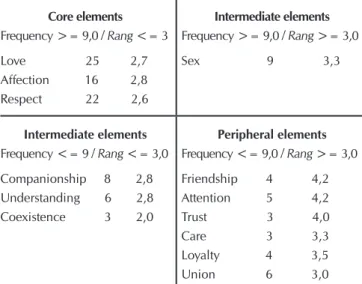
As they listened to the evocator term sexuality, the subjects evoked a total of 150 words. Of these, 43 were different and 35 were repeated. The core words that had repercussions on the analysis by the software are shown in the four-quadrant chart and discussed below. The evoked words that did not appear in the four-quadrant chart were: dedication, dialogue, communication, dignity, convivial, sincerity, joy, tolerance, understanding, partnership, health, enjoy, attraction, con-tempt, loneliness, shame, complicity, responsibility, pleasure, creativity, caresses and moral. This is justified by the low fre-quency of their evoking; they were also mentioned last, i.e., they were not promptly spoken.
The upper left quadrant in the four-quadrant chart (Figure 1) presents a likely central core of representation of sexuality for the elderly, with the following words: love, affection and respect. These words were the most frequently evoked by the elderly. The intermediate elements were recognized by the words that are displayed in the upper quadrants right and low-er left: sex, companionship, undlow-erstanding and coexistence.
Core elements
Frequency >= 9,0 / Rang <= 3
Love 25 2,7 Affection 16 2,8 Respect 22 2,6
Intermediate elements
Frequency >= 9,0 / Rang >= 3,0
Sex 9 3,3
Intermediate elements
Frequency <= 9 / Rang <= 3,0
Companionship 8 2,8 Understanding 6 2,8 Coexistence 3 2,0
Peripheral elements
Frequency <= 9,0 / Rang >= 3,0
Friendship 4 4,2 Attention 5 4,2 Trust 3 4,0 Care 3 3,3 Loyalty 4 3,5 Union 6 3,0
Figure 1 - Four-quadrant chart from analysis of evocations to the evocator term “sexuality”, Maracanaú, CE, Brazil, 2013
DISCUSSION
The core elements behave as a more stable element of rep-resentation, and may vary in nature from the peripheral ele-ments(14). Therefore, what emerges from these evocations brings
the reflection that the representation of sexuality transcends the biological and deviates from the latent idea of the sexual act as the first and only sexual experience. The terms that comprised the core showed deep relational conditions that demonstrate the priority importance in the experience of sexuality for the elderly.
it was the second lexical element in rang, promptly evoked by the elderly. The word love is expressed as important in the perception of sexuality for the elderly. The ability to feel and receive love emerged in the speech of the studied elderly for maintaining human and intimate relationships between couples(20). Also, love proposes the complicity within couples,
mutual respect and donation from partners; strengthens the relationship in a powerful way; and provides modeling of the existence of generations, giving meaning to life(3).
The word respect was evoked 22 times. Although it was not the most frequent, it was established as the most readily evoked term according to rang (2,636). Affection ranked third regarding frequency of evocations and rang. Respect and affection, also members of the supposed core elements, were considered nec-essary to strengthen coexistence, because mature love tends not to require drastic changes in the other. Warmth and empathy strengthen coexistence within the couples(18).
The idea that women conceive love, affection and respect as fundamental prior to sexual pleasure was corroborated. Thus, the women’s view of the stability of the relationship is seen through feelings that favor interaction and connection as conditions prior to being open to the sexual act. That is be-cause women generally do not separate love from sex(9).
This finding, however, does not exclude sex from these in-dividuals’ lives. The word sex, displayed in the upper right quadrant, was the only element in the first periphery. This pe-riphery has words with a high frequency of evocations. How-ever, they were not promptly spoken. This word was evoked by seven married elderly, one widowed and one single. Thus, it might be thought that sexual relations are vivid in older cou-ples, contradicting the imaginary social view that they do not have a sexually active life.
Often, sex and sexuality are understood by society as syn-onyms. Although people understand sexuality as an expression of affection and endearment, they intertwine and reposition sexuality as intercourse. In the same context, caresses and touch play key roles in the exercise of sexuality(19). Therefore,
biologi-cal, psychologibiologi-cal, social, cultural, ethibiologi-cal, religious and histori-cal aspects influence the sexual practices of each social group.
In the elderly group, desire and sexual frequency can be-come less frequent. In addition, older people tend to seek more lasting relationships, and sexual intercourse, although still as sat-isfying as in youth, is characterized by a slower excitation and a less intense orgasm. Therefore, the elderly recognize the sexual act as an emotional, real experience. Even facing significant age changes, the body still has numerous possibilities(3).
The words companionship, understanding and coexistence were found within the intermediate zone, represented by less
frequent evocations but ones that were more readily spoken. There was a positive structure in relation to the experience of sexuality by older people, since the affective dimensions (love, affection, companionship, understanding), and the be-havior dimensions (sex, respect) are associated with the con-stitution that represents these elderly. This aspect should lead to rethinking by society and health care professionals about the possibility of a broader discussion about the topic.
This thought is reinforced by elements displayed in the low-er right quadrant: friendship, attention, trust, care, loyalty and union. Although they are less frequent and less promptly spo-ken, they contribute to the amplitude of understanding of the sexuality of older people, promoting the possibility of reduc-ing the existreduc-ing stigma in the sexuality-older adult binomial.
The relationship among these words indicates the perceived need for connecting, surrendering, and accountability for one another. A study on sexuality among the elderly reveals recogni-tion of understanding, conversarecogni-tion, companionship, friendship and dialogue as ways of living sexuality, fully and satisfactorilly(20).
It is important that health professionals can take care of the elderly, considering the raised issues related to sexuality. The findings of this study are expected to contribute to the sensitiza-tion of health care professionals regarding the elderly as complex and comprehensive beings, as well as the experience of sexuality as a constituent of aging with quality, enabling care that is free of judgment and prejudice. This amplitude provides autonomy to these subjects and creates space for discussions about sexual health of the elderly and the prevention of STDs/HIV/Aids(6,21).
The small sample size reinforces the need for further re-search related to the social representations of sexuality for the elderly. We also observed a small number of scientific papers related to the subject, indicating that there is urgency for stud-ies on sexuality in older age from a larger perspective
CONCLUSION
The analyses of the obtained material enabled us to point to love, respect and affection as core elements that structure and organize the social representation of sexuality for the el-derly, as developed by the studied group, based on the So-cial Representation Theory. Sex appeared as a peripheral ele-ment with a high frequency of evocations, however it was not promptly mentioned, suggesting it was not the most important aspect for the elderly.
Aspects related to the sexuality of older adults should be better studied in the academic context, thereby encouraging professionals to reflect on the mechanisms that generate val-ues and attitudes regarding to the theme.
REFERENCES
1. Vilhena J, Novaes JV, Rosa CM. [The shadow of a body that presents itself: body image and aging]. Rev Latinoam Psicopat Fundam [Internet]. 2014 Jun [cited 2014 Dec 10];17(2):251-64. Available from: http://www.scielo.br/pdf/ rlpf/v17n2/1415-4714-rlpf-17-02-00251.pdf Portuguese.
3. Moraes KM, Vasconcelos DP, Silva ASR, Silva RCC, San-tiago LMM, Freitas CASL. [The beauty of companionship and sexuality for couples in the best age: caring for elderly couple]. Rev Bras Geriatr Gerontol [Internet]. 2011 [cited 2014 Dec 10];14(4):787-98. Available from: http://www. scielo.br/pdf/rbgg/v14n4/a18v14n4 Portuguese.
4. Cezar AK, Aires M, Paz AA. [Prevention of sexually trans-mitted diseases in the point of view of elderly clients of a Family Health Strategy]. Rev Bras Enferm [Internet]. 2012 Sep-Oct [cited 2014 Dec 10];65(5):745-50. Avail-able from: http://www.scielo.br/pdf/reben/v65n5/05.pdf Portuguese.
5. Frugoli A, Magalhães Júnior CAO. [Sexuality in third age in the perception of a female elderly group and in-dications for the enviromental education]. Arq Ciênc Saúde UNIPAR [Internet]. 2011 Jan-Apr [cited 2014 Dec 10];15(1):85-93. Available from: http://revistas.unipar.br/ saude/article/view/3696/2398 Portuguese.
6. Andrade AN, Nascimento MMP, Oliveira MMD, Queiro-ga RM, Fonseca FLA, Lacerda SNB, et al. [Elderly’s percep-tions of living groups: study in the city of Cajazeiras-PB]. Rev Bras Geriatr Gerontol [Internet]. 2014 Jan-Mar [cited 2014 Dec 10];17(1):39-48. Available from: http://www. scielo.br/pdf/rbgg/v17n1/1809-9823-rbgg-17-01-00039. pdf Portuguese.
7. Wylie KR, Wood A, McManus R. Sexuality and old age. Bundesgesundheitsblatt Gesundheitsforschung Gesund-heitsschutz [Internet]. 2013[cited 2014 Dec 10];56(2):223-230. Available from: http://link.springer.com/content/pdf/10.100 7%2Fs00103-012-1602-4.pdf
8. Alencar DL, Marques APO, Leal MCC, Vieira JCM. [Fac-tors that influence the sexuality of the elderly: an inte-grative review]. Cien Saude Colet [Internet]. 2013[cited 2014 Dec 10]; 56(2)223-230. Available from: http://www. scielo.br/pdf/csc/v19n8/1413-8123-csc-19-08-03533.pdf Portuguese.
9. Bearzotti P. [Sexuality: a freudian psychoanalytical con-cept]. Arq Neuro-Psiquiatr[Internet]. 1994 [cited 2014 Dec 10];52(1):113-7. Available from: http://www.scielo.br/pdf/ anp/v52n1/24.pdf Portuguese
10. Fernandes MGM, Garcia LG. [The aged body on the percep-tion of elderly men]. Rev Bras Enferm[Internet]. 2011 [cited 2014 Dec 10]; 64(3):472-7. Available from: http://www.sci-elo.br/pdf/reben/v64n3/v64n3a10.pdf Portuguese.
11. Maschio MBM, Balbino AP, Souza PFR, Kalinke LP. [Sex-uality in the elderly: prevention methods for STDs and AIDS]. Rev Gaúcha Enferm[Internet]. 2011 [cited 2014 Dec 10]; 32(3):583-9. Available from: http://www.scielo.
br/pdf/rgenf/v32n3/21.pdf Portuguese.
12. Rocha LF. [Social Representations Theory: the Breaking of Paradigms of the Classic Trends of the Psychological Theories]. Psicologia: ciência e profissão[Internet]. 2014 [cited 2014 Dec 10]; 34(1):46-65. Available from: http:// www.scielo.br/pdf/pcp/v34n1/v34n1a05.pdf Portuguese.
13. Moscovici S. A representação social da psicanálise. Rio de Janeiro: Zahar; 1978.
14. Sá CP. Núcleo central das representações sociais. Petrópo-lis: Vozes; 1996.
15. Machado LB, Aniceto RA. [Core and periphery of social representation cycles between learning teachers]. En-saio: aval. pol. públi. Educ. [Internet] 2010[cited 2014 Dec 10]; 18(67):345-64. Available from: http://www. scielo.br/scielo.php?script=sci_arttext&pid=S0104-40 362010000200009&lng=en&nrm=iso Portuguese.
16. Oliveira JDS, Pessoa Júnior JM, Miranda FAN, Cavalcante ES, Almeida MG. Stress of nurses in emergency care: a social representations study. Online Bras J Nurs [Internet] 2014 [cited 2014 Dec 11]; 13(2):150-7. Available from: http://www.revenf.bvs.br/pdf/objn/v13n2/v13n2a04.pdf
17. Brasil. Conselho Nacional de Saúde. Resolução Nº 466/12. Diretrizes e normas regulamentadas de pesquisa envolvendo seres humanos. Brasília, DF, 2012.
18. Nogueira MML, Brasil D, Sousa MFB, Santos RL, Dourado MC. [Sexual satisfaction in dementia]. Rev Psiq Clín. [In-ternet] 2013 [cited 2014 Dec 10]; 40(2):77-80. Available from: http://www.hcnet.usp.br/ipq/revista/vol40/n2/77.htm Portuguese.
19. Brak-Lamy G. As buscas de felicidade nos relacionamen-tos erótico-amorosos heterossexuais: uma investigação antropológica em contexto urbano noturno. Saúde Re-produtiva Sexualidade eSociedade. [Internet] 2012 [cited 2014 Dec 10];1:7-27. Available from: http://www.revistas. apf.pt/index.php/srss/article/view/16/pdf
20. Silva EM, Melo GL, Carvalho MM, Silva JC, Luz VLES. [The meaning of sexuality for the elderly aided by the fam-ily health strategy]. Revista Interdisciplinar NOVAFAPI, [Internet] 2011 [cited 2014 Dec 10]; 4(4):30-5. Available from: http://www.novafapi.com.br/sistemas/revistainter-disciplinar/v4n4/pesquisa/p5_v4n4.pdf Portuguese.