Radiol Bras. 2014 Mai/Jun;47(3):141–148 141
SUS in nuclear medicine in Brazil: analysis and comparison
of data provided by Datasus and CNEN
*
O SUS na medicina nuclear do Brasil: avaliação e comparação dos dados fornecidos pelo Datasus e CNEN
Pozzo L, Coura Filho G, Osso Júnior JA, Squair PL. SUS in nuclear medicine in Brazil: analysis and comparison of data provided by Datasus and CNEN. Radiol Bras. 2014 Mai/Jun;47(3):141–148.
Abstract
R e s u m o
Objective: To investigate the outpatient access to nuclear medicine procedures by means of the Brazilian Unified Health System (SUS), analyzing the correspondence between data provided by this system and those from Comissão Nacional de Energia Nuclear (CNEN) (National Commission of Nuclear Energy).
Materials and Methods: Data provided by Datasus regarding number of scintillation chambers, outpatient procedures performed from 2008 to 2012, administrative responsibility for such procedures, type of service providers and outsourced services were retrieved and evaluated. Also, such data were compared with those from institutions certified by CNEN.
Results: The present study demonstrated that the system still lacks maturity in terms of correct data input, particularly regarding equipment available. It was possible to list the most common procedures and check the growth of the specialty along the study period. Private centers are responsible for most of the procedures covered and reimbursed by SUS. However, many healthcare facilities are not certified by CNEN.
Conclusion: Datasus provides relevant data for analysis as done in the present study, although some issues still require attention. The present study has quantitatively depicted the Brazilian reality regarding access to nuclear medicine procedures offered by/for SUS. Keywords: SUS; Nuclear medicine; Gamma camera.
Objetivo: Investigar o acesso a procedimentos ambulatoriais de medicina nuclear por intermédio do Sistema Único de Saúde (SUS) do Brasil e analisar a correspondência dos dados fornecidos por este sistema com os da Comissão Nacional de Energia Nuclear (CNEN).
Materiais e Métodos: Foram obtidos e avaliados os dados disponíveis no Datasus quanto a quantidade de câmaras de cintilação, procedimentos ambulatoriais de 2008 a 2012, esfera administrativa responsável por estes procedimentos, tipo de prestador de servi-ços e terceirização de serviservi-ços. Também foi feita comparação com os dados de estabelecimentos autorizados pela CNEN.
Resultados: O estudo mostrou que ainda falta amadurecimento do sistema quanto à sua completa alimentação, especialmente no campo de equipamentos disponíveis. Foi possível elencar os procedimentos mais realizados e verificar o crescimento da especialidade no período estudado. Estabelecimentos privados são responsáveis pela maior parte dos procedimentos cobertos pelo SUS. Entretanto, muitos estabelecimentos de saúde não são autorizados pela CNEN.
Conclusão: O Datasus oferece dados importantes para uma análise como a feita neste estudo, embora alguns pontos ainda deman-dem atenção. O trabalho mostrou, quantitativamente, a realidade brasileira quanto ao acesso a procedimentos de medicina nuclear oferecidos pelo/para o SUS.
Unitermos: SUS; Medicina nuclear; Câmara de cintilação.
* Study developed at Instituto de Pesquisas Energéticas e Nucleares (IPEN/CNEN-SP), São Paulo, SP, Brazil.
1. PhD, Researcher at the Radiopharmacy Center of Instituto de Pesquisas Ener-géticas e Nucleares (IPEN/CNEN-SP), São Paulo, SP, Brazil.
2. Specialization in Nuclear and Legal Medicine, MD, Physician I at Instituto do Câncer do Estado de São Paulo Octavio Frias de Oliveira (Icesp), São Paulo, SP, Brazil.
3. PhD, Manager – Management of Research and Development, Radiopharmacy Center of Instituto de Pesquisas Energéticas e Nucleares (IPEN/CNEN-SP), São Paulo, SP, Brazil.
4. Master, Technologist at Radiopharmacy Center of Instituto de Pesquisas Ener-géticas e Nucleares (IPEN/CNEN-SP), São Paulo, SP, Brazil.
is based on access universality, equity and integral care(1). The system is understood as being a single system as it fol-lows the same fundamentals and organizational principles throughout the entire Brazilian territory under the responsi-bility of autonomous government spheres at federal, State and municipal levels. It comprises units, services and actions with a common purpose.
The SUS follows principles of regionalization and hierarchization, i.e., the services must be organized at cres-cent levels of technological complexity, within a delimited geographic area, and with the definition of the targeted
popu-Lorena Pozzo1, George Coura Filho2, João Alberto Osso Júnior3, Peterson Lima Squair4
Mailing Address: Dra. Lorena Pozzo. Rua Cotoxó, 424, ap. 83, Vila Pompéia. São Paulo, SP, Brazil, 05021-000. E-mail: [email protected].
Received September 4, 2013. Accepted after revision January 10, 2014.
INTRODUCTION
lation. It also follows the principles of resolubility, decen-tralization, citizens’ participation and complementarity with the private sector. As regards the latter, the Brazilian Con-stitution defines that the private sector can become a part of SUS, as agreed and contracted, provided that SUS rules and regulations are followed by such entities. Additionally, among the private services, preference must be given to philanthropic and nonprofit entities. It is important to re-member that according to Law No. 8.080 dated 1990, Chap-ter 2, Article26, Paragraph 4 establishes that “owners, man-agers and directors of contracted services are forbidden to serve in leadership or commissioned positions at SUS”.
In order to meet the above mentioned principles, for the decentralization of healthcare activities and feasibility of social control on the utilization of available resources, the Informatics on Health Department – Datasus was created. In 2011 it became a part of the Secretary of Strategic and Participative Management of the Health Ministry.
The Outpatient Data System of Datasus (SIA/SUS) is a computer system whose forms are mandatorily filled out and input by all managers with public or private services under their responsibility. The SIA/SUS comprises data on the number of outpatient procedures that were performed un-der SUS coverage, either at the public or at the private net-work. The outpatient procedures are structured into groups, subgroups and organization levels. In their processing, other databanks are utilized such as the case of the National Reg-ister of Health Services (CNES), besides the SIA/SUS Pro-cedures Table(2).
The data from CNES, created by the Ordinance MS/ SAS 376, dated October 3, 2000, comprise the knowledge on the health services with information such as physical area, human resources, equipment, hospital and outpatient ser-vices. It covers all hospitals in the country, as well as all outpatient services either connected or not connected with SUS. The CNES is one of the databases utilized by the SIA and by the Hospital Data System (SIH), and the responsi-bility for including services by means of the Health Service Registration Form (FCES), data updating and maintenance lies with the State or municipal managers. It is even pos-sible to investigate the number of connections of an indi-vidual health professional with SUS-accredited health ser-vices.
Nuclear medicine
Nuclear medicine is a medical specialty whose main characteristic is the utilization of unsealed ionizing radiation sources. Those must be linked to molecules of biological interest, composing substances called radiopharmaceuticals which are administered to patients for diagnostic or thera-peutic purposes. If the utilized radionuclide is an emitter of electromagnetic radiation (gamma) or positrons, it is pos-sible to map the distribution of the material within the patient’s body with an external detector called gamma cam-era or a positron emission tomography (PET) apparatus. If
the utilized radionuclide is a beta particle emitter, such as
131
I, it is possible to perform specific therapies for many types of tumors. In some cases it is also possible do detect the braking radiation of such particles in order to compose an image acquired with a gamma camera for therapy follow-up, for example. A multi- and interdisciplinary team includ-ing physicians, technologists or biomedical technicians, medical physicists, radiopharmacists and a nursing team trained for working with unsealed radiation sources is re-quired for the application of such a technique.
Nuclear medicine procedures, as well as magnetic reso-nance imaging and x-ray computed tomography, are classi-fied by SUS as high-complexity procedures, i.e, procedures involving high technology and high costs. The unified table of procedures comprises only 50 outpatient procedures based on the utilization of 99m
Tc and primary radioisotopes (131
I,
67
Ga, 201
Tl) sources. However, the specialty currently uti-lizes positron emitters with very short half-lives, such as 18
F, besides particle emitting radioisotopes such as 177
Lu for therapeutic purposes, which are not yet contemplated by SUS1
. The utilization of [18
F]FDG for some types of dis-eases within SUS is under public consultation as the present article is being reviewed. Thus, nuclear medicine practiced within SUS is quite more restricted than that practiced in the complementary healthcare network or even at private institutions. Table 1 shows a list of the radiopharmaceuticals produced by Instituto de Pesquisas Energéticas e Nucleares (IPEN/CNEN-SP) and respective applications. IPEN is a State institution responsible for the implementation and dis-semination of nuclear medicine in the country, as it devel-oped and has been producing the main products utilized by the specialty since 1959(3,4). The last column shows the prod-ucts currently utilized in procedures supported by SUS. It is important to highlight that there are procedures supported by SUS which are rarely or never performed, such as pan-creatic scintigraphy and determination of red blood cell sur-vival time (with radioisotopes).
The present study is aimed at mapping the access to SUS by those patients who require outpatient nuclear medicine high-complexity diagnostic procedures throughout the en-tire national territory and by regions. The authors aimed at analyzing most of the available data in order to depict a more complete scenario of the specialty. Then, data regarding number of specific apparatuses (gamma cameras), outsourcing of procedures and most performed procedures, for example, were analyzed. The hospital procedures which require hos-pital admission were not analyzed, as a different investiga-tion method would be required.
Considering that radiopharmaceuticals are utilized in nuclear medicine procedures, the institutions that perform such procedures must be licensed by Comissão Nacional de Energia
1 The Federal Government Science, Technology and Strategic Inputs
Nuclear (CNEN). Thus, the present study also aimed at veri-fying the correspondence between data obtained from Datasus and those made available by CNEN (www.cnen.gov.br).
MATERIALS AND METHODS
Data on the number of existing gamma cameras were obtained at CNESnet(5). The investigation was carried out by State, for all municipalities within field 1– Imaging di-agnosis apparatuses, code 01 – gamma cameras. The search returns the CNES number, the name of the health service, the city where it is located and the number of apparatuses in operation.
The number of outpatient procedures carried out and approved by SUS in the period of January through Decem-ber 2008 was evaluated and after that, the same evaluation was made for 2009, 2010, 2011 and 2012 per State and per
region. An investigation on the administrative instances (pri-vate, federal, State or municipal) responsible for such pro-cedures was also carried out. Also, the distribution of such procedures was also investigated with respect to type of ser-vice provider: federal institution, State institution, munici-pal institution, private for-profit organization, for-profit ser-vices operating under SIMPLES tax regime, non-profit pri-vate services, philanthropic service with valid CNES regis-tration.
A search was made on code 151 nuclear medicine spe-cialized service offered by several centers either SUS or outsourced. The search was made for outpatient in vivo
nuclear medicine procedures, per State, and subsequently grouped for the entire country. Thus, it was possible to com-pare such result on a State by State basis, with the list of authorized CNEN services (<www.cnen.gov.br>, March Table 1—Products made by IPEN/CNEN-SP, their applications and coverage by SUS*.
* Modified from https://www.ipen.br/conteudo/upload/201009101032310.ipen_produtos_servicos_082010.doc. Name of the group / product
Technetium generator-99mTc
Sodium iodide-131I
Sodium iodide-131I capsule
Sodium iodide-123I
Thallium chloride-201Tl
Sodium chromate-51Cr
Gallium citrate-67Ga 131I-MIBG 123I-MIBG 131I-SAH
Hippuran-131I
Lipiodol-131I
EDTA-51Cr
Human serum albumin-51Cr
EDTMP-153Sm
Hydroxypatite-153Sm
FDG-18F
111In DTPA octreotate
Hydroxypatite-90Y 177Lu DOTA octreotate
GHA HSA Dextran 500 Dextran 70 Disida DMSA DTPA EC ECD Colloidal tin Sodium phytate MAA MDP
Sodium pyrophosphate SAH
MIBI
Application
Labeling of lyophilized kits and tests; activities 250 mCi, 500 mCi, 750 mCi, 1000 mCi, 1250 mCi, 1500 mCi and 2000 mCi
Thyroid function study
Treatment of thyroid cancer and hyperthyroidism Thyroid function study
Stress and rest cardiac imaging to assess cardiac muscle injury extent. Labeling of erythrocytes. Splenic gammagraphy
Localization of tumors in soft tissue and inflammatory lesions Pheochromocytomas and neuroblastomas scintigraphy
Scintigraphy of suprarenal tumors and pheochromocytomas-neuroblastomas Determination of plasma and blood volume
Renal function study Hepatomas therapy
Glomerular filtration rate determination Gastrointestinal protein loss study
Relief of pain caused by bone metastases. Therapeutic dose from 70 to 100 mCi Rheumatoid arthritis treatment
Diagnosis of cardiac function, breast cancer, lymphoma and lung cancer
Study of neuroendocrine tumors and other types of cancer such as lymphoma, kidney, lung, brain and breast Treatment of rheumatoid arthritis
Treatment of neuroendocrine tumors and other types of cancer such as lymphoma, kidney, lung, brain and breast Renal and brain scintigraphy
Blood flow studies and placental scintigraphy Lymphatic system study
Lymphatic system study Hepatobiliary scintigraphy Renal scintigraphy Renal and brain scintigraphy Renal function study Cerebral perfusion study Hepatosplenic scintigraphy Hepatic scintigraphy Lung scintigraphy Bone scintigraphy
Bone scintigraphy, diagnosis of acute myocardial infarction, in vivo labeling of red blood cell Cardiac blood pooling and ventriculography
Evaluation of myocardial perfusion and detection of breast and parathyroid tumors
SUS
Yes
2013). Such services are licensed for operations and can cur-rently purchase radiopharmaceuticals for nuclear medicine.
RESULTS
According to the investigation regarding apparatuses, there would be 875 gamma cameras in Brazil, 834 of those currently in operation. Such a figure does not match reality, as a finer analysis shows that only 49.7% of the apparatuses currently in utilization (415) are located at nuclear medi-cine services. The other 50.3% are located, according to Datasus, at dental or radiology clinics which do not perform nuclear medicine procedures. Such an analysis is possible as Datasus provides access to data regarding each one of the listed health services. Among the entities that operate their own nuclear medicine service, and therefore certainly have gamma cameras, 74.2% are private while only 6.3% are public.
In 2012, 392,264 outpatient nuclear medicine proce-dures were performed by SUS. Amongst the 50 types of pro-cedures covered by SUS, 7 correspond to 92.1% of the per-formed procedures, as follows: rest-stress myocardial tigraphy (a minimum of three views), whole-body bone scin-tigraphy either with or without blood flow images, renal scintigraphy/renography (qualitative and/or quantitative), renal dynamic study with or without diuretics, thyroid scin-tigraphy with or without uptake, whole-body scinscin-tigraphy. Figure 1 shows the regional distribution of such procedures throughout the national territory. There is a noticeable con-centration in the most developed and more densely popu-lated Southeastern region, followed by the Northeastern and Southern regions. Although the Southern region is in the third position in absolute figures, its procedures/1,000 in-habitants ratio is higher than that of the Northeastern region. In the investigated period, from 2008 to 2012, the num-ber of outpatient procedures performed by SUS increased by 26.5%. However such a growth was not uniform, with 48.0% in the Northern region, 40% in the Mid-western re-gion, and with the Southeastern region demonstrating the lowest growth (21.4%). The growth was not constant either along those years. Between 2009 and 2010, a growth of 8.2% was observed, and between 2010 and 2011 it was 9.3%. It is interesting to observe that between 2008 and 2009 the growth was 1.4%, despite the worldwide shortage of 99
Mo/99m
Tc generators, the main radioactive diagnostic agent utilized in nuclear medicine.
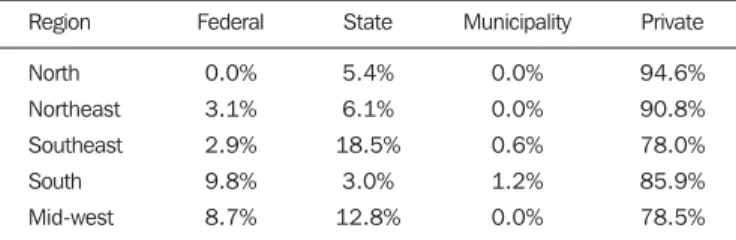
Amongst all nuclear medicine outpatient procedures sup-ported by SUS, 82% were performed at private institutions (Figure 2). Such a distribution is similar to the distribution of other high complexity imaging diagnosis procedures, such as magnetic resonance imaging and x-ray computed tomog-raphy. However in those two specific cases, according to the data from Datasus, private services are responsible for 74.0% and 54.0% of the procedures, respectively. Table 2 shows that private services are responsible for practically all the procedures performed in the Northern region, closely
fol-Figure 1. Regional distribution of the seven nuclear medicine procedures most performed by SUS and procedures/1,000 inhabitants ratio.
Figure 2. National outpatient procedures production by SUS per administrative instance in 2012.
diagnostic procedures for SUS, is accountable for such a value. In the States of Mato Grosso, Mato Grosso do Sul and Goiás, such procedures are exclusively performed by private services.
The private services are divided into: for profit private services; for profit private services operating under SIMPLES regime; non-profit private services; philanthropic services with a valid CNES. According to Table 3, there is a great variation among the regions as regards types of services pro-viders responsible for such diagnostic procedures. In the Mid-western region, practically all the patients requiring diag-nostic procedures (93.8%) are referred to for profit private services, followed by the Northern region (77.4%). The
Southeastern region is the region that gets closer to the in-tent to prioritize non-profit services. The Southern and North-eastern regions present a more balanced division between for profit and non-profit services.
As the contribution of the different types of services pro-viders between 2008 and 2012 is analyzed, it is observed that the only modality that consistently grew was that of private for profit services (Figure 3). The contribution of private non-profit services in 2012 should be highlighted. Rio Grande do Sul and São Paulo are the main contributors to such an increase: in 2011 there were respectively 126 and 2,491 pro-cedures performed by services in those States, and in 2012 there were 7,611 and 66,413 procedures, characterizing approximately a 60-fold and a 26-fold increase, respectively. According to the CNES databank, there are 776 services performing specialized in vivo nuclear medicine procedures,
79.3% private and 20.7% public belonging to one of the three levels of the public sector, with a predominance of federal and State levels, primarily in more developed States such as São Paulo. The private entities have their own services in 70.0% of the cases. The others utilize outsourced services. The situation is the opposite in the case of public entities: less than 30% of them have their own services, and more Table 2—Outpatient procedures production at SUS per region and per
adminis-trative level in 2012.
Region
North Northeast Southeast South Mid-west
Federal
0.0% 3.1% 2.9% 9.8% 8.7%
State
5.4% 6.1% 18.5%
3.0% 12.8%
Municipality
0.0% 0.0% 0.6% 1.2% 0.0%
Private
94.6% 90.8% 78.0% 85.9% 78.5%
Table 3—Outpatient procedures production at SUS per region and per type of service in 2012.
Region
North Northeast Southeast South Mid-west
For profit private services Individual/Legal entity
77.4% 54.2% 25.1% 59.6% 93.8%
For profit private service under SIMPLES regime
0.0% 0.6% 0.6% 0.5% 0.0%
Private non-profit service
22.6% 26.0% 42.1% 19.0% 2.1%
Philantropic service with valid CNES
0.0% 19.2% 32.2% 20.8% 4.2%
than 70.0% of the nuclear medicine procedures are performed by outsourced private services (Table 4). In total, 61.3% of the offered services are provided by themselves, while 38.0% are outsourced.
Table 4—Services that provide nuclear medicine procedures with in-house or outsourced resources. Private services Public services Total 615 161 776 In-house services 433 (70.4%) 43 (26.7%) 476 Outsourced services 177 (28.8%) 118 (73.3%) 295
Table 5—In-house nuclear medicine services and services authorized by CNEN per State and region.
State and region
Rondônia Acre Amazonas Roraima Pará Amapá Tocantins North Maranhão Piauí Ceará
Rio Grande do Norte Paraíba Pernambuco Alagoas Sergipe Bahia Northeast Minas Gerais Espírito Santo Rio de Janeiro São Paulo
Southeast
Paraná Santa Catarina Rio Grande do Sul
South
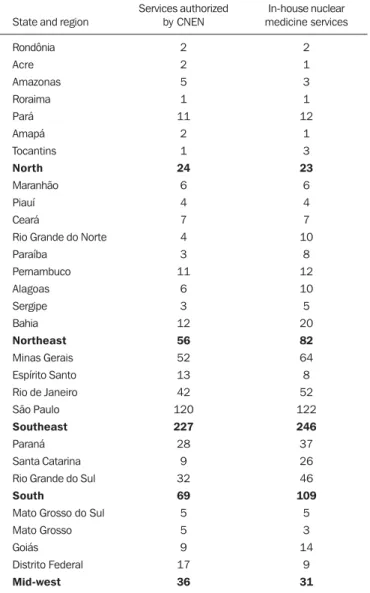
Mato Grosso do Sul Mato Grosso Goiás Distrito Federal Mid-west Services authorized by CNEN 2 2 5 1 11 2 1 24 6 4 7 4 3 11 6 3 12 56 52 13 42 120 227 28 9 32 69 5 5 9 17 36 In-house nuclear medicine services 2 1 3 1 12 1 3 23 6 4 7 10 8 12 10 5 20 82 64 8 52 122 246 37 26 46 109 5 3 14 9 31 As the number of entities offering their own nuclear
medicine services with the list of services accredited by CNEN, one observes a discrepancy of 13.4%, i.e., 64 out of the 476 private services that perform outpatient procedures paid by SUS are not authorized by CNEN to receive radio-active materials and, therefore, could not provide diagnos-tic nuclear medicine services.
Table 5 shows the situation per State and per region. The CNEN authorization is given to services to purchase half-life radioactive materials for studies such as in vivo99mTc imaging, for therapies utilizing 153
Sm, for example, and for positron emitters (PET) imaging, the latter not being sup-ported by SUS. Thus, sometimes, in some States, the num-ber of services authorized by CNEN can be higher than that listed by Datasus. However, the cases where the opposite occurs – a number of services authorized by CNEN smaller than that listed by SUS –, deserve attention. Such is the case in the Northeastern, Southeastern and Southern regions, led by the latter. Santa Catarina is the State with the highest number of services not authorized by CNEN, in spite of being listed by SUS, with 17 services, followed by Rio Grande do Sul with 14, and by Minas Gerais with 12 services.
Datasus does not provide fields to be filled out neither with the name of the technical manager nor the name of the radiological protection supervisor. The presence of those two professionals is mandatory as per the CNEN – NN 3.05 Regulation(6).
DISCUSSION
Although the filling-out of the SUS forms is mandatory for acknowledgement and payment of the procedures per-formed by the public network and by the partnering private network, not all fields are filled-out with reliable informa-tion. Such is the case of the information on number of gamma cameras that is important to depict the current scenario with reliable prospects on the reality of nuclear medicine proce-dures available to the Brazilian population by means of SUS. Such information was previously utilized by Freitas et al.(7) for the State of São Paulo. However the limitations found by the present study had not been identified. The present study demonstrates that it is possible to generate estimates based on other data provided by CNES. According to a market investigation carried out in 2009 by BizAcumen(8), in 2010
there were approximately 1,850 gamma cameras in The United States of America, a number 4.5 times the estimated number for Brazil in 2012. A way to verify such values would be comparing them with those at the CNEN database, since the installation and use of nuclear medicine imaging equip-ment must be notified to CNEN by the health service.
in-creases in determined States such as Mato Grosso do Sul, where all nuclear medicine diagnostic procedures are car-ried out at private services. As the partnering private network is not obliged to meet the entire demand from SUS, part of the population may not receive care, for the benefit of the privately supported patients. Thus, the offering of nuclear medicine procedures performed by public services should be increased, starting by the States where the private services perform higher percentages of the procedures.
Despite the great number of procedures performed at philanthropic services, there is no consistence in their growth over the years. In 2012, that number was considerably re-duced, while the number of procedures performed at non-profit private organizations, which were decreasing since 2009, actually presented a noticeable increase in that period. Such a fact should be further studied in other instances.
Cardiac perfusion scintigraphy is the main performed procedure, corresponding to 54% of the total. It is expected that almost all such procedures be performed by means of single photon emission computed tomography (SPECT), although SUS pays the same value both for tomographic and planar procedures. Such a difference, which leads to differ-ent diagnostic quality, cannot be verified by data supplied by Datasus. Bone scintigraphy corresponds to 25% of all procedures. A great part of such studies must be based on whole-body scans and not only on planar acquisitions. Such data cannot be retrieved from Datasus either. It is important to highlight that patients submitted to those two procedures benefit considerably when the procedures are performed in hybrid SPECT/CT apparatuses. With those apparatuses, it is possible to simultaneously obtain functional data provided by nuclear medicine, and anatomical data provided by CT, so the approach to be adopted and the total cost of the treat-ment could be optimized. The simultaneous acquisition of functional and anatomical data is not covered by SUS. That is an important point to be evaluated as one considers a unified public system, but that is not yet a reality for SUS. One should also consider the aging of the population, leading to ever increasing number of cases of heart disease and cancer in general. There is an ever increasing need for reviewing the utilization of SUS’s resources, considering that the early diagnosis of such and other diseases could be done by means of the nuclear medicine technology, particularly by means of hybrid SPECT/CT and PET/CT equipment.
The present study was not aimed at investigating the uti-lization of PET or PET/CT, as there are no available data at Datasus on the utilization of such methods. But, although SUS does not cover PET procedures and hybrid PET/CT methods either yet, they should be promptly considered in the context of the increasing demand for oncology services as previously discussed.
Currently, Brazil utilizes approximately 450 Ci of 99m
Tc per week that come from 99
Mo/99m
Tc generators supplied by IPEN/CNEN-SP. Brazil does not produce the required
99
Mo and imports such material from Argentina, South
Af-rica and Canada. However there is an ongoing effort applied on the project of building the Brazilian Multipurpose Reac-tor (RMB)(9). Such a reactor will produce 1,000 Ci of 99
Mo per week. The Brazilian Ministry of Science, Technology and Innovation estimates a considerable development of nuclear medicine in the country. Such investment may be increased by joint efforts with the Ministry of Health towards stimulating the growth of the specialty in the public network, as the private sector demonstrates to be very efficient in meet-ing its own demand as well as part of the demand from SUS, as demonstrated by the present study.
The discrepancy between the number of nuclear medi-cine services enrolled at SUS and those accredited and li-censed by CNEN indicates the need for placing efforts to unify the data. It is very important to remind that the CNEN’s authorization is based upon principles of radiological pro-tection which must be in force at the enrolled institutions, in order to guarantee the safe utilization of unsealed radia-tion sources in nuclear medicine. Thus, it would be inter-esting that institutions enrolled at SUS only receive the pay-ment for their services provided that they are authorized by CNEN to utilize radioactive materials in the specified quan-tities. Also, it is important that the mandatory SUS forms include fields to be filled out with the name of the profes-sional in charge of radiological protection supervision at the institution and with the function of responsible technical manager.
Finally, it is important to highlight that the inclusion of a given clinic or nuclear medicine service in the list of institutions authorized by CNEN depends upon the initia-tive of the managers of such clinics or services. CNEN is accountable for the licensing and enforcement of its stan-dards. The input of data to Datasus is done by the health managers at municipal, State and federal levels. Such man-agers are responsible for the accuracy in the presentation of those data. For that reason, a modification must be directly made in the forms in order to mandatorily reflect the data contained in the CNEN lists.
CONCLUSION
Datasus provides a wealth of information for investiga-tions on the reality of nuclear medicine in Brazil. However it is still necessary to include some fields to be filled out, such as the case of the name of radiological protection su-pervisor. The present study strongly indicates the need for integration with the CNEN database.
The present study has quantitatively demonstrated the reality that the nuclear medicine practiced by/for SUS actu-ally occurs in the private sphere, but in an even greater pro-portion than imaging diagnosis procedures of equal com-plexity. Additionally it has also indicated points requiring further investigations as the type of service providers. Also it has also included a geographical mapping of smaller or greater necessities in terms of development of the specialty in the public sector, depending on the State.
REFERENCES
1. Brasil. Ministério da Saúde. Secretaria Nacional de Assistência à Saúde. ABC do SUS – Doutrinas e princípios. [acessado em 11 de março de 2013]. Disponível em: http://biblioteca.planejamento.gov.br/biblio- teca-tematica-1/textos/saude-epidemias-xcampanhas-dados-desco-bertas/texto-17-abc-do-sus-doutrinas-e-principios.pdf.
2. Brasil. Ministério da Saúde. Conselho Nacional de Secretários de Saúde. Assistência de média e alta complexidade no SUS. Coleção Progestores – Para entender a gestão do SUS. [acessado em 20 de fevereiro de 2013]. Disponível em: http://bvsms.saude.gov.br/bvs/ publicacoes/colec_progestores_livro9.pdf
3. Instituto de Pesquisas Energéticas e Nucleares. Centro de Radiofar-mácia – Quem somos. [acessado em 10 de março de 2013]. Disponí-vel em: https://www.ipen.br/sitio/?idm=113.
4. GordonAMPL. Instituto de Pesquisas Energéticas e Nucleares – (1956-2000): um estudo de caso à luz da história da ciência, da tec-nologia e da cultura brasileira. [Tese de doutorado]. São Paulo, SP: Universidade de São Paulo. [acessado em 1º de dezembro de 2010]. Disponível em: http://www.ipen.br/biblioteca/teses/11602.pdf. 5. Brasil. Ministério da Saúde. CNESNet. Cadastro Nacional de
Esta-belecimentos de Saúde. [acessado em 20 de fevereiro de 2013]. Dis-ponível em: http://cnes.datasus.gov.br/.
6. Brasil. Ministério da Ciência, Tecnologia e Inovação. Comissão Na-cional de Energia Nuclear. CNEN NN 3.05 – Requisitos de radio-proteção e segurança para serviços de medicina nuclear. [acessado em 10 de março de 2013]. Disponível em: http://www.cnen.gov.br/ seguranca/normas/pdf/Nrm305.pdf.
7. Freitas MB, Yoshimura EM. Levantamento da distribuição de equi-pamentos de diagnóstico por imagem e da frequência de exames ra-diológicos no Estado de São Paulo. Radiol Bras. 2005;38:347–54. 8. ReportLinker. Nuclear medicine – A global update of market trends – opportunities. BizAcumen.2009. PR Newswire Association LLC, New York, USA. [acessado em 11 de março de 2013]. Disponível em: http://www.reportlinker.com/p0164233/Nuclear-Medicine—A-Global-Update-of-Market-Trends—Opportunities.html.