Fonseca JM et al. / Cloverleaf skull syndrome: case report
Radiol Bras. 2014 Mai/Jun;47(3):189–190 189
0100-3984 © Colégio Brasileiro de Radiologia e Diagnóstico por Imagem
Case Report
Cloverleaf skull syndrome: case report
*
Síndrome do crânio em folha de trevo: relato de caso
Fonseca JM, Borém LMA. Cloverleaf skull syndrome: case report. Radiol Bras. 2014 Mai/Jun;47(3):189–190.
Abstract
R e s u m o
The present report is aimed at describing a rare case of cranial malformation – cloverleaf skull syndrome –, whose presence was noticed after the birth of a child with signs of abnormality. Imaging diagnosis methods such as computed tomography and conventional radiography were used to characterize the syndrome.
Keywords: Syndrome; Malformation; Computed tomography.
O objetivo deste relato é apresentar um caso raro de malformação craniana – a síndrome do crânio em folha de trevo –, cuja caracte-rística foi percebida após o nascimento de uma criança com os sinais da anomalia. Métodos de diagnóstico por imagem, como tomo-grafia computadorizada e radiotomo-grafia convencional, foram utilizados para a caracterização da síndrome.
Unitermos: Síndrome; Malformação; Tomografia computadorizada.
* Study developed at Hospital Santa Casa de Montes Claros, Montes Claros, MG, Brazil.
1. Biomedicine Post-graduate, Technical Coordinator, Imaging Division of Funda-ção Dilson Godinho, Montes Claros, MG, Brazil.
2. Master, Fellow PhD degree, MD, Radiologist at Hospital Santa Casa de Montes Claros, Montes Claros, MG, Brazil.
Mailing Address: Junio Marcos Fonseca. Rua Guiana Francesa, 200, Bairro João Alves. Montes Claros, MG, Brazil, 39402-307. E-mail: [email protected].
Received January 28, 2013. Accepted after revision August 12, 2013.
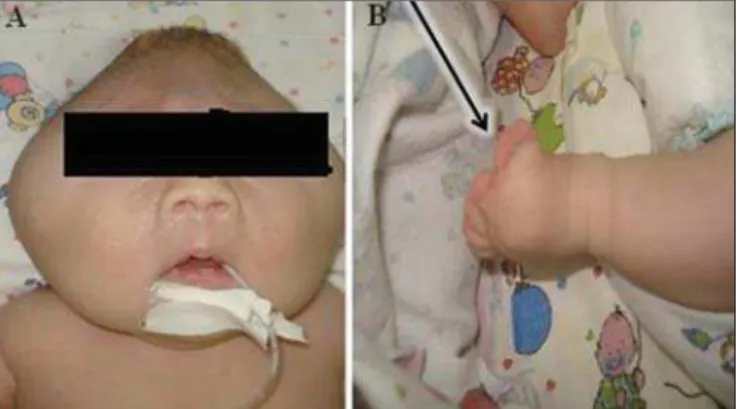
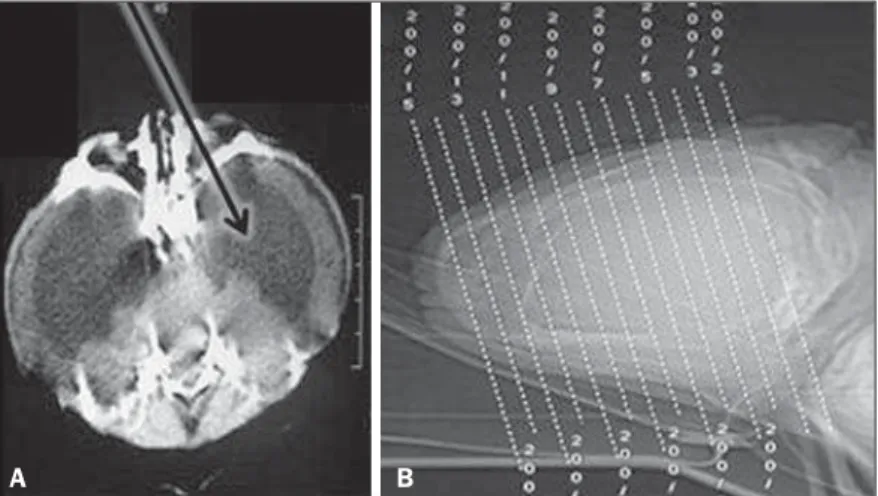
fifth minute of life, respectively. At physical examination multiple malformations were observed, with altered cranio-facial configuration, low ear implantation, hypertelorism, exophthalmos, omphalocele and polydactyly (Figure 1). Chest radiography demonstrated dextrocardia (Figure 2), and computed tomography demonstrated abnormal configuration of the calvaria, with the typical trilobed “cloverleaf” aspect, bulging of the middle cranial fossae and dilatation of the ventricular system. Signs of closure of sagittal, coronal and lambdoid sutures were also observed (Figure 3). The pa-tient presented cardiorespiratory arrest episodes, progress-ing to death on January 7, 2011.
DISCUSSION
Cloverleaf skull syndrome is a rare presentation of cran-iosynostosis with clinical features consisting in trilobed skull, exophthalmos, low ear implantation and upper airway. Hy-drocephalus is also a common finding, despite the multifac-torial nature of such an abnormality(4).
It is a congenital anomaly that may be present as an iso-lated defect, but generally is classified as dysostotic syn-Junio Marcos Fonseca1, Luciana Mendes Araújo Borém2
INTRODUCTION
Cloverleaf skull syndrome is an abnormal configuration of the calvaria classified as craniosynostosis, consisting of pre-mature ossification of cranial sutures. It is a deformity char-acterized by a remarkable enlargement of the head, with a trilobed configuration of the frontal view, resembling a three-leaved clover(1). This abnormality occurs as a result from a
severe alteration in the development of the skull, with prema-ture synostosis of some cranial suprema-tures(1), most commonly the
coronal and lambdoid sutures(2), in association with
hydro-cephalus, leading to a marked bulging of the head in the region of the anterior fontanel and laterally in the temporal regions, with the typical appearance of a “cloverleaf”(1).
Syndromic and nonsyndromic presentations have been reported. Because of the anomalies both in the calvaria and in the skull base and face, this is one of the craniosynostoses currently requiring the most complex multidisciplinary approach(1).
The first report about such a syndrome in the literature occurred in 1973 and, over the years only some tens of cases have been documented worldwide(3). The present report describes a case of a severe craniofacial condition that is known as “cloverleaf skull syndrome”.
CASE REPORT
A female patient born from Cesarean section on January 4, 2011, weighting 3,815 g and Apgar 7 and 8 at the first and
Figure 1.A: Demonstration of typical craniofacial alterations. B: Syndactyly (arrow).
Fonseca JM et al. / Cloverleaf skull syndrome: case report
Radiol Bras. 2014 Mai/Jun;47(3):189–190 190
dromes such as achondroplasia, craniofacial dysostosis (Crouzon syndrome), Apert or Pfeiffer syndromes(2). Until 1981, only 30 cases had been published in the literature, the first of them in 1973, in the ophthalmic literature(3).
The precise etiopathogenesis of this syndrome is still to be completely known(3), with theories involving altered membranous-osseous and/or endochondral ossification, gen-eralized chondrodysplastic process(2), and a possible
vascu-lar origin associated with the abnormal osteoclastic resorp-tion(5). Recently, genetic investigations have contributed to advances in the understanding of the molecular basis of some craniosynostosis syndromes, highlighting mutations in the genes FGFR1, FGFR2, FGFR3, TWIST and MSX2(6).
The diagnosis of such a syndrome can be made in the prenatal period by means of ultrasonography, which detects the altered cranial morphology and hydrocephalus. Tradi-tionally, the diagnosis occurs during routine prenatal follow-up at the second gestational trimester. However, with the increasing use of obstetric ultrasonography at the first ges-tational trimester, such alterations may be detected increas-ingly earlier over the gestation(7).
After birth, as an abnormal configuration of the calva-ria is detected, a radiological evaluation is required to char-acterize the deformity and guide the corrective surgical pro-cedure. There is a significant improvement in the prognosis of affected children in cases where the diagnosis and the sur-gical intervention occur as early as possible. Computed to-mography with three-dimensional reconstruction contributes to the assessment of craniofacial bone deformities and asso-ciated intracranial alterations, demonstrating to be a useful tool to define the prognosis and for the surgical planning(8).
The present case was not classified into any specific syn-drome category, and the cardiorespiratory instability hindered
the attempts of surgical intervention. The early death of the infant demonstrates how the association with malformations may worsen the prognosis of this condition.
Despite the unfavorable outcome of many cases, advances in surgical, anesthetic and intensive care techniques have transformed a condition previously considered untreatable into a potentially treatable condition, with acceptable neu-rological and aesthetic results(2).
The relevance of the imaging diagnosis and character-ization of this syndrome, particularly in the prenatal period, is highlighted in order to allow for the planning and institu-tion of the treatment as earlier as possible.
REFERENCES
1. Iannaccone G, Gerlini G. The so-called “cloverleaf skull syndrome”. A report of three cases with a discussion of its relationships with thanatophoric dwarfism and the craniostenoses. Pediat Radiol. 1974;2:175–84.
2. Manjila S, Chim H, Eisele S, et al. History of the Kleeblattschädel deformity: origin of concepts and evolution of management in the past 50 years. Neurosurg Focus. 2010;29:E7.
3. Ghose S, Mehta U. The Kleeblattschadel (cloverleaf skull) syndrome. Indian J Ophthalmol. 1986;34:61–6.
4. Ito S, Matsui K, Ohsaki E, et al. A cloverleaf skull syndrome prob-ably of Beare-Stevenson type associated with Chiari malformation. Brain Dev. 1996;18:307–11.
5. Dambrain R, Freund M, Verellen G, et al. Considerations about the cloverleaf skull. J Craniofac Genet Dev Biol. 1987;7:387–401. 6. Arduino-Meirelles AP, Lacerda CBF, Gil-da-Silva-Lopes VL. Aspectos
sobre desenvolvimento de linguagem oral em craniossinostoses sin-drômicas. Pró-Fono. 2006;18:213–20.
7. Chitty LS, Khalil A, Barrett AN, et al. Safe, accurate, prenatal diag-nosis of thanatophoric dysplasia using ultrasound and free fetal DNA. Prenatal Diagn. 2013;33:416–23.
8. Trad CS, Rosique RG. Craniossinostoses primárias: ensaio icono-gráfico. Radiol Bras. 2005;38:377–80.
Figure 3.A: Trilobed aspect of the skull, with hydrocephalus and bulging of the middle fossae (arrow). B: Scout demonstrating a marked enlargement of the skull in the region of the anterior fontanel.
A B