Cecília Helena de Siqueira Sigaud
I, Bruna Rodrigues dos Santos
II,
Priscila Costa
I, Aurea Tamami Minagawa Toriyama
II Universidade de São Paulo, School of Nursing. São Paulo, Brazil.
II Universidade de São Paulo, School of Nursing, Postgraduate Program in Primary Care and Family Health. São Paulo, Brazil.
How to cite this article:
Sigaud CHS, Santos BR, Costa P, Toriyama ATM. Promoting oral care in the preschool child: effects of a playful learning intervention. Rev Bras Enferm [Internet]. 2017;70(3):519-25. DOI: http://dx.doi.org/10.1590/0034-7167-2016-0237
Submission: 05-25-2016 Approval: 11-13-2016
BSTRACT
Objective: To compare the number of appropriate behaviors for tooth brushing before and after a playful learning intervention with preschool children. Method: A quasi-experimental, quantitative, before and after study design was conducted in an early childhood educational institution, with children between three and i ve years of age. The intervention consisted of three meetings with educational activities about tooth brushing, whose outcome was evaluated by means of observation of ten behaviors suitable for tooth brushing. Results: Forty-four children participated in the study. The mean of adequate behaviors was 4.4 before the intervention, and 8.5 after the intervention. A signii cant increase in the adoption of appropriate behaviors for tooth brushing (p <0.01) was identii ed. Conclusion: Nurses can enhance oral health promotion actions with preschoolers in preschool institution using playful learning interventions
Descriptors: Oral Hygiene; Health Education; Child Health; Child Day Care Centers; Nursing.
RESUMO
Objetivo: Comparar o número de comportamentos adequados para a escovação de dentes antes e após uma intervenção educativa lúdica com pré-escolares. Método: Estudo quase-experimental, do tipo antes-depois, com abordagem quantitativa e conduzido em instituição de educação infantil com crianças entre três e cinco anos de idade. A intervenção consistiu em três encontros com atividades educativas lúdicas sobre escovação de dentes, cujo efeito foi avaliado por meio da observação de dez comportamentos adequados para a escovação dos dentes. Resultados: Participaram do estudo 44 crianças. A média de comportamentos adequados foi de 4,4 antes da intervenção e 8,5 após a mesma. Houve um aumento signii cativo na adoção de comportamentos adequados para a escovação de dentes (p < 0,01). Conclusão: Por meio de intervenções educativas lúdicas, recomenda-se que os enfermeiros potencializem as ações de promoção da saúde bucal com pré-escolares em instituições de educação infantil.
Descritores:Higiene Bucal; Educação em Saúde; Saúde da Criança; Creches; Enfermagem.
ARESUMEN
Objetivo: Comparar el número de comportamientos adecuados para cepillarse los dientes antes y después de una intervención educativa lúdica con preescolares. Método: Estudio cuasi-experimental, antes y después, con enfoque cuantitativo conducido en una institución de educación infantil con niños entre tres y cinco años de edad. La intervención consistió en tres sesiones con actividades educativa lúdicas sobre cepillarse los dientes, cuyo efecto se evaluó mediante la observación de diez comportamientos adecuados para cepillarse los dientes. Resultados: El estudio incluyó a 44 niños. El promedio de comportamientos adecuados fue de 4,4 antes de la intervención y de 8,5 después. Hubo un aumento signii cativo en la adopción de comportamientos adecuados para el cepillado de los dientes (p<0,01). Conclusión: A través de intervenciones educativas lúdicas, se recomienda
Promoting oral care in the preschool child:
effects of a playful learning intervention
INTRODUCTION
Childhood is a critical period of acquisition of new knowledge and habits, which may be reflected later in health-related behav-iors. The World Health Organization supported the promotion of oral health, in 1989, as an integral part of health actions for all. The oral health goal for 2010, not yet reached in Brazil, was 90% five-year-old children would be free of dental caries(1).
The latest National Oral Health Survey conducted in all re-gions of Brazil revealed that only 46.6% of Brazilian children, less than five years of age, were free of caries in the decidu-ous dentition. The mean number of caries within the decidudecidu-ous dentition was 2.43 teeth; less than 20% of the cases had been treated. The results showed that preschoolers need effective in-terventions to promote oral hygiene and prevention of caries(2). Corroborating these findings, and demonstrating the serious epidemiological situation of oral health in Brazilian children, a study conducted in Rio de Janeiro showed that the prevalence of caries in children aged two and six years was 33.3%(3).
The pattern of oral hygiene in preschoolers is influenced by several factors. A study performed with 1,122 children under the age of five, born in Pelotas, showed that 42.7% of the children showed patterns of oral hygiene that were consid-ered irregular. The overall prevalence of dental plaque was 37.0%, and it was higher among those with irregular oral hygiene, who were members of families in the lowest fam-ily income quartile, and with less educated mothers(4). Other factors that may influence the occurrence of problems related to oral health in preschool children include: excessive sugar consumption, inadequate exposure to fluoride, poor access to water and safe sanitation facilities, poor access to oral health services, primary health care with a focus on promotion of oral hygiene and proper brushing, as well as prevention of injuries on an individual and collective scope(1,5).
Epidemiological data(2-4) on oral health problems of pre-school children emphasize the importance of educational interventions, planned according to the characteristics of a group’s developmental stage, which includes children be-tween three and five years of age.
The kindergarten schools are privileged spaces for collec-tive interventions aimed at the promotion of healthy behav-iors and the development of child autonomy. The nurse, as a health professional, is responsible for advancing actions from the perspective of integral development of the child in the pre-school environment, using projects that articulate health and education to address vulnerabilities that jeopardize the full development of children(6).
The actions of health promotion and prevention of diseases in childhood educational institutions can be conducted by the multiprofessional primary health care team, with educators
and the community. Some themes involve: promoting food safety and healthy eating; bodily practices, physical activity and leisure; environmental health and sustainable develop-ment; prevention of violence and accidents, promotion of body hygiene, including oral hygiene, among others. This partnership between health and education should be includ-ed in the political-pinclud-edagogical project of the centers of early childhood education, respecting the competence and autono-my of educators and pedagogical teams, as well as the socio-cultural diversity of each place(6).
Considering that preschoolers are developing affective, so-cial, and motor and language skills that allow greater autonomy for their personal care, and for active participation in their rou-tine at home and in educational institutions, it is relevant that healthy behaviors are promoted and consolidated in this age group. In addition, oral health education is an opportunity for children to develop skills to take care of themselves, as they may suffer limitations from their parents to perform self-care actions(5).
Some studies have evaluated the effects of interventions to promote preschool oral hygiene. However, most studies have demonstrated health education interventions developed for the parents of the children(7-8). Evidence regarding the effectiveness of behavioral interventions in pre-schools, in order to promote the acquisition of knowledge on oral hygiene, behavior change and reduction of the prevalence of caries is insufficient(5,9). However, the study of educational interventions for promoting healthy oral hygiene habits in pre-schools by nurses is rare. Once the knowl-edge gap is verified, it is essential to generate evidence for oral health education practices conducted by nurses with preschool children in educational institutions.
The hypothesis of the present study is that the number of appropriate behaviors related to tooth brushing would be greater after the playful learning intervention, compared to the values before the intervention.
OBJECTIVE
To compare the number of appropriate behaviors related to tooth brushing in preschool children before and after the implementation of a playful learning intervention.
METHOD
Ethical aspects
The development of the study met the national and interna-tional standards of research ethics involving human subjects. The research project was approved by the Research Ethics Com-mittee of the School of Nursing of the University of São Paulo, and was authorized by the director of the childhood educa-tional institution. All those responsible for the children enrolled
Priscila Costa E-mail: [email protected] CORRESPONDING AUTHOR
que los enfermeros potencien las acciones de promoción de la salud bucal de niños preescolares en las instituciones de educación infantil.
received clarification on the objectives of the study, agreed to participate, and signed the Terms of Free and Informed Consent form, allowing their children to participate. In addition, all the children showed interest in participating in the meetings, as well as allowing systematic observation of tooth brushing.
Design, place of study and period
This was a quasi-experimental, before-after study with a quantitative approach. The manipulation of the independent variable (learning intervention) occurred without designation of a control group or randomization of the participants. In before-after studies, a measurement occurred before and after each participant was exposed to the intervention. Thus, each child served as his own control for the evaluation of the effects of a playful learning intervention on tooth brushing. The study was conducted in a nursery/preschool at a state public uni-versity in the city of São Paulo, from March to May of 2014.
Sample, inclusion and exclusion criteria
To calculate the sample size, a of 0.05 and of 0.80 was assumed, in addition to a minimum difference of two adequate behaviors before and after the intervention, resulting in a mini-mum sample of 32 subjects. The inclusion criteria of the study population were: children regularly enrolled in kindergarten; age between three and five years. All children who met the inclu-sion criteria were invited to participate, resulting in 50 children. Considering the possibility of losses during the intervention, the researchers chose to invite all the children who met the inclu-sion criteria. The excluinclu-sion criterion was not participating in the three educational meetings on tooth brushing, which comprised the playful learning intervention in this research.
Study protocol
First, all children included in the study had their behav-iors evaluated during tooth brushing. For this, the researcher (nurse) adopted a list with ten adequate behaviors related to tooth brushing: 1) put a small amount (small pea or rice grain) of toothpaste on the brush; 2) brush the teeth internally; 3) brush the teeth externally; 4) brush anterior teeth (incisors and canines); 5) brush the posterior teeth (premolars and molars); 6) brush the contact surface of the teeth; 7) brush the teeth of the upper dental arch (maxilla); 8) brush the teeth of the lower dental arch (mandible); 9) brush the surface of the tongue; and 10) rinse the mouth with water at least once. Systematized observations, performed approximately ten days before the beginning of the intervention, were made in groups of three children at a time during tooth brushing, which was consid-ered the evaluation of the pre-intervention behaviors(10).
The intervention consisted of three meetings aimed at edu-cating children to adopt appropriate behaviors related to tooth brushing. The meetings between the researcher and the chil-dren were consecutive and occurred in the childhood educa-tional institutions, with an interval in between them of one to four days. All had the same sequence and format, allowing children of different ages to have the same experience. Each meeting lasted approximately 60 minutes, and was conducted by one of the researchers.
At the first meeting, the objective was to improve the chil-dren’s knowledge regarding the parts of the mouth, their functions and importance of caring for them, as well as to warn them about problems associated with inadequate oral hygiene. To do this, a conversation was initiated, aided by the use of a giant mouth model made for children’s use, allowing them to touch, identify and reflect on the functions and impor-tance of each part that make up the mouth. This was followed by the awareness of the need to take care of all parts of the mouth to maintain health; otherwise problems could occur if there was pronounced or prolonged carelessness. The prob-lems were illustrated with the display of figures of children with decayed teeth, tartar and gingivitis.
In the second meeting, a conversation circle was conduct-ed using large plush dolls with human dental arches and giant toothbrushes, aiming to work on relevant aspects of the tooth brushing practice, as an effective measure for the health/hy-giene of the mouth. The following aspects regarding the prac-tice of tooth brushing were emphasized: using a small amount of toothpaste, brushing all the faces of the teeth and tongue, mouthwash with water, and finishing with the use of dental floss. After the conversation, the children had the opportunity for, in an unscripted manner, practicing brushing and flossing the dolls.
The third and final meeting was aimed at reinforcing the relevant aspects of tooth brushing, culminating with an experi-ential practice. The meeting began with a viewing of a known music video for children, the video of Rá-Tim-Bum Castle, with a rat brushing his teeth, which deals with the subject, stimulating the children to sing. Next, a set of illustrated cards with pictures and figures was presented, demonstrating ap-propriate and inadequate aspects of brushing, so that children could remember and differentiate them. The group was then given the opportunity to apply toothpaste that highlight the bacterial plaque on teeth, explaining the effect of pinking the areas of the teeth that needed to be brushed better. To reduce the children’s fear, the researcher demonstrated the use of the dentifrice containing a plaque-disclosing agent on himself, and made a careful brushing to remove the pink spots, which indicated dirt, from his own teeth and invited those interested to participate in the activity. Some children accepted and got excited about the game, others refused because they were afraid. At the end, all the children performed the practice of brushing their own teeth, with a mirror to identify areas that demanded more attention during the brushing. The pink col-oration was removed with brushing in all children who had the product that marks the bacteria plaque voluntarily applied to their teeth.
The manner of participation of the children in the activities varied somewhat according to the age group. Those who were three and four years of age were more suspicious and withdrawn initially, handling the resources more reservedly, especially in the case of the use of the bacte-rial plaque marker. Once confi-dent, they actively and intensely participated in the games. In addition, the four-year-olds, and especially the five-year-olds, expressed their ideas more eas-ily in the group because of their greater verbal fluency.
The evaluation of tooth brushing behaviors after the inter-vention was assessed in all children, between three and seven days after the third meeting. The same list (10) of ten behaviors used at the pre-intervention time was adopted. Thus, the effect studied was the number of appropriate behaviors related to tooth brushing, evaluated in all research subjects, before and after the intervention.
Analysis of results and statistics
Categorical variables were presented according to absolute and relative frequencies, and descriptive statistics were used for numerical variables, including mean, standard deviation, minimum and maximum values. For analysis of association, a significance level of 5% was considered, and a Student’s t-test and Mann-Whitney test were performed.
RESULTS
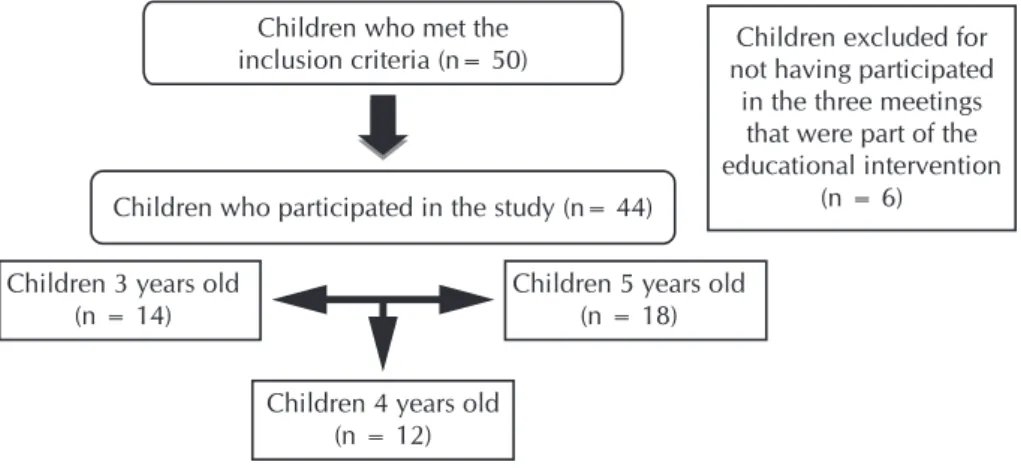
A total of 44 children participated in the study, according to Figure 1. The mean age of participants was 4.1 years (standard deviation: 0.85). The majority were female (52.3%).
Considering the 44 children participating in the study, the mean number of appropriate behaviors related to tooth brushing before the intervention was 4.43 (standard devia-tion:1.96), ranging from one to nine. After the intervention, the mean of appropriate behaviors was 8.56 (standard devia-tion: 1.64), ranging from two to ten. There was a statistically significant difference in the number of appropriate behaviors before and after the playful learning intervention (p=0.0083).
Table 1 shows the distribution of correct answers for the ten behaviors observed before and after the intervention.
The behavior with the greatest right answers before the in-tervention was the first: “Put a small amount of toothpaste on the brush”. The behaviors with the highest number of errors before the intervention were “Brush teeth of the lower dental arch” and “Brush surface of the tongue”. The data reveal a significant improvement in the percentage of correctness of these items after the intervention.
The effects of playful learning intervention on tooth brush-ing were also analyzed accordbrush-ing to the child’s age (Table 2).
Children who met the
inclusion criteria (n= 50) not having participated Children excluded for in the three meetings
that were part of the educational intervention
(n = 6) Children who participated in the study (n= 44)
Children 5 years old (n = 18)
Children 4 years old (n = 12) Children 3 years old
(n = 14)
Figure 1 – Participants of the study, São Paulo, Brazil, 2014
Table 1 – Distribution of appropriate behaviors for tooth brushing before and after the intervention, São Paulo, Brazil, 2014
Appropriate behaviors
Before intervention
n (%)
After intervention
n (%)
p
value
Put a small amount (small pea or rice grain) of toothpaste on
the brush 44 (100.0%) 44 (100.0%) 1
Brush teeth internally 22 (50.0%) 37 (84.1%) 0.001
Brush teeth externally 29 (65.9%) 43 (97.7%) 0.001
Brush front teeth (incisors
and canines) 14 (31.8%) 43 (97.7%) < 0.001
Brush posterior teeth
(premolars and molars) 12 (27.3%) 43 (97.7%) < 0.001
Brush contact surface of the
teeth 14 (31.8%) 38 (86.4%) < 0.001
Brush teeth of the upper
dental arch 14 (31.8%) 22 (50.0%) 0.061 Brush teeth of the lower
dental arch 11 (25.0%) 23 (52.3%) 0.003
Brush surface of the tongue 5 (11.4%) 38 (86.4%) < 0.001
Rinse mouth with water at
least once 30 (68.2%) 44 (100.0%) 0.001
Table 2 – Mean of appropriate behaviors related to tooth brushing before and after the intervention according to the child›s age, São Paulo, Brazil, 2014
Child age
Before intervention Mean (standard
deviation)
After intervention Mean (standard
deviation)
p
value
Children 3 years old 3.0 (1.51) 7.8 (1.52) 0.54
Younger children (3 years old) showed fewer appropri-ate behaviors before and after the intervention. However, all groups presented an increase in the number of appropriate behaviors after the intervention, but without a statistically sig-nificant difference.
DISCUSSION
The results obtained in the present study reveal the acquisi-tion of adequate behaviors in relaacquisi-tion to tooth brushing after the learning intervention with preschool children, demon-strating effectiveness. Oral health education interventions in pre-schools have the potential to encourage children to estab-lish and maintain effective oral hygiene routines(5).
National and international studies have shown that health education in the school environment favors the involvement of the child in developing new knowledge, facilitating change in habits. A survey conducted in Pernambuco, with 169 chil-dren enrolled in pre-school and elementary school, adopted lectures and play activities appropriate to the age group to promote oral health. The results showed a reduction in the percentage of deficient brushing from 20.7% to 4.1%, and regular from 62.1% to 49.7%, with an increase in the good hygiene index from 8.9% to 32%(9).
A randomized clinical trial aimed at evaluating the effica-cy of an educational-preventive oral health activity with 38 children, aged three to five years, showed the effectiveness of this strategy in reducing visible plaque and gingival bleeding. The didactic resources used in the educational activities were theater with puppets, interactive games, macromodels, brush and toothpaste, and posters. The activities emphasized topics such as dental caries, gingivitis, brushing with toothpaste, use of dental floss, and relationship of diet with dental caries(11).
Another national study evaluated the effectiveness of brush-ing supervision in dental plaque removal and brush damage in 49 children, aged 3 to 5 years, who received new tooth-brushes and participated in a puppet theater on oral health. The results showed that professional supervision in multiple sessions was effective in reducing plaque indexes, which were not influenced by brush damage, showing the need for con-tinuous motivation for oral hygiene(12).
A study in India with 100 preschoolers assessed the impact of three different methods of health education. Participants were randomly selected and divided into four groups. Group A received oral health education from a dentist. Group B re-ceived it from the class teacher, who was trained by a dentist. Group C received it from dental residents wearing cartoon characters; Group D was the control group. The best indexes of oral health evaluated three months after the intervention were the group that received the intervention in a playful way, that is, with health professionals imitating cartoon characters(13).
An investigation conducted in Thailand with 3,706 children evaluated the benefit of a dental health promotion program com-bined with teacher-supervised tooth brushing in pre-schools using
fluoride toothpaste. After two years of follow-up, the results
re-vealed significant improvements in dental plaque scores with up to a 34% reduction in caries occurrence(14). It is important
to highlight that none of these studies(9,11-14) was developed by nurses. This demonstrates the need to strengthen and expand the integration of the nurse in health education activities in pre-schools, such as oral health, in addition to producing and disseminating knowledge related to the topic.
Considering the relationship between the child’s age and the adoption of appropriate behaviors for tooth brushing, the findings of the present investigation are similar to those of a study developed at a kindergarten in Brasília-DF (15). The study showed that children aged 5 to 6 years present a greater ability to properly brush their teeth when compared to children aged 3 and 4 years, showing that the manual ability for brushing skills is acquired after a certain age. The study in question evaluated the efficacy of educational intervention in children based on the reduction of plaque indexes.
Motivation and health education are important tools for promoting the oral health of preschool children. It is under-stood that appropriate educational programs on oral hygiene have a potential motivating value, as they constitute a means of introducing children’s health care in a pleasant way. Reaf-firming the learning intervention implemented in this study for the effective increase of learning, the construction of knowl-edge by children should occur in a relaxed and participative way. Audiovisuals, games, puppets, theater and dynamics are recommended as excellent means of promoting learning, pro-viding children with a variety of experiences and stimuli in a fun and enjoyable way, and motivating them for self-care(16-17). The use of individual instruction for the practice of oral hy-giene with preschoolers is also suggested, and is considered useful because it is an easy and low cost method(15).
For better learning in children, it is important that educa-tional programs are not performed once, but repetitively, evi-dencing the effectiveness of the reinforcement on the educa-tion of oral hygiene practices(9).
Study limitations
Quasi-experimental studies have limitations in controlling factors external to the intervention. Another disadvantage is the lack of a control group for comparison. However, as the present study used a before-after design, each child was his own control. Other limitations refer to the unicentric nature of the research, and to the limited size of the sample by age subgroup (three, four and five years).
Contributions to the area of nursing and public health Early childhood educational institutions, in partnership with the professionals of the primary health care services, pro-vide privileged space for the promotion of children’s health. The school health program(Programa Saúde na Escola - PSE), instituted by Presidential Decree No. 6,286, represents a means of articulation between school and health units. Inter-sectoral and interdisciplinary actions aim to establish practices for health promotion and injury prevention in children, ado-lescents, youth and adult students in Brazil(6). In this context, nurses play a crucial role in the promotion of child health, and prevention of disease in kindergarten and pre-school children.
professionals should seek to promote health education ac-tions for the adoption of healthy living habits from pre-school. The school health program’s health promotion actions could include activities aimed at children, families and professionals in the area of education, in order to promote good oral hygiene at home, in the educational institution, and in the community. The evidence points to some effective public health measures for caries prevention. Fluoride toothpaste is recommended for tooth brushing, along with regular plaque removal, and decreased consumption of sweetened foods. For the future, addressing risk factors related to social determinants, diet, and community involvement in strengthening healthy choices and behaviors related to oral hygiene will require research(18).
CONCLUSION
The realization of playful educational interventions with preschool children is effective to improve appropriate behav-iors related to the practice of tooth brushing. These actions should use methods and playful resources appropriate to the child’s age group. Educational programs should be seen as important strategies for development of health habits in pre-school children. The institutions of early childhood education are a privileged space for this, because it is in infancy that the child learns and incorporates personal care habits. Nurses must potentiate oral health promotion actions with preschool-ers during kindergarten.
REFERENCES
1. Watt RG. Strategies and approaches in oral disease prevention and health promotion. Bull World Health Organ [Internet]. 2005 [cited 2015 May 16];83(9):711-8. Available from: http://www.scielosp.org/pdf/bwho/v83n9/v83n9a18.pdf
2. Brasil. Ministério da Saúde. Secretaria de Atenção à Saúde. Departamento de Atenção Básica. Coordenação Nacional de Saúde Bucal. SB Brasil 2010: Pesquisa Nacional de Saúde Bucal: resultados principais. Brasília: MS; 2012.
3. Avellar-Silva ABV, Oliveira LMC, Silveira RG, Miasato JM, Neves AA. Prevalência de cárie dentária em pré-escolares de uma escola particular em uma região rural do Estado do Rio de Janeiro. Rev Bras Pesq Saúde [Internet]. 2012 [cited 2015 May 16];14(1):49-56. Available from: http://www.periodicos.ufes.br/RBPS/article/viewFile/3409/2670
4. Cascaes AM, Peres KG, Peres MA, Demarco FF, Santos I, Matijasevich A, Barros AJD. Validity of 5-year-old children’s oral hygiene pattern referred by mothers. Rev Saúde Pública [Internet]. 2011 [cited 2015 May 16];45(4):668-75. Available from: http://www. scielo.br/pdf/rsp/v45n4/en_2830.pdf
5. Cooper AM, O’Malley LA, Elison SN, Armstrong R, Burnside G, Adair P, Dugdill L, Pine C. Primary school-based behavioural interventions for preventing caries. Cochrane Database Syst Rev [Internet]. 2013 [cited 2015 May 16];5:CD009378. Available from: https://www.ncbi.nlm.nih.gov/pubmed/23728691
6. Brasil. Ministério da Saúde. Ministério da Saúde, Ministério da Educação. Caderno do gestor do Programa de Saúde Escolar. Brasília; 2015.
7. Raj S, Goel S, Sharma VL, Goel NK. Short-term impact of oral hygiene training package to Anganwadi workers on improving oral hygiene of preschool children in North Indian City. BMC Oral Health [Internet]. 2013 [cited 2015 May 16];13:67. Available from: http://bmcoralhealth.biomedcentral.com/articles/10.1186/1472-6831-13-67
8. Gibbs L, Waters E, Christian B, Gold L, Young D, Silva A,et al. Teeth tales: a community-based child oral health promotion trial with migrant families in Australia. BMJ Open [Internet]. 2015 [cited 2015 May 16];5(6):e007321. Available from: http://bmjopen. bmj.com/content/5/6/e007321
9. Carvalho THL, Pinheiro NMS, Santos JMA, Costa LED, Queiroz FS, Nóbrega CBC. Estratégias de promoção de saúde para crianças em idade pré-escolar do município de Patos-PB. Rev Odontol UNESP [Internet]. 2013 [cited 2015 May 16];42(6):426-31. Available from: http://www.scielo.br/pdf/rounesp/v42n6/v42n6a06.pdf
10. Brasil. Ministério da Saúde. Mantenha seu sorriso fazendo a higiene bucal corretamente. Brasília: Ministério da Saúde; 2012. p7-8.
11. Barreto DM, Paiva SM, Ramos-Jorge ML, Ferreira MC. Evaluation of the effectiveness of an educational preventive activity with preschoolers: pilot study for a randomized clinical trial. Arq Odontol [Internet]. 2013 [cited 2015 May 16];49(3):113-21. Available from: http://www.odonto.ufmg.br/images/Revista/Volume_49/numero3/rev-49-3%2018-12-2013-2.pdf
12. Wambier LM, Dias G, Bittar P, Pochapski MT, Wambier DS, Chibinski ACR, Santos FA. The influence of tooth brushing supervision on the dental plaque index and toothbrush wear in preschool children. Rev Odontol UNESP [Internet]. 2013 [cited 2015 May 16];42(6):408-13. Available from: http://www.scielo.br/pdf/rounesp/v42n6/v42n6a03.pdf
13. John BJ, Asokan S, Shankar S. Evaluation of different health education interventions among preschoolers: a randomized controlled pilot trial. J Indian Soc Pedod Prev Dent [Internet]. 2013 [cited 2015 May 16];31(2):96-9. Available from: https://www.ncbi.nlm. nih.gov/pubmed/23886720
14. Petersen PE, Hunsrisakhun J, Thearmontree A, Pithpornchaiyakul S, Hintao J, Jürgensen N, Ellwood RP. School based intervention for improving the oral health of children in southern Thailand. Community Dent Health [Internet]. 2015 [cited 2015 May 16];32(1):44-50. Available from: https://www.ncbi.nlm.nih.gov/pubmed/26263592
2002 [cited 2015 May 16];13(2):133-6. Available from: http://www.scielo.br/pdf/bdj/v13n2/v13n2a11.pdf
16. Gitirana VFD, Lopes G, Lemos S, Rego MA. [Evaluation of a mouth health care school program with 4 to 5 year-old children]. Rev Biociênc [Internet]. 2003 [cited 2015 May 16];9(4):47-51. Available from: http://periodicos.unitau.br/ojs-2.2/index.php/ biociencias/article/view/121/93 Portuguese.
17. Garcia PPNS, Corona SAM, Valsecki Jr A. Educação e motivação: impacto de um programa preventivo com ênfase na educação de hábitos de higiene oral. Rev Odontol UNESP [Internet]. 1998 [cited 2015 May 16];27(2):393-03. Available from: http:// revodontolunesp.com.br/files/v27n2/v27n2a04.pdf