8 Rev Bras Med Esporte – Vol. 19, No 1 – Jan/Fev, 2013
FACTORS ASSOCIATED WITH SELF-RATED POSITIVE
HEALTH IN ACTIVE YOUNG MEN FROM
SERGIPE STATE, BRAZIL
ORIGINAL ARTICLE
Aldemir Smith-Menezes1
Maria de Fátima da Silva duarte2
1. Federal institute of Education, Science and Technology from Sergipe/ itabaiana Campus - Sergipe, Brazil. 2. Federal university of de Santa Catarina/uFSC - Santa Catarina, Brazil.
Mailing address:
Rua dr. José Campos de Souza, 14 - Conjunto dom pedro i
Bairro: José Conrado de Araújo -49085-160 – Aracaju, SE, Brasil. E-mail: [email protected]
EXERCISE AND SPORTS MEDICINE CLINIC
ABSTRACT
introduction: Self-rated positive health seems to be associated with various factors in the general population. Among active men, the association with such traits seems to be unclear. Objective: This work has aimed to verify the factors associated with self-rated positive health in active young men. Material and Methods: cross sectional research was carried out with a sample of 695 male conscripts, taken from the male population (age of 18 years), in the mandatory army enlisting process. The study variables were: socio-economic status, marital status, education, work, smoking, alcohol consumption, stress, regular physical activity practice and self-rated health. in order to analyze the data likelihood, ratio tests were calculated and hierarchicallogistic regression analysis applied. Results: Association between self-rated positive health and high education –eight or more years (OR=3.38; Ci 95%; 1.83-6.23), and non- smoking (OR=3.42; Ci 95%; 1.69-6.92) was found. When the analysis was adjusted to social-demographic variables, high education (OR=3.05; Ci 95%; 1.63-5.73), and non-smoking (OR=3.03; Ci 95%; 1.47-6.25) kept on the model being associated with self-rated positive health. Conclusion: Such findings suggest the need to develop intervention strategies in an intersectional and multi-professional manner in the public health departments, related to risk behavior and social factors.
Keywords: self-rated health, army enlisting, active men, Sergipe, Brazil.
INTRODUCTION
The analysis of the self-rated health is fairly complex; howe-ver, evidence derived from longitudinal studies show that the negative self-rated analysis is related to mortality in general1 and
in individuals with diabetes2. Such relationship can be boosted
when combined with low levels of physical fitness3. Similarly,
some demographic and socio-economic factors as well as other related to lifestyle are directly associated with health self-evalua-tion in industrialists4,5, adults6,7 and in the elderly8, being able to
determine a positive or negative perception, which contributes to the development of future interventions in many population subgroups9. Moreover, negative self-rated health is associated
with higher frequency of chronic diseases10, smoking over 20
cigarettes a day, insufficient levels of physical activities11,12, low
weight or obesity13, female sex, advanced age, low educational
background and compromised health14.
Some studies have shown that physically active men present better self-rated health compared to the insufficiently active ones15-17. Others point out regular practice of physical activity
as predictor of positive self-rated health15, and, therefore, it is
believed that different associated factors may boost even more the wellness of physically active individuals, reinforcing the need of research which evidences this correlation. in the northeast of Brazil, there are not many studies about the associations of factors with health evaluation in young subjects. Thus, in this study, we tried to verify the factors associated with health in active young subjects from Sergipe state, Brazil.
MATERIALS AND METHODS
The research was epidemiological and of transversal cohort, carried out with young adults at military enlistment age in Sergipe state, Brazil. According to data provided by the military institution (Brazilian Army), 5,114 men enlisted enrolled in the mandatory mi-litary enlistment in 2007.
The criteria adopted for inclusion of the participants in the research were the following: willingness to participate in the research, correctly filling out of the given questionnaire, absence of refractoriness (age above 18 years) and absence of insufficient levels of physical activity (< 150 min/week).
data collection was performed in the 28th Snipers Rank – Bra-zilian Army, located in the city of Aracaju, Sergipe, under authori-zation of the Higher Command of the institution. The mentioned research was approved by the Ethics in Research Committee of the Tiradentes university (file # 1,612/07).
Simple random process in two stages was performed for sample selection. On the first stage, before starting the study, three days of the week were raffled (Tuesday, Thursday and Friday) and, on the second one, 30 young men were selected per raffled day to answer a questionnaire. in the selection of the individuals who constituted the sample, they were organized and the raffle was randomly per-formed among the participants.
Estimation of sample size considered confidence interval of 95%, prevalence of adolescents with insufficient levels of physical activity of 39%18 and acceptable error of sample in four percentage points,
9
Rev Bras Med Esporte – Vol. 19, No 1 – Jan/Fev, 2013
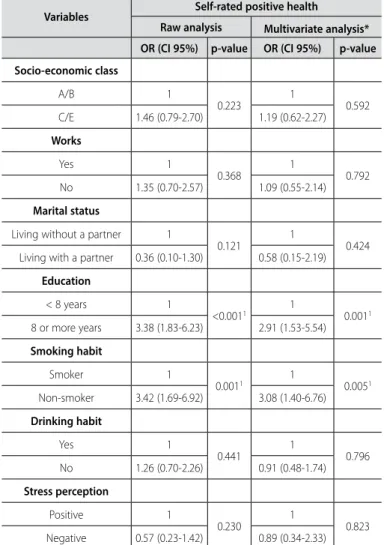
concerning the positive self-rated health are presented in table 2. in the raw analysis of the variables the young subjects with higher educational level – eight years or more of study (raw OR analysis = 3.38, 95% Ci: 1.83-6.23) and non-smokers (raw OR analysis = 3.42, 95% Ci: 1.69-6.92) presented higher chance of perceiving themsel-ves with positive health than the young subjects with less than eight years of education and smokers, respectively.
When the analyses were adjusted to the socio-demographic va-riables, again the young subjects with higher educational level and non-smokers presented higher chance of positive self-rated health (p < 0.05). Among the young subjects with eight or more years of education the probability of presenting better self-rated health was three times higher compared to the less educated (adjusted OR = 2.91; 95% Ci: 1.53-5.54). likewise, the non-smokers also presented higher proportion of presenting positive self-rated health when compared to the smokers (adjusted OR = 3.08; 95% Ci: 1.40-6.76). representativeness, 20% were added to perform multivariate
analy-sis and 10% to occasional loss, collecting hence data of 740 illegible young subjects. due to the sample loss of 45 subjects who did not fill out the questionnaire correctly, 695 young subjects participated in the final research.
information about socio-economic and behavior aspects as well as self-rated health was collected. The socio-economic status was identified through questions concerning the Brazilian Economical Classification Criteria 20. The variables were initially analyzed in a
descriptive manner. The socio-economic variable was categori-zed in: A/B classes = 1; and C/E classes = 2 for better adjustment. in order to calculate the weekly energy expenditure (MET/min/ week), in different dimensions of the physical activity (walks and moderate and vigorous physical exertion), the international physical Activities Questionnaire, short version (ipAQ) was used21. The level
of physical activity was classified according to the Guidelines for data processing and analysis of the international physical Activity Questionnaire (ipAQ)22.
in order to evaluate further health risk behavior, questions concerning stress perception, drinking habit and smoking habits have been added3. The behavior variables were presented in the
following manner: smoking habit (smokers versus non-smokers), drinking habit (yes versus no). Stress was evaluated with the use of a likert scale with four possibilities for an answer (rarely stressed, so-metimes stressed, almost always stressed and excessively stressed); however, in order to better adjust the data analysis, (rarely stressed added to sometimes stressed ) was classified as positive percep-tion and (almost always stressed added to excessively stressed) as negative perception; while self-rated health was performed using the following question11: How do you evaluate your health? with
five choices for an answer (very good, good, average, bad and very bad). However, for data analysis, the answers were dichotomized in: positive health (very good/good) and negative health (average/ bad/very bad).
Verosimilarity ratio test was used in the data analysis in order to confirm which predicting variables would be associated with self--rated heath. Subsequently, using the forward selection method, raw analysis and multivariate analysis by hierarchy logistics regres-sion were applied, and the socio-demographic variables were found in the most distal determination level (marital status, educational background, socio-economic class and whether or not the person works), while the behavior variables were in the most proximal level (smoking habit, drinking habit and stress perception). it is worth mentioning that the multivariate analysis was only used for the va-riables of the same level and higher level with p value < 0.20 in the raw analysis. The significance level adopted was ≤ 5%. The statistical package SpSS, version 15.0 was used for the analysis.
RESULTS
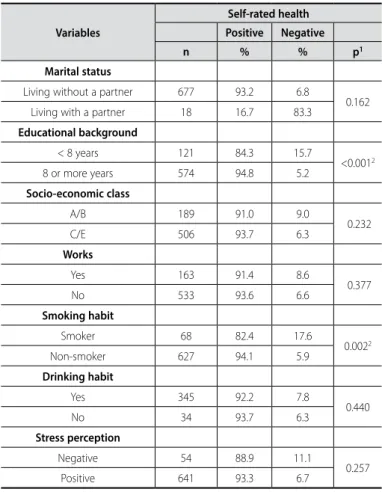
The socio-demographic and behavior characteristics are presen-ted in table 1. The young subjects studied here were predominantly single, of lower socio-economic class (C/E classes), with over eight years of education, with low stress level and non-workers. in the verosimilarity ratio analysis, only education and smoking habit were associated (p < 0.05) with self-rated health.
The raw and multivariate analyses for the independent variables
Table 1. Socio-demographic and behavior characteristics associated with health self--evaluation in men in the military enlistment age. Sergipe, Brazil, 2007.
Variables
Self-rated health
Positive Negative
n % % p1
Marital status
living without a partner 677 93.2 6.8
0.162 living with a partner 18 16.7 83.3
Educational background
< 8 years 121 84.3 15.7
<0.0012
8 or more years 574 94.8 5.2
Socio-economic class
A/B 189 91.0 9.0
0.232
C/E 506 93.7 6.3
Works
Yes 163 91.4 8.6
0.377
No 533 93.6 6.6
Smoking habit
Smoker 68 82.4 17.6
0.0022
Non-smoker 627 94.1 5.9
Drinking habit
Yes 345 92.2 7.8
0.440
No 34 93.7 6.3
Stress perception
Negative 54 88.9 11.1
0.257 positive 641 93.3 6.7
1Analysis of the likelihood ratio 2p < 0,05.
DISCUSSION
The present study, whose aim was to verify the factors associa-ted with self-raassocia-ted health in active young subjects, was performed with a specific young population who were under mandatory mi-litary enlistment in the state of Sergipe, Brazil.
10 Rev Bras Med Esporte – Vol. 19, No 1 – Jan/Fev, 2013
Another questionnaire performed with individuals older than 13 years pointed out that the main determinants of self-rated health are inversely related to socio-economic status (income per capita), age, with additional contributions from the educational level for men9,28.
The second aspect refers to the evidence about other factors aassociated with self-rated health in active men. The main evidence of this study was that self-rated positive health in active men and at military enlistment age, also seems to be influenced by educational level and smoking habit, suggesting hence interventions which try to modify a set of associated factors. despite the specific characte-ristics of this sample, the prevalence of positive self-rated health in the mentioned investigation was high, similarly to the one found in further studies6,27,29, for different population subgroups, proving
that regardless of age, sex and other risk factors may determine the self-rated health.
Additionally, other investigations found in the literature tried to verify the association of lifestyle factors with positive or negative self-rated health, using many research instruments in populations in different ages and sex, but not aiming at active individuals. Re-search held in Sweden6 with subjects from both sexes, shows that
age , the absence of the smoking habit and the high educational level were associated with positive self-rated health, similar results to the ones found in this study. Another study held in Greece14
evidenced that being female, having lower educational level, pre-senting advanced age and compromised health were determinant in the negative self-rated health. On the other hand, regular physical exercise, better sleeping quality, healthy eating habits and religious habits determined the positive self-rated health.
dachs and Santos9, in a representative sample of the Brazilian
population, found dependence of positive self-rated health to high educational level and socio-economic class. in research followed for five years and carried out with middle-aged adults, they evi-denced the association between practice of leisure physical acti-vity and positive self-rated health, being more evident among the younger ones16. Similar data were found in the investigation in 15
countries members of the European union17. Additionally, material,
psychosocial and lifestyle conditions seem to be independent in the determination of negative health7. in the present investigation,
association between education and smoking habit with self-rated health was found after adjustment to the variables of the distal level with p < 0.20 in the raw analysis.
And the last but not the least third aspect refers to the perfor-mance of study only with male young subjects at the same age. Research carried out about self-rated health in Brazil, more speci-fically in the northeast, is limited, especially with specific popula-tion subgroup. investigapopula-tion held with three European countries evidenced some similar and some different factors associated with self-rated health; however, the psychosomatic complaints were the most important aspects in the determination of self-rated health in university students30. in a population of diabetic individuals2,
middle-aged15 and elderly men31, the evidence of the lack of
ho-mogeneity between the population subgroups justify this study.
CONCLUSION
Such findings are of great relevance, since adolescence is a tran-sition moment in which people should take new identity in society,
Table 2. Raw and multivariate Odds ratio (OR) for independent variables concerning self-rated positive health among young subjects (Sergipe. Brazil. 2007).
Variables Self-rated positive health
Raw analysis Multivariate analysis*
OR (CI 95%) p-value OR (CI 95%) p-value
Socio-economic class
A/B 1
0.223 1 0.592 C/E 1.46 (0.79-2.70) 1.19 (0.62-2.27)
Works
Yes 1
0.368 1 0.792 No 1.35 (0.70-2.57) 1.09 (0.55-2.14)
Marital status
living without a partner 1
0.121 1 0.424 living with a partner 0.36 (0.10-1.30) 0.58 (0.15-2.19)
Education
< 8 years 1
<0.0011 1 0.0011
8 or more years 3.38 (1.83-6.23) 2.91 (1.53-5.54)
Smoking habit
Smoker 1
0.0011 1 0.0051
Non-smoker 3.42 (1.69-6.92) 3.08 (1.40-6.76)
Drinking habit
Yes 1
0.441 1 0.796 No 1.26 (0.70-2.26) 0.91 (0.48-1.74)
Stress perception
positive 1
0.230 1 0.823 Negative 0.57 (0.23-1.42) 0.89 (0.34-2.33) *Adjusted to the proximal level. 1p < 0.05.
lifestyle constantly evidenced in the literature. in this investigation, interesting characteristics concerning lifestyle of the young subjects were found. prevalence of smoking habit was of 49.1%, relatively lower compared to the ones found by Alves et al.24, in which 57%
of the adolescents of Feira de Santana (BA) had already ingested alcoholic drinks. The use of alcohol among adolescents seems to be associated with work, and alcoholism with the male sex and alcoholism family history25. likewise, alcohol dependence is related
to age range from 14 to 39 years, higher income, lower educational level, undefined religion and use of illicit drugs26.
Concerning smoking, only 9.8% of the active adolescents from this study reported being smokers. in investigations held in South America, the main factors among young subjects to adopt the smoking habit were: smoking among siblings and friends, advanced age, low school performance, male sex, parents’ divorce and paid work27. The indicators described point to multidimensional
measures of the aspects related to alcohol and smoking habits, which may directly interfere in the self-rated health.
11
Rev Bras Med Esporte – Vol. 19, No 1 – Jan/Fev, 2013
favoring conflict with one’s self and the environment where one lives, due to the need of self-assurance within his/her culture. Thus, the mentioned investigation presented some important informa-tion to the Sergipe state.
This study presented as limitations: the use of questionnaire, which may favor errors in the transcription of the answers; difference of the used instrument from other studies makes comparative analyses di-fficult; restriction to data generalization to the young subjects partici-pating in this research and finally, since it is a transversal investigation, it presents limitations intrinsic to the method for the impossibility to have the participants of the sample followed (retrocausality).
The data described in the present study enabled to identify
strong association between smoking and education with the de-pendent variable positive self-rated health among active young subjects. Thus, it is suggested that the public sectors are more attentive, considering the multidimensional aspects, highlighting health education in an attempt to modify some risk behavior, such as keeping active, not smoking and avoiding excessive alcohol con-sumption so that the risks to health of this population subgroup can be minimized.
All authors have declared there is not any potential conflict of interests concerning this article.
REFERENCES
1. Guimarães JMN, Chor d, Werneck Gl, Carvalho MS, Coeli CM, lopes CS, et al. Association between self-rated health and mortality: 10 years follow-up to the pro-Saude cohort study. BMC public Health 2012;12:676. doi:10.1186/1471-2458-12-676.
2. Wennberg p, Rolandsson O, Jerde’n l, Boeing H, Sluik d, Kaaks R, et al. Self-rated health and mortality in individuals with diabetes mellitus: prospective cohort study. BMJ Open 2012;2:e000760. doi:10.1136/ bmjopen-2011-000760.
3. Gander J, lee d-C, Sui x, Hébert JR, Hooker Sp, Blair SN. Self-rated health status and cardiorespiratory fitness as predictors of mortality in men. Br J Sports Med 2011;45(14):1095-100. doi:10.1136/bjsm.2010.079855. 4. Fonseca AS, Blank VlG, Barros MVG, Nahas MV. percepção de saúde e fatores associados em industriários
de Santa Catarina, Brasil. Cad Saúde pública 2008;24:567-76.
5. Höfelmann dA, Blank N. Autoavaliação de saúde entre trabalhadores de uma indústria no sul do Brasil. Rev Saúde pública 2007;4:777-87.
6. Södergren M, Sundquist J, Johansson S-E, Sundquist K. physical activity, exercise and self-rated health: a population-based study from Sweden. BMC public Health 2008;8:352.
7. Molarius A, Berglund K, Eriksson C, lambe M, Nordstro E, Eriksson HG, Feldman i. Socioeconomic conditions, lifestyle factors, and self-rated health among men and women in Sweden. Eur J public Health 2006;17:125-33.
8. Takkinen S, Suutama T, Ruoppila i. More meaneng by exercising? physical activity as a predictor of a sense meaning in life and self-rated health and functioning in old age. J Aging phys Act 2001;9:128-41. 9. dachs JNW, Santos ApR. Auto-avaliação do estado de saúde no Brasil: análise dos dados da pNAd/2003.
Ciên Saude Colet 2006;11:887-94.
10. Barreto SM, Figueiredo RC. doença crônica, auto-avaliação de saúde e comportamento de risco: diferença de gênero. Rev Saúde pública 2009;43(Supl 2):38-47.
11. Alricsson M, landstad BJ, Romild u, Werner S. Self-related health, physical activity and complaints in Swedish high school students. Scientific World Journal 2006;6:816-26.
12. Abolfotouh MA, Bassiouni FA, Mounir GM, Fayyad RCh. Health-related lifestyles and risk behaviours among students living in Alexandria university Hostels. East Mediterr Health J 2007;13:376-91. 13. Barros MBA, zanchetta lM, Moura EC, Malta dC. Auto-avaliação da saúde e fatores associados, Brasil,
2006. Rev Saúde pública 2009;43(Supl 2):27-37.
14. darviri C, Fouka G, Gnardellis C, Artemiadis AK, Tigani x, Alexopoulos EC. determinants of Self-Rated Health in a Representative Sample of a Rural population: A Cross-Sectional Study in Greece. int J Environ Res public Health 2012;9:943-54; doi:10.3390/ijerph9030943.
15. Okano G, Miyake H, Mori M. leisure time physical activity as a determinant of self-perceived health and fitness in middle-aged male employees. J Occup Health 2003;45:286-92.
16. parkes KR. physical activity and self-rated health: interactive effects of activity in work, and leisure domains. Br J Health psychol 2006;11:533-50.
17. Abu-Omar K, Rütten A, Robine J-M. Self-rated health and physical activity in the European union. Soz.- präventivmed 2004;49:235-42.
18. Oehlschlaeger MHK, pinheiro RT, Horta B, Gelatti C, San’tana p. prevalência e fatores associados ao sedentarismo em adolescentes de área urbana. Rev Saúde pública 2004;38:157-63.
19. luiz RR, Magnanini MMF. O tamanho da amostra em investigações epidemiológicas. in: Medronho RA (Org.). Epidemiologia. São paulo: Atheneu. 2000;295-307.
20. ANEp. Critério de Classificação Sócio Econômica. Brasil. São paulo: 2000. http://www.datavale-sp.com. br/CCEB.pdf. Acessado em 21/10/2007.
21. Matsudo S, Araújo T, Matsudo V, Andrade d, Andrade E, Oliveira lC, et al. Questionário internacional de Atividade Física (ipAQ): estudo de validade e reprodutibilidade no Brasil. Rev Bras Ativ Fis Saude 2001;2:5-18.
22. Guidelines for data processing and analysis of the international physical Activity Questionnaire (ipAQ). disponível na internet via uRl: HTTp://www.ipaq.ki.se, atualizado em 2005.
23. Barros MVG. Atividade Física no lazer e outros comportamentos relacionados à saúde dos trabalhadores da indústria no Estado de Santa Catarina, Brasil. [dissertação de mestrado]. Florianópolis: universidade Federal de Santa Catarina; 1999.
24. Alves VQM, Costa COM, Nascimento Sobrinho Cl, Santos CASl, Gomes WA, Assis dR. uso de Bebidas Alcoólicas entre Adolescentes: perfil de experimentação, uso regular e fatores de risco. Feira de Santana – Bahia. R Baiana Saude pub 2005; 29: 91-104.
25. Souza dpO, Areco KN, Silveira Filho dx. Álcool e alcoolismo entre adolescentes da rede estadual de ensino de Cuiabá, Mato Grosso. Rev Saúde pública 2005;3:585-92.
26. Barros MBA, Botega NJ, dalgalarrondo p, Marín-león l, Oliveira HB. prevalence of alcohol abuse and associated factors in a population-based study. Rev Saúde pública 2007;41:502-9.
27. Malcon MC, Menezes AMB, Maia MFS, Chatkin M, Victora CG. prevalência e fatores de risco para taba-gismo em adolescentes na América do Sul: uma revisão sistemática da literatura. Rev panam Salud publica/pan Am J public Health 2003;13:222-8.
28. dachs JNW. determinantes das desigualdades na auto-avaliação do estado de saúde no Brasil: análise dos dados da pNAd/1998. Ciên Saude Colet 2002;7:641-57.
29. Kaleta d, Makowiec-dąbrowska E, Jegier A. physical activity and self–perceived health status. int J Occup Med Environ Health 2006;19:61-9.
30. Mikolajczyk RT, Brzoska p, Maier C, Ottova V, Meier S, dudziak u, et al. Factors associated with self-rated health status in university students: a cross-sectional study in three European countries. BMC public Health 2008;8:215 doi:10.1186/1471-2458-8-215.