Volume 30, número 1, 2005
www.scielo.br/eq
The Li
+, Na
+and K
+ion exchange reaction process on the surface
of mixed oxide SiO
2/TiO
2/Sb
2O
5surface prepared by the Sol-Gel
processing method
C. U. Ferreira1, J. E. Gonçalves1, Y. V. Kholin2* and Y. Gushikem1*
1Instituto de Quimica, Universidade Estadual de Campinas, Caixa Postal 6154, 13083-970 Campinas, SP, Brazil; 2Chemical Faculty, V.N. Karazin Kharkov National University,4 Svoboda Square, Kharkov 61077, Ukraine
*Corresponding authors
Abstract: The porous mixed oxide SiO2/TiO2/Sb2O5 obtained by the sol-gel processing method presented a good ion exchange property and a high exchange capacity towards the Li+, Na+ and K+ ions. In the H+/ M+ ion exchange process, the H+ / Na+ could be described as presenting an ideal character. The ion exchange equilibria of Li+ and K+ were quantitatively described with the help of the model of fixed tetradentate centers. The results of simulation evidence that for the H+ / Li+ exchange the usual situation takes place: the affinity of the material to the Li+ ions is decreased with increasing the degree of ion exchange. On the contrary, for K+ the effects of positive cooperativity, that facilitate the H+ / K+ exchange, were revealed.
Keywords: silica-titania-antimonia mixed oxide; ion exchange; alkaline metal ions; stability constants.
Introduction
The synthetic inorganic ion exchangers include an important class of materials because they are normally obtained as rigid matrices and do not swell in aqueous solutions, normally presenting good chemical selectivity associated with a high thermal and chemical stabilities [1,2].
Among these materials, titanium (IV) antimonate has been described as a good ion exchanger [3-6]. It has been prepared by mixing aqueous solutions of Ti (IV) and SbCl5 and the precipitated solids separated by filtration. However, this method has not been lead to a useful product because fine powders and samples having low specific surface areas were normally obtained [7-11]. Alternatively, the sol-gel processing method has been used to prepare materials with characteristics of high homogeneity and purity, controlled porosity and well-modeled particles [12-14]. The material prepared by using this procedure,
presented also high ion exchange capacities towards the alkaline metal ions in the following order of increasing affinity: Li+< Na+ < K+ [15]. In order to explain the mechanism of the exchange process and in particular the higher affinity of the material by the heavier metal ion along the serie, the process of H+/M+ exchange on the sorbent surface should be studied in more detail. The model of an ideal exchange process as normally used to calculate the equilibrium constants in solids such as organic resins apparently can not to be applied to porous solid presenting a heterogeneous surface. A model that takes into consideration the lateral interaction on the solid surface between the neighbor acid sites which can affect the exchange process must be considered [16,17]. The aim of this work is to describe and discuss the ion exchange process of Li+,Na+ and K+ ion on the surface of porous SiO
Experimental part
The SiO2/TiO2 mixed oxide was prepared according to procedure described elsewhere [15]. The SiO2/TiO2 binary oxide was prepared in three steps according to the procedures described as follows: (1) 12.1 ml of 0.85 mol l-1 HNO
3 aqueous solution was added to 250 mL of 50% (v/v) tetraethoxysilane (TEOS)/ethanol solution, and the mixture was stirred at 353 K for 2.5 h. (2) About 21 ml of titanium (IV) butoxyde (TBO) and 490 ml of ethanol were then added and the mixture was stirred for 2 h at room temperature. (3) 66 ml of 0.6 mol l -1 HNO
3 solution were slowly added and allowed to rest for gelation. The formed xerogels were ground, dried at 383 K for 24 h and sieved in order to obtain particles size between 75 and 250 µm.
Incorporation of Sb(V) into SiO2/TiO2
About 15 g of the mixed oxide obtained was immersed in 500 ml of distilled water and 20 ml of 0.3 mol l-1 Sb (V) (prepared from SbCl
5) aqueous solution were added and the suspension heated at 333 K for 8 h. The solid was filtered, washed with 1.0 mol l-1 HNO
3 solution in order to avoid Sb(V)
hidrolysis and to eliminate choride ion, and finally with deionized water until the washing solution achieved a neutral pH.
Ion exchange isotherms
The ion exchange capacities for the sample was determined by weighing about 100 mg of the materials and adding into 50.0 mL of 1.0 mol l-1 MCl solution (M = Li+, Na+, K+) and shaken for 8 h at 298 K. 25.0 mL of the supernatant solution was titrated with standard 0.05 mol l-1 NaOH solution [2]. The isotherms were determined by immersing 100 mg of SiO2/TiO2/Sb2O5 into 50 ml of the ions with concentrations between 8x10⁻⁵ and 5x10⁻³ mol l-1. Each mixture was shaken about 24 h at 298 K and the concentration of the metal ion in the solution phase was determined. The measurements were carried out on a B 262 Micronal flame photometer apparatus. Results and discussions
The main characteristics of the solid obtained, SiO2TiO2 and SiO2/TiO2/Sb2O5 are summarized in Table 1. For sake of brevity, both solids will hereafter designated as ST and STSb.
Table 1. Chemical analyses results, surface areas and average pole volumes for SiO2/TiO2 and SiO2/TiO2/ Sb2O5
Table 1 shows that the Sb content is 9.8 wt% which corresponds to 0.8 mmol g-1 of the element in the matrix. The specific surface areas determined by the BET method, shows an area of 528 m2g-1 for STSb and 607 m2g-1 for ST. The results show that for STSb the blocking of the finest pores by the antimony oxide is not significant an thus, the decrease of the area upon coating the ST surface is very small.
Ion exchange isotherms
Figures 1a-c show the ion exchange
isotherms for Li+, Na+ and K+ ion on STSb at 298 K. Clearly we observe that at the limit of saturation condition on the isotherm curves the adsorption capacities are Li+ < Na+ ~ K+. The ion exchange process on the solid surface can be represented by the equation:
H
+ + M+ →←M
+ + H+ , Kexch eq 1where the bars mean the solid phase and
Kexch is the concentration equilibrium constant,
where the concentrations in solution phase are expressed as mol l-1 and in the solid phase as mol g-1.
Simulations of ions-exchange equilibria
The initial values of log Kexch were estimated for all experimental points with the use of eq 2, for different molar fraction of the metal, , on the solid phase STSb. For an ideal ion exchange case is expected log Kexch value do not depend on . As an example, Figure 2 shows the plot of log Kexch plotted against .
Figure 2. Plot of log Kexch against
χ
K+ for an ionexchange process on STSb at 298 K.
We observe that the ion exchange process H+/K+ do not correspond to the model of the ideal exchange, i.e. the replacement of H+ with K+ leads to increasing of log Kexch. The deviation from an ideal model is also observed for the exchange process H+/Li+ and H+/Na+. These results are indicating that the energetical heterogeneity of the materials manifest at the H+/M+ exchange process. Both, the quantitative description of the ion exchange equilibria and characteristics of the mate-rial require taking this feature into account. There are several possible ways to perform this [18-23]. In this work the model of fixed polydentate centers has been be used [16,17]. According to it, the surface of the material is considered as the assemblage of the polydentate ion exchange centers whereas the ion exchange process is represented by the scheme below, where the stepwise equilibrium Figure 1. Ion exchange isotherms at 298K on STSb
reactions are characterized with the corresponding constants K1,K2 , K3...
Scheme 1. Ion exchange as presented by the model of the fixed bidentate centers. ~QH is the center of the ion exchange.
The overall constants are defined as
βi = K1×K2×K3×…= Ki, where Z is the number of
the stages. To use the model it is necessary to de-termine the size of the center (Z) and to calculate the values of Ki or βi.
The following procedure was used to solve this task.
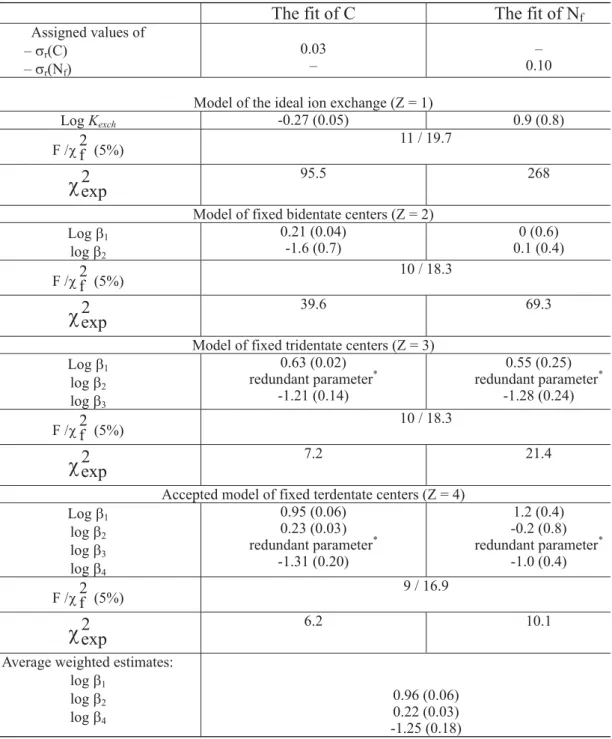
Step 1. The tentative value Z =1 was fixed. Step 2. The unknown concentration equilibrium constants bi were calculated by the
non-linear least-square method [24] applied to minimize criterion
eq 3
where k is the number of the experimental
Table 2. The results of testing the model of the ideal ion exchange for the H+ / Na+ exchange*
*Here and below the values in parentheses are the standard deviations.
points, ∆k is the difference between the calculated and experimental values, ∆ = Ccalc – Cexp or ∆ = N
f calc
– Nfexp, where C is the equilibrium concentration of the metal ions in solution (mol l 1), N
f is the specific amount of the adsorbed metal ions (mol·g-1), w
k is the statistical weight of the Kth measurement
assigned as:
eq 4
where Ak is the experimental value (C of Nf) and σr is its relative error [25]. All computations were
performed with the aid of the software program CLINP 2.1 [26].
Step 3. The adequacy of the model was tested. If the model fitted experimental data unsatisfactorily, the current Z value is increased and new calculations of the equilibrium constants are performed (see step 2).
To test the adequacy of the models, the glo-bal criterion χ2 is used [27]. The model is assumed to be adequate if the following inequality holds,
, eq 5
where is the 5% point of the chi-squared distribution with f degrees of freedom (f = N - x, where x is the number of the parameters to be calculated).
* It is impossible to calculate the equilibrium constant because at all experimental points the degrees of formation of the reaction product do not exceed 0.01% of the total Li+ concentration.
Table 4. The results of simulation of the H+ / K+ exchange
One important feature of the H+ / K+ ion exchange should be noted. When the replacement of H+ by K+ in the tetradentate center occurs, it is impossible to determine the stepwise ion exchange constants Ki. That is for the reason that the intermediate species and are practically absent. This fact points to the
on the base of inorganic oxides. A similar example of the positive cooperativity for such materials was recently described [28]. Unfortunately, the scarcity of information about this new generation of materials does not allow to propose now more or less clear explanation of the revealed phenomenon and requires further investigation.
Degrees of formation of different species
Conclusions
The porous solid STSb showed a good ion exchange property possessing a high exchange capacity towards the Li+, Na+ and K+ ions.
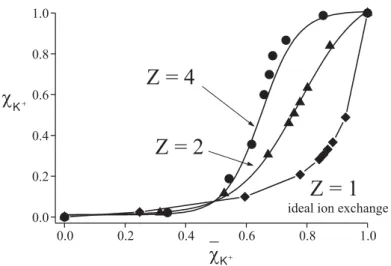
In the H+/M+ ion exchange process, the H+ / Na+ could be described as presenting an ideal character. The ion exchange equilibria of Li+ and K+ were quantitatively described with the help of the model of fixed tetradentate centers. The results of simulation evidence that for the H+ / Li+ exchange the usual situation takes place: the affinity of the Figure 3. The ion exchange isotherm of K+.
+
K
χ
is the molar fraction of K+ in aqueous solution and+
K
χ
is the molar fraction of K+ in solid phase.
in the solid phase (Figures 4 and 5) corroborate a great difference between the nature of the ion exchange process for Li+ and K+. In the case of the H+ / Li+ exchange, species , relatively depleted with Li+, predominates at extents of reaction 0.15 – 0.55, while for the H+ / K+ ion exchange species , enriched with K+, is the main potassium entity in the solid phase
material to the Li+ ions is decreased with increasing the degree of ion exchange. On the contrary, for K+ the effects of positive cooperativity, that facilitate the H+ / K+ exchange, were revealed.
Acknowledgements
YG is indebted to CNPq/Pronex and Fapesp for financial supports.
[1] A. Clearfield, Inorganic Ion Exchange Materials; CRC Press Inc.: Boca Raton, FL, 1982.
[2]. G. N. Vayssilov, Catal. Rev. Sci. Eng. 39 (1997) 209 [3] M. Abe, R. Chitrakar, M. Tsuji, K. Fukumoto, Solv. Extr. Ion Exch. 3 (1985) 149
[4] M. Tsuji, M. Abe, Solv. Extr. Ion Exch. 2 (1984) 253 [5] H. Kaneto, M. Abe, M. Tsuji, Y. Tamaura, Chromatographia 35 (1993) 193
[6] A. Clearfield, D.S. Thakur, Appl. Catal. 26 (1986) 1 [7] F. J. Berry, P. M. Gogarty, Solid States Commun. 64 (1987) 273
[8] M Abe, T. Ito, Bull. Chem. Soc. Jpn. 41 (1968) 333 [9] M. Abe, R. Chitrakar, Bull. Chem. Soc. Jpn. 60 (1987) 2274
[10] Z. Liu, J. Tabora, R. J. Davis, J. Cat. 149 (1994) 117 [11] F. J. Berry, P. M. Gogarty, J. Chem. Soc. Dalton Trans. 2161 (1988)
[12] C. J. Brinker, G. W. Schere, Sol-Gel Science - “The Physics an Chemistry of Sol-Gel Processing”, Academic Press, Inc.: San Diego, 1990
[13] R. J. Davis, Z. Liu, Chem. Mater. 9 (1997) 2311 [14] A. A. S. Alfaya, Y. Gushikem, S. C. Castro, Chem. Mater 10 (1998) 909
[15]. J.E.Gonçalves, Y. Gushikem and S.C. de Castro, J. Non-Cryst. Solids 260 (1999) 125
[16]. G.V. Kudryavtsev, D.V. Milchenko, V.V. Yagov, A.A.
Lo-pat-kin, J. Colloid Interface Sci. 140 (1990) 114 [17]. M.S.P. Francisco, W.C. da Silva, R. Landers, Y.V. Kholin, Y. Gushikem, Langmuir 20 (2004) 8707
[18]. L.K. Koopal, “Ion adsorption on minerl oxide surface in: Adsorption on new modified inorganic sorbents”, EA. Dabrowsky, V.A. Tertyky, Amsterdam, Elsevier, (1996) p. 7 5 7
[19]. L.K. Koopal, W.H. van Riemsdijk, J.C.M. Witt, M.F. Benedetti, J. Collolid Interface Sci. 166 (1994) 51 [20]. G.V. Kudryatsev, D.V. Milchenko, V.V. Yagov, A.A. Lopatkin, J. Colloid Interface Sci. 140 (1990) 114 [21]. V.Sh. Mamleev, P.P. Zolotarev, P.P. Gladyshev, Nauka, Alma-Ata, 288 (1989)
[22]. P. Venema, T. Hiemstra, W.H. van Riemdsdjik, J. Col-loid Interface Sci. 181 (1996) 45
[23]. R. Charmas, W. Piasecki, Langmuir 12 (1996) 5458 [24]. Draper N.R., Smith H., “Applied Regression Analysis”, John Wiley & Sons, N.Y., 2nd Ed. (1981) Vol. 2
[25]. Bugaevsky A.A., Kholin Yu.V., Anal. Chim. Acta 241 (1991) 353
[26]. Merny S.A., Konyaev D.S., Kholin Yu. V., Kharkov
University Bulletin 420 (1998) 112
[27]. L. Sachs, “Statistische Auswertungsmethoden”, Springer-Verlag, Berlin, (1972)
[28]. A.M. Lazarin, C.A. Borgo, Y. Gushikem, Y.V. Kholin, Anal. Chim. Acta 477 (2003) 305
C. U. Ferreira, J. E. Gonçalves, Y. V. Kholin, Y. Gushikem. O processo da reação de troca iônica de Li+, Na+ e K+ na superfície do óxido misto SiO
2/TiO2/Sb2O5 preparado pelo método de processamento Sol-Gel Resumo: O óxido misto poroso SiO2/TiO2/Sb2O5, obtido pelo método de processamento sol-gel, apresen-tou uma boa propriedade e elevada capacidade de troca iônica com os íons Li+, Na+ e K+. No processo de troca iônica H+/M+, o H+/Na+ apresentou um caráter ideal. Os equilíbrios de troca de Li+ e K+ foram quantitativamente descritos através de um modelo de centros tetradentados fixos. Os resultados de simu-lação evidenciaram que para troca H+/Li+ temos uma situação normal: a afinidade do material pelo íon Li+ decresce com o aumento do grau de troca. Para o K+, o efeito positivo do cooperativismo que facilitaria a troca H+/K+, revelou um efeito contrário.
Palavras-chave: oxido misto de silica-titania-antimonia; troca iônica; ions de metais alcalinos; constantes
de estabilidade.