Private education in Argentina and Brazil
I*Ana Maria F. AlmeidaII Manuel Alejandro GiovineIII Maria Teresa G. AlvesIV Sandra ZieglerV
Abstract
Exploring the concept of segmentation, this article demonstrates how the expansion of the Argentinian and Brazilian school systems has been associated to processes of school differentiation that have contributed to the production and reproduction of educational inequalities. Based on the analysis of historical statistics on literacy and school enrollment as well as of documents that register the school transformations since the end of the 1800s, the article shows, first, that in both school systems, segmentation processes were and are based on the separation between public and private education rather than on differentiation of public schools curriculum. It shows also that while this type of segmentation is quite recent in Argentina, it is an old feature of the Brazilian school system. Finally, the article documents a progressive convergence between the two systems, as the private schools still offer a reserved space for the schooling of the Brazilian privileged groups and has increasingly played this role in Argentina in the last decades.
Keywords
Segmentation of school systems — Private and public education — Educational inequalities.
* Translated by Viviane Ramos. Contact: [email protected]
I- Acknowledgments:
The author II would like to acknowledge the research support received from CNPq(Proc. 310926/2015-7)..
The author III would like to acknowledge the support to the research given by Consejo Nacional de Investigaciones Científicas y Técnicas.
The author IV would like to acknowledge CNPq (Proc. 446638/2014-5) and Fapemig (APQ-02544-14) for their support. The author V acknowledges the research support received from the Programa Redes Universitarias – Secretaría de Políticas Universitarias, Ministerio de Educación de la Nación, Argentina.
II- Universidade de Campinas (Unicamp), Campinas, SP, Brasil.
Contact: [email protected].
III- Universidad Nacional de Córdoba, Córdoba, Argentina.
Contact: [email protected].
IV- Universidade Federal de Minas Gerais (UFMG), Belo Horizonte, MG, Brasil. Contact: [email protected]
A educação privada na Argentina e no Brasil
IAna Maria F. AlmeidaII Manuel Alejandro GiovineIII Maria Teresa G. AlvesIV Sandra ZieglerV
Resumo
Explorando o conceito de segmentação, este artigo procura demonstrar como a expansão dos sistemas de ensino argentino e brasileiro se articula a processos de diferenciação da oferta escolar que contribuem para a produção e a reprodução das desigualdades educacionais. Partindo da análise de estatísticas históricas sobre a variação da alfabetização e das matrículas desde o final do século XIX e de documentos que registram as transformações na organização dos sistemas de ensino, o artigo mostra, em primeiro lugar, que, em ambos os sistemas, processos de segmentação se apoiaram e ainda se apoiam mais amplamente na clivagem entre educação pública e privada do que na diferenciação do currículo da escola pública. Além disso, mostra que essa clivagem é bastante recente na Argentina e muito antiga no Brasil, onde antecedeu a própria constituição do sistema nacional de ensino. Finalmente, em terceiro lugar, o artigo registra uma tendência de convergência entre os dois sistemas, já que a educação privada continua a garantir um espaço reservado para a escolarização dos grupos mais privilegiados no Brasil e desempenha com cada vez maior força esse papel na Argentina.
Palavras chave
Segmentação do sistema de ensino – Educação privada e educação pública – Desigualdades educacionais.
I-Agradecimentos:
A autora II agradece ao CNPq, pelo apoio a uma pesquisa cujos resultados parciais são apresentados aqui (Proc. 310926/2015-7). O autor III agradece o apoio que sua pesquisa recebeu do Consejo Nacional de Investigaciones Científicas y Técnicas. A autora IV agradece ao CNPq (Processo 446638/2014-5) e à Fapemig (APQ-02544-14) pelos apoios à pesquisa que viabilizaram as análises aqui apresentadas.
A autora V agradece ao Programa Redes Universitarias – Secretaría de Políticas Universitarias, Ministerio de Educación de la Nación, Argentina, pelo apoio que permitiu a apresentação dos resultados de suas pesquisa neste artigo.
II- Universidade de Campinas (Unicamp), Campinas, SP, Brasil.
Contato: [email protected].
III- Universidad Nacional de Córdoba, Córdoba, Argentina.
Contato: [email protected].
IV- Universidade Federal de Minas Gerais (UFMG), Belo Horizonte, MG, Brasil. Contato: [email protected]
Introduction
We have known, for almost half a century now, that educational inequalities are closely associated with students’ socioeconomic characteristics (BOURDIEU; PASSERON, 1970; BAUDELOT; ESTABLET, 1972; BOWLES; GINTIS, 1976), as well as their race (HASENBALG; SILVA, 1999, 2003; SOARES; ALVES, 2003), and gender (CARVALHO, 2003). This indicates that the educational systems are, on one hand, sensible to the cleavages that organize the social relations in their societies and, on the other, that they can be thought of as “intermediaries more or less meaningful between the social position of parents and their children.” (RINGER, 1979, p. 12).
Findings as these have led an increasing number of scholars to focus on identifying, describing, and explaining the social and institutional dynamics that make the educational system so permeable to the more general principles of social organization, leading to an active area of studies marked, in general, by the empirical dimension of the issues pursued by researchers, normally guided by an interest to contribute to public policies (BUCHMANN, 2011). This helps to explain why so many works have focused, throughout the 20th century, on specific countries and, as pointed out by Buchmann (2011), most commonly the one where both researchers and the reader are immersed.
By contrast, the comparative study here proposed, which examines the social place of private school in Argentina and Brazil, follows a quite different tradition. It aims, on one hand, to enter into dialogue with the intellectual production that has been pointing out, since at least the 1970s, the global character of schooling expansion since the 19th century and its relationship with the processes of building and consolidation of national educational systems (ARCHER, 1982; MÜLLER; RINGER; SIMON, 1989; RAMIREZ; BOLI, 1987). On the other, it investigates how this expansion relates to the processes of differentiation in school offerwhich
contribute to the production and reproduction of educational inequalities (RINGER, 1979). In this perspective, the comparative approach can contribute to establish the level of specificity of the phenomena, to refine explanations of typical phenomena in certain national contexts, and also to go forward on the understanding of how transnational dynamics can have strong national consequences.
Thus, this text uses a comparative perspective to explore the weight of institutional arrangements to canalize resourc0es and define expectations and strategies which, combined, will lead to the production and maintenance of educational inequalities (MÜLLER; RINGER; SIMON, 1989; LUCAS, 1999; BRASLAVSKY, 1980; TIRAMONTI, 1995). Particularly, the text examines the role played in these processes by the educational system internal differentiation.
This is not a new problem. Several studies have shown that the processes that led to the emergence and consolidation of educational national systems, be it in Western Europe and in North America from the end of the 18th century and during the 19th century, or in other parts of the world throughout the 20th century, were marked by disputes that resulted in types of school organization characterized, among other things, by the isolation of the privileged groups school experiences from the ones reserved to the population in general (RINGER, 1979). Surely, such isolation resulted in a series of advantages for these groups, for instance, the accumulation of pedagogical resources to support successful school trajectories, as it happens when one assembles students from rich or highly-educated backgrounds in the same environment (KARABEL, 2006; LAREAU, 1989), the creation of social networks which can be useful to enter the job market (SENDÓN, 2013; GESSAGHI, 2016) and the marriage market (PINÇON; PINÇON-CHARLOT, 2002), among others.
certain levels of education from being accessed by the largest part of the population. Such mechanism was not necessarily imposed by laws and regulations, but, in general, was the result of obstacles faced by working-class children and certain less-privileged fractions of the middle classes to reach higher level of schooling, be it for the lack of school, or the lack of material and/or pedagogical support in the schools.
The simple fact that the secondary education had advanced in a slower rhythm than the primary one contributed to nurture this situation, implying a relative closure of the first to the social classes that succeeded in finishing the second. In Western Europe and in the United States, this situation tended to alter only when secondary school came close to universalization.
Nevertheless, even though it allowed the progressive entrance of all in the more advanced levels of formation, the primary school universalization was followed by measures that created an internal differentiation in the secondary level system. From that point, the isolation of the school experience of the privileged groups was guaranteed by the association between specific paths that associate, at the same time, particular types of curricula and students’ social origins. The result was the production of a structure of stratified educational opportunities depending on the social position of families.
Until nowadays, the internal differentiation of the education system continues to play an important role on the production of educational inequalities in different national contexts, as shown by recent studies on segmentation and tracking (LUCAS; BERENDS, 2007). Argentina and Brazil are no exceptions, as different studies have already shown (TEDESCO, 1986; ZIEGLER, 2004; ALMEIDA, 2015; PEROSA, 2009).
The schooling reserved to students from privileged backgrounds can be located within the public sector, as in France, for example,
with the creation of a dual system described by Baudelot and Establet (1972), as well as in Germany (DEPPE; KRÜGER, 2015) and in Argentina through most part of the 20th century (TEDESCO, 1986; DUSSEL; PINEAU, 1995), or in the private sector, as happened quite early in other countries such as in Brazil (HAIDAR, 2008).
As we will see, each of the countries analyzed here had gone through different processes of expansion and differentiation. In the case of Argentina, we observe an early expansion, based on an institutional format characterized by the predominant role of public school, more specifically, the state school, to use the vocabulary of this system. In the case of Brazil, conversely, the late expansion came to fruition in a segmented system, in which the schooling of the more privileged groups was mainly done in the private sector, with little participation of the public one (PEROSA, 2010).
Expansion of schooling in a comparative perspective
Different starting points and rhythms have marked Argentinean and Brazilian school expansion. As in several Western European and North American countries, the organization of the school offer in a system, which encompasses the national territory, has followed in both countries the processes of power concentration that accompanied the creation of National States. Progressively, it gave rise to the establishment of a central bureaucracy, the secularization of the political sphere, the unification of an internal market, and the creation of education national systems in charge of forming citizens able to participate in this new social arrangement.
In Argentina, as well as in Uruguay and Chile, the processes of creating national education systems took place in the 19th century, much earlier than in other countries of Latin America. Besides, the universalization of schooling was achieved much faster in these countries when compared to other experiences in the region. In Brazil, for instance, the national systematization of schooling only started in the 1930s, consolidating only in the 1960s. Before this, the systematization progressed mainly in the state level, following asymmetric processes of school expansion, resulting in a strong regional inequality. The universalization was reached only in the end of the 20th century.
Therefore, even though the expansion of schooling in Argentina and Brazil was continuous during the period analyzed, resulting in the progressive incorporation of different social groups fractions, we see a distinct asymmetry regarding the starting points and rhythms of both countries. In Argentina, we observe a meaningful expansion in primary school- children between 6 and 12 years old- between the end of the 19th century and mid-20th, under a centralized model in which the federal government took the lead in the promotion of schooling in the whole country.
The first law of Education, Law 1.420 (1884), as well as the Law Laínez (1905), promoted the creation, by the central government, of public free laic primary school with compulsory attendance in all territory (TEDESCO, 1986; BRASLAVSKY; KRAWCZYK, 1988).
In Brazil, even though the first general law regarding elementary education was passed in 1827 (FARIA FILHO, 2000), right after independence, recommending the creation of “schools to teach the first letters in every city, village, and the more populated places of the Empire”1, the first primary schools organized in a system appeared under the responsibility of the states only in the end of the 19th century and beginning of the 20th century (SOUZA, 1998).
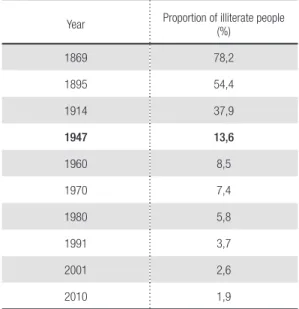
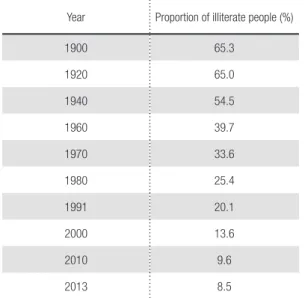
Such difference has important effects. It allows us to understand why illiteracy became residual in Argentina in the 1940s, when less than 15% of the population with more than 15 years declared themselves illiterate, as shown in Table 1, while in Brazil this happened only in 2000, as shown in Table 2.
Table 1 – Argentina – Evolution of the proportion of illiterate people in the population of 15-year- old or more.
Year Proportion of illiterate people (%)
1869 78,2
1895 54,4
1914 37,9
1947 13,6
1960 8,5
1970 7,4
1980 5,8
1991 3,7
2001 2,6
2010 1,9
Source: based on data presented by Rivas, Vera,and Bezem (2010) and the Censo Nacional de Población Hogares y Viviendas (INDEC, 2010).
Table 2 – Brazil – Evolution of the proportion of illiterate people in the population of 15- year-old or more.
Year Proportion of illiterate people (%)
1900 65.3
1920 65.0
1940 54.5
1960 39.7
1970 33.6
1980 25.4
1991 20.1
2000 13.6
2010 9.6
2013 8.5
Source: Historical Series and Synthesis of Social Indicators (IBGE).
The same difference in rhythm has marked the expansion of schooling in both countries. In Argentina, as shown on table 3, the enrollment rates in the elementary school, for children ranging from 6 to 12 years old, surpassed 85% in 1960. In Brazil, as shown on table 4, the enrollment in elementary school, for children between 7 and 14 years old, reached 83% only in 1993, more than 30 years later2. Furthermore, Argentina reached a rate of 90% of enrollment in elementary school in 1980, approximately 20 years earlier than Brazil. The latter reached the same rate only in 1998.
It is also important to note that, in the Brazilian case, most children and youngsters enrolled in elementary school were in fact, enrolled in the first four grades that correspond to the former primary school. To reach the last four grades was a great was quite an obstacle to the less privileged groups during most 20th century (RIBEIRO, 1991). In
2 - Until 2006, elementary school in Brazil attended children from 7 to 14 years old. From that year on, it started to be the period between the 1st and 9th year, attending children from 6 to 14. In Argentina, primary school corresponds to the level of children aged from 6 to 12.
the 2000s, this obstacle was moved to the end of secondary school.
Table 3 – Argentina – Evolution of enrollment rate in elementary education (1869-2010).
Year Enrollment rate in primary education (%)
1869 20.0
1895 31.0
1914 48.0
1947 73.5
1960 85.6
1970 87.7
1980 90.1
1991 95.7
2001 97.9
2010 98.9
Source: based on data presented by Rivas, Vera, and Bezem (2010) and Censo Nacional de Población Hogares y Viviendas (INDEC, 2010).
Table 4 – Brazil – Evolution of enrollment rate in elementary school (1970-2013).*
Year Enrollment rate in elementary school (%)
1970 67,0
1980 80,0
1992 81,4
1993 83,0
1998 91,0
2001 93,4
2003 94,0
2008 94,9
2011 95,6
2013 96,1
Something similar happened in both countries regarding the secondary education, normally attended by teenagers from 13 to 17 years in Argentina and 15 to 17 in Brazil. As shown on table 5, the rate of enrollment in this educational level in Argentina reached almost 60% in the beginning of the 90s, surpassing 80% in 2010. While in Brazil, as shown on table 6, the rate was still under 60% in 2014, last year for which data is available.
Table 5 – Argentina – Evolution of enrollment rates in secondary school (1970-2010).
Year Enrollment Rates In Secondary School (%)
1970 32,8
1980 42,2
1991 59,3
2001 71,5
2010 82,2
Source: based data presented by Rivas Vera and Bezem (2010) and the Censo Nacional de Población Hogares y Viviendas (INDEC, 2010).
Table 6 – Brazil – Evolution of enrollment rates in secondary school (1980-2014).
Year Enrollment rates in high school (%)
1980 14,3
1992 18,3
1993 19,0
1998 30,0
2001 37,5
2003 43,4
2006 47,3
2008 50,6
2011 51,8
2013 55,3
2014 56,5
Source: for 1980, Censo Demográfico (IBGE); for the other years: IETS/OPE Sociais, based on Pesquisa Nacional por Amostra de Domicílios (PNAD).
The data presented above show the significant differences in the rhythm of school expansion in both countries. The more general data on all levels of education in a more recent period, presented on tables 7 and 8, indicate the similarities and differences between the two countries.
Table 7 – Argentina – Enrollment rate by age group (2001 e 2010).
2001 2010 Increase
0-3 years -- --
--3-5 years 52,9 67,5 14,6
6-11 years 98,2 99,0 0,8
12-17 years 87,4 89,0 1,6
18-24 years 36,9 36,4 -0,5
Source: Censo Nacional de Población Hogares y Viviendas (INDEC, 2001/2010).
Tabela 8 – Brazil – Enrollment rate by age group (2001 e 2014).
2001 2014 Increase
0-3 years 13,8 29,6 15,8
4-5/6 years 66,4 89,1 22,7
6/7-14 years 94,6 97,5 2,9
15-17 years 77,7 82,6 4,9
18-24 years 34,0 30,0 -4,0
Sources: for 2001, age groups 0 to 17 years old, Todos pela Educação (2014); age groups from 18 to 24 years old, Castro (2009). For 2014, Síntese de Indicadores Sociais (IBGE). All indicators based on PNAD data (IBGE).
As we can see, the vertical segmentation, meaning the differential access to higher levels of education among social groups, was never fully resolved, especially in Brazil. Adding to that, its effect was reinforced by processes of curricula differentiation associated with social origin, that is, by a horizontal segmentation that we will discuss in the next section.
Private education and the segmentation of educational systems in Argentina and Brazil
from complex historical processes. In Argentina, it was initially a result from transformations within the public system itself to which the opposition between private and public systems was more recently added. In Brazil, differently, the horizontal segmentation has been strongly associated with the weight of the private education since the creation of the national educational system.
In Argentina, the enrollment in private school in the primary level was lower than 8,8% between 1930 and 1960, while in the secondary level it was almost inexistent until the mid-40s. In 1960, in a period that coincides with the initial expansion of this level of education, the enrollment rate reached 10,4% and began to expand from there.
The increasing interest for private school grew in parallel to the expansion of public secondary education that, in turn, was followed by an increase in the internal differentiation of this educational level, resulting from the creation of a circuit of vocational education, through which part of low-income families were incorporated into higher levels of education (DUSSEL; PINEAU, 1995). Generalist education, which prepares for higher education, was reserved to the more privileged groups. During most of the 20th century, private education did not play an important role in the schooling of dominant groups. This happened only more recently, as we will discuss later on.
In Brazil, the most significant horizontal segmentation during the 20th century and still important nowadays opposes private and public schools. It preceded the creation of a national educational system, which gained power in the 1930s and 40s, and was still in place during the system consolidation phase that lasted approximately until the 1980s. During this period, most enrollments in the secondary level were in the private sector. In 1956, for instance, when estimates show that only 6% of the population between 12 and 18 years old were enrolled in what was considered
the secondary education at the time- the last four years of the current elementary school and the three years of high school- only 26,8% of students were enrolled in public schools (ABREU, 2005).
Thus, summing up, we have two different situations. On one hand, in the case of Argentina, we see an early expansion of secondary school, following the expansion of primary school and a formal horizontal segmentation within the public sector, associating different branches of education to the social origins of enrolled students. On the other hand, in the Brazilian case, we observe a modest expansion of the secondary school during the 20th century, simultaneously to an early informal horizontal segmentation between public and private sectors, which the establishment of a national educational system could not resolve.
This difference between the two systems tends to be reduced lately mainly because in Argentina there has been an expansion of enrollments in private schools, in all levels. Such expansion has many reasons. In the initial level of schooling, corresponding to preschool, private schools fill a void that the state has not been able to fulfill (VATIUK, 2010). In primary and secondary levels, the increase of private schools arises, mainly, from the perception of certain social groups that there is a process of deterioration of public schools (NARODOWSKI; MOSCHETTI, 2015). Finally, in the higher education, there has been an increase in the non-university private sector, mainly in the vocational sector, which serves as an entrance door to the job market for certain fractions of middle and low- income groups.
Table 9 – Argentina – Enrollments in secondary education by educational system sector and year
Educational system sector
Enrollments per year (%)
Variation (%) 1996-2014*
1996 1998 2000 2002 2004 2006 2008 2010 2012 2014
State 73,6 72,9 72,8 72,8 72,3 72,0 71,8 72,2 71,7 71,5 18,1
Private 26,4 27,1 27,2 27,2 27,7 28,0 28,2 27,8 28,3 28,5 31,0
Source: 1996 to 2014, historic series DINIECE, Ministerio de Educación de la Nación3
3 - Due to the changes that took place in the education system, the data presented on this table regarding 1996, 1997, and 1998 refer to the enrollment in the last year of primary school added to the enrollment in the secondary level, including vocational schools.
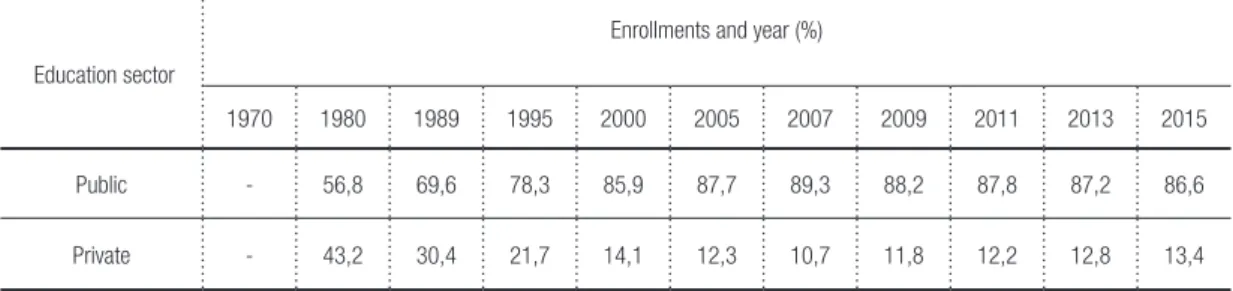
In the Brazilian case, the participation of private schools in secondary education was very significant in the period between the beginning of the 20th century and the 1980s. As can be seen on table 10, until the end of the 1980s, private schools were still responsible for a third of enrollments in secondary school. From the 1980s on, the rapid expansion of public schools have eventually altered the state of things. The incorporation of new contingents was done mainly in the public sector. As a result, the proportion of enrollments in private schools has decreased, reaching the lowest level in 2007, when it received 10,7% of all enrollments in this educational level, with a small increase after that.
In Brazil, private school began to be seen, from the 1970s on, as an alternative to those groups that, having already reached secondary education, saw this level been expanded and, therefore, losing its exclusivity. Thus, private schools, the traditional enclave of more privileged groups, became also the destiny of children from different fractions of the middle-classes. This tendency can be understood also as a consequence of insufficient investments in public education to support its expansion, which led to a lack of infrastructure and teachers to supply the demands of an increasingly high enrollment. However, despite the growth in the flow of students from middle classes to private secondary schools, most enrollments were still in the secondary public schools due to its strong expansion.
Table 10 – Brazil – Enrollments in secondary school per educational sector and year.
Education sector
Enrollments and year (%)
1970 1980 1989 1995 2000 2005 2007 2009 2011 2013 2015
Public - 56,8 69,6 78,3 85,9 87,7 89,3 88,2 87,8 87,2 86,6
Private - 43,2 30,4 21,7 14,1 12,3 10,7 11,8 12,2 12,8 13,4
Source: For 1980 to 1989, Historic Series (IBGE); and for 1995 to 2015 Sinopses Estatísticas (INEP).
The analysis of enrollments considering the income of families allows us to understand this point. In the case
Table 11 – Brazil – Population enrolled in school per level, educational system sector, according to per capita family income quintile in 2007 and 2014 (%).
Level
Income
quintile 1 2 3 4 5
Variation % private
Years 2007 2014 2007 2014 2007 2014 2007 2014 2007 2014 q1 q5
Income* R$76 R$186 R$179 R$408 R$307 R$652 R$503 R$1009 R$1.569 R$2.903
Preschool
Public 91 93 79 89 69 82 50 73 19 42
-2 -23
Private 9 7 21 11 31 18 50 27 81 58
School Elementary
Public 98 98 94 96 89 93 72 87 36 58
0 -22
Private 2 2 6 4 11 7 28 13 64 42
High school
Public 98 98 96 97 92 96 79 91 45 71
0 -26
Private 2 2 4 3 8 4 21 9 55 29
Higher education
Public 41 45 36 38 25 29 21 25 20 21
-4 -1
Private 59 55 64 62 75 71 79 75 80 79
(*) Average per capita family income. Minimum wage: R$ 380,00 in 2007; R$ 724,00 in 2014.
Dollar (commercial/sale): R$1,88 on 16/07/2007 and R$2,20 on 16/07/2014 (http://www.portalbrasil.net.htm). Source: created by the authors based on data from Pnad 2007 and 2014 (IBGE).
As can be seen here, in all educational levels, the relation between family income and the educational sector in which the children and youngsters are enrolled is clear: students with lower family income are predominantly in public schools. Private schools become more predominant only in the fifth quintile of income. Besides this, enrollment in public schools increases in all income quintiles between 2007 and 2014, except in the first quintile of elementary and secondary education, in which its importance continues the same.
We can notice that the situation is very
different in higher education. In all income levels the higher enrollment is predominantly in private institutions. However, it is noteworthy that, in 2014, there was a slight decrease in the participation of the private sector in all quintiles of family income, even if it is still the majority, a change that results from the expansion of public higher education.
Table 12 – Argentina – Population enrolled in school per level, educational system sector, according to per capita family income quintile in 2007 and 2014 (%).
Level
Quintile 1 2 3 4 5 Variation %
private
Year Income*
2007 2014 2007 2014 2007 2014 2007 2014 2007 2014 q1 q5
$155 $1008 $349 $2157 $547 $3308 R$862 $5020 $1917 $10771
Initial education
State 86 89 67 66 53 49 31 37 20 24
-3 -4
Private 14 11 33 34 47 51 69 63 80 76
Primary education
State 89 88 70 71 56 53 37 38 34 24
1 10
Private 11 12 30 29 44 47 63 62 66 76
Secondary education
State 90 89 79 80 60 66 47 56 31 38
1 -7
Private 10 11 21 20 40 34 53 44 69 62
Higher education
State 80 86 82 88 76 78 72 74 60 71
-6 -11
Private 20 14 18 12 24 22 28 26 40 29
Non-university higher education
State 68 77 67 83 55 62 60 65 33 54
-9 -21
Private 32 23 33 17 45 38 40 35 67 46
University higher education
State 86 91 86 90 83 84 75 76 66 76
-5 -10
Private 14 9 14 10 17 16 25 24 34 24
(*)Average per capita family income in Argentinean pesos. Minimum wage in Argentinean pesos: $ 900,00 in 2007; $ 4.400,00 in 2014. Dollar: $ 3,10 on 16/07/2007 and $ 8,15 on 16/07/2014 (https://es.investing.com/currencies/usd-ars-historical-data).
Source: created by the authors based on data from Encuesta Permanente de Hogares 2007 e 2014.
decrease of the enrollments in the private sector in all quintiles, except the first one, in which there is a small increase. This indicates the occurrence of a setback in private education in the higher quintiles, even though there is still a strong inequality of enrollments according to family income.
Contrasting with Brazil, these data indicate that, in the period studied, the proportion of enrollments in Argentinian private education grows in all educational levels according to the increase of family income. That said, we notice that the proportion of enrollments changes depending on the educational level. In preschool, primary, and secondary levels, the enrollments in private education surpass 50% of all enrollments in families that belong to higher income quintiles. In the different types of higher education listed above, most part of The elementary level is quite similar
to preschool in terms of the association between system sector and family income. The enrollments in public education are mainly in the first income quintiles (1, 2 and 3), while the enrollment in private education is concentrated in quintiles 4 and 5. In this level, we observe an increase of enrollment in the private sector in the order of 11% in the last quintile of income.
the enrollments is in the state sector, except the fifth quintile regarding the “non-university higher education”, but only in 2001. Finally, also contrary to Brazil that presents a decrease in the demand for private secondary education in almost all levels and quintiles between 2007 and 2014, we observe in Argentina an increase of this demand in many quintiles.
The meaning of private schools
To understand the implications of these differences between the two systems provoked, on one hand, by the increase, in the total number of enrollments, of the participation of private schools in Argentina and, on the other hand, by the increase of the participation of public schools in Brazil, one needs to have in mind that when referring to private schools in one country and in the other we are dealing with different realities. In the Brazilian case, private education is the one offered by schools maintained by various organizations, that can be families, religious congregations, private foundations, among others. These schools can be a single establishment or be part of a series of schools distributed in different cities or states in the country. An example of the latter are the several conglomerates of schools maintained by religious congregations, but there are also many conglomerates maintained by laic organization and companies, even, more recently, those with open capital.
These schools have administrative autonomy, respecting the work laws of the country. During most of the 20th century, Brazilian private schools received contributions of different types of public resources. Nowadays, this is not possible anymore. With few exceptions, these schools today depend only on privately earned resources, generally from the tuition paid by students’ parents, to maintain themselves and develop a lucrative operation, when it happens4.
4- However it is still in place a tax break favorable to the enrollment in private schools. In 2016, families could discount from their taxes an amount of R$
Besides this, Brazilian private schools have total autonomy to define their managing staff, as well as recruiting teachers and students; however this is not followed by total pedagogical autonomy. Schools are submitted to guidelines that organize the national education system and have to respect the regulations of the states in which they are located. These regulations define the number of school days and school working hours, the organization of spaces, as well as the basic curriculum of the different levels of education, including the language used in class. Even though they guarantee certain homogeneity among schools, such regulations leave space to develop particular pedagogical styles, an important aspect to survive in the competitive field of Brazilian private education.
In the case of Argentina, there is a differentiation within the private system. On one hand, there is a type of private school that receives state money to pay teachers. Another part does not receive any state financing and thus, depends only on the resources obtained through tuition charged to the families in order to cover their costs and have a profit. These schools are more elitist and attend more privileged families than the others which receive financial contributions from the state and are, in its great majority, managed by catholic religious congregations.
We consider the separation of students between the public and private sectors in these two national systems as segmentation. We do so because students’ social differentiation based on the school circuit they attend corresponds, at the same time, to a differentiation in the curriculum adopted by each school. In Argentina and in Brazil, the curricular difference derives, in most part of the system, from arrangements that are not legally formalized, as, in both cases, the state recognizes only a single and unified curriculum, defined by it, allowing just minor
variations to fulfill the demands defined by the provinces, in the case of Argentina, or by the states, in the Brazilian case.
However, from this common structure, schools become differentiated in terms of their curriculum. In both countries, state schools have less autonomy than private schools to modify the prescribed curriculum. One of the reasons is financial restriction. The possibility to add contents beyond the minimum required - such as the offering of different foreign languages, art and sport practices as well as the deepening of certain areas of knowledge, etc. - depends on extra resources and is, for this reason, practically inexistent. Generally, activities that go beyond the official curriculum happen in state schools only when they get additional state funding, through special programs or, in rarer cases, by the voluntary contributions from families.
Moreover, in the Brazilian case, the public school sector deals with a chronic insufficiency of resources that threats even possibility of developing the prescribed curriculum. For instance, there is a lack of teachers, an excessive number of students by class, lack of conditions to offer support for the students with low performance, among others. As a result, not even the prescribed curriculum is fully developed in a significant part of state schools.
In contrast, in both countries, private schools, even though they are supposed to adopt the same curriculum imposed by the State, have their own resources, which allow them to have a greater autonomy when defining the school work. They can adopt longer school days, propose a more intensive teaching load of certain academic areas, and develop athletic and artistic activities, as well as extracurricular activities. Furthermore, they can adopt their own pedagogical styles, leading to a certain specialization, as it happens with schools that offer experiences of self-development or focus on arts or sciences.
This difference among the schools curricula has its effects. In Argentina, studies done since the beginning of the 2000s have
been showing that the probability of learning the contents considered as adequate to each educational level is strongly associated to the type of school the student attends. As the access to different types of school is strongly associated to social origin, we find what Cervini (2003, 2004) and Cervini, Dari and Quiroz (2013) treat as sociocultural segmentation of the institutional frame, to indicate exactly the association between the types and levels of contents and students’ social class.
Moreover, the social distinction derived from a schooling done in the private sector has effects beyond the school sphere, as the incentive to develop capacities and competences rare among the population- such as the mastery of foreign languages, the preparation to occupy leadership positions, as well as the creation of social networks can provide significant advantage in the work and marriage markets.
These variations are associated to school performance. Around a quarter of students from municipal and state schools have a performance in Saeb considered below basic (23% and 26% respectively) and the majority has a basic performance (52% and 53%), what means that they do not have an adequate performance to their level .
Amongst the students of private schools, the majority has a performance considered adequate or advanced (59%). The difference compared with the percentage of students with an advanced performance is enormous- 18% in private schools, against 4% and 3% in state and municipal schools, respectively .
Faced by this scenario, we can better understand the reason why the attendance to private schools was, during the 20th century in Brazil, an important resource to access more prestigious higher education institutions, normally public ones, which have demanding entrance exams.
Final remarks
The segmentation of educational systems has been considered in the literature as an important mechanism of reproduction of educational inequalities. It is responsible for the differences in educational experiences of children and youngsters depending on their social origins. In this article, we compared the cases of Argentina and Brazil so as to explore this question.
As we had tried to show, the basic educational curriculum in both systems is, nowadays, officially the same. However, the curricular difference starts early and is strongly associated with the social origin of students. Instead of happening within the public school, as in most countries that have a national education system, the differentiation follows the cleavage between public and private schools and is not regulated by any legislation or official regulation, besides the one which gives space for curricula differentiation. It is,
nonetheless, effective in practice, even if based essentially on the differences in resources of each type of school.
To understand the broader meaning of this arrangement, it is important to keep in mind that the importance given to private schools in the division of the work to educate the new generations expresses the solutions given by each society to the two opposite tendencies that structure the struggles surrounding the educational system.
On one hand, there is a tendency of particularism, which consists on the tolerance or even stimulus to coexistence, in the same national state, of various school models that correspond, more or less closely, to the views on the socialization of younger generations, typical from specific groups or fractions of social groups. Private school finds, in this case, a fertile ground to its development.
On the other, there is the tendency towards school universalism. This universal school would result from disputes among social groups to impose their school model as universal. The presence of unique general regulations regarding the organization of schools, including the definition of curriculum and teacher formation, is a characteristic of systems that tend towards universalism. The universal school, in general state-run, tends to prosper in this environment.
The experience that led the universal, laic schools, managed and subsidized by the State, to the most prominent place in the school system, as seen in France, is not frequent. As argued by Oberti (2005, p. 6), the importance of private school was, through a good part of schooling history, associated “with the place occupied by religions and their relation to the State”. That is why variations in relation to the French model of a universal obligatory laic school are quite frequent (OBERTI, 2005). In the United States, for instance, obligatory school was implemented in the whole national territory without the need of a central administration (TYACK, 1974). In Italy, only recently school laicity became a widely accepted value (BARONE, 2005). There are many examples as these.
Thus, far from been thought as an anomaly, the tension between opposite tendencies of particularism and universalism, materialized, among others, in the opposition between private and public school, can be better understood if considered within an analytical framework that treats the
educational systems as spaces of constant struggle for increasing benefits associated with schooling (BOURDIEU; PASSERON, 1970; BOURDIEU; BOLTANSKI, 1975). In this logic, to examine the social place occupied by the private school in different education systems in a certain moment can be a productive entry point to understand the particular state of the relation between the forces that boost these two tendencies in specific moments of history. It is a productive strategy to understand the effects of institutional arrangements that shape each education system on the production and reproduction of social inequalities.
To conclude, it is important to notice that this segmentation pattern between public and private, traditional in Brazil and increasing in Argentina, seems to be a world trend (MAXWELL; AGGLETON, 2015), which appears to indicate the need of more comparative studies that can contribute to deepen our understanding on the contemporary processes of social differentiation that have school as its base.
References
ABREU, Jayme. A Educação secundária no Brasil. Revista Brasileira de Estudos Pedagógicos, Brasília, DF, v. 86, v. 212, p 39-84, 2005.
ALMEIDA, Ana Maria F. A escola dos dirigentes paulistas: ensino médio, vestibular e estratificação social. Belo Horizonte: Argvmentum, 2009.
ALMEIDA, Ana Maria F. The changing strategies of social closure in elite education in Brazil. In: VAN ZANTEN, Agnès; BALL, Stephen; DARCHY-KOECHLIN, Brigitte (Ed.). Elites, privilege and excellence: the national and global redefinition of educational advantage. v. 1. London: Routledge, 2015. p. 71-81.
ARCHER, Margaret. The sociology of educational expansion: take-off, growth and inflation of educational systems. London: SAGE, 1982.
BARONE, Carlo. La faiblesse de l’instruction privée en Italie: un paradoxe? Sociétés Contemporaines, Paris, n. 59-60, p. 97-119, 2005.
BAUDELOT, Christian; ESTABLET, Roger. L’école capitaliste en France. Paris: Maspero, 1972.
BOURDIEU, Pierre; BOLTANSKI, Luc. Le titre et le poste: rapports entre le système de production et le système de reproduction.
Actes de la Recherche en Sciences Sociales, Paris, v. 1. n. 2, p. 95-107, 1975.
BOWLES, Samuel; GINTIS, Herbert. Schooling in capitalist America: educational reform and the contradictions of economic life. London; Henley: Routledge: Kegan Paul, 1976.
BRASLAVSKY, Cecilia. La educación argentina (1955-1980): primera historia integral, Buenos Aires: Centro Editor de América Latina, 1980.
BRASLAVSKY, Cecilia; KRAWCZYK, Nora. La escuela pública. Buenos Aires: Miño y Dávila, 1988. (Cuadernos Flacso).
BUCHMANN, Claudia. Frontiers in comparative and international sociology of education: American distinctiveness and global diversity. In: HALLINAN, Maureen T. (Ed.). Frontiers in sociology of education. London: Springer, 2011. p. 35-51.
CARVALHO, Marília Pinto de. Sucesso e fracasso escolar: uma questão de gênero. Educação e Pesquisa, São Paulo, v. 29, n. 1, p. 185-193, 2003.
CASTRO, Jorge Abraão. Evolução e desigualdade na educação brasileira. Educação & Sociedade, Campinas, v. 30, p. 673-697, 2009.
CERVINI, Rubén. Diferencias de resultados cognitivos y no-cognitivos entre estudiantes de escuelas públicas y privadas en la educación secundaria de Argentina: un análisis multinivel. Education Policy Analysis Archives, Tempe, v. 11, n. 6, p. 1-32, 2003. Disponível em: <http://epaa.asu.edu/ojs/article/view/234/360>. Acesso em: 2 maio 2017.
CERVINI, Rubén. Nivel y variación de la equidad en la educación media de Argentina. Revista Iberoamericana de Educación, n. 34/4, p. 1-19, 2004. Disponível em: http://rieoei.org/indice_tematico_bbdd.php?id_tema=34.
CERVINI, Rubén; DARI, Nora; QUIROZ, Silvia. Factores institucionales del logro en matemática en la educación media de Argentina, 1998-2007: una actualización. Revista Iberoamericana sobre Calidad, Eficacia y Cambio en Educación, Madri, v. 11, n. 2, p. 119-148, 2013. Disponível em: <http://www.rinace.net/reice/numeros/arts/vol11num2/art6.htm>. Acesso em: 10 maio 2017.
CICOUREL, Aaron; KITSUSE, John I. The educational decision makers: an advanced study in sociology. Indianápolis: Bobbs-Merryl, 1963.
DEPPE, Ulrike; KRÜGER, Heinz-Hermann. Elite education in Germany? Trends, developments and challenges. In: MAXWELL, Claire; AGGLETON, Peter (Org.). Elite education: international perspectives. London: Routledge, 2015. p. 104-113.
DURHAM, Eunice. A educação no governo Fernando Henrique Cardoso. Tempo Social, São Paulo, v. 11, n. 2, p. 231-254, 1999.
DUSSEL, Inés; PINEAU, Pablo. De cuando la clase obrera entró al paraíso: la educación técnica estatal en el primer peronismo. In: PUIGGRÓS, Adriana. Discursos pedagógicos e imaginario social en el peronismo. Buenos Aires: Galerna, 1995. p. 107-176.
FARIA FILHO, Luciano; VIDAL, Diana. Os tempos e os espaços escolares no processo de institucionalização da escola primária no Brasil. Revista Brasileira de Educação, Rio de Janeiro, n. 15, p. 19-34, 2000.
GESSAGHI, Victoria. La educación de la clase alta argentina: entre la herencia y el mérito. Buenos Aires: Siglo XXI, 2016.
HAIDAR, Maria de Lourdes M. O ensino secundário no Império. São Paulo: Edusp, 2008.
HASENBALG, Carlos; SILVA, Nelson do Valle. Família, cor e acesso à escola no Brasil. In: HASENBALG, Carlos; SILVA, Nelson do Valle; LIMA, Marcia. Cor e estratificação social. Rio de Janeiro: Contra Capa, 1999. p. 126-147.-Buenos Aires: Indec, 2001.
INDEC. INSTITUTO NACIONAL DE ESTADÍSTICAS Y CENSOS. Censo nacional de población, hogares y vivienda. Buenos Aires: Indec, 2010.
INDEC. INSTITUTO NACIONAL DE ESTADÍSTICAS Y CENSOS. Encuesta permanente de hogares. Buenos Aires: Indec, 2014. Segundo trimestre 2007 y tercer trimestre, 2014.
KARABEL, Jerome. The chosen: the hidden history of admission and exclusion at Harvard, Yale, and Princeton. Boston: Mariner Books, 2006.
LAREAU, Annette. Home advantage. Social class and parental intervention in elementary education. Philadelphia: Falmer, 1989.
LUCAS, Samuel R.; BERENDS, Mark. Race and track location in U.S. public schools. Research in Social Stratification and Mobility, Amsterdã, v. 25, n. 3, p. 169-187, 2007.
MAXWELL, Claire; Aggleton, Peter (Org.). Elite education: international perspectives. London: Routledge, 2015.
MINISTERIO DE EDUCACIÓN CIENCIA Y TECNOLOGÍA. Dirección Nacional de Información y Estadística de la Calidad Educativa.
Anuario de estadísticas educativas (1996/2014). Buenos Aires: [s. n.], 2014.
MINISTERIO DE EDUCACIÓN CIENCIA Y TECNOLOGÍA, Dirección Nacional de Información y Estadística de la Calidad Educativa.
Informes de resultados ONE 2003, 2005, 2007, 2010, 2013, 2016. Buenos Aires: [s. n.], 2016.
MINISTERIO de Educación Ciencia y Tecnología. Secretaría de Políticas universitarias. Anuario (2003/2014): estadísticas universitarias. Buenos Aires: [s. n.], 2014.
MÜLLER, Detlef K.; RINGER, Fritz; SIMON, Brian Muller. The rise of the modern educational system. Cambridge: Cambridge University Press; Paris: La Maison des Sciences de l’Homme, 1989.
NARODOWSKI, Mariano; MOSCHETTI, Mauro. The growth of private education in Argentina: evidence and explantation. Compare, London, v. 45, n. 1, p. 47-69, 2015.
OBERTI, Marco. Dynamiques institutionnelles et pratiques scolaries: les frontiers poreuses du públic et du privé. Sociétés Contemporaines, Paris, n. 59-60, p. 5-11, 2005.
PEREYRA, Ana. La fragmentación de la oferta educativa en América Latina: la educación pública vs. la educación privada. Perfiles Educativos, Cidade do México, v. 30, n. 120, p. 132-146, 2008.
PEROSA, Graziela S. Escola e destinos femininos. Belo Horizonte: Argvmentum, 2009.
PEROSA, Graziela S. A passagem pelo sistema de ensino em três gerações: classe e gênero na segmentação do sistema de ensino,
Educação & Sociedade, Campinas, v. 31, n. 111, p. 391-409, 2010.
PINÇON, Michel; PINÇON-CHARLOT, Monique. A infância dos chefes: a socialização dos herdeiros ricos na França. In: ALMEIDA, Ana Maria F.; NOGUEIRA, Maria Alice. A escolarização das elites: panorama internacional da pesquisa. Petrópolis: Vozes, 2002. p. 11-28.
RAMIREZ, Francisco; BOLI, John. The political construction of mass schooling: European origins and worldwide institutionalization.
Sociology of Education, Washington, DC, v. 60, n. 1, p. 2-17, 1987.
RIBEIRO, Sérgio Costa. A pedagogia da repetência. Estudos Avançados, São Paulo, v. 5, n. 12, p. 7-21, 1991.
RINGER, Fritz. Education and society in modern Europe. Bloomington: Indiana University Press, 1979.
RIVAS, Axel; VERA, Alejandro; BEZEM, Pablo. Radiografía de la educación Argentina. Buenos Aires: Fundación Cippec, 2010.
SENDÓN, María Alejandra. Consideraciones actuales en torno al debate del papel de la educación. Revista Propuesta Educativa, Buenos Aires, n. 40, v. 2, p. 8-31, 2013.
SOARES, José Francisco. Índice de desenvolvimento da educação de São Paulo - IDESP: bases metodológicas. São Paulo em Perspectiva, São Paulo, v. 23, n. 1, p. 29-41, 2009.
SOARES, José Francisco; ALVES, Maria Teresa Gonzaga. Desigualdades raciais no sistema brasileiro de educação básica.
Educação e Pesquisa, São Paulo, v. 29, n. 1, p. 147-165, 2003 .
SOUZA, Rosa Fátima. Templos de civilização: a implantação da escola primária graduada no estado de São Paulo (1890-1910). São Paulo: Unesp, 1998.
TEDESCO, Juan Carlos. Educación y sociedad en la Argentina 1880- 1945. Buenos Aires: Solar, 1986.
TIRAMONTI, Guillermina (Org.). La trama de la desigualdad educativa. Mutaciones recientes en la escuela media. Buenos Aires: Manantial, 2004.
TODOS PELA EDUCAÇÃO. Anuário brasileiro da educação básica: 2014. São Paulo: Moderna, 2014.
TYACK, David B. The one best system: a history of American urban education. Cambridge: Harvard University Press, 1974.
VATIUK, Verona. Tendencias recientes del nivel inicial: un análisis estadístico de la situación en Argentina. Buenos Aires: OEI: Unicef, 2010.
WOESSMAN, Ludger. International evidence on school tracking: a review. CESifo DICE Report, 2009. Disponível em: <http:// citeseerx.ist.psu.edu/viewdoc/download?doi=10.1.1.551.1536&rep=rep1&type=pdf>. Acesso em: 26 fev. 2017.
ZIEGLER, Sandra. La escolarización de las elites: un acercamiento a la socialización de los jóvenes de sectores favorecidos en la Argentina actual. In: TIRAMONTI, Guillermina (Org.) La trama de la desigualdad educativa: mutaciones recientes en la escuela media. Buenos Aires: Manantial, 2004. . p. 73-99.
Received on March19th, 2017
Approved on June 20th, 2017
Ana Maria F. Almeida is Associate Professor at the University of Campinas School of Education, Brazil (FE/Unicamp). Her research examines the contribution of education for the production and reproduction of inequalities.
Manuel Alejandro Giovine is Assistant Professor at the School of Communication Sciences at the Universidad Nacional de Córdoba (UNC) in Argentina. A PhD student in Instituto de Humanidades (Conicet), his doctorate research examines the educational strategies of dominant groups in Córdoba, Argentina.
Maria Teresa G. Alves is Assistant Professor at the Federal University of Minas Gerais School of Education (FE/UFMG), and Coordinator of the Research Center on Educational Inequalities (Nupede). She studies school effects on student performance and the contextual differences of schools and educational systems.