Exchange rate pass-through inlation and
wage differentials in late-industrializing
economies: the Mexican case
TERESA S. LóPEz GUADALUPE MánTEy LUIS QUInTAnA*
This paper investigates exchange rate pass-through inlation, and the wage bar-gaining process, in a developing economy in which irms’ market power is largely dependent on technical progress embodied in imported intermediates and capital goods. It develops a heterodox model of income distribution, based on theoreti-cal contributions from Latin American structuralists, labor market segmentationists and post-Keynesian writers, and it presents supportive empirical evidence from the Mexican economy.
Keywords: income distribution; inlation; developing economies. JEL Classiication: E11; E12; E31; J31; O11.
INTRODUCTION
Conventional macroeconomic theory, by assuming representative agents and competitive markets, has been unable to deal with the heterogeneous structures of production typical of developing countries.
Many writers have denied the uniqueness of economic theory, particularly
Brazilian Journal of Political Economy, vol 32, nº 4 (129), pp 634-655, October-December/2012
with regard to growth constraints and inflation determinants, in semi-industrialized countries.
In the late 1940s, a group of economists working at the United Nations Com-mission for Latin America claimed that the development process in backward economies could not be explained as a stage of capitalist development following the same path of early industrialized nations (Prebisch, 1949, 1983; Rodríguez, 1980; Bielchowsky, 1998). Their analyses were based on the historical evolution of
economic relations between rich and poor countries, and the specialization in for-eign trade that ensued. The center-periphery models they elaborated emphasized differences in production patterns resulting from less developed countries’ techno-logical backwardness, which made them exporters of raw materials and importers of capital goods and intermediates.
One point stressed by these writers — which has been notably neglected in mainstream macroeconomics — is that currency devaluations become strongly inflationary when there is a sizeable technological dependence from abroad, and when the Marshall-Lerner condition is not fulfilled. The basic forces that produce
structural inflation, as this phenomenon was named, cannot be imputed to
mon-etary expansion; but rather, the increase in money supply that accompanies cur-rency depreciation is one mechanism by means of which developing countries solve the distribution conflict brought about by the exchange rate adjustment (Lustig, 1988; Camara and Vernengo, 2001).
In the early 1960s Chenery argued that growth models were inadequate as a basis for development policy, because they neglected important questions that con-strain growth in developing economies, such as foreign exchange availability and technological dependence on developed countries (Chenery and Bruno, 1962).
Thirlwall (1979, 2003) has further developed these ideas, in his influential balance of payments constrained growth model, where the income elasticities of exports and imports determine the long-run path of a country.
In this paper, we investigate the exchange rate pass-through inflation, and the wage bargaining process, in a developing economy where firms’ market power is largely dependent on technical progress embodied in imported intermediates and capital goods. Our main objective is to establish how conflicting claims on income are eventually settled in this type of economy, in order to assess the inflationary consequences of currency devaluation, monetary policy and labor market behavior. The paper is divided into six sections. In the first section, we review the deter-minants of exchange rate pass-through inflation and factor income distribution under different market structures. On the basis of this information, we conjecture the likely effects of currency depreciation in an economy in which oligopolistic firms are the price leaders.
In the second section, we formalize a model of pricing and income distribution under imperfect competition.
pow-er is based on their technical advances. Then, we examine the consequences of such assumptions through the model presented, illustrating them with statistical data on the Mexican economy.
In the next section, we use our analytical framework to study the effects of increased international capital mobility and speculative investment on factor in-come distribution in developing countries.
In the fifth section we present an empirical estimation of the model with quar-terly data on the Mexican economy from the 1978-2010 period. We conclude with a few policy recommendations derived from our econometric results.
ExChANGE RATE PASS-ThROUGh INFLATION AND INCOME DISTRIBUTION UNDER DIFFERENT MARKET STRUCTURES
The new consensus in macroeconomics rests on the neoclassical theory of income distribution, dependent on the marginal productivities of productive factors, and a hybrid theory of inflation that reconciles rational expectations on future inflation with the Keynesian Phillips curve (Panico and Salvadori, 2006). In this framework, inflation (P) depends on nominal wage increases and the output gap (or the change in unit labor costs, ULC), as well as on past and rationally expected inflation (Romer, 2000; Svensson, 1997; Galí et al., 2001). In open economy mod-els, the direct effect of exchange rate changes (E) on import prices is also incorpo-rated (Svensson, 2000; Ball, 2000).
ΔP = ULC + b E (1.1)
where b represents the share of imports in gross domestic product.
In line with neoclassical theory, this approach disregards imperfect competi-tion and distribucompeti-tion conflict, along with the corresponding equilibrium correccompeti-tion mechanisms.
The pioneering work of Kalecki (1956) has ever since inspired a long stream of mark-up pricing models that aimed to explain the behavior of firms under im-perfect competition. In the late 1980s, multinational firms’ pricing behavior under imperfect competition received specific attention, because of the unexpected effects from exchange rates variation on import and export prices, as well as on the trade balance of major industrial countries (Krugman and Baldwin, 1987).
Empirical evidence indicated that pricing to market was a common practice for multinational enterprises in international trade, and exchange rate pass-through imports prices was incomplete. Arestis and Milberg (1993) studied this phenome-non within the framework of Eichner’s model. Notwithstanding they were primar-ily concerned with foreign firms’ pricing behavior in developed countries, we be-lieve their analytical framework may also be useful to explain the inflationary consequences of currency devaluations in less developed countries.
he postulated that the mark-up would be dependent upon the firm’s demand for investing resources and supply conditions of additional finance. The leading firm would be planning its investment outlays on the basis of the new assets’ mar-ginal productivities; and in so doing, it would decide how much of the required finance should come from retained earnings, and how much it should raise from financial markets.
Because of its market power, the firm would be able to increase the mark-up in order to finance its desired expansion. Nevertheless, this option can be expected to involve costs in the future, to the extent that the firm’s customers find substitutes for the product; new competitors enter the market, or the government decides to raise the tax levy.
Eichner assumed these trade-offs could be estimated by the leader, who would eventually resort to internal finance, up to the point where its expected cost equaled the market rate of interest.
One important implication of this theory, which we shall return to later, is that an expansionary monetary policy that lowers the rate of interest would actu-ally be deflationary, and not inflationary as mainstream economic theory postulates Credit availability, at moderate interest rates, would discourage firms with market power from raising funds internally, thereby contributing to stabilizing prices.
Following Eichner, Arestis and Milberg (1993) define the price charged by an individual firm (P) as the sum of average variable cost (AVC), plus fixed costs (FC) and the corporate levy (or the cost of internal finance, CL) per unit of output, as-suming the firm operates at normal capacity. Normal capacity is defined as the product of the standard operating ratio (SOR) times the engineering rated capac-ity (ERC):
P = AVC + [(FC + CL)/ (SOR*ERC)] (1.2)
For a foreign firm operating in the domestic market, the right-hand side of the above equation would have to be multiplied by the exchange rate (e).
Variations in the exchange rate would translate into price changes in propor-tion to their effects on: i) average variable costs; ii) the firm’s projects for expansion, as well as the required financing to carry them out; and iii) domestic interest rates. Eventually, the pricing decision for the foreign firm, as well as for national corporations, will depend on average variable costs expressed in the local currency, the level of desired investment, the implicit cost of internal funds (i.e., by raising the product price), and the interest rate on borrowed funds.
Depreciation of the local currency brings about a rise in the implicit cost of internal funds for the foreign firm, since its average variable cost and overheads expressed in the local currency increase, and its competitive position vis-à-vis rival domestic corporations deteriorates. A rise in the internal cost of funds, in this model, would lead to a fall in the mark-up; that is, to an incomplete exchange rate pass-through. The foreign firm would be compelled to finance its new investments by means of additional borrowing.
depreciation, the cost of internal funds for all corporations would rise further, mark-ups would fall to a larger extent, and the exchange rate pass-through would still be more limited.
On the grounds of Eichner’s model, and assuming the corporate levy repre-sents the objective variable for the firm, the rate of inflation would depend on the expected profitability of new assets, the market rate of interest, and unions’ bar-gaining power. If the marginal productivity of investment rose (i.e., because em-bodied technical progress involved increased efficiency, product differentiation etc.), and everything else remained the same, the mark-up would widen and real wages would fall. Since workers’ expectations would be disappointed, at the following wage negotiation, labor unions would exert pressure on firms’ management in order to get a share in productivity gains.
Post-Keynesian mark-up pricing models assume wage bargaining is carried out in nominal terms, even though workers strive for a target real wage (Arestis and Skuse, 1991; Sawyer, 1982). Among the variables that influence labor demands, these models consider market conditions, price expectations, the highest real wage hitherto observed, and prevailing wage differentials among different groups of work-ers. Eventually, however, it is mark-up pricing that determines income distribution. The important question here, in order to disclose the effect of nominal wage rates on inflation, is to what extent unions become satisfied when they hit the real wage rate target and/or maintain wage differentials with other groups of workers. If these are their main objectives, as several authors affirm, then it is irrelevant that wage bargaining is conducted in money terms; for the real wage rate would eventu-ally be historiceventu-ally determined (Sawyer, 1982).
Joan Robinson argued that trade unions are not always conscious of the extent to which wages should rise, provided they rise at all. She pointed out that accord-ingly, when technical progress enables innovators to pay wages above market rates, by lowering average costs, the latter become allies of trade unions, even though eventually the degree of monopoly rises (Robinson, 1966, p. 94).
In these theoretical approaches to income distribution under imperfect com-petition, one finds two pervasive ideas. First, that in oligopolistic product markets, capital accumulation is a defensive policy by means of which the price leading firm strengthens its market power. Second, that the productivity gains from embodied technical progress are initially appropriated by oligopolistic entrepreneurs, who share them with their employees only later, and always in a discretional manner (i.e., since eventually real wages depend on mark-ups), either under the pressure of labor unions, or by their own initiative.
As a matter of fact, these two ideas are at the core of segmented labor market theory.
a result of this behavior, workers in oligopolistic firms are not paid according to their productivity or skills, but on the basis of institutional seniority privileges and custom (Gordon, 1972).
The proponents of this approach distinguish two types of labor markets: first, the primary market, which includes the best jobs, and is characterized by high wages; on-the-job training; economic security and career advancement; employment relations governed by formal rules previously agreed upon with labor unions; and isolation from outsiders’ competition.
By contrast, the secondary market clusters the worst jobs, or those not requir-ing special skills. In this market, wages are determined by supply and demand; individual incomes depend more heavily on variations in working hours than on wages; working conditions are unfavorable; employment is variable; and there are few opportunities for advancement (Piore, 1971).
Since training costs differ among industries and firms, the primary market is
balkanized (Leontaridi, 1998); each oligopolistic firm builds up its internal job ladder
and wage structure, which are connected with the external market through only a few “ports of entry”. At these points, workers recruited by the oligopolistic firm are paid a wage above the market rate, but as they are trained and upgraded, their wages rise according to the institutional rules set by the firm. In this way, a part of the gains in total factor productivity, brought about by technical progress, are re-distributed in a discretional way among skilled workers (Blanchflower et al., 1996).
It thus follows that nominal wage increases in the primary market cannot be a source of inflationary pressures, since they are administered by the firm on the basis of its target profit margin and its desired rate of accumulation.
Nominal wage increases in the secondary market might have inflationary ef-fects, to the extent that they exert pressure on wages at primary markets’ ports of entry. Nevertheless, since at these points the oligopolistic firm actually bids up the external market rate, and there is scope to compensate for a higher starting wage by shrinking wage differentials at the upper levels of the internal wage structure, its impact on the average variable cost would be limited.
hence, we may conclude that under conditions of oligopolistic competition and segmented labor markets, it is unlikely that skilled labor nominal wage in-creases become a source of inflationary pressures; rather, one may expect that primary labor markets behave as buffers that mitigate the distributive conflict that causes inflation.
STyLIzED FACTS IN ExChANGE RATE PASS-ThROUGh AND INCOME DISTRIBUTION UNDER AN OLIGOPOLy
The price level (P) is dependent on the exchange rate (ER), the unit labor cost (ULC), and a random error (u1):
P = a1 + a2 ER + a3 ULC + u1 (2.1) where a2 > 0and a3 < 0
The main difference with the conventional price equation in Section 1 is the negative sign of a3, the unit labor cost coefficient, which is explained by the rent-sharing mechanism assumed in primary labor markets.
Unit labor cost (ULC) is a function of technical conditions of production, which we assume constant in the short run, but falling in the long run as a result of technical progress; wage rates in both primary (W1) and secondary (W2) labor markets; and a stochastic disturbance term (u2). The primary market wage rate is expressed as a wage differential (DIF) with respect to the wage rate in the second-ary market; and the latter is assumed to be dependent on the institutionally deter-mined minimum wage (Wmin), so that:
DIF = W1 / W2
ULC = b1 + b2 DIF + b3 Wmin + u2 (2.2)
where b2 , b3 > 0
The wage differential equation portrays a rent-sharing process. The constant term reflects the structural elements, such as income distribution in society and the degree of product market oligopoly, determining efficiency wages at the ports of entry into firms’ internal job structures. The two explanatory variables indicate the profit stabilizing role of skilled labor pay-roll.
It is assumed that skilled labor wage differentials shrink when the overall level of employment (EMP) rises, and wages in the secondary (competitive) market start to climb.
On the contrary, skilled workers’ wage differentials swell if firms have easy access to credit that lowers their financial costs.
DIF = γ1 + γ2 EMP + γ3 CRED + u3 (2.3) where γ1, γ3 > 0 and γ2 < 0
The model assumes an oligopolistic market structure, in which currency de-valuation brings about a fall in economic activity (Krugman and Taylor, 1979).
If central banks tighten monetary policy after the exchange rate adjustment, as they usually do, with the aim of moderating its inflationary consequences, cred-it stringency further slows down income growth.
An increase in unemployment depresses wages in the secondary labor market, and also strengthens oligopsony in primary labor markets, in which labor produc-tivity can be enhanced by means of the criteria applied in internal job evaluations. As the productivity of the previously employed skilled workers increases, some of
Skilled workers’ wage differentials will increase as unskilled workers’ wages decline, but credit stringency operates in the opposite direction.
Rising unemployment on the whole, and declining wages in the secondary market, are likely to reduce labor costs. Therefore, it is not surprising that an in-crease in inflation, brought about by currency devaluation, coincides in time with a fall in unit labor costs. In fact, under conditions of oligopolistic competition, as the workers’ share in income declines, and the income multiplier falls, the contrac-tionary and inflacontrac-tionary effects of devaluation become stronger, because in such circumstances, price leading firms prefer to adjust the quantity supplied rather than their price.
Recursive substitution of Equations (2.2) and (2.3) into Equation (2.1) leads to the following reduced form of the inflation function:
P = δ1 + δ2 ER + δ3 CRED + δ4 EMP + δ5 Wmin + u4 (2.4)
where δ2, δ4 > 0; and δ3, δ5 < 0
It can be seen, from the signs of δ2 and δ3, that the inflationary impact of cur-rency devaluation is amplified when it is accompanied by a tight monetary policy, and together bring about a fall in capacity utilization.
Contrariwise, the opposite signs of δ4 and δ5 indicate that the inflationary ef-fect of rising employment, during a cyclical expansion, tends to be offset by the deflationary effect of higher capacity utilization due to workers’ increasing demand.
ExChANGE RATE PASS-ThROUGh AND INCOME DISTRIBUTION IN A DEVELOPING ECONOMy
In this section, we introduce into our analytical framework two peculiarities of the developing economy: i) an excess supply of unskilled labor; and ii) a high degree of dependence on imported capital goods and technology.
We assume that oligopolistic firms’ market power is based upon imported technology and capital goods; and investigate the inflationary effects of bank cred-it expansion, exchange rate depreciation, and skilled labor wage bargaining.
Credit expansion and inlation
In such a model, bank credit expansion would, by lowering the loan rate, diminish the maximum cost the oligopolistic firm would be willing to incur, in the case of raising the funds required for investment from its earnings (corporate levy). Since mark-up depends positively on the corporate levy, prices would tend to fall.
In this framework, bank credit cannot be inflationary for two reasons: first, because under oligopolistic competition there is always excess capacity; and second, because the bank credit likewise granted to oligopolistic firms would enable them to undertake new projects and benefit from technical progress.
prices (because of its inverse relation to interest rates), it is important to notice that it may actually become inflationary in an indirect way, if it brings about an excess of imports over exports, prompting currency depreciation. We deal with this prob-lem in the following section.
In a developing economy, where technical progress is embodied in imported material inputs and factor services, and the Marshall-Lerner condition does not hold, foreign producers naturally become the price leaders.
On the basis of Eichner’s model, one should expect that an exchange rate depreciation, under such circumstances, would bring about an amplified effect on domestic inflation, and not the incomplete pass-through observed in industrialized countries, because:
• it would raise the cost of investment projects expressed in the local currency, and therefore the corporate levy;
• the prices of the imported inputs that form part of the variable cost would also increase;
• expectations of recession would induce local producers to raise their mark--ups, without fear of foreign competition;
• the monetary authority would be moved to raise the rate of interest, in order to soothe inflation, thereby increasing firms’ financial costs (Palley, 2002). It is for these reasons that, in a developing economy, currency devaluation does not contribute to stabilizing the balance of payments, but rather it sets out a devaluation-inflation-devaluation spiral.
Latin American structuralists arrived at the same conclusion, though they explained it on different grounds, as the result of an inelastic supply of tradable primary goods and commodities in the short run, and an inelastic demand for im-ports during the early stages of industrialization (Prebisch, 1983; Rodríguez, 1980; Noyola 1957; Pinto, 1975).
More recently, other authors have explained the large exchange rate pass-through inflation in developing countries as a result of their incapacity to borrow abroad in their own currency (“original sin”) and their liabilities dollarization (Eichengreen, 2002; Calvo and Reinhart, 2000; Eichengreen et al., 2003).
Wages and inlation
In this section, we use the analytical framework developed to trace the effects of skilled labor wage increases on the inflation rate in a developing economy.
On the basis of segmented labor market theory, one would expect that an excess supply of unskilled labor would keep real wage rates in the secondary mar-ket at a very low level. Even though this theory rejects the possibility of arbitrage between the two markets, it is conceivable that what people consider to be a “fair wage” for a skilled worker is related in some way to the average wage for unskilled workers. From here it would follow that the wage rate at the lowest port of entry to the internal wage structures of oligopolistic firms would also be low.
If workers and unions behaved as it is usually assumed they do, and if: 1. they were mainly concerned with achieving a target real wage rate, which
is proxied by the largest one they got in the past; and
2. they aimed at maintaining their wage differentials with respect to other groups of workers;
oligopolistic firms would have wide scope to let skilled workers share in the productivity gains from technical progress, without impairing their growth pros-pects.
Given that in a surplus (unskilled) labor economy the recruiting wage rates at the bottom of the oligopolistic firms’ internal job structures would be permanent-ly pulled down by the (low) average wage in the secondary market, the latter would operate as a nominal anchor for every wage structure in the primary markets. In countries where market forces, if left unrestricted, would drive the unskilled labor wage rate below a tolerable level, and where a minimum wage is enforced by law, this institutionally determined wage rate fulfils the anchor function for the two segments of the labor market.
In this analytical framework, it is conceivable that the decision on the produc-tivity gains from technical progress that the oligopolistic firm distributes among its employees will be dependent on the corporate levy; that is, on that part of the firm’s financial needs that must be satisfied with internal funds. Since the corporate levy is positively associated with the loan rate of interest, one should expect that skilled workers’ wage differentials with respect to unskilled workers will be inversely de-pendent on interest rates, and directly related to credit availability.
The main conclusion that we derive from this analysis is that the process of skilled labor wage determination, by its nature, is not a source of inflationary pres-sures. Causality would go in the opposite direction: from price rises brought about by an increasing degree of monopoly, to skilled labor administered wages. If pro-ductivity had not grown, skilled labor wages would not have been raised.
hence, productivity gains and the labor sharing factor are direct functions of investment growth and credit availability. From this point of view, credit expansion and economic growth could actually be deflationary, and could reduce income inequalities, provided imports do not exceed export capacity.
Nevertheless, our model differs from this approach on three points: i) its ex-plicit consideration of firms’ market power based on imported technology and capital goods; ii) the assumption of an excess supply of unskilled labor and seg-mented labor markets; and iii) the adoption of Eichner’s theory of the determinants of firms’ mark-up under oligopoly.
These elements bring about distinct conclusions on the role of wages and ex-change rates on inflation and income distribution in developing economies.
CAPITAL MOBILITy, SPECULATIVE INVESTMENT AND ThE DESIRED RATE OF ACCUMULATION
In Eichner’s model, the firm’s planned investment is exogenously determined, and therefore it is neither affected by the market rate of interest nor by the cost of internal funds. Obviously this is an unrealistic assumption.
In any open economy, speculative investment in foreign assets, and capital gains on financial assets (brought about by changes in domestic and international interest rates, as well as in the exchange rate) determine changes in productive in-vestment decisions.
Taking into account that worldwide financial deregulation and innovation have increased capital mobility, we may assume that through arbitrage they have led to the establishment of a minimum profit margin on international financial investments that sets a floor to productive investment profitability.
In a developing economy, where currency depreciations are usually large, and followed by analogous increases in inflation and interest rates, along with a decline in economic activity, asset substitution is more intense.
In the last section, we concluded that skilled labor wage rates were adminis-tered prices in the oligopolistic firm, and behaved like buffers in resolving the conflicting claims on income. Seeing that labor immigration confronts political opposition in almost every country, while international capital inflows are usually welcome, it is conceivable that the different degree of mobility of capital and labor reinforces the passive role of wage rates in the inflationary process.
In fact, the threat posed by international capital mobility has led developing countries to undertake economic policies and institutional reforms that lower the risks and enhance the profitability of foreign investments, at the same time that they establish institutional reforms aimed at deregulating the labor market (FitzGer-ald, 2005; Alvarez, 2002).
Revista de Economia Política 32 (4), 2012 645 STRUCTURAL INFLATION AND UNIT LABOR
COSTS IN A DEVELOPING ECONOMy
Mexico is a typical example of a developing economy subject to structural infla-tion (see Graph 1). Various estimates of the exchange rate elasticity of inflainfla-tion indi-cate it approaches unity1. Granger causality tests systematically indicate that exchange
rate variations anticipate consumer price changes, and not the other way around, as relative purchasing parity theory holds (Martínez et al., 2001; Mántey, 2006).
The tests give unambiguous significant results with quarterly lags from 1 to 40.
-100 -50 0 50 100 150 200 250 300
1981Q1 1982Q1 1983Q1 1984Q1 1985Q1 1986Q1 1987Q1 1988Q1 1989Q1 1990Q1 1991Q1 1992Q1 1993Q1 1994Q1 1995Q1 1996Q1 1997Q1 1998Q1 1999Q1 2000Q1 2001Q1 2002Q1 2003Q1 2004Q1 2005Q1 2006Q1 2007Q1 2008Q1
Percentage
Graph 1: Inflation, currency devaluation and unit labor cost
(Annual growth rates)
Inflation Unit labor cost index
Currency devaluation
In addition, labor organization in Mexico has been traditionally weak. In the manufacturing industry, only 20% of firms report unionized labor (López and López, 2006); and a tripartite body, in which representatives of the government, entrepreneurs and labor unions participate, settles the minimum wage rates for blue and white collar activities, which operate as guidelines for industry and firm wage contracting. These elements, as we shall see, account for the unusual inverse rela-tionship that Graph 1 reveals, between the rate of inflation and changes in unit labor costs in manufacturing.
These two phenomena contrast sharply with the experience of developed
coun-1 Galindo et al. (2007), on the basis of a cointegration price equation and an error correction model
tries. Arestis and Milberg (1994), in their investigation of the inflationary effects of exchange rates and unit labor costs in Great Britain and the United States during the 1972-1989 period, found that in the former country, the exchange rate pass-through coefficient was 0.009, while the absolute values of the coefficients for wage and productivity increases were 0.474 and 0.341, respectively. In the United States, the absolute values of the same coefficients were 0.015, 0.375 and 0.001.
Calvo and Reinhart (2000), who also estimated the exchange rate pass-through inflation in a sample of 25 countries from 1970 to 1999, observed that in emerging economies it was four times greater than in developed countries.
We argued earlier that the magnified response of inflation to exchange rate variations in a developing economy was a result of its dependence on imported technology, and of domestic firms’ market power being based upon imported cap-ital goods and intermediates. Since these issues have been largely studied, not only by the Latin American writers already mentioned, but by other authors as well (Palley, 2001; Taylor, 1983; hernández-Barriga, 2009; Ampudia, 2007; Mántey, 2005), we shall concentrate here on explaining the inverse relationship between unit labor costs and inflation.
Unit labor costs vary directly with wage rate changes, and inversely to labor productivity growth. In Mexico, fixed investment, gross domestic product, and the marginal output/capital ratio are highly correlated (see Graph 2), thereby indicating not only the effectiveness of the investment multiplier, but also the generation of productivity gains from embodied technical progress.
-50 -40 -30 -20 -10 0 10 20 30 40
-0.4 -0.3 -0.2 -0.1 0 0.1 0.2 0.3
1981Q1 1982Q2 1983Q3 1984Q4 1986Q1 1987Q2 1988Q3 1989Q4 1991Q1 1992Q2 1993Q3 1994Q4 1996Q1 1997Q2 1998Q3 1999Q4 2001Q1 2002Q2 2003Q3 2004Q4 2006Q1 2007Q2 2008Q3
Percentage
Marginal
Y/K
Graph 2: Gross fixed investment and productivity gains
Marginal output/capital ratio (yearly average)
Real investment annual growth rate
Revista de Economia Política 32 (4), 2012 647 Fixed investment is inversely related to exchange rate behavior, as we antici-pated, because of the high degree of substitution between productive assets and deposits in foreign currencies, in firms’ investment decisions (see Graph 3).
-100 -50 0 50 100 150 200 250 300
1981Q1 1982Q1 1983Q1 1984Q1 1985Q1 1986Q1 1987Q1 1988Q1 1989Q1 1990Q1 1991Q1 1992Q1 1993Q1 1994Q1 1995Q1 1996Q1 1997Q1 1998Q1 1999Q1 2000Q1 2001Q1 2002Q1 2003Q1 2004Q1 2005Q1 2006Q1 2007Q1 2008Q1
Percentages
Graph 3 : Currency devaluation and real investment
(Annual growth rates)
Currency devaluation
Gross fixed investment
It is for this reason that, when the national currency appreciates, and the rate of inflation falls, investment flourishes and total factor productivity increases. Un-der these circumstances, price leading firms are better disposed to share a part of the productivity gains with their skilled workers, so the average real wage increas-es; but since wages rise only after productivity gains have been realized, a change in investment is followed by a change in the same direction in unit labor cost. Conversely, when fixed investment falls, and productivity growth declines, skilled labor real wages are likely to stagnate, and unit labor costs go down.
For this reason, currency depreciation coincides in time with a rise in the infla-tion rate, and also with a fall in unit labor costs; while currency appreciainfla-tion sta-bilizes domestic prices, and brings about a rise in unit labor costs.
hence, in a developing labor surplus economy, heavily dependent on im-ported capital goods and technology, the labor market operates like a buffer that absorbs the shocks that otherwise would lead to an inflationary solution to resolve conflicting claims on income. Let us consider the case of trade openness with cur-rency overvaluation.
From the early 1980s to the mid-1990s, the Mexican economy went through a swift process of deregulation and opening, in which the real exchange rate varied widely, often exposing domestic industry to foreign competition in unfavorable
terms. Under these circumstances, manufacturing firms were compelled to increase labor productivity, which they achieved in the short run mostly by lowering em-ployment (see Graph 4).
60 80 100 120 140 160 180 200
0.1 0.2 0.3 0.4
0.5 0.6
1980Q4 1981Q4 1982Q4 1983Q4 1984Q4 1985Q4 1986Q4 1987Q4 1988Q4 1989Q4 1990Q4 1991Q4 1992Q4 1993Q4 1994Q4 1995Q4 1996Q4 1997Q4 1998Q4 1999Q4 2000Q4 2001Q4 2002Q4 2003Q4 2004Q4 2005Q4 2006Q4 2007Q4 2008Q4
Labor productivity
Degree of openness
Graph 4: Degree of openness and labor productivity
(Four trimester moving averages)
Degree of openness
Labor productivity
While output per worker in manufacturing increased by more than 92% in real terms from 1980 to 2008, the institutionally determined minimum wage lost two thirds of its purchasing power in the same period. The average unskilled labor real wage in that sector decreased 22%; and the skilled labor real wage showed the larg-est swings, ending only 8% above its 1980 level (see Graph 5).
In Graph 5 we can observe that the three wage rate series underwent similar behavior with respect to their turning points; whereas labor productivity behaved differently, with its turning points not always coinciding with the former.
These facts are consistent with two of our assumptions: first, that in the wage bargaining process, labor unions’ prime concern is to defend wage differentials; and second, that firms share productivity gains with white collar workers on a discretional basis.
Skilled labor wage rates exhibit the same pattern of twists as unskilled labor wages, but they were not pulled downwards by the institutional minimum wage. Accordingly, skilled workers’ wage differentials widened.
Notes: Openness was proxied by the ratio of exports plus imports to GDP.
4 AIC 0
20 40 60 80 100 120 140 160 180 200
1980Q4 1982Q1 1983Q2 1984Q3 1985Q4 1987Q1 1988Q2 1989Q3 1990Q4 1992Q1 1993Q2 1994Q3 1995Q4 1997Q1 1998Q2 1999Q3 2000Q4 2002Q1 2003Q2 2004Q3 2005Q4 2007Q1 2008Q2
Indexes Base 1980=100
Graph 5: Labor productivity, minimum wage, skilled and unskilled workers wage rates
(Indexes Base 1980=100)
Labor productivity Minimum wage
Unskilled labor wage rate Skilled labor wage rate
ExChANGE RATE PASS-ThROUGh AND FACTOR INCOME DISTRIBUTION IN MExICO
The three equation model proposed in Section 3 was empirically tested with quarterly data on the Mexican economy for the period 1980.1-2008.4.
The sample period was so defined in order to capture the large fluctuations in the exchange rate experienced after the 1982 and 1994 crises, as well as the per-sistent decline in employment and minimum wages from 1980 onwards.
Variables in the equations were proxied by the following indicators, and trans-formed into logarithms:
P Consumer Price Index
ER Inter-bank peso-US dollar exchange rate at the end of period ULC Share of total labor income in output, in manufacturing industry Wmin Minimum real wage index
DIF Ratio of white collar workers’ average wage index to blue collar workers’ average wage index, in manufacturing industry
EMP Index of employment in manufacturing industry CRED Ratio of bank credit to monetary base
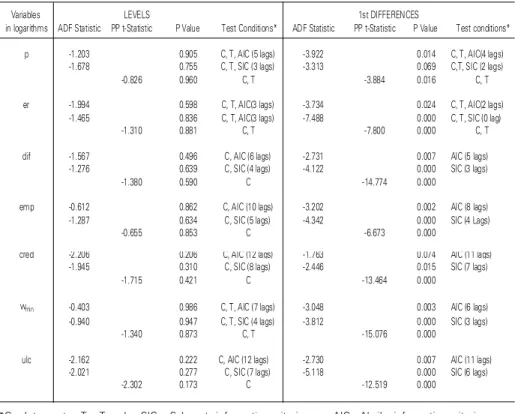
Since all the series in logarithms appeared to be integrated of order one (see Table 1), we explored cointegration by means of the Johansen procedure.
Table 1: Augmented Dickey-Fuller and Phillips-Perron Unit Root Tests
Variables LEVELS 1st DIFFERENCES
in logarithms ADF Statistic PP t-Statistic P Value Test Conditions* ADF Statistic PP t-Statistic P Value Test conditions*
p -1.203 0.905 C, T, AIC (5 lags) -3.922 0.014 C, T, AIC(4 lags) -1.678 0.755 C, T, SIC (3 lags) -3.313 0.069 C,T, SIC (2 lags)
-0.826 0.960 C, T -3.884 0.016 C, T
er -1.994 0.598 C, T, AIC(3 lags) -3.734 0.024 C, T, AIC(2 lags) -1.465 0.836 C, T, AIC(3 lags) -7.488 0.000 C, T, SIC (0 lag)
-1.310 0.881 C, T -7.800 0.000 C, T
dif -1.567 0.496 C, AIC (6 lags) -2.731 0.007 AIC (5 lags) -1.276 0.639 C, SIC (4 lags) -4.122 0.000 SIC (3 lags)
-1.380 0.590 C -14.774 0.000
emp -0.612 0.862 C, AIC (10 lags) -3.202 0.002 AIC (8 lags) -1.287 0.634 C, SIC (5 lags) -4.342 0.000 SIC (4 Lags)
-0.655 0.853 C -6.673 0.000
cred -2.206 0.206 C, AIC (12 lags) -1.763 0.074 AIC (11 lags) -1.945 0.310 C, SIC (8 lags) -2.446 0.015 SIC (7 lags)
-1.715 0.421 C -13.464 0.000
wmin -0.403 0.986 C, T, AIC (7 lags) -3.048 0.003 AIC (6 lags) -0.940 0.947 C, T, SIC (4 lags) -3.812 0.000 SIC (3 lags)
-1.340 0.873 C, T -15.076 0.000
ulc -2.162 0.222 C, AIC (12 lags) -2.730 0.007 AIC (11 lags) -2.021 0.277 C, SIC (7 lags) -5.118 0.000 SIC (6 lags)
-2.302 0.173 C -12.519 0.000
*C = Intercept T = Trend SIC = Schwartz information criterion AIC =Akaike information criterion
For the three equations we obtained cointegrating vectors. Table 2 shows the results, on the grounds of the trace statistic.
Table 2: Johansen cointegration test results
Equation Ho Trace Statistic Critical Value (0.05) Probability Test Conditions
Deterministic trend in data (5.1) p = f (er, ulc) None 48.478 29.797 0.000 No intercept or trend
At most one 15.349 15.495 0. 053 in CE or VAR 1-2 lags
(5.2) ulc = f (dif, wmin) None 41.633 35.193 0.009 Intercept in CE At most one 15.753 20.262 0.186 No intercept in VAR
1-4 lags
(5.3) dif = f (cred, emp) None 47.447 35.193 0.002 Intercept in CE At most one 14.930 20.262 0.230 No intercept in VAR
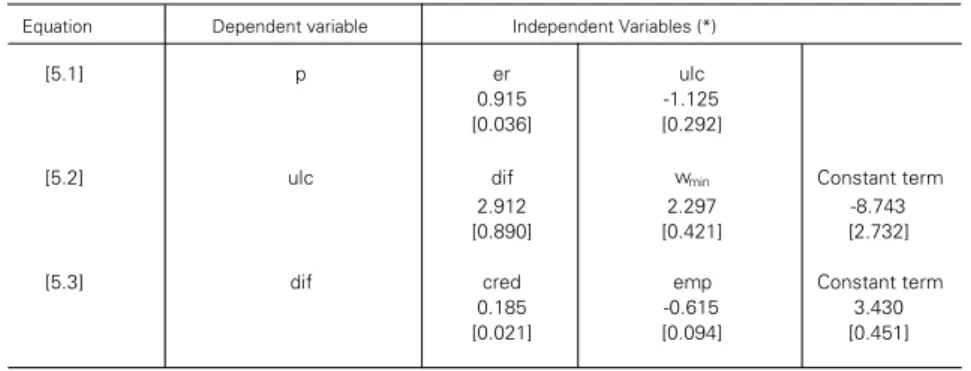
All the variables in the cointegrating vectors showed the expected signs. Table 3 summarizes these results.
Table 3: Estimated equations by the method of cointegration
Equation Dependent variable Independent Variables (*)
[5.1] p er ulc
0.915 -1.125
[0.036] [0.292]
[5.2] ulc dif wmin Constant term
2.912 2.297 -8.743
[0.890] [0.421] [2.732]
[5.3] dif cred emp Constant term
0.185 -0.615 3.430
[0.021] [0.094] [0.451]
(*) Figures in parenthesis below coefficients are standard errors
Equation (5.1) shows that in Mexico, unlike what is observed in developed countries (Calvo and Reinhart, 2000; Arestis and Milberg, 1994), exchange rate pass-through inflation is high, and unit labor costs are negatively associated with inflation rates. The estimated elasticity of inflation with respect to the exchange rate is 0.915, and is not very different from the unit value obtained by Garcés (1999).
The high, negative elasticity of inflation to a change in labor costs, –1.125, suggests that in Mexico, a fall in employment and wage rates has a strong negative effect on aggregate demand, and induces oligopolistic firms to adjust their supply rather than pass over to prices the fall in labor costs. This result is consistent with Verdoorn’s principle.
Equation (5.2) measures the influence of skilled workers’ wage differentials and the institutional minimum wage (which is a basic reference in secondary labor markets) on unit labor cost. The estimated elasticities are notably high, 2.3 and 2.9, respectively, which reflects the strong effects that changes in employment exert on labor incomes. The negative constant term is consistent with the long-run effects of technical progress.
Equation (5.3) provides support to our beliefs about the role of skilled labor wage differentials as shock-absorbers that stabilize the profit rate.
The high, negative elasticity (-0.62) of skilled workers’ wage differentials with respect to employment can be explained by the isolation of primary labor markets from outsiders’ competition, and the discretional administration of internal wage structures. Meanwhile, the positive influence of credit on wage spreads reflects firms’ lower reliance on internal funds for investment when they have easy access to external finance.
theory predictions about the constancy of wage differentials between skilled and unskilled workers, because of their dependence on social structure and conventions. As a final point, this equation suggests that, in a developing economy, the cost of external funds does not exert a significant influence on oligopolistic firms’ mark-up, as Eichner envisaged. Rather, innovating entrepreneurs are able to transfer backwards, to the skilled labor market, the financial constraints on their desired investment.
CONCLUDING REMARKS
We have attempted to demonstrate that two traits of a developing economy, namely its dependence on imported technology, intermediates and capital goods, and its excess supply of unskilled labor, bring about significant differences in the way the price level responds to exchange rate variations, bank credit expansion and wage rate increases, as compared with a developed economy.
It has been argued that in a semi-industrialized economy, local currency de-preciation has a large inflationary effect because domestic firms’ market power is entrenched in imported capital goods; and because this inflationary response in-duces tight credit policies that raise interest rates.
We contended that, as a result of the increased international mobility of finan-cial capital and the fixity of labor, in an open economy profits are the prior deduc-tion in income distribudeduc-tion, and wages are the residual. In conformity with seg-mented labor market theory, we concluded that price leading firms discretionally share amongst their skilled workers the productivity gains from embodied techni-cal progress. Therefore, skilled labor wage increases should not be considered a source of inflationary pressures.
We maintained that when a desired rate of accumulation determines firms’ mark-up over costs, expansionary credit policies may actually become deflationary. Only when flexible credit policies bring about an excess of imports over exports that leads to currency devaluation, they become inflationary. hence, for a develop-ing economy the limit to credit expansion is given by Thirlwall’s law.
From these premises it follows that a developing economy may achieve high-er rates of growth, and a more equitable distribution of income, by means of an expansionary credit policy, provided it satisfies the following conditions:
1. Credit finances projects that increase total factor productivity.
2. Credit is allocated in activities that lower the income elasticity of imports and/or raise the income elasticity of exports.
3. The financial structure efficiently transforms short term bank credit into long term investment funding (Davidson, 1986).
1992). Latin American countries, by contrast, failed to link their credit policies to a long-run industrialization strategy; they regulated bank loans mainly as a means to stabilize the trade account of the balance of payments (Studart, 1998). It is not surprising, thus, that the former region had registered much higher rates of growth and lower degrees of income inequality than the latter, during the last four decades.
REFERENCES
ALVAREz, A. (2002) “La inestabilidad inanciera internacional y sus implicaciones en México”, in Mántey G., N. Levy (eds.), Globalización Financiera e Integración Monetaria: Una Perspectiva desde los Países en Desarrollo, UNAM-M. A. Porrúa, Mexico.
AMPUDIA, N. C. (2007) “Política monetaria, restricción crediticia y empleo”, in G. Mántey, N. Levy (eds.), Políticas Macroeconómicas para Países en Desarrollo, UNAM-M. A. Porrúa, Mexico. ARESTIS, P. and W. MILBERG (1994) “Degree of Monopoly, pricing and lexible exchange rates”,
Journal of Post-Keynesian Economics, 16 (2): 167-88.
ARESTIS, P. and F. SKUSE (1991) “Wage and price setting in a Post-Keynesian theory of inlation”,
Economies et Societés, 25 (11-12): 91-106.
BALL, L. (2000) “Policy rules and external shocks”, NBER Working Paper, No. 7910, September. BAQUEIRO, A., A. DíAz DE LEÓN and A. TORRES GARCíA (2003) “¿Temor a la lotación o a la
inlación? La importancia del ‘traspaso’ del tipo de cambio a los precios”, Banco de México Do-cumentos de Investigación, No. 2003-02.
BARDSEN, G., E. S. JANSEN and R. NyMOEN (2004) “Econometric evaluation of the New Keyne-sian Phillips Curve”, Oxford Bulletin of Economics and Statistics, 66, Supplement: 671-686. BIELChOWSKy, R. (1998) “Cincuenta años del pensamiento de la CEPAL: una reseña”, in Cincuenta
Años de Pensamiento en la CEPAL: Textos Escogidos, Fondo de Cultura Económica-CEPAL, Santiago.
BLANChFLOWER, D. G., A. J. OSWALD and P. SANFEy (1996) “Wages, proits, and rent-sharing”,
Quarterly Journal of Economics, 111 (1): 227-51.
BUSTELO, P. (1992) “La industrialización en América Latina y Asia Oriental: un análisis comparado”,
Comercio Exterior, 42 (12): 1111-19.
CALVO, G. A. and C. M. REINhART (2000) “Fixing for your life”, NBER Working Paper, No. 8006, November.
CAMARA, A. and M. VERNENGO (2001) “The German balance of payments school and the Latin American Neo-structuralists”, in L. P. Rochon and M. Vernengo (eds.), Credit, Interest Rates and the Open Economy, Edward Elgar, Cheltenham.
ChENERy, h. P. and M. BRUNO (1962) “Development alternatives in an open economy: the case of Israel”, The Economic Journal, 72 (285): 79-103.
DAVIDSON, P. (1986) “Finance, funding, saving and investment”, Journal of Post-Keynesian Econo-mics, 9 (1): 101-10.
EIChENGREEN, B. (2002) “Can emerging markets loat? should they inlation target?”, Banco Cen-tral do Brasil Working Paper Series, No. 36, February.
EIChENGREEN, B., R. hAUSMANN and U. PANIzzA (2003) “Currency mismatches, debt intole-rance nd original sin: why they are not the same and why it matters”, NBER Working Paper Se-ries, No. 10036, October.
EIChNER, A. S. (1988) “Una teoría de la determinación del margen de ganancia en el oligopolio”, in Ocampo J. A. (ed.), Economía Poskeynesiana, Fondo de Cultura Económica, Serie Lecturas, No. 60, Mexico.
GALí, J., M. GERTLER and J. D. LÓPEz-SALIDO (2001) “European inlation dynamics”, European Economic Review, 45: 1237-1270.
GALINDO, L. M., R. ESCALANTE and h. CATALáN (2007) “Modelo econométrico dinámico y es-table de la tasa de inlación en México con bandas de probabilidad”, Comercio Exterior, 57(8): 618-631.
GARCéS, D. (1999) “Determinación del nivel de precios y dinámica inlacionaria en México”, Banco de México, Documento de Investigación No. 9907.
GORDON, D. M. (1972) Theories of Poverty and Underemployment, D. C. heath, Lexington Mass. hALL, R. L. and hITCh C. J. (1939) “Price theory and business behavior”, Oxford Economic Papers,
2, reprinted in Sawyer M. C. (ed.) (1988): Schools of Thought in Economics, Vol. 2, Post-Keyne-sian Economics Edward Elgar, Aldershot.
hAUSMANN, R., h. PANIzzA and E. STEIN (2001) “Why do countries loat the way they loat?”,
Journal of Development Economics, 66: 387-414.
hERNáNDEz-BARRIGA, P. (2009) “Tipos de cambio e inlación en América Latina”, in Mántey G., López T. S. (eds.), Política Monetaria con Elevado Traspaso del Tipo de Cambio La Experiencia Mexicana con Metas de Inlación, UNAM-Plaza y Valdés, Mexico.
KALECKI, M. (1956) Teoría de la Dinámica Económica, Fondo de Cultura Económica, México. KRUGMAN, P. and BALDWIN R. (1987) “The persistence of the U. S. trade deicit”, Brookings Papers
on Economic Activity, (1): 1-43.
KRUGMAN, P. and L. TAyLOR (1978) “Contractionary effects of devaluation”, Journal of Internatio-nal Economics, 8(3): 445-56.
LALL, S. (1997) “Selective policies for export promotion: Lessons from the Asian Tigers”, Research for Action, No. 43, United Nations University WIDER.
LEONTARIDI, M. R. (1998) “Segmented labor markets: theory and evidence”, Journal of Economic Surveys, 12 (1): 63-101.
LÓPEz, A. and LÓPEz J. (2006): “Manufacturing real wages in Mexico”, Brazilian Journal of Politi-cal Economy, 26 (3): 459-74.
LUSTIG, N. (1988) “Del estructuralismo al neo-estructuralismo: la búsqueda de un paradigma hetero-doxo”, Colección Estudios CIEPLAN, 23: 35-50.
MáNTEy, G. (2005) “Salarios, dinero e inlación”, in Mántey G., Levy N. (eds.), Inlación, Crédito y Salarios: Nuevos Enfoques de Política Monetaria para Mercados Imperfectos, UNAM-M. A. Por-rúa, Mexico.
MáNTEy, G. (2006) “Inlation targeting and exchange rate risk in emerging economies subject to structural inlation”, in S. Motamen-Samadian (ed.), Economic and Financial Developments in Latin America, Palgrave Macmillan, New york.
NOyOLA, J. F. (1957) “Inlación y desarrollo económico en Chile y México”, Panorama Económico, 11(170), reprinted in CEPAL (1998): Cincuenta Años de Pensamiento en la CEPAL, FCE-CEPAL,
Santiago.
PALLEy, T. I. (2001) “Escaping the policy credibilitytrap: reshaping the debate over the international inancial architecture”, Problemas del Desarrollo, 32 (126): 111-24.
PANICO, C. and N. SALVADORI (2006) “Introduction”, in N. Salvadori and C. Panico (eds.), Classi-cal, Neoclassical and Keynesian Views on Growth and Distribution, E. Elgar, Cheltenham. PINTO, A. (1975) Inlación: Raíces Estructurales, Fondo de Cultura Económica, Lecturas del FCE No.
3, Mexico.
PIORE, M. J. (1971) “The dual labor market: theory and implications”, in Gordon D. M. (ed.), Proble-ms in Political Economy: An Urban Perspective, D. C. heath, Lexington Mass.
PREBISCh, R. (1949) “El desarrollo económico de la América Latina y algunos de sus principales problemas”, Trimestre Económico, 16 (63): 347-431.
PREBISCh, R. (1983) “Cinco etapas de mi pensamiento sobre el desarrollo”, Trimestre Económico, 50 (198): 1077-96.
ROBINSON, J. (1966) The Accumulation of Capital, Macmillan, London.
ROME, D. (2000) “Keynesian macroeconomics without the LM curve”, Journal of Economic Perspec-tives, 14(2): 149-169.
SAWyER, M. (1982) “Collective bargaining, oligopoly and macroeconomics”, Oxford Economic Pa-pers, 34 (3): 428-48.
STUDART, R. (1998) “Políticas inancieras y crecimiento en el contexto del desarrollo: lecciones deri-vadas de América Latina y del Sudeste Asiático en los años ochenta”, Investigación Económica,
57 (224): 15-42.
SVENSSON, L. E. O. (1997) “Inlation forecast targeting: implementing and monitoring inlation tar-gets”, European Economic Review, 41: 1111-1146.
SVENSSON, L. E. O. (2000) “Open economy inlation targeting”, Journal of International Economics, 50: 155-183.
TAyLOR, L. (1983) Structuralist Macroeconomics Applicable Models for the Third World, Basic Books Inc., New york.
ThIRLWALL, A. P. (1979) “The balance of payments constraint as an explanation of international growth differences”, Banca Nazionale del Lavoro Quarterly Review, 128: 45-53.