Printed version ISSN 0001-3765 / Online version ISSN 1678-2690 http://dx.doi.org/10.1590/0001-3765201720160648
www.scielo.br/aabc
Mitochondria-rich cells changes induced by nitrite exposure in
tambaqui (Colossoma macropomum Cuvier, 1818)
OSCAR T.F. DA COSTA1
, CLEVERSON A. RAMOS1
, WALLICE P. DUNCAN1 , JULIANA L.V. LAMEIRAS2
and MARISA N. FERNANDES3
1
Departamento de Morfologia, Universidade Federal do Amazonas, Avenida General Rodrigo Octávio Jordão Ramos, 6200, 69077-000 Manaus, AM, Brazil
2
Programa de Pós-Graduação em Biotecnologia, Universidade Federal do Amazonas, Avenida General Rodrigo Octávio Jordão Ramos, 6200, 69077-000 Manaus, AM, Brazil
3
Departamento de Ciências Fisiológicas, Universidade Federal de São Carlos, Rodovia Washington Luis, Km 235, 13565-905 São Carlos, SP, Brazil
Manuscript received on September 26, 2016; accepted for publication on October 28, 2016
ABSTRACT
The gill mitochondria-rich cells of the juvenile Amazonian fish Colossoma macropomum were analyzed using light and scanning and transmission electron microscopy after 96 h exposure to 0.04 and 0.2 mM
nitrite. Although the number of mitochondria-rich cells decreased significantly in the lamellar epithelium, no decrease was found in the interlamellar region of the gill filament. Nitrite exposure caused significant
reduction on the apical surface area of individual mitochondria-rich cells (p < 0.05), with a resulting
reduction of the fractional area of these cells in both the lamellar and filament epithelium. Swelling of
endoplasmic reticulum cisternae, nuclear envelope and mitochondria were the main changes found in the mitochondria-rich cells. Cristae lysis and matrix vacuolization characterized the mitochondrial changes. The overall ultrastructural changes indicated cellular functional disruption caused by exposure to nitrite. The changes observed in the gill indicate that the cellular structures involved in the process of energy production become severely damaged by exposure to nitrite indicating irreversible damage conducting to cell death.
Key words: cell damage, fish, gills, morphometry, ultrastructure.
Correspondence to: Oscar Tadeu Ferreira da Costa E-mail: [email protected]
INTRODUCTION
Nitrite (NO2-) is an intermediate product of bacterial ammonia decomposition that occurs naturally in ecosystems. Normally, low environmental levels are maintained as a result of balanced bacteria-driven nitrification and denitrification processes
(Lewis Jr and Morris 1986, Jensen 2003). At
low concentrations, NO2- is beneficial for fish as
an exogenous reservoir for nitric oxide, which
is a key signaling molecule in cardiovascular
regulation (Hansen and Jensen 2010, Jensen and
high levels of organic matter favor the occasional development of NO2- in the Amazonian environment and in fish culture systems. The active mechanism for NO2- uptake by the gill mitochondria-rich cells (MRCs) and its possible toxic effect on these cells were previously discussed (Jensen 2003, Williams and Eddy 1986, Gaino et al. 1984).
Nitrite enters the bloodstream via the same mechanism of Cl- uptake on gill MRCs. Inside the fish, NO2- promotes methemoglobinemia, decreasing the O2-carrying capacity of the blood, and bioconcentrates in liver, brain, muscle, and gills, disrupting its functions (Margiocco et al. 1983, Jensen 2003, Tomasso 2012). In the present, scarce information is available on the ultrastructural changes leading to cell damage under NO2- stress in freshwater fish. The main purpose of the study reported on herein was to evaluate the effect of NO2- on the distribution and ultrastructure of the branchial MRCs of an Amazonian serrasalmid species, Colossoma macropomum Cuvier, 1818, which is locally known as tambaqui and inhabits waters with low levels of Cl-, low pH and, periodically hypoxic. This water-breathing species is intensively exploited in aquaculture programs but little is known about its tolerance to toxic compounds.
MATERIALS AND METHODS
EXPERIMENTAL ANIMALS
This study was conducted in accordance with national and institutional guidelines for the protection of human and animal welfare. Juvenile specimens of C. macropomum [body mass = 73.66 ± 4.00 g, mean ± sem.], were obtained from Centro Nacional de Pesquisa e Conservação de Peixes Continentais (CEPTA, Pirassununga, Brazil, with permission from MMA/SISBIO; Protocol Num. 33918). Fish were kept indoors for at least 4 weeks in 1,000-liter holding tanks supplied with running aerated water (with a temperature of 21°C, pH of
7.4, water PO2 > 130 mmHg, [Ca2+] of 0.043 mM; [Na+] of 0.034 mM; [Cl-] < 0.014 mM; and [NO2-] < 0.004 mM). The animals were fed daily to satiation with commercial fish food pellets. Excess of food decanted at the bottom of the tanks were removed by siphoning. Feeding was suspended two days before the experiments. The photoperiod adopted was 12 h of daylight and 12 h of night throughout the acclimation and experimental periods.
NITRITE EXPOSURE
Ten fish per treatment were placed in an experimental aquarium (with a volume of 63 L) supplied with continuous aerated water from the same source as the holding water and acclimatized for 24 h prior to adding reagent-grade NaNO2 (Merck, Germany) to provide the selected concentrations of 0.04 and 0.2 mM NaNO2; 96 h LC50 NO2- = 0.16 mM according to Costa et al. (2004). The NO2- concentration was measured and adjusted according to Strickland and Parsons (1972). Similar tests without addition of NO2- were used for control purposes. Observed deaths were reported. Following the 96 h exposure to NO2-, the fish were removed from the test aquarium and anesthetized (0.5 % Benzocaine, Sigma-Aldrich, USA), and sacrificed with a blow to the head.
SAMPLING AND TISSUE PROCESSING
(longitudinal sections perpendicular to the surface of the secondary lamella). Sections were stained with PAS (periodic acid-Schiff) reaction and subsequently 0.5 % toluidine blue (Kiernan 2008) and analyzed under a BX-51 Olympus microscope equipped with a Panasonic DMC-FZ20 camera (Osaka, Japan).
For transmission electron microscopy, small fragments of filaments that contained lamellae were fixed in 2.5 % glutaraldehyde solution buffered with 0.1 M phosphate-buffer saline (pH 7.3) for 2 h. The samples were post-fixed in a 1 % OsO4 solution, dehydrated with an acetone series, and embedded in Araldite 6005 (Ladd Research Industries, Inc., Burlington, VT, USA). Ultra-thin (60-70 nm thick) sections were contrasted with uranyl acetate and lead citrate and examined under a Philips CM 120 electron microscope. Sixteen photomicrographs from each fish were analyzed for cytological changes in MRCs, and the results were presented as semi-quantitative means of the ultrastructural changes observed.
For the scanning electron microscopy analysis, pairs of filaments attached to the septum were fixed in 2.5 % glutaraldehyde solution buffered with 0.1 M phosphate-buffer saline (pH 7.3) for 2 h. The samples were dehydrated with a graded ethanol series up to pure ethanol and then CO2 critical-point dried. Filament pairs were glued with silver paint onto the specimen stub (the lateral side of the filaments parallel to the face plan of the stub plate), coated with gold in a vacuum sputterer and examined under a Zeiss DSM 940 scanning microscope at 25 kV.
GILL MORPHOMETRY AND CELL COUNTS
Morphometric analyses were performed on 1 mm thick serial sections stained with PAS- toluidine blue. Digitized images were analyzed using the SigmaScan software package (SYSTAT, Statistical and Graphical Software, CA, USA). During this
analysis, a Merz test array (Merz 1967) was superimposed over the video monitor to ensure random orientation of the measurements on each section at a magnification of at approximately
1,400. The Merz intercepts with the borders of the lamellar epithelia and lamellar and filament epithelia were used to define the starting point for a two-points measurement [modified from (Audet and Wood 1993)]. The thickness of the lamellar and filamentar epithelium was measured from the surface in contact with the ambient water to the respective basement membrane. The thicknesses of the lamellae and filaments were
measured from the external surface to the external surface of the respective region. Thirty randomly located measurements were performed per fish.
The frequency of MRCs was counted on five consecutive lamellae and respective interlamellar regions of filaments on three different filaments per fish (90 measurements/fish). All cell counts and measurements were performed using a randomized blind method in which the counter did not know
whether tissue sections were from NO2--treated experimental or untreated control animals.
Measurements of the apical surface area of MRCs were performed on the trailing edges of the filaments (10-20 lamellae distal from the septum) using scanning electron microscopy. The apical surface area was determined by tracing the cell
perimeter on a calibrated digitizer tablet using the SigmaScan software package (SYSTAT, Statistical and Graphical Software, CA, USA) according to
(Bindon et al. 1994). Random areas were recorded at a magnification of approximately 1,500. The apical MRC area was used to calculate the MRCs
fractional surface area (FSA, i.e., the fraction of the gill filament epithelial surface that was occupied by MRCs) and the cell density according to the
STATISTICAL ANALYSES
All data are expressed as the mean ± sem (standard error of the mean) unless stated otherwise. The statistical significance between data sets was determined using one-way ANOVA followed by Bonferroni post hoc test with a significant level of
5 %. Statistical analyses were performed using the SigmaStat software package (SYSTAT, Statistical and Graphical Software, CA, USA).
RESULTS
Mortality after 96 h of NO2- exposure was 20 and 60 % (0.04 and 0.2 mM, respectively). No deaths were observed in the control group.
The morphology of gill filaments and lamellae of C. macropomum (Figure 1a-c) is similar to that described for other teleost species. The secondary lamellae were regularly spaced on both sides of the gill filaments and consisted of two epithelial layers of cells separated by rows of pillar cells interspersed with blood spaces. The control fish of this species exhibited numerous MRCs on their lamellae (Figure 1a). Fish exposed to 0.04 mM presented thinner and longer lamellae interspersed with protruding and swollen MRCs with varied morphologies. Pillar cells flanges were apparently retracted, thus revealing increased vessel space (Figure 1b). At a higher level of NO2- exposure (0.2 mM), filaments had a slender appearance. The filament epithelium was only 3-4 cells thicker (Figure 1c) and thickness of lamella was reduced in more than 30 % (Figure 1d). Following these changes, we observed a significant decrease in the thickness of epithelium of lamella, approximately 40 % for both NO2- exposures (Figure 1e). The thickness of filament was significantly reduced after exposure to NO2- (16 % and 31 %, respectively, in fish exposed to 0.04 and 0.2 mM) (Figure 1f). The filamentar epithelium was reduced by 25 % and 42 % following the same pattern previously reported (Figure 1g). Nitrite exposure reduced the frequency
of MRCs on lamella approximately 51-57 % (Figure 1h), but no significant changes in the frequency of these cells on the filament (interlamellar region) were observed (Figure 1i).
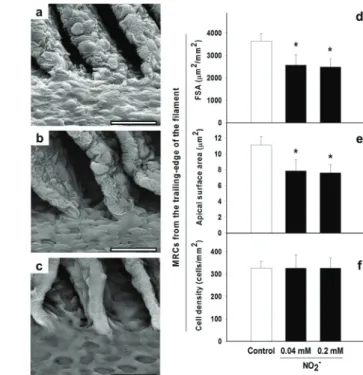
Nitrite stress resulted in slender shape lamellae; more pronounced at higher concentration tested (Figure 2a-c). Nitrite exposure reduced the FSA and the apical surface area of MRCs approximately 30 % (Figure 2d-e). No change in the density of the MRCs on filaments was observed (Figure 2f).
Figure 1 - Light micrographs and morphometry of gills of C. macropomum. a. Filament and lamellae from the control group exhibited numerous MRCs (arrows) and swollen and short lamellae. MRCs are easily distinguished in this resin section because of their round shapes. b. 0.04 mM NO2-: these lamellae were characterized by a gradual decrease in the number of MRCs and increased interlamellar space (double arrowhead). Some MRCs exhibit swelling and visible changes in the nuclear material. c. 0.2 mM NO2-: scarce MRCs were observed on lamellae. d. Thickness of lamellae; e. Thickness of lamellar epithelium; f. Thickness of filament; g. Thickness
of filament epithelium. h. Frequency of MRCs on lamellae and (i) filament. *Significantly different (p < 0.05) from control. Scale bars = 25 m
Figure 2 - SEM and surface measurements of gills of C. macropomum. a. Control group. b. 0.04 mM NO2
-. c-. 0-.2 mM NO2-. Note the changes in the structure of lamellae and filament
surface after exposure to NO2-. d. MRC fractional surface area. e. Apical surface area. f. MRC density. *Significantly different (p < 0.05) from control. Scale bars = 10 m.
swelling and internally were characterized by progressive loss of organelles and membrane breakdown charactering necrosis.
DISCUSSION
Our results showed that NO2- exposure of C. macropomum promoted morphological changes in the gill epithelium and damage of MRCs. In general, these results confirmed the high sensitivity of C. macropomum to NO2- reported by Costa et al. (2004) where hemolytic anemia was the main change observed in fish blood. These morphological
findings are potential inducers of severe ion and osmoregulation disturbance in freshwater fish living in ion poor water.
The high density of MRCs in the lamellar epithelium of C. macropomum of the control group may be due to the low ion concentration in the environmental water, which characterizes Brazil’s continental waters. Several studies have shown high MRCs proliferation in fish living in ion-poor water (Perry 1997), although Fernandes and Perna-Martins (2002) noted the significantly variable number of MRCs in Brazil’s freshwater fish.
The sharp reduction of MRCs in lamellar epithelium may be related to increased cell death and low cellular differentiation in this epithelium. Indeed, most of the ultrastructural changes in MRCs displayed a morphological pattern of necrosis. Previous studies have suggested that NO2- increases MRCs activity to maintain ion homeostasis (Gaino Figure 3 - TEM of MRCs from lamellae of C. macropomum. a. Control group. b. 0.04 mM NO2
-. c. 0.2 mM NO2
-. Hypertrophic
MRCs were filled with distend and dense mitochondria (m),
distend tubular system (arrow), lysosome-like bodies (l),
myelin whorls (mw) and large vacuoles (v). * = extension of
pavement cell. Scale bars: a, c = 1 m; b = 5 m.
TABLE I
Ultrastructural changes in the gill MRCs of C. macropomum after exposure to NO2- concentrations for
96 h.
Cytological Parameters
[NO2 -] (mM)
0.00 0.04 0.20
Nuclei
Deformation of
nuclear envelope - ++ ++++
Dilation of nuclear
envelope cisternae - ++ ++++
Tubular system
Overall amount ++ +++ ++++
Dilation of cisternae - +++ ++++
Fragmentation of
cisternae - +++ +++
Lysosomal elements
Overall amount + ++ +++
Myelinated bodies +/- ++ +++
Cytoplasmic vacuoles ++ ++ +++
Mitochondria
Overall amount ++++ +++ ++
Morphological
heterogeneity - ++ +++
Formation of
myelin-like whorls - ++ +++
Vacuolization - ++ +++
Outer membrane
rupture - - ++
Coding: -, absent; +/-, very little developed; +, little developed; ++, moderately developed; +++, strongly developed; ++++, very strongly developed.
et al. 1984), which, in combination with the direct toxic effects of NO2-, contributes to reduce the cell’s cycle.
Our results are, in general, congruent with those found in the ultrastructure of MRCs of
(0.03 mM NO2-) for 72 h (Gaino et al. 1984). Furthermore, we also found signs of severe damage in mitochondria after NO2- exposure, evidencing clear irreversible cellular damage. Mitochondria is a target for NO2- binding (Shiva 2010). Nitrite binds to heme moieties of mitochondrial cytochrome components of the respiratory chain, inhibiting respiration, and stopping or reducing ATP production (Jensen et al. 2015). Mitochondrial swelling has been related to the toxic action of compounds deriving from NO2- in rat liver hepatocytes (Rusu et al. 1979).
Cell and organelle swelling, as reported in our study, possibly reflect the inhibition of Na+
/ K+ ATPase, promoting in cell K+ efflux and Na+ uptake, as previously reported in C. carpio
(Knudsen and Jensen 1997, Jensen et al. 1987). In addition to osmotic changes, NO2- at high concentrations in tissue causes an excess of NO generation resulting in excessive induction of iron-nitrosylation, nitrosation of cellular thiols and amines, exacerbating NO2- toxicity and interfering with the functioning of many key proteins (Jensen et al. 2015).
In our study, we present evidence that cell death by non-apoptotic program (necrosis) was prevalent and is not morphologically different from that described for other species exposed to toxic substances (Mallatt 1985) or following transfer from fresh water to seawater (Bonga and Van der Meij 1989). Evidences indicate that necrosis is the main cell death program triggered when ATP levels drop rapidly after NO2- stress (Leist et al. 1997, Brown and Borutaite 2002, Leist et al. 1999). In opposition to other studies, few cells were demised from epithelia by apoptosis, however, this cell death program has been reported after NO2 -intoxication in fish (Jia et al. 2015, Sun et al. 2014). The prevalence of necrotic MRCs may evidence variability in energy use of cells or may indicate different levels of mitochondrial damage which
may trigger one or the other mechanism of cell death.
In conclusion, MRCs are particularly affected by NO2- exposure. The changes observed in this study indicate that NO2- is toxic to C. macropomum
and has a potential to affect important physiological process by disrupting the MRC ultrastructure and its distribution along the branchial epithelium. The changes observed in the gill indicate that the cellular structures involved in the process of energy production become severely damaged by exposure to NO2- indicating irreversible damage resulting in cell death.
ACKNOWLEDGMENTS
This work was supported by Conselho Nacional de Desenvolvimento Científico e Tecnológico (CNPq) and Coordenação de Aperfeiçoamento de Pessoal de Nível Superior (CAPES). We gratefully acknowledge the technicians of the Laboratório de Caracterização Estrutural (LCE, UFSCar) for their assistance and Centro Nacional de Pesquisa e Conservação de Peixes Continentais (CEPTA) for providing the fish, and Fundação de Amparo à Pesquisa do Estado do Amazonas (FAPEAM) for financial support (Grant number 062.00821/2014/ PAPAC). Marisa N. Fernandes is the recipient of a research fellowship from CNPq. Juliana L. V. Lameiras is the recipient of a postgraduate fellowship from CAPES.
REFERENCES
AUDET C AND WOOD CM. 1993. Branchial morphological and endocrine responses of rainbow trout (Oncorhynchus mykiss) to a long-term sublethal acid exposure in which acclimation did not occur. Can J Fish Aquat Sci 50: 198-209. BINDON S, GILMOUR K, FENWICK J AND PERRY S.
1994. The effects of branchial chloride cell proliferation on respiratory function in the rainbow trout Oncorhynchus mykiss. J Exp Biol 197: 47-63.
and chloride cells in the gills of the teleost Oreochromis mossambicus. Cell Tissue Res 255: 235-243.
BROWN GC AND BORUTAITE V. 2002. Nitric oxide inhibition of mitochondrial respiration and its role in cell death. Free Radic Biol Med 33: 1440-1450.
COSTA OTF, FERREIRA DJS, MENDONÇA FLP AND FERNANDES MN. 2004. Susceptibility of the Amazonian fish, Colossoma macropomum (Serrasalminae), to short-term exposure to nitrite. Aquaculture 232: 627-636. EVANS DH, PIERMARINI PM AND CHOE KP. 2005. The
multifunctional fish gill: dominant site of gas exchange, osmoregulation, acid-base regulation, and excretion of nitrogenous waste. Physiol Rev 85: 97-177.
FERNANDES MN AND PERNA-MARTINS SA. 2002. Chloride cell responses to long-term exposure to distilled and hard water in the gill of the armored catfish, Hypostomus tietensis (Loricariidae). Acta Zoo 83: 321-328.
GAINO E, ARILLO A AND MENSI P. 1984. Involvement of the gill chloride cells of trout under acute nitrite intoxication. Comp Biochem Physiol A: Physiol 77: 611-617.
HANSEN MN AND JENSEN FB. 2010. Nitric oxide metabolites in goldfish under normoxic and hypoxic conditions. J Exp Biol 213: 3593-3602.
JENSEN FB. 2003. Nitrite disrupts multiple physiological functions in aquatic animals. Comp Biochem Physiol A: Mol Integr Physiol 135: 9-24.
JENSEN FB, ANDERSEN NA AND HEISLER N. 1987. Effects of nitrite exposure on blood respiratory properties, acid-base and electrolyte regulation in the carp (Cyprinus carpio). J Comp Physiol B 157: 533-541.
JENSEN FB, GERBER L, HANSEN MN AND MADSEN SS. 2015. Metabolic fates and effects of nitrite in brown trout under normoxic and hypoxic conditions: blood and tissue nitrite metabolism and interactions with branchial NOS, Na+/K+-ATPase and hsp70 expression. J Exp Biol 218: 2015-2022.
JENSEN FB AND HANSEN MN. 2011. Differential uptake and metabolism of nitrite in normoxic and hypoxic goldfish. Aquat Toxicol 101: 318-325.
JIA R, HAN C, LEI J-L, LIU B-L, HUANG B, HUO H-H AND YIN S-T. 2015. Effects of nitrite exposure on haematological parameters, oxidative stress and apoptosis in juvenile turbot (Scophthalmus maximus). Aquat Toxicol 169: 1-9.
KIERNAN JA. 2008. Histological and histochemical methods: theory and practice. 4th
ed., U. K.: Scion - Bloxham. KNUDSEN PK AND JENSEN FB. 1997. Recovery from
nitrite-induced methaemoglobinaemia and potassium balance disturbances in carp. Fish Physiol Biochem 16: 1-10.
LEIST M, SINGLE B, CASTOLDI AF, KÜHNLE S AND NICOTERA P. 1997. Intracellular adenosine triphosphate (ATP) concentration: a switch in the decision between apoptosis and necrosis. J Exp Med 185: 1481-1486.
LEIST M, SINGLE B, NAUMANN H, FAVA E, SIMON B, KÜHNLE S AND NICOTERA P. 1999. Nitric oxide inhibits execution of apoptosis at two distinct ATP-dependent steps upstream and downstream of mitochondrial cytochrome c release. Biochem Biophys Res Commun 258: 215-221. LEWIS JR WM AND MORRIS DP. 1986. Toxicity of nitrite to
fish: a review. Trans Am Fish Soc 115: 183-195.
MALLATT J. 1985. Fish gill structural changes induced by toxicants and other irritants: a statistical review. Can J Fish Aquat Sci 42: 630-648.
MARGIOCCO C, ARILLO A, MENSI P AND SCHENONE G. 1983. Nitrite bioaccumulation in Salmo gairdneri Rich. and hematological consequences. Aquat Toxicol 3: 261-270. MARSHALL WS, BRYSON SE, DARLING P, WHITTEN
C, PATRICK M, WILKIE M, WOOD CM AND BUCKLAND-NICKS J. 1997. NaCl transport and ultrastructure of opercular epithelium from a freshwater-adapted euryhaline teleost, Fundulus heteroclitus. J Exp Zool 277: 23-37.
MARTINEZ CB AND SOUZA MM. 2002. Acute effects of nitrite on ion regulation in two neotropical fish species. Comp Biochem Physiol A: Mol Integr Physiol 133: 151-160. MERZ WA. 1967. Die Streckenmessungen an gerichteten
Strukturen im Mikroskop und ihre Anwendung zur Bestimmung von Oberflächen-Volumen-Relationen im Knochengewebe. Mikroskopie 22: 132-142.
PERRY SF. 1997. The chloride cell: structure and function in the gills of freshwater fishes. Annu Rev Physiol 59: 325-347. RUSU M, PREDA N, GRACIUN C, GADALEANU V AND
BUCUR N. 1979. Histoenzymological and ultrastructural changes in rats following the administration of aminopyrine and nitrite (nitrosoaminopyrine). IARC Sci Publ: 803-812. SHIVA S. 2010. Mitochondria as metabolizers and targets of
nitrite. Nitric Oxide 22: 64-74.
STRICKLAND JDH AND PARSONS TR. 1972. A Practical Handbook of Seawater Analysis. 2nd
ed., Ottawa: Bulletin 167. Fish Res B Can, 310 p.
SUN S, ZHU J, GE X, ZHANG C, MIAO L AND JIANG X. 2014. Cloning and expression analysis of a heat shock
protein 90 β isoform gene from the gills of Wuchang
bream (Megalobrama amblycephala Yih) subjected to nitrite stress. Gen Mol Res 14: 3036-3051.
SVOBODOVÁ Z, MÁCHOVÁ J, DRASTICHOVÁ J, GROCH L, LUSKOVÁ V, POLESZCZUK G, VELÍŠEK J AND KROUPOVÁ H. 2005. Haematological and biochemical profiles of carp blood following nitrite exposure at different concentrations of chloride. Aquacult Res 36: 1177-1184.
TOMASSO J. 2012. Environmental nitrite and aquaculture: a perspective. Aquacult Int 20: 1107-1116.