www.atmos-chem-phys.net/13/6727/2013/ doi:10.5194/acp-13-6727-2013
© Author(s) 2013. CC Attribution 3.0 License.
Atmospheric
Chemistry
and Physics
Geoscientiic
Geoscientiic
Geoscientiic
Geoscientiic
Diffusion of volatile organics through porous snow:
impact of surface adsorption and grain boundaries
T. Bartels-Rausch1, S. N. Wren2, S. Schreiber1, F. Riche3, M. Schneebeli1, and M. Ammann1
1Paul Scherrer Institute, Laboratory of Radio- and Environmental Chemistry, 5232 Villigen PSI, Switzerland 2University of Toronto, Department of Chemistry, Toronto, Ontario M5S 3H6, Canada
3WSL Institute for Snow and Avalanche Research SLF, 7260 Davos Dorf, Switzerland Correspondence to:T. Bartels-Rausch ([email protected])
Received: 1 February 2013 – Published in Atmos. Chem. Phys. Discuss.: 7 March 2013 Revised: 17 May 2013 – Accepted: 22 May 2013 – Published: 18 July 2013
Abstract.Release of trace gases from surface snow on earth drives atmospheric chemistry, especially in the polar regions. The gas-phase diffusion of methanol and of acetone through the interstitial air of snow was investigated in a well-controlled laboratory study in the temperature range of 223 to 263 K. The aim of this study was to evaluate how the struc-ture of the snowpack, the interaction of the trace gases with the snow surface, and the grain boundaries influence the dif-fusion on timescales up to 1 h. The diffusive loss of these two volatile organics into packed snow samples was measured us-ing a chemical ionization mass spectrometer. The structure of the snow was analysed by means of X-ray-computed micro-tomography.
The observed diffusion profiles could be well described based on gas-phase diffusion and the known structure of the snow sample at temperatures≥ 253 K. At colder tem-peratures, surface interactions start to dominate the diffu-sive transport. Parameterizing these interactions in terms of adsorption to the solid ice surface, i.e. using temperature-dependent air–ice partitioning coefficients, better described the observed diffusion profiles than the use of air–liquid par-titioning coefficients.
No changes in the diffusive fluxes were observed by in-creasing the number of grain boundaries in the snow sample by a factor of 7, indicating that for these volatile organic trace gases, uptake into grain boundaries does not play a role on the timescale of diffusion through porous surface snow. For this, a snow sample with an artificially high amount of ice grains was produced and the grain boundary surface mea-sured using thin sections.
In conclusion, we have shown that the diffusivity can be predicted when the structure of the snowpack and the parti-tioning of the trace gas to solid ice is known.
1 Introduction
1.1 Environmental relevance
Snow cover on the earth’s surface is of significant environ-mental importance (Bartels-Rausch et al., 2012a). For exam-ple, the Arctic surface snow can hold a high concentration of volatile organic molecules (Shepson and Sumner, 1999). Snow also covers large parts of the Northern Hemisphere in winter, and high concentrations of volatile organics have been found in such surface snows (Kos and Ariya, 2010). Both in the Arctic, where volatile organics in snow are in-vestigated as photochemical products, and in non-polar re-gions, where volatile organics mostly originate from biolog-ical soil emission (Groffman et al., 2001; Swanson, 2005) or from polluted air masses (Kos and Ariya, 2010), the fluxes between the snow and the air might impact air quality and climate change (Domine and Shepson, 2002; Grannas et al., 2007; Seok et al., 2009).
(i.e. gas phase) is generally described by an effective diffu-sivity in the two-phase sample (Schwarzenbach et al., 2003). In Eq. (1), the effective diffusivity (Deff) is described by the gas-phase diffusion coefficient (Dair), the free volume in the porous material (porosity,ρ), and the microscopic shape of the pores (tortuosity,τ). For trace gases that interact with the surface of the porous material by surface adsorption, the gas– solid partitioning coefficient (Ki), the ice / air volume ratio
(rsp), and the specific surface area (SSA) are additionally in-cluded in the parameterization ofDeff(Schwarzenbach et al., 2003; Herbert et al., 2006a; Domine et al., 2008). The ef-fective diffusivity of any gas can thus be calculated based on known gas-phase diffusivity, microstructure of the porous medium and sorption characteristics.
Deff=Dair× φ τ ×
1
1+rsp×Ki×SSA
(1)
In polar and subalpine snow or firn, the above correlation between the structure and the effective diffusivity has been empirically confirmed for non-surface interacting gases such as CO2, CH4, O2, and SF6 (Schwander et al., 1993; Fabre et al., 2000; Seok et al., 2009). Going one step further, Pinzer et al. (2010) have recently carefully verified the structure– diffusivity relationship for NO by bringing together precise structural information gained from X-ray-computed tomog-raphy with observed effective diffusivities in well-defined laboratory experiments.
1.2 Diffusion and surface interaction
Pinzer et al. (2010) have further confirmed that species that interact strongly with ice surfaces, such as HONO (Chu et al., 2000; Bartels-Rausch et al., 2002; Kerbrat et al., 2010), ex-hibit a much lower effective diffusivity. The effective diffu-sivity at temperatures of 250 to 270 K is 2–3 orders of mag-nitude smaller for HONO compared to non-interacting gases such as NO and NO2. The authors found that the lower ef-fective diffusivity could be directly linked to HONO’s strong air–ice partitioning. In particular, the air–ice partitioning co-efficient determined based on the diffusivity agreed within experimental uncertainties with the Langmuir partitioning coefficient. The Langmuir model treats the partitioning as ad-sorption to solid ice surfaces (Crowley et al., 2010).
1.2.1 Wet snow
The finding of slow gas transport of interacting gases in snow is in agreement with a number of earlier field obser-vations on the diffusion of SO2(Choi et al., 2000), volatile-(Helmig et al., 2009), and semi-volatile organics (Herbert et al., 2006a,b). For example, Herbert et al. (2006a) found that the effective diffusion of semi-volatile organics scaled with their tendency to stick to snow surfaces. However, in these field studies temperatures approached (and even ex-ceeded) the melting point of ice, and consequently the snow
held liquid water. Even the presence of a small fraction of liquid in wet snow can significantly modify the trace gas– snow interaction, as both adsorption to the solid ice surface and dissolution into the liquid fraction might occur simul-taneously (Choi et al., 2000; Bartels-Rausch et al., 2012b). Consequently, it was found that using the air–ice partition-ing coefficient to model transport of semi-volatile organics in snow largely underestimated the diffusivities, questioning the application of these gas–solid partitioning data to derive the effective diffusivity for such wet snows (Herbert et al., 2006a,b). The authors suggest that the air–water partitioning might dominate the interaction and that the gas–liquid par-titioning coefficient (i.e. Henry’s law coefficients) might be better suited to describe diffusion in snow at temperatures close to the melting point. However, no direct measurement of the effective diffusivity was made in these studies, so the validity of using Henry’s law coefficients has yet to be deter-mined.
1.2.2 Dry snow
Herbert et al. (2006a,b) further suggested that the gas–liquid partitioning coefficient might be of importance for the inter-action of trace gases with snow even at colder temperatures and in the absence of liquid. This idea is often motivated by the air–ice interface being disordered at a molecular level at temperatures approaching the melting point (Thomas et al., 2011; Bartels-Rausch et al., 2012b). The temperature depen-dence and thickness of this disordered layer, often referred to as quasi-liquid layer, has been investigated by a number of different techniques (Li and Somorjai, 2007). While a con-clusive temperature–depth relationship can still not be given, the studies agree that the thickness of the disorder increases with temperatures approaching the melting point and reaches significant thicknesses of a few monolayers or more at tem-peratures of≈260 K (Bartels-Rausch et al., 2012b). Because the surface disorder is not a true liquid and has distinctly different structural properties from a liquid (Bartels-Rausch et al., 2012b), we refer to snow with a pronounced surface disorder as dry snow.
disorder is based on fundamentally different processes com-pared to adsorption to solid surfaces and thus calls for a spe-cific parameterization.
The first aim of this study was thus to determine the extent to which sorption processes impact the diffusion of volatile organics through a dry snowpack. By comparing observed diffusivities to simulations based on the air–liquid partition-ing coefficients and on the air–solid partitionpartition-ing, the focus is placed on the question concerning which of the two param-eterizations is superior to describe the interaction of trace gases with snow. A previously developed experimental set-up that allows the diffusion of trace gases into artificial snow samples to be quantified was used (Pinzer and Schneebeli, 2009; Pinzer et al., 2010). A key feature is that the structure of the snow is analysed in detail using X-ray-computed to-mography (Kerbrat et al., 2008).
1.3 Surface interaction and grain boundaries
Grain boundaries are defined as contact area between indi-vidual ice grains. Diffusion along grain boundaries is natu-rally faster than diffusion through ice crystals (Thibert and Domine, 1997; Huthwelker et al., 2006). In addition, dif-fusion into the volume that they enclose might possibly be another explanation for the observed long-lasting uptake of trace gases to ice and snow (Huthwelker et al., 2006; Kerbrat et al., 2010; Bartels-Rausch et al., 2012b). Indeed, Kerbrat et al. (2010) observed a significant diffusive bulk uptake of HONO into polycrystalline ice that increased the overall up-take of HONO to snow at temperatures≥240 K. In contrast, in experiments with snow samples that tended to be com-posed of single crystal snow grains and thus have a low grain boundary density, no bulk uptake was detected (Pinzer et al., 2010). The authors argued that the difference in the grain boundary content might explain the different long-term fate of HONO for the two samples, but conclusive results could not be drawn as a detailed analysis of the grain boundaries was lacking. Additional uncertainty comes from the use of two different experimental techniques, a snow diffusion ex-periment, as used in this study, and a packed bed flow tube study for the polycrystalline snow.
In this light, a second aim of this study was to explore whether or not the effective diffusivity of a trace gas is re-duced in samples that have an artificially high amount of grain boundaries, but otherwise similar geometric properties. To do this, we took advantage of recent, in-detail character-izations of grain boundaries in snow samples (Riche et al., 2012a,b).
1.4 Affinity of trace gases to snow
In this study, acetone and methanol were chosen to investi-gate the diffusivity in snow and the impact of grain bound-aries. First, both are of environmental significance, because volatile organics are an important source of atmospheric HOx
humidifier
dp: 263 - 223 K
VOC source
5 and 9 ppb
cooling loop
mass. spec.
nitrogen
160 ml/min
NO anal.
3 cm
1
0
cm
1
cm
NO source
~ 6 ppb
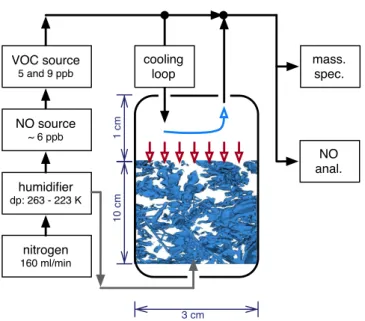
Fig. 1.Illustrative scheme of the experimental set-up showing the snow diffusion chamber. A N2flow containing traces of acetone, methanol, and NO is passed over a snow sample (blue arrow). The trace gases diffuse into the porous snow sample from the headspace (red arrows). Before the experiments the sample can be purged to remove volatile impurities (grey arrow). Dew point is denoted as dp, filled circles represent three-way valves, and NO is added to confirm correct preparation of the snow samples (see text for details).
2 Experimental method
The experimental set-up has been adapted from Pinzer et al. (2010) and is illustrated in Fig. 1. Central to the experimental procedure is that trace gases are passed over a snow sample and their slow diffusive loss into the porous snow is moni-tored using a chemical ionization mass spectrometer.
2.1 Sample preparation and characterization
Two types of artificial snow were used in this work: one type, which we refer to as snow-maker snow, was prepared by ex-posing thin nylon wires to water vapour in a cold room at 248 K (L¨owe et al., 2011). Sublimation of de-mineralized water kept at 303 K produced the required water fluxes. Its production thus mimics how snowflakes nucleate in the at-mosphere. The produced snow was stored for 6 weeks at 268 K. The accelerated sintering and isothermal metamor-phism during this storage resulted in small rounded grains. For the other snow type, hereafter shock-frozen snow, small ice spheres were rapidly frozen by spraying ultra pure water (MilliQ quality, 0.05 µS) into liquid nitrogen. The samples were annealed at least for 10 days at 243 K, during which time their appearance changed form milky-white to shiny-clear. Samples were prepared from either snow type by siev-ing the snow to a fraction of 500–600 µm in diameter, fillsiev-ing it into the sample holder – referred to as the snow diffusion chamber (Sect. 2.2) – and purging it over night with a stream of nitrogen in order to minimize contamination with volatile organics. This handling was done in a freezer at 243 K, and the purge gas was humidified to the vapour pressure over the snowpack sample. Prior to use, the purge gas was discon-nected and the gas inlet on the snow diffusion chamber was sealed.
The porosity and surface area of the snow in the snow dif-fusion chamber were extracted by image processing from X-ray-computed micro-tomography reconstructions derived on a Scanco µCT80 (Kerbrat et al., 2008; Pinzer and Schneebeli, 2009; Riche et al., 2012a,b). For this, the sample was sieved to a fraction of 500 to 600 µm in diameter, stored in a closed glass vessel for 1 day, and filled into a cylindrical tomog-raphy sample holder (0.4×8 cm) to create the porous snow sample. Before the X-ray computed micro-tomography, the snow-maker samples were stored at 243 K for 1 week, the shock-frozen samples at 254 K for 3 weeks. The tortuosity was calculated based on this microstructure by a finite el-ement simulation of the temperature field in porous snow samples, as described by Kaempfer et al. (2005). The grain boundaries of the shock-frozen samples were analysed using a stereological method (Riche et al., 2012b). For these mea-surements the structure of the porous snow samples was fixed with diethyl phthalate. This fixation is necessary to cut thin sections of 1 to 2 cm2 and 150 µm thickness of the porous snow samples. The slicing and analysis of the thin sections’
grain boundary content under the polarization microscope boundary content was done in a cold room at 253 K.
When dosing trace gases to ice, it is important to con-sider the phase diagram to ensure that work is done within the ice stability regime. Unfortunately, the water–methanol, water–acetone, and the water–acetone–methanol phase dia-grams are not known. Nevertheless, melting of the ice sam-ples at 263 K can be excluded, because the melting point depressions of either organics are too low (Flick, 1998). At colder temperatures, we have direct spectroscopic evidence from previous work that ice is the stable phase upon adsorp-tion of acetone at temperatures of 218 K (Starr et al., 2011).
2.2 Experimental set-up
Acetone and methanol concentrations of
1×10¹¹molecules cm−3 and 2×10¹¹molecules cm−3, respectively, were simultaneously dosed to the headspace of the snow diffusion chamber by passing a carrier gas (N2, Carbagas, 99.999 %) over permeation tubes (VICI dynamical) inside a permeation oven (VICI dynacalibrator). Prior to picking up the organic trace gases, the carrier gas was humidified by passing it over an ice surface so that the dew point of water in the gas flow matched the temperature of the snow sample. Flows of the carrier gas were controlled by mass flow controllers (Brooks 5850) or flow regulators (Voegtlin red-y) with an accuracy of 1 % or better. Before entering the snow diffusion chamber, the gas flow was cooled to the temperature of the snow sample. Additionally, traces of NO were dosed to the carrier gas along with acetone and methanol. NO does not interact with the ice surfaces and its diffusion behaviour has been well characterized (Pinzer et al., 2010). Its loss from the carrier gas and the time profiles of recovery were carefully examined to identify and discard experiments where systematic errors, such as small leaks in the sample holder, or cracks in the snowpack sample, occurred.
Methanol and acetone were detected using a chemical ion-ization mass spectrometer, as previously described (Bartels-Rausch et al., 2005; Ulrich et al., 2012). Water clusters from a Po-210 source or from a corona discharge served as ion-ization reagents at 20 mbar pressure. Methanol and acetone were detected as their positively charged water clusters. The NO concentration profile was recorded simultaneously to the mass spectrometry data by means of a chemiluminescence analyser (eco physics).
has contact to the gas in the headspace with an area of this interface of ≈10 cm2. The entire snow diffusion chamber rests inside a temperature-regulated thermo-jacket. Neither methanol nor acetone showed any retention in the empty sample holder down to 223 K.
2.3 Diffusion profiles
The loss of either trace gas from the carrier gas and the time profile of recovery were the main observables of this study. To derive these recovery profiles, the signal intensity in the absence of methanol and acetone was recorded for 15 min (background), followed by the intensity in the presence of both organics and with the sample holder and headspace by-passed for 30 min (full intensity); then the flow was by-passed via the sample holder for 60 min, followed by measurements of the full intensity and of the background. Any drifts in the background or in the full intensity signal were corrected by fitting the respective traces. The data shown in this work are averages of 2–3 individual experimental runs.
2.4 Simulation
To derive the diffusive loss of volatile organics from the headspace into the snowpack sample, a numerical simulation was used. For non-interacting species, the term 1/(1+rsp× Ki×SSA)in Eq. (1) is negligible, and Pinzer et al. (2010)
have developed an analytic solution to the one-dimensional diffusion problem into a finite volume (Fick’s second law):
∂c ∂t =Deff
∂2c
∂x, (2)
wherecis the concentration of trace gas in the interstitial air of the porous snow sample. The analytic solution was successfully used to describe the loss of NO and NO2from the headspace into the porous snow sample (Pinzer et al., 2010). However, it is only applicable if the flux into the snow is small, because a constant gas-phase concentration at the snow–air interface at c(x = 0) was employed as the boundary condition.
For the general case of strong uptake to the ice, the gas-phase concentration in the headspace drops rapidly when the carrier gas is first routed through the snow diffusion cham-ber. This is due to fast adsorption to the top surface of the porous snow sample; eventually the gas-phase concentration in the headspace relaxes back to equilibrium. Thus, the proximation of a constant boundary condition cannot be ap-plied. Instead, we treat the full flux balance in the headspace numerically. The flux balance is given by
c0×F =cout×F+jdiff×A. (3) Here, c0 is the concentration of trace gas entering the headspace with the carrier gas, cout is the concentration of trace gas in the carrier gas at the exit of the headspace, F is the gas flow through the headspace,Ais the cross-section
area of the snow cylinder, andjdiffis the diffusion flux into the porous sample. We assume ideal mixing in the headspace volume, so that the concentration right above the snow equals cout. This assumption seems well justified, because the total flux of trace gases from the headspace to the snow sample rarely exceeds 20 %. With the diffusion flux through a porous medium as given in Eq. (2) (Schwarzenbach et al., 2003), Eq. (3) can be rearranged to yield the boundary condition at the snow–air interface:
c0×F =c(x=0)×F−A×φ×Dair
∂2c(x=0)
∂2x . (4) Calculations and analysis were done with MATLAB.
3 Results
3.1 Diffusion profiles
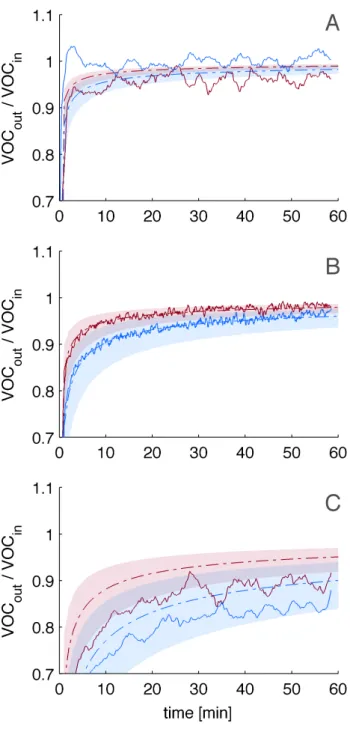
We first studied the diffusive transport of the volatile organ-ics acetone and methanol through a snow-maker snow sam-ple, the freezing process of which mimics nucleation of ice crystals in the atmosphere. Figure 2 shows the primary servable of these experiments, the mean experimentally ob-served recovery profiles. The obob-served profiles of individual experimental runs at each temperature were almost identical: the standard deviations of the three individually measured re-coveries at 10 min, 30 min, and 60 min were around 10% or better. The reproducibility of the experiments at 243 K was, at≈1 %, significantly better and the scatter in the profiles much less pronounced, because different ionization condi-tions in the mass spectrometer were used that improved the signal-to-noise ratio.
The first observation is that the gas-phase concentrations in the headspace recover quickly, indicating that the over-all losses from the overlaying gas phase by gas-phase diffu-sion into the porous snowpack are small, and have a pro-nounced temperature dependence. At 263 K the observed profiles show, within the reproducibility of 10 %, an immedi-ate recovery to the initial gas-phase concentration of acetone and methanol and thus resemble the profiles of NO (Pinzer et al., 2010), a trace gas that does not interact with the ice surface at those temperatures (Bartels-Rausch et al., 2002). Similar fast recoveries have been observed at 253 K (data not shown). This indicates that under these warm conditions, dif-fusion through the dry snowpack is fast for both volatile or-ganics. Given the small air volume of 55 cm3in the porous snow sample, the concentration gradient is eliminated rapidly and diffusion from the carrier gas stops.
Fig. 2. Mean experimental recovery profiles (solid lines) of methanol (blue) and acetone (red) at different temperatures ((A) 263 K (n=3),(B)243 K (n=2), (C)223 K (n=3)) in packed snow-maker snow. Also shown are results from numerical simula-tions of the recovery (dashed line) with uncertainties (shaded area), where the air–ice partitioning (Langmuir coefficient) was used to parameterize the effective diffusivity.
such a strong temperature dependence (Pinzer et al., 2010). Second, methanol recovers slower than acetone, which is consistent with its stronger interaction with ice (Crowley et al., 2010).
3.2 Simulation – Langmuir vs. Henry
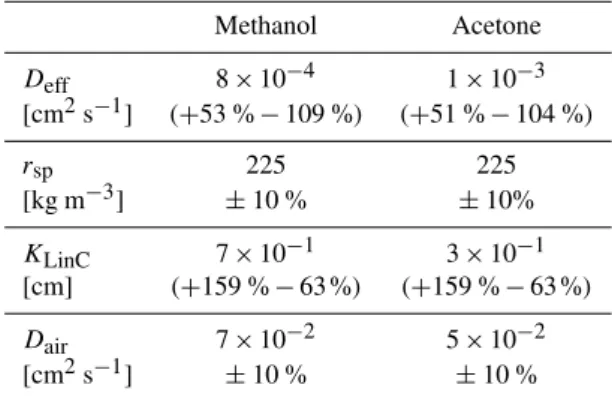
To extract more quantitative data from the experiments, the observed recovery profiles were compared to simulations based on the snow sample’s porosity and tortuosity, as well as on the specific interactions of methanol and acetone with ice as given in Eq. (1). Table 1 lists calculated values of the effec-tive diffusivity for acetone and methanol through the porous snow samples at 243 K. In this particular sample, the effec-tive diffusivity is slower than the diffusivity in air by a fac-tor of 50 or more. For this calculation, and the simulations shown in Fig. 2, the gas-phase diffusion constants were taken from Winkelmann (2007a,b), and extrapolated to the temper-ature of the experiment, based on the reported tempertemper-ature dependence of methanol gas-phase diffusion (Winkelmann, 2007a):KLinCand their temperature dependence were taken from Crowley et al. (2010);rsp was calculated based on the porosity and the snow density as measured in this study and given in Table 1. Also shown is the uncertainty in the sim-ulation results (Fig. 2 and Table 1). The uncertainty was as-sessed by repeating the calculations, taking the published er-ror range ofKLinC(Crowley et al., 2010) as input and chang-ing the other input parameters by 10 % each.
The results show that acetone recoveries are very well cap-tured and follow the simulations closely (Fig. 2). One excep-tion is data at 223 K, where the mean of the experimental runs lies on the lower edge of the simulation. Given the un-certainties of the experimental results and in the simulation, the agreement is good. Methanol shows a very good agree-ment except at 263 K, where the observed recovery is faster than the simulation and also compared to the recovery of NO. This is presumably an artefact by the ionization schemes in the mass spectrometer. Release of methanol from potentially contaminated samples was excluded as a reason for these high recoveries. Given that the diffusivity of methanol is not influenced by surface interactions, any temperature-induced change to the ice surface structure can also not explain a faster recovery than predicted based on solid ice–air parti-tioning.
Two conclusions can be drawn. First, surface interactions have a strong impact on diffusive transport through the open pore space of dry snow and dominate the diffusivity at tem-peratures where adsorption equilibrium predicts a signifi-cant surface concentration. Second, the Langmuir coefficient, used to parameterize the reversible surface adsorption of trace gases to ice, describes the interaction of trace gases with the ice surface during diffusion well.
Table 1.Calculated effective diffusion constant (Deff) of methanol and acetone for snow-maker snow at 243 K. Calculation were done based on Eq. (1) with the solid ice / air ratio (rsp ), the gas-phase diffusion constant (Dair) and the Langmuir partitioning coefficient (KLinC) as input.
Methanol Acetone
Deff 8×10⁻⁴ 1×10⁻³
[cm2s−1] (+53 %−109 %) (+51 %−104 %)
rsp 225 225
[kg m−3] ±10 % ±10%
KLinC 7×10⁻¹ 3×10⁻¹ [cm] (+159 %−63 %) (+159 %−63 %)
Dair 7×10⁻² 5×10⁻²
[cm2s−1] ±10 % ±10 %
snow (Thomas et al., 2011; Bartels-Rausch et al., 2012b). As shown in Fig. 3, the air–liquid partitioning is not suited to de-scribe the observed recovery profiles at temperatures at and below 243 K. For these simulations, the distribution of the volatile organics between ice and air was parameterized as uptake into a 1–30 nm-thick liquid covering the total specific surface area of the snow sample. Henry’s law coefficients were taken from Snider and Dawson (1985) and extrapolated to the temperatures of the snow sample. The calculations re-veal that at 263 K the results are invariant to the simulations based on the air–ice partitioning coefficient, as both results show a negligible influence of partitioning to the snow sur-face on the diffusive transport (Fig. 2 and 3). At colder tem-peratures the simulations based on Henry’s law coefficients predict faster recoveries than observed for acetone, and even more so for methanol (Fig. 3). At 223 K Henry’s law coeffi-cients still predict a negligible influence of partitioning to the snow surface for the diffusion of both methanol and acetone. From this we conclude that the surface interaction with dry snow during the diffusive process can be better described as air–solid partitioning at temperatures up to 263 K. This con-clusion is in-line with a number of earlier measurements that determined the reversible adsorption of volatile trace gases to ice and showed that the interaction of trace gases with ice is generally well described by an air–solid partitioning constant at temperature up to≈240 K and for some species, such as HONO, even up to 260 K (Crowley et al., 2010). Describing interactions with ice surfaces based on properties of liquid water is a very controversial topic of debate (Bartels-Rausch et al., 2012b). Our results show that parameterizing the ice surface with properties of a super-cooled solution is indeed an over-simplification. For dissolution into the disordered in-terface at the ice surface to be an important factor, the vol-ume of this interface needs to be large enough to accommo-date significant amounts of solutes, and the solvation mech-anism needs to be similar to that of liquid water. Current
in-Fig. 3. Experimental recovery profiles (solid lines) of methanol (blue) and acetone (red) at different temperatures ((A)263 K,(B) 243 K,(C)223 K) in snow-maker snow. Also shown are results from numerical simulations of the recovery (dashed line) with uncertain-ties (shaded area), where the air–water partitioning (Henry’s law coefficient) was used to parameterize the effective diffusivity.
this might provide a feedback that enhances the uptake (Mc-Neill et al., 2006, 2007). Similar processes might also oper-ate during the adsorption of volatile organics. However, re-cent direct surface-sensitive observations of the structure of water molecules upon adsorption of volatile organics, such as acetone and acetic acid, have clearly shown that at tem-peratures of 243 K the thickness of the disordered interface is not significantly increased, as those measurements give no indication that the thickness is larger than a few nm upon adsorption of these organic traces (Starr et al., 2011; Kre-pelova et al., 2013). These surface-sensitive studies further clearly show that the adsorbed volatile organics remain on the surface of the ice and do not enter deep into the crys-tal structure. Based on depth profiles of carbon (from acetic acid) in the ice surface, Krepelova et al. (2013) showed that acetic acid does not reach depths deeper than 2 nm and con-cluded that reversible surface adsorption describes this situa-tion well. In conclusion, this study gives clear evidence that, at temperatures where the surface disorder is thin, air–liquid partitioning does not adequately describe the interaction with the ice surface. That the interaction of many volatile organics with ice is a purely surface process is supported by surface-sensitive spectroscopy that gives no indication for dissolution of acetic acid in the ice. An exception for this adsorption-dominated interaction is formaldehyde. Barret et al. (2011b) have shown that this small organic trace gas forms solid so-lutions with ice and that this solution equilibrium with the ice crystal can explain observed formaldehyde exchanges be-tween the air and the surface snow in the Arctic (Barret et al., 2011a).
At temperatures approaching the melting point, but low enough to prevent (partial) melting, the surface interaction of these volatile organics is too small to significantly impact the diffusion in dry snow, and this is reflected by both parame-terizations.
3.3 Impact of grain boundaries
To study the effect of grain boundaries on the diffusion of trace gases through porous snow, experiments were per-formed with a second type of snow sample with a very high grain boundary content. Figure 5 shows the morphology of the shock-frozen snow as viewed under a polarization micro-scope. The contact area between individual ice spheres per volume of the snow sample, hereafter specific grain boundary area, adds 2 mm2mm−3(Riche et al., 2012a). Additionally, about 60–70 % of those spheres consist of several smaller ice crystals, so the total specific grain boundary area equals 10 mm2mm−3(Riche et al., 2012a). In contrast, natural snow freezes by condensation of vapour in the gas phase, and indi-vidual snow spheres are always single crystals (Riche et al., 2012b). The snow-maker snow used in this study was not analysed for its grain boundary content, but we argue that it is also composed of single crystals and that the total grain boundary area is only given by the contact area between
in-Table 2.Properties of the different types of snow samples as deter-mined by stereology (grain boundary area) and by X-ray-computed micro-tomography. SSA is the specific surface area and GBA the total grain boundary area
Shock-frozen Snow-maker
Porosity [–] 0.42 0.57
Density [kg m−3] 531 393
SSA [cm2g−1] 116 211
Tortuosity [–] 1.54 1.48
GBA [mm2mm−3] 10 2
dividual ice grains. Based on the measured contact area of ice spheres in the shock-frozen snow and accounting for the lower density of snow-maker snow (Table 2), one can esti-mate a total specific grain boundary area of 1.5 mm2mm−3. Using this estimate, the specific grain boundary area in the two snow samples differs by a factor of 7.
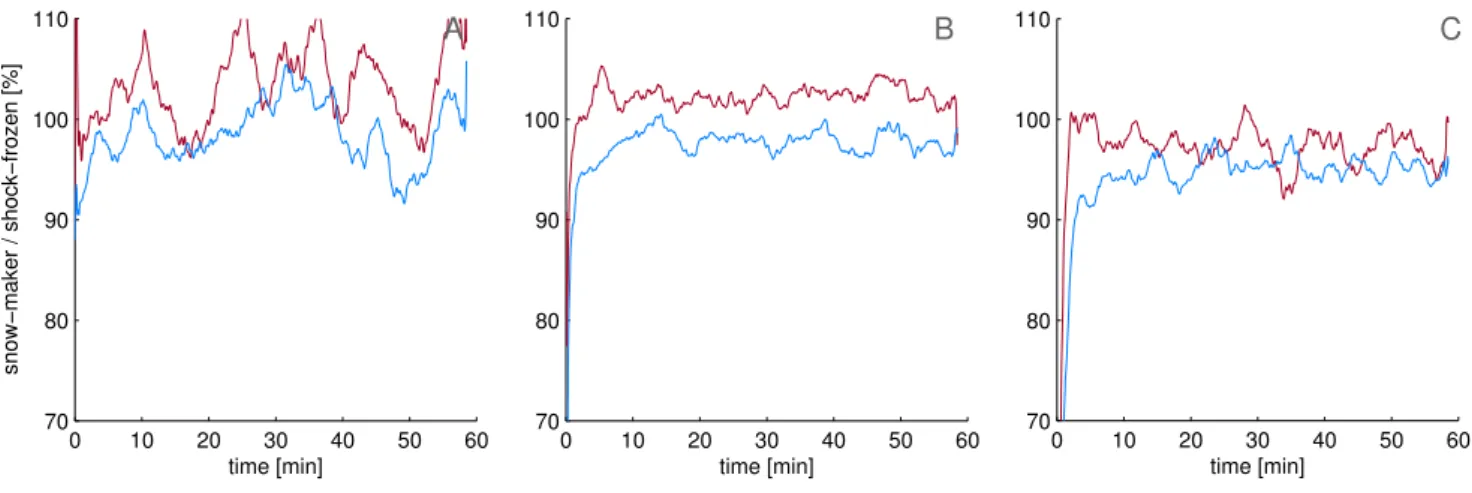
The impact of this large difference in grain boundary con-tent on the diffusion of methanol and acetone through dry snow is shown in Fig. 4. Here, the experimental recovery profiles are plotted as a ratio of snow-maker to shock-frozen snow, for three temperatures. Figure 4 clearly shows that a larger grain boundary content does not enhance the inter-action of methanol and acetone with the ice phase during diffusion through porous snow. The recovery profiles over packed shock-frozen polycrystalline ice spheres agree within 10 % to the recovery profiles over snow-maker snow. That is, the plotted ratio in Fig. 4 lies within the 90–110 % in-terval. A better agreement of the observed profiles was not expected, as the samples differed slightly in surface area and microstructure (Table 2). This negligible impact of grain boundaries in dry snow holds for temperatures spanning 263 to 223 K. In principle, grain boundaries have the potential to impact the uptake of trace gases in two ways. First, the mi-croscopic surface structure differs at grain boundaries from the free surface, and this may directly impact the adsorption equilibrium, e.g. by providing sites of energetically preferred adsorption (Donaldson et al., 2012). For example, McNeill et al. (2007) have observed two different adsorption modes for ice samples with varying grain size and have suggested that a particular reversible adsorption mode takes place at grain boundaries. Second, grain boundaries may also provide a channel through which adsorbates can diffuse rapidly away from the surface (Thibert and Domine, 1997) and which may serve as long-term reservoirs for adsorbates (Huthwelker et al., 2006).
0 10 20 30 40 50 60 70
80 90 100 110
snow−maker / shock−frozen [%]
time [min]
0 10 20 30 40 50 60
70 80 90 100 110
time [min]
0 10 20 30 40 50 60
70 80 90 100 110
time [min]
A B C
Fig. 4. Comparison of diffusivities in polycrystalline and single-crystalline samples. Shown is the ratio of the observed recovery profiles of methanol (blue) and acetone (red) at different temperatures ((A)263 K,(B)243 K,(C)223 K) for a single-crystalline and polycrystalline sample.
Fig. 5. Thin slice of a polycrystalline ice sample as seen under a polarization microscope. Coloured areas visualize individual ice crystals. The slice also shows the porosity of the snow sample.
polycrystalline ice was investigated in a packed bed flow tube (Bartels-Rausch et al., 2005). This study verifies this con-clusion and expands it to warmer temperatures and longer timescales, where diffusive processes become increasingly dominating (Kerbrat et al., 2010), and does so using a well-characterized snow sample. The earlier experiments were done in the temperature range of 198 to 223 K, and lasted ap-proximately 20 minutes. Further support for the irrelevance
of grain boundaries for short-term adsorption comes from molecular dynamics calculations that have shown that inter-action of acetone with the neat ice surface is energetically more favourable than the interaction with ice at grain bound-aries (Hammer et al., 2009).
The interaction of methanol with different types of ice has not been investigated before. Results from a molecular dy-namics study indicate that methanol adsorbs to ice by form-ing hydrogen bonds at the surface at 210 K and by dissolv-ing into the upper water molecule layers of the ice crystal at 250 K. Given that a dissolved molecule may diffuse more easily into grain boundaries, one would have expected differ-ent recovery profiles of methanol on the two types of snow in our experiments. However, the results presented here show that, even for this highly soluble molecule with its rather small size, surface adsorption dominates its interaction with polycrystalline ice on timescales of one hour.
4 Conclusions
In this study the diffusive transport of methanol and acetone into porous snow was investigated by monitoring the concen-tration of the two gases in the air above a dry snow sample.
– At temperatures above 243 K diffusion of methanol and acetone into porous snow is fast and identical to that of NO, a gas that does not interact with ice surfaces. At lower temperatures (243 K and 223 K) diffusion of both organics is significantly slowed with methanol diffusing slower than acetone. This trend reflects the tendency to adsorb to ice surfaces.
– The effective diffusivities of both gases, as well as their temperature dependence, can be well described by tak-ing into account the snow geometric properties and sur-face interactions. Results from our numerical simula-tions show that surface interacsimula-tions can dominate dif-fusivity at low temperatures, and that the air–solid par-titioning coefficient describes the reversible interaction with trace gases well.
– By comparing the diffusion profiles of acetone and methanol through porous snow samples which differed in their total grain boundary content, we found that grain boundaries neither enhance surface adsorption nor im-pede diffusion through the open pore space of snow on the timescale of 1 h.
5 Atmospheric implication
This study shows that the diffusion of acetone and methanol through surface snow under most temperatures typical for the Arctic and the non-polar cryosphere is fast. As a conse-quence, the release of acetone and methanol from the snow-pack to the overlaying air is rapid, ensuring an almost instant exchange with the air masses, where acetone and methanol are important source of radicals (Heard et al., 2006). Further, the fast diffusion limits their residence time in the snowpack and thus the probability for chemistry there. Only under very cold conditions that may prevail in Antarctica or rarely in the Arctic will surface adsorption significantly slow the diffusive transport through snow.
More importantly, this study verifies the use of Eq. (1) to predict the diffusivity of these atmospheric trace gases through a snowpack and shows that surface adsorption is a key factor controlling this transport. Knowing the snowpack geometric properties, gas-phase diffusion, and partitioning equilibrium is sufficient to predict the diffusivity.
The air–liquid partitioning does not adequately describe the interaction with dry snow. We propose that this might also be applied to other volatile and, more interestingly, semi-volatile species, for which surface adsorption dominates the interaction with snow. It should also apply to snow and ice of different microstructures, including frozen ice clouds.
Whether the Langmuir or Henry’s law coefficient is supe-rior to parameterize the uptake of trace gases to solid ice is an open question also in research focusing on the upper troposphere (Neu and Prather, 2012). As the interaction of trace gases with wet snow differs significantly from dry snow (Clapsaddle and Lamb, 1989; Herbert et al., 2006b; Bartels-Rausch et al., 2012b), this finding holds as long as the snow is dry and liquid water is not present.
The (potential) flux of these organic compounds into the grain boundaries is too small to impact their diffusive trans-port in the gas phase, and this will likely also hold for most larger organic molecules. For other species, such as inorganic acids or formaldehyde, grain boundaries may still present a significant sink (Huthwelker et al., 2001; Kerbrat et al., 2010).
Acknowledgements. The authors thank D. J. Donaldson for continuing support and discussion. The Swiss National Science Foundation supported the research, SNF grants 200020 125179 and 200021 121857. S.N. Wren thanks the Centre for Global Change Science (CGCS) at the University of Toronto for a Graduate Student Award. The editor thanks the referees for assisting in evaluating this paper.
Edited by: V. Faye McNeill
References
Abbatt, J. P. D., Bartels-Rausch, T., Ullerstam, M., and Ye, T. J.: Uptake of acetone, ethanol and benzene to snow and ice: Effects of surface area and temperature, Environ. Res. Lett., 3, 045008, doi:10.1088/1748-9326/3/4/045008, 2008.
Baker, M. and Dash, J. G.: Comment on: Surface layers on ice by CA Knight, J. Geophys. Res., 101, 12929–12936, doi:10.1029/96JD00555, 1996.
Barret, M., Domine, F., Houdier, S., Gallet, J.-C., Weibring, P., Walega, J., Fried, A., and Richter, D.: Formaldehyde in the Alaskan Arctic snowpack: Partitioning and physical processes involved in air-snow exchanges, J. Geophys. Res., 116, D00R03, doi:10.1029/2011JD016038, 2011a.
Barret, M., Houdier, S., and Domine, F.: Thermodynamics of the formaldehyde – water and formaldehyde – ice systems for atmospheric applications, J. Phys. Chem. A, 115, 307–317, doi:10.1021/jp108907u, 2011b.
Bartels-Rausch, T., Eichler, B., Zimmermann, P., G¨aggeler, H. W., and Ammann, M.: The adsorption enthalpy of nitrogen ox-ides on crystalline ice, Atmos. Chem. Phys., 2, 235–247, doi:10.5194/acp-2-235-2002, 2002.
Bartels-Rausch, T., Guimbaud, C., G¨aggeler, H. W., and Ammann, M.: The partitioning of acetone to different types of ice and snow between 198 and 223 K, Geophys. Res. Lett., 31, L16110, doi:10.1029/2004gl020070, 2004.
Bartels-Rausch, T., Bergeron, V., Cartwright, J., Escribano, R., Finney, J., Grothe, H., Guti´errez, P., Haapala, J., Kuhs, W., Pet-tersson, J., Price, S., Sainz-D´ıaz, C., Stokes, D., Strazzulla, G., Thomson, E., Trinks, H., and Uras-Aytemiz, N.: Ice structures, patterns, and processes: A view across the icefields, Rev. Mod. Phys., 84, 885–944, doi:10.1103/RevModPhys.84.885, 2012a. Bartels-Rausch, T., Jacobi, H. W., Kahan, T. F., Thomas, J. L.,
Thomson, E. S., Abbatt, J. P. D., Ammann, M., Blackford, J. R., Bluhm, H., Boxe, C. S., Domine, F., Frey, M. M., Gladich, I., Guzman, M. I., Heger, D., Huthwelker, T., Kl´an, P., Kuhs, W. F., Kuo, M. H., Maus, S., Moussa, S. G., McNeill, V. F., Newberg, J. T., Pettersson, J. B. C., Roeselova, M., and Sodeau, J. R.: Re-lationship between snow microstructure and physical and chem-ical processes, Atmos. Chem. Phys. Discuss., 12, 30409–30541, doi:10.5194/acpd-12-30409-2012, 2012b.
Behr, P., Terziyski, A., and Zellner, R.: Acetone adsorption on ice surfaces in the temperature range T = 190 – 220 K: Evidence for aging effects due to crystallographic changes of the adsorption sites, J. Phys. Chem. A, 110, 8098–8107, doi:10.1021/jp0563742, 2006.
Choi, J., Conklin, M. H., Bales, R. C., and Sommerfeld, R. A.: Ex-perimental investigation of SO2uptake in snow, Atmos. Envi-ron., 34, 793–801, doi:10.1016/S1352-2310(99)00286-1, 2000. Chu, L., Diao, G., and Chu, L. T.: Heterogeneous interaction and
reaction of HONO on ice films between 173 and 230 K, J. Phys. Chem. A, 104, 3150–3158, doi:10.1021/jp9937151, 2000. Clapsaddle, C. and Lamb, D.: The sorption behavior of SO2on ice
at temperatures between 30◦C and 5◦C, Geophys. Res. Lett., 16, 1173–1176, doi:10.1029/GL016i010p01173, 1989.
Collignon, B. and Picaud, S.: Comparison between methanol and formaldehyde adsorption on ice: A molecular dynamics study, Chem. Phys. Lett., 393, 457–463, doi:10.1016/j.cplett.2004.06.085, 2004.
Crowley, J. N., Ammann, M., Cox, R. A., Hynes, R. G., Jenkin, M. E., Mellouki, A., Rossi, M. J., Troe, J., and Wallington, T. J.: Evaluated kinetic and photochemical data for atmospheric chem-istry: Volume V – heterogeneous reactions on solid substrates, Atmos. Chem. Phys., 10, 9059–9223, doi:10.5194/acp-10-9059-2010, 2010.
Domine, F. and Rey-Hannot, L.: Adsorption isotherms of acetone on ice between 193 and 213 K, Geophys. Res. Lett., 29, 1873, doi:10.1029/2002GL015078, 2002.
Domine, F. and Shepson, P. B.: Air-snow interactions and atmospheric chemistry, Science, 297, 1506–1510, doi:10.1126/science.1074610, 2002.
Domine, F., Albert, M. R., Huthwelker, T., Jacobi, H. W., Kokhanovsky, A. A., Lehning, M., Picard, G., and Simpson, W. R.: Snow physics as relevant to snow photochemistry, Atmos. Chem. Phys., 8, 171–208, doi:10.5194/acp-8-171-2008, 2008. Domine, F., Bock, J., Voisin, D., and Donaldson, D. J.: Can we
model snow photochemistry? Problems with the current ap-proaches, J. Phys. Chem. A, p. 130418151008006, 2013. Donaldson, D. J., Ammann, M., Bartels-Rausch, T., and P¨oschl,
U.: Standard states and thermochemical kinetics in heteroge-neous atmospheric chemistry, J. Phys. Chem. A, 116, 6312– 6316, doi:10.1021/jp212015g, 2012.
Fabre, A., Barnola, J.-M., Arnaud, L., and Chappellaz, J.: Determi-nation of gas diffusivity in polar firn: Comparison between ex-perimental measurements and inverse modeling, Geophys. Res.
Lett., 27, 557–560, doi:10.1029/1999GL010780, 2000. Flick, E. W.: Industrial solvents handbook (5th edition), William
Andrew Publishing/Noyes, http://www.knovel.com/web/portal/ browse/display? EXT KNOVEL DISPLAY bookid=363, 1998. Grannas, A. M., Jones, A. E., Dibb, J. E., Ammann, M., Anasta-sio, C., Beine, H. J., Bergin, M. H., Bottenheim, J. W., Boxe, C. S., Chen, G., Crawford, J. H., Domine, F., Frey, M. M., Guz-man, M. I., Heard, D., Helmig, D., Hoffmann, M. R., Honrath, R., Huey, L. G., Hutterli, M., Jacobi, H.-W., Klan, P., Lefer, B., McConnell, J., Plane, J., Sander, R., Savarino, J., Shepson, P. B., Simpson, W., Sodeau, J. R., von Glasow, R., Weller, R., and Wolff, E. W.: An overview of snow photochemistry: Evidence, mechanisms and impacts, Atmos. Chem. Phys., 7, 4329–4373, doi:10.5194/acp-7-4329-2007, 2007.
Groffman, P. M., Driscoll, C. T., Fahey, T. J., Hardy, J. P., Fitzhugh, R. D., and Tierney, G. L.: Colder soils in a warmer world: A snow manipulation study in a northern hardwood forest ecosystem, Biogeochem., 56, 135–150, doi:10.1023/A:1013039830323, 2001.
Guimbaud, C., Bartels-Rausch, T., and Ammann, M.: An atmo-spheric pressure chemical ionization mass spectrometer (APCI-MS) combined with a chromatographic technique to measure the adsorption enthalpy of acetone on ice, Int. J. Mass. Spectrom., 226, 279–290, doi:10.1016/S1387-3806(03)00019-8, 2003. Hammer, S. M., Panisch, R., Kobus, M., Glinnemann, J., and
Schmidt, M. U.: Simulation of absorption sites of acetone at ice: (0001) surface, bulk ice and small-angle grain boundaries, Cryst. Eng. Comm., 11, 1291–1302, doi:10.1039/b820918a, 2009. Hantal, G., Jedlovszky, P., Hoang, P. N. M., and Picaud, S.:
Inves-tigation of the adsorption behaviour of acetone at the surface of ice. A grand canonical Monte Carlo simulation study, Phys. Chem. Chem. Phys., 10, 6369–6380, doi:10.1039/b808466a, 2008.
Heard, D. E., Read, K. A., Methven, J., Al-Haider, S., Bloss, W. J., Johnson, G. P., Pilling, M. J., Seakins, P. W., Smith, S. C., Som-mariva, R., Stanton, J. C., Still, T. J., Ingham, T., Brooks, B., de Leeuw, G., Jackson, A. V., McQuaid, J. B., Morgan, R., Smith, M. H., Carpenter, L. J., Carslaw, N., Hamilton, J., Hopkins, J. R., Lee, J. D., Lewis, A. C., Purvis, R. M., Wevill, D. J., Brough, N., Green, T., Mills, G., Penkett, S. A., Plane, J. M. C., Saiz-Lopez, A., Worton, D., Monks, P. S., Fleming, Z. L., Rickard, A. R., Al-farra, M. R., Allan, J. D., Bower, K., Coe, H., Cubison, M., Flynn, M., McFiggans, G., Gallagher, M., Norton, E. G., O apos Dowd, C. D., Shillito, J., Topping, D., Vaughan, G., Williams, P., Bitter, M., Ball, S. M., Jones, R. L., Povey, I. M., O apos Doherty, S., Simmonds, P. G., Allen, A., Kinnersley, R. P., Beddows, D. C. S., Dall apos Osto, M., Harrison, R. M., Donovan, R. J., Heal, M. R., Jennings, S. G., Noone, C., and Spain, G.: The North Atlantic marine boundary layer experiment (NAMBLEX). Overview of the campaign held at Mace Head, Ireland, in summer 2002, At-mos. Chem. Phys., 6, 2241–2272, doi:10.5194/acp-6-2241-2006, 2006.
Helmig, D., Apel, E., Blake, D. R., Ganzeveld, L., Lefer, B. L., Meinardi, S., and Swanson, A. L.: Release and up-take of volatile inorganic and organic gases through the snow-pack at Niwot Ridge, Colorado, Biogeochem., 95, 167–183, doi:10.1007/s10533-009-9326-8, 2009.
or-ganic compounds into fresh and aged snow, Atmos. Environ., 40, 1385–1393, doi:10.1016/j.atmosenv.2005.10.055, 2006a. Herbert, B. M. J., Villa, S., and Halsall, C. J.: Chemical interactions
with snow: Understanding the behavior and fate of semi-volatile organic compounds in snow, Ecotox. Environ. Safety, 63, 3–16, doi:10.1016/j.ecoenv.2005.05.012, 2006b.
Hudson, P. K., Zondlo, M. A., and Tolbert, M. A.: The interaction of methanol, acetone, and acetaldehyde with ice and nitric acid-doped ice: Implications for cirrus clouds, J. Phys. Chem. A, 106, 2882–2888, doi:10.1021/jp012718m, 2002.
Huthwelker, T., Lamb, D., Baker, M., Swanson, B., and Peter, T.: Uptake of SO2by polycrystalline water ice, J. Colloid Interface Sci., 238, 147–159, doi:10.1006/jcis.2001.7507, 2001.
Huthwelker, T., Ammann, M., and Peter, T.: The uptake of acidic gases on ice, Chem. Rev., 106, 1375–1444, doi:10.1021/Cr020506v, 2006.
Jedlovszky, P., P´artay, L., Hoang, P. N. M., Picaud, S., von Hess-berg, P., and Crowley, J. N.: Determination of the adsorption isotherm of methanol on the surface of ice. An experimental and Grand Canonical Monte Carlo simulation study, J. Am. Chem. Soc., 128, 15300–15309, doi:10.1021/Ja065553, 2006.
Kaempfer, T. U., Schneebeli, M., and Sokratov, S. A.: A microstruc-tural approach to model heat transfer in snow, Geophys. Res. Lett., 32, L21503, doi:10.1029/2005GL023873, 2005.
Kerbrat, M., Pinzer, B. R., Huthwelker, T., G¨aggeler, H. W., Am-mann, M., and Schneebeli, M.: Measuring the specific surface area of snow with X-ray tomography and gas adsorption: Com-parison and implications for surface smoothness, Atmos. Chem. Phys., 8, 1261–1275, doi:10.5194/acp-8-1261-2008, 2008. Kerbrat, M., Huthwelker, T., G¨aggeler, H. W., and Ammann, M.:
Interaction of nitrous acid with polycrystalline ice: Adsorption on the surface and diffusion into the bulk, J. Phys. Chem. C, 114, 2208–2219, doi:10.1021/jp909535c, 2010.
Knight, C. A.: Reply, J. Geophys. Res., 101, 12933–12936, doi:10.1029/96JD00556, 1996a.
Knight, C. A.: Surface layers on ice, J. Geophys. Res., 101, 12921– 12928, doi:10.1029/96JD00554, 1996b.
Kos, G. and Ariya, P. A.: Volatile organic compounds in snow in the Quebec-Windsor Corridor, J. Geophys. Res., 115, D01302, doi:10.1029/2009JD012391, 2010.
Krepelova, A., Bartels-Rausch, T., Brown, M. A., Bluhm, H., and Ammann, M.: Adsorption of acetic acid on ice studied by ambient-pressure XPS and partial-electron-yield NEXAFS spectroscopy at 230–240 K, J. Phys. Chem. A, 117, 401–409, doi:10.1021/jp3102332, 2013.
Li, Y. and Somorjai, G. A.: Surface premelting of ice, J. Phys. Chem. C, 111, 9631–9637, 2007.
L¨owe, H., Spiegel, J., and Schneebeli, M.: Interfacial and structural relaxations of snow under isothermal conditions, J. Glaciol., 57, 499–510, doi:doi:10.3189/002214311796905569, 2011. Marinelli, F. and Allouche, A.: An ab initio study of acetone and
formaldehyde monolayers adsorbed on ice, Chem. Phys., 272, 137–147, doi:10.1016/S0301-0104(01)00442-6, 2001.
McNeill, V. F., Loerting, T., Geiger, F. M., Trout, B. L., and Molina, M. J.: Hydrogen chloride-induced surface disordering on ice, P. Natl Acad. Sci., 103, 9422–9427, doi:10.1073/pnas.0603494103, 2006.
McNeill, V. F., Geiger, F. M., Loerting, T., Trout, B. L., Molina, L. T., and Molina, M. J.: Interaction of hydrogen chloride
with ice surfaces: The effects of grain size, surface rough-ness, and surface disorder, J. Phys. Chem. A, 111, 6274–6284, doi:10.1021/Jp068914g, 2007.
Neu, J. L. and Prather, M. J.: Toward a more physical representation of precipitation scavenging in global chemistry models: Cloud overlap and ice physics and their impact on tropospheric ozone, Atmos. Chem. Phys., 12, 3289–3310, doi:10.5194/acp-12-3289-2012, 2012.
Peybern`es, N., Marchand, C., Le Calv´e, S., and Mirabel, P.: Ad-sorption studies of acetone and 2,3-butanedione on ice surfaces between 193 and 223 K, Phys. Chem. Chem. Phys., 6, 1277– 1284, doi:10.1039/B315064j, 2004.
Picaud, S. and Hoang, P. N. M.: Adsorption of acetone molecules on proton ordered ice. A molecular dynamics study, J. Chem. Phys., 112, 9898–9908, doi:10.1063/1.481627, 2000.
Pinzer, B. R. and Schneebeli, M.: Breeding snow: An instru-mented sample holder for simultaneous tomographic and ther-mal studies, Meas. Sci. Technol., 20, 095705, doi:10.1088/0957-0233/20/9/095705, 2009.
Pinzer, B. R., Kerbrat, M., Huthwelker, T., G¨aggeler, H. W., Schnee-beli, M., and Ammann, M.: Diffusion of NOx and HONO in snow: A laboratory study, J. Geophys. Res., 115, D03304, doi:10.1029/2009JD012459, 2010.
Riche, F., Bartels-Rausch, T., Schreiber, S., Ammann, M., and Schneebeli, M.: Temporal evolution of surface and grain bound-ary area in artificial ice beads and implications for snow chem-istry, J. Glaciol., 58, 815–817, doi:10.3189/2012JoG12J058, 2012a.
Riche, F., Schneebeli, M., and Tschanz, S. A.: Design-based stere-ology to quantify structural properties of artificial and natural snow using thin sections, Cold Reg. Sci. Technol., 79–80, 67– 74, doi:10.1016/j.coldregions.2012.03.008, 2012b.
Schwander, J., Barnola, J.-M., Andri´e, C., Leuenberger, M., Ludin, A., Raynaud, D., and Stauffer, B.: The age of the air in the firn and the ice at Summit, Greenland, J. Geophys. Res., 98, 2831– 2838, doi:10.1029/92JD02383, 1993.
Schwarzenbach, R. P., Gschwend, P. M., and Imboden, D. M.: En-vironmental organic chemistry, Wiley-Interscience, New York, 2003.
Seok, B., Helmig, D., Williams, M. W., Liptzin, D., Chowanski, K., and Hueber, J.: An automated system for continuous mea-surements of trace gas fluxes through snow: An evaluation of the gas diffusion method at a subalpine forest site, Niwot Ridge, Colorado, Biogeochem., 95, 95–113, doi:10.1007/s10533-009-9302-3, 2009.
Shepson, P. B. and Sumner, A. L.: Snowpack production of formaldehyde and its effect on the Arctic troposphere., Nature, 398, 230–233, doi:10.1038/18423, 1999.
Snider, J. R. and Dawson, G. A.: Tropospheric light al-cohols, carbonyls, and acetonitrile: Concentrations in the southwestern United States and Henry’s Law data, Jour-nal of Geophysical Research: Atmospheres, 90, 3797–3805, doi:10.1029/JD090iD02p03797, 1985.
Swanson, A. L.: Trace gas emissions through a winter snowpack in the subalpine ecosystem at Niwot Ridge, Colorado, Geophys. Res. Lett., 32, L03805, doi:10.1029/2004GL021809, 2005. Thibert, E. and Domine, F.: Thermodynamics and kinetics of the
solid solution of HCl in ice, J. Phys. Chem. B, 101, 3554–3565, doi:10.1021/jp962115o, 1997.
Thomas, J. L., Stutz, J., Lefer, B., Huey, L. G., Toyota, K., Dibb, J. E., and von Glasow, R.: Modeling chemistry in and above snow at Summit, Greenland – part 1: Model description and results, Atmos. Chem. Phys., 11, 4899–4914, doi:10.5194/acp-11-4899-2011, 2011.
Ulrich, T., Ammann, M., Leutwyler, S., and Bartels-Rausch, T.: The adsorption of peroxynitric acid on ice between 230 K and 253 K, Atmos. Chem. Phys., 12, 1833–1845, doi:10.5194/acp-12-1833-2012, 2012.
Winkelmann, J.: Diffusion of methanol; nitrogen, Vol. 15A, Springer-Verlag Berlin Heidelberg, doi:10.1007/978-3-540-49718-9 538, 2007a.
Winkelmann, J.: Diffusion of propan-2-one; air, Vol. 15A, Springer-Verlag Berlin Heidelberg, doi:10.1007/978-3-540-49718-9 636, 2007b.