NOTA
MINERAL NUTRITION AND CAFFEINE CONTENT
IN COFFEE LEAVES
( 1)PAULO MAZZAFERA(2)
ABSTRACT
The effect of nutrient supply on the caffeine content of coffee (Coffea arabica L.)
leaves was investigated. Seeds were germinated in nutrient-agar media lacking N, P, K, Ca, Mg, S, Zn, B or Mo. The control treatment contained all essential nutrients. The caffeine concentration was determined seven months after seed sowing when the seedlings have 3 to 4 pair of leaves. The omission of K induced the highest caffeine content in the leaves (24.5 g.kg-1). Caffeine in the control treatment was 21.9 g.kg -1. Absence of P induced the lowest
content, 17.5 g.kg-1.
Index terms: caffeine, Coffea arabica L.,mineral nutrition.
RESUMO
NUTRIÇÃO MINERAL E CONTEÚDO DE CAFEÍNA EM FOLHAS DE CAFÉ O efeito do suprimento de nutrientes sobre o conteúdo de cafeína em folhas de café
(Coffea arabica L.) foi estudado. Sementes foram germinadas em meios nutrientes de ágar
deficientes em N, P, K, Ca, Mg, S, Zn, B ou Mo. O meio-controle continha todos os nutrien-tes essenciais. A concentração de cafeína foi determinada sete meses após a colocação das sementes nos meios, quando três a quatro pares de folhas haviam sido emitidos. A omissão de K induziu o maior conteúdo de cafeína nas folhas (24,5 g.kg-1). O conteúdo do alcalóide
no tratamento-controle foi de 21,9 g.kg-1.A ausência de P induziu maior redução, sendo o
conteúdo de 17,5 g.kg-1.
Termos de indexação: cafeína, Coffea arabica L., nutrição mineral.
(1) Received for publication in January 27th 1999 and approved in July 7th, 1999.
(2) Departamento de Fisiologia Vegetal, Instituto de Biologia, Universidade Estadual de Campinas, Caixa Postal 6.109, 13083-970 Campinas
Caffeine is the most abundant and important alkaloid in coffee. Despite its taste, this alkaloid does not contribute for more than 10% of the coffee bitter-ness (Clifford, 1985). The importance of caffeine in the coffee beverage seems to be solely as a stimulant, which is the main reason for its popularity over the centuries.
Although there is thousands of alkaloids in nature some have economic importance because of their physiological effects on humans. Consequently, in view of commercial interests, many studies have been carried out to investigate the factors that would increase their contents in plant tissues and, especially, in cell suspensions. For this purpose different types of stress have been used such as osmotic stress (Godoy-Hernández & Loyola-Vargas, 1991; Saenz et al., 1993), salt stress (Brachet & Cosson, 1983) and fungal elicitors (Baumert et al., 1991; Godoy-Hernández & Loyola-Vargas, 1991).
Few studies have been carried out with caffeine from coffee plants. Light, in amounts of 400 µmol.m-2.s-1, induced caffeine accumulation in coffee cell suspen-sions (Frischknecht & Baumann, 1985). Depending on the size of the cell aggregate, NaCl can also cause an increase on caffeine contents (Frischknecht & Baumann, 1985). However, as often to most alkaloids, coffee tissue culture or cell suspension does not ac-cumulate caffeine in amounts comparable to those found in plant tissues (Waller et al., 1983; Frischknecht & Baumann, 1985). Therefore, it would be interesting to learn more about the environmental and agricultural influences on the caffeine contents of coffee beans and leaves.
A coffee shrub usually takes 2 to 3 years to produce the first fruits, fact that is quite inconvenient for studying the effect of mineral deficiencies on the caffeine contents of beans. Carelli et al. (1989) have demonstrated the difficulties of growing coffee un-der hydroponics untill a stage were the plant is pro-ductive. On the other hand field experiments would not permit full control of nutrient deficiencies. There-fore, it would be interesting to evaluate caffeine varia-tion in leaves as a response to mineral supply in seed-lings growing in nutrient-agar medium.
Material and Methods
Ripe fruits of C. arabica cv. Catuaí Vermelho
were collected from a shrub growing outdoors in the experimental plots of Universidade Estadual de Campinas, State of São Paulo, Brazil. Under aseptic conditions, they were surface-sterilized by immersion in 80% ethanol for 5 min followed by washing with sterile H2O and immersion in commercial NaOCl so-lution (2% Cl) for 30 min. After extensive washing with sterile H2O the fruits were manually depulped and seeds were treated with 0.5 N NaOH for 30 min, to remove the adhered mucilage. The fruits were washed 10 times with sterile H2O and the excess H2O was removed by laying the seeds on sterile paper filter. Variations of the complete Hoagland solution (Hoagland & Arnon, 1950) were used to induce defi-ciencies. Solutions lacking N, K, P, Ca, Mg, S, B, Zn or Mo were prepared with deionized H2O. As con-trol, a complete Hoagland nutrient-agar was prepared. The nutrient-agar media were prepared by boiling the nutrient solutions containing 1% agar in a microwave oven. Before the addition of agar and boiling, all nu-trient solutions were passed through 0.2 µm filters. The nutrient-agar media were distributed in 500 mL flasks (100 mL per flask) in an aseptic chamber. When NH4 was included, it was added as a filtered solution concentrated 10 times after the agar temperature had dropped to approximately 50oC.
Three selected seeds were placed in each flask with the flat face down. The flasks were sealed with parafilm and left in a growth chamber (temperature 20-25oC and photon flux density of ca 250 µmol.m-2.s-1) until most of the seedlings produced 3 to 4 pair of leaves. Five replicates were prepared for each treat-ment and control.
Results and Discussion
Two months elapsed before the emergence of the radicles. Probably, this long period occurred be-cause the endocarp was not removed (Válio, 1980), and also because of the sterile conditions, which pre-vented microbial action on this physical barrier. Usu-ally radicle emergence in germinating coffee seeds takes 15 to 20 days under non-sterile conditions.
At harvesting time, the leaves were smaller than usually found on seedlings of the same age growing in greenhouse or nursery. This might have occurred because of the low light intensity of the growth cham-ber compared to natural day light. On the other hand, the light intensity of the growth chamber (250 µmol. m-2.s-1) might have not interfered with caffeine bio-synthesis. Frischknecht & Baumann (1985) observed that a similar light intensity (400 µmol.m-2.s-1) induced caffeine accumulation in coffee cell suspensions com-pared to cells grown in the dark.
Except for the leaves of seedlings from the treatment -N, which were slightly chlorotic, no typi-cal visible symptoms of deficiency were observed. This might have happened because there was not enough time for the development of typical deficiency symptoms. Because N in coffee is required in higher amounts compared to other nutrients (Moraes & Catani, 1964), it became limiting in the -N treatment, and leaf chlorosis could be observed in young leaves. The leaves did not differ in dry matter.
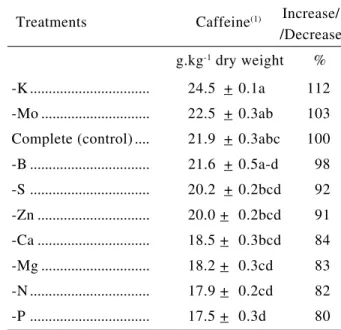
The caffeine content found in the leaves (Table 1) was higher than values reported in the literature for C. arabica (Mazzafera & Magalhães, 1991).
How-ever, this would be expected since it has been dem-onstrated that younger leaves have higher alkaloid contents than older leaves (Frischknecht et al., 1986). Although statistically similar to the control treatment, omission of K induced the greatest increase (12%) of caffeine contents in leaves. Except for Mo, all other nutrient omissions led to lower values than the control. Treatments -N and -P showed the lowest contents.
There is no report in the literature regarding the influence of mineral deficiencies on the caffeine metabolism. Regarding the methyltransferases in-volved in the caffeine biosynthesis it is not of our knowledge any study indicating that these enzymes are dependent on a specific ion. However, the oppo-site occurs with the biodegradation route. Caffeine degradation in fruits and leaves of coffee follows the sequence: caffeine theophylline(1,3-dimethylxan-thine) 3-methylxanthine xanthine uric acid 000allantoin -> allantoic acid -> urea + glyoxylic acid -> NH4 + CO2. Urease, responsible for urea degrada-tion, is dependent on nickel (Stebbins & Polacco, 1995), has very low activity in coffee fruits and leaves (Vitória & Mazzafera, 1999), and is positioned in the very end of the caffeine catabolism (Suzuki et al., 1992). Vitória & Mazzafera (1999) observed that the activity of xanthine oxidase in vitro assays with
pro-tein extracts from coffee fruits and leaves of C. arabica was improved by addition of Mo in the
reac-tion mixture. However, here it was observed that the accumulation of caffeine due to Mo deficiency did not differ from the control treatment.
Table 1. Caffeine content in leaves of coffee seedlings grown in nutrient agar media deficient in nutrients
-K ... 24.5 + 0.1a 112 -Mo ... 22.5 + 0.3ab 103 Complete (control) .... 21.9 + 0.3abc 100 -B ... 21.6 + 0.5a-d 98 -S ... 20.2 + 0.2bcd 92 -Zn ... 20.0 + 0.2bcd 91 -Ca ... 18.5 + 0.3bcd 84 -Mg ... 18.2 + 0.3cd 83 -N ... 17.9 + 0.2cd 82 -P ... 17.5 + 0.3d 80 Treatments Caffeine(1) Increase/
/Decrease g.kg-1 dry weight %
(1) Different letters indicate statistical significance by Duncan test (p
< 0.05).
> – >
– > – > –
> –
> – >
–
Lukaszewski et al. (1992) observed that boric acid inhibited allantoate amidohydrolase in soybean leaves, causing accumulation of allantoic acid. This enzyme is involved in caffeine catabolism (Suzuki et al., 1992). If the opposite is true, B deficiency would cause decrease of allantoate and therefore, in caffeine. However, the alkaloid level in the leaves of -B treat-ment was similar to the control. At the same time, allantoate amidohydrolase is dependent on manga-nese, but this nutrient was not tested in the present work.
Since alkaloids are N-containing compounds, low caffeine content might be expected in the plants of -N treatment. Although there is few exceptions, several reports have shown an increase in alkaloid content due to N fertilization (Waller & Nowacki, 1978). On the other hand, the response may vary de-pending on the nutrient source (nitrate, ammonium or urea) and the alkaloid type.
Regarding other nutrients, Cu amendments en-hanced and Zn depressed nicotine contents in Nico-tiana tabacum (Tso et al., 1973). B, Mo, Mn and Cu
amendments caused a decrease on alkaloid contents in Lupinus species (Mironenko, 1965). In most cases,
depletion of potassium reduces alkaloid contents in plants (Waller & Nowacki, 1978). However, in all such cases it is not known the mechanisms leading to alkaloid accumulation.
Recently, Yun et al. (1999) showed that K and Mg fertilizer application increased caffeine in tea leaves (Camellia sinensis). However, the experiment
was carried out in the field in a soil with low pH and low organic matter, which may have also interfered with the results.
To our knowledge only one investigation re-ports on the effect of mineral nutrition on caffeine contents of leaves and seeds of coffee (Rodriguez, 1961). The omission of Fe, Mn, B, Zn and Mo was tested throughout one year in three-year old coffee shrubs (C. arabica cv. Bourbon) by spray or soil
fer-tilization associated or not with gypsum or lime ap-plication in the soil. Reduction in caffeine contents (3.2%), although not statistically significant, was
observed in the seeds with gypsum omission and an increase (17.5%) with Zn omission. The control plants were sprayed with these micronutrients. The author did not report any nutritional deficiency symptoms probably because the experiment was carried out during a short period and also because the nutritional conditions of the soil may have interfered with the results.
It is very likely that these interferences did not occur in the present work. From our data it is not pos-sible to speculate the way each nutrient affected caf-feine metabolism. However, it is clear that cafcaf-feine contents in coffee is leveled by a balanced mineral nutrition. Considering that the metabolism of caffeine is very similar in fruits and leaves of C. arabica
(Suzuki & Waller, 1984; Mazzafera et al., 1994; Ashihara et al., 1996) it is possible that the responses observed here might be observed also in fruits.
References
ASHIHARA, H.; MONTEIRO, A.M.; MORITZ, T.; GILLIES, F.M. & CROZIER, A. Catabolism of caffeine and related purine alkaloids in leaves of Coffea arabica L. Planta,
Heidelberg, 198: 334-339, 1996.
BAUMERT, A.; MAIER, W.; SCHUMANN, B. & GROGER, D. Increased accumulation of acridone alkaloids by cell suspension cultures of Ruta graveolens in response to
elicitors. Journal of Plant Physiology, Jena, 139:224-228, 1991.
BRACHET, J. & COSSON, L. Changes in the total alkaloid content of Datura inoxia Mill. subjected to salt stress. Journal of Experimental Botany, Oxford, 37:650-656, 1983.
CARELLI, M.L.C.; FAHL, J.I. & MAGALHÃES, A.C. Assi-milação de nitrato durante o desenvolvimento reprodutivo de plantas de café. Revista Brasileira de Ciência do Solo,
Campinas, 13:59-64, 1989.
CLIFFORD, M. N. Chemical and physical aspects of green coffee and coffee products. In: CLIFFORD, M. N. & WILLSON, K.C., eds. Coffee: botany; biochemistry and
FRISCHKNECHT, P.M. & BAUMANN, T.W. Stress induced formation of purine alkaloids in plant tissue culture of
Coffea arabica. Phytochemistry, Oxford,24:2255-2257, 1985.
FRISCHKNECHT, P.M.; ULMER-DUFEK, J. & BAUMANN, T.W. Purine alkaloid formation in buds and developing leaflets of Coffea arabica: expression of an optimal
defence strategy? Phytochemistry, Oxford, 25:613-616, 1986.
GODOY-HERNÁNDEZ, G. & LOYOLA-VARGAS, V.M. Effect of fungal homogenate, enzyme inhibitors and osmotic stress on alkaloid content of Catharanthus roseus
cell suspension cultures. Plant Cell Reports, Heidelberg,
10:537-540, 1991.
HOAGLAND, D.R. & ARNON, D.I. The water: culture
method for growing plants whithout soil. Berkeley, California Agriculture Experimental Station, 1950. 39p. (Circular 347)
LUKASZEWSKI, K.M.; BLEVINS, D.G. & RANDALL, D.D. Asparagine and boric acid cause allantoate accumulation in soybean leaves inhibiting manganese-dependent allantoate amidohydrolase. Plant Physiology, Bethesda,
99: 1670-1676, 1992.
MAZZAFERA, P.; CROZIER, A. & MAGALHÃES, A.C. Caffeine metabolism in Coffea arabica and other species
of coffee. Phytochemistry, Oxford, 30:3913-3916, 1991.
MAZZAFERA, P.; CROZIER, A. & SANDBERG, G. Studies on the metabolic control of caffeine turnover in developing endosperms and leaves of Coffea arabica and Coffea dewevrei. Journal of Agricultural and Food Chemistry,
Washington, 42:1423, 1994.
MAZZAFERA, P. & MAGALHÃES, A.C. Cafeína em folhas e sementes de Coffea e Paracoffea. Revista Brasileira de Botânica, São Paulo, 14:157-160, 1991.
MORAES, F.R.P. & CATANI, R.A. A absorção de elementos minerais pelo fruto do cafeeiro durante sua formação.
Bragantia, Campinas, 23:331-336, 1964.
MIRONENKO, A.V. Fiziologya I Biokhimiya Lupina. Minsk,
Nauka i Tekhnika, 1965. 325p.
RODRIGUEZ, S.J. The chemical composition of green coffee beans and coffee leaves as related to soil and foliar
applications of secondary and minor elements. East
Lansing, 1961. 121p. Ph.D. Thesis - Michigan State University, 1961.
SAENZ, L.; SANTAMARÍA, J.M.; VILLANUEVA, M.A.; LOYOLA-VARGAS, V.M. & OROPEZA, C. Changes in the alkaloid content of plants of Catharanthus roseus
L. (Don). as a result of water stress and treatment with abscisic acid. Journal of Plant Physiology, Jena,
142:244-247, 1993.
STEBBINS, N.E. & POLACCO, J.C. Urease is not essential for ureide degradation in soybean. Plant Physiology,
Bethesda, 109: 169-175, 1995.
SUZUKI, T.; ASHIHARA, H. & WALLER, G.R. Purine and purine alkaloids metabolism in Cammelia and Coffea
plants. Phytochemistry, Oxford, 31: 2575-2584, 1992.
SUZUKI, T. & WALLER, G.R. Biosynthesis and bio-degradation of caffeine, theobromine, and theophylline in Coffea arabica L. fruits. Journal of Agricultural and Food Chemistry, Washington, 32:845-848, 1984.
TSO, T.C.; SOROKIN, T.P. & ENGELHAUPT, M.E. Effects of some rare elements on nicotine content of the tobacco plant. Plant Physiology, Bethesda, 51:805-806, 1973.
VÁLIO, I.F.M. Inhibition of germination of coffee seeds (Coffea arabica L. cv. Mundo Novo) by the endocarp. Journal of Seed Technology, East Lansing, 5:32-39, 1980.
VITÓRIA, A.P. & MAZZAFERA, P. Xanthine degradation and related enzymes activities in leaves and fruits of two
Coffea species differing in caffeine catabolism. Journal
of Agricultural and Food Chemistry, Washington,
47:1851-1855, 1999.
WALLER, G.R.; MACVEAN, C.D. & SUZUKI, T. High production of caffeine and related activities in callus cultures of Coffea arabica L. Plant Cell Reports, Heidelberg, 2:109-112, 1983.
WALLER, G.R. & NOWACKI, E.K. Alkaloid biology and metabolism in plants. New York, Plenum Press, 1978.
293p.