Accepted Manuscript
Title: Chemical profiling of infusions and decoctions of Helichrysum italicumsubsp. picardii by UHPLC-PDA-MS and in vitro biological activities comparatively with green tea (Camellia sinensis) and rooibos tisane (Aspalathus linearis) Authors: Catarina Guerreiro Pereira, Lu´ısa Barreira,
Sebastiaan Bijttebier, Luc Pieters, Vanessa Neves, Maria Jo˜ao Rodrigues, Ricardo Rivas, Jo˜ao Varela, Lu´ısa Cust´odio
PII: S0731-7085(17)31420-6
DOI: http://dx.doi.org/doi:10.1016/j.jpba.2017.07.007
Reference: PBA 11386
To appear in: Journal of Pharmaceutical and Biomedical Analysis Received date: 1-6-2017
Revised date: 4-7-2017
Accepted date: 7-7-2017
Please cite this article as: Catarina Guerreiro Pereira, Lu´ısa Barreira, Sebastiaan Bijttebier, Luc Pieters, Vanessa Neves, Maria Jo˜ao Rodrigues, Ricardo Rivas, Jo˜ao Varela, Lu´ısa Cust´odio, Chemical profiling of infusions and decoctions of Helichrysum italicum subsp.picardii by UHPLC-PDA-MS and in vitro biological activities comparatively with green tea (Camellia sinensis) and rooibos tisane (Aspalathus linearis), Journal of Pharmaceutical and Biomedical Analysishttp://dx.doi.org/10.1016/j.jpba.2017.07.007
This is a PDF file of an unedited manuscript that has been accepted for publication. As a service to our customers we are providing this early version of the manuscript. The manuscript will undergo copyediting, typesetting, and review of the resulting proof before it is published in its final form. Please note that during the production process errors may be discovered which could affect the content, and all legal disclaimers that apply to the journal pertain.
Chemical profiling of infusions and decoctions of Helichrysum italicum subsp. picardii by UHPLC-PDA-MS and in vitro biological activities comparatively with green tea (Camellia sinensis) and rooibos tisane (Aspalathus linearis)
Biochemical assets of Helichrysum italicum picardii
Catarina Guerreiro Pereiraa, Luísa Barreiraa, Sebastiaan Bijttebierb,c, Luc Pietersb, Vanessa Nevesa, Maria João Rodriguesa, Ricardo Rivasa, João Varelaa, Luísa Custódioa,*
aCentre of Marine Sciences, University of Algarve, Faculty of Sciences and Technology, Ed. 7, Campus of Gambelas, 8005-139 Faro, Portugal.
bUniversity of Antwerp, Natural Products & Food Research and Analysis (NatuRA), Antwerp, Belgium.
cFlemish Institute for Technological Research (VITO), Business Unit Separation and Conversion Technology (SCT), Mol, Belgium.
*Corresponding author: Luísa Custódio, CCMAR, University of Algarve, Faculty of Sciences and Technology, Ed. 7, Campus of Gambelas, 8005-139 Faro, Portugal. Telephone: +351 289 800900 ext. 7381. E-mail: [email protected] .
E-mail addresses: [email protected] , [email protected] , [email protected] , [email protected] , [email protected] , [email protected] , [email protected] , [email protected]
Highlights
H. italicum stems/leaves and flowers tisanes have high phenolic content
H. italicum stems/leaves and flowers tisanes were as antioxidant as green/red teas H. italicum had moderate in vitro antidiabetic properties and were not toxic
Chlorogenic and quinic acids were the major phenolics in H. italicum H. italicum has potential to be explored as functional beverage
Abstract
Several medicinal plants are currently used by the food industry as functional additives, for example botanical extracts in herbal drinks. Moreover, the scientific community has recently begun focusing on halophytes as sources of functional beverages. Helichrysum italicum subsp. picardii (everlasting) is an aromatic halophyte common in southern Europe frequently used as spice and in traditional medicine. In this context, this work explored for the first time
H. italicum subsp. picardii as a potential source of innovative herbal beverages with potential
health promoting properties. For that purpose, infusions and decoctions were prepared from roots, vegetative aerial-organs (stems and leaves) and flowers and evaluated for in vitro antioxidant and anti-diabetic activities. Samples were also assessed for toxicity in different mammallian cell lines and chemically characterized by spectrophotometric methods and ultra-high performance liquid chromatography–photodiode array–mass-spectrometry (UHPLC-PDA-MS). Results were expressed relating to ‘a cup-of-tea’ and compared with those obtained with green tea (Camellia sinensis) and rooibos tisane (Aspalathus linearis). Tisanes from the everlasting’s above-ground organs, particularly flowers, have high polyphenolic content and several phenolics were identified; the main compounds were chlorogenic and quinic acids, dicaffeoylquinic-acid isomers and gnaphaliin-A. The antioxidant activity of beverages from the everlasting’s above-ground organs matched or surpassed that of green tea and rooibos. Its anti-diabetic activity was moderate and toxicity low. Overall, our results suggest that the everlasting is a potential source of innovative and functional herbal beverages.
Keywords: Herbal beverages, Functional beverages, Phenolics, Oxidative stress mammalian!
1. Introduction
Tea is one of the most common beverages in the world. Pairing a pleasant taste to stimulating effects and potential health benefits, this popular drink is a cocktail of biologically active phytochemicals as, for example, catechins and gallocatechins. Herbal teas, or tisanes, are infusions or decoctions of any plant material whereas real teas are prepared from the leaves of the tea plant, Camellia sinensis (L.) Kuntze. [1]. The health benefits derived from the consumption of real tea, particularly the green type, are well described and include cancer prevention, reduction of cardiovascular risk, anti-diabetic and anti-obesity properties and / or protection against oxidative damage and oxidative stress-related diseases [1,2]. As for herbal teas, consumption benefits can be associated with the plants’ medicinal properties. For example, the popular herbal red tea, from the rooibos plant Aspalathus linearis (Burm.f.) Dahlg., is marketed for its high antioxidant and anti-ageing potential [3].
Nowadays, a wide panoply of medicinal plants (e.g. Aloe vera and Hibiscus sp.) are used by the food industry as sources of functional additives, such as botanical extracts in herbal beverages, and are commercially available in local stores and supermarkets to be consumed as tisanes for health-related purposes [4]. But medicinal extremophiles, halophytes in particular, although representing an outstanding reservoir of bioactive compounds are still quite unexploited [5]. Nevertheless, the scientific community has just recently begun focusing on aqueous extracts from halophytes with potential to be functional beverages, like Limonium
algarvense Erben [6] and Crithmum maritimum L. [7]. Moreover, specialty stores have started
to sell some halophytes as functional herbal beverages, namely sea buckthorn (Hippophae
rhamnoides), and the gourmet food market has also turned its attention to halophyte products,
like Salicornia sp. [8,9].
Helichrysum plants (Asteraceae), commonly called “everlasting”, have medicinal uses
urinary disorders, burns, venomous bites or hernias [10]. Helichrysum italicum (Roth) G. Don plays an important role in the traditional medicine of Mediterranean countries and is often used as spice due to its curry-like scent. Its subspecies H. italicum (Roth) G. Don subsp.
picardii (Boiss & Reuter) Franco is a facultative halophyte found in the southern Europe,
including Portugal [10,11]. Folk therapeutic uses of infusions and decoctions of the plant are associated to analgesic properties and dermatologic, respiratory and digestive disorders with inflammatory, allergic or infectious components [10,12]. Research concerning H. italicum focuses mainly on organic extracts and in vitro studies indicate that this everlasting has antimicrobial and anti-inflammatory properties, among others, and contains a wide phytochemical profile that includes different classes of bioactive molecules from which the most common are phenolic compounds and terpenes [10,12,13].
Herbal teas are a major source of dietary bioactive phytochemicals in our diet, including phenolics with recognized antioxidant properties and with beneficial outcomes in certain health challenges [4,14]. Oxidative stress is an underlying cause for several degenerative diseases and the use of antioxidants can prevent or reduce the severity of oxidative stress-related diseases [15]. Moreover, consumption of antioxidants from natural sources has become a consumer-trend for health purposes, promoting the antioxidant market growth [14]. In this sense, medicinal plants like H. italicum subsp. picardii have a high commercial potential to be explored not only in traditional medicine but also as herbal functional beverages in the health foods category. A similar approach has already been reported for different plants, including glycophytes such as Lathyrus species [16] and Hymenocrater
bituminosus L. [17] and halophytes, like Chritmum maritimum L. [7], Limonium algarvense
L. [6] and Juncus species [18].
To the best of our knowledge there is no information regarding the biological activities or phenolic composition of infusions and decoctions of this everlasting species. Therefore,
this work aimed to evaluate if this everlasting could be explored as a source of innovative food additives. For that purpose, infusions and decoctions were prepared from roots, vegetative aerial-organs and flowers from the everlasting and evaluated for in vitro antioxidant and anti-diabetic activities, and for polyphenolic profile. Additionally, a preliminary toxicological evaluation was made in vitro by determining samples toxicity against mammalian cells. Green and herbal red (rooibos) teas were used for comparison since they are the most consumed tea beverages worldwide and are sought for their strong antioxidant properties.
2. Materials and methods
2.1. Reagents
All chemicals used were of analytical grade. Reagents 1,1-diphenyl-2picrylhydrazyl (DPPH), 2,2'-azino-bis(3-ethylbenzothiazoline-6-sulfonic acid) (ABTS), sulphanilamide, N-(1-naphthyl) ethylenediamine dihydrochloride (NED), ethylenediamine tetraacetic acid (EDTA), pyrocatechol violet, sodium nitrite, aluminium chloride, butylated hydroxytoluene (BHT), formic acid and ammonium formate were purchased from Sigma-Aldrich (Germany). Ultra-high performance liquid chromatography (UHPLC) grade acetonitrile was purchased from Biosolve (The Netherlands). Merck (Germany) supplied phosphoric acid and Folin-Ciocalteau (F-C) phenol reagent. Commercially available mixtures to calibrate the mass spectrometer, i.e., MSCAL5–1EA (caffeine, tetrapeptide ‘‘Met-Arg-Phe-Ala’’, Ultramark) for positive ion mode and MSCAL6–1EA (sodium dodecylsulfate, taurocholic acid sodium salt, Ultramark) for negative ion mode were purchased from Supelco (USA). Reference standards apigenin, catechin, epicatechin, epigallocatechin, epigallocatechin gallate, flavone, 4-hydroxybenzaldehyde, naringin, quercetin, rutin, uvaol, and caffeic, chlorogenic, coumaric, ferulic, gallic, gentisic, m-hydroxybenzoic, p-hydroxybenzoic, oleanolic, rosmarinic, salicylic
and syringic acids were purchased from Sigma-Aldrich (Germany); apigenin-7-O-glucoside (apigetrin), cyanidin-3-O-arabinoside, cyanidin-3-O-galactoside chloride (ideain chloride), cyanidin-3-O-glucoside chloride (kuromanin chloride), cyanidin-3-O-rutinoside chloride (keracyanin chloride), (+)-dihydrokaempferol ((+)-aromadendrin), galangin, kaempferol, kaempferol-3-O-glucoside (astragalin), luteolin, naringenin, quercetin-3-O-arabinoside (avicularin), quercetin-3-O-galactoside (hyperin), quercetin-3-O-glucoside (isoquercitrin), quercetin-3-O-rhamnoside (quercitrin), phloretin, phloretin-O-20-glucoside (phloridzin), and procyanidin B2 were purchased from Phytolab (Germany); hesperidin, hesperidin methyl chalcone, limonin, neohesperidin dihydrochalcone, protocatechuic acid, propyl gallate, and sinapinic, dihydrocaffeic, hydroferulic, ellagic, and quinic acids were obtained from Sigma– Aldrich (Belgium). Additional reagents / solvents were obtained from VWR International (Belgium).
2.2. Plant collection
Whole plants of H. italicum subsp. picardii were collected in the Ria Formosa area, a coastal lagoon in south Portugal, near Cabanas de Tavira (37°07'51.3"N 7°36'35.6"W) in June 2013. The taxonomical classification was performed by the botanist Dr. Manuel J. Pinto (National Museum of Natural History, University of Lisbon, Botanical Garden, Portugal). A voucher specimen is kept at the herbarium of the Marbiotech laboratory (voucher code MBH32). Plants were divided in roots, vegetative aerial-organs (stems and leaves) and flowers, oven dried for 3 days at 50°C, milled and stored at -20°C until use. Dried leaves of green tea plant (C. sinensis, produced in Azores, Portugal) and rooibos plant (A. linearis, produced in Cape Town, South Africa.) were bought in a regional supermarket, milled and stored at -20ºC.
Extracts were prepared by homogenizing 1 g of the dried plant material in 200 mL of ultrapure water to equal a “cup-of-tea”. For infusions biomass was immersed in boiling water for 5 min, for decoctions biomass was boiled in water for 5 min. Aqueous extracts were filtered (Whatman nº 4) and stored at -20ºC until use. Independent extractions (n 3) of the different plant parts were made and extracts from the different extractions were tested for their bioactivities and phytochemical (spectrophotometric) content. As no significant differences were found among corresponding extracts from the different extractions, for the LC-PDA-MS analysis aliquots of the extracts were freeze-dried and pooled accordingly, and stored in a moist free environment at -20 °C protected from light.
2.4. Phytochemical composition of the extracts
2.4.1. Total polyphenols (TPC), flavonoids (TFC) and condensed tannin (CTC) content
TPC was determined by the F-C assay with absorbance measured at 725 nm using gallic acid as a standard; results were expressed as milligrams of gallic acid equivalents per cup-of-tea (mg GAE/200mL). TFC was estimated by the aluminium chloride colorimetric method; absorbance was measured at 510 nm using rutin as standard and results were expressed as rutin equivalents per cup-of-tea (mg RE/200mL). The CTC was assessed by the 4-dimethylaminocinnamaldehyde (DMACA) method; absorbance was measured at 640 nm using catechin as standard and results were expressed as mg of catechin equivalents per cup-of-tea (mg CE/200mL). All methods are described in Rodrigues et al. [19].
2.4.2. Hydroxycinnamic acid derivatives (HAD) and flavonols content
HAD and flavonols were estimated as described by Rodrigues et al. [19]. Absorbance was read at 320 nm to determine HAD using caffeic acid as standard, and at 360 nm to estimate
flavonols using quercetin as standard. Results were expressed as standard equivalents per cup-of-tea (CAE and QE, respectively; mg/200mL).
2.4.3. Profile of moderately polar compounds by UHPLC
Standard stock solutions were prepared in UHPLC-grade methanol (1 mg/mL) and stored in the dark, 4°C (standards are listed in section 2.1. Reagents). Dilutions were prepared in 60:40 (v:v) methanol:ammonium formate buffer (40 mM). Approximately 15 mg of freeze-dried H.
italicum subsp. picardii pooled extracts were dissolved in 20 mL 60:40 methanol:water +
ammonium formate (40 mM) followed by 10 min sonication (40 kHz, 100W). Samples were centrifuged (3000 rpm), supernatants diluted 100x and stored together with undiluted extracts at 4°C until analysis. Both undiluted and 100-fold diluted everlasting extracts were analysed with a generic ultra-high performance liquid chromatography – photodiode array – mass spectrometry (UHPLC-PDA-MS) method for moderately polar phytochemicals adapted from De Paepe et al. [20]. For analysis, 5 µL of extract was injected with a CTC PAL™ autosampler (CTC Analytics, Zwingen, Switzerland) on a Waters Acquity UPLC BEH SHIELD RP18 column (3.0 mm×150 mm, 1.7 µm; Waters, Milford, MA) and thermostatically (40°C) eluted with an Accela™ quaternary solvent manager and a ‘Hot Pocket’ column oven (Thermo Fisher Scientific, Bremen, Germany). The mobile phase solvents consisted of water + 0.1% formic acid (A) and acetonitrile + 0.1% formic acid (B), and the gradient was set as follows (min/%A): 0.0/100, 9.91/74, 18.51/35, 18.76/0, 23.76/0, 23.88/100, 26.00/100. For detection, an MS (Q Exactive™; Thermo Fisher Scientific, Bremen, Germany) was used with heated electrospray ionization (HESI). For quantitative analysis, full scan data were acquired using polarity switching with a mass/charge (m/z) range of 120-1800 and resolving power set at 70 000 at full width at half maximum (FWHM). Spray voltage was set at ±2.5 kV, sheath gas and auxiliary gas at 47 and 15 (adimensional)
respectively, and capillary temperature at 350°C. The lowest calibration point that was included in the calibration curve was used to calculate the LOQs. The LOQs can be different for the same compound between extracts as the yields (mg dry extract/g plant value) differ per extract; these yields were used to calculate the LOQs. The concentration ranges described by De Paepe et al. [20] were also used during the present work. As quality control, a midrange calibration point was chosen as continuing calibration verification standard (CCV) in order to verify that the calibration of the analytical system was still acceptable. The frequency of CCV analysis was once every ten injections. Data were also recorded using data dependent fragmentation (ddMS2) in positive and negative ionization mode (one analysis per mode) to obtain additional structural information (resolving power set at 17 500 FWHM, stepped collision energy 10, 30, 50 V, isolation window: 4 m/z). The PDA detector was set to scan from 190 to 800 nm during all analyses. Results regarding concentrations of identified compounds were calculated as µg/g dried plant material, i.e. µg/cup-of-tea, based on the extracts’ yield.
2.5. Antioxidant activity
2.5.1. Determination of antioxidant activity by five radical-based assays
The radical scavenging activities (RSA) on DPPH, nitric oxide (NO), ABTS, superoxide (O2 ) and hydroxyl (OH ) radicals was evaluated as described previously [6,19] using respectively BHT, catechin (1 mg/mL) or ascorbic acid (10 mg/mL) as positive controls. Results were expressed as percentage of antioxidant activity in a cup-of-tea, relative to a control containing ultrapure water.
The ferric reducing antioxidant power (FRAP) of the extracts, i.e., their ability to reduce Fe3+, along with the metal chelating activities on copper (CCA) and iron (ICA) were assayed as described by Rodrigues et al. [19], using BHT and EDTA as positive controls (1 mg/mL). Results were calculated and expressed as percentage of antioxidant activity in a cup-of-tea, relative to a positive control for FRAP and to a negative control (ultrapure water) for CCA and ICA.
2.6 In vitro anti-diabetic activity: inhibition of -glucosidase
The microbial -glucosidase inhibitory activity was determined according to Kwon et al. [21], using acarbose as a positive control (10 mg/mL). The enzyme was obtained from the yeast Saccharomyces cerevisiae. Results were expressed as percentage of inhibitory activity in a cup-of-tea, relative to a control (ultrapure water).
2.7. Toxicological evaluation of the samples
Cell culture was made as described by Rodrigues et al. [6]. Murine microglia cell line (N9 cells) was obtained from the Faculty of Pharmacy and Centre for Neurosciences and Cell Biology (University of Coimbra, Portugal); human hepatocellular carcinoma cell line (HepG2 cells) was provided by Dr. Vera Marques, and murine bone marrow stromal cell line (S17 cells) by Dr. Nuno Santos (CBME, University of Algarve, Portugal). Toxicity of the samples was evaluated following Rodrigues et al. [6]. Freeze-dried extracts were dissolved directly in culture medium and applied at the concentration of 100 g/mL for 72 h. Cells incubated with culture medium alone were considered as negative control; hydrogen peroxide (H2O2) was used as positive control for cell toxicity. Cell viability was determined by the MTT assay and absorbance measured at 590 nm. Results were expressed in terms of cell viability (%).
2.8. Statistical analysis
Results were expressed as mean ± standard deviation (SD), and experiments were conducted at least in triplicate. Significant differences (p < 0.05) were assessed by one-way analysis of variance (ANOVA) using the Tukey pairwise multiple comparison test or Kruskal Wallis one-way analysis of variance on ranks (Dunn’s test) when parametricity of data did not prevail. Statistical analyses were performed using XLStat2014® by Addinsoft (Spain).
3. Results and Discussion
3.1. Phytochemical analysis
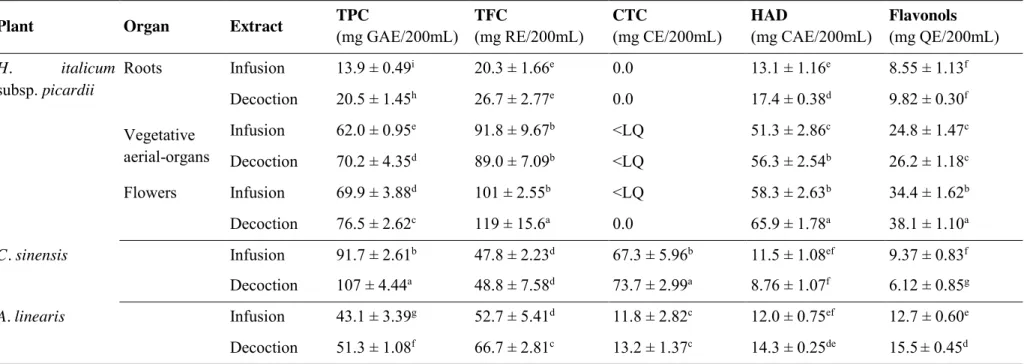
The phenolic contents of the samples were assessed by spectrophotometric methods, namely the total contents in polyphenols (TPC), flavonoids (TFC) and condensed tannins (TCT), hydroxycinnamic acid derivatives (HAD) and flavonols, and are presented as mg per cup-of-tea (mg/200mL) in Table 1 (further information pertained to the methods is presented in Table S1, supplementary material). The green tea decoction and infusion had the highest TPC (107 and 91.7 mg/cup-of-tea, respectively), followed by the extracts from flowers and vegetative aerial-organs (stems & leaves) of H. italicum subsp. picardii, which in turn were richer in TPC than rooibos tisanes. The TFC was greatest in the flowers’ decoction from H. italicum subsp. picardii (119 mg/cup-of-tea) followed by its infusions and the vegetative aerial-organs extracts, showing higher flavonoid content than the green and herbal red teas. The HAD and flavonols showed a similar pattern to the TFC: highest values in the decoction from the everlasting flowers (65.9 and 38.1 mg/cup-of-tea, respectively), and cups-of-tea from flowers and stems & leaves having more of these compounds than green teas and rooibos tisanes. Content of condensed tannins in H. italicum subsp. picardii teas was below the limit of quantification (2.45 mg/cup-of-tea), which can be considered positive in terms of flavoring from the consumer’s perspective given the astringent taste these compounds are known for.
Overall, tisanes from H. italicum subsp. picardii above-ground organs, particularly decoctions from flowers, can be considered of high polyphenolic content especially if compared to the phenolic-rich C. sinensis and herbal A. linearis teas [22,23].
The phytochemical profile of infusions and decoctions from H. italicum subsp. picardii organs was further analysed by a generic LC-PDA-MS method for moderately polar phytochemicals, such as phenolic constituents. The analytical LC-PDA-MS methodology, adapted from De Paepe et al. [20], was previously validated by the same authors [20] for the quantitation of phenolic constituents in apple cultivars. The performance characteristics taken into account for the validation of the measurement method were curve fit, range, sensitivity (instrumental detection limit, instrumental quantification limit, method limits of detection and quantification), precision (repeatability, intermediate precision) and trueness, as well as specificity. The goal of the LC-PDA-MS analyses during this study is to explore the phytochemical profile of infusions and decoctions from H. italicum subsp. picardii organs,
i.e. to (tentatively) identify unknown phytochemical constituents and to get an estimate of
their concentrations (when reference standards were available) and relative abundances. It is out of the scope of the present work to perform a method validation for accurate quantitation of phenolic constituents in H. italicum extracts. In Table 2 are the concentrations of phenolics found in the everlasting extracts, using reference standards for quantification. However, in natural products research analytical standards are often very expensive or not commercially available. Therefore, when no standards were available, tentative identification of compounds was accomplished based upon the available chromatographic and spectral information. Orbitrap MS detectors can routinely generate mass spectra with a resolving power up to 140 000 FWHM and obtain mass accuracies within 1 – 2 ppm; this enables the calculation of the most probable molecular formulae of the generated precursor and product ions [24]. The higher the resolution and the mass accuracy, the more confident compound identification
becomes. This utility combined with the selectivity and sensitivity of current hyphenated UHPLC-PDA-MS systems has paved the way towards generic phytochemical analysis [25]. During the current study, 96% and 89% of the mass deviations measured for the precursor ions in HESI negative and HESI positive mode, respectively, were ≤ 2 ppm. During this study, a hybrid quadrupole-orbital trap MS-analyser (Q Exactive, Thermo Fisher Scientific) was used, which enables selective ion fragmentation. In a selective ion fragmentation experiment, ions of a particular m/z-range are selected (precursor ions) with a quadrupole and subsequently fragmented into product ions. This functionality contributes significantly to compound identification by generating clean product ion spectra. Selective ion fragmentation is particularly useful for associating product ions with precursor ions during coelution of multiple compounds, as is often the case in complex plant extracts. Data-dependent fragmentation was used to obtain clean product ion spectra of the detected analytes. Product ions are substructures of the precursor ions, formed during fragmentation: structures were assigned to unknown peaks only when both the m/z-values and molecular formulae/structures of the precursor and product ions were in agreement. Additional information for dereplication was often acquired from PDA spectra, in-house and commercial compound databases (Dictionary of Natural Products [26], ChemSpider [27] and PubChem [28]) and peer reviewed publications. An in-house database with chromatographic and spectral data of reference standards and previously identified compounds was used to compare chromatographic behaviour and product ion spectra of structurally similar compounds found during the current study. These commercial databases allow to find known molecular structures for a most probable molecular formula obtained from a precursor ion. As described by Sumner et al. [29], the metabolomics community consensus is that the leading challenge of metabolomics is the chemically accurate identification of large numbers of metabolites observed in various non-targeted profiling experiments: accurate structure identification requires significant effort
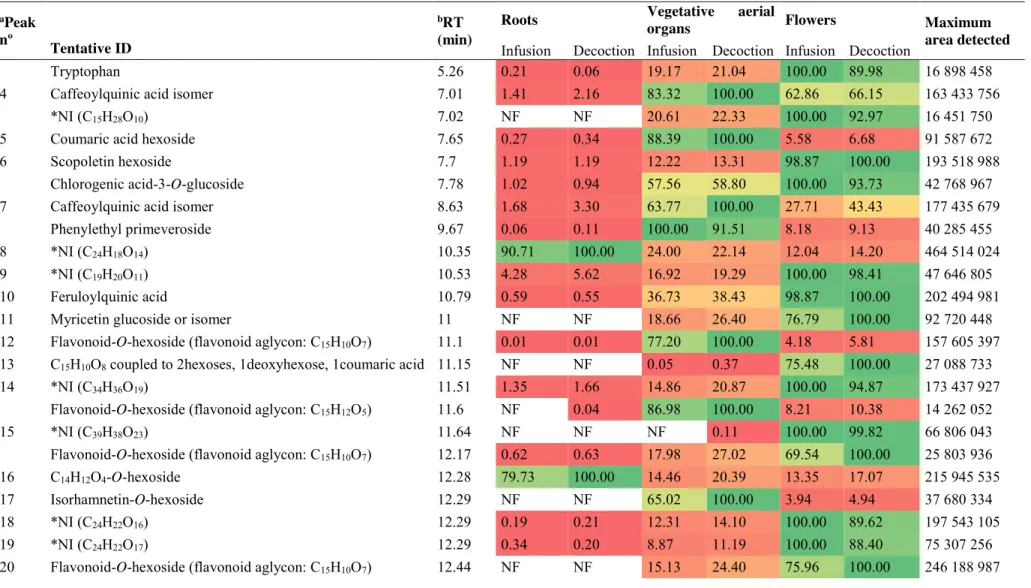
which increases dramatically with the increased amount of detected metabolites per analysis. The Chemical Analysis Working Group of the Metabolomics Standards Initiative proposed four identification classes: 1 – confident identifications based upon a minimum of two orthogonal data relative to an authentic standard; 2 – putatively annotated compounds (e.g. without chemical reference standards, based upon physicochemical properties and/or spectral similarity with public/commercial spectral libraries; 3 – putatively characterized compound classes (e.g. based upon characteristic physicochemical properties of a chemical class of compounds, or by spectral similarity to known compounds of a chemical class); 4 – unknown compounds. The compounds identified with reference standards during the present study belong to confidence class 1, while the compounds that were tentatively identified without reference standards belong to classes 2 (reported in H. italicum previously) and 3 (not reported in H. italicum before). Since different compounds tend to have different ionization efficiencies during LC-MS analysis no absolute quantitative comparison can be made but relative abundances per compound in-between samples can be calculated. Table 3 shows relative abundances of the (tentatively) identified compounds in the everlasting extracts. Diagnostic chromatographic and MS data used for compound identification plus literature used for compound identity confirmation can be found in Table S2 (supplementary material). Figure 1 represents the extracts’ PDA-chromatograms at combined wavelengths (280-330 nm).
A wide versatility of predominantly phenolic constituents was (tentatively) identified in
H. italicum subsp. picardii extracts (Tables 2 and 3). Most phenolics were already described
in Helichrysum species except for salicylic acid that is, to the best of our knowledge, here firstly described in the genus. For H. italicum, no reports were found detailing quinic, protocatechuic, p-hydroxybenzoic and syringic acids (but quinic acid derivatives are described in Mari et al. [30]), rutin, apigetrin and quercetin (its glycoside quercetin
3-O-glucoside is reported in Mari et al. [30]), which are currently described for the first time in this species. Additionally, Table S2 details the tentatively identified compounds that were already reported in H. italicum.
According to Table 2, a higher diversity of compounds and with consistently higher levels was found in tisanes from vegetative aerial-organs and flowers along with a similarity in the composition of major phenolics in these aboveground organs. The main phenolics detected were quinic and chlorogenic acids, higher in the vegetative aerial-organs (8.2 - 8.7 and 6.9 - 7.7 mg/cup-of-tea, respectively) than in the flower extracts (4.7 - 4.9 and 5.2 - 6.0 mg/cup-of-tea, respectively). Preferentially detected in flower’s tisanes was astragalin (0.49 - 0.6 mg/cup-of-tea), hyperin and/or isoquercitrin (they are isomers and co-elute; 0.35 - 0.36 mg/cup-of-tea) and caffeic acid (0.14 - 0.15 mg/cup-of-tea), while syringic and oleanolic acids were higher in vegetative aerial-organs extracts (0.16 - 0.17 and 0.11 mg/cup-of-tea, respectively). Table 3 and Figure 1 also show the composition similarity of major constituents and higher compound diversity of tisanes from vegetative aerial-organs and flowers, with the main tentatively identified compounds being dicaffeoylquinic acid isomers and gnaphaliin A. Note that the “maximum area detected” (Table 3) provides a semi-quantitative information of compound abundance but it should not be interpreted as absolute quantitative comparison since this is not possible based on areas obtained with LC-MS. Composition of root extracts was very different from that of above-ground organs with less abundance and diversity of compounds and, unfortunately, their most abundant compounds (peaks 25 and 30 in Figure 1) shown in the PDA-chromatograms were not identified (Figure 1, Table 3). Moreover, some major compounds already reported in H. italicum were not detected, such as naringenin-7-O-glucoside [31], along with other phenolics compiled in Maksimovic et al. [13], possibly due to the extraction solvent / methods or to the natural phytochemical variations in-between plants, a variability that has been already reported for this species [10,32].
Secondary metabolites like phenolic compounds are implicated in the plant’s response to pressures such as predation, infection by pathogens and parasites or wounding, but content in phenolics may also increase under abiotic stress conditions [33]. Extreme temperatures, UV-radiation, salinity or drought are pronounced environmental challenges for halophyte / extremophile plants that live and thrive under such harsh conditions [5,33]. Abiotic stress enhances production and accumulation of reactive oxygen species (ROS) demanding a powerful antioxidant system. As a result, those plants synthesize antioxidant compounds including polyphenolics to counteract ROS and protect cellular structures and metabolic functions from oxidative damage [5,34]. Therefore, the higher phenolic accumulation and assortment in stems & leaves and flower extracts might suggest their protective role was in play possibly against excessive UV-radiation, heat and predation in the above-ground organs.
3.2. Biological activities: in vitro antioxidant and anti-diabetic properties
ROS, such as the superoxide or hydroxyl radicals, are formed naturally in biological systems but an imbalance between the antioxidant defenses and ROS production can result in damaging oxidative stress. This involves damage to cellular macromolecules (like proteins, lipids, DNA) and deregulation of cellular functions with implications in several degenerative and pathological alterations (for example, aging, cancer, diabetes, and neurodegenerative diseases) [15,35]. However, it is well documented that antioxidants effectively fight free radicals and oxidative damage and thus they are able to reduce or prevent the severity of different oxidative stress-related diseases [14,35]. Antioxidants are thus an essential group of medicinal preventive molecules and are also used as food additives to prevent harmful modifications of foods which are sensitive to oxidation [5]. In this context, there is a growing economical and security interest on the identification of halophyte species with high antioxidant content aiming at its use in the food industry and in preventive medicine to
replace synthetic antioxidants [5].
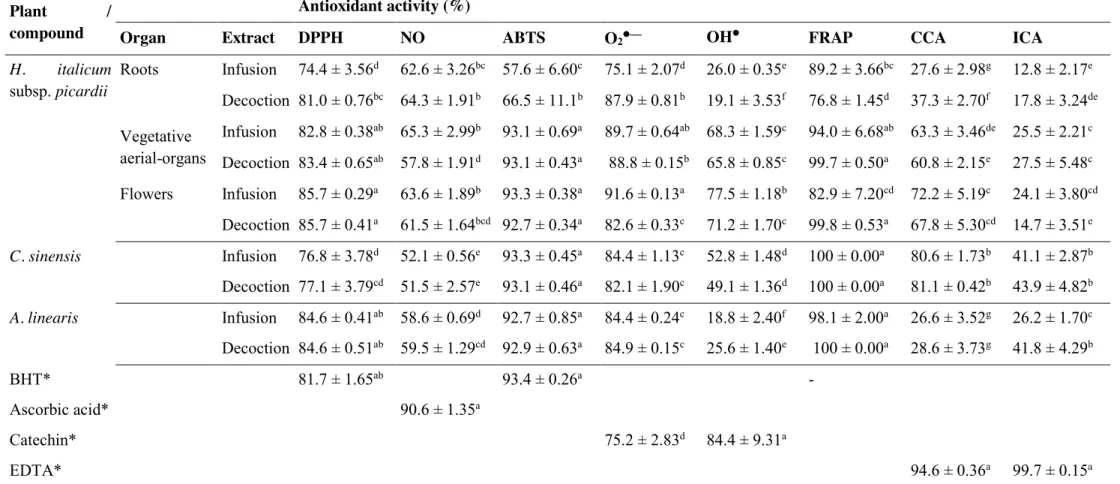
In this work, the antioxidant potential of a cup-of-tea from H. italicum subsp. picardii organs was assessed in comparison to those of C. sinensis and A. linearis and results are summarized on Table 4. Overall, the antioxidant activity of everlasting’s vegetative aerial-organs and flowers herbal teas matched or even surpassed that of green teas and rooibos beverages (Table 4). Comparing with C. sinensis teas, tisanes from H. italicum subsp. picardii flowers and stems & leaves were more effective in scavenging DPPH, NO and OH radicals and had similar RSA against ABTS. In relation to A. linearis herbal teas, the same everlasting’s tisanes matched its DPPH and ABTS scavenging capacity and surpassed its OH RSA; from those tisanes, infusions along with roots decoctions were also more active against the NO radical. Moreover, stems & leaves extracts, flowers infusions and roots decoctions had higher O2 scavenging activity than both green and herbal red teas. As for the metal-related activities, the capacity to reduce iron (FRAP) was similar between the everlasting’s vegetative aerial-organs tisanes and flowers’ decoction and the commercial beverages, but green tea was more active in chelating copper and iron. This was probably due to its higher tannin contents since tannins are known metal chelating agents [36]. However, tisanes from
H. italicum subsp. picardii vegetative aerial-organs and flowers were more efficient in
chelating copper than rooibos extracts. High antioxidant activity has already been described in
H. italicum [12,37,38] but studies have seldom focused on aqueous extracts [10] and none
was found concerning “cup-of-tea” samples from the different anatomical organs. Our results confirm the strong in vitro antioxidant capacity of H. italicum subsp. picardii, particularly flowers and stems & leaves, and thus show that beverages made from this plant may be useful in preventing oxidative-stress diseases much like the world renowned green tea is reported to be [1,2].
The therapeutic benefits of herbal beverages are related to their high polyphenolic content [4]. Phenolics are recognized powerful antioxidants [5,35] and the everlasting’s antioxidant capacity seems to reflect its high phenolic content. In fact, flowers and vegetative aerial-organs were consistently the extracts with higher amounts of TPC, TFC, HAD and flavonols (Table 1) and, except for TPC, they were higher than those detected in the green and herbal red teas. The amount and diversity of phenolics can contribute to the stronger antioxidant activities in tisanes from flowers and stems & leaves: they were determined at higher amounts in these organ’s extracts and in greater variety than in roots (Tables 2 and 3). Moreover, the levels of the main components detected in these organs namely quinic and chlorogenic acids, which are reported antioxidant compounds [39,40], were more than 10-fold higher in the above-ground organs. Additionally, some of the other phenolics can have also contributed through addictive and / or synergistic effects. For example, the main tentatively identified compounds dicaffeoylquinic acid isomers are also described as strong antioxidants [41]. Some of the phenolics identified in this everlasting's extracts are described in literature as natural bioactive compounds, which can help explain the plant's medicinal uses. For example, besides the above-mentioned antioxidant compounds, chlorogenic acid has anti-diabetic properties [40], and gnaphaliin, pinocembrin, tiliroside and arzanol have anti-inflammatory activity [10,13]. These and other bioactivities (antiviral, antimicrobial, cytotoxic) have been confirmed in extracts or isolated compounds from other H. italicum subspecies [10,13] but, to the best of our knowledge, the present study is the first reporting biological activities and phenolic composition of infusions and decoctions from this everlasting subspecies.
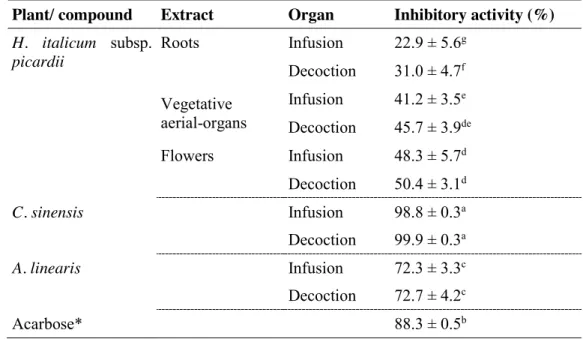
The anti-diabetic potential was assessed through the inhibition of -glucosidase; the inhibition of such carbohydrate-hydrolyzing enzyme is a therapeutic strategy for the treatment of diabetes mellitus type 2 (T2DM), delaying carbohydrate digestion and reducing postprandial hyperglycemia [31,42]. H. italicum subsp. picardii tisanes had a moderate to low
activity particularly if compared to green tea (Table 5). A “cup-of-tea” from everlasting flowers induced around 50% of -glucosidase inhibition (infusion: 48.3%, decoction: 50.4%), followed by tisanes from the vegetative aerial-organs (infusion: 41.2%, decoction: 45.7%), while the roots’ enzyme inhibition was lowest (infusion: 22.9%, decoction: 31.0%). The current -glucosidase inhibitory capacity in everlasting’s tisanes was lower than reported by Garza et al. [31] in H. italicum methanolic extracts but this difference can be ascribed to the different extraction solvents / processes used and / or to a natural variability in secondary metabolites’ content. Nevertheless, kaempferol 3-O-glucoside (astragalin), presently found at noteworthy concentrations in flowers tisanes (0.49 - 0.60 mg/cup-of-tea, Table 2), has shown
in vitro and in vivo inhibitory effect on α-glucosidase [43]. Furthermore, chlorogenic acid,
one of the main compounds here determined in everlasting’s herbal teas, has claimed hypoglycemic and hypolipidemic effects and can regulate glucose and lipid metabolic disorders associated to the progression of diabetes and obesity, among others [40]. Our results thus suggest that H. italicum subsp. picardii flowers’ tisanes can be useful in the control of glucose levels, when used in combined anti-diabetic strategies, by inhibiting dietary carbohydrate digestive enzymes. In fact, Garza et al. [31] also found this anti-diabetic potential in methanolic extracts from H. italicum. Moreover, oxidative stress has been found to mediate the effects of diabetes [42] and given the strong antioxidant potential of the everlasting flowers’ tisanes, its consumption may also indirectly contribute to prevent or attenuate the disease’s symptoms. As expected the commercial teas had a high in vitro anti-diabetic potential: C. sinensis teas had 99% of -glucosidase inhibition and A. linearis herbal teas 72%. In fact, the consumption of both teas, but especially green tea, is associated with anti-diabetic effects, either as prevention or to ameliorate symptoms associated with T2DM [1,2,23].
3.3. Toxicological evaluation
To ascertain the safety of new products for human consumption, for example plant extracts or herbal beverages, it is crucial to determine their toxicity. Preliminary toxicity screenings of compounds or natural extracts are commonly assessed by in vitro methods such as cytotoxicity towards different mammalian cell lines, providing fast and reliable results and reducing in vivo testing [6,7,44,45]. In this sense, a preliminary toxicological evaluation of H.
italicum subsp. picardii tisanes was performed on three cell lines to assess cellular viability
after incubation with the extracts, alongside with C. sinensis and A. linearis beverages for comparison. Results are summarized in Figure 2. The everlasting’s extracts had low toxicity with cell viability values similar or higher than those obtained for green and herbal red teas. None of the extracts from the three plants were toxic for hepatocarcinoma (HepG2) cells. For the microglia (N9) cell line, everlasting’s tisanes toxicity was very low (>80% viability, except for stems & leaves’ infusion which was 73%), as was green tea, while rooibos extracts exerted a moderate toxicity with cell viability between 58% and 66%. Stromal (S17) cells were more sensitive to toxic effects but, nevertheless, everlasting roots’ extracts were only moderately toxic (53 - 56% viability) and not significantly different from the toxicity exerted by commercial teas (56 - 61% viability), whereas everlasting’s vegetative aerial-organs and flowers had low toxicity (66 - 77% viability). Overall, these results are quite promising as preliminary toxicological evaluation of the beverages under study, particularly if compared to the ones obtained for the largely consumed green tea and rooibos tisanes, and suggest that these aqueous extracts can be regarded as non-toxic beverages. In vitro toxicity studies of H.
italicum are scarce and include only essential oils and some organic extracts but nevertheless
they also indicate a favorable safe profile [10]. However, although in vitro cell culture methods are generally accepted as a very effective method for safety testing [45], further experiments on mammalian animal models should be pursued.
4. Conclusion
Our results indicate that infusions and decoctions made from H. italicum subsp. picardii above-ground organs, particularly flowers, have a high and diverse polyphenolic content, with similar or even higher antioxidant potential than the commercial green and herbal red teas, showing moderate anti-diabetic potential and low toxicity in in vitro models. Altogether, our data suggests that everlasting tisanes, especially those from flowers could be further explored as potential health-promoting food additives to be used, for example, in innovative herbal beverages.
Acknowledgements
This work received national funds through Foundation for Science and Technology (FCT, Portugal) project CCMAR/Multi/04326/2013. Catarina Guerreiro Pereira and Maria João Rodrigues acknowledges FCT for the PhD grants SFRH/BD/94407/2013 and SFRH/BD/116604/2016, respectively. Sebastiaan Bijttebier thanks the Research Foundation - Flanders (FWO) for a post-doc grant (12M8315N). Luísa Custódio was supported by FCT Investigator Programme (IF/00049/2012).
References
[1] S. Patel. Green tea as a nutraceutical: the latest developments. Food Sci. Technol. Res. 19 (2013) 923–932.
[2] N. Khan, H. Mukhtar. Tea polyphenols for health promotion. Life Sci. 81 (2007) 519–533. [3] E. Joubert, D. de Beer. Rooibos (Aspalathus linearis) beyond the farm gate: From herbal
tea to potential phytopharmaceutical. S. Afr. J. Bot. 77 (2011) 869–886.
[4] J.G. Gruenwald. Novel botanical ingredients for beverages. Clin. Dermatol. 27 (2009) 210–216.
[5] R. Ksouri, W.M. Ksouri, I. Jallali, A. Debez, C. Magné, I. Hiroko, C. Abdelly. Medicinal halophytes: potent source of health promoting biomolecules with medical, nutraceutical and food applications. Crit. Rev. Biotechnol. 32 (2012) 289–326.
[6] M.J. Rodrigues, V. Neves, A. Martins, A.P. Rauter, N.R. Neng, J.M.F. Nogueira, J. Varela, L. Barreira, L. Custódio. In vitro antioxidant and anti-inflammatory properties of
Limonium algarvense flowers’ infusions and decoctions: A comparison with green tea
(Camellia sinensis). Food Chem. 200 (2016) 322–329.
[7] C.G. Pereira, L. Barreira, N.R. Neng, J.M.F. Nogueira, C. Marques, T.F. Santos, J. Varela, L. Custodio. Searching for new sources of innovative products for the food industry within halophyte aromatic plants: In vitro antioxidant activity and phenolic and mineral contents of infusions and decoctions of Crithmum maritimum L. Food Chem. Toxicol. (2017) http://dx.doi.org/10.1016/j.fct.2017.04.018.
[8] L. Barreira, E. Resek, M.I. Rocha, H. Pereira, N.M. Bandarra, M. Moreira da Silva, J. Varela, L. Custódio. Halophytes: Gourmet food with nutritional properties? Food Comp. Anal. 59 (2017) 35–42.
[9] Y. Ventura, M. Sagi. Halophyte crop cultivation: The case for Salicornia and
Sarcocornia. Environ. Exp. Bot. 92 (2013) 144–153.
[10] D.A. Viegas, A. Palmeira-de-Oliveira, L. Salgueiro, J. Martinez-de-Oliveira, R. Palmeira-de-Oliveira. Helichrysum italicum: From traditional use to scientific data. J. Ethnopharmacol. 151 (2014) 54–65.
[11] P. Bingre, C. Aguiar, D. Espírito-Santo, P. Arsénio, T. Monteiro-Henriques, Guia de árvores e arbustos de Portugal Continental. Jornal Público, Fundação Luso-Americana para o Desenvolvimento, Liga para a Protecção da Natureza, Lisboa, 2007.
[12] R.M. Facino, M. Carini, L. Franzoi, O. Pirola, E. Bosisio. Phytochemical characterization and radical scavenger activity of flavonoids from Helichrysum italicum G. Don (Compositae). Pharmacol. Res. 22 (1990) 709–721.
[13] S. Maksimovic, V. Tadic, D. Skala, I. Zizovic. Separation of phytochemicals from
Helichrysum italicum: An analysis of different isolation techniques and biological activity
of prepared extracts. Phytochemistry 138 (2017) 9–28.
[14] C.-C. Lu, G.-C Yen. Antioxidative and anti-inflammatory activity of functional foods. Curr. Opin. Food Sci. 2 (2015) 1–8.
[15] V. Sindhi, V. Gupta, K. Sharma, S. Bhatnagar, R. Kumari, N. Dhaka. Potential applications of antioxidants – A review. J. Pharm. Res. 7 (2013) 828–835.
[16] E.J. Llorent-Martínez, P. Ortega-Barrales, G. Zengin, A. Mocan, M.J. Simirgiotis, R. Ceylan, S. Uysal, A. Aktumsek. Evaluation of antioxidant potential, enzyme inhibition activity and phenolic profile of Lathyrus cicera and Lathyrus digitatus: Potential sources of bioactive compounds for the food industry. Food Chem. Toxicol. (2017) http://dx.doi.org/10.1016/j.fct.2017.03.002.
[17] S. Bahadori, M.B Bahadori, G. Zengin, F. Maggi, L. Dinparast, A. Aktumsek. Chemical composition profile of the essential oil from Hymenocrater bituminosus and their health
functionality. Int. J. Food Properties. (2017) http://dx.doi.org/10.1080/10942912.2017.1325901.
[18] M.J. Rodrigues, K.N. Gangadhar, G. Zengin, A. Mollica, J. Varela, L. Barreira, L. Custodio. Juncaceae species as sources of innovative bioactive compounds for the food industry: In vitro antioxidant activity, neuroprotective properties and in silico studies. Food Chem. Toxicol. (2017) http://dx.doi.org/10.1016/j.fct.2017.04.006.
[19] M.J. Rodrigues, A. Soszynski, A. Martins, A.P. Rauter, N.R. Neng, J.M.F. Nogueira, J. Varela, L. Barreira, L. Custódio. Unravelling the antioxidant potential and the phenolic composition of different anatomical organs of the marine halophyte Limonium algarvense. Ind. Crops Prod. 77 (2015) 315–322.
[20] D. De Paepe, K. Servaes, B. Noten, L. Diels, M. De Loose, B. Van Droogenbroeck, S. Voorspoels. An improved mass spectrometric method for identification and quantification of phenolic compounds in apple fruits. Food Chem. 136 (2013) 368–375.
[21] Y.I. Kwon, E. Apostolidis, K. Shetty. In vitro studies of eggplant (Solanum melongena) phenolics as inhibitors of key enzymes relevant for type 2 diabetes and hypertension. Bioresour. Technol. 99 (2008) 2981–2988.
[22] F. Shahidi. Antioxidant factors in plant foods and selected oilseeds. BioFactors. (2000) 179–185.
[23] D.L. McKay, J.B. Blumberg. A review of the bioactivity of South African herbal teas: rooibos (Aspalathus linearis) and honeybush (Cyclopia intermedia). Phytother. Res. 21 (2007) 1–16.
[24] T. Kind, O. Fiehn. Metabolomic database annotations via query of elemental compositions: mass accuracy is insufficient even at less than 1 ppm. BMC Bioinformatics 7 (2006) 234.
[25] C. Ibáñez, V. García-Cañas, A. Valdés, C. Simó. Novel MS-based approaches and applications in food metabolomics. Trends Anal. Chem. 52 (2013) 100–111.
[26] Dictionary of Natural Products, version 2016, Chapman and Hall/CRC, DVD, ISBN 9780412491504.
[27] Royal Society of Chemistry, ChemSpider chemical structure database. http://www.chemspider.com/, 2016 (accessed 10/2016).
[28] PubChem online chemistry database. https://pubchem.ncbi.nlm.nih.gov, 2016 (accessed 10/2016).
[29] L.W. Sumner, Z. Lei, B.J. Nikolau, K. Saito, U. Roessner, R. Trengove. Proposed quantitative and alphanumeric metabolite identification metrics. Metabolomics 10 (2014) 1047–1049.
[30] A. Mari, A. Napolitano, M. Masullo, C. Pizza, S. Piacente. Identification and quantitative determination of the polar constituents in Helichrysum italicum flowers and derived food supplements. J. Pharm. Biomed. Anal. 96 (2014) 249–255.
[31] A.L. Garza, U. Etxeberria, M.P. Lostao, B.S. Román, J. Barrenetxe, J.A. Martínez, F.I. Milagro. Helichrysum and grapefruit extracts inhibit carbohydrate digestion and absorption, improving postprandial glucose levels and hyperinsulinemia in rats. J. Agric. Food Chem. 61 (2013) 12012–12019.
[32] S. Melito, A. Sias, G.L. Petretto, M. Chessa, G. Pintore, A. Porceddu. Genetic and metabolite diversity of Sardinian populations of Helichrysum italicum. PLoS ONE 8[11] (2013): e79043.
[33] M. Naczk, F. Shahidi. Phenolics in cereals, fruits and vegetables: Occurrence, extraction and analysis. J. Pharm. Biomed. Anal. 41 (2006) 1523–1542.
[34] A. Buhmann, J. Papenbrock. An economic point of view of secondary compounds in halophytes. Funct. Plant Biol. 40 (2013) 952–967.
[35] S. Saeidnia, M. Abdollahi. Toxicological and pharmacological concerns on oxidative stress and related diseases. Toxicol. Appl. Pharmacol. 273 (2013) 442–455.
[36] M. Karamać. Chelation of Cu(II), Zn(II), and Fe(II) by Tannin Constituents of Selected Edible Nuts. Int. J. Mol. Sci. 10 (2009) 5485-5497.
[37] E. Guinoiseau, V. Lorenzi, A. Luciani, A. Muselli, J. Costa, J. Casanova, L. Berti, Biological properties and resistance reversal effect of Helichrysum italicum (Roth) G. Don., in: E. Méndez-Vilas (Ed.), Microbial pathogens and strategies for combating them: science, technology and education, Volume 2, Formatex Research Center, Badajoz, 2013, pp. 1073–1080.
[38] A. Sala, M.C. Recio, R.M. Giner, S. Máñez, H. Tournier, G. Schinella. Anti-inflammatory and antioxidant properties of Helichrysum italicum. J. Pharm. Pharmacol. 54 (2002) 365–371.
[39] R.W. Pero, H. Lund, T. Leanderson. Antioxidant metabolism induced by quinic acid. Increased urinary excretion of tryptophan and nicotinamide. Phytother. Res. 23 (2008) 335–346.
[40] S. Meng, J. Cao, Q. Feng, J. Peng, Y. Hu. Roles of chlorogenic acid on regulating glucose and lipids metabolism: a review. Evidence-Based Complementary Altern. Med. Article ID 801457 (2013) 11 pages.
[41] F. Shahidi, P. Ambigaipalan. Phenolics and polyphenolics in foods, beverages and spices: Antioxidant activity and health effects: A review. J. Funct. Foods. 18 (2015) 820– 897.
[42] D.K. Patel, R. Kumar, D. Laloo, S. Hemalatha. Natural medicines from plant source used for therapy of diabetes mellitus: An overview of its pharmacological aspects. Asian Pac. J. Trop. Dis. (2012) 239–250.
[43] D.F. Pereira, L.H. Cazarolli, C. Lavado, V. Mengatto, M.S.R.B. Figueiredo, A. Guedes, M.G. Pizzolatii, F.R.M.B Silva. Effects of flavonoids on α-glucosidase activity: potential targets for glucose homeostasis. Nutrition. 27 (2011) 1161–1167.
[44] D.R. Nogueira, M. Mitjans, M.R. Infante, M.P. Vinardell. Comparative sensitivity of tumor and non-tumor cell lines as a reliable approach for in vitro cytotoxicity screening of lysine-based surfactants with potential pharmaceutical applications. Int. J. Pharm. 420 (2011) 5–58.
[45] B. Saad, H. Azaizeh, G. Abu-Hijleh, O. Said. Safety of traditional Arab herbal medicine. Evidence-Based Complementary Altern. Med. 3 (2006) 433–439.
Figure 1. PDA chromatograms (280 + 330 nm) of the extracts from H. italicum subsp.
picardii roots (A: infusion, B: decoction), vegetative aerial-organs (C: infusion, D: decoction)
and flowers (E: infusion, F: decoction). Peak numbers refer to compounds listed in Tables 2 and 3.
Figure 2. Toxicity of infusions and decoctions (100 g/mL extract dw) from H. italicum subsp. picardii organs and from green (C. sinensis) and red (A. linearis) teas on mammalian cell lines: A) N9, B) S17 and C) HepG2. Cells treated only with cell culture medium were used as controls; H2O2 was used as positive control for cell toxicity. Values represent the mean ± sd of at least three experiments performed in triplicate (n = 9). In each graph different letters mean significant differences (p < 0.05).RT: roots, VAO: vegetative aerial-organs, FL: flowers, CS: Camelia sinensis, AL: Aspalathus linearis.
Table 1. Phenolic content1 (mg/cup-of-tea) in infusions and decoctions from H. italicum subsp. picardii organs and from green (C. sinensis) and red (A. linearis) teas: total polyphenol content (TPC), total flavonoid content (TFC) condensed tannin content (CTC), hydroxycinnamic acid derivatives (HAD) and flavonols. In each column, different letters mean significant differences (p < 0.05).
Plant Organ Extract TPC (mg GAE/200mL) TFC (mg RE/200mL) CTC (mg CE/200mL) HAD (mg CAE/200mL) Flavonols (mg QE/200mL)
H. italicum subsp. picardii Roots Infusion 13.9 ± 0.49i 20.3 ± 1.66e 0.0 13.1 ± 1.16e 8.55 ± 1.13f Decoction 20.5 ± 1.45h 26.7 ± 2.77e 0.0 17.4 ± 0.38d 9.82 ± 0.30f Vegetative aerial-organs Infusion 62.0 ± 0.95e 91.8 ± 9.67b <LQ 51.3 ± 2.86c 24.8 ± 1.47c Decoction 70.2 ± 4.35d 89.0 ± 7.09b <LQ 56.3 ± 2.54b 26.2 ± 1.18c Flowers Infusion 69.9 ± 3.88d 101 ± 2.55b <LQ 58.3 ± 2.63b 34.4 ± 1.62b Decoction 76.5 ± 2.62c 119 ± 15.6a 0.0 65.9 ± 1.78a 38.1 ± 1.10a C. sinensis Infusion 91.7 ± 2.61b 47.8 ± 2.23d 67.3 ± 5.96b 11.5 ± 1.08ef 9.37 ± 0.83f Decoction 107 ± 4.44a 48.8 ± 7.58d 73.7 ± 2.99a 8.76 ± 1.07f 6.12 ± 0.85g A. linearis Infusion 43.1 ± 3.39g 52.7 ± 5.41d 11.8 ± 2.82c 12.0 ± 0.75ef 12.7 ± 0.60e Decoction 51.3 ± 1.08f 66.7 ± 2.81c 13.2 ± 1.37c 14.3 ± 0.25de 15.5± 0.45d 1Data represent the mean ± SD (n ≥ 6). LQ (CTC) = 2.45 mg/200mL
Table 2. Concentrations of compounds in infusions and decoctions from H. italicum subsp. picardii organs (µg/g dry biomass, i.e., µg/cup-of-tea), calculated with reference standards using LC-MS. Quantitation limits are presented as ≤ LOQs (µg/g dry biomass).
aPeak nº
bRT (min)
Roots Vegetative aerial-organs Flowers
Compound Infusion Decoction Infusion Decoction Infusion Decoction
Quinic acid 1.56 300 510 8200 8700 4900 4700 Protocatechuic acid 6.38 2.3 2.3 82 90 41 49 p-Hydroxybenzoic acid 8.74 ≤ 4 ≤ 3 40 52 48 53 1 Chlorogenic acid 8.94 190 190 6900 7700 6000 5200 Syringic acid 9.50 ≤ 37 ≤ 31 160 170 ≤ 105 ≤ 135 2 Caffeic acid 9.74 11 21 57 73 150 140 Rutin 12.10 ≤ 1.4 ≤ 1.2 ≤ 3 ≤ 5 60 60 Coumaric acid 12.20 ≤ 0.5 ≤ 0.4 6.2 6.9 4.5 6.6 Ferulic acid 12.36 ≤ 4 5.2 ≤ 10 ≤ 14 20 19
3 Hyperin and/or isoquercitrin 12.62 ≤ 9 ≤ 8 ≤ 23 ≤ 31 350 360
Apigetrin 13.28 ≤ 2 ≤ 2 36 54 41 74 Astragalin 13.35 ≤ 2 ≤ 2 29 45 490 600 Salicylic acid 14.09 ≤ 1.4 ≤ 1.2 14 15 4.9 5.1 Quercetin 16.44 ≤ 4 ≤ 3 ≤ 10 ≤ 14 12 ≤ 15 Kaempferol 18.13 ≤ 2 ≤ 2 4.9 6.8 36 45 Galangin 20.10 ≤ 2 ≤ 2 34 59 41 79 Oleanolic acid 23.24 ≤ 10 13 ≤ 23 110 ≤ 28 40
a Corresponding peak number in the chromatograms on Fig.1. b RT – retention times
Table 3. Relative abundances (%) of the tentatively identified compounds in infusions and decoctions from H. italicum subsp. picardii organs, analysed by LC-PDA-MS. Red = 0%, yellow = 50%, green = 100%; every percentage in between is a mixture of these colours.
aPeak
nº
bRT
(min)
Roots Vegetative aerial
organs Flowers Maximum
area detected
Tentative ID Infusion Decoction Infusion Decoction Infusion Decoction
Tryptophan 5.26 0.21 0.06 19.17 21.04 100.00 89.98 16 898 458
4 Caffeoylquinic acid isomer 7.01 1.41 2.16 83.32 100.00 62.86 66.15 163 433 756
*NI (C15H28O10) 7.02 NF NF 20.61 22.33 100.00 92.97 16 451 750
5 Coumaric acid hexoside 7.65 0.27 0.34 88.39 100.00 5.58 6.68 91 587 672
6 Scopoletin hexoside 7.7 1.19 1.19 12.22 13.31 98.87 100.00 193 518 988
Chlorogenic acid-3-O-glucoside 7.78 1.02 0.94 57.56 58.80 100.00 93.73 42 768 967
7 Caffeoylquinic acid isomer 8.63 1.68 3.30 63.77 100.00 27.71 43.43 177 435 679
Phenylethyl primeveroside 9.67 0.06 0.11 100.00 91.51 8.18 9.13 40 285 455
8 *NI (C24H18O14) 10.35 90.71 100.00 24.00 22.14 12.04 14.20 464 514 024
9 *NI (C19H20O11) 10.53 4.28 5.62 16.92 19.29 100.00 98.41 47 646 805
10 Feruloylquinic acid 10.79 0.59 0.55 36.73 38.43 98.87 100.00 202 494 981
11 Myricetin glucoside or isomer 11 NF NF 18.66 26.40 76.79 100.00 92 720 448
12 Flavonoid-O-hexoside (flavonoid aglycon: C15H10O7) 11.1 0.01 0.01 77.20 100.00 4.18 5.81 157 605 397
13 C15H10O8 coupled to 2hexoses, 1deoxyhexose, 1coumaric acid 11.15 NF NF 0.05 0.37 75.48 100.00 27 088 733
14 *NI (C34H36O19) 11.51 1.35 1.66 14.86 20.87 100.00 94.87 173 437 927
Flavonoid-O-hexoside (flavonoid aglycon: C15H12O5) 11.6 NF 0.04 86.98 100.00 8.21 10.38 14 262 052
15 *NI (C39H38O23) 11.64 NF NF NF 0.11 100.00 99.82 66 806 043
Flavonoid-O-hexoside (flavonoid aglycon: C15H10O7) 12.17 0.62 0.63 17.98 27.02 69.54 100.00 25 803 936
16 C14H12O4-O-hexoside 12.28 79.73 100.00 14.46 20.39 13.35 17.07 215 945 535
17 Isorhamnetin-O-hexoside 12.29 NF NF 65.02 100.00 3.94 4.94 37 680 334
18 *NI (C24H22O16) 12.29 0.19 0.21 12.31 14.10 100.00 89.62 197 543 105
19 *NI (C24H22O17) 12.29 0.34 0.20 8.87 11.19 100.00 88.40 75 307 256
21 Dicaffeoylquinic acid 13.1 1.20 1.58 66.49 100.00 36.56 61.17 774 049 004
Isorhamnetin-O-hexoside 13.37 NF NF 5.42 14.04 83.62 100.00 31 958 060
22 Dicaffeoylquinic acid 13.44 0.95 0.76 64.14 73.25 96.39 100.00 3 585 117 791
23 *NI (C26H30O13) 13.74 100.00 97.09 5.64 4.89 1.12 1.10 901 518 717
24 Dicaffeoylquinic acid 13.85 1.17 1.28 71.37 100.00 55.80 78.69 1 636 538 799
Flavonoid-O-hexoside (flavonoid aglycon: C15H10O7) 13.92 0.25 0.29 3.60 5.80 100.00 99.59 49 122 107
25 *NI (C33H22O17) 14.02 100.00 64.54 4.02 2.51 0.14 0.25 264 637 977
Dicaffeoylquinic acid methyl ester 14.07 0.80 1.46 52.17 78.68 63.44 100.00 9 174 467
26 Methoxyoxalyl-dicaffeoylquinic acid 14.17 0.10 0.11 94.00 100.00 2.16 2.10 295 286 636
27 Dicaffeoylquinic acid methyl ester 14.42 0.14 0.17 26.04 26.87 100.00 99.84 101 372 663
28 *NI (C33H22O17) 14.45 100.00 71.62 1.63 0.78 NF NF 165 493 549
29 *NI (C33H22O17) 14.57 100.00 66.92 1.88 0.91 NF NF 144 606 985
Helichrysin 14.77 NF NF 80.65 100.00 2.79 4.15 3 404 695
Dicaffeoylquinic acid methyl ester 14.82 0.90 1.03 59.96 73.11 70.60 100.00 25 279 181
30 *NI (C37H28O19) 14.96 100.00 53.47 0.64 0.21 NF NF 295 393 282
31 Quercetin coupled to coumaric acid and hexose 15.03 NF NF 0.04 0.07 96.22 100.00 366 986 546
32 *NI (C26H32O13) 15.34 100.00 86.95 3.00 3.16 0.26 0.17 178 374 605 33 Tiliroside (kaempferol-3-O-p-coumaroylglucopyranoside) 15.79 0.01 0.00 0.52 0.90 89.74 100.00 536 636 121 34 *NI (C29H34O16) 15.94 100.00 70.98 3.05 2.91 0.29 0.17 334 978 768 Isomer of naringenin 16.52 NF NF 89.35 100.00 24.84 31.56 63 885 073 35 Methoxyluteolin 16.58 NF NF 25.79 35.96 83.25 100.00 29 212 020 Isomer of naringenin 16.76 0.01 0.01 83.14 100.00 26.41 32.50 178 428 280 Apigenin 17.79 4.82 3.05 62.44 89.81 73.34 100.00 2 029 743 Isorhamnetin 17.91 0.89 0.51 66.05 93.53 78.95 100.00 2 525 227 36 Methoxyflavonoid (C16H14O5) 18.5 0.01 0.02 85.11 100.00 7.48 10.98 161 014 058 4-Hydroxy-3-(3-methyl-2-butenyl) acetophenone 18.66 NF NF 24.27 20.73 100.00 98.39 5 640 296 37 Pinocembrin 19.08 0.02 0.02 70.77 100.00 16.17 25.25 5 192 433 767 38 Gnaphaliin A 19.43 0.09 0.12 47.20 63.41 60.78 100.00 2 251 428 101 39 Gnaphaliin B 19.81 0.05 0.07 49.77 72.41 56.30 100.00 207 717 204 40 Methoxyflavonoid (C16H12O5) 20.06 0.08 0.10 41.55 64.99 58.76 100.00 1 646 873 985
Helipyrone 20.92 NF NF 16.37 8.97 100.00 88.27 39 453 111
Arzanol 21.66 NF NF NF NF 45.77 100.00 35 054 309
Methylarzanol 22.03 NF NF NF NF 27.85 100.00 14 237 273
*NI – compound not identified NF – not found
a Corresponding peak number in the chromatograms on Fig.1.
Table 4. Antioxidant activity of infusions and decoctions from H. italicum subsp. picardii organs and from green (C. sinensis) and red (A.
linearis) teas (% activity in a cup-of-tea): radical scavenging on DPPH, ABTS, NO, O2 and OH radicals, metal chelating activities on copper
(CCA) and iron (ICA), and ferric reducing antioxidant power (FRAP). In each column different letters mean significant differences (p<0.05).
Plant / compound
Antioxidant activity (%)
Organ Extract DPPH NO ABTS O2 OH FRAP CCA ICA
H. italicum subsp. picardii Roots Infusion 74.4 ± 3.56d 62.6 ± 3.26bc 57.6 ± 6.60c 75.1 ± 2.07d 26.0 ± 0.35e 89.2 ± 3.66bc 27.6 ± 2.98g 12.8 ± 2.17e Decoction 81.0 ± 0.76bc 64.3 ± 1.91b 66.5 ± 11.1b 87.9 ± 0.81b 19.1 ± 3.53f 76.8 ± 1.45d 37.3 ± 2.70f 17.8 ± 3.24de Vegetative aerial-organs Infusion 82.8 ± 0.38ab 65.3 ± 2.99b 93.1 ± 0.69a 89.7 ± 0.64ab 68.3 ± 1.59c 94.0 ± 6.68ab 63.3 ± 3.46de 25.5 ± 2.21c Decoction 83.4 ± 0.65ab 57.8 ± 1.91d 93.1 ± 0.43a 88.8 ± 0.15b 65.8 ± 0.85c 99.7 ± 0.50a 60.8 ± 2.15e 27.5 ± 5.48c Flowers Infusion 85.7 ± 0.29a 63.6 ± 1.89b 93.3 ± 0.38a 91.6 ± 0.13a 77.5 ± 1.18b 82.9 ± 7.20cd 72.2 ± 5.19c 24.1 ± 3.80cd Decoction 85.7 ± 0.41a 61.5 ± 1.64bcd 92.7 ± 0.34a 82.6 ± 0.33c 71.2 ± 1.70c 99.8 ± 0.53a 67.8 ± 5.30cd 14.7 ± 3.51e C. sinensis Infusion 76.8 ± 3.78d 52.1 ± 0.56e 93.3 ± 0.45a 84.4 ± 1.13c 52.8 ± 1.48d 100 ± 0.00a 80.6 ± 1.73b 41.1 ± 2.87b Decoction 77.1 ± 3.79cd 51.5 ± 2.57e 93.1 ± 0.46a 82.1 ± 1.90c 49.1 ± 1.36d 100 ± 0.00a 81.1 ± 0.42b 43.9 ± 4.82b A. linearis Infusion 84.6 ± 0.41ab 58.6 ± 0.69d 92.7 ± 0.85a 84.4 ± 0.24c 18.8 ± 2.40f 98.1 ± 2.00a 26.6 ± 3.52g 26.2 ± 1.70c Decoction 84.6 ± 0.51ab 59.5 ± 1.29cd 92.9 ± 0.63a 84.9 ± 0.15c 25.6 ± 1.40e 100 ± 0.00a 28.6 ± 3.73g 41.8 ± 4.29b BHT* 81.7 ± 1.65ab 93.4 ± 0.26a - Ascorbic acid* 90.6 ± 1.35a Catechin* 75.2 ± 2.83d 84.4 ± 9.31a EDTA* 94.6 ± 0.36a 99.7 ± 0.15a
*Positive controls tested at 1 mg/mL (BHT, catechin and EDTA) or 10 mg/mL (ascorbic acid). Values represent the mean ± SD of at least three experiments performed in triplicate (n = 9).
Table 5. Inhibitory activity on microbial α-glucosidase of infusions and decoctions from H.
italicum subsp. picardii organs and from green (C. sinensis) and red (A. linearis) teas (%
activity in a cup-of-tea). In each column different letters mean significant differences (p<0.05).
Plant/ compound Extract Organ Inhibitory activity (%)
H. italicum subsp. picardii Roots Infusion 22.9 ± 5.6g Decoction 31.0 ± 4.7f Vegetative aerial-organs Infusion 41.2 ± 3.5e Decoction 45.7 ± 3.9de Flowers Infusion 48.3 ± 5.7d Decoction 50.4 ± 3.1d C. sinensis Infusion 98.8 ± 0.3a Decoction 99.9 ± 0.3a A. linearis Infusion 72.3 ± 3.3c Decoction 72.7 ± 4.2c Acarbose* 88.3 ± 0.5b *Positive control at 10 mg/mL.